1946: Bruno Tesch and Karl Weinbacher, Zyklon-B manufacturers

On this date in 1946, British hangman Albert Pierrepoint hanged seven German war criminals at Hameln Prison.

These seven comprised two distinct groups charged in two very different misdeeds:

Karl Eberhard Schöngarth and four others hanged for executing a downed Allied pilot in 1944.

Bruno Tesch and Karl Weinbacher were executed for a critical support role in the Holocust: they were principles of the chemical manufacturer Testa, which sold Zyklon-B to the Reich for use in the gas chambers.


Zyklon was just a brand hame (“Cyclone”)

Hydrogen cyanide had been employed as a legitimate pesticide and de-lousing agent for many years before World War II. Because of its danger, the odorless deadly gas was sold spiced with an odorant to alert humans accidentally exposed to it.

Tesch and Weinbacher had their necks stretched because they were shown to have knowingly sold this product sans odor, reflecting Testa’s complicity in its intended use upon humans. (A third Testa employee was acquitted, having inadequate knowledge of the firm’s operations.)

On this day..

1946: Ten at Hameln for killing Allied POWs

On this date in 1946, the British hanged 10 convicted war criminals at Hameln Prison, notably including seven for the “Dreierwalde Airfield murders” of four Allied prisoners of war.

Picture from this book about RAF POWs in wartime Germany, which also supplies the unknown names: A.W. Armstrong and R.F. Gunn of the RAF; B.F. Greenwood and J.E. Paradise of the RAAF.

In that case, two British and three Australian airmen had been captured after bailing out during a March 21 raid. Taken to the nearby aerodrome between Dreierwalde and Hopsten in Westphalia, they were marched out the next day ostensibly for transport to a POW compound. Instead, they all ended up shot by their guards — although Australian Flight-Lieutenant Berick was able to escape, wounded, and survive the war.

The nub of the case was whether the guards cold-bloodedly murdered their prisoners (prosecutors’ version), or whether there was an escape attempt by the airmen that caused the guards to start shooting (defense version).

Berick’s affidavit to the effect that no escape had been attempted weighed very heavily here — that nothing was afoot until he suddenly perceived the guards cocking their weapons. Karl Amberger would testify on behalf of himself and his men that the five had been suspiciously taking their bearings as they marched and suddenly broke off running in different directions.

The defense counsel’s attempt to reconcile these accounts in the haze of war was not fantastical — “saying that the cocking of the action of a weapon by one guard was not unnatural given the fact that five prisoners had to be guarded in a lane in the growing dusk … [while] Berick and the other prisoners probably regarded it as likely that they were to be shot, as others in their position had been, and began to run when it was not necessary.” But it did not carry the day.

Three other Germans joined this bunch on the scaffold, for similar but unrelated POW abuses.

  • Erich Hoffmanm, condemned by a joint British-Norwegian court in Oslo for the murder of Allied POWs in occupied Norway.
  • Friedrich Uhrig, for murdering a downed Royal Air Force pilot at Langlingen.
  • Franz Kircher, for killing three airmen at Essen-West.

On this day..

Feast Day of St. Victor and St. Corona

May 14 is the feast date of St. Victor, a Christian Roman soldier and his co-religionist and possible spouse Corona. Both the city and the century (and therefore the reality) of their passion are uncertain.

For the believer, what these martyrs lack in firm historicity they make up for in practical effect.

Corona chanced to become associated by medieval times with money — possibly the coincidence of her name, meaning crown,* with the sigils on coins — and thus she got wrapped up into a variety of pecuniary prayers and incantations. Strictly unofficial stuff from Rome’s standpoint, you understand: treasure-hunting, lotteries, wagering, and other fond fantasies of unearned windfalls.

The solemn devout might laugh, but “dear god, give me some stuff” comprises an underrated share of popular theology. J. Dillinger cites this charmer in Magical Treasure Hunting in Europe and North America: A History, dating to 1794 Austria:

Virgin and martyr Corona, I, a poor sinner, ask you to remember your great mercy and honour and your control over the treasures of the world and whoever asks you in the name of Jesus Christ your dear bridegroom, in his name you have power to give worldly goods to me, a poor and needy person, so I beg you with all of my humble heart, oh virgin and martyr Corona relief [sic] me from my needs and my poverty by giving me 50000 florins of good gold for the salvation of my soul through the redemption of my need body.

This enchantment needs to be added to the web’s supply of money-drawing rituals.

Because engaging such supernatural entities was a frightful venture for the petitioner, be he ever so humble, the prayer amusingly contains an equally elaborate chant for dismissing Saint Moneybags after she has paid up.

Now go away in the peace of God, which shall be between you and me, go back to the place where you came from, the eternal peace of God shall be and shall stay forever between you and me, and you will come again, when I wish to see you. Now go away and be blessed, through God and his holy five wounds, and go away in the peace of God, and the blessing be between you and me and the mine. Amen.

* Her legend can be found attributed to St. Stephanie: like “Corona”, the name Stephanie means “crown”.

On this day..

1920: Rickey Harrison, Hudson Duster

On this date in 1920, Rickey Harrison of the Greenwich Village “Hudson Dusters” went to the electric chair for a murder committed in the course of an armed robbery.

As befits a gaggle of old time New York hoodlums this crowd was rife with colorful nicknames — Goo Goo Knox, Circular Jack, Ding Dong — and hired out its thrashings in service of Tammany Hall‘s rude electoral manipulations. Their signal achievement was earning a popular doggerel tribute that rang in the streets in its day, by beating senseless a beat cop who’d had the temerity to arrest some of their number.

Says Dinny [patrolman Dennis Sullivan], “Here’s me only chance
To gain meself a name;
I’ll clean up the Hudson Dusters,
And reach the hall of fame.”*
He lost his stick and cannon,
and his shield they took away.
It was then he remembered,
Every dog had his day.

At their peak the Hudson Dusters could rank as one of the brighter stars in the dizzying constellation of Big Apple crooks. Herbert Asbury’s classic The Gangs of New York notes that “perhaps fifty small groups … operated south of Forty-second street [and] owed allegiance to the Gophers, Eastmans, Five Pointers, Gas Housers, and Hudson Dusters … Each of these small gangs was supreme in its own territory, which other gangs under the same sovereighty might not invade, but its leader was always responsible to the chieftain of the larger gang, just as a prince is responsible to his king.” Allegedly future Catholic social justice activist Dorothy Day, then a teenage radical journalist just moved to New York City, enjoyed carousing with the Dusters in the 1910s.

Despite political pull through Tammany (and heavenly pull through Dorothy) arrests and gang wars dusted the Dusters over the first two decades of the 20th century.

Our man Rickey Harrison, a pipsqueak Irishman with a substandard nickname (“Greenwich Village Terror” … lame), led a gangland raid on a high-stakes poker game at the Knickerbocker Waiters Club on September 7, 1918, and shot dead a Canadian soldier who refused to give up his boodle. Harrison would go to his grave insisting that it was not he who fired the fatal shot, although he was markedly less scrupulous about accounting the undetected and unprosecuted crimes of his career.

As a last indignity, Harrison and another murderer named Chester Cantine — who preceded the gangster to the electric chair — had to brace themselves for eternity within earshot of a raucous Sing Sing vandeville show where prisoners and 800 visitors were “applauding and roaring with laughter in an improvised theatre a few feet away … comic sketches [and] jazz music resounded throughout the prison.” (New York Times, May 14, 1920)

Harrison’s last sentiment — “Let us hope and pray they will never do this thing to another man, innocent or guilty” — still awaits fulfillment a century later.

* The apparent allusion is to the Hall of Fame for Great Americas, a civic pantheon opened in 1900 that is now part of Bronx Community College. This outdoor colonnade, still extant but largely forgotten, imported its busts-of-great-men concept from Bavaria; the Hall’s popularity in its time makes it the ancestor of the innumerable Halls of Fame that have since come to litter the North American civic landscape.

On this day..

1775: William Pitman, for murdering his slave

(Thanks to Meaghan Good of the Charley Project for the guest post. -ed.)

On this date in 1775,* plantation owner William Pitman was hanged for murder in King George County, Virginia.

Pitman had a reputation as a brutal man and was no stranger to the Virginia courts; he had been making appearances since the 1750s. So perhaps it was not surprising that he got strung up eventually.

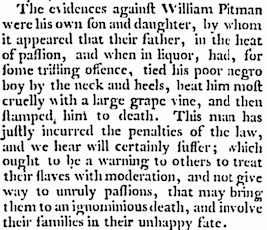
Virginia Gazette, Apr. 21, 1775

What is surprising, indeed perhaps unprecedented, is that the murder victim was one of his own slaves.

The Virginia Gazette, which published the sole surviving account of the incident, says that Pitman, “in liquor” and “in the heat of passion” lost his temper, “tied his poor negro boy by his neck and heels,” and beat him with a large grapevine before stomping him to death.

Pitman can hardly have been the first, or the last, slaveowner to slaughter his own “property” but it was usually impossible to get a conviction because blacks were not allowed to testify against whites in court. In this case, however, two white people — Pitman’s own son and daughter — sealed the case by giving evidence against their father.

The Gazette, writing on April 21, said Pitman had “justly incurred the penalties of the law” and said hopefully that the story might be “a warning to others to treat their slaves with moderation, and not give way to unruly passions, that my bring them to an ignominious death, and involve their families in their unhappy fate.”

* Pitman’s hanging “yesterday” is reported in the Saturday, May 13 issue of the Virginia Gazette — a different Virginia Gazette from the one quoted in this post, as it happens: three competing papers used this same branding; the report in this post’s body on the circumstances of Pitman’s conviction comes from Dixon and Hunter’s Gazette, while the May 13 item establishing the hanging date is from Alexander Purdie’s Gazette.

Purdie’s May 13 edition further adds that when the sheriff came to fetch him on the fatal day, “Pitman made some resistance, but was soon overpowered; he behaved with decency at the place of execution, and attributed his unhappy fate to the effect of intemperate drinking.”

On this day..

1528: Eitelhans Langenmantel, Thomas Jefferson ancestor

On this date in 1528, the Augsburg Anabaptist Eitelhans Langenmantel was executed as a heretic, along with a servant and a maid. Langenmantel had used his own fortune to print several dissident tracts.

His infant grandson, Daniel Hoechstetter, would eventually emigrate to Cumberland where he did honorable business for England’s Royal Mines as part of a community of German miners.

Through this Anglicized descendant, Langenmantel is the maternal great great great great great great great grandfather of U.S. President and Founding Father Thomas Jefferson.

On this day..

1643: The Book of Sports

On this date in 1643, all copies of the Book of Sports were publicly burned by the common hangman.

Product of the queer eddies of a century’s religious reformation, the 1617 edict commonly going under this winsome title was no athletes’ According to Hoyle; rather, it authorized for Sundays “any lawful recreation, such as dancing, either men or women; archery for men, leaping, vaulting, or any other such harmless recreation, nor from having of May-games, Whitsun-ales, and Morris-dances; and the setting up of May-poles and other sports therewith used.”

The day of the week was the decisive thing here. These traditional pastimes had long multiplied upon the numerous feast-days speckling the Catholic medieval calendar, but with the English Reformation this clutch of Papist holidays had been collapsed into just … Sundays. And so sportive Englishmen took their May-poles and Morris-dances to the Sabbath.


The Sabbath Breakers, by J.C. Dollman (1895)

By the late 16th and early 17th century the burgeoning Puritan movement was burnishing its sourpuss bona fides by — among other things — espousing a strict Sabbatarianism requiring that on their one day of rest from holiday-less labor people be “taken up the whole time in the public and private exercises of His [God’s] worship, and in the duties of necessity and mercy.” No vaulting or any other such harmless recreation for you!

I allowe not of such excesse of ryot & superfluitie as is there used. I thinke, it convenient for one Friend to visite another (at sometimes) as oportunitie & occasion shall offer it selfe, but wherfore shuld the whole towne, parish, village and cuntrey, keepe one and the same day, and make such gluttonous feasts as they doo? And therfore, to conclude, they are to no end, except it be to draw a great frequencie of whores, drabbes, theives and verlets together, to maintai[n] […] whordome, bawdrie, gluttony, drunkennesse, thiefte, murther, swearing and all kind of mischief and abhomination. For, these be the ends wherto these feastes, and wakesses doo tende.

Philip Stubbes, 1583

As one might well suppose from the eventual alliances in the English Civil War, the sports stuff was one of the fault lines between high church and low, and between crown and Parliament. Like any proper inbred royal, King James I loved himself a good hunt, and not only of witches — so he was nonplussed when passing through Lancashire to discover citizen grievances over killjoy blackrobes shutting down their Maypoles. He issued the Book of Sports explicitly in response, “to see that no man do trouble or molest any of our loyal and dutiful people, in or for their lawful recreations.”* This gave leisure-seeking commoners something to throw in the faces of their neighborhood nabobs, and Puritans another abomination to grow incensed about.

The Book of Sports remained law of the realm into the reign of James’s Puritan-allergic son Charles I but Puritan muscle grew stronger all the while,** eventually becoming irresistible when Parliament was recalled in 1640 and the high church bishop William Laud was ousted.

The outcome in 1643 was the rough impeachment of the sports book and I don’t mean Vegas.

It is this day ordered by the Lords and Commons in Parliament, that the Booke concerning the enjoyning and tollerating of Sports upon the Lord’s Day be forthwith burned by the hand of the common Hangman in Cheape-side, and other usuall places: and to this purpose, the Sheriffs of London and Middlesex respectively are hereby required to be assistant to the effectuall execution of this order, and see the said Books burnt accordingly. And all persons who have any of the said Books in their hands, are hereby required forthwith to deliver them to one of the Sheriffes of London, to be burnt according to this Order.

John Browne, Cler. Parl.
Henry Elsynge, Cler. P.D. Com.

The Sheriffes of London and Middlesex have assigned Wednesday next the 10th of this instant May, at twelve of the clock, for the putting in execution of the foresaid Ordinance; and therefore doe require all persons that have any of the Bookes therein mentioned, to bring them in by that time, that they may be burned accordingly.

John Langham,
Thomas Andrewes

London

Printed for Thomas Underhill in Great Wood strete, May 9, 1643

Obviously this is not an “execution” even in the metaphorical sense of executions by effigy but part of the wider remit of the hangman, whose duties ran to all sorts of public law enforcement as well as to cajoling society’s untouchables.

Still, “purging by fire” of the printed word was extraordinary treatment reserved for blasphemous or seditious books, not uncommonly accompanied by corporal punishment or even death for their authors. It would not far stretch matters to see in the Puritan Parliament’s disdainful lese-majeste against the hand of the past king its imminent regicidal stroke upon the neck of the current one.

* The Book of Sports wasn’t all license; for the amusements it authorized, it prohibited them to those who “are not present in the church at the service of God, before their going to the said recreations.” Even for the godly it evinced explicit preference for “such exercises as may make [subjects’] bodies more able for war,” therefore excluding “all unlawful games to be used upon Sundays only, as bear and bull-baitings, interludes and at all times in the meaner sort of people by law prohibited, bowling.”

This was a man with a philosophy on exercise as rigorous as any personal fitness coach. James, who was a prolific scribbler, elsewhere “debarre[d] all rough and violent exercises, as the footeball; meeter for laming, than making able the users thereof.” In four centuries since James so pronounced, England have only ever won the football World Cup once.

** Numerous Puritans fled oppressively pleasurable off-days and took their dour Sabbaths to New England where their descendants could one day propound several of the world’s most obnoxious sporting concerns.

On this day..

1887: Charles Smith

(Thanks to Meaghan Good of the Charley Project for the guest post. -ed.)

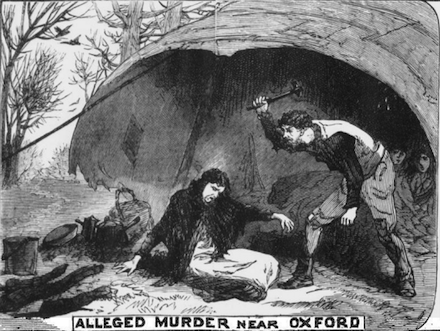
On this date in 1887, 63-year-old Charles Smith was judicially hanged at Oxford Castle Prison by James Berry. He’d brutally murdered his wife in front of their children that February.

The Smith family were Gypsies: Charles, his wife Lucy, their 17-year-old daughter Oceana (known as Oshey) and their 11-year-old son Prince Albert. As Nicola Sly notes in her book Oxfordshire Murders,

The lifestyle of Gypsy families in 1887 was not one to be envied. The traveling people were at the mercy of the weather all year round, whether the heat of summer or the bitter cold of winter. Forced to scratch a living any way they could, many supplemented their meager income with a little poaching or petty theft. Thus they were very rarely welcomed in any area and were always in fear of the local police who almost invariably moved them on wherever they tried to settle.

According to this account, Lucy had borne many children, but only four lived long. By the time of the murder, one of the children had died and one, a daughter named Elizabeth, had grown up and left home.

Charles’s siblings regularly got in trouble with the law, and at least one of his siblings was transported for sheep theft. He and Lucy, however, were somewhat more fortunate: Lucy possessed a valid peddler’s license. In the 1881 censuses, both had their occupations listed as “hawker.” Charles made baskets, skewers, roasting forks, meat stands and pegs which his wife sold.

Throughout their lives Charles and his family traveled around Oxfordshire, pitching a tent wherever they could find a place, and in February 1887, they were camped on public land near Headlington. They’d been there before and were friendly with some of the local residents, including a couple coincidentally also named Smith.

Charles was a violent man who regularly beat his wife and children; Oshey stated he beat his wife every day, and Prince Albert would later testify, “He has been knocking my mother about nearly all his life.”

At one point the domestic violence had gotten so bad that Lucy had gone so far as to take out a formal complaint against her husband for cruelty. She never followed up on it, though.

On the 18th of February, Kate and George Smith, who lived in a nearby cottage, visited the tent and noted Lucy was visibly bruised. They asked Charles why he’d beaten her and he wouldn’t give a reason, but said it was over something that happened thirty years before.

The visitors advised him to forgive and forget, but Charles acted surly and hostile for the rest of the day. Lucy was so frightened of him that for a long time she stayed outside the tent in the bitter cold, and only partially dressed, rather than go inside where her husband was. At bedtime she finally came in.

In the early hours of the next morning, Charles began shouting at his wife, waking the children. As Oshey and Prince Albert watched in horror, their father picked up a hammer and attacked Lucy, beating her on her head, back and legs until he was too tired to do it anymore. Then he laid down and went peacefully asleep.

Mortally wounded, Lucy crawled out of the tent to get some water from a nearby stream. She never returned, and eventually Oshey went out to check on her and found her dead.

When Charles realized what he’d done, he sank to his knees beside Lucy’s battered corpse and sobbed, crying, “My wench, my wench!”

Oshey and Prince Albert ran for help, going to the same neighbors who’d visited the night before. When Kate Smith answered the door, Oshey blurted, “My Mammy’s dead. He’s been and killed her with the hammer.”

Kate and George rushed to the scene of the crime. Charles had dragged Lucy’s body into the tent and lain it out on some straw. He told them Lucy had “fallen down” and died. George told everyone he was going to fetch a doctor, but instead he went to the police, returning with two constables. By then Charles had calmed down and said casually, “Good morning. I have got a dead ‘un this morning.”

One of the constables searched the tent and found the bloodstained hammer concealed under some straw. Charles, whose coat was also bloodstained, was placed under arrest for the willful murder of his wife. The autopsy showed she’d died of a fractured skull; Charles had hit her head with the hammer three or four times.

At the ensuing trial in April, Oshey was the star witness against her father, although Charles kept shouting that she was telling lies and was a “nasty, wicked wretch.” Prince Albert testified also, as did Kate and George Smith.

The defense argued that Charles had no intention of killing his wife and there was no motive, and so it was a case of manslaughter. However, the jury returned a verdict of murder.

After he was condemned to die, Charles turned to religion for solace, praying with the prison chaplain. Some of his relatives came to visit, although Oshey and Prince Albert stayed away. His eldest daughter Elizabeth made the strange observation that “when he was a drunkard there was not a kinder man living, that something or somebody turned him into a teetotaler, and from that time he had been a cruel wretch.”

While walking to the scaffold, Charles fainted on the trapdoor just before James Berry drew the bolt. The hanging went smoothly and it was judged he died quickly and painlessly.

As for the orphaned Oshey and Prince Albert, it was recorded that “through the noble hearted philanthropy, of Miss Skene, of this City, the girl Oceana has been placed in a Home in York, and boy the Prince Albert, through the same thoughtfulness, will also be brought up to acquire the means of earning an honest livelihood.”

On this day..

1679: La Bosse, Poison Affair culprit

On this date in 1679, the French soothsayer Marie Bosse went to the stake as France dealt out death for the Affair of the Poisons.

After the disgrace and 1676 execution of that aristocrat Locusta, the Madame de Brinvilliers, Louis XIV set his pathbreaking police chief on the trail of the “divineresses” whose potions were sought and feared as the remedy to every domestic ill.

Over six-odd years some 36 souls would succumb to this investigation, 34 upon the scaffold and two tortured to death in prison. Perhaps the best-known of these was a woman named La Voisin, whom we have met in these grim pages before. Our subject today is the woman who named La Voisin to her prosecutors.

Too deep in her cups at a Christmas 1678 party — a time at which the few arrests of alchemists and folk magicians could not yet really be said to be a Poison Affair — our principal La Bosse dropped some indiscreet braggadocio as to her prowess and market share in the poisoning game.

When word got back to the torchlit cowls at the Chambre Ardente, she’d be arrested and interrogated to great profit for investigators. La Bosse blabbed all about other poisoners, including the king’s own lover, the Madame de Montespan and the aforementioned La Voisin.

This was fatal to La Bosse as well as to La Voisin but proved less so to highest muckity-mucks. Accusations reaching the king’s own bedchamber and perhaps even compassing contemplated regicide were thought dangerous to explore and helped to drop the curtain on the entire poison-hunt: “the enormity of their crimes proved their safeguard,” in the supposed words of the investigator.

Later in 1679, a Thomas CorneilleJean Donneau de Vise comedy ridiculing poisoners and pretended magicians debuted. La Divineresse, whose title character was named “Jobin” and had an associate named “Du Clos”, was a smash hit, running for several months — which was more than could be said by that time for these characters’ real-life inspirations. (La Voisin went to the stake in February 1680.)

Recommended: an eight-part blog series on Poison at the Court of Louis XIV begins here; scroll down to advance installment by installment.

On this day..

1805: Not Bartlett Ambler, possible buggerer

From “Buggery and the British Navy”, in History of Homosexuality in Europe and America

Unlike modern military law, which tends to distinguish in some way between homosexual acts between consenting adults and what is often the equivalent of rape of a shipmate, the navy during this period made no such distinctions. A boy who had been seduced or forced to commit buggery, therefore, was under great pressure to turn in his partner or attacker, for if they were caught and it appeared he had consented, the “victim” might well be as severely punished as the aggressor. Needless to say, there were serious problems in determining whether or not the boys called to testify were telling the truth, or simply using the buggery charge as a means of destroying a shipmate or officer they particularly disliked.

The courts were often acutely conscious of that possibility and there was even some objection to allowing young boys to testify in buggery trials. In 1772, the defense protested the testimony of John Ellis, a twelve year old boy who had accused one John Palmer of buggery. Despite the protest, however, it was decided that he could legally testify and Palmer was convicted of attempted buggery.

The problem of boys testifying against men in buggery cases are clearly revealed in the Bartlett Ambler case. Ambler was accused by four boys of sodomitic practices. Each testified that Ambler threatened to have them flogged if they told what had occurred. One of the boys, John Davy, said, “…and I had scarce buttoned up my breeches when he said be sure don’t tell no person of it. I’ll be very good to you, but if you tell any person of it I’ll get you flogged.” Ambler based his defense on the alleged wickedness of his accusers. Joseph Dorman, the ship’s corporal, was called upon to discuss the character of three of the witnesses.

Q. Do you know if the boys who have been examined in support of the charge against me are notorious liars?

A. Two of them Hopkins and Willcott have been several times punished for lying.

Court. What is the character of the boy Davy?

A. He bears a very bad character by the whole ship’s company.

Ambler also called upon Midshipman Robert Baker who told the court:

Davy is a very wicked boy indeed as ever lived everyone in the ship will say that if it was in his power he would hang his own father — I hear Hooper’s mother say that her son had denied to her all that had been said against the prisoner.

The court had to weigh the testimony of the four boys who accused Ambler of buggery against the evidence of Ambler’s witnesses, who denigrated the character of the boys and testified to his good reputation. The judges sentenced Ambler to be hanged, but as a sign of their unease, sent the following letter to the Admiralty Secretary, along with the minutes of the trial:

By desire of the members of a Court Martial assembled by me this day to try Mr. Bartlett Ambler, I have to request you will call their lordship’s consideration to the hardship the Court have labored under in being obliged to condemn a man to death, upon the evidence of four boys, the eldest not more than thirteen years of age, and therefore recommend him to mercy.

The recommendation was endorsed by His Majesty on May 8, 1805, and Ambler was pardoned.

It is clear that boys could be intimidated into testifying against innocent men. In one disturbing case, a boy was caught under the blanket of Edward Martin. Evidently, the boy did not have a bed or blanket of his own, and Martin took him in as an act of kindness. The captain of the ship had the boy flogged and threatened him with another whipping if he refused to testify. Under the threat of further punishment, the boy confessed that Martin had buggered him. The trial record reads:

Prosecutor. Did you inform me that the Prisoner had committed that unnatural crime on you twice?

James. Yes, but I was afraid that the Captain would flog me.

In this case, the prisoner was acquitted, but the case does suggest the many possible abuses in buggery trials: that the testimony of boys was suspect, that fear of punishment or promise of reward might be used to intimidate them into giving false evidence against a shipmate, that the boy could be motivated by dislike or a desire for vengeance.

Trial transcripts of the testimony offered against Bartlett Ambler — and summoned by Ambler in his defense, who averred the “wicked” and “very bad” character of the childish witnesses — are available in Gay Warriors: A Documentary History from the Ancient World to the Present.

On this day..