2015: Aftab Bahadur Masih, “I just received my Black Warrant”

A year ago today, Pakistan amid its ravenous 2015 execution binge hanged Aftab Bahadur Masih in Lahore for a 1992 murder.


Two faces of Aftab Bahadur Masih, separated by two decades on death row.

According to the anti-death penalty organization Reprieve, Masih was only 15 years old when he committed the crime. According to Masih himself, he never committed it at all — but instead was tortured into confession by the police.

Don’t take my word for it. Masih wrote a moving first-person essay for the Guardian that was published hours before his hanging.

I just received my Black Warrant. It says I will be hanged by the neck until dead on Wednesday, 10 June. I am innocent, but I do not know whether that will make any difference.

Read the rest here. Masih was also a self-taught painter; one of his products can be seen in this Wall Street Journal story.

On this day..

1741: Cook, Robin, Caesar and Cuffee

On this date in 1741, four black men were burned in New York City.

This is the third execution date in that year’s great suppression of a purported slave conspiracy, and it is here that its wantonly inquisitorial character clearly comes to the fore. Accusations under the gallows (or in this case, the pyres) topple like domino-tiles into fresh arrests and new accusations, until from a couple of luckless thieves there are 30-plus souls in the grave.

Eleven days prior, when two slaves named Cuffee and Quack had burned at the stake for this sensational plot, a sham offer of clemency had been extended them with the very fagots beneath their feet. Under this extortion the men had owned the plot, a confession the court privileged as the truth of dying men (for they were burnt anyway, despite their compliance), they duly named as co-conspirators several of those we find in the next tranch of slaves tried before the colony’s highest court.

(We must do Cuffee and Quack the justice of noting that by the time they burned, all those who were to be tried next were already in jail with them, arrested upon the information of another fellow-slave informing to save his own skin. Perhaps the men at the stake supposed their fellows already burnt flesh, and their own accusations strictly ornamental.)

By this point in events, the court was convinced past arguing that a white barkeep named Hughson (whose own Executed Today entry is fast approaching) had played host to large meetings of New York’s Negros, where they drank together and leered at the white servant and toasted one another’s plans to destroy the city. When slaves were wrung for information about the “plot” it was largely to name those who had participated in these supposed meetings. But since a master conspiracy against white New York was now presumed — its alleged leaders had been the first to die — little was required to damn a man but to place him at one of these slaves’ sabbaths. Trials could now become quite perfunctory on any one person’s actual role or misdeeds: just tie him to the satanic cabal.

Even the crown’s own opening statement to the court on June 8 basically promised to mail it in.

It will, I doubt not, appear to you, upon hearing our Witnesses for the King on this Trial, that these six Negroes are some of the Conspirators who combined with those principal Incendiaries, Hughson and his Family, to set on fire the King’s House, and this whole Town, and to kill and murder the Inhabitants.

But as I have already, upon the Trial of the Negro Quack, for burning the King’s House, and of another Negro called Cuffee, for burning Mr. Philipse’s Storehouse, and likewise on the last Trial of Hughson, his Wife and Daughter, and Kerry, endeavoured to set forth their Heinousness of so horrible and detestable a Conspiracy; and the Dangers this City and Province may still be exposed to, until Examples are made of all such as have been concerned in this most wicked Plot; I think I have no Need upon this Trial, to say any Thing further on either of these Heads; not doubting but when you have heard the Crimes which these Criminals stand charged with, proved against them, you will find them Guilty.

The six in question were appended to the horrible and detestable Conspiracy as bullet points in depositions full of denunciations: namely, by the white servant Mary Burton, who was the Abigail Williams character of this particular witch hunt; by Cuffee’s and Quack’s tricked confession at the stake; and by three other slaves — Sandy, Sarah,* and Fortune — who had all been arrested themselves and gave their evidence under the pall of their own probable execution for any failure in cooperation.**

The court would surely reply here that such a society can rarely be penetrated but by dirty hands and compromised witnesses.** Seen in such a light, the roles imputed to these six would have been terrifying.

  • Jack was a “captain” in the cell and resolved “his Knife was so sharp, that if it came a-cross a white Man’s Head, it would cut it off” (according to Sandy); he with Cook “used to be at the Meetings at Hughson’s, when they were talking of firing the Town and murdering the People” (Mary Burton)
  • Cuffee and Caesar “fired Van Zant’s Storehouse” (according to the dying confessions of both Quack and the previous Cuffee) with Caesar declaring for good measure that “he would kill the white Men, and drink their Blood to their good Healths: This about a Fortnight or Three Weeks before the Fort burnt.” (Sandy)
  • Robin “had a Knife there, and sharpened it; and consented to help kill the white Men, and take their Wives.” (Sandy)
  • Jamaica “(being a Fidler) said, he would dance over [white New Yorkers] while they were roasting in the Flames; and said, he had been Slave long enough.” (Mary Burton)

There is at times a suspicious confluence of language — and a repeated fixation on black men seizing white women — that suggest the interrogator’s influence. Nevertheless, depositions overlapping on a number of key points have persuaded not only the slaves’ jurors but some of their latter-day interlocutors that they truly were party to a most audacious design. Every one of them was condemned to death. Jamaica, the fiddler, received the liberality of a three-day wait; the other five were all to burn the very next afternoon — June 9, 1741.

Their actual execution is a one-sentence afterthought in a record already by the morrow speeding along to the next proceedings: “This Day also, The Negroes Cook, Robin (Chamber’s) Caesar (Peck’s) Cuffee (Gomez’s) were executed according to Sentence.” The reader will notice that where five were doomed, only four have died. The fifth, Jack — that fell captain whetting his sharp blade for white throats — was busy that morning saving his own neck by supplying evidence for the crown, straight from the center of the plot. So Jack instead remained in the courtroom, detailing for his prosecutors (soon to be his pardoners) a fresh roster of prey, even as his comrades were wrenched from the courthouse’s basement jail and set alight in downtown Manhattan.

* Our very partial compiler Daniel Horsmanden admits that this witness “was one of the oddest Animals amongst the black Confederates, and gave the most Trouble in her Examinations; a Creature of an outragious Spirit: When she was first interrogated upon this Examination about the Conspiracy, she absolutely denied she knew any Thing of the Matter … her Conduct was such upon the Whole, that what she said, if not confirmed by others, or concurring Circumstances, could not deserve entire Credit.”

** In fact, the court did make this argument (“if Pagan Negroes could not be received as Witnesses against each other … [then] the greatest Villanies would often pass with Impunity”), for it was also defending itself as early as July of 1741 against contemporary whites who doubted that any actual terrorist conspiracy existed among the slaves. The anonymous New England critic whose letter surviving to us compares New York in 1741 to Salem in 1692 noticed “that such Confessions unless some certain Overt Act appears to confirm the same are not worth a Straw; for many times they are obtained by foul means, by force or torment, by Surprise, by flattery, by Distraction, by Discontent with their circumstances, through envy that they may bring others into the same condemnation, or in hopes of a longer time to live, or to die an easier death.” This was a soul ahead of its time.

On this day..

1743: John Breads, Rye killer

On this day in 1743, John Breads met his fate on the gallows in the small Sussex town of Rye, on the south coast of England. The spectacle of his hanging was compounded by the subsequent use of the gibbet, a cage in which Breads’s body was left exposed to the elements in Gibbets Marsh for more than 20 years.

On the face of it, this was just another hanging in the dustbin of history, but author Paul Kleber Monod uses it as the focal point of a book, The Murder of Mr. Grebell: Madness and Civility in an English Town (review | another), in which he wraps Rye, the murder and the execution into the social structures of England (especially small-town England) of the 18th century.

Although the murder itself is a small part of Monod’s book, he nonetheless outlines two aspects of the Breads story which make it worth a look by readers of Executed Today:

  1. the issue of fairness in the handling of the trial and execution; and
  2. the killer’s attempt to assert “mental distraction”

The facts of the murder itself seem fairly straightforward, although a little quirky, since the whole affair was apparently a case of mistaken identity: James Lamb, the then-mayor of Rye, was invited to dinner on March 16, 1743, to celebrate the appointment of his son John to the customs service. Lamb was feeling ill that day and asked his brother-in- law, Allen Grebell, to attend the dinner in his place. As Grebell was returning home after the event, he was attacked and stabbed in the churchyard by John Breads; although Grebell was able to make it back to his home, he died that night from his wounds.

When Breads was arrested for the murder, he claimed he had intended to kill Lamb, not Grebell. Monod points out that, since Lamb was related (albeit by marriage) to the victim, normal procedure would have been to move any hearing or trial to another jurisdiction, or at least allow an independent jurist to preside over the case. Breads’s assertion that Lamb was the intended victim should have given the Mayor even more reason not to be involved.

Instead, he insisted on keeping the trial in Rye and compounded the irregularity by acting as both prosecutor for the grand jury and as judge for the trial, thus ignoring judicial standards relating to conflict of interest. Additionally, one description of the trial claims that Lamb testified during the trial itself; if this is true, Monod says, such testimony was a breach of common law, which dictated that judges could not testify in cases over which they were presiding.

Monod introduces a commentary by Rye resident and lawyer Henry Dodson, who questioned whether Breads had received a fair trial in light of Lamb’s actions:

How fair a Tryal, the Prisoner had, I leave the Reader, to determine after he is informed, the above Mr. Lamb, was Mayor, Coroner, Party Prosecuting, Judge, Witness and Sheriff, in Presenting, Trying and Executing the said John Breads.

I suppose, he was Mayor, Coroner, and Sheriff, as essentiall, to the office of Mayoralty; Party and prosecutor, as Brother in Law to the Unfortunate good Gentleman, that was Killed; and Judge, and Witness out of Zeal, in getting the Prisoner proved Sane …

Dodson seemed to feel that Lambs involvement in the case was just a little too personal, and the fact that Breads was gibbeted after his execution might lend some credence to that idea. Gibbeting, Monod points out, was not usually a punishment imposed by a judge, but rather by royal order, and it was generally reserved for the most serious of killers.

But Monod puts the trial into a larger social context, suggesting that

the trial of John Breads bears a message about how the law operated in the 18th century [and] stands as an example of how authority might assert itself aggressively and unrestrainedly. The last word belonged to the judge … a kind of paternalism based on the social (and hence moral) inequality between defendant and judge. It was the opinion of the magistrate that counted.

[This] system reflected a social and political structure in which authority had been concentrated in a few hands, usually by inheritance … Breads had little chance of escaping the most extreme form of retribution.

The second point of interest in the Breads trial was that it stood at the cusp of a new understanding of insanity in the commission of crimes.

This is a mere replica of the Breads gibbet on display at the Rye Museum, but the town council still has possession of the original, skull and all. It’s reported to be a highly sought gawk, but it can only be seen by special arrangement.

Although Breads originally claimed his plan was to kill the mayor, he changed his tune at the trial, where he was reported as having said that “if he had committed the Fact, he knew nothing of it, for it was done when he was in Distraction … In short, he affected Madness …” (Kentish Post, June 1-4, 1743)

Or, in today’s parlance that would fitfully develop, “Not guilty by reason of insanity.”

Insanity had been a legitimate defense for years, but the definition of insanity was very much in flux at this time. Doctors suggested that madness was due to a mental defect rather than possession by an evil spirit and lawyers were pushing the idea that homicide required “malice aforethought,” while many average citizens still believed that those who were mad were in the grip of the devil.

Monod proposes yet another possibility by putting the question into a sociological context: “Insanity does not operate randomly,” he writes. “It cannot separate a sufferer from the social context in which he or she exists.”

For Breads, whose upbringing had been closely tied to his church, that context included unsuccessful attempts in the late 1600s by religious purists to wrest control of Rye’s government and economy from the wealthy secular class, and the antagonistic feelings that remained from the abject failure of that effort and the perceived religious persecution that followed it. Breads was no doubt influenced by that antagonism, Monod suggests, and those feelings “may have alienated him from the way the town was governed … [He] wanted to vent his rage on the oligarchs.” As a result, “Even in his madness, Breads was trapped by his own history and that of his native town.”

Whatever the source of Breads’ “distraction,” it did him no good. But it did become one piece of a serious conversation about the issue — a conversation which has continued for centuries.

On this day..

1945: Mile Budak, Ustasha ideologue

On this date in 1945, seven former members of Croatia’s World War II Ustasha regime were hanged in Zagreb by Tito‘s postwar Yugoslav government — the morning after they had all been death-sentenced at a one-day military trial.*

Despite the presence of wartime Prime Minister Nikola Mandic (English Wikipedia entry | Croatian) in the batch, the marquee name was writer Mile Budak
(English Wikipedia entry | the far more detailed Croatian and German).

The “minister of culture with a machine gun” in the branding of his leftist literary contemporary Miroslav Krleza, Budak spent the interwar years writing hit novels valorizing the Croatian peasantry (The 1,000-page OgnjišteHearth — is the magnum opus) and also voluminous copy for far-right periodicals. Thanks to the latter activity, Budak endured an arrest, an attempted assassination, several years’ self-imposed exile to Italy, and (after his return) the murder of his wife.

Small wonder that when Germany broke off from the post-imperial Kingdom of Yugoslavia an “independent” Croatian puppet state, Budak signed up as its chief propagandist. Initially Minister of Education in 1941, he subsequently became its ambassador to Germany, and in 1943 its Foreign Minister.

He’s most notorious for the alleged aphorism “One third of the Serbs we will kill, one third expel, and the last third convert to Catholicism” — and though adherents widely dispute his authorship of any such phrase, Budak’s racial cosmology elevating Croatians (“an intersection of Slav and Gothic blood”) over their South Slav brethren was part of the intellectual scaffolding for his state’s wartime campaign of ethnic cleansing against Serbs. (It goes without saying that Jews and Roma were even more screwed.)

Judgments on the literary merit of Budak’s output appear to be driven heavily by the critic’s sympathy level with Budak’s politics. Post-independence Croatia has a robust far right that has often shown keen to rehabilitate the Ustasha, so it’s no surprise that Budak has been rediscovered as a writer and his name stapled to numerous streets in Croatia** and even to one in the Bosnian city Mostar — strictly in honor of his artistry and not the war business, mind you.

* Indeed, several — Mandic included — were only yielded up from British captivity in mid-May. (Link goes to a Croatian pdf)

** There’s one, for instance, in present-day nationalist enclave Knin — formerly the capital of the Serbian Krajina during the internecine 1990s wars. Knin’s capture and, er, ethnic reordering is the occasion celebrated on Croatia’s Victory Day holiday (August 5). It was for this operation that Croatian general Ante Gotovina was prosecuted by the International Criminal Tribunal for the former Yugoslavia; Gotovina’s eventual shock acquittal and release to a great nationalist orgy in Zagreb led Serbia to quit cooperation with the ICTY’s “selective justice”.

On this day..

1971: Sean Flynn and Dana Stone, Vietnam War photojournalists

On an unknown date thought to be approximately June of 1971, American photojournalists Sean Flynn and Dana Stone were executed by Communist captors in Southeast Asia.

Flynn is the big name of the pair,* literally: a former actor, he wasn’t in like his superstar father Errol Flynn. After trading on his prestigious name for a few silver screen credits, Sean grew bored of Hollywood and pivoted into a career in wanderlust — trying his hand as a safari guide and a singer before washing up in Vietnam where the action was in January 1966.

He made his name there as a man who would find a way to snatch an indelible image out of war’s hurricane, even at the risk of his own life.


One of Flynn’s photos: A captured Viet Cong being tortured. (1966)

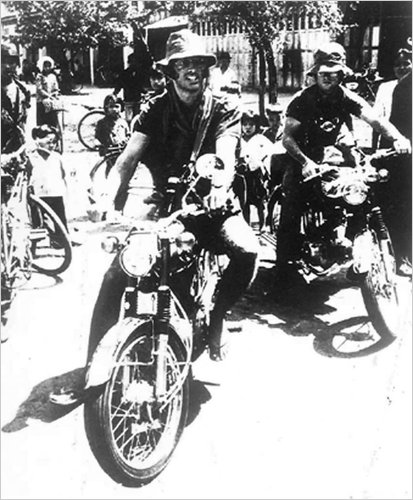
On April 6, 1970, Flynn and fellow risk-seeking photojournalist Dana Stone hopped on rented motorbikes bound for the front lines in Cambodia. It was a last mission born of their characteristic bravado — all but bursting out of the frame astride their crotch rockets in the last photo that would become their epitaph. They were never seen again; having apparently been detained at a Viet Cong checkpoint, it’s thought that they ended up in the hands of Cambodian Khmer Rouge guerrillas and were held for over a year before they were slain by their jailers.


Flynn (left) and Stone mount the bikes for their lethal assignment. This is the last picture ever taken of them.

Sean’s mother, actress Lili Damita, spent years seeking definitive information about his fate, without success. Dana’s brother, John Thomas Stone, joined the army in 1971 reportedly with a similar end in mind; he was killed by friendly fire in Afghanistan in 2006. The prevailing conclusion about their fate arrives via the investigation of their colleague and friend, Australian journalist Tim Page — a man for whom memorializing the journalists who lost their lives during the Vietnam War has been a lifelong mission.

Though Flynn’s and Stone’s guts are undeniable, not everyone appreciated their methods. “Dana Stone and Sean Flynn [son of the Hollywood actor, Errol Flynn] were straight out of Easy Rider, riding around on motorcycles carrying pearl-handled pistols. Cowboys, really,” said fellow photog Don McCullin. “I think they did more harm than good to our profession.”

* He’s not to be confused with present-day actor Sean Flynn — that’s our Sean Flynn’s nephew. (Sean the nephew was named for Sean the uncle.)

On this day..

1891: Christian Fuerst and Charles Sheppard

OMAHA, Neb., June 5. — Charles Sheppard and Christian Fuerst, who murdered Carl Pulsifer Dec. 10, 1889, and then robbed the body of $20, were hanged at Frement [sic] at 10:30 this morning. Sheppard nearly fainted on the gallows, but Fuerst acted entirely unconcerned. When the men were asked if they had anything to say Fuerst replied, “nothin,” but Sheppard said, “We are the men who did the deed and therefore no one else can be accused of it.” Both of the men’s necks were broken.

Dallas Morning News, June 6, 1891

On this day..

1867: Gottlieb Williams, eyeballed

From the very first volume of the Transactions of the American Ophthalmological Society, spanning 1864 to 1871. The society, and the journal, are still going strong.

The ellipses omit three other hangings investigated by Dr. Dyer.

FRACTURE OF THE CRYSTALLINE LENS IN PERSONS EXECUTED BY HANGING.
By E. Dyer, M.D., of Philadelphia, Pa.

Three years ago I presented to the Society the result of the examination of the eyes of a man who was hanged, also some experiments on the effects of hanging on the crystalline lens of the dog. In the case of the man the anterior capsule and the lens of the right eye were fractured. The direction of the fracture was horizontal and a line below the centre, extending as far back as the middle of the lens. In the left eye the anterior capsule only as involved. In one dog the same conditions were found, in another only one lens was fractured, and in a third no lesion was detected.

Since then I have experimented on rabbits. Two were hanged and four were strangulated. The trachea in two of the latter were laid bare and tied, but no fracture was detected in any case. Drs. S.W. Mitchell and W.W. Keen, who assisted me at the experiments on the dogs, were present.

The following are the notes of several executions at which I have been present since my report of the case already mentioned. I have been able to examine the eyes of the criminals both before and after death.

Gottlieb Williams, aet. 34, was executed in Philadelphia, June 4, 1867. Drop four and one-half feet; the knot slipped so as to be under the occiput; suspended thirty minutes; convulsive movements lasted five minutes; neck not dislocated.

Examination at 11.54 A.M., five minutes after the body was cut down. Appearance of eyes natural; no protrustion; no injection of conjunctival vessels, corneae clear.

Right eye, pupil well dilated; media clear. Small point seen on the anterior capsule of the lens in the median line, just above the margin of the pupil. At 12, M., spot more distinct; at 12.26 P.M., spot still present, somewhat elongated. Optic nerve normal; retinal vessels small.

Left eye, pupil smaller than the right; cornea clear; lens in normal condition; optic nerve normal; arteries small. I was not allowed to remove the eyes.

Drs. H. Yale Smith, physician to the prison, W.W. Keen and J. Ewing Mears assisted me in the examination.

This unpleasant series of investigations has been pursued ith the hope of throwing some light on the vexed question of the mechanism of the accommodation, but as yet without any satisfactory result.

On this day..

1898: James Fleming Parker

This morning in 1898 — allegedly after enjoying the company of an obliging prostitute during the preceding night as a favor from the sheriff, a childhood friend* — James Fleming Parker hanged on Courthouse Square in Prescott, Arizona.

An effective tort lawyer would have saved Parker from his untimely end, for his path to the gallows began when he lost a prized horse struck by an Atlantic and Pacific train and the railroad — spiraling towards bankruptcy in the wake of the Panic of 1893 — came up with only the most niggardly award.

Incensed, Parker went and got his the old-fashioned way: by sticking up an A&P train.

A few things went wrong.

For one, Parker botched the heist and had to flee the iron horse with an underwhelming haul, a dead confederate in his wake.

For another, he’d been recognized and was arrested a week later after a chase through the Arizona wilderness.

And finally, he decided to double his bad bet by leading a jailbreak while awaiting trial — in the course of which he fatally shotgunned a deputy district attorney who had responded to the hue and cry. Parker was lucky to end up in the clutches of that friendly sheriff instead of lynched to the nearest trestle or telegraph pole by an angry posse, but the upshot was the same.

Last sentiment, according to the Tombstone Epitaph** (June 5, 1898):

I have not much to say; I claim I am getting something that ain’t due me; but everyone who is going to be hung says the same thing, so that cuts no figure. Whenever people say I have to go, I am one that can go.

And then he went.

* If so, this last communion followed hours after Parker’s conversion to Catholicism.

** Really.

On this day..

1882: Sandy Mathews, in Memphis

From the June 3, 1882 Chicago Tribune:

Six Thousand People Present at the Execution of Sandy Mathews.

MEMPHIS, Tenn., June 2 — Sandy Mathews, colored, who murdered Essick Polk, colored, twele miles north of this city last October, was hanged in the county-jail yard this afternoon at 1 o’clock. The execution was witnessed by fully 6,000 people, a majority of whom were colored. The condemned man made a speech from the gallows, in which he confessed the killing, and implored his hearers to repent of their sins and go with him to Heaven. His neck was broken by the fall.

THE GALLOWS

had been erected in the southern portion of the jail-yard and was built high enough to give a full view to the ccrowd that jammed the streets running parallel with the jail. Matthews [sic] slept well last night, and partook of a hearty breakfast this morning. He bade farewell to his wife about 11 o’clock, and began making preparations for the hanging. A few weeks ago he embraced Catholicism, and was attended in his cell by the Rev. Father Lucius, of St. Mary’s Catholic Church. He called for his dinner at noon, and ate heartily, and afterwards smoked a cigar. At half-past 12 o’clock he was brought from his cell and conveyed to the scaffold, where he addressed the crowd for twenty minutes in

A DISCONNECTED SPEECH,

confessing to having killed Polk, and at the same time imploring his hearers to repent of their sins ere too late, and be forgiven, as he had done. He then knelt and repeated the Lord’s Prayer, after which the Rev. Father Lucius said the prayers for the dying. The condemned man was handcuffed, and his arms, and legs, and ankles strapped. The black cap was adjusted, and, as he uttered the words

“FAREWELL FRIENDS, FAREWELL WORLD,”

the drop was sprung, and his body shot down. His neck was broken by the fall, and ther was but very slight convulsions of the body. During the speech many of the colored people responded to his implorations by shouting, “Bless the Lord, Amen.” Sandy Mathews killed Essick Polk for having enticed his wife from him. He struck him three blows with an ax. Several hours afterwards he took the dead remains and buried them in a field near his house. The hole not being large enough, he chopped the dead body in pieces, and thus buried them. The crime was kept concealed for five months, but revealed by a stepdaughter of Mathews, who was the only witness to the killing, and upon whose testimony he was convicted. Gov. Hawkins was appealed to, but declined to interfere with the sentence of the lower court, which was afterwards confirmed by the Supreme Court.

On this day..

1970: Pedro Eugenio Aramburu, by the Montoneros

On this date in 1970, Argentine general and former dictator Pedro Eugenio Aramburu was shot by a band of Peronist student guerrillas.

Aramburu (English Wikipedia entry | Spanish) was one of the major figures behind the 1955 Revolución Libertadora that sent populist president Juan Peron fleeing to Spain. Peron was initially succeeded in the presidency by another general named Eduardo Lonardi, but before 1955 was out Aramburu had overthrown and replaced him, too; Aramburu ran the ruling junta until elections in 1958, maintaining a sharp ban on any vestige of Peronism — including even the mere mention of the exiled ex-president. He also had General Juan Jose Valle shot for plotting a Peronist coup in 1956.

The next two decades saw Argentina’s political institutions grow ever more painfully brittle, as shaky civilian governments were toppled in turn by equally shaky military rulers, every turn of the wheel eroding the country’s norms of orderly governance without attaining a stable political coalition. The charismatic Aramburu remained throughout a pole of anti-Peronism, which mattered as Peron’s long shadow grew and his return to Argentina began to seem likely.*

The faltering legitimacy of the government in turn spawned leftist guerrilla movements like the Peronist Montoneros, who entered Argentina’s political fray in gobsmacking style by abducting Aramburu in an affair the guerrillas called “Operation Pindapoy”.

On May 29, 1970 — Argentina’s Army Day and also the one-year anniversary of a suppressed popular uprising against the military government — two of the Montoneros terrorists disguised themselves as junior officers and presented themselves at Aramburu’s unguarded Buenos Aires apartment, claiming that the army had assigned them as his escort. The ruse worked like a charm.

With their prey in hand, the “officers” and their confederates stuffed him in a Peugeot and followed clattering dirt roads to evade police checkpoints, arriving that evening to a safehouse they had readied in the hamlet of Timote. There, a trio of young radicals constituted themselves a revolutionary tribunal and put Aramburu on “trial” for the murder of Gen. Valle and his fellow Peronist rebels fourteen years before.

Mario Firmenich, one of the dozen young Montoneros kidnappers, would later describe the three days they spent with their celebrated prisoner for a magazine: “His attitude was calm. If he was nervous, he controlled it.” Firmenich, who is still alive, has always insisted as he said then that their action evinced the popular will. “For the first time the people could sit on the bench and judge and condemn. That is what the Montoneros performed in Timote: to show the populace, that, beyond the pitfalls, legal chicanery and repression, there was a path to true justice, which stems from the will of a people.”

True justice was executed in the basement of their hideout. Having announced the inevitable verdict to Gen. Aramburu half an hour before, the leader of the cell shot him in the chest and then the head. The Montoneros then buried him, still bound and gagged, right there in the cellar — slathered with quicklime in an effort to hide the evidence.

It was a shocking blow to a fragile polity, and would help speed the (probably inevitable) fall of Gen. Juan Carlos Ongania, who was ousted from the presidency just a week after Aramburu’s murder.**

To grasp the profound effect of the kidnapping and murder of Aramburu it is necessary only to consult any Argentine periodical issued after May 29, 1970. Shortly after the kidnapping, Ongania announced in a televised speech that the death penalty would be imposed for crimes against public order. This decree was insufficient, however, to alleviate the feeling that order and authority had collapsed for good. (Source)

During Argentina’s subsequent dictatorship (and its escalating “Dirty War” against, amongst other subversives, the Montoneros), the town square of Timote was named for its unwilling guest Aramburu. That name has been changed in recent years.

* Peron did in fact return in 1973, amid bloodshed.

** Aramburu was probably involved in a plot to get rid of Ongania, whose credibility had gone to pieces in early 1970 quite independent of the Montoneros. Firmenich suspects this might account for the ex-president’s compliance with the purported junior officers who abducted him.

On this day..