1942: Shimon Cohen, ladykiller

(Thanks to Meaghan Good of the Charley Project for the guest post. -ed.)

On this date in 1942, at close to 11:00 p.m., Shimon Cohen was shot to death in the village of Kalesnik, Lithuania.

A barber by trade, he had somehow managed to evade the roundup and mass shooting of all the Jews in the area eight months before. But he could only postpone capture and death for so long.

The details of Shimon’s death were recorded in the diary of 22-year-old Abelis Veinsteinas, later known as Aba Gefen, a fellow Jew who was also hiding in the area. Gefen and his brother were staying in the home of the Matulevich family in exchange for payment.

On May 18, Gefen wrote:

[Two days ago] Shimon Cohen was caught at friends of his. A fight broke out between the wife of the farmer who was hiding him and the farmer’s sister. One of the women informed on Shimon to the mayor of the village, who told the police. Shimon and the farmer were arrested. They say Shimon asked a priest to come and convert him, because he knows that he will die and he wants to die a a Catholic. I am very sorry to hear that — that he’ll die as a traitor to his people.

Shimon, it seems, was quite the ladies’ man, juggling multiple romantic partners at the same time. As often happens in these cases, it came back to bite him in the ass:

It seems that Shimon was betrayed by Marta, his mistress. When the Germans began to remove Jews from the town, Marta suggested that he hide with her family in the country. He agreed and lived with her at her brother’s house. But Marta’s sister-in-law also fell in love with him. Jealousy and hatred got the better of the two women. Shimon thought he would be able to save his life by declaring his love for both of them. But Marta was furious that he was making love to her sister-in-law and turned him in.

It would be kind of a funny story if it didn’t involve Nazis and death.

As Gefen recorded in subsequent diary entries, one of Shimon’s lady friends tried to save him by pulling some boards loose from the wall of the prison outhouse so he could escape. Shimon did indeed run away, but the authorities quickly caught him and he wasted no time in selling out the woman who had facilitated his escape attempt. (She was arrested, but her ultimate fate is unrecorded.)

In the days prior to his death, Shimon took religious instruction from a priest and was baptized.

At great risk, Gefen would occasionally leave his attic hideout and go to the village to retrieve some more of his family’s valuables to give to the Matuleviches.

He wrote in his diary that he was out on one of those surreptitious excursions, tiptoeing in the dark in his stocking feet, when he heard Shimon Cohen being executed:

When Mrs. Matulevitch and I went to Kalesnik at night and crossed the railroad tracks not far from the road that leads there, we heard shots … Today, when Mrs. Matulevich came back from the village, it turned out that those shots were bullets that killed Shimon Cohen, a Jew who converted just before his death. May Shimon rest in peace — but it was still no way to die.

[…]

Piletsky the partisan shot him. He had shot Jews before. In fact, they say he’s shot seventeen Jews. Now he’s killed Shimon, and he got 15 German marks for his trouble.

Gefen and his brother survived the war, staying with various villagers and occasionally in the fields. He moved to Israel in 1948. He published his diary under the title Hope in Darkness.

On this day..

1965: Eli Cohen, Israel’s man in Damascus

On this date in 1965, Israel’s greatest spy suffered an ignominious public hanging in Martyrs Square, Damascus.


The signage swaddling the body denounces his crimes.

Eliahu Ben Saul Cohen — you can call him Eli(e) — was an Egyptian Jew who got recruited by Israeli intelligence to put his Arabic credentials to use in the cloak and dagger game.

You could say he’d found his calling.

After a spell establishing his cover story credentials in Argentina, he “returned” to Syria posing as a prodigal returning emigrant. There, he became the Zionist Richard Sorge.

Brazenly infiltrating the ascendant Ba’ath party and Syrian elite circles as wealthy businessman “Kamel Amin Thaabet”, Cohen piped years of high-quality intelligence to Israel from the very pinnacle of its enemy’s power structure.

(As described in this account, Eli’s own brother, another Mossad agent, was at one point charged with deciphering the spy’s communiques — thereby accidentally catching up with the family business.)


The trusted Eli Cohen in a snapshot with Syrian officials in the Golan Heights, overlooking Israel.

Cohen’s information on Syrian positions in the Golan has been credited with helping Israel win the Six-Day War in 1967.

But he wasn’t around to see it.

By that time, Syrian and Soviet intelligence had finally traced the damaging radio transmissions to “Kamel’s” apartment. He was purportedly — the matter is disputed, and smacks of hagiography — so influential and well-trusted at that point that he was on the verge of being named Deputy Minister of Defense.

Instead, he had a future in the martyr business.

A few books about Eli Cohen

After Cohen’s January 1965 arrest, events moved with implacable dispatch, and neither spy swaps nor diplomatic arm-twisting would avail an agent so embarrassingly, damagingly accomplished. Thousands turned out to cheer the spy’s public hanging, or gawk at the body as it remained hanging throughout the morning. Thousands more watched the live telecast of the execution.

(Six Syrians drew prison sentences for their parts in Cohen’s spy ring.)

Israel is still on about getting his body back from the Syrians. Whether or not that ever happens, the man lives on as a hero for his side. His story is the subject of the 1987 TV movie The Impossible Spy.

On this day..

1868: Kondo Isami, Shinsengumi

On this date in 1868, Shinsengumi commander Kondo Isami was beheaded at Itabashi as the civil war between the Tokugawa Shogunate and the rising Meiji government that would replace it unfolded.

A commoner raised to samurai, Kondo is famous for commanding the Shinsengumi, a sort of shogunate paramilitary renowned for hunting pro-imperial samurai.

This, of course, was ultimately a nonstarter, notwithstanding the Shinsengumi’s flair for dramatic success.

Kondo had little power to reverse the Tokugawa Shogunate’s deteriorating position even though his skill earned him progressively higher appointments in its service.

In the event, however, our principal lost the Battle of Koshu-Katsunuma, and was captured shortly thereafter.

From there, nature took its course.

He was brought in a cage to Itabashi, near Yedo, where he was beheaded. His head was put in spirits and sent to Kioto, where it was exposed in the dry bed of the Kamogawa near the fourth bridge. This most shameful of all punishments was inflicted upon Kondo Isami because, as chief adviser of his lord, the prince of Aidru, he had made himself especially hateful to the southern clans. (Source)

As a result, Kondo wouldn’t be around to say “I told you so” when the victorious Meiji scrapped their samurai-friendly xenophobia and replaced their former supporters in the warrior caste with a modernized army.

But he and his doomed band of upwardly-mobile swordsmen in romantic service of a historical dead-end are still with us. Shinsengumi adventures and Kondo Isami characters remain a staple of popular culture.

[flv:https://www.executedtoday.com/video/Shinsengumi_trailer.flv 440 330]

On this day..

1691: Jacob Leisler, “a Walloon who has sett at the head of the Rable”

On this date in 1691, Jacob Leisler was executed in New York, a New World casualty of the Glorious Revolution back in the mother country.

In an era when transatlantic communication moved at the speed of a galleon, the 1688 overthrow of England’s Stuart monarchy initiated an agonizing period of political uncertainty in Albion’s far-flung American provinces.

And to the question of who was really in charge were appended the many local political issues of the colonies — religious, economic, political.

One of the empire’s dominant fault political fault lines in the foregoing years had been the succession to follow England’s last Catholic monarch, James II. For Calvinists whose dynastic champion was the House of Orange, the marriage of their guy William III to James’s daughter raised the prospect of an eventual claim on the English throne. Those hopes seemed dashed when James fathered a son, to the elation of Catholics who now aspired to a lasting Catholic line.

When word reached New York, still a majority-Dutch city thanks to its original mother country, of the ascent of that their countryman William III and England’s Protestant establishment had forcibly disinherited the infant prince and his dad, it did not take long for local Dutch factions to run off the former King James’s plenipotentiaries. (An irony, since New York was named for that very same now-deposed King James: he’d been the Duke of York when it was seized for the Dutch in the 1660s.)

That ex-monarch’s brief reign had seen the establishment of a much-resented Dominion of New England, welding together everything from New Jersey to Maine into a super-colony whose high-handed boss was arrested by a Boston mob. (He sailed for England.) That gentleman’s lieutenant, in New York, likewise absconded as his own authority crumbled … a sort of American Glorious Revolution shadowing the one across the pond.

The Frankfurt-born Leisler was a colonial mercantile magnate, one of the 17th century’s wealthiest New Yorkers, notable for his Orangist sympathies and Calvinist religious inclination. It was to this important private citizen (who was also a militia captain) that de facto executive power fell in the New York colony — and it was indeed the New York colony specifically, since the reassertion of local prerogatives and pre-1685 administrative units had been one of the immediate consequences of the shakeout in America.
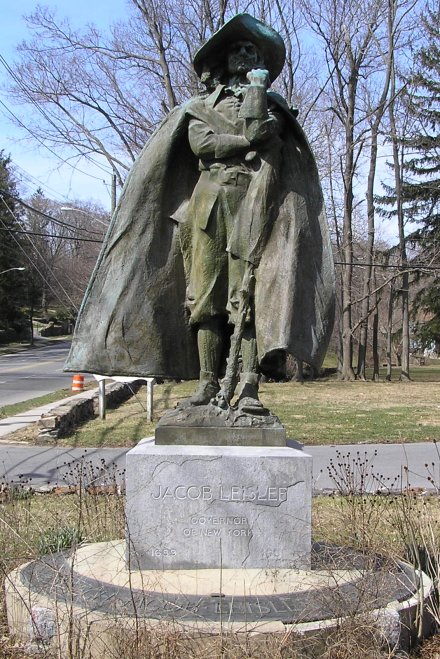

Statue of Jacob Leisler in New Rochelle, N.Y. — which Leisler helped create as a settlement for refugee Huguenots.

And once in the saddle, the Dutch Calvinist Leisler essentially ran a populist administration against the colonial oligarchy, which replied by vilifying him as a “usurper” and “rebel”.

Internal politics in New York and its neighbors during those months make fascinating reading.* Quakers and Catholics aligned against Protestants. Albany aligned against New York, until Leisler brought the former to heel. Clergy chose up sides. Leisler summoned a sort of proto-continental congress of colonial representatives (all the way to the West Indies) to hash out their situation.

And what was that situation? There had been a revolution, after all, and there was no agreed-upon representative of the royal authority present in New York. An assembly of militia leaders had asked Leisler to assume leadership, so was he really outside his rights to treat as his the London dispatches addressed to “such as, for the time being, take care for preserving the public peace and administering the law in New York”?

It’s a moment whose ferment of democratic energy can be read to presage the next century’s (proper) revolution.

Yet it was also not a revolution in the Cromwellian, world-turned-upside-down sense. For the English polity, and certainly for the conduct it preferred in its frontier possessions, continuity was the order of the day. Even in England herself, William and Mary were more than pleased to govern with Tories who could see their way to releasing their fealty to the Stuarts.

There was an empire to run, after all.

From that standpoint, Leisler’s anti-oligarchical policies and fractious disputes with other colonial elites were a bad business. There’s no sense in letting France make inroads because your governors are bickering over predestination or some such.

So formally, the realm’s new rulers continued all non-Catholic personnel in their posts. With the Dominion governors ejected, it was just a matter of dispatching fresh executives to take over. It’s just that this process required months … during which Leisler was managing New York the way he figured it ought to be managed, and his enemies were consequently painting him as a rebel.

Leisler pronounced himself, this whole time, anxious to submit his authority to the new governor upon the production of proper credentials. If he was surprised that the new monarchs tendered appointees of the very same factions recently expelled,** Leisler showed it only in his exactitude for procedure: because of a logistical cock-up, an aide to the new colonial governor arrived first, and when Leisler refused to hand over his fort without the royal warrant, a tense standoff ensued. It was resolved when the real governor, Henry Sloughter of ominous name, finally showed up.

Sloughter had his “predecessor” immediately arrested, along with others of his circle and harshly tried for treason and murder by a court stacked with anti-Leisler political enemies.†

Ultimately Leisler was condemned to die along with his secretary and son-in-law Jacob Milborne, but even Sloughter was loath to enforce the sentence. The story goes that Leisler’s most implacable foes had to get Sloughter drunk to put his signature on the death-warrant. (Sloughter died a couple of months later himself, for maximum operatic effect.)

On Saturday morning, May 16, 1691, the largest crowd ever gathered in New York City stood, rain soaked and weeping, all eyes fixed as a limp body was cut from the gallows and placed on the block. With a clean blow, the executioner’s ax cut off the head of the “halfe dead” Jacob Leisler — loyal lieutenant governor or rebel tyrant, depending on one’s point of view. Amid the “shrieks of the people,” fainting women (some “taken in labour”), and tumultuous jostling for “pieces of his garments” and strands of his hair, as “for a martyr,” the newly arrived and unfortunately named royal governor, Henry Sloughter, worried that his decision to execute Leisler might not, after all, end the “diseases and troubles of this Government.” Indeed, for years afterward New Yorkers bitterly divided over Leisler and the 1689 uprising that, in the wake of England’s Glorious Revolution, had led to his assumption of power in the provincial government.

-David Voorhees, who elsewhere contends that these divisions “continue to inform American politics to the present day.”*

A few years later, a more Leisler-friendly Parliament restored the dead man’s estate to his heirs, a sort of implicit admission that the whole head-chopping thing might have been a bit much.

This character figures to bear more historical consideration than he has heretofore enjoyed; further to that end, there’s a Jacob Leisler Papers Project devoted to marshaling at New York University the primary documents connected with Leisler.

* See, for instance, David Voorhees in “‘to assert our Right before it be quite lost’: The Leisler Rebellion in the Delaware River Valley” in Pennsylvania History, Winter 1997 — and, Voorhees again in “The ‘fervent Zeale’ of Jacob Leisler,” The William and Mary Quarterly, July 1994.

** Literally so: Francis Nicholson, whom Leisler ousted from New York, tried to get himself appointed governor; he was instead sent to Virginia and continued in royal service in the colonies for decades to come.

† e.g., Joseph Dudley, one of Leisler’s judges, whose penchant for authoritarian justice has been noted elsewhere in these pages.

On this day..

1976: Lt. Col. Bukar Dimka and six coup confederates

On this date in 1976, Nigeria executed the leading spirit of an abortive Nigerian coup was shot for the “abortive” part of that coup.

That February 13, Bukar Dimka had taken to the airwaves to announce the assassination of Nigeria’s incumbent military strongman, Murtala Mohammed.*

Good morning fellow Nigerians.

This is Lt. Colonel B. Dimka of the Nigerian Army calling. I bring you good tidings. Murtala Muhammed’s deficiency has been detected. His government is now overthrown by the young revolutionaries. All the 19 military governors have no powers over the states they now govern. The states affairs will be run by military brigade commanders until further notice.

Any acts of looting or raids will be death. Everyone should be calm. Please stay by your radio for further announcements. All borders, air and sea ports are closed until futher notice. Curfew is imposed from 6am to 6pm. Thank you. We are all together.

-From Romancing the Gun: The Press as Promoter of Military Rule

They were not all together.

Mohammed’s second-in-command, Olusegun Obasanjo, instantly quashed the putsch and served notice that assassinating the head of state would not be welcome on his watch.**

A large body of coup conspirators were publicly executed within a month; the Nigerian Defense Minister was among them.

Dimka himself managed to remain at large for most of that month, so he wasn’t among that crop. Instead, Obasanjo had the pleasure of announcing Dimka’s execution separately, along with that of

a former state governor, Joseph Gomwalk … “two of the principal actors” in the coup.

New York Times, May 16, 1976

The coup was thought to have aimed at restoring the guy Mohammed deposed, Yakubu Gowon, who was luckily in exile in England and therefore escaped a similarly grim fate.

Years later, he received an official pardon; Gowon is still alive, one of Nigeria’s elder political statesmen.

* When next in Lagos to transfer several million in oil wealth from a secret bank account, be sure to visit Mohammed’s bullet-ridden Mercedes.

** Obasanjo handed power to a democratic government in 1979; that government was itself later toppled by the military, but Obasanjo eventually served as Nigeria’s elected president from 1999 to 2007.

On this day..

1883: Joe Brady, the first of the Invincibles

“All patriots on earth must respect him (Joe Brady).”

John Boyle O’Reilly

On this date in 1883, Britain set about the grim work of avenging the assassination of its Irish plenipotentiaries by hanging Joe Brady at Kilmainham Gaol.

“He was brought up as a stonemason,” the May 15, 1883 London Times recalled of the by-then-hanged man, “of herculean strength, his occupation developing the muscular power of his arms, which told with such terrible effect when he drove the knives into the bodies of his victims.”

Those knife-driven bodies belonged to Irish civil servant Thomas Henry Burke (a quisling figure, in the eyes of Irish nationalists) and the English politician Lord Frederick Cavendish, who were jumped while taking a stroll in a Dublin park on May 6, 1882.

The authors of their destruction — beyond Joe Brady, personally — were the splinter of radical Fenians known as “the Invincibles”, who figured on the vincibility of the collaborators and informers who made British control of Ireland possible. Especially their vincibility to stonemason-wielded surgical knives.

Efficient, and surely less than genteel, police work busted up the cell after those spectacular homicides, inducing leadership figures to turn state’s evidence against their subordinates. Four more men consequently hanged in the month following Brady’s execution. The stool pigeons got to walk.

History did not delay her verdict on these characters.

While Invincible-turned-informer James Carey was promptly murdered in retaliation, Brady et al joined nationalist mythology as martyrs who “died a Fenian blade.”

Ballad of Joe Brady

I am a bold undaunted youth, Joe Brady is my name,
From the chapel of North Anne Street one Sunday as I came,
All to my surprise who should I espy but Moreno and Cockade;
Says one unto the other: “Here comes our Fenian blade”.

I did not know the reason why they ordered me to stand,
I did not know the reason why they gave me such a command.
But when I saw James Carey there, I knew I was betrayed.
I’ll face death before dishonour and die a Fenian blade.

They marched me up North Anne Street without the least delay,
The people passed me on the path, it filled them with dismay.
My sister cried, “I see you Joe, if old Mallon gives me lave,
Keep up your heart for Ireland like a true-born Fenian Blade.

It happened in the Phoenix Park all in the month of May,
Lord Cavendish and Burke came out for to see the polo play.
James Carey gave the signal and his handkerchief he waved,
Then he gave full information against our Fenian blades.

It was in Kilmainham Prison the Invincibles were hung.
Mrs Kelly she stood there all in mourning for her son.
She threw back her shawl and said to all:
“Though he fills a lime-pit grave,
My son was no informer and he died a Fenian blade.”

And if the Times‘ report (the same May 15 article) is to be believed (reporters weren’t actually allowed to witness the execution itself), Brady wore that invincible conviction to the scaffold.

“Up to the last moment,” the paper reported, “he retained the animal courage which he displayed in the deed itself, which, though dastardly as regards the unarmed men whom he attacked, was daring in its other circumstances.”

Speaking of animal courage.

Our man Brady, very famous in Ireland around the turn of the century, makes a little appearance in the referential soup of James Joyce’s Ulysses* for animal spirits of a different sort: a conversation about his hanging provides the departure point for a Joycean meander into the phenomenon of scaffold priapism.

–There’s one thing it hasn’t a deterrent effect on, says Alf.

–What’s that? says Joe.

–The poor bugger’s tool that’s being hanged, says Alf.

–That so? says Joe.

–God’s truth, says Alf. I heard that from the head warder that was in

Kilmainham when they hanged Joe Brady, the invincible. He told me when they cut him down after the drop it was standing up in their faces like a poker.

–Ruling passion strong in death, says Joe, as someone said.

–That can be explained by science, says Bloom. It’s only a natural phenomenon, don’t you see, because on account of the …

And then he starts with his jawbreakers about phenomenon and science and this phenomenon and the other phenomenon.

The distinguished scientist Herr Professor Luitpold Blumenduft tendered medical evidence to the effect that the instantaneous fracture of the cervical vertebrae and consequent scission of the spinal cord would, according to the best approved tradition of medical science, be calculated to inevitably produce in the human subject a violent ganglionic stimulus of the nerve centres of the genital apparatus, thereby causing the elastic pores of the CORPORA CAVERNOSA to rapidly dilate in such a way as to instantaneously facilitate the flow of blood to that part of the human anatomy known as the penis or male organ resulting in the phenomenon which has been denominated by the faculty a morbid upwards and outwards philoprogenitive erection IN ARTICULO MORTIS PER DIMINUTIONEM CAPITIS.

* As was Brady’s getaway driver James “Skin-the-Goat” Fitzharris, who became a national celebrity by serving a long prison sentence for refusing to inform on anyone.

On this day..

2005: Shanmugam Murugesu, for the chronic

On this date in 2005, Singapore hanged a 34-year-old for pot.

Shanmugam Murugesu, an ethnically Tamil Singaporean, was nabbed carrying a kilo of marijuana.

Your basic “wtf drug war” case study, this divorced father actually represented Singapore at international watersports competitions and otherwise led a productive, non-criminal life.

The city-state: a mite crazy over drugs. (And over the death penalty.) Mere mary jane is among the substances that can get you a death sentence there — carrying 500 grams or more is supposed to trigger automatic execution.

While awaiting that fate, Shanmugam befriended the young Australian drug mule and “simple soul” Van Tuong Nguyen, who was bound to follow in his footsteps; Shanmugam’s last appeal to his lawyer was “to save Nguyen Tuong Van’s life at all costs.”

(No luck, but it’s the thought that counts.)

Shanmugam Murugesu’s hanging was also notable as a civic event in Singapore for the landmark public protest (organized in large measure by the hanged man’s own family) it generated — a rarity for that “Disneyland with the death penalty”.

Public Forum on Death Penalty and Campaign for Shanmugam Murugesu from Jacob George on Vimeo.

On this day..

1730: James Dalton, Hogarth allusion

On this date in 1730, career criminal James Dalton was executed at Tyburn.

Detail view (click for full image) of James Dalton’s wig box depicted in the boudoir of prostitute Moll Hackabout in Hogarth’s A Harlot’s Progress.

Crime ran in the family for young master Dalton; his father hanged upon the information of notorious (and himself eventual gallows-bird) Jonathan Wild. According to the Ordinary of Newgate’s report, our day’s principal “went between his Father’s Legs in the Cart, to his fatal Exit at Tyburn.”*

Who knows but what naughty urchins (or parents) in the throng were deterred by that affecting spectacle. For the Daltons, it was more like Take Your Child to Work Day.

While the elder Dalton’s skills ran towards card-sharping, young master James went in for the more conventional varieties of larceny — both those practiced by stealth, and those practiced by force.

These pursuits saw him twice transported to America, for which we have to thank the English judiciary on account of Dalton’s resultant biography at Early American Crime.

(In)famous for his many dalliances, Dalton’s exploits could move copy in their day — and their author transgress the lines between the underworld and “legitimate” celebrity.

“In the height of all our Robberies” [Dalton] and his companions “used to go to the Playhouse, dressed like Gentlemen,” and that once, while watching The Beggar’s Opera, “Captain Macheath’s Fetters happening to be loose,” one of them “call’d out, Captain, Captain, your Bazzel is undone.” The real thieves, having shown up the actors with their superior knowledge of both irons and cant, then retired in style to an alehouse, “in four Chairs, with six Lights before each Chair.”**

Just another hanged thief.

Except, also not — because while his career in malefaction would undoubtedly have added up to a death sentence, his condemnation was secured upon the word of a perjurer upon a very doubtful charge.

A character named John Waller, an “affidavit man” whose profession was supplying bogus testimony to hang whomever could be hanged where a reward was available, insisted that Dalton had robbed him upon the roads. Dalton vigorously denied (and even rebutted with evidence) this charge even while admitting his general life of crime, but it was upon this dubious offense against Waller that he stretched his neck. Dalton died at Tyburn with three others, though a fifth member of their party, one Hugh Norton or Haughton, managed to cheat the executioner by hanging himself in his cell.†

It was the rough justice of the 18th century, a time frequently admitting opportunity to repay tit for tat.

In this case, the professional perjurer who hanged Dalton was two years later convicted himself after making a bogus accusation of highway robbery. Waller was condemned by the court to stand in the pillory at the Seven Dials — a dangerous punishment cousin to the era’s death penalty, inasmuch as the mob violence thereby invited not infrequently proved fatal.


John Waller bombarded with refuse in the pillory.

Waller had quite a reputation, but the fury of the crowd was nothing next to that of James Dalton’s brother, Edward — who, with a confederate, brazenly climbed onto the platform, wrenched the “assize man” out of his pillory, and savagely beat him to death.

* Cited in this impressive compendium of Dalton-related primary sources.

** Andrea McKenzie, “The Real Macheath: Social Satire, Appropriation, and Eighteenth-Century Criminal Biography,” Huntington Library Quarterly, Vol. 69, No. 4 (December 2006), with the quotes supplied by a 1730 publication called “The Life and Actions of James Dalton (the Noted Street-Robber)”

† Norton/Haughton was posthumously hanged in chains the next day.

On this day..

1744: Jan, of Johonnes Van Houten

From the Proceedings of the New Jersey Historical Society, only one small instance of the “terrible example” in store for the Garden State’s “large body of slaves to be kept in subjection.”

May 10, 1744 — The negro man “Jan,” of Johonnes Van Houten, was tried “for poysoning and attempting to do the same to several blacks at the township of Bergen; to wit, the negro man of Arent Toers, named Lowis, and has some time past poysoned two wenches of Garret Ross, of the same precinct, and attempted several more.” Convicted and sentenced to be hanged May 11, between 10 and 12, at Bergen; “at the suitablest place, where Peter Marselis and Michel Vreeland shall think proper.”


Was it the slave trade that capitalized the Van Houten cracker empire?

On this day..

1900: Three Algerians in Setif

On this date in 1900, three Algerian criminals called (in the next day’s dispatch in Le Petit Parisien) Bou-Mechada-Saïd-ben-Mohamed, Chabli-Lakdar-ben-Abdallah and Boulakras-Tahad-ben-Saad were guillotined for a murder committed just 11 days before in Setif, Algeria.

On this day..