1946: The treacherous Theodore Schurch

One day after William Joyce became the last Briton put to death for treason, 27-year-old Theodore Schurch hanged for treachery at London’s Pentonville Prison.

Like Joyce, Schurch had enrolled in the British Union of Fascists as a teenager in the 1930’s, and it was reputedly at the party’s direction that he joined the army as a driver.

During World War II, Schurch crossed and recrossed enemy lines, delivering operational intelligence to the Italians and Germans by helping to interrogate prisoners of war, or posing as a P.O.W. himself to gain the confidences of other captured Allied soldiers.

Scurch’s army buddies seemed to think he was alright, and there was probably more than a shred of truth to the defense’s contention, paraphrased by the London Times (September 18, 1945), that the lad

was a poor, uneducated fool who was caught young [by fascist ideology] when he knew no better and jockeyed into a position from which he could not recover.

But obviously, one makes this argument when one is in no position to contest factually the capital charges against oneself, and indeed has admitted much of it. Schurch was convicted on all nine counts of treachery, plus one of desertion. Not a big fish, maybe — but just the right size to become the last man hanged in Britain for a crime other than murder.

He’s actually listed as a war casualty, which in a way he was, on the Commonwealth War Graves Commission’s Brookwood Memorial outside of London.

On this day..

1946: William Joyce, Lord Haw-Haw

On this date in 1946, fascist William Joyce, famous by the nickname “Lord Haw-Haw” for his English-language Nazi propaganda broadcasts, was hanged at Wandsworth Prison for treason.

As a pugilistic young anti-Semite with the unusual credential of being a Unionist Irish Catholic, Joyce had been a moving spirit in the interwar British fascist party. (Since audio broadcasts would define Joyce’s life, it seems appropriate to refer the reader for a fuller biography to this recent Oxford biography podcast.)

But because time loves a good laugh, it had the guy haranguing his countrymen for insufficient patriotism marked out for the last treason execution in British history, and unrepentant about it by the time he got there.

The Brooklyn-born Joyce (he never lost his American citizenship) who naturalized as a German in 1940 had a rather tenuous claim on the patriotic high horse to begin with, and after the war, that meant the treason charge proceeded on legally doubtful grounds: speaking the King’s English didn’t mean he owed allegiance to the king. Prosecutors ultimately hung him with a British passport he’d obtained fraudulently, and the legal principle has never since sat well with jurists.

It was just the tool at hand. The British government really hated the guy.*

However limited the resources at his disposal — sparse intelligence, paltry staff, and of course, after 1942, a disastrously collapsing war effort — he had fashioned them into broadcast spin to twist the British lion’s tail in countless British homes throughout the war.

Here’s one episode, with Joyce savaging Winston Churchill, selected from archive.org’s library of Joyce broadcasts (1-7, 8-16, 17-23).

[audio:William_Joyce_Churchill.mp3]

Joyce’s star shone brightest and his invective cut deepest early in the war. Once everything at the front stopped coming up Teutons, he descended into irrelevance and self-parody, albeit without professing the slightest doubt in his fascist convictions.

This last broadcast, prepared just a few days before Germany capitulated, has our day’s principal ramblingly drunkenly from the besieged Nazi capital.

[audio:William_Joyce_final_broadcast.mp3]

Content-wise, not much had changed eight months later, but at least he managed to make his gallows statement coherently.

In death as in life, I defy the Jews who caused this last war, and I defy the power of darkness which they represent. I warn the British people against the crushing imperialism of the Soviet Union. May Britain be great once again and the hour of the greatest danger in the West may the standard be raised from the dust, crowned with the words — you have conquered nevertheless. I am proud to die for my ideals and I am sorry for the sons of Britain who have died without knowing why.

There’s a thorough, and lavishly illustrated, history of Joyce here.

* Authorities passed on prosecuting his wife Margaret, who’d also appeared on some Lord Haw-Haw broadcasts. Under the circumstances, Joyce’s daughter (by his first marriage) Heather Iandolo turned out pretty balanced.

On this day..

1994: Mansour Kikhia?

Fifteen years ago, a Libyan-born dissident of American nationality was abducted from a human rights conference in Cairo.

The fate or current whereabouts of Mansour Kikhia remain unknown to this day — although one widely-suspected scenario (and the conclusion of a CIA report on the incident) is that he was spirited to Libya and secretly executed early in 1994.

While other speculation has had Kikhia being held alive, the insulin-dependent diabetic would have been in a bad way absent the sort of painstaking medical attention he would not likely have been receiving from his captors.

The former Libyan foreign minister and United Nations ambassador, who had broken with dictator Muammar al-Gaddafi in 1980, was in Egypt to participate in an Arab Organization of Human Rights conference. The date he vanished from his hotel, last seen in the company of unknown Egyptian men driving vehicles with Mukhabarat markings, was December 10, 1993 — the 45th anniversary of the seminal modern human rights document, the Universal Declaration of Human Rights.

Several distinguished Middle Eastern scholars wrote an open letter shortly after Kikhia’s disappearance imploring

Arabs, Americans with an interest in the Arab world and human rights organizations not to rest until he regains his freedom. Nothing could be worse than to let the governments concerned think he will be forgotten.

If not “forgotten” in the strictest sense — see some links of the bulletins issued over the years to keep alive his memory — the governments concerned sure seem to have paid no price for having disappeared Mansour Kikhia.

On this day..

1892: Sylvester Henry Bell

The state of Vermont has long since dispensed with the death penalty; it hasn’t had a death penalty law on the books since 1964, and its last execution was a decade before that. (Source)

But back when the traps were dropping on Green Mountain State scaffolds, no consideration of sentiment (or holiday pay) barred hanging a man on New Year’s Day, as occurred in 1892.

You could call Sylvester Bell a ladykiller.

According to family genealogists familiar with the case, the Canadian-born farmer used two of his wife’s relatives as character witnesses in his naturalization proceedings … and eight months later, shot said wife, the mother of his five children. Not only did Sylvester win acquittal for this non-fatal attack, Marcia Farnsworth Bell actually had to fight to get a divorce on the grounds of “intolerable severity”.

Marcia and her unmarried children moved to Randolph, Vt., where the kids opened a major department store.

Nothing daunted, a then-54-year-old Sylvester remarried the decades-younger Emma Lock (or Locke) in 1887.


‘Til death do us part: Sylvester and Emma’s marriage certificate.

We may imagine an ensuing union not altogether free of discord,* as we rejoin the public record of their lives with the Jan. 2, 1890 Burlington Clipper.

It appears that Mrs. Bell had left her husband and applied for a divorce. Thursday she, in company with Deputy Sheriff Hall, went to the house to remove her things. Bell met them very pleasantly and permitted her to pick up her goods. As she was about ready to leave she went up stairs and he followed her. Soon afterward a pistol shot was heard and Officer Hall rushed up, and Bell met him at the door of the room into which Mrs. Bell had gone and handed him the pistol, saying, “Take this. I have done the deed.” The ball entered the head of the unfortunate woman, just back of the ear, and she lived about thirty minutes, unconscious.

Bell was put under arrest and for a time the excitement, and sympathy was so strong for the murdered woman that it looked as if Bell would be lynched, but the law will now be allowed to take its course.

The article understatedly observed, “Bell’s reputation with his wives is bad.”

The course of the law will not hold much suspense for readers of this blog.

The novelty of the eventual New Year’s execution attracted the New York Times which (botching the hanged man’s name and the date of his crime) reported the scene from the scaffold, where “Stephen” Bell bought himself an extra 34 minutes in this vale of tears with the verbosity of his last statement.

WINDSOR, Vt., Jan. 1. — Stephen H. Bell was hanged here this afternoon for the murder of his wife, in the town of Fairfax, Dec. 26, 1880. At 1:40 the door of the west wing of the prison was closed and at 1:44 the prisoner was taken from his cell, where he was holding an earnest conversation with Chaplain Wassall.

The prisoner was somewhat pale from long confinement. He boldly ascended the steps and, although assisted, appeared to be nerved up for the occasion. Chaplain Wassall offered a fervent prayer, during which Bell bowed and covered his face with his hand. Sheriff Lovell, as soon as the Chaplain had finished, stepped forward and said: “Stephen H. Bell, have you anything to say why the penalty of the law should not be executed on you?”

Bell, rather pale and tremulous, stood erect, and after addressing the Sheriff and officers in charge, asking for all the time he wanted in which to speak, began a talk which lasted thirty-four minutes. It was a rambling statement, in which he declared his innocence. When he had finished, Bell stepped back to his chair.

Sheriff Lovell took him by the arm, and the condemned man stood up bravely. When Deputies How and Randall had pinioned his wrists, arms, and legs Bell stepped on the drop and said: “Gentlemen, I am a dying man; good-bye.” Instantly the Sheriff touched the spring and the drop fell. In fourteen minutes he was pronounced dead. The body was buried in Windsor Cemetery.

Interestingly, Bell was the only person executed in his state during a 22-year period from 1883 to 1905. That span is bookended in Vermont’s death penalty annals by the first woman hanged in Vermont and the last woman hanged in Vermont.

Bell’s descendants continue to seek information on Sylvester; anyone who may know more can get in contact via this author.

* Another report of the murder describes Emma fleeing to live with her parents on account of Sylvester’s repeatedly menacing her with a butcher knife and a gun, until the “overseer of the poor, after a time succeeded in getting them together again, he giving up his pistol and agreeing to behave himself.” Clearly, it was a different time for domestic violence victims.

On this day..

1900: En Hai, the murderer of von Ketteler

On the last day of the 19th century, a Chinese officer was beheaded on the public street where he had precipitated western* military intervention in the Boxer Rebellion by killing a German diplomat.

Foreign commercial penetration — and domination — was generating domestic turmoil in China. As liberal reforms foundered in the late 1890’s, a more radical anti-foreigner movement blending spiritualism and martial arts launched the Boxer Rebellion (or Yihetuan Qiyi, in the local coinage).

In addition to massacring hated missionaries, the Boxers besieged foreign diplomatic missions in Peking … and veteran German ambassador Klemens von Ketteler was killed in a firefight on a crowded street. (The particular circumstances of the killing seem highly confused, and were immediately colored by the various interested parties’ axe-grinding; it’s sometimes called an “assassination,” but there’s no proof von Ketteler was specifically targeted, and the ambassador himself managed to get a shot off in the fray.)

Given the financial interests at stake, it would be far too much to say that von Ketteler’s death caused the military intervention that ensued, but it certainly catalyzed the conflict. The next day, China’s Dowager Empress declared war against the Eight-Nation Alliance. Within two months, Peking (Beijing) was under foreign occupation.

The man detained as von Ketteler’s murderer — En Hai, or Enhai, or Su-Hai — was proud to claim the act himself, and intimations of the Chinese government’s official blessing for anti-foreigner activities were carefully massaged since the Eight-Nation powers would have need of the Qing dynasty to keep order locally.


On the afternoon of this day in 1900, En Hai was brought out from German custody to the street where von Ketteler had met his end and handed over to the Chinese for beheading. Notice the substantial foreign attendance in both the photograph and the drawing. A German officer’s diary entry cited in The Origins of the Boxer War: A Multinational Study recounted the scene.

Ketteler’s murderer was executed at last — for months past the unfortunate wretch has been begging for his execution. It took place in one of the busiest thoroughfares but there were only a few curious onlookers. Scarcely fifty yards away the usual business was being quietly transacted in the streets, people who were eating did not suffer themselves to be interrupted, and a teller of fairy-tales who was recounting his absurd stories had interested his numerous audience much more than the execution.

And to see that the lesson would not be lost on future generations of Chinese, the humiliating peace imposed upon China that December (and formally signed the following year) required China to expiate its guilt by

erect[ing] on the spot of the assassination of his Excellency the late Baron von Ketteler, commemorative monument worthy of the rank of the deceased, and bearing an inscription in the Latin, German, and Chinese languages which shall express the regrets of His Majesty the Emperor of China for the murder committed

Having been made an offer it couldn’t refuse, China honored the intersection (German link) where both the victim and his killer had died in their turns with a massive pailou archway, inscribed

This monument has been erected by order of His Majesty the Emperor of China for the Imperial German Minister Baron von Ketteler, who fell on this spot by heinous murder on the 20th of June, 1900, in everlasting commemoration of his name, as an eternal token of the Emperor’s wrath about this crime, as a warning to all.


A historical postcard of Ketteler monument.

“Everlasting commemoration,” in this case, lasted 15 years.

The national aspirations that had fired the Boxers reared up again in 1911-12 to topple the Qing. Days after Germany’s surrender in World War I, the Chinese Republic began removing the von Ketteler monument.

Visitors will need to look sharp to catch it now, in Zhongshan Park (aka Sun Yat-Sen Park or Central Park), where it has been rededicated to abstractions that age a little better than our German civil servant.

But this was still not quite the last the name von Ketteler was heard in the consular world. A relative (German link) of the man slain in Peking was a conservative diplomat of the Weimar and early Nazi period who opposed the national socialist government. Wilhelm Emmanuel von Ketteler was abducted by the Gestapo in 1938 and murdered thereafter in unclear circumstances, possibly for involvement in a very early plot to kill Hitler.

* “Western” in this case includes Japan, the regional industrial power that also flanked the Russian Empire to the east — very much a player on the European balance-of-power chessboard. Germany (obviously), France, Italy, Russia, the U.K., and the U.S.A. were the other nations involved in the intervention, along with the Austro-Hungarian Empire, whose naval deployment to China included future Sound of Music character Georg Ritter von Trapp.

A fair amount of detail on China’s foreign relations during this period is available free in the (dry, and sometimes dated) public-domain 1918 work The International Relations of the Chinese Empire.

On this day..

1896: Dr. Jose Rizal, father of the independent Philippines

December 30 is Rizal Day (Araw ng Kabayanihan ni Dr. Jose Rizal in Tagalog) in the Philippines, for the execution that date in 1896 of the great martyr of Philippine independence.

Also available free at gutenberg.org (the HTML version is very well-illustrated).

At Jose Rizal’s birth in 1861, it had been 340 years since Magellan had reached (and died at) the Philippines under the Spanish flag.

In Rizal’s century of romantic nationalism, independence movements stirred abroad in the Spanish Empire … too weak yet in the Philippines and elsewhere during the mid-1800s, but unmistakably prefiguring those national destinies that this day’s victim would come to embody.

Oddly, Jose Rizal was not even the most “revolutionary” of his farming family’s 11 children. That distinction went to older brother Paciano, who was under an official cloud before Jose hit adolescence for his relationship with the Gomburza priests, and would later serve as a brigadier general in the revolutionary army of Emilio Aguinaldo.

Jose was less strident — and more brilliant.

Though reputedly an adept fencer and crack shot with a pistol, the renaissance man’s gifts ran more to the life of the mind.

At the Universidad Central de Madrid, the University of Paris, and the University of Heidelberg, Jose Rizal studied ophthalmology and anthropology, and pursued the variegated artistic interests of his youth.

His two novels published from Europe, Noli Me Tangere and El Filibusterismo*, both criticized colonial authorities and their Vatican adjutants and struck nationalist chords that put him on the Spanish government’s watch list.

“I die without seeing the dawn brighten over my native land! You, who have it to see, welcome it — and forget not those who have fallen during the night!” -From Noli Me Tangere

Rizal also penned essays and editorials in a less symbolic vein, like this one skewering the stereotype of the lazy native by turning the mirror upon colonial agents who were waiting to prey on the fruit of native labor:

How is it strange, then, that discouragement may have been infused into the spirit of the inhabitants of the Philippines, when … they did not know whether they would see sprout the seed they were planting, whether their field was going to be their grave or their crop would go to feed their executioner? What is there strange in it, when we see the pious but impotent friars of that time trying to free their poor parishioners from the tyranny of the encomenderos by advising them to stop work in the mines, to abandon their commerce, to break up their looms, pointing out to them heaven for their whole hope, preparing them for death as their only consolation?

Man works for an object. Remove the object and you reduce him to inaction The most active man in the world will fold his arms from the instant he understands that it is madness to bestir himself, that this work will be the cause of his trouble, that for him it will be the cause of vexations at home and of the pirate’s greed abroad. It seems that these thoughts have never entered the minds of those who cry out against the indolence of the Filipinos.

(This essay and both novels are available in the original Spanish and in English at gutenberg.org, along with various translations of Rizal’s various fiction and non-fiction work.)

Fire-eating stuff in the eyes of the Spanish crown, but Rizal wasn’t the bomb-throwing type himself.

As the Philippine Revolution that would break the Spanish yoke on the islands took shape in the summer of 1896, Rizal applied to go to Spanish Cuba to treat victims of the yellow fever, and even explicitly disavowed the revolution.

Countrymen: I have given proofs, as well as the best of you, of desiring liberty for our country, and I continue to desire it. But I place as a premise the education of the people, so that by means of instruction and work they may have a personality of their own and that they may make themselves worthy of that same liberty. In my writings I have recommended the study of the civic virtues, without which there can be no redemption. I have also written (and my words have been repeated) that reforms, to be fruitful, must come from _above_, that those which spring from _below_ are uncertain and insecure movements. Imbued with these ideas, I cannot do less than condemn, and I do condemn, this absurd, savage rebellion, planned behind my back, which dishonors the Filipinos and discredits those who can speak for us. I abominate all criminal actions and refuse any kind of participation in them, pitying with all my heart the dupes who have allowed themselves to be deceived. Go back, then, to your homes, and may God forgive those who have acted in bad faith.

This stance on the revolution — the fact that he thought and wrote but never struck a blow — has engendered some controversy over the rightfulness of Rizal’s place in the national pantheon, as has his anti-clericalism and a disputed Vatican claim that Rizal retracted his criticisms of the Church before his death. One Spanish contemporary called Rizal “the Tagalog Hamlet.”

But mostly he is seen as the Spanish government at the time saw him, and as many revolutionaries did as well: as the lodestar of the Philippines’ national aspirations.

Rizal was arrested en route to his humanitarian assignment in Cuba and returned to Manila to face trial for sedition, rebellion and conspiracy, by which point, of course, the verdict was quite preordained. He was shot in the back by a firing squad, uttering the Christ-like last words “consummatum est” — “it is finished.”

Rizal’s execution, and the events preceding it, are depicted in this long excerpt of a 1998 film:


Jose Rizal’s execution.


Near the spot Rizal was actually executed, his martyrdom depicted in statuary.

There are any number of Jose Rizal tribute sites online. JoseRizal.ph and JoseRizal.info are two good places to delve deeper.

* A filibuster is a private military expedition, and more typically associated with Anglo American campaigns against the Spanish-speaking lands to the south, like those of William Walker.

On this day..

1903: Emily Swann and John Gallagher, the Wombwell murderers

On this date in 1903, a 42-year-old mother of 11 was hanged side by side with her 30-year-old lover for murdering an abusive husband in the small South Yorkshire town of Wombwell.

That June, Emily Swann had shown her outgoing boarder and lover John Gallagher (together with some neighbors) the results of William Swann’s latest beating. John returned to the house and repaid the injuries in kind — and with interest.

After some minutes of fighting audible to the neighbors, Bill had been beaten to death.

Emily’s battered-wife situation might cut a lot more ice today, but by the jurisprudence of the day it was a fairly straightforward case, especially since all kinds of incriminating remarks were attributed by the neighbors to both Emily and John — “Give it to him, Johnnie, punch him to death,” for instance, and Gallagher’s own mid-bout respite at a neighbor’s house where he reported having broken four ribs with plans to break more. Both illustrated a level of intent among both parties beyond the heat of passion.

And you wouldn’t say the authorities were disposed to sympathize with Emily’s situation in general. They rather viewed her immorality — with John and otherwise — as the cause of the thrashings William gave her.

the wonder is that he has not killed her. He has frequently gone home after leaving work and found his wife drunk in the house and nothing prepared for him in the way of food. (case file comment, quoted here)

Fortified by a stiff drink of brandy, Emily Swann glided onto the platform at Leeds’ Armley Prison beside her already-trussed defender and delivered the somewhat famous greeting, “Good morning John.” Gallagher managed to return the salutation, and a few seconds before both were launched into eternity, she replied, “Good-bye. God bless you.”

It was an unusual exchange because the English execution protocol did not solicit remarks from the doomed prisoner, and in the occasional double hangings,* most participants were too frightened, awed or preoccupied to make small talk with their fellow-sufferers in the few seconds available.

* England would soon do away with double hangings altogether. Subsequent convicts to be hanged “together,” like Edith Thompson and Frederick Bywaters, were in fact executed simultaneously but at different prisons.

On this day..

1894: Chief Two Sticks, Ghost Dancer

On this date in 1894, Sioux Chief Cha Nopa Uhah (“Two Sticks”) was hanged in Deadwood, S.D., for instigating the murder of white ranchers on the Pine Ridge Reservation.

The story begins little more than two years after one of the most tragic and emblematic events in the white conquest of North America — Wounded Knee:

By early 1893, the “Ghost Dance” religious movement that had animated the Lakota people had not disappeared … nor had the futile dream of armed resistance to white domination.

A band under Chief Two Sticks, a leader described as resistant to settled white civilization and inclined towards retaining the traditional nomadic life, raided a white cattle ranch. The raid was not deadly, but its consequences were.

Indian police dispatched to arrest the raiders were killed in a shootout, after which the raiders again attacked the ranch — looking this time for men, not cattle. Four white cowboys were killed.

A number of additional Indians died when tribal authorities deployed in force to stop Two Sticks’ followers, perhaps narrowly averting much worse — as it’s a given that federal authorities would not have countenanced Two Sticks’ continued liberty.

The chief himself was severely wounded in the process, and only after a lengthy recovery was he well enough to stand trial in the white men’s courts in Deadwood.

His last words, according to an impressive HistoryNet retelling of Chief Two Sticks’ tale with a great deal of detail about his last hours (including an attempted suicide, so that he could die by Indian hands), denied responsibility for the violence.

My heart is not bad. I did not kill the cowboys; the Indian boys [meaning White Faced Horse, Fights With, Two Two and First Eagle] killed them. I have killed many Indians, but never killed a white man; I never pulled a gun on a white man. The great father* and the men under him should talk to me and I would show them I am innocent. The white men are going to kill me for something I haven’t done. I am a great chief myself. I have always been a friend of the white man. The white men will find out sometime that I am innocent and then they will be sorry they killed me. The great father will be sorry, too, and he will be ashamed. My people will be ashamed, too. My heart is straight and I like everybody. God made all hearts the same. My heart is the same as the white man’s. If I had not been innocent I would not have come up here so good when they wanted me. They know I am innocent or they would not let me go around here. My heart knows I am not guilty and I am happy. I am not afraid to die. I was taught that if I raised my hands to God and told a lie that God would kill me that day. I never told a lie in my life.

The killing and execution are related (from the white settlers’ point of view) in The Black Hills trails : a history of the struggles of the pioneers in the winning of the Black Hills by Jesse Brown and A.M. Willard.

* Earlier that day, Two Sticks had received word that President (and former hangman) Grover Cleveland had denied him clemency.

On this day..

1979: Hafizullah Amin

On this date in 1979, the 104-day term of Afghan president Hafizullah Amin met a violent end as a Soviet-engineered coup raised the curtain on a war destined to bring misery to both Cold War combatants.

The Soviet Union’s ongoing intervention in Afghan politics had through the 1970’s steadily mired it deeper into an unstable political situation.

Now, it was running out of patience with the country’s president, Hafizullah Amin.
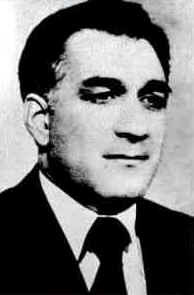
He’d got the best of rival Nur Mohammad Taraki in a power struggle that September, but to the political chaos and the blossoming Islamic insurgency roiling his country, Amin added a level of brutality that was all his own, and a streak of diplomatic independence that was distinctly unwelcome in Moscow.

Amin was a Communist himself, and both he and the predecessor he’d murdered had wanted ever-increasing Soviet aid to keep the country stable.

But that proved to be a Faustian bargain.

Though Kabul radio would announce that Amin had been tried and summarily executed for “crimes against the state,” the short-lived dictator’s fate had been decided two weeks before when the Soviet Politburo passed a secret resolution for his ouster — having lost whatever confidence it had once held in him as a dependable satellite governor.

“The Soviet Union,” said the New York Times in a more innocent time,

has seemed deeply troubled by the inability of either the Taraki or Amin governments to put down the rebellions in Afghanistan, which have been largely tribal but also militantly anti-Communist.

Amin survived a KGB poisoning, so the Red Army dispensed with subtlety by raiding the palace, plucking their preferred satrap out of exile in eastern Europe to take Amin’s place.

It would not see the last of Afghanistan until 10 years, 15,000 Soviet dead, and hundreds of thousands of Afghan casualties later.


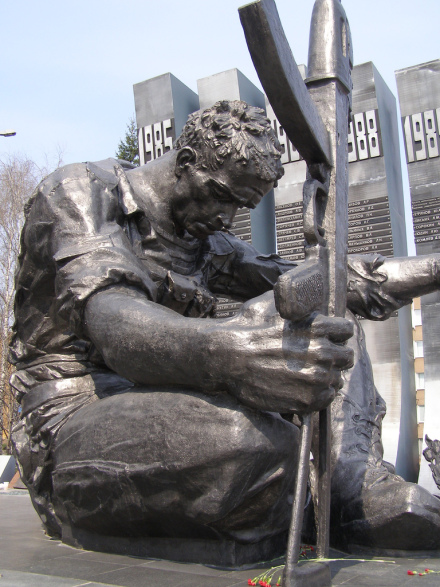
A memorial in Ekaterinburg, Russia, to the Soviet dead in the Afghan war. Image courtesy of beatdrifter (Andy Holmes).

On this day..

1862: Asa Lewis, Confederate deserter

On this date in 1862, a 19-year-old Confederate infantryman became the tragic victim at Murfreesboro, Tenn., of his army’s need to shore up military discipline.

Kentuckian Asa Lewis was shot for desertion, for having returned home after his enlistment expired in order to help his family plant the season’s crops.

“French leave”,* it’s sometimes called — an illicit but temporary and often unpunished absence from the unit.

According to Mark Weitz’s More Damning Than Slaughter: Desertion in the Confederate Army, it was a pervasive phenomenon — as were more permanent desertions which menaced the small Confederate army, fighting amid the soldiers’ own farms, whose languishing from the conscription of able-bodied men presented a constant temptation to depart.**

[The South’s] white population combined with its preferred form of agriculture to create a potential pool of men who could hardly be called disposable … To find the Southern soldier one must go down the food chain into that vast sea of men referred to as yeomen and poor whites. These men and their sons would form the backbone of the Southern army, an army of farmers, men whose lives were as governed by the seasons as the lives of their fathers and grandfathers before them. These men could not be spared in the same way as their Northern counterparts without affecting the quality of their families’ lives — and often those families’ very survival.

Under less urgent circumstances, Lewis would be the poster child for the guy who would sort of deserve to slide for the odd spell of French leave.

He’d fought with distinction, earning decorations and promotions, and his mother and sisters were reportedly starving without his help. He was only being kept in the army after his term of engagement by the 19th-century equivalent of a stop-loss policy.

But Lewis had the bad fortune to go AWOL — it seems he did intend to return — right when the urgency of the army-wide desertion situation was becoming apparent to Confederate brass … and while serving under the general who Weitz says took it most seriously.

Gen. Braxton Bragg had issued an amnesty earlier that fall to clear the decks, and then declared pitiless treatment of desertion going forward.

Bragg understood something that his superiors, peers, and colleagues did not: the Confederacy had an army of farmers … Bragg knew that these men were fighting at home, that they would [sic] were being drawn back there, and that he had to take immediate steps to close off the avenues of departure.

Bragg tightened the screws on soldiers who straggled on the march (a common strategy to slink away), on grunts seeking medical furloughs (already establishing themselves as a halfway house towards a discharge), and on Confederate prisoners obtained by exchange for Union POWs (who were no longer paroled back home, but kept with the army).

Asa Lewis was hardly the only man shot under the policy. But construing mere French leave as capitally punishable “desertion” gave the general a chance to put the fear of a Confederate firing squad into other potential stragglers and malingerers — and the Kentuckian campaign to obtain clemency for the poor kid probably only helped Bragg’s purpose.

The next day’s Rebel Banner (cited in this free Google books offering) ran this item:

[A]midst a drenching rain-storm, Asa Lewis, member of Captain Page’s company, Sixth Kentucky regiment, was shot by a file of men. He was executed upon a charge of desertion, which was fully proven against him. The scene was one of great impressiveness and solemnity. The several regiments of Hanson’s brigade were drawn up in a hollow square, while Generals Breckinridge and Hanson, with their staffs, were present to witness the execution. The prisoner was conveyed from jail to the brigade drill-ground on an open wagon, under the escort of a file of ten men, commanded by Major Morse and Lieut. George B. Brumley. Lewis’s hands were tied behind him, a few words were said to him by Generals Brekinridge and Hanson, and word fire was given, and all was over. The unfortunate man conducted himself with great coolness and composure. He was said to have been a brave soldier, and distinguished himself at the battle of Shiloh.

Official journos may have been approving — Weitz says a contemporary newspaper report approvingly claimed that “when Bragg saw his army melting away from desertion he began shooting every man convicted by a court-martial, and that as a result his army had become ‘well disciplined'” — but less charitable interpretations of Bragg would hew more to the line that the man was simply being a petty, vindictive tyrant.

The aforementioned execution witness Breckinridge, for instance, was a Kentuckian himself and hated Bragg’s guts. (A week later, Bragg would waste 10,000 Confederate lives at the Battle of Stones River, and the rift became irreparable.)

* The French call it “English leave”.

** Other able-bodied farm laborers in the South, of course, were better inclined to back the Union.

On this day..