2006: Three old men and a taxi driver

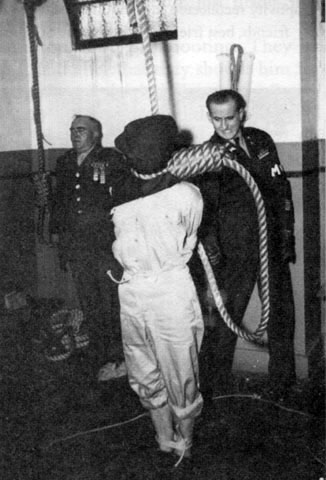
Two years ago today, Japan resumed executions after a break of more than a year with four hangings.

Septuagenarians Yoshio Fujinami (wheelchair-bound) and Yoshimitsu Akiyama (partially blind) both needed the guards’ assistance to reach the trap at Tokyo Detention Center, a mere hour after they were informed of their imminent demise.

Two other prisoners, 64-year-old Michio Fukuoka and 44-year-old Hiroaki Hidaka, were simultaneously hanged in Osaka and Hiroshima, respectively.

Hidaka, a serial killer, had dropped his appeals and thus died a mere 12 years after his crimes. Fukouka died maintaining his innocence of three murders from 1978-81 he said police torture had forced him to confess. The oldest men were on the hook for killings dating to 1975 and 1981. (Much more from The Japan Times.)

Talk about justice delayed.

In Japan’s strange death penalty system, the condemned might await death for decades only to be hanged, as these were, with next to no warning. Their families and supporters did not hear about it until after the deed was done.

These hangings, though protested, were not altogether unexpected, for a break in the Japanese Diet around the end of the year often heralds an appearance on the public stage by the gallows. (Look for them in 2008 as the Diet goes out of session starting today.) And a turnover at the top of the Justice Ministry had replaced a pol disinclined to authorize any hangings, the source of the long break between executions during a decade when Japan’s use of the death penalty has generally been intensifying.

Although at least one particularly pressing motivation for this date’s hanging will not be present this year. After the long hiatus, an anonymous official told a newspaper,

We absolutely wanted to avoid ending the year with zero executions.

But in 2008, Japan has already carried out more hangings than in any year since 1975.


A panel from former prison guard Toshio Sakamato’s “How the death penalty is carried out”. More here.

On this day..

1705: John “Half-Hanged” Smith Half-Hanged

Because we executioners are not bereft of sentiment, it is with glad season’s tidings that we remember the veritable rebirth on Christmas Eve of housebreaker John Smith, who was cut down from the Tyburn tree this day in 1705 and revived.

“Though the crimes committed by this man were not marked with particular atrocity, nor his life sufficiently remarkable for a place in these volumes, yet the circumstances attending his fate at the place of execution are perhaps more singular than any we may have to record,” begins the Newgate Calendar, and one can all but see our Marlow setting light to his tobacco as he makes ready to unspool a particularly satisfying yarn.

After John Smith dangled 15 minutes this day at Tyburn, the crowd at his hanging began calling for a reprieve. One gets the impression our narrator may be eliding in a sentence quite an unruly affair; that “the malefactor was cut down” we may well guess, but after a mere 15 minutes? Did the crowd overpower the sentries, or were the officers of the law simply in a Christmas spirit?

There is, too, allusion to his friends’ working to obtain clemency and failing. Family and supporters of the accused intervened at Tyburn in all sorts of meddlesome ways, when they could — pulling the condemned prisoner’s legs to shorten his suffering, or holding his legs up to give him a chance at survival; fighting with anatomists for possession of the corpse, and obviously agitating for mercy at the slightest opportunity. Was it these friends who instigated the crowd’s appeal?

Whether or not Smith’s luck was as dumb as William Duell‘s, they did cut him down, and did revive him “in consequence of bleeding and other proper applications.”

So, what’s it like to be hanged?

When he had perfectly recovered his senses he was asked what were his feelings at the time of execution; to which he repeatedly replied, in substance, as follows. When he was turned off, he for some time was sensible of very great pain, occasioned by the weight of his body, and felt his spirits in a strange commotion, violently pressing upwards. That having forced their way to his head, he as it were saw a great blaze, or glaring light, which seemed to go out at his eyes with a flash, and then he lost all sense of pain. That after he was cut down, and began to come to himself, the blood and spirits, forcing themselves into their former channels, put him, by a sort of pricking or shooting, to such intolerable pain that he could have wished those hanged who had cut him down.

All this violent commotion of the spirit was enough to score a pardon, but not quite equal to the task of reforming the man now known as “Half-Hanged Smith”.

Our narrator relates that he went twice more to the Old Bailey in some danger of his neck, escaping once on a technicality and then again upon the uncommonly timely death of the prosecutor.

Nothing more is henceforth heard of the man, and it is unknown whether he decided to stop tempting fate, or whether officers of the law were in no further mood to tempt the hand of a Providence evidently determined to protect him, or whether some still more mysterious purpose thereafter summoned him away from the worldly cares of the justices.


And laying his finger aside of his nose,
And giving a nod, up the chimney he rose;
He sprang to his sleigh, to his team gave a whistle,
And away they all flew like the down of a thistle.
But I heard him exclaim, ere he drove out of sight,
“Happy Christmas to all, and to all a good-night.”

Update: Courtesy of Anthony Vaver’s captivating Early American Crime, it looks like Smith was eventually sentenced to penal transportation to the Virginia colony.

On this day..

1948: Hideki Tojo and six other Japanese war criminals

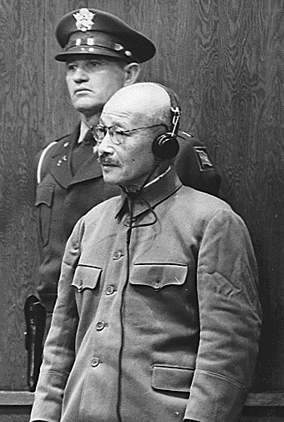
On this date in 1948, seven “Class A” war criminals, including Japan’s wartime Prime Minister Hideki Tojo, were hanged at Sugamo Prison by the American occupation authorities.

Like other Axis heads of state, Tojo was in for a bad end: he shot himself in the chest before American troops could arrest him, but missed his heart even though a doctor had helpfully marked the spot on his chest for him.


Fail.

However inevitable Tojo’s postwar fate, however, he was not exactly of a kind with the likes of Hitler and Mussolini. Indeed, he’d been cashiered from his Prime Ministerial gig in 1944 by the real power behind the throne — the Japanese military.

Unlike the “Fuhrer” and “Il Duce,” Tojo was a reflector, not a creator, of national thought. His word was not law. It was not his command or dictate. He was one among many and not even the first among equals. He was a militarist — misguided, naive, and narrow in outlook; he regarded war as a legitimate instrument of national policy; he apparently believed what he told the court, and failed to recognize the patent contradictions between his contentions and the facts. This had been his undoing.

That’s Robert Butow in Tojo and the Coming of War. Butow argues that the titular authority in Japan (he became Prime Minister shortly before the bombing of Pearl Harbor), a dedicated, patriotic officer of adequate talents but limited vision, came much too late and controlled much too little to be seen as the equal of the European theater’s villains.

The Japan of which General Hideki Tojo became premier was operated by remote control. It was a country in which puppet politics had reached a high state of development, to the detriment of the national welfare. The ranking members of the military services were the robots of their subordinates — the so-called chuken shoko, the nucleus group, which was active “at the center” and which was composed largely of field-grade officers. They, in turn, were influenced by younger elements within the services at large and by ultranationalists outside military ranks. The civilian members of the cabinet were the robots of the military — especially of the nucleus group, working through the service ministers and the chiefs of the army and navy general staffs. The Emperor himself, through no fault of his own, was the robot of the government — of the cabinet and the supreme command, a prisoner of the circumstances into which he was born … Finally, the nation — the one hundred million dedicated souls, the sum and substance of Japan, from whom the blood and toil and tears and sweat of Churchill’s phrase were wrung — the nation was the robot of the throne.

He was the man for his time and place. He fit right in.

Even when being fitted for a noose.

Once Tojo had recovered from his errant self-inflicted wound,* and even though he had been among those opposing surrender even after the atomic bombings, he played ball with the International Military Tribunal for the Far East (whose trial transcripts run to 50,000 pages).

The former premier embraced responsibility, diligently shielding the Emperor from any intimation of guilt (some argue this was the procedure’s entire raison d’etre, from the perspective of both the prosecution and the defense), and walked a dignified and honorable last mile in the courtrooms of the victor’s justice, presenting his perspective as he knew it in the context of a wish for peace between the late antagonists.

1. I deny that Japan “declared war on civilization.”

2. To advocate a New Order was to seek freedom and respect for peoples without prejudice, and to seek a stable basis for the existence all peoples, equally, and free of threats. Thus, it was to seek true civilization and true justice for all the peoples of the world, and to view this as the destruction of personal freedom and respect is to be assailed by the hatred and emotion of war, and to make hasty judgments.

3. I would like to point out their [my accusers’] inhumane and uncivilized actions in East Asia ever since the Middle Ages.

4. In the shadow of the prosperity of Europe and America, the colored peoples of East Asia and Africa have been sacrificed and forced into a state of semi-colonization. I would point out that the cultural advance of these people has been suppressed in the past and continues to be suppressed in the present by policies designed to keep them in ignorance.

5. I would point out that Japan’s proposal at the Versailles Peace Conference on the principle of racial equality was rejected by delegates such as those from Britain and the United States.

6. Of two through five above, which is civilization? Which is international justice? Justice has nothing to do with victor nations and vanquished nations, but must be a moral standard that all the world’s peoples can agree to. To seek this and to achieve it — that is true civilization.

7. In order to understand this, all nations must hate war, forsake emotion, reflect upon their pasts, and think calmly.

The “Class A” convicts not executed along with Tojo were freed afterwards.

Tojo has enjoyed a bit of a latter-day resurgence in the public regard, product of the nationalist right’s resurgence in Japan. The hanged man’s granddaughter Yuko Tojo has waged a tireless campaign to clear him.

Further to that end, his ashes — and those of the other Class A convicts — were covertly added to the controversial Yasukuni Shrine, and remain there to this day. That public tribute to principals of Japan’s bloody foreign occupations has become a hot political football between Japan and other nations, especially China.

But after all, Tojo the man was never a leper, but part and parcel of his times. Small wonder that we moderns hear an echo of the general’s postwar justification for the War in the Pacific from the country that hanged him.

Japan … faced considerable military threats as well.

Japan attempted to circumvent these dangerous circumstances by diplomatic negotiation, and though Japan heaped concession upon concession, in the hope of finding a solution through mutual compromise, there was no progress because the United States would not retreat from its original position. …

Since events had progressed as they had, it became clear that to continue in this manner was to lead the nation to disaster. With options thus foreclosed, in order to protect and defend the nation and clear the obstacles that stood in its path, a decisive appeal to arms was made.

The problematic nature of the war crimes proceedings in postwar Japan (especially vis-a-vis those in Germany) is examined in Yuma Totani’s The Tokyo War Crimes Trial: The Pursuit of Justice in the Wake of World War II. The author discussed her research on the New Books In History podcast.

[audio:http://newbooksinhistory.com/podpress_trac/web/720/0/Totani%20Interview.mp3]

* According to John Dower’s Embracing Defeat, the suicide scenario angered some nationalists because Tojo only “belatedly summoned the will to die,” and “chose the foreigner’s way of the bullet rather than the samurai’s way of the sword, and then botched even this.”

On this day..

2003: Liu Yong, for corruption

On this date in 2003, Liu Yong’s situation took a very abrupt turn for the worse.

The wealthy Communist Party member and Shenyang city legislator had been sentenced to death 20 months before in a corruption case for ordering the murder of a tobacco vendor as part of a mafioso racket of graft, extortion, black marketeering, and kindred mayhem.

When that sentence was reduced on retrial on a showing that Liu’s confession was extracted by torture, public outcry at the appearance of a well-connected insider getting off scot-free led the Supreme Court to take the unprecedented step of yet again re-trying a criminal case itself.

“According to China’s legal system, a criminal case can usually be tried only twice,” as China Daily lightly put it.

Amnesty International is less measured, and alleges that the irregular Supreme Court hearing was ordered by political insiders to buttress the credibility of the country’s anti-corruption drive — and to avoid setting any precedent that evidence of torture should mitigate criminal sentencing. (China certainly found defenders for the trial (the link is to an ugly layout of raw HTML).)

The high court handed down its sentence this very day, after which Liu was immediately hailed to one of China’s mobile execution vans, given a lethal injection, and cremated.

On this day..

1855: The slave Celia, who had no right to resist

(Thanks to Caitlin at Vast Public Indifference for the guest post -ed.)

In 1850, 60-year-old Robert Newsom, a prosperous farmer, traveled forty miles from his home in Callaway County, Missouri to neighboring Audrain County to buy a slave. Newsom was the head of a large and complex household that included several of his grown children, grandchildren, and five enslaved boys and men. His wife had died a few years earlier, a consideration that may have influenced his decision to purchase a female slave, a fourteen-year-old girl named Celia.

From the first day, Newsom treated Celia as his concubine. Testimony given before the Missouri Supreme Court in 1855 indicates that Newsom raped Celia for the first time on the journey home from the slave market. He installed her in a small cabin behind his house, where he continued to rape her on a regular basis over the next five years. During that time, she gave birth to two children.

In the spring of 1855, Celia began a relationship with George, another slave on the farm, and soon discovered that she was pregnant again. At George’s urging, Celia approached Newsom’s daughters and pled with them to protect her from their father during her pregnancy. The oldest daughter, Mary, later testified that Celia had threatened to hurt Newsom if he came to her cabin again, but there is no evidence that either she or her sister intervened.

On the night of June 23, 1855, Robert Newsom went to Celia’s cabin, no doubt intent on raping her yet again. He never returned to his own home.

Although Celia was never allowed to testify in her own defense, investigators reconstructed the events of the night through a combination of physical evidence and Celia’s confession. Fearful of Newsom, Celia had hidden a hefty stick in a corner of her cabin. When Newsom attacked her that night, Celia retrieved her weapon and beat him to death with it. She then dismembered the body and burned it to ashes in her fireplace. The next morning, Celia offered Newsom’s eleven-year-old grandson two dozen walnuts in exchange for his help cleaning out the fireplace and spreading the ashes in the yard.

The jury that convicted Celia of murder accepted her confession as fact, but some elements of her tale do not ring true. As Melton McLaurin observes in his book, Celia, A Slave, the task of cutting enough wood and tending the roaring fire necessary to consume a human corpse in a single night “would have taxed the strength of a healthy woman, and Celia was pregnant and sick” (McLaurin, 49). McLaurin implies that George either helped Celia or was primarily responsible for Newsom’s demise and that Celia may have lied to protect him. George disappeared shortly after the murder and was never arrested or charged.

Celia stood trial for Newsom’s murder in October of 1855 (State of Missouri v. Celia, a Slave). Her lawyer, John Jameson, argued that Celia was legally entitled to defend herself from a would-be rapist under an 1845 law that made any attempt “to take any woman unlawfully against her will and by force, menace or duress, compel her to be defiled” a felony. He requested that the jury be instructed that

The words “any woman” in the first clause of the 29th section, of second article of laws of Missouri for 1845, concerning crimes & punishments, embrace slave women, as well as free white women.

The judge, William Augustus Hall, refused to honor the defense’s motion. Instead, he instructed the jury that a slave had no right to resist her master, even in the case of sexual assault. The jury found Celia guilty and sentenced her to death. (Celia’s child was delivered stillborn in prison.) The Missouri Supreme Court denied her appeal, and she was hanged on December 21, 1855.

Celia’s story is currently part of the interactive Slavery and the Making of America exhibit at PBS.org.

For more information, please see the following books:

McLaurin, Melton A. Celia, a Slave: A True Story. (University of Georgia Press, 1991). Google Books preview

Gordon-Reed, Annette, ed. Race on Trial: Law and Justice in American History. (Oxford University Press, 2002). Google Books preview.

On this day..

1786: Hannah Ocuish, age 12

(Thanks to Caitlin at Vast Public Indifference for the guest post -ed.)

On December 20, 1786, the Sheriff of New London, Conn., led a distraught 12-year-old girl to the gallows, placed a rope around her neck, and hanged her in front of a crowd of spectators. The girl was Hannah Ocuish, a young member of the Pequot nation. She was charged with the murder of six-year-old Eunice Bolles, a white girl with whom Hannah had quarreled the previous summer.

While it is difficult to get a clear picture of Hannah’s life from the available sources, it is clear that hers was not a comfortable existence. An appendix to Rev. Henry Channing’s execution sermon notes that Hannah’s mother was “an abandoned creature, much addicted to the vice of drunkenness,” who sent Hannah to work as a servant in a white family’s home. At the age of six, Hannah was accused of beating a white child while trying to steal her necklace. The anonymous author describes Hannah’s character thus:

Her conduct, as appeared in evidence before the honorable Superior Court was marked with almost every thing bad. Theft and lying were her common vices. To these were added a maliciousness of disposition which made the children in the neighborhood much afraid of her. She had a degree of artful cunning and sagacity beyond many of her years.

This description, expressed in terms designed to emphasize the importance of training children in obedience, may or may not be accurate. Regardless, all evidence suggests that Hannah was alone in a hostile world.

On July 21, 1786, someone found Eunice Bolles’ body at the side of the road outside Norwich, Conn. The corpse displayed signs of extreme trauma: “the head and body were mangled in a shocking manner, the back and one arm broken, and a number of heavy stones placed on the body, arms and legs.” Investigators questioned Hannah, who initially denied any involvement, but mentioned that she had seen a group of boys on the road earlier. The town officials did not believe her. On July 22, “she was closely questioned, but repeatedly denied that she was guilty.” Still unconvinced, the investigators “carried [Hannah] to the house where the body lay, and being charged with the crime, burst into tears and confessed that she killed her, saying if she could be forgiven she would never do so again.”

Hannah’s confession, which was accepted as truth by the court, indicated that she had sought revenge on Eunice because the younger girl had “complained of her in strawberry time … for taking away her strawberries.” When Hannah saw Eunice walking to school alone, she beat and choked her, covering the body with rocks “to make people think that the wall fell upon her and killed her.”

Rev. Henry Channing, a talented local minister, visited Hannah in prison many times, urging her to repent so that her soul might be spared. On the day of her execution, he delivered a thundering sermon entitled, God Admonishing His People of Their Duty as Parents and Masters, which held Hannah up as an example of what could happen if parents did not raise their children to be “dutiful and obedient.”

Her crimes, he argued, were the “natural consequences of too great parental indulgence,” and warned that “appetites and passions unrestrained in childhood become furious in youth; and ensure dishonour, disease and an untimely death.” In the portion of the sermon directed at Hannah herself, Channing did his best to scare her into repentance:

HANNAH! — prisoner at the bar– agreeably to the laws of the land you have arraigned, tried and convicted of the crime of murder … The good and safety of society requires, that no one, of such a malignant character, shall be suffered to live, and the punishment of death is but the just demerit of your crime: and the sparing you on account of your age, would, as the law says, be of dangerous consequence to the publick, by holding up an idea, that children might commit such atrocious crimes with impunity … And you must consider that after death you must undergo another trial, infinitely more solemn and awful than what you have here passed through, before that God against whom you offended; at whose bar the deceased child will appear as a swift witness against you — And you will be condemned and consigned to an everlasting punishment, unless you now obtain a pardon, by confessing and sincerely repenting of your sins, and applying to his sovereign grace, through the merits of his Son, Jesus Christ, for mercy, who is able and willing to save the greatest offenders, who repent and believe in him.

At her trial in October, Hannah “appeared entirely unconcerned,” but as the date of her execution approached, she began to show fear. In early December, visitors began to ask her how long she had to live, and Hannah “would tell the Number of her Days with manifest Agitation.” On December 19th, she “appeared in great Distress . . . and continued in Tears most of the Day, and until her Execution.” Witnesses to her execution reported that Hannah “seemed greatly afraid when at the Gallows.” With her last words, she “thanked the Sheriff for his kindness, and launched into the eternal World.”

In the United States, the youngest children put to death by the government have all be children of color. James Arcene, a Cherokee boy, was only 10 or 11 years old when he was hanged for committed a robbery and murder that resulted in his 1885 hanging in Arkansas.* At 12, Hannah Ocuish was the youngest female offender executed by any state. In the 20th century, the youngest children executed were both African-American: 13-year-old Fortune Ferguson of Florida (1927) and 14-year-old George Stinney of South Carolina (1944).

In 2005, the United States Supreme Court abolished the death penalty for criminals who committed their crimes as juveniles (Roper v. Simmons). The court split 5-4, with Jutices Scalia, O’Connor, Thomas, and Chief Justice Rehnquist dissenting. In his dissent, Justice Scalia excoriated the majority for considering international consensus (along with the laws of 30 of the 50 U.S. states) on the cruelty of executing children under the age of 18 when determining the standard for “cruel and unusual.” Justice Scalia, an avowed proponent of Constitutional originalism, proclaimed, “I do not believe that the meaning of our Eighth Amendment, any more than the meaning of other provisions of our Constitution, should be determined by the subjective views of five Members of this Court and like-minded foreigners.”

* This post originally asserted that Arcene was a juvenile when hanged. In fact, he was (or claimed to have been) 10 years old or so at the time he committed the crime, but was not tried and hanged until over a decade later. (This is corrected in the Arcene post.) -ed.

On this day..

1922: Seven Republican guerrillas in the Curragh of Kildare

(Thanks to author and historian James Durney for the guest post, an excerpt from On the One Road: Political Unrest in Kildare 1913-1994. -ed.)

Seven men were executed in the Glasshouse, in the Curragh Camp on December 19 in the biggest official executions of the Civil War. They were Patrick Bagnall and Patrick Mangan, Fairgreen, Kildare; Joseph Johnston, Station Road, Kildare; Bryan Moore and Patrick Nolan, Rathbride, Kildare; Stephen White, Abbey St. Kildare and James O’ Connor, Bansha, Co. Tipperary. These seven men, along with Comdt. Thomas Behan were found in a dug-out at Mooresbridge, on the edge of the Curragh, on the night of December 13. They were under the command of Comdt. Bryan Moore, 38, a veteran IRA officer, and comprised a section of the 6th Battn. Column. They were armed with rifles bought from a soldier stationed in Naas Barracks.

A detachment of troops from the Curragh searching a farmhouse at Mooresbridge, about one-and-a-half miles from the Curragh Camp, “found the proprietress in possession of a fully loaded Webley revolver.” A subsequent search disclosed a dug-out underneath a floor. The dug-out was surrounded by National soldiers who called on the men to come out. Eight men were in the dug-out, which was also found to contain 10 rifles, a quantity of ammunition, one exploder, a roll of cable and food supplies. When they surrendered Tom Behan was struck with a rifle butt and had his arm broken. When the captives were ordered into the back of a truck Tom Behan could not climb aboard because of his broken arm. He was struck again on the head with a rifle butt and died at the scene. Behan was a veteran IRA man and at the time of his death was Intelligence Officer, 1st Eastern Division. The Free State authorities claimed that Behan was shot while trying to escape through a window in the Glasshouse (so called because of its roof), issuing a statement saying: “One of the party of men arrested when trying to make his escape from the hut in which he was detained at the Curragh, ignoring the warning of the sentry to desist, was fired on and fatally wounded.” Mick Sheehan was in the Glasshouse at the time and thought it highly unusual that an experienced volunteer like Tom Behan would try to escape through such a small window. It was only years later that he found out the truth. The Glasshouse was a small stone and brick military prison up the hill where the military usually housed their own prisoners. It consisted of two floors enclosed within a twelve foot high walled enclosure with cells for 64 prisoners. During the Civil War, and after, it was used as a punishment block for Republican prisoners.

The remaining seven men were executed by firing squad on the morning of December 19. The following official report was issued from Army Headquarters, GHQ, on that evening: “Stephen White, Abbey Street, Kildare, labourer; Joseph Johnson, Station Road, Kildare, railway worker; Patrick Mangan, Fair Green, Kildare, railway worker; Patrick Nolan, Rathbride, Kildare, railway worker; Brian Moore, Rathbride, Kildare, labourer; James O’Connor, Bansha, Tipperary, railway worker; Patrick Bagnel, Fair Green, Kildare, labourer who with others, were arrested at Rathbride, Co. Kildare, on the 13th inst., were charged before a Military Committee with being in possession, without proper authority, of – 10 rifles, 200 rounds of ammunition therefor, 4 bomb detonators, 1 exploder.

“They were found guilty and sentenced to death. The sentence was duly executed this morning, 19th inst., at 8.30 a.m.”

This stone at Grey Abbey commemorates the seven IRA men. Image courtesy of Mario Corrigan.

They were all veteran IRA men and belonged to a column of ten which operated against railways, goods trains and some shops in the vicinity of Kildare. Five of them were on the derailment of engines at Cherryville on December 11 when they made a serious attempt to dislocate the whole railway service on the Great Southern and Western Railway Line. Two engines were taken out of a shed at Kildare and sent down the line by Cherryville. One engine ran out of steam and did no harm, while the other overturned and blocked the line for a considerable time. The column was also responsible for an ambush on National troops at the Curragh Siding on November 23 when a large party of troops were returning to Dublin after escorting prisoners to the Curragh Internment Camp. On their return journey the troops were fired on at the Curragh Siding and two were wounded. In the confusion a policeman was accidentally shot by a National soldier. Father Donnelly, chaplain to the troops, administered to the seven volunteers before their executions. They were shot one by one and were buried in the yard adjacent to the Glasshouse.

The last letters from the seven men were printed in the Republican paper Eire. /The Irish/ /Nation/. James O’Connor of Bansha wrote to his mother: “I am going to Eternal Glory tomorrow morning with six other true-hearted Irishmen.” Patrick Mangan wrote to his mother: “I am to be shot in the morning. I fought for Ireland and am sorry I could not do more… I have made my peace with God and was never so happy as tonight.”

On March 31 1923 Eire (The Irish Nation) printed the last poignant letters from Bryan Moore, Patrick Bagnell and Paddy Nolan under the title ‘Last letters of “executed” soldiers of the IRA.’*

Letter of Bryan Moore to his Brother.

Hare Park Prison, 18-12-22.

Dear Pat, – I am about to die for the Cause of Ireland as many did before. Pray for me and get the children to pray for me. I’ve just had the priest and will see him again in the morning at 6.30 and receive Holy Communion. He says we are to be envied the deaths we are about to meet, as we shall go straight to Heaven.

Do all you can for Father and Mother. Tell Mary and Kathleen to say a prayer for me every night,

Bryan.

Letter of Bryan Moore to Mother and Father.

Hare Park Prison, 18-12-22.

Dear Mother and Father, – I am about to be executed in the morning and I wish to bid you good-bye, and to ask you to pray for me and the rest of the boys.

I had the priest this evening and will see him again to night. I am resigned to die. God comfort you both.

Tell Johnny to pray for me. – Your loving Son.

Bryan.

Letter of Bryan Moore.

Hare Park Prison, 18-12-22.

Dear Johnny, – Good-bye, and be good to Father and Mother. Pray for me. – Bryan.

P.S. – You can do a man’s part by looking after Father and Mother. Tell them not to worry for me, as I am better off. God bless you.

Dear Annie, – Good-bye. God bless you. Pray for me.

Bryan.

Letter of Patrick Bagnall to his Uncle.

Hare Park Prison, 18-12-22.

Dear Jimmy, – I hope you and Willie are well. Tell all the boys and girls I was asking for them. I am writing to my sister and father. I am to be shot in the morning, 19th December, at 8.15. Mind Mary and do what you can for her. I know this will nearly kill her. We had a priest who heard our confessions. We are all here, seven of us – Johnston, Mangan, White, Moore, Nolan, Connor, and I. We are all to go “West” together, so don’t forget to pray for us. I know you and Willie will be sorry, but it is all for the best, and I hope it sets old Ireland free. We are not afraid to die.

Tell them all in Kildare I was asking for them. Don’t forget Harry Moore. We are dying happy anyway. So good-bye old Kildare, good-bye Jimmy and God bless you. I will meet you in Heaven. Tell Tom Byrne I was asking for him. – Your loving nephew, Paddy Bagnall.

The priest’s name and address is Father_____, Curragh Camp, a very nice man: you can write him if you want to. He said we will die like men anyway.

Letter of Paddy Nolan to his Father and Mother.

Curragh Camp Prison, 18-12-22.

Dear father and Mother, – I am writing my last few lines to you. I am to be executed to-morrow morning, and I hope you will bear it with the courage of an Irish Father and Mother. I am proud to die for the Cause I loved and honoured, and for which I give up my young life.

Six more of my comrades are to be executed. We have all been to confession and Holy Communion. Father ______ told us we would go straight to Heaven, so do not worry.

Dearest Mother, there are a few pounds in my suitcase, you can have them, or anything else in the house belonging to me.

Loving Father and Mother , good-bye for ever, – Your fond and faithful Son.

Paddy.

Father _____, Curragh Camp, sends his sympathies and prayers.

Letter of Paddy Nolan to his Elder Brothers and Sisters.

Curragh Camp Prison, 18-12-22.

My Dear Brothers and Sisters.

Now that I’m about to part from this world, I ask you for one favour – be kind and good to Father and Mother, and never dishonour the Cause for which I die – a Free and Independent Ireland. I bear no ill will to any person. Fond Sisters and Brothers, pray for me. Good-bye forever.

Paddy.

Letter to his Young Brothers and Sisters.

My Dear little ones, – I, your fond brother about to pass out of this world, ask you loving little ones to offer up your innocent prayers for me and my comrades on Christmas morning. Be good children, and always obey your parents and do everything in your power to make them happy. God bless you little ones. Good-bye for ever. – Paddy.

The executions caused a lot of bitterness locally. Both Mick Sheehan’s uncles, who had taken the pro-Treaty side, left the National Army. One, Capt. Patrick Kelly, who had served in the Republican Police, resigned his commission and went to the Civic Guards.

* The last letter of 18-year-old Stephen White, which seems not to have been printed at the time, can be read on this history of the day’s executions. -ed.

On this day..

1878: John Kehoe, king and last of the Molly Maguires

On this date in 1878, John “Black Jack” Kehoe was hanged in Pottsville — as Pennsylvania’s anthracite trusts took a victory lap around the corpses of the Molly Maguires.

Even to say what the Mollies were is to take a side in their life-and-death struggle. Irish immigrants fleeing the potato famine had poured into Pennsylvania’s coal mining country in the mid-19th century, where life in the mines was nasty, brutish and short, and the pay wasn’t anything to write home about either.

In a time when capital ruthlessly hunted any intimation of labor organizing and the Irish were a distinctly second-class people, the (apparent, or at least alleged) response of the Mollies was natural: form a secret society, and wring by threat of bodily harm the concessions it could not pursue by collective bargaining. For the recent Irish transplants, the tableau of a Catholic underclass working for a Protestant landlord who owned (and gouged on) everything in sight had a certain familiar feel.

Terrorists? They certainly used violence to achieve political objectives, at least if the testimony of their foes is credited. But they weren’t the only ones.

Mine owners turned public and private violence on Irish radicals pushing for things like the eight-hour day. The notorious strike-breaking Pinkerton Detective Agency was detailed to infiltrate the Mollies.

The main blow against the Mollies was struck over a period of (extrajudicial) vigilante justice in the mid-1870’s, culminating in “Pennsylvania’s Day of the Rope” in 1877, when ten supposed members were (judicially) hanged around the Keystone State.

Kehoe, a power broker in mining country with some sway at the capital who was reputed to call the shots among the Maguires, faced the hangman singly a year later for an 1862 cold-case murder so doubtfully ascribed to Kehoe that the governor hesitated to sign the death warrant.

He signed it just the same, marking a sort of ceremonial “end to Molly-ism.” The New York Times exulted two days hence “that the widely-extended and long-continued tyranny and terror of this association is at an end,” and all because the resolute executive had gone and sent a hempen message to “the savage and benighted population of the coal region.”

The lesson taught by the punishment of the Molly Maguires would have been shorn of much of its terror and impressiveness if the energetic and persistent efforts made in behalf of KEHOE, the reputed king of that organization, had resulted in rescuing him from the gallows. If they had even so far succeeded as to have caused his punishment to be commuted to imprisonment for life, the admonitory influence of his fate upon the murderous clain of whom he was the last surviving chief would have been greatly lessened, and the snake of Molly Maguire-ism, of which he was the forked tongue and fangs, might haply have been only scotched, not killed. … The law has shown that it has subtlety enough to hunt [the Molly Maguires] through every possible labyrinth of refuge and strip from them every artifice of disguise, and power enough to wring them out of the desperate grasp of sympathizing constituencies and crush them.

Florid.

Like we said, violence wasn’t the exclusive resort of one side. But the monopoly of violence … that was held, as always, by the same hands that held the monopolies. Sean Connery as Kehoe reflects on the uneven contest while awaiting his fate in a (fictional) exchange with the Pinkerton mole who condemned him from the 1970 film The Molly Maguires.*

Pennsylvania Gov. John Hartranft left office a few weeks later, and reflected in his outgoing address on the lessons “the manufacturers and operators” ought to draw from the late unpleasantness.

The Mollie Maguire murders, like the agrarian murders in Ireland, and the trades-union outrages, arsons, and machine-breakings in England, were not the work of the so-called criminal classes. They were essentially class murders … If some of the leading spirits of the class had been members of a board of arbitration as representatives of labor, with some of the employers or their agents as representatives of capital, it is not unreasonable to suppose that most of the disagreements that have kept the coal regions in a state of turmoil might have been amicably adjusted, and many of those who were assassinated and of those who have been hanged living to-day.

101 years later, Kehoe received what was thought to be the first and only posthumous pardon in the state’s history. The Mollies’ true extent, purpose and actual actions — even their very existence as anything but a stalking-horse for the more thorough conquest of surplus labor — remain hotly debated to this day, since the public record of this tight-lipped society consists of little beyond the courtroom testimony of a handful of parties thoroughly prejudiced to hostility by class interest or payoffs.

* Written by Walter Bernstein, who had only recently emerged from the Hollywood blacklist for his Communist proclivities.

On this day..

1182: Maria of Antioch

On an uncertain date thought to be around the end of 1182, the mother of the Byzantine emperor was strangled to death in Constantinople on her adolescent son’s authority.

In signing his mother’s death warrant, 13-year-old Alexios II signed his own … and that of his dynasty.

The progeny of a nearby Crusader principality, Maria of Antioch was dynastically married to Alexios’ dad, Manuel I.

Two realms separated by a common religion, Orthodox Byzantium’s relationship with western Crusaders was fraught at best, and it was about to get a lot testier. Maria’s Latin heritage went over like a lead balloon in the Greek empire.

When her husband died in 1180, the widow was left in a tenuous position as the unpopular regent of a child-emperor in a political snakepit.

In short order, Andronikos I Komnenos, after a lifetime of scheming, got his mitts on the throne two years after he’d been obliged to grovel in chains before Maria’s husband to be allowed a peacable retirement.

Some retirement.

Byzantine historian Niketas Choniates narrates Andronikos’s ruthless divide-and-conquer path to the purple.

Having thus slaughtered those whom he had been most eager to seize, Andronikos bided his time to assail others; some he delivered over to prison, some he condemned to banishment, and some he utterly destroyed in various ways. Those few who remained were anxious to go along with the majority and to reverse their former course. They changed their minds like the unstable planets and offered their necks to Andronikos to be tread underfoot, revolving around him as their axis, and so Andronikos hastened to bring about the ruin of the empress. After leveling several accusations against her, he finally charged her with treason and convened a court sympathetic to his cause with judges certain to condemn, not try, the wretched woman. The empress, who had attempted to enlist the help of her sister’s husband, Bela [III], the king of Hungary, writing him letters and tempting him with grand promises to ravage the lands around Branicevo and Belgrade, was led away to a cramped dungeon near the Monastery of Saint Diomedes. There she was grossly reviled by the guards as the butt of their jokes, and, pining with hunger and thirst, she was haunted by a vision of the executioner standing on her right where his edge would cut most surely. Andronikos’s ferocity did not abate even a whit. In the words of David, he perceived trouble and wrath and hastened to deliver her over to death, annoyed by the fact that she was still numbered among the living. Ere long he again assembled the justices who mete out injustice and whose right hand is the right hand of iniquity. He inquired as to what punishment the laws decree for traitors of cities and provinces, receiving in hand a written judgment sentencing such criminals to death, his assault against the empress went unchecked. When these lawless men raised their voices and shouted aloud as they cast their votes that this ill-starred woman must depart this life, a decree condemning her to death was immediately signed by her son, the emperor, written as though with a drop of his mother’s blood.

Elected to carry out this loathsome and unholy deed were Andronikos’s firstborn son Manuel and the sebastos George, the brother of Andronikos’s wife. Both men recoiled from their selection in disgust and contemned the emperor’s decree, declaring that they had not concurred earlier in the empress’s execution and that their hands would remain guiltless of such defilement; now, even more so, they could not endure to see her innocent body broken. This unexpected reply struck Andronikos like a thunderbolt. He continually twisted the hairs of his beard around his fingers, his eyes were filled with fire, and, shaking his head up and down, he repeatedly pitied himself and was greatly troubled that he did not have friends who delighted in blood and were eager to commit murder at the nod of his head. Holding his rage in check, like a hot-blooded horse champing at the bit or like smoke wrapping itself around a flame, he quenched his unremitting anger and postponed the execution. A few days later he condemned the ill-starred empress to a wretched death by strangulation. The sentence was carried out under the supervision of Constantine Tripsychos, who held the office of hetairarch, and the eunuch Pterygeonites … And she, who was the sweet light and a vision of beauty unto men, was buried in obscurity in the sand of the nearby shore (O Sun, who didst look down upon this defilement, and Thou, O Word of God, who art without beginning, how inscrutable is thy forbearance!). The bloodthirsty soul of Andronikos exulted at this, for with the extermination of Manuel’s family, with the imperial garden laid waste, he would reign as sole monarch over the Roman empire and hold sway with impunity.

The next year, Andronikos dispensed with the charade and had the young Alexios strangled, too.

A much worse fate awaited Andronikos himself not long after, with still less able successors to follow him … sending the Byzantine Empire into a calamitous tailspin that would see Constantinople sacked by those antagonistic western Crusaders within a generation.

Update: Maria’s German Wikipedia page pegs her execution date at August 27, 1182, citing Detlev Schwennike, Europäische Stammtafeln Band II, Tafel 177, Verlag Stargardt, Marburg, 1984.

On this day..

1943: Elfriede Scholz, Erich Maria Remarque’s sister

On this date in 1943, pacifist novelist Erich Maria Remarque lost his youngest sister to the Nazi regime — beheaded because her “brother is beyond our reach.”

Actually, Elfriede Scholz was convicted (upon the denunciation of her landlady a few weeks before) by the kangaroo People’s Court for undermining the war effort. (“Wehrkraftzersetzung” — German has a word for everything.)

Like her brother, Elfriede was a staunch opponent of the Nazi government, and in 1943 that could certainly have sufficed to get her a one-way trip to Plotzensee Prison.

But Roland Freisler‘s verdict explicitly referenced (German link) her more famous brother — upon whom the Nazis would have poured out an interwar era’s worth of fury had they been able to get to him in America.

Ihr Bruder ist uns entwischt, aber Sie werden uns nicht entwischen! (Your brother is beyond our reach, but you will not escape us!

Though Erich Maria Remarque and Adolf Hitler had served together at the Third Battle of Ypres, they didn’t quite see eye to eye after the Great War.

Remarque’s immortal anti-war novel All Quiet on the Western Front was banned and burned by war-glorifying Nazis (they also said Remarque was of Jewish descent, apparently without any factual basis).

Erna, Elfriede and Erich Remark — the author later restored an ancestral spelling of his name that had been Germanized in the 19th century — in happier times.

Remarque left Germany, an intellectual celebrity and man-about-town who rubbed shoulders with the likes of Marlene Dietrich (with whom he had a passionate affair) and Ernest Hemingway (with whom he did not).

The Nazis stripped his citizenship, and fumed that they couldn’t get their jackboots on him. (At one point, Goebbels invited Remarque to return. Sly.)

But Elfriede, they could get. She had stayed in her native Germany with her husband and family.

Not content with taking her head off, Berlin added a particularly vicious twist by billing the expatriate author 90 marks for the executioner’s trouble.

The author never said or wrote much about Elfriede, even his diaries. But years later, Erich Remarque dedicated his novel about life in a concentration camp, Spark of Life, to his late sister. Today, there’s a street named for Elfriede in the Remarques’ native Osnabruck.

More about Remarque at the German (but the site is multilingual) Erich Maria Remarque-Friedenszentrum and this online exhibit from New York University.

Better still, here’s the 1930 film version of All Quiet on the Western Front — that year’s Academy Award winner as Best Picture.

On this day..