1610: Francois Ravaillac, because Paris was worth more than a mass

On this date in 1610, the fanatical Catholic who assassinated Henri IV of France was ripped apart on the Place de Greve.

The road to this man’s calvary begins long before his infamous crime, even long before the birth of his illustrious victim.

The Protestant Reformation — so richly represented in the executioner’s annals — had fractured France in the 16th century.

After decades of voluptuously indecisive Catholic-versus-Hugeunot slaughter, matters had finally been settled by the man upon whom French absolutism would erect its (ill-fated) edifice.

Henri IV, the first Bourbon monarch and a Huguenot, had unified the country by the sword, capped by his memorably politic conversion to Catholicism in 1593 to win over the holdout capital of Paris — the occasion of his understated declaration that “Paris is worth a mass”.

Let us tarry here to appreciate “the good king Henri” in a kaleidoscope of flattering artwork to the tune of Vive Henri IV, the monarchy’s unofficial anthem after its subject’s passing:

Did you catch that last image?

Henri’s fine gesture of sectarian triangulation and the reign of relative calm it inaugurated were naturally resented by godly partisans of both camps who either considered his conversion a betrayal or considered the king a closet Protestant.
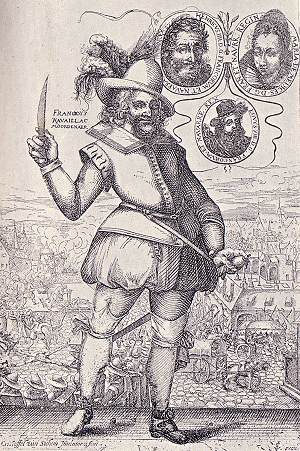
At the crazed end of this latter spectrum, we meet our day’s principal, Francois Ravaillac.

Readers unconstrained by time may enjoy this Tolstoyan trek into the regicide’s mind and milieu, but it will suffice us to say that the modern shotgun-wielding postal clerk who just seemed like a quiet, harmless type to all his coworkers might like the cut of Ravaillac’s jib. A bit of a loner, a bit of a professional washout, with a penchant for religious visions and a passel of ill-arranged grievances … by this point in the movie, that’s about what you expect the police profiler to be reciting.*

It is only right that such a contemporary-sounding lone nut story ought to have a vigorous conspiratorial counternarrative.

There has always been a strong suspicion that behind Ravaillac’s hand was the work of the scheming Catholic Duc d’Epernon, perhaps even with the complicity of Henri’s wife Marie de’ Medici, who had conveniently been crowned as queen the day before the murder** and promptly teamed up with Epernon to cement an alliance with a traditional French rival, the ultra-Catholic Habsburgs.

Balzac, for one, had no doubt about it:

all of [her] actions were prejudicial to France … Marie de’ Medici wasted the wealth amassed by Henri IV.; she never purged herself of the charge of having known of the king’s assassination; her ‘intimate’ was d’Epernon, who did not ward off Ravaillac’s blow, and who was proved to have known the murderer personally for a long time. … [T]he victory Richelieu at last won over her (on the Day of the Dupes) was due solely to the discovery the cardinal made, and imparted to Louis XIII, of secret documents relating to the death of Henri IV.

The historical jury is out on that question, presumably for good.

If Ravaillac was a conspirator, he proved to be a damned good one, denying under repeated torture that he had any accomplices. On this date, the tortures reached their crescendo and conclusion — to the horrible delight of the Parisian mob, as reported by Alistair Horne (via The Corner):

On 27 May, still protesting that he had acted as a free agent on a divinely inspired mission, Ravaillac was put to death. Before being drawn and quartered, the lot of the regicide, on the Place de Grève scaffold he was scalded with burning sulphur, molten lead and boiling oil and resin, his flesh then torn by pincers. Then his arms and legs were attached to horses which pulled in opposite directions. One of the horses “foundered,” so a zealous chevalier offered his mount; “the animal was full of vigour and pulled away a thigh.” After an hour and a half of this horrendous cruelty, Ravaillac died, as the mob tried to prevent him receiving last rites. When he finally expired,

“…the entire populace, no matter what their rank, hurled themselves on the body with their swords, knives, sticks or anything else to hand and began beating, hacking and tearing at it. They snatched the limbs from the executioner, savagely chopping them up and dragging the pieces through the streets.”

Children made a bonfire and flung remains of Ravaillac’s body on it. According to one witness, Nicholas Pasquier, one woman actually ate some of the flesh. The executioner, supposed to have the body of the regicide reduced to ashes to complete the ritual demanded by the law, could find nothing but his shirt.

Ravaillac was the last Frenchman drawn and quartered for a century and a half — but his punishment as a regicide formed the precedent for that handed down in 1757 to Damiens.

* No need, though, as Francois wasn’t hard to catch: he stepped up to Henri’s carriage when it was caught in a traffic jam on May 14, 1610, and stabbed the king to death plain as can be. He was lucky (sort of) to avoid a lynching.

** Rubens later painted a gaudy celebration of this event.

On this day..

1923: Albert Leo Schlageter, Nazi martyr

On this date in 1923, a German paramilitary was shot by a French firing squad near Dusseldorf for his anti-occupation sabotage efforts.

Albert Leo Schlageter, a World War I veteran and conservative Catholic who signed up with the right-wing Freikorps and tangled with communists after the war, joined the fledging Nazi party when it absorbed his Freikorps unit in 1922.

The next year, France occupied the Ruhr to secure war reparations payments then crippling Germany, which would do much to speed the rise of the Nazis in the years ahead.

Schlageter was nabbed sabotaging railroad lines in resistance, and Berlin’s protests didn’t help him much.

He became a Nazi martyr literally overnight, and as the nationalist right ascended, the place of his passion was marked with a 90-foot cross and used for party rallies. His name christened a naval vessel, a Luftwaffe fighter wing, two SA units, and several Nazi badges and decorations:

A 1923 NSDAP pin honoring Schlageter.

There was also a play about him, Schlageter, whose debut performance was for Hitler’s first birthday as Chancellor in 1933. The most famous work of Hanns Johst, it was notable for the line “Wenn ich ‘Kultur’ höre, entsichere ich meinen Browning!” — “When I hear the word ‘culture’, I reach for my gun!” — subsequently adopted by so many gun-reaching Nazi kulturkampfers that it is provenance is regularly misattributed.

Unsurprisingly, Schlageter’s cult has waned into obscurity since 1945. But one needs not endorse his philosophy or its horrifying posthumous expressions to appreciate the man’s struggle against foreign occupation and bravery in what he took to be the country’s interests.

For the Communist Karl Radek, this martyr of the right stood for many more whose sincere intentions had been bent against themselves — “those German Fascisti, who honestly thought to serve the German people.” Addressing the Communist International’s Executive Committee in the days after the officer’s execution, Radek anticipated Schlageter pointing the way to a future very different from that which came to pass:

Schlageter, a courageous soldier of the counter-revolution, deserves to be sincerely honoured by us, the soldiers of the revolution.

Schlageter went … to the Ruhr, not in the year 1923 but in the year 1920. Do you know what that meant? He took part in the attack of German capital upon the Ruhr workers; he fought in the ranks of the troops whose task it was to bring the miners of the Ruhr under the heel of the iron and coal kings. The troops of Waters, in whose ranks he fought, fired the same leaden bullets with which General Degoutte quelled the Ruhr workers. We have no reason to believe that it was from selfish motives that Schlageter helped to subdue the starving miners.

The way in which he risked his life speaks on his behalf, and proves that he was convinced he was serving the German people.

[The German Communist Party] believe[s] that the great majority of the nationalist-minded masses belong not to the camp of the capitalists but to the camp of the workers. We want to find, and we shall find, the path to these masses. We shall do all in our power to make men like Schlageter, who are prepared to go to their deaths for a common cause, not wanderers into the void, but wanderers into a better future for the whole of mankind; that they should not spill their hot, unselfish blood for the profit of the coal and iron barons, but in the cause of the great toiling German people, which is a member of the family of peoples fighting for their emancipation.

Schlageter himself cannot now hear this declaration, but we are convinced that there are hundreds of Schlageters who will hear it and understand it.

On this day..

1979: John Spenkelink, the harbinger

On this date in 1979, John Spenkelink was electrocuted in Florida — the first man executed involuntarily in the U.S. since 1967.

A series of court decisions in the 1970’s had scrapped the country’s old death penalty institutions and obliged legislators to restructure the process. Now, the new architecture was in place and the decade-long hiatus in actual executions was drawing to a close.

Gary Gilmore had earned trivia-question notoriety as the first put to death under the new regime two years before, but Gilmore was always an outlier, a bizarrely active exponent of his own death who greased the skids for himself.

Spenkelink was the true harbinger. For six years, a span which seemed long then but would today rate on the speedy side, Spenkelink resisted death with every tool at his disposal. Florida officials fought just as stubbornly to kill him.

An itinerant parolee, he had in 1973 shot a fellow drifter named Joseph J. Szymankiewicz.

Spenkelink claimed that Szymankiewicz had stolen his money, forced him to play Russian roulette, and sexually assaulted him, all of which seemed within the vicious character attested of the victim. But the killing itself was clearly not a moment of passion or immediate self-defense: Spenkelink had left their shared hotel room, returned with a gun, and shot his man in the back.

In the new Court-mandated balancing act between “aggravating” and “mitigating” factors whose intent was to harmonize unfair application of the death penalty, this evident premeditation is what doomed Spenkelink. (The fact that Spenkelink committed the crime for pecuniary gain — that is, to get back his own money — also militated against him. The Clark County (Ind.) Prosecutor’s site has some legal briefs in addition to media reports on the case.)

In the larger reality not circumscribed by legal briefs, the defendant wasn’t exactly Charles Manson. More considerable than the act itself was where it occurred (North Florida) and the rootless, friendless character of its author — a “white nigger”. As Florida Supreme Court Justice Richard Ervin put it:

As usual under “discretion,’ it is left to sentencing judges to determine in particular cases who will get death. We know intuitively who will: the poor, the underprivileged, the public defender clients, the blacks and other minority people, the mentally incompetent or those holding unpopular or unorthodox ideologies. The affluent usually escape the death penalty.

The result here is an old story, often repeated in this jurisdiction where the subconscious prejudices and local mores outweigh humane, civilized understanding when certain segments of the population are up for sentencing for murder.

Or in Spenkelink’s epigram, which he often signed to prison correspondence, “capital punishment means those without capital get the punishment.”

The last of his 22 appeals* was rejected by the Supreme Court this very day. Ten minutes later, trussed hand and foot with each of his orifices stopped up and two shots of whiskey for the ride, Spenkelink was presented in Old Sparky to the event’s official witnesses.** It had been 15 years since the chair’s last use; prison officials didn’t remember how to operate it — but they managed to pull it off with no more than the electric chair’s average ration of gruesomeness.

Five minutes later, Spenkelink was declared dead — and the death penalty was back in America.†

* Filed by David Kendall, later to gain a measure of fame as Bill Clinton’s personal attorney during his impeachment.

** Spenkelink was gagged when the blinds were opened to the witnesses, and denied a final statement (his famous bon mot about those without the capital is sometimes mistakenly reported as his last words). Since the witnesses had not seen the prisoner brought in, rumors spread that he had fought the guards, even that his neck had been broken in the altercation and that he was dead or dying by the time the first 2,250-volt jolt hit him. This rumor in turn caused the state not only to exhume and autopsy Spenkelink, but to institute a policy of autopsying all executed prisoners … and the documentary trail created by this policy contributed to the Sunshine State’s later legal and public relations headaches with its execution protocols.

† Executions would remain freak events — one or two a year — until the mid-1980’s when they finally resumed taking place with regularity sufficient to return them to the everyday fabric of American life.

On this day..

1917: Dr. Arthur Waite, the Playboy Poisoner

On this date in 1917, a 29-year-old former dentist took a seat in Sing Sing’s electric chair — his poisoning career nipped in the bud by woman’s intuition.

Here’s the scenario, as sketched in the rip-roaring Criminal Poisoning: Investigational Guide for Law Enforcement, Toxicologists, Forensic Scientists, and Attorneys (I’ve added paragraph breaks for ease on the eyes):

The first dentist in our collection, Dr. Waite, was a good looking raconteur, who most likely preferred playing tennis to practicing dentistry. He grew up in Grand Rapids, Michigan, and after graduating from dental school went to South Africa to practice. Waite eventually left Africa under some suspicious accusations and returned to Michigan, where he wooed and married the daughter of John and Hannah Peck.

John Peck was a millionaire pharmacist who owned a reputable drug company in the city. The newlyweds were furnished with posh accommodations in New York City by the grateful Pecks. There, Arthur spent much of his time dabbling in the area of bacteriology, and also took on a mistress.

In January 1916, shortly after Hannah Peck arrived to visit the Waits in New York, she suddenly became ill and died. Her body was immediately cremated and returned to Michigan for burial. In March of the same year, John Peck also went to New York to console his daughter and her husband over the death of his wife. He too soon became ill and died. However, before his body could be cremated an anonymous telegram was received in Grand Rapids stating “suspicion aroused, demand autopsy.” Surprisingly, the autopsy indicated that John Peck was loaded with arsenic, and an investigation ensued.

The accusing finger eventually pointed to the playboy dentist, and he was taken in for interrogation. A search of his dwelling revealed numerous bacterial cultures, as well as texts dealing with toxicology. Under interrogation, Dr. Waite changed his story numerous times. First he stated that he had obtained arsenic for his father-in-law, who wanted to commit suicide to end his grief over the loss of his wife. Then Dr. Waite claimed his own body was inhabited by the spirit of an evil Egyptian priest, who had instructed him to kill his in-laws in order to gain their wealth. Eventually, Dr. Waite felt if he told what had actually happened the courts would find him insane, so he revealed the whole story of administering typhoid, pneumonia, diphtheria organisms, and arsenic while the Peck’s [sic] were undergoing work in his dental chair.

It did not take the jury long to see through the manipulations of Dr. Waite, and they convicted him of the murders. Dr. Waite was electrocuted at Sing Sing Prison on May 24, 1917.

That decisive anonymous tip, it emerged, came from a New Jersey schoolteacher named Elizabeth Hardwick, whose father, one Dr. Cornell, was cousin to the victim. Here’s how the New York Times reported it (pdf) a few years later, ruminating on the chancy breaks that sometimes solve criminal cases:

The day after Mr. Peck’s death, Dr. Cornell called at the Waite apartment to pay his respects. Waite, with the Peck millions almost in his hands, forgot his suavity for a moment and greeted his father-in-law’s cousin so rudely that Dr. Cornell was hurt. At home that night the doctor expressed his amazement at the demeanor of the erstwhile gracious Waite.

This set the seal on the suspicions which Miss Hardwick had always harbored. Saying nothing to any one she hurried to the telegraph office and sent a telegram to Percy Peck, the murdered man’s son, in Grand Rapids.

“This case,” said Commissioner Faurot, “was interesting because a woman’s intuition seized upon a moment’s carelessness on the part of one of the most fiendish murderers in police records to undo the criminal. Without her, the authorities never would have investigated the case. Waite certainly would have murdered his wife and perhaps others before he got through.”

Long forgotten now, Waite — who had smooth-talked his way into New York society seemingly with designs of cutting a swath of bodies through it* — made quite the infamous figure in his day. This Times article (pdf again) from days after his arrest suggests a whiff of the case’s sensation to contemporaries.

* The authorities, who naturally had no incentive to downplay the menace of their killer, figured his wife, his mistress and his mistress’ husband were next in line — though there was also no obvious way Waite could have cashed in on the latter two.

On this day..

1498: Girolamo Savonarola, as he had once burned vanities

On this date in 1498, the Dominican friar who had once bent Florence to his austere will was hung in chains and burned.

Girolamo Savonarola preached standing-room-only, millenial sermons against worldly immorality, in the early 1490’s. By 1494, when peninsular politics chased a weak Medici scion from Florence, he had become its master.

He makes a complex character, with a streak of flawed greatness even his contemporary enemies recognized; his anti-Renaissance theology was severe but not dour, fired as it was by a genuine spiritual passion that spoke to real needs of his audience and a real crisis growing in the Church. And he did not disdain the revolutionary real-world implications of his faith.

Savonarola instituted Republican government with a touch of the Taliban — a vice squad of young hooligans to rough up rouged ladies and card-players;* a famous Bonfire of the Vanities in which Botticelli incinerated some of his own work — but also a populist economic touch.

For reasons both internal (the killjoy factor of busting up dice games wore out its welcome) and external (his French ally Charles VIII was driven from Italy, and Savonarola made a dire enemy of the corrupt Borgia pontiff Alexander VI), the priest’s grip on Florence weakened. In April 1498, he was arrested with two other clerics; all three were tortured into signing confessions, then hanged in the Piazza della Signoria by an insolent executioner.

The doomed Savonarola anguished that he had not been strong enough to resist the tortures of the rack, and penned in contrition the Latin meditation Infelix ego:

Alas wretch that I am, destitute of all help, who have offended heaven and earth — where shall I go? Whither shall I turn myself? To whom shall I fly? Who will take pity on me? To heaven I dare not lift up my eyes, for I have deeply sinned against it; on earth I find no refuge, for I have been an offence to it…

Like Savonarola’s memory and teachings, it spread — often illicitly — in a Europe ready for religious reform. Infelix ego has been frequently set to devotional music, like this version by Orlande de Lassus:

[audio:Infelix_Ego_Lassus.mp3]

Savonarola might have been in himself a dead end, an unsuccessful prophet quickly rolled back, but he nonetheless possesses a recognizable essence that distills both the Zeitgeist of his time and the immemorial hunger for simplicity and virtue that coexists with the equally human celebration of pleasure and beauty. He left complex legacies to both the Church and the city his reforms sought (and ultimately failed) to scourge.

In religion, his castigation of the vice and sin of the Church (a position of which he was an outstanding but hardly a lonely advocate) prefigured the coming Reformation. But Savonarola also never left off the most devout affiliation to Catholicism, nor sought institutional schism even when he had been excommunicated.** What to make of such a man? He is both depicted (at the base of a Martin Luther statue) at the Worms Reformation Monument, and proposed for present-day Catholic canonization.

So too his secular legacy — the theocrat who burned books and expelled the Medici and was reduced to ashes for his reactionary principles — merits a respectful recollection in Florence, even if few would actually want to live in his republic. He repelled Machiavelli, a libertine counselor of the post-Savonarola Florentine Republic, but perhaps fascinated him as well, as a prince with a precisely backward grasp of his own power.

This stone marking the site of the execution stands at a crossroads of tourist traffic in a thicket of statuary, mostly nude and/or classically inspired, outside the entrance to one of Europe’s principle collections of Renaissance art.

One wonders what the old Dominican would have made of it.

Books about Savonarola’s Florence

* Savonarola also made sodomy punishable by death.

** Alexander VI tried first to get him (in Lyndon Johnson’s fragrant phrase) inside the tent pissing out by making him a cardinal, which Savonarola spurned.

On this day..

1833: Midgegooroo, Noongar rebel

On this date in 1833, an aged aboriginal Noongar (or Nyungar) was sentenced to execution and summarily shot in southwest Australia.

Midgegooroo was one of the many indigenous casualties of European settlement — Perth, in this case.

Little is documented of his life but the end and that, of course, by his enemies; he helped raise resistance to the arriving whites in 1831 after a native was killed trying to raid a potato patch. As tensions heightened over the ensuing months, he was outlawed with a £20 reward on his head. He was sentenced — possibly without any sort of formal trial — and summarily shot a few days after capture.

Midgegooroo’s son Yagan outlived his father two more months, and in that scanty condescension of destiny carved a place as one of Australia’s most illustrious native rebels. (pdf)

In the end, inevitably, Yagan’s fate was the same — not so precisely as to qualify him directly for these pages but ambush by settlers amounted to much the same as the rickety assemblage of formal semi-legalisms that thrust his father into the ground: the law of conquest without apology. It would be years yet before any white would face the law’s lethal sanction for killing Australian natives.

Yagan’s head was hewn off and packed for England as a grisly trophy-cum-souvenir-cum-“anthropological curiosity”. Not until the recent trend towards repatriating such remains was it was finally exhumed and returned to the Noongar nation — in 1997.

On this day..

1425: Parisina Malatesta and Ugo d’Este, for incest

On this date in 1425, the Marquess of Ferrara had his wife and son beheaded for an incestuous affair, along with a courtier who had kept their secret.

The “incest” was social rather than sanguinary: the lovers were not related. Like many a Renaissance despot, Niccolò III d’Este produced a multitudinous assortment of illegitimate children and underaged dynastic wives. Small wonder, one might think, that the 14-year-old (at her marriage) Parisina Malatesta (the link is to her Italian Wikipedia page) should come to prefer the attentions of the Duke’s eldest bastard Ugo (one year her junior) to those of a spouse more than twenty years older.

Awww.

Still, the affair has its curious aspect, apart from the obvious. The Duke was on that timeless monarchical quest for legitimate male issue; Parisina Malatesta would bear him two surviving daughters and a son who died in infancy during her teenage years.

One can hardly fail to think of that more renowned decapitated queen of the next century Anne Boleyn. Like Anne, Parisina lost her head to an incest allegation after a few years’ failure to give her husband an heir.

The need for specifically legitimate succession, however, was somewhat less pressing in tightly run Ferrara than early Tudor England. As the oldest illegitimate son, Ugo himself had a chance to succeed by his father’s appointment — in fact, the second illegitimate son Leonello ultimately did just that. For this reason, Ugo and Parisina — the latter threatening to supplant the former with a legitimate child of her own — might have been natural rivals, and there is some hint of initial enmity between the two. One wonders if there might not have been a twist of obscured courtly skullduggery about this day’s bloody climax.

In any event, interlocutors have preferred the personal aspect, and little wonder. The Marquess played his part by being stricken with anguish and remorse for his ruthless treatment of a favored son, possibly aided by a general reaction of horror among most contemporaries.*

Retold in later years as scandal (though never with much sympathy for the marquess**) its Byronic potential as tragic love story was eventually seized by, well, Lord Byron. His “Parisina” gives us two true hearts in the flower of youth crushed by the cruel weight of their unjust world … although he found it more apt to conclude with only the boy losing his head while the wail of his lover signals a more ambiguous fate.

With all the consciousness that he
Had only passed a just decree;
That they had wrought their doom of ill;
Yet Azo’s† age was wretched still.
The tainted branches of the tree,
If lopped with care, a strength may give,
By which the rest shall bloom and live
All greenly fresh and wildly free:
But if the lightning, in its wrath,
The waving boughs with fury scathe,
The massy trunk the ruin feels,
And never more a leaf reveals.

Mascagni also adapted it for the opera in 1913 — a legendarily tiresome four-hour affair. One review’s famous recommendation (apt enough for the subject as well as the performance) was “Cut, cut, cut!”

* The Marquess was less troubled about his wife, and promulgated a decree imposing like punishment for any other wife guilty of such a crime. The sentence was actually carried out upon a magistrate’s wife.

** Gibbon tut-tutted the affair, simultaneously helping circulate it anew:

Under the reign of Nicholas III, Ferrara was polluted with a domestic tragedy. By the testimony of a maid, and his own observation, the Marquis of Este discovered the incestuous loves of his wife Parisina, and Hugo his bastard son, a beautiful and valiant youth. They were beheaded in the castle by the sentence of a father and husband, who published his shame, and survived their execution. He was unfortunate, if they were guilty: if they were innocent, he was still more unfortunate; nor is there any possible situation in which I can sincerely approve the last act of the justice of a parent.

† Niccolo is “Azo” in the poem, for metric convenience. The House of Este had produced a number of lords named Azzo over the preceding centuries.

On this day..

1820: Karl Ludwig Sand, a curious strand of German history

Alexandre Dumas recognized the name of Karl Ludwig Sand, who lost his head on this date in 1820 in Mannheim, Germany, for the murder of the dramatist and humorist August von Kotzebue.

The assassination of von Kotzebue* worried the Prussian monarchy — then headed by Friederich Wilhelm III — and precipitated a series of proclamations, reforms, and internal struggles that finally led to a full-scale rebellion 30 years later.

A print showing Sand stabbing August von Koetzebue. Sand is reported to have shouted, “Here, you traitor to the fatherland!”

Sand was a member of a Burschenschaft,** a liberal student fraternity organization which appealed to nationalist Germans seeking a unified German nation-state, and he and others in his group regarded von Kotzebue as a plague on their cause. Von Kotzebue was then Councillor of the Russian Legation, the culmination of over a decade in the Russian civil service, and a spinmeister for the Russian regime. In 1816, while Sand was in college, von Kotzebue was tasked with managing the flow of information into the Prussian state in an effort to increase the monarch’s popularity in Germany.

At the very least, then, von Kotzebue had no love for the Burschenshaft movement from the start, which originated in the university town of Jena, and he did not hold back his criticisms in his weekly literature newpaper Literatische Wochenblatt. He casually disparaged the Burschenschaften, as this stab in the review of a novel in one of the earlier editions evidences:

Longing and love in the work is described in a way which, in the judgment of the Jenaer Recensenten, resembles a light Spring rain that is at least refreshing. That is more than one can say of the Jenaer Literature-Zeitung, which roughly resembles an autumnal rain that simply makes one wet without refreshing at all.

But the student organizations were on the rise during Sand’s time at university as a theology student, and the turbulent events in France during his final days in school were having ripple effects across the German populace. It was in this climate that a young man who was “distinguished at once by the gifts of the mind and the faculties of the soul” (as his Gymnasium rector put it) and who sought to become a pastor was drawn to the nationalistic movement. Sand’s opposition to the imperial rule of Prussia became increasingly more urgent after his studies, and he was determined to make a statement through action, eschewing what he called “simply writing and talking.” On March 23, 1819, the 22-year old found von Kotzebue in his house and stabbed him in front of several witnesses. Sand was quickly arrested and sentenced to death.†

A print depicting the Wartburg Festival of 1817, Burschenschaft colors prominently displayed. (Click for larger image.)

As a result of von Kotzebue’s murder, Prince Klemens Wenzel von Metternich set down a series of decrees, known as the Karlsbad Decrees, which sought to quell any thoughts of rebellion before they could fully ferment. The decrees limited both university activity and press activity, constraining the actions of university employees and setting down harsh restrictions on anyone who might dare question the monarch’s authority.

Sand’s contemporaries outside of Germany were hardly pleased with the death of von Kotzebue, which they saw as the precursor to a greater turmoil, and two decades of removal from the event proved a powerful force. By the time Dumas visited the site of Sand’s beheading and penned his own biography of the man, a thorough rendering of Sand’s brief life — much of it reconstructed from Sand’s writings and the memories of those who knew him — the rebellion of the Burschenschaften was once again afoot, this time with permanent consequences for the German people.

In the end, nationalism and constitutionalism were not the panaceas Sand and other Burschenschaefter may have liked. While Sand would hardly have counted as a Nazi (his Puritanical theology would have fallen on deaf ears in that regime), he would have recognized that group’s near-religious fervor of the public book burnings anti pro-German sentiments as a distant echo of the Burschenschaft’s Wartburg Festival.†† Indeed, the so-called Third Reich could never have existed without the Second Reich, whose seeds Sand and his fellow nationalists were sowing a half century early when his fateful date with the axe arrived.

* The name is also spelled “Kozebue” by some sources.

** The Burschenschaften were roughly based on the Lützow Free Corps, an academic paramilitary group which fought during the Napoleonic Wars. During their height of popularity, the Burschenschaften adopted the black-red-gold flag that was reclaimed by the Frankfurt Parliament in 1949 to be the official German flag.

† In the end, Sand and von Kotzebue were buried at the same cemetery.

†† The Wartburg Festival, held in 1817, was a celebration of Martin Luther’s proclamation against the church. An interesting discussion of the appeal of such festivals to the students of the day is given in The Course of German Nationalism: From Frederick the Great to Bismarck.

On this day..

1536: Anne Boleyn

On this date in 1536, Anne Boleyn lost her head.

Any queen decapitated by her king would of course rate an entry in these grim pages. But this does not quite explain Anne Boleyn‘s enduring appeal, relevance and recognizability for the most casual of modern observers, and her concomitant footprint in popular culture, even with the “Greek tragedy” quality of her life.

Anne stands at the fulcrum of England’s epochal leap into modernity. Whether she was that fulcrum might depend on the reader’s sympathy for the Great Man theory of history, but little more do we injure our headless queen to regard her as the woman for her time and place — the accidental hero (or villain) raised up and thrown down by the tectonic forces of her milieu.

Through Anne was born — for reasons of momentary political arrangements of long-forgotten dynasts, which seems a shockingly parochial proximate cause — the English Reformation, and through the Reformation was born the crown’s decisive triumph over the nobility, the broad middle class nurtured on the spoils of Catholic monasteries, the rising Britannia fit to rule. Most would take as an epitaph historical accidents of such magnitude.

Of course, by those same accidents, Anne was the instrument of thousands of deaths herself, and little did she appear troubled in life by the corpses upon which she ascended the throne.

Her own family maps the change wrought on England. An ancestor was beheaded in the Wars of the Roses, medieval England’s last great breakdown; her uncle Thomas Howard was one of the throwback scheming Dukes, mastered by his sovereign to the extent of issuing Anne’s capital sentence from his own lips;* the beheaded woman’s daughter, Queen Elizabeth I, set a recognizably centralized English state on the path of empire.

Fitting tribute that, from the Tower where she met her end** to lands undreamt-of in her time, people still, like Henry, find her captivating.

[audio:http://www.bl.uk/whatson/podcasts/podcast95533.mp3]

* Anne’s father also declared for her guilt. Unprincipled as these men undoubtedly were, it cannot have been a pleasant responsibility; the question of whether she was actually guilty of adultery-cum-treason, the fatal charge extracted from a supposed lover by torture, has been hotly and inconclusively disputed by posterity.

** With a solemn speech submissive to Henry but not admitting any guilt — in an earlier moment of levity, she had famously remarked of the French swordsman hired to do the job, “I heard say the executioner was very good, and I have a little neck.”

On this day..

2004: Case Study: Kelsey Patterson

The case of Kelsey Patterson, who was executed in 2004, is one of the most compelling examples of what can happen when the mental health system fails to provide adequate care and in doing so, puts the public at risk. For more than two decades, Patterson struggled with paranoid schizophrenia. His severe delusions and elaborate conspiracy theories led him to commit several irrational and motiveless assaults. Yet instead of investing resources in a long-term treatment plan, the state of Texas largely left Patterson to his own devices, until one day his mental illness pushed him to the point of no return.

A Cycle of Illness, Violence, and Neglect

Kelsey Patterson spent much of the 1980s in and out of two state mental hospitals. His condition would be stabilized, but would deteriorate once he was removed from psychiatric care. According to a Houston Chronicle from 11 August 2002 (“Mentally Ill Killer’s Life on the Line”), when he stopped taking his medication, he would become belligerent. An earlier article in the same newspaper (“Is Mentally Ill Death Row Inmate Sane Enough to Die?”, Houston Chronicle, 14 November 1999) noted he was “left half-treated and unsupervised by the state for years despite a history of psychotically inspired, near-fatal assaults.”

Kelsey Patterson: Not all there.

In 1980, Patterson shot and wounded Richard Lane, a Dallas co-worker who he believed was conspiring against him and attempting to poison his food (it was Lane’s first day on the job). Lane survived and Patterson was sent to the maximum security unit at Rusk State Hospital, where he was found incompetent to stand trial and diagnosed with schizophrenia. Although restored to competency through treatment, doctors determined that he had been unable to conform his conduct to the law, a key provision of Texas’ insanity statute at the time. Prosecutors dismissed the charges, deeming him insane at the time of the crime.

In 1983, Patterson shot and wounded a co-worker in his hometown of Palestine in another motiveless, delusional assault. Again he spent months at Rusk State Hospital before being restored to competency. Once again he was found unable to conform his behavior to the law, and the attempted murder charge was dismissed.

Back in Dallas in 1986, he assaulted yet another co-worker and was sent to Terrell State Hospital. As with the previous incidents, no charges were filed because of his mental health status. He was hospitalized once more in 1988 after reportedly threatening family members and complaining that people were trying to poison him. That hospital stay lasted only 34 days.

Throughout this period, Patterson denied that he was mentally ill, would stop taking his medications, and refused to comply with treatment plans. His delusions continued to worsen, and he believed that everyone was out to get him, particularly “the authorities.” According to his brother, he sometimes would tape the edges of his windows and doors to determine if anyone had come in the room. He also heard voices talking to him through the walls and over the loudspeakers during his time in jail.

On September 25, 1992, just days after his brother once again tried to have him committed to a psychiatric facility, Patterson walked a short distance from his home to a local oil supply business in Palestine, where he shot and killed both the owner, Louis Oates, and his secretary, Dorothy Kay Harris, at whom he screamed “You ain’t going to get away with it.” After the shooting, he put down the gun, stripped to his socks, and paced, shouting incomprehensibly until the police arrived. As with his previous assaults, there seemed to be no real motive or explanation for the crime – Patterson had only a casual acquaintance with the victims. Yet in this instance, the state not only decided to pursue charges but also to seek the death penalty, arguing that Patterson met the new legal standard of sanity, which merely required the defendant to know that his conduct was wrong. The ability to conform one’s conduct to the law was no longer part of the insanity defense in Texas. By all accounts, however, Patterson’s delusional beliefs were the same as always.

Excerpt from a 13-page letter from Kelsey Patterson to the Texas Court of Criminal Appeals. (Image owned by author.)


Patterson’s Competency Hearing and Capital Trial

At his competency hearing, two physicians did not dispute his mental illness but declared Patterson to be competent to stand trial. Dr. James Grigson – who had diagnosed Patterson with schizophrenia 12 years earlier – reversed course and testified that in this latest assault, Patterson had been sane at the time of the crime. He had spoken with Patterson for less than five minutes and had not conducted a comprehensive evaluation, yet was absolutely confident in his assessment.*

Against the advice of his attorneys, Patterson took the witness stand during the hearing and rambled about the conspiracies against him. He offered this explanation for his behavior:

They have some type of implant devices that they used on me in the military, which I receive. Like the device that they put in the inner ear in which they can send subliminal message and make a person act beyond their controllability to know you have taken an action.”

The jury found him competent to stand trial, in spite of the clear evidence that he did not possess a rational or factual understanding of the proceedings against him and was unable to consult with his attorneys, whom he believed were plotting against him. Patterson was constantly removed from the courtroom during his trial because of his disruptive behavior and outbursts about the devices implanted in his body. The jury rejected his insanity defense, found him guilty of capital murder, and sentenced him to death.

A Permanent Stay of Execution

During his time on death row, Patterson consistently maintained that he was the victim of an elaborate conspiracy, and he wrote rambling, incoherent letters to court officials, his family, politicians, and others. He refused to meet with mental health professionals or his lawyers, which made it impossible to formally assess his competence. Both state and federal courts upheld his conviction and found him competent to be executed. In November 2003, the U.S. Supreme Court refused to hear his appeal and the state set his execution for the following May.

Upon learning of his execution date, Patterson’s letters referred to a “permanent stay of execution” that he said he had received on grounds of innocence. Competency for execution requires an inmate to be aware of the impending execution and the reason for it.

On May 17, 2004, the Texas Board of Pardons and Paroles issued an extremely rare recommendation of clemency for Kelsey Patterson because of his mental illness; the vote was 5-1 and was only the second such recommendation in the board’s history. Governor Rick Perry rejected the recommendation, however, “in the interests of justice and public safety.” Kelsey Patterson was executed on May 18, 2004, delusional until the very end, as evidenced by his incoherent last statement:

Statement to what? State what? I am not guilty of the charge of capital murder. Steal me and my family’s money. My truth will always be my truth. There is no kin and no friend; no fear what you do to me. No kin to you undertaker. Murderer. … Get my money. Give me my rights. Give me my rights. Give me my rights. Give me my life back.

For more information on death penalty cases involving mental illness, go to http://www.tcadp.org/index.php?page=mental-illness or visit http://preventionnotpunishment.blogspot.com

* Dr. Grigson was known as “Dr. Death” because his testimony was instrumental in sending so many people to death row. He later was expelled from the American Psychiatric Association and Texas Society of Psychiatric Physicians because of his unethical, unscientific testimony in such cases.

Kristin Houle is a 2007 Soros Justice Fellow based in Austin, Texas.

On this day..