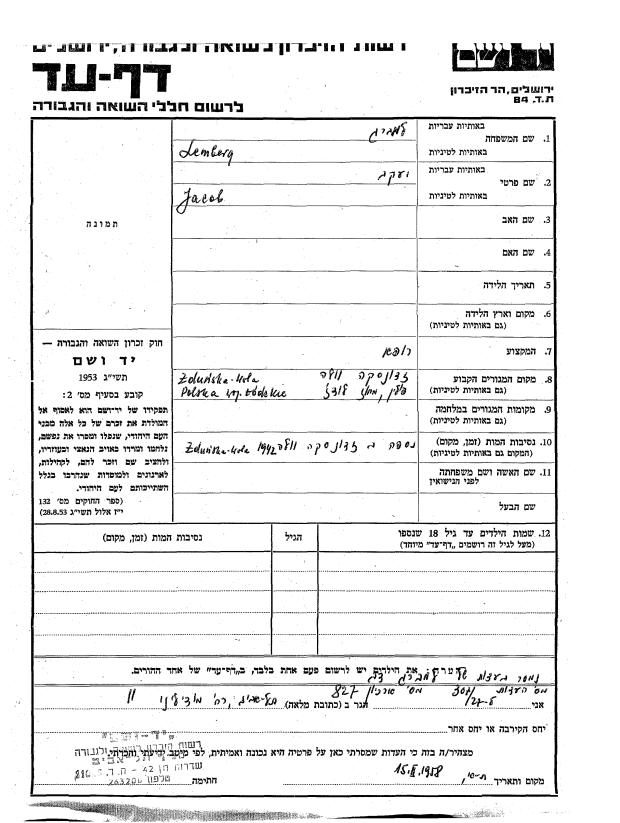
On this date in 1942, on the first day of Purim, Jakub Lemberg was executed together with his family in the Nazi ghetto in Zdunska Wola, Poland.
Lemburg, a 43-year-old internist and pediatrician, was head of the Judenrat in Zdunska Wola and thus it was his task to do the Nazis’ dirty work, such as putting together lists of his fellow-Jews for deportation.
He revealed himself to be a man of exceptional character and courage, and the circumstances of his death, as recorded in Louis Falstein’s The Martyrdom of Jewish Physicians in Poland, should not be forgotten:
The Gestapo chief ordered Dr. Lemberg to deliver ten Jews to be hanged for the ten hanged sons of Haman. Dr. Lemberg replied that he could deliver only four Jews: himself, his wife and their two children. Hans Biebow, “the Butcher of Lodz,” seized Dr. Lemberg and turned him over to the executioners, who killed him in the cemetery.
The Zdunska Wola ghetto was liquidated five months later. And in 1947, Biebow got his.
Here’s an image of Lemberg testimony (in Hebrew) from the Yad Vashem database.
On this day in 1942, the Nazis shot five Jewish men from Sokal, which was then part of Poland and now belongs to the Ukraine.
During the first years of the war, the Germans had designated Sokal as a Judenstadt (literally “Jew-town”), a central destination point for all Jews expelled from nearby towns and villages. Or, as diarist Moshe Maltz put it, “A solitary island in a sea of blood.”
It was Maltz, an Orthodox Jew and native of Sokal, who recorded the executions described in this entry. He kept regular notes throughout the war about the plight of Sokal’s Jews — not a diary exactly, but a chronicle, meant for the benefit of history.
On February 24, five Jews from Sokal were taken to a place somewhere on the outskirts of town and shot. One of them was Yeshaye, son of Yankel the coachman. In 1940, during the period of Soviet occupation, Yeshaye had been a coachman working for the NKVD. Now the Gestapo called him and ordered him to turn over to them the reins of his horses. They said to him, “We’ll give you three days to deliver those reins to us. If we don’t get them by that time, we’ll have you shot.” Yeshaye thought that the Gestapo must be joking. How could he go on working as a coachman without his reins? Unfortunately for Yeshaye, the Gestapo men were in dead earnest.
Also among the five shot was Dr. Knopf, a lawyer who had converted to Christianity. The Germans had ordered him to dismiss his Gentile maid so that she could be sent to work in Germany. Knopf petitioned the Gestapo to let him have his maid back. That’s why the Germans shot him. Despite his baptism, he was simply not an Aryan. The third victim was blind Yankel, who was found guilty of buying and slaughtering a calf. Under German occupation regulations, cattle can be slaughtered only by officially approved butchers.
In October 1942, the Jews of Sokal were confined to a ghetto. The following month Maltz wrote, with the same dispassionate tone, of the murder of his fourteen-month-old daughter at the hands of the Nazis.
Later in November he escaped from the ghetto with his wife and surviving son. They had made an arrangement with a Polish woman who lived nearby, and moved into her hayloft, above the pigsty.
Eventually fourteen people from three families in all would come to live in the hayloft. All of them survived except Maltz’s sister, who died of fever while in hiding. The others staggered out into daylight, barely able to walk, when the Russians liberated the area in July 1944.
Maltz and his entire family eventually emigrated to the USA.
When the Nazis attacked the house at 29 Kupiecka Street, rounding up all of its residents into the street, a bold young man, Izchok Malmed, whipped out a jar of acid from his pocket, hurling it in the face of a Nazi soldier, who was blinded at once. Seeking revenge, the sightless Nazi fired his revolver several times, hitting another Nazi soldier and instantly killing him. In the melee, Malmed vanished.
Commandant Friedl, after learning what had happened, ordered that one hundred men, women and children living in the area where the incident occurred be rounded up and force-marched to a nearby garden, where they were lined up against the wall of an adjacent bet hamidrash and shot with machine guns.
Afterward Nazi soldiers captured another group of Jews, forcing them to dig a large pit for the bodies of the one hundred martyrs. A thin layer of earth covered them. Some were still alive, their hands groping upward through the earth.
The Nazi soldier accidentally shot by his colleague whom Malmed had blinded was carried to the Judenrat building, and his body was placed on [Judenrat Chairman Efraim] Barasz’s desk. Friedl then proclaimed to Barasz, “See what your Jewish criminals have done. Now we shall take revenge. You shall see what we can do.” Friedl issued an ultimatum for the perpetrator of the crime to surrender within twenty-four hours. Failing that, the entire ghetto would be destroyed with everyone in it.
Barasz knew the Nazis meant what they said. He sent word to Malmed to give himself up and thereby save thousands of Jewish lives. As soon as Malmed heard, he surrendered himself to the Nazis.
Tamarof’s diary described in detail Malmed’s courage. Asked why he killed the Nazi soldier, he replied: “I hate you. I regret I only killed one. Before my eyes my parents were murdered. Ten thousand Jews in Slonim were liquidated before me. I have no regrets.” Tamarof tried to slip poison to Malmed but failed. Even the police could not get near the prisoner.
The next morning, Izchok Malmed, a hero of the ghetto, was hanged in the square where he had performed his act of courage. Despite the horrible torture to which he had been subjected, Malmed cursed the Nazi murderers. After several minutes of hanging on the gallows, the rope broke and the body fell to the earth. Instantaneously, the Nazis riddled Malmed’s corpse with bullets and re-hanged the body for another forty-eight hours.
Kupiecka Street was renamed Malmed Street after the war. Near the site of Malmed’s execution is a plaque reading, in Polish and in Hebrew, “Icchok Malmed, the hero and fighter of the Bialystok Ghetto, was killed here by the Nazi murderers on 8 February 1943. In his honor.”
* The Zchor account spells his name “Izchok” but on the memorial plaque it says “Icchok”. It’s a form of the name Isaac.
On this day in 1942, three anonymous Jewish residents of the Bialystok Ghetto in Nazi-occupied Poland were hung in the public square across the street from the Judenrat (Jewish Council) building. The three worked at the ghetto’s oil factory, and had been caught smuggling sunflower seeds.
The residents of the ghetto paid little attention to the execution, accepting it with resignation. It was hardly remarked on.
But this event was yet another small indication of dire events looming in the near future. Compared to those in other Nazi ghettos, such as those at Warsaw and Lodz, the Bialystok Jews had it pretty good. The ghetto, noted Sara Bender in her 2008 book The Jews of Bialystok During World War II and the Holocaust, was “organized, industrious, and even prosperous. Unlike other ghettos, it never experienced starvation or abject poverty.”
And it was seen as relatively safe. This day’s sort of vicious, arbitrary executions for minor rule infractions, which were so common elsewhere, were not at all frequent in Bialystok. Neither were the mass deportations that had by late 1942 decimated almost all the other ghettos.
Well, Bialystok’s turn was coming.
Unbeknownst to the Bialystokers, just as the sunflower seed smugglers were meeting their end, the powers that be in Berlin were debating the future of the ghetto. The Nazis in immediate charge of the ghetto wanted to keep it, and had logical reasons for doing so: namely, that it was a center of great industry, producing all kinds of goods for the German Army at almost no cost.
Killing off tens of thousands of hardworking slaves during wartime makes about as much sense as hanging three people over sunflower seeds, but this is what Berlin decided to do.
In early- to mid-February 1943, there was a surprise Aktion in the ghetto: 2,000 were killed and a further 10,000 deported to the Treblinka Extermination Camp. About 30,000 remained.
Once it was over, most of the surviving Bialystokers breathed a sigh of relief and hoped against hope that the worst was over — while a small underground group quietly organized an uprising for when the time came.
The rebellion, however, never really had time to get off the ground. When the final deportation occurred in August 1943, almost everyone went quietly in shock to their deaths. A cell of less than 100 fighters put up a few days’ struggle, enough to earn a footnote in history, before the last of the ghetto blew away with the ashes.
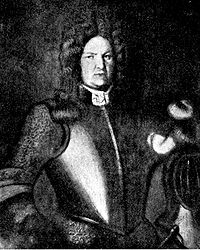
On ths date (N.S.) in 1707, Livonian nobleman Johann Patkul was broken on the wheel at Kazimierz Biskupi, Poland for a decade’s treasonable scheming against the Swedish crown.
Livonia — essentially present-day Latvia, plus a chunk of Estonia — was at this time a part of the Swedish Empire in the latter’s twilight as a world power.
Financially pinched after the protracted and bloody but indecisive Scanian War, the Swedish king Charles XI imposed his great reduction — a heavy tax on the landed aristocracy allowing the crown to reclaim as its own any property that it had held formerly and granted out. There was a lot of such land mortgaged out generations before to raise capital for the Thirty Years War. War giveth, war taketh away. Hands up everyone who feels bad for the nobility.
Of course, all the 17th century nobles felt bad for the nobility.
Johann Patkul was the young — maybe too young — man deputized by Livonian bluebloods to go complain about it to Charles. When sharp but respectful eloquence predictably failed to obtain his ends, he dropped the “respectful” part — and for this lese majeste had to bug out of Sweden with an in absentia death sentence at his heels.
Having failed to obtain pardon from the offended monarch or from his heir Charles XII, Patkul just decided to change teams full stop. You could call this treachery (Charles XII did) but this is an age before nationalism. What was the Swedish royal house to a Latvian noble if he could get a better deal elsewhere?
“Elsewhere” for Johann Patkul meant Polish-Lithuanian king Augustus the Strong, and/or Russian tsar Peter the Great. Our refugee aristocrat spent the 1700s conducting vigorous behind-the-scenes shuttle diplomacy to engineer an alliance against his former masters and carve their respective pounds of flesh out of Sweden. Patkul himself, of course, would get a healthy bite from Livonia for his trouble.
In this campaign Patkul was merely an “unhappy instrument” (as a British correspondent quoted here put it): the antagonists in question had ample reason of their own for this statecraft; had they not, some itinerant conspirator pining for a lost manor could scarcely have conjured it.
But Patkul was a useful instrument: energetic, discreet, willful, and so he could surely claim some ownership of the product. Think of him as the convenient enabler — the Ahmed Chalabi of the Great Northern War that tore apart the Baltic environs for the first two decades of the 18th century.
It was rather fitting, then, that Patkul was devoured by his offspring when Sweden forced a peace upon Poland that resulted in Patkul’s being handed over to the Swedish authorities. The man’s extradition was specified by name in the treaty.
Patkul’s brutal execution inflamed some outside opinion against the Swedes (which presumably mattered not a whit to the progress of hostilities); a purported account of his execution-eve conversation with his confessor is given in this extremely sympathetic English pamphlet.
Though it’s safe to say that Patkul didn’t get what he wanted — let’s guess that the public shattering of his bones prior to a protracted death by exposure was towards the “worst case scenario” end of the calculus — the Great Northern War did indeed loose Livonia from the Swedish yoke … in favor, instead, of the Russian. Peter the Great accepted Livonia’s capitulation in 1710.
Mission accomplished.
Patkul is not to be confused with Baron Peikel/Pykul, a different fellow who was also executed for disobedience to Sweden in 1707.
On August 6, 1942, in the Warsaw Ghetto, Polish/Jewish hero Janusz Korczak marched with his orphans to the death trains and into legend.
The man, his activities in the ghetto, and above all his famed final walk to the Umschlagplatz, are mentioned in many books and memoirs about the ghetto.
Korczak’s real name was Henryk Goldschmidt. He took the name Janusz Korczak (pronounced “ya-nish kor-chok”) for his writing and it wound up taking over his entire life, a la Mark Twain.
Born in an observant Jewish household in Warsaw (which was then Russian Territory) in either 1878 or 1879,* he became man of the house after his father suffered a nervous breakdown in 1889 and eventually had to be hospitalized.
By thirteen, bored by school, he was writing poetry and learning foreign languages by himself. He went to medical school and served as a military doctor with the Russian Army in the Sino-Japanese War of 1905-1906. Eventually he was promoted to the rank of major.
Korczak’s true calling wasn’t in medicine, however, but in writing and in working with children. He found himself drawn to neglected and abused youngsters, and believed in treating every child with honesty and respect.
While he was in China with the military, his first book, Child of the Drawing Room, became famous in Poland. He didn’t realize he was a celebrity until he returned home.
He tried to distance himself from his writing and his fame and be an ordinary pediatrician, but people wanted to see him, to the extent that they would pretend their children were sick in order to entice him to their homes.
Korczak wrote later that one woman claimed her sons had the flu and, when he made a house call, insisted on serving him tea.
“Have you been writing anything lately?” she asked.
“Prescriptions,” he replied, and left, realizing he’d been had.
In 1910, he gave up his medical practice to start an orphanage for Jewish children age seven to fourteen. His institution was very different from most of that time and place, for Korczak had very democratic ideas: the children wrote their own newspaper and had their own parliament and court system.
If one child had a falling-out with another, the urchin could “sue” and bring a case to be decided before the orphanage court, which met once a week. (Even teachers and other staff members could be sued.) The orphanage court also held trials for children accused of violating one of the home’s rules.
Children were rewarded for good behavior, and spanked only as a last resort. Every child had a private, lockable drawer to hold their most precious belongings. Korczak carefully monitored the children’s health and also acted as a sort of informal therapist, encouraging them — most of them orphans from backgrounds of desperate poverty and abuse — to talk about their feelings. The children called him Pan (“Mister”) Doctor.
When World War I broke out, Korczak left the orphanage to serve in the Army again. He left it in good hands, however, in the care of teachers and staff he had trained himself.
“All the world is submerged in blood and fire, in tears and mourning,” he wrote sadly of his war experiences.
It was while in the trenches on the Eastern Front that he began writing a book on child development, titled For The Love of a Child. In 1918, the war finally ended, Poland became a free and independent nation, and Korczak returned to his orphans in Warsaw.
He stayed busy, setting up a second orphanage in 1919, and afterwards writing King Matt the First. The novel, a children’s story about a young boy who becomes king and puts the country’s children in charge, became a bestseller throughout the country in the wake of the calamity lately unleashed by the grown-ups. The sequel, King Matt on the Desert Island, was also a commercial success.
Korczak continued to work for his children, however; he consulted at Warsaw’s juvenile court, and in 1928 founded third orphanage, called Our Home, which had attached dormitories for teachers-in-training and was intended for Catholic children.
In 1925, Korczak wrote another book called When I Am Little Again, told from the point of view of a middle-aged teacher and meant to be read by both children and adults.
He started a children’s newspaper, the Little Review, in 1926. Saying he wanted to “defend children” in his new paper, he invited children from all over Poland to write and tell him the stories of their lives. The newspaper lasted until 1939.
He also hosted a hugely popular radio show, using the name “Old Doctor.” The program was terminated in 1937, however, after only a couple of years; Korczak’s employers with the radio station were reluctant to keep a Jew on the air. When his identity became known, the right-wing press castigated him, saying that as Jew he could never be a real Pole and shouldn’t be allowed to educate Polish children.
Like any public figure, Korczak had his critics. Anti-Semites called Our Home “a new nest of Masonry and potential Communism erected in the heart of the capital.” Communists said his institutions weren’t Communist enough; Zionists criticized him for not directing the children towards a life in Palestine; religious Jews said there wasn’t enough religion in the orphanages while assimilationist Jews said there was too much.
Yet Korczak’s methods worked.
In a follow-up study he conducted of all the former residents 21 years after the first of his institutions was opened, he found that only a few had turned to crime or prostitution as adults. The same could not be said for children who graduated from other children’s homes in Poland.
During the 1930s, many of Korczak’s friends encouraged him to move to Palestine to escape the growing problems in Poland. He actually visited a kibbutz there, but he couldn’t make up his mind whether or to go; he had trouble leaning Hebrew and wasn’t sure a man of his age could start a whole new life.
“I don’t have forty years to spend in the desert,” he wrote to a friend.
Germany’s invasion of Poland in 1939 settled the question for him; leaving the country was no longer an option. Korczak volunteered for the Army again, but was turned down due to his age.
As the Nazis tightened their strangehold around Poland and Poland’s Jews, Korczak did the best he could to shied his orphans from the chaos, suffering and bigotry around them.
He turned his pen to appeals for funds for the children. As a protest against the occupation, he walked around the city openly in his old Polish Army uniform as well as the required Star of David armband.
The uniform proved surprisingly useful: he told a friend that when he went door to door asking for money for the children, “Some people are generous, but not everyone. If they’re difficult, I just undo my coat and reveal my Polish uniform. They get so nervous about having someone in uniform in their place that they give me something just to make me leave.”
The Warsaw Ghetto opened in 1940, and the orphanage was outside its boundaries, so they had to move. (Later, the Germans reduced the size of the ghetto, and Korczak’s orphanage had to relocate again.)
The Warsaw Ghetto was a kind of hell for Jews; allotted rations of only 800 calories a day — if they could get that — people died in droves of starvation and related diseases, including typhus and tuberculosis, as well as deliberate murder by the Nazis and their collaborators.
As recorded in Betty Lifton’s biography, a gentile friend, Igor Newerly, offered to help Korczak escape this fate:
“Everyone’s worried about your going into the ghetto with the children,” Newerly told him. “Just say the word and we’ll get you false identity papers to live on our side.”
“And the children?”
“We’ll try to hide as many as we can in monasteries and private homes.”
Korczak put down his cigarette, took off his glasses in their cheap round metal frames, and began wiping them with his handkerchief as he always did when he was stalling for time.
Finally, he asked: “Do you realize how difficult it would be to hide one hundred and seventy Jewish children — that’s that’s how many we have now.”
“We’d try,” Newerlv repeated.
“But can you guarantee me that every child will be safe?”
Newerly shook his head sadly: “I’m afraid that’s impossible. We can’t guarantee anything” — he
paused — “even for ourselves.”
Korczak thanked his friend, but turned him down. He would take his chances in the ghetto. His decision was sensible for the time — the “Final Solution” had not been conceived of, and no one knew what the eventual fate of the ghetto residents would be.
Lifton records:
On the day they were scheduled to depart, November 29, the children lined up in the courtyard as rehearsed, while Korczak made a final inspection of the wagons filled with the coal and potatoes that he had so arduously procured on his daily rounds. The children waved goodbye sadly to the Polish janitor, Piotr Zalewski, who was staying behind to care for the house. His face was swollen almost beyond recognition from the beating he had received the day before when he and the laundress had applied to the Nazi police for permission to go into the ghetto with the orphans. The Germans had thrown the laundress out, but detained Zalewski for questioning. Didn’t he know that Aryans were no longer allowed to work for Jews? When the janitor replied that after twenty years of service he considered the orphanage his home, the Germans thrashed him with whips and rifle butts.
[…]
The orphans tried to sing as they marched out of the courtyard and into the street, clutching their few possessions. The green flag of King Matt, with a Jewish star on one side, flew over the little parade as it made its way through the teeming streets the short distance to 33 Chlodna Street. When they reached the place where the wall cut along Chlodna, slicing its “Aryan” half off from the ghetto, they found German and Polish police at the gate demanding identification, as if they were crossing a foreign border.
Within the ghetto, Korczak continued his activities for children’s welfare.
He tirelessly solicited aid for the orphanage to keep the children clothed and fed. He and others held benefit concerts and poetry readings, and put posters all around the ghetto saying “OUR CHILDREN MUST LIVE” and “A CHILD IS THE HOLIEST OF BEINGS.”
He took the job as director of a hopelessly underfunded shelter that housed a thousand children; in spite of his efforts, the mortality rate there was sixty percent.
Everywhere children were dying of starvation and disease on the streets or in filthy, overcrowded hovels; Korczak lobbied for the creation of a sort of hospice where they could at least breathe their last in clean, quiet surroundings.
For himself he functioned mostly on pure willpower. It was hard for him to eat when he knew the children were hungry. Five shots of pure alcohol a day, mixed with water, provided precious calories.
Yet his health was failing. His friends noticed how emaciated he had become: “ill, wasted and stooped.” He had a persistent cough and a doctor who examined him diagnosed him with pulmonary edema. Nightmares interrupted his sleep. “How hard it is to live,” he wrote, “how easy to die!”
Yet he carried on.
In the summer of 1942, it became increasingly apparent that the ghetto would be liquidated. Igor Newerly approached Korczak again and offered to help save whoever he could.
Korczak declined his offer again, but gave him his diary for safekeeping — a sign that Korczak, too, knew the end was coming. He had decided to throw his lot in with the children.
In July, the Nazis announced that there were “too many Jews” and they were sending away the children, the old, the sick and anyone else who could not work. Orphans, of course, would be at the top of the list. Resettlement meant death, and many of the ghetto residents knew it, although a substantial number clung to the hope that they would be placed in work camps and find someway of surviving a little longer.
Adam Czerniaków, the Warsaw Ghetto Chairman and Korczak’s personal friend, took his own life rather than supervise the deportations.
For the next few weeks, people were marched or dragged to the death trains, packed inside and driven off to the Treblinka Extermination Camp for gassing.
Many people tried to hide, for the most part unsuccessfully, to escape being deported. Some of the ghetto residents were so hungry that they volunteered to go, because the Nazis promised bread and marmalade to anyone who reported of their own accord.
Korczak’s orphanage’s turn came on August 6. He and the staff had made up their minds earlier: all of them would go together. And they would go quietly, in an orderly fashion, so as not to frighten the children.
Their walk to the death trains, witnessed by thousands, has passed into Holocaust legend.
Lipton records:
The Germans had taken a roll call: one hundred and ninety-two children and ten adults. Korczak was at the head of this little army, the tattered remnants of the generations of moral soldiers he had raised in his children’s republic. He held five-year-old Romcia in one arm, and perhaps Szymonek Jakubowicz…
Stefa followed a little way back with the nine- to twelve year-olds. There were Giena, with sad, dark eyes like her mother’s; Eva Mandelblatt, whose brother had been in the orphanage before her. Halinka Pinchonson, who chose to go with Korczak rather than stay behind with her mother. There were Jakub, who wrote the poem about Moses; Leon with his polished box; Mietek with his dead brother’s prayer book; and Abus, who had stayed too long on the toilet.
There were Zygmus, Sami, Hanka, and Aronek, who had signed the petition to play in the church garden; Hella, who was always restless; big Hanna, who had asthma; and little Hanna with her pale, tubercular smile; Mendelek, who had the bad dream; and the agitated boy who had not wanted to leave his dying mother. There were Abrasha, who had played Amal, with his violin; Jerzyk, the fakir. Chaimek, the doctor; Adek, the lord mayor. , and the rest of the cast of The Post Office, all following their own Pan Doctor on their way to meet the Messiah King. One of the older boys carried the green flag of King Matt, the blue Star of David set against a field of white on one side. The older children took turns carrying the flag during the course of their two-mile walk…
The young protagonist of Jerry Spinelli’s novel Milkweed described it this way:
The orphans were going by. They were marching. Their heads were high and they were singing the song I had learned. I sang along with them. Not one was dressed in rags. Everyone wore shoes. Doctor Korczak lead the way…
“The very stones of the street,” wrote Yehoshue Perle, another chronicler, “wept at the sight of the procession.”
As the group waited for the trains to leave, Korczak’s many friends were seeking out anyone with influence, desperately trying to get them out of Umschlagplatz and back to the orphanage to die another day.
It was said that a German officer, who had been a fan Korczak’s King Matt books as a child, offered him the chance to leave — without the children. Korczak refused.
His presence kept the children calm; if he left them they might panic. He knew what was coming, and he knew he could not force the children to face death alone. The fact that he was in such poor health and probably would not have survived the war in any case does not make his sacrifice any less.
Eventually the orphans and the staff boarded the train and were hauled away. There were no survivors. His name is listed on a memorial stone at the site where Treblinka once stood — the only such stone with a name on it.
Korczak’s legacy is not just in books; his name and image have been used in a lot of memorabilia over the years, and have appeared on stamps in Poland, Israel and Germany. In 1991, Polish filmmaker Andrzej Wajda made a film about Korczak and his last march. There are four statues of him in Warsaw, and a school for street children in Thailand is named after him.
From Andrzej Wajda’s Korczak.
* His year of birth is uncertain; Korczak himself may not have known it.
Sometime in July 1943, a lucky accident saved the lives of thirteen-year-old Halina Birenbaum and a group of other girls and women, all of them inmates at the Majdanek Concentration Camp outside of Lublin, Poland.
Halina’s mother was sent to the gas chambers immediately upon their arrival at Majdanek. The daughter was spared to work and endure the torture that was daily life in the camp. “We were tormented day after day by roll calls, starvation, slave labor, beatings and vermin,” she recalled later in her memoir, Hope Is the Last to Die. “Lice devoured us at night.”
After two months of this, Halina was selected and sent along with her sister-in-law, Hela, and other female inmates to an empty hut in the men’s camp. The women had no idea what the Nazis wanted them for; there was nothing to do but wait.
When it was dark outside, the Storm Troopers locked the hut and switched off the light. I nestled up to Hela, and we both fell asleep on the floor, dreaming of a better camp, easier work, tolerable living conditions…
In the middle of the night, the SS noisily threw open the hut door, arousing us with their shouts and beatings; they began herding us out, making sure that no one hid or escaped. A fearful confusion ensued.
Sleepy, frightened to death, we crowded to the door, pushing and trampling one another in the darkness and panic. The Storm Troopers ran around like mad dogs. They made us form fours, lit electric lamps and counted us, swearing.
“They are taking us to the crematorium!” The terrible news fell on us like a thunderbolt and spread like lightning through the ranks.
My heart beat rapidly. I could not believe it. Once again I could not believe that death was possible, as months earlier, on the WarsawUmshlag, when the Nazis set up a machine-gun in front of us … And I did not yield to the general panic and despair.
The SS gave an order and we moved off … in the direction of the crematorium. Some women were weeping, others tearing their hair, praying, or bidding farewell to mothers or sisters.
They herded us into a hut, the interior of which resembled a bathhouse. Despite the darkness, we observed stacks of empty gas containers on the ground in front of the hut. There was a strange sweetish odor in the air. There was no doubt now that they were taking us to execution. The women went out of their minds … They groaned, wailed, had convulsions.
They herded us into the bathhouse, and barred the door behind us. Now we had to carry out an order given previously: undress and hang out clothes up on hooks on the wall. Obediently we undressed in silence. We knew there was no way out. We hung out clothes up, then sat down on benches along the walls, waiting in extreme agitation … When and how would death come?
Time passed. Hour followed hour. But nothing happened. No one came. It was silent both inside and outside the bathhouse. Perhaps they had forgotten us? A faint hope slowly began emerging … Toward morning they came back; after the nightmare of waiting for death in the gas chamber, we went outside. They counted us again (as though anyone could have escaped from that locked building!), and took us back to the men’s camp, to the same hut as the day before. There we learned from the prisoners that the supplies of gas has unexpectedly run out during the night … We had been spared on account of this accident.
Later that day, Halina and her fellow inmates were put on a truck and taken to Auschwitz.
Several times more she escaped death by the skin of her teeth. She would survive the war, move to Israel, and become a writer, poet and translator.
On this date in 1944, 24-year-old Krystyna Wituska [Polish language link] was guillotined inside the Halle-Saale Prison in Germany.
She’d been convicted of espionage and treason in relation to her activities with the Polish Underground.
Although for months she had feared the Germans were on to her, it wasn’t Krystyna’s own actions that lead to her arrest in October 1942. No, it was the ghost of lovers past.
A short time before, the Nazis had picked up a former boyfriend of hers who was coincidentally also involved with the Underground. The couple had been engaged at one time, but they hadn’t seen each other since 1938 and Krystyna’s passion for him had long since cooled. It was merely a remarkably unlucky chance that the Gestapo happened to find her name in his apartment.
Krystyna’s death sentence was confirmed in May 1943, but over a year passed before she was actually put to death.
During the interval she kept in touch with her family and friends by mail. Her letters, punctuated with requests for items like food and warm clothing, were remarkably cheerful and upbeat in spite of her gloomy surroundings.
Don’t think she was in denial about her fate, however, for she alluded to it frequently.
“I am not distressed that I must die,” she wrote to one acquaintance in August 1943. “If you have a good understanding of life, you know how to accept death. The important thing is to maintain one’s human dignity to the end.”
In Poland, courts of regular jurisdiction rendered altogether 318 final death sentences between 1956 and 1988 (the last full year of communist rule), that is, on average, 10 death sentences per year … Seven death penalty sentences were passed on average each year in the 1960s; this number almost doubled in the 1970s. The decade of the 1980s was marked by the emergence of Solidarity, the first independent civic body ever in existence in a communist country, by the imposition of Martial Law in December of 1981, and by the repressive political climate in the subsequent years. However, one notices a pronounced decrease in the number of death sentences compared to the previous decade. Altogether sixty such sentences were passed between 1980 and 1988, an average of 7.7 per year … Jaruzelski‘s military regime used more carrots than sticks when dealing with the political opposition.
The contemporary artistic reflection of elites’ growing concern over capital punishment was the 1989 Krzysztof Kieslowski flick critiquing the death penalty in his Dekalog series.
Though Poland continued to hand out death sentences until the mid-Nineties, a moratorium on actual executions took hold.
On this day in 1942, Sergeant Anton Schmid was executed for high treason. His crime: saving the lives of Jews in Nazi-occupied Vilna, Poland (now part of Lithuania and called Vilnius).
Schmid was born in Vienna and owned a radio shop there before he was drafted into the German Army following the Anschluss in 1938.
After Germany’s invasion of Russia in mid-1941, Schmid was put in charge of a unit in Vilna, tasked with collecting and reassigning soldiers who had been separated from their units. He witnessed the sufferings of the Jewish population in the Vilna Ghetto and was so horrified, he decided to take action.
Schmid used his position in the military to help Jews by employing them as workers for his unit, forging papers to get them out of prison and out of the ghetto, and using Army trucks to escort them away from the city.
At great personal risk, he would go into the ghetto to hand out food and warn the inhabitants when the Germans were planning roundups. In dire situations he would even hide people in his own apartment to protect them from the Nazis. He maintained close contact with Jewish resistance organizations and assisted their activities in a variety of ways.
According to one account by a Jewish woman who was herself killed later in 1942,
[Schmid] would mock the Jews and say how easily they could be fooled, and at the same time tried to find out what the Germans were planning. As soon as he learned something new, he would tell his Jews and order them to tell their friends so that they could hide until the situation stabilized … He negotiated on their behalf like a dedicated father, without fear of being punished if he was found out. He put them in his working place and provided them with food and drink. He gave them soup and bread. In short, in those chaotic days of massacres he managed to save dozens of Jews …
Although the Jewish Underground warned Schmid that his activities had become too widely known and he was in great danger, he refused to put a stop to his effort to save the Vilna Jews. In response to their concerns he reportedly said that if given a choice between “living as a murderer and dying as a rescuer,” he would choose to die.
He saved an estimated 250 to 300 people before his arrest in January or February 1942.
At his court-marshal, his attorney tried to say Schmid had taken the Jews out of the Vilna Ghetto because he thought they could better serve the Reich elsewhere. Schmid refused to allow this, however, openly proclaiming that he had been trying to save Jewish lives. He was convicted on February 25 and sentenced to die.
In a letter to his wife and daughter, just days before his death, he tried to explain himself:
Here there were a great many Jews who were being rounded up by the Lithuanian militia and shot to death in a meadow outside the city, groups of 2-3,000 at a time. On the way there, they were smashing children against trees and such like. You can imagine how I felt … You know how I am with my soft heart. I couldn’t think otherwise and helped them… This is a heavy blow for us, but please forgive me. I was just behaving like a human being and didn’t want to hurt anyone.
In 1967, twenty-five years after his death, Schmid was honored as a Righteous Gentile by Yad Vashem. His widow attended the ceremony on his behalf and accepted a medal reading “Whoever saves one life, saves the entire world.”


 The man, his activities in the ghetto, and above all his famed final walk to the Umschlagplatz, are mentioned in many books and memoirs about the ghetto.
 Halina’s mother was sent to the gas chambers immediately upon their arrival at Majdanek. The daughter was spared to work and endure the torture that was daily life in the camp. “We were tormented day after day by roll calls, starvation, slave labor, beatings and vermin,” she recalled later in her memoir,
  She’d been convicted of espionage and treason in relation to her activities with the Polish Underground.
 Schmid was born in Vienna and owned a radio shop there before he was drafted into the German Army following the