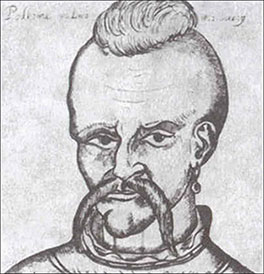
On this date in 1578, Cossack hetman Ivan Pidkova lost his head in Lviv.
Pidkova* — the name means “horseshoe” and alludes to the horsemanship that would be de rigueur for a Cossack leader — had risen by his aptitude to leadership of the Zaporozhian Cossacks in present-day Ukraine.
His death was a bid to promote himself from the steppe to power over neighboring Moldavia, and in fairness to Ivan Moldavia was worth a go.
Its throne was held at that time by a new guy named Peter the Lame, and although the nickname just referred to Peter’s physical deformity, he was a creature of the Ottoman court who scarcely knew Moldavia before he became its vassal ruler in 1574. He was twice temporarily deposed before finally voluntarily resigning in 1591 so that he could retire to the comforts of Italy.
The first deposition came courtesy of our man Pidkova.
Claiming kinship with Peter’s late predecessor Ivan III,** Pidkova seized Iasi and proclaimed himself hospodar of Moldavia until the arrival of Ottoman reinforcements refuted the conceit.
This whole border region between the Polish-Lithuanian Empire to the north and the Ottomans to the south was a perennial trouble spot. Putatively subjects of the Polish crown, the refractory Cossacks were known to raid Ottoman territory illicitly and provoke diplomatic headaches on both sides of the border.
At this particular moment — 1578, that is — the Polish king Stephen Batory had only just concluded a truce with the Ottomans. As Batory had war with Russia to worry about, he was more than keen to keep his southern frontier calm; Polish troops captured the Cossack pretender and had him put to an exemplary death.
Monument to Ivan Pidkova in present-day Lviv. Image (c) stacy2005ua, a prolific photographer of Lviv’s environs whose work can be enjoyed at FaceAndHeart.com or on Flickr, and used with permission.
Ukraine’s national bard Taras Shevchenko celebrated Ivan Pidkova in an eponymous 1839 poem:
There was a time in our Ukraine
When cannon roared with glee,
A time when Zaporozhian men
Excelled in mastery!
They lived as masters — freedom’s joy
And glory were their gain:
All that has passed, and what is left
Is grave-mounds on the plain!
High are those ancient tumuli
In which were laid to rest
The Cossacks’ fair white bodies
In silken cerements dressed.
High are those mounds, serene and dark
Like mountains they appear,
Their gentle whispers in the wind
Of freedom’s fate we hear.
These witnesses of ancient fame
Hold converse with the breeze;
The Cossacks’ grandson reaps the grass
And sings old memories.
There was a time when in ukraine
Even distress would dance,
And sorrow in a tavern drank
In honeyed brandy’s trance.
There was a time when life was good
In that Ukraine of ours …
Recall it then — perhaps the heart
May briefly bathe in flowers.
II.
A murky cloud from Liman’s shore
Covers the sun from sight;
The sea is like an angry beast
That groans and howls with might.
It floods the mighty Danube’s mouth.
“My fellows, come with me
Within our barks! The waves are wild.
Let’s have a merry spree!”
The Zaporozhians rushed out;
The stream with ships was roiled.
“Roar on, O sea!” they all sang out,
As waves beneath them boiled.
Billows like mountains round them surged,
They saw no land, no sky.
Yet not a Cossack heart grew faint,
Their eagerness ran high.
A bold kingfisher flies o’erhead
As on they sail and sing;
The brave otaman in the van
Leads on their mustering.
He strides the deck, and in his mouth
His pipe grows cold from thought;
He casts his glances here and there
Where exploits may be wrought.
He curled his long black whiskers,
He twirled his forelock free,
Then raised his cap — the vessels stopped:
 :”Death to the enemy!
Not to Sinope, comrades,
Brave lads beyond all doubt!
We’ll drive on full to Istanbul
To seek the Sultan out!”
“Well spoken, our fine chieftain!”
They roared in chorus back.
“I thank you, lads!” He donned his cap.
Again the seaward track
Beneath their keels began to boil;
And once more thoughtfully
He paced the deck in mute content
And gazed upon the sea.
That translation is via The Poetical Works of Taras Shevchenko; the original in Ukrainian can be enjoyed here. The exact text of that poem also comprises the lyrics of this jam:
* Or Ioan Potcoava, as Ivan came from Romanian stock.
[Adolf Eichmann] did not expect the Jews to share the general enthusiasm over their destruction, but he did expect more than compliance, he expected — and received, to a truly extraordinary degree — their cooperation. This was “of course the very cornerstone” of everything he did … Without Jewish help in administrative and police work — the final rounding up of Jews in Berlin was, as I have mentioned, done entirely by Jewish police — there would have been either complete chaos or an impossibly severe drain on German manpower …
To a Jew this role of the Jewish leaders in the destruction of their own people is undoubtedly the darkest chapter of the whole dark story.
Among the many horrors of the Holocaust were the Judenräte, Jewish administrative councils set up under the aegis of Nazi Germany’s occupation of Eastern Europe.
Typically recruited from local elites and granted special privileges by the Germans, these collaborators managed the day-to-day operations of the ghettos, up to and including the horrible sharp end of Final Solution: confiscating Jewish property for the Germans, registering and organizing Jews destined for slave labor or extermination, and even managing deportations with the desperate hope that willingly engaging a sacrifice they could never prevent might enable them to save some others. Once all the deportations were done, the Judenrat itself would be executed or deported: Faust had nothing on this bargain.
Chaim Rumkowski, perhaps the most (in)famous Judenrat administrator, issued posterity the definitive howl of a collaborator’s agony when he was forced by the imminent Lodz Ghetto children’s action to implore Lodz’s families to peaceably surrender their young people to certain death: “I never imagined I would be forced to deliver this sacrifice to the altar with my own hands. In my old age, I must stretch out my hands and beg. Brothers and sisters: Hand them over to me! Fathers and mothers: Give me your children!”
Rumkowski, a deeply checkered figure who fended off liquidation of his ghetto until the very late date of 1944, well knew that Judenrat personnel were entirely disposable. After all, he delivered this plaintive speech on September 4, 1942 — just three days after his counterpart in the Lvov Ghetto had been publicly strung up on a balcony.
Six Jews (including Henryk Landsberg) hanged in the Lvov Ghetto, September 1, 1942 (via). The US Holocaust Memorial Museum also identifies this clearly distinct execution as a picture of Lvov Jewish Council members being hanged in September 1942.
The city of Lwow/Lvov (or to use its present-day Ukrainian spelling, Lviv) had had a centuries-old Jewish population when the Soviet Union seized it from Poland in consequence of the Molotov-Ribbentrop pact. That population almost immediately doubled as Jewish refugees fleeing the half of Poland that Germany got in the deal poured into the city.
Practically on the frontier of the German/Soviet border, Lvov was captured in the opening days of Germany’s June 1941 surprise invasion of the USSR. In November-December 1941, the 100,000-plus Jews* still surviving in Lvov (after several post-conquest massacres) were crammed cheek to jowl into the new Lvov Ghetto. There they endured the usual litany of privations for World War II ghettos: starvation rations, routine humiliation, periodic murders. forced labor at the nearby Janowska concentration camp.
The ghetto’s first chairman, Dr. Josef Parnas, didn’t live to see 1942 before he was killed in prison for non-cooperation. Dr. Adolf Rotfeld followed him, and died of “natural” causes in office a few months later.
Dr. Henryk Landsberg, a lawyer, succeeded Rotfeld. He had been a respected community figure before the war, but was disposable to the Nazis as his predecessors; during a large-scale Aktion to cull the camp and further reduce its boundaries, a Jewish butcher resisting the SS killed one of his persecutors. Landsberg and a number of the Jewish policemen employed by the Judenrat were summarily put to death.
“I have gladly accepted the nomination,” Landsberg’s successor remarked. “Maybe they will shoot me soon.” He was indeed shot (or perhaps committed suicide to avoid that fate) in the first week of January 1943. (All this from Judenrat: The Jewish Councils in Eastern Europe Under Nazi Occupation)
The Lvov Ghetto was liquidated June 1, 1943; a bare handful of its former inmates escaped into the sewers or managed to avoid death in the camps before the war ended. After the Red Army took back the city, a 1945 survey of the Jewish Provisional Committee in Lvov tallied just 823 Jews. Today, there are all of 5,000.
On this date in 1635,* the German aristocrat and general Hans Ulrich [von] Schaffgotsch lost his head in Regensburg.
Schaffgotsch (German Wikipedia entry: most information about him online is in German) would have appeared to have won the birthright lottery. Sure, he was no king, but being born to a hereditary Silesian baron of distinguished blue-blood lineage, and being dynastically married to a princess, put him squarely within the 1 percent’s 1 percent.**
Schaffgotsch caught one very bad break: he was born to come of age during the Thirty Years’ War.
The Schaffgotsch family had different branches going, but Hans Ulrich’s was Protestant — and this was also the predominant faith in early 17th century Silesia. (It adhered to the unsuccessfulBohemian Revolt.)
Doctrinal differences aside, Schaffgotsch had favorable terms from the Catholic emperor. He also made himself good friends with a fantastically wealthy duke named Albrecht von Wallenstein. Wallenstein was a little shaky on the religion question himself; he’d been raised Protestant and converted to Catholicism for unknown reasons.
When the Thirty Years’ War came calling again late in the 1620s, Wallenstein used his capacious wealth to field a large army in service of Ferdinand, and Schaffgotsch went right along as the generalissimo’s able adjutant. But Ferdinand, who was short on both cash and troops to call his own, soon came to fear this capable general upon whom he overmuch depended. When the opportunity arose, the sovereign abruptly relieved Wallenstein of command in 1630 — only to have to reinstate him in 1632† when his replacement got killed.
It turns out Ferdinand did have good cause for suspicion. Wallenstein was dissatisfied with the emperor’s treatment as well, and covertly treated with the Protestant league to switch sides or overthrow the emperor and rule in Bohemia. The detection of these plans in Vienna led Ferdinand to have Wallenstein judged by a secret court, then assassinated in 1634.‡
As his aide, Schaffgotsch too was soon dealt with. Unlike the dangerous Wallenstein, Schaffgotsch was a small enough target to arrest and prosecute in the conventional way — which happened in 1635. Schaffgotsch obstinately refused under torture to admit any involvement in treason, but he was condemned to death all the same.
The Silesian aristocrat might have felt hard done by, but he relieved some annoyance with an old-fashioned shopping spree. Schaffgotsch went out in style (German link) by plumping for black drapings for the scaffold, ordering a custom coffin, doing up all his servants in black mourning garb, and bribing the executioner of Regensburg to behead him seated in a chair. (The lord rooted himself so firmly in his seat that his head flew off at the sword’s stroke without his body toppling over.)
Afterwards, Schaffgotsch’s body was laid out for last respects for two days in Regensburg Blauen Krebs inn, which still exists to this day. (And has the story on its website.)
* Gregorian date. With Catholic and Protestant powers both going at it, dating gets confusing in this period; it would have been July 13 per the Julian calendar still in use by most Protestants, and this date is also sometimes attributed.
** Click here for some appealing views of Kynast (Chojnik), one of Schaffgotsch’s castles.
† Wallenstein commanded Habsburg forces at the Battle of Lutzen in November 1632, where Sweden’s King Gustavus Adolphus was killed.
‡ Wallenstein’s treachery and death are the topic of Schiller’s play Wallenstein.
On this date in 1944, Jakob Edelstein, his wife Miriam, their twelve-year-son Arieh and his mother-in-law Mrs. Olliner were shot to death at the Auschwitz Concentration Camp in Poland. They had been inmates in Auschwitz since the previous December; Jakob had been in an isolation cell the whole time while the others stayed in the so-called “Family Camp.”
For two years prior they’d lived in Theresienstadt (also known by its Czech name, Terezin), a the former Czech fortress town that had been turned into a city just for Jews. Jakob Edelstein was named Eldest of the Jews and was nominally in charge of the place, but in practice he had no choice but to cater to the whims of the Nazis. He was assisted by a deputy and a council of twelve.
Edelstein, a Czech Jew born in 1903, had been a leader within the Jewish community in Prague and had had papers for himself and his family to emigrate to Palestine. But when the Nazis took over Czechoslovakia, Edelstein and the other Zionist leaders decided it was their duty to stay and do what they could for the community during this time of crisis.
He became a liaison between the Germans the Jewish community and tried to facilitate immigration to Palestine. From 1939 to 1941 he made several trips back and forth between Czechoslovakia and Palestine, with permission from the Germans, trying to find ways for more Jews to emigrate.
Theresienstadt was a strange place: neither concentration camp nor ghetto but something in-between, it was billed as a “paradise” and a “gift” from Hitler to the Jewish people.
Elderly Jews were sent there, as well as Jews who were “prominent” for some reason or had Aryan connections (such as Jews who had a non-Jewish spouse). It was advertised as a luxurious resort community where they could live out the rest of their lives in ease and plenty.
Residents were allowed to receive food packages from the outside, and send postcards (one per month, limited to 30 words, and censored).
Many people believed the propaganda and were persuaded to go there voluntarily, signing all their possessions and assets to the German government in exchange for what they thought would be a comfortable and peaceful retirement.
The 500-ish Danish Jews who weren’t evacuated to Sweden by the Danish Underground right after the Nazi invasion of Denmark were ultimately sent to Theresienstadt. Many talented artists, actors, musicians and scholars lived there. The Nazis would ultimately make a propaganda film about how wonderful life was in Theresienstadt, and a Red Cross delegation toured the place and came away satisfied.
As you might have guessed, living conditions within the fortress city didn’t exactly live up to what it said in the brochures.
It’s true that it was possible to survive in Theresienstadt for an extended time period, even for the duration of the war. There were no gas chambers and relatively few executions. Certainly it was worlds apart from, say, Auschwitz or Treblinka. But that was as close to “paradise” as it got.
Yes, there were stores, more than a dozen of them, but their stock consisted of “goods the Nazis had originally confiscated from the residents and later found they didn’t need or want.”
Theresienstadt, like the Lodz Ghetto, had a bank and its own money, but there was nothing to spend it on. “The ghetto crowns,” Berkley says, “were used mostly like Monopoly money in playing cards and other games. Still, the bank staff kept themselves busy balancing their books, and auditors arrived regularly from Berlin to ensure the accuracy of the bank’s essentially fictitious accounts.”
Theresienstadt’s population, at its peak, was 58,497, in a town which before the war had a population of less than 10,000. Nearly everyone had lice, toilets and taps were scarce, and disease was rampant.
Families were separated, with husbands, wives and children each residing in different barracks.
“Horrendous as Theresienstadt housing conditions may have been,” Berkley says, “they were not the residents’ chief source of daily suffering. Food, or rather, the lack of it, weighed on them much more heavily.” The menu, he explains,
consisted chiefly of bread, potatoes, and a watery soup. Some margarine and sugar — about two ounces a week of the former and less than one and one-half ounces of the latter — were sometimes included. The residents were also to receive up to four ounces of meat, mostly horseflesh, and up to eight ounces of skim milk a week, though many a week would see less or none of those foodstuffs available. No fruits were ever officially distributed, and turnips were the only vegetable to show up with any regularity.
Estimates of total per capita calories provided daily ranged from 1300 or less, to 1800, with the lower figure being more frequently mentioned. This should be compared with the “Special Regime” given the worst offenders in the Soviet labor camps which provided about 2,000 calories.
According to modern nutritional guidelines, to maintain a healthy weight, the average adult with an average level of physical activity needs 2,000 to 2,500 calories a day. At Theresienstadt all inmates between age 14 and 70 had to work long hours, many of them at strenuous jobs. In addition to being calorie-deficient, the Theresienstadt rations lacked essential vitamins and minerals. It’s no wonder that one survivor later recalled, “After three months in Theresienstadt, there was only one feeling left in my body: hunger.”
Six months after his arrival, Edelstein and the Council of Elders made a difficult decision about the food problem, as Berkley records:
It became apparent that an even distribution of the food supply would not allow the ghetto to survive. Those doing heavy work needed more than those doing normal work, and the latter needed more than nonworkers. In addition, children required extra rations, for they represented the Jewish future…
Thus, heavy workers … began to receive a little over 2,000 calories of food a day. Children were to get 1,800 and regular workers a little over 1,500. But the daily intake for nonworkers, which included most of the elderly, fell to less than 1,000 calories.
This terrible choice, however necessary to the population’s long-term survival, consigned thousands of people to death.
But even though starvation and disease took many lives, the most deadly aspect of life in Theresienstadt was deportation.
Contrary to what the propaganda messages said about people living out their lives in Theresienstadt, it was largely a transit camp. Most people who arrived would be sent on “to the east” sooner or later; some of them lasted only a few days in the fortress city before being deported.
Although certain classes of people, such as decorated World War I veterans, “prominent” people and those over 65, were in theory exempted from deportation, in practice anyone could be sent away and just about everyone ultimately was.
Approximately 145,000 denizens passed through Theresienstadt during the course of its existence, most of them from Czechoslovakia, Germany, and Austria. About a quarter of these inmates died within Theresienstadt itself. Another 88,000 were deported to Auschwitz and other camps in the East, almost all of them dying there. Out of about 15,000 children who passed through Theresienstadt, less than 2,000 survived, and some estimates put the number in the low hundreds.
When the camp was liberated, it had a population of about 17,000, and most of those had arrived in the during the final months of the war.
Jakob Edelstein didn’t know about the gas chambers when he became Eldest of the Jews at Theresienstadt in December 1941, but he knew that conditions in the East were very bad and realized that, in order for the community to sustain itself, as many people as possible had to remain within Czechoslovakia.
As a committed Zionist, he hoped that the young people in the camp would survive and go on to colonize Israel. Like most otherleaders of Jewish communities throughout Nazi-occupied Europe, he made the decision to cooperate with the occupiers in hopes of saving lives.
And as far as that goes, he failed, as the numbers quoted above indicate. But if he failed, so did everyone else.
Unlike many Jewish officials in the Nazi ghettos, he wasn’t corrupt and he wasn’t a toady to the Germans. It’s worth noting that he had many opportunities to flee the country with his family, even after the war started: all he had to do was not come back to Europe after one of his trips overseas.
But he stayed, because he felt he had a responsibility to his beleaguered people.
Edelstein did the best he could with what he had to work with, which is all you can say for anybody. He worked tirelessly, making himself available at all hours, and under his leadership the camp developed a welfare system as well as many cultural and sports activities.
His job as Eldest of the Jews in Theresienstadt, trying to play the balancing act between advocating for his people and not pissing off the Germans, was always extremely stressful, difficult and dangerous.
But things really started to go downhill for him after the city’s first commandant, Siegfried Siedl, got reassigned to Bergen-Belsen in July 1943.
Siedl’s replacement, Anton Burger, hated Czechs and took an immediate dislike to Edelstein as a result. He replaced Edelstein with Paul Eppstein [German language link, as is the next], a German, and demoted Edelstein to first deputy to Eppstein. Benjamin Murmelstein, an Austrian, became second deputy.
This wasn’t enough for Burger, however, as George Berkley records:
As leader of the Czech Jews, [Edelstein] naturally bore the brunt of Burger’s hatred for them. The new commandant had not only deported many of his countrymen and his chief aide … but had also moved Germans and Austrians into key positions formerly held by Czechs. Burger had apparently also stirred up his own superiors against him for during the fall some bakery workers, looking out the window, saw and heard Eichmann sharply dressing down Edelstein and even threatening to have him shot.
The incident alarmed Edelstein’s many loyal followers and the next day the leaders of Hechalutz, the largest Zionist organization in the camp, met with him to urge him to flee. They said they could help him escape … But though he suspected a Nazi scheme to get rid of him, Edelstein refused to run away.
In the end, the Nazis didn’t need to trump up any charges of insubordination or sabotage against their former Eldest of the Jews: they found some real “crimes.” It seems that Edelstein had been saving people from deportation by allowing them to remain in Theresienstadt, off the books, and adding the names of dead people to the transport lists to make the numbers match up.
He was immediately arrested. It was November 9, 1943, the fifth anniversary of Kristallnacht.
Edelstein was kept in custody in Theresienstadt until December 18, when he and his mother-in-law, his wife, and his young son were sent to Auschwitz with a transport of 2,500 others. The transport became part of the Auschwitz “Family Camp”, joining 5,000 Czech Jews who’d arrived there from Theresienstadt in September.
Edelstein’s family was allowed to join the Family Camp. Edelstein himself was put in the punishment block and subjected to interrogation although not, apparently, tortured. He gave nothing away.
In March 1944, the residents of the Family Camp who’d arrived in September were gassed. The December group was allowed to stay alive for the time being.
On June 20, an SS officer went to Edelstein’s cell and told him he’d been sentenced to death. While the condemned man (who’d become quite popular in jail) was taking leave of his fellow inmates, the SS officer got impatient and snapped, “quickly, quickly.”
Edelstein replied, “I am the master of my last movements.”
He was driven to the execution site and then the car went away to fetch Miriam, Ariah and Mrs. Olliner. Miriam had measles and had to be brought on a stretcher. The Nazis forced Jakob Edelstein to watch as his wife, child and mother-in-law were shot to death. He was the last of them to die.
The remaining residents of the family camp were gassed in early July 1944.
Paul Eppstein was executed in Theresienstadt in September. Murmelstein became Eldest of the Jews in his place and actually managed to survive the war. Because he had lived, he spent the rest of his life under a cloud of distrust and suspicion as a possible collaborator.
Siegfried Siedl was hanged for war crimes in 1947. Anton Burger escaped Allied custody (twice) after the war, assumed a new identity and died of natural causes in Essen in 1991. His true identity wasn’t discovered for years after his death.
After the war, the city of Theresienstadt reverted to its former name of Terezin, and the fortress became an internment camp for ethnic Germans, who found themselves quite unpopular in the newly liberated Czechoslovakia and were expelled from the country in droves. The internment camp closed in 1948.
The modern town of Terezin has a population of 3,500 and is noted for its manufacture of knitwork and furniture. Tourists from all over the world come to learn about its important role in one of the most tragic events in modern history.
On this date in 1942, two Jewish men were hanged in the city of Sosnowiec (pronounced sos-no-vitz) in Nazi-occupied Poland, and two more were hanged in the nearby city of Bedzin (pronounced ben-jin).
These executions were witnessed by thousands of people and carefully choreographed, as historian Mary Fulbrook records in her book A Small Town Near Auschwitz:*
The hangings in Bedzin and Sosnowiec had been orchestrated in advance, in meticulous detail, by the Police President in Sosnowiec. The execution in Bedzin was to take place one hour later than the one in Sosnowiec. As much thought was given by the police authorities to questions of security and seating arrangements as might be appropriate for a modern open-air musical concert: this was not to be a simple punishment for an individual offense, as had happened innumerable times, but rather a mass spectacle, intended to have a major impact on the audience…
The identities of the executed Jews in Bedzin have been lost to history. (Correction: Per Yad Vashem, they were Jehuda Warman and “Feffer” (no first name).) They were hanged at the old Jewish cemetery on the corner of Zawale Street, before a crowd of about 5,000, at 5:00 p.m. Jewish workers in the Bedzin Ghetto had their work identity cards confiscated that day and were let out of work early, at 4:00 p.m., and ordered to watch the hangings. Only after they witnessed the executions did they get their work cards back. The bodies remained hanging on the scaffold until 7:30 p.m.
The condemned men in Sosnowiec were 30-year-old Mayer Kohn and his father, Nachun or Nahum.
Nachun (left, with wife) and Mayer.
They’d been caught trading on the black market, probably trying to feed their families, as no one could live long on the official rations. But as Fulbrook points out, the actual offense didn’t matter much to the Nazis:
These coordinated public spectacles of mass hangings do not seem … to have been in direct response to a particular crime; it seems there was a policy of ‘any Jew will do’, although infringements of German rules (including not only black market dealings but also very trivial ‘offenses’) were adduced as the ostensible ‘reason’ for these executions.
Thousands of people, both Jews and Germans, watched Mayer and Nachun Kohn die, then quietly went home.
Although virtually the entire Kohn family perished at the hands of the Nazis, Mayer and Nachun Kohn can claim a bit of immortality by virtue of being mentioned in Maus, Art Spiegelman’s famous graphic novel about the Holocaust: the author’s father, Vladek, hailed from Sosnowiec.
Niewiadomski (English Wikipedia entry | Polish), whose father had taken part in the 19th century’s anti-Russian January Uprising, was a talented painter with a serious nationalist streak.
And that was really the done thing for his time and generation: his painting career from the 1890’s into the early 20th century maps the Young Poland movement of up-and-coming artists experimenting with new forms and celebrating romantic attachment to their prostrate homeland.
“The conscience of Polish literature,” Young Poland writer Stefan Zeromski, as depicted by Niewiadomski.
When not promoting patriotic appreciation of the Tatra Mountains, Niewiadomski enjoyed supporting Polish National Democracy, a right-wing movement raging against the Cossack yoke.
Niewiadomski was a true enough believer to serve time in a tsarist prison, but he was far from the leading light of either the artistic or political movements. By the time Poland attained independence (Niewiadomski worked for Polish intelligence during World War I, and even finagled a cameo on the front lines), he was in his fifties and seemingly settling in for a slow moulder into obsolescence in bureaucratic posts and artistic monographs.
(Of course, had he done so, the next decades would have brought him their own surprises.)
Instead, the 1922 election for President of the Polish Republic, which was decided in that country’s National Assembly, saw parliamentary horsetrading elevate an engineer on the strength of the left parties’ votes — a shock victory over Niewiadomski’s preferred right-wing candidate Count Maurycy Klemens Zamoyski, the infant republic’s Bush v. Gore.
It came to street disturbances, to assaulting members of parliament, to demonstrations “for” and “against.” There were casualties. Lumps of dirty snow were thrown at the carriage of the president-elect as it drove across the town. Newspapers dreamt of “a lump of snow that will change into an avalanche” and about removal of that man-“hindrance,” that man-“obstacle.” … The infamous ride through the streets of Warsaw was a ride down death’s lane. Someone hit the first president of the republic in the head with a stick, someone else waved brass knuckles in his face …
So, five days into Gabriel Narutowicz‘s term, Niewiadomski did what any violent, disaffected patriot would do: he gunned down the new Polish president at the Zacheta art gallery. It’s always great to see artists participating in the political dialogue.
The shots by Niewiadomski marked an end to the week of hatred. Poland suffered a shock — even the Right did. National reconciliation bloomed like a thousand flowers. The president’s funeral became an occasion for a deeply disturbed society to demonstrate. Half a million people walked in the funeral procession!
-Bojarska, again
Less than seven weeks later, Niewiadomski christened that national reconciliation with his blood … at a fortress the Russians had once used to garrison his country, Warsaw Citadel.
At the evening roll-call of the prisoners, Max Bialas instructed those who had arrived that same day to line up on the side. It was not clear who was to be liquidated — the new arrivals or those who had arrived earlier. At that moment Berliner jumped out from the ranks of the prisoners, lurched toward Bialas and stabbed him with a knife. A great commotion followed. The Ukranian guards opened fire. Berliner was killed on the spot. and in the course of the shooting more than ten other prisoners were killed and others were wounded. When the tumult subsided the prisoners were lined up again for roll-call. Christian Wirth, who was in Treblinka at the time, arrived on the scene accompanied by Kurt Franz, the second in command of the camp. Ten men were removed from the ranks and shot on the spot in full view of all the others. On the following day, during the morning roll-call, another 150 men were taken out, brought to the Lazarett [the so-called “hospital” which was in fact an execution site] and shot there.
Little is known about Berliner.
According to the testimony of fellow-inmate Abraham Krzepicki, he was a middle-aged Jewish citizen of Argentina who had lived in that country for many years.
He and his wife and young daughter traveled to Poland on vacation in the summer of 1939. They could have picked a better time: when Germany invaded on September 1, 1939, the Berliners were unable to return home. Their Argentine passports should have protected them, but they ended up in the Warsaw Ghetto and were transported to Treblinka. Berliner’s wife and child were gassed immediately, but he was spared to work.
This reprieve would be expected to last days, or a few weeks at the most before he too would go to the gas chamber. Berliner became consumed with rage and the thirst for revenge, supposedly saying, “When the oppressors give me two choices, I always take the third.”
As he must have known he would, Berliner died a horrible death — according to Krzepicki, he was beaten to death with a shovel.
Ironically, following Bialas’s murder, conditions for prisoners at Treblinka actually improved.
This was strictly for pragmatic reasons, as Arad noted: “The Jews selected for temporary work were a danger to the Germans, and the Berliner incident had proved it … When people knew they had nothing to lose, an act of despair like that of Meir Berliner could happen again and again.”
Rather than constantly killing and replacing their workers, the Nazis in charge of the camp decided to create a permanent staff of prisoner-workers and treat them with relative humanity. In this way, they hoped to prevent further acts of suicidal violence on the part of the Jews.
The existence of a permanent cadre of workers made it possible to plan and organize a revolt and mass escape from the camp. In August 1943, after months of conspiring and gathering the necessary weapons, the inmates killed most of the guards and made a run for it. About 300 or so actually made it outside of camp; of those, approximately 60 would survive the war.
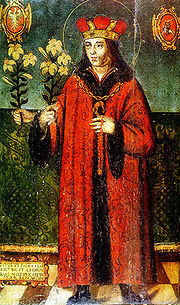
On this date in 1481, two Lithuanian princes were beheaded in Vilnius for plotting the assassination of the Polish-Lithuanian king.
This late 15th century was a heady time for Poland under the Jagiellon dynasty, and one of this dynasty’s going projects was keeping the adjacent realms of Poland and Lithuania linked together. In time, they would become formally joined, but at this point they were independent entities “united” only by the personal union of the Jagiellon monarch himself.
That monarch in the late 15th century was the redoubtable Casimir IV (Kazimierz IV): Grand Duke of Lithuania since 1440, King of Poland since 1447. Casimir’s family hailed from Lithuania; indeed, as that place had been last European place to Christianize, Casimir’s own father had been born a pagan.
Casimir IV’s eponymous son is St. Casimir, patron saint of both Lithuania and Poland; both actively honor his feast date of March 4.
Lithuania agonistes
Lithuania had a strong independent streak (pdf), and its boyars did not necessarily see eye to eye with the Grand Duke. Casimir was keen on centralizing Lithuania’s administration and checking the potential rivalry of the most powerful Lithuanian families, the classic seeds of crown-vs-nobility conflict the world over.
And both watched with a wary eye the growth of Muscovy under the energetic leadership of Ivan III, aka Ivan the Great.
That expanding state in the 1470s gobbled up the buffer city-state of Novgorod; Ivan III’s newly-minted honorific Tsar of all the Rus(sians) openly announced his designs on Lithuania’s own historically Slavic Ruthenian territory. “The gatherer of the Russian lands,” Ivan is known as … and Lithuania (much larger then than it is now) stood to be the gatheree.
The Great Stand on the River Ugra
Come 1480, Casimir was allied against Moscow with the Mongol Horde, the famous “Tatar yoke” that had been collecting Russian tribute for two-plus centuries. In Russian historiography this is the crucial moment when that yoke is thrown off, and the Muscovites accomplished that in part by crossing up the Lithuanians.
The Horde, having marched through Lithuanian territory, assembled on the banks of the Ugra River, opposite a waiting Muscovite army. Neither army attacked. Instead, they waited … and waited … and waited some more.
The Horde, for its part, was waiting for reinforcements from its Lithuanian ally. But those reinforcements never arrived, thanks in part to Russia’s alliance with Crimean khan Mengli Giray, who seems to have absorbed Casimir’s attention in the fall of 1480 with a vexing combination of raids into southern Lithuania and dilatory ceasefire diplomacy. Distracted by the homeland threat, Lithuania never got around to supporting the Horde … and the Horde, after freezing itself on the banks of the Ugra for a couple of months, simply marched away in frustration.
Moscow never again paid it tribute … and its Crimean ally destroyed the Great Horde utterly in 1502.
Chop
This was the context, back in Lithuania, for the attempt on Casimir’s life that would cost two princes their heads. Notwithstanding his unhelpful alliance with the Great Horde, it seems apparent that Casimir himself espoused a fundamentally western policy: the Jagiellon dynasty had branches in Hungary, Bohemia, Germany, and Casimir had more taste for meddling in these realms than dealing with Russia. One could imagine how a Lithuanian magnate out his lucrative Novgorod trade would feel like the head man didn’t really have his eye on the ball; in 1478, a Lithuanian delegation even requested that Casimir appoint a Lithuanian governor to look after the interests of the Grand Duchy. (Casimir refused.)
And these nobles were getting it at both ends, since Casimir’s state-centralization project meant that they were being cut down to size in terms of their internal political power, too.
Apparently with the support of Moscow itself (whose expansionary interest is self-evident) Iwan Holszanski and Fedor Bielski hatched a plan to murder the Grand Duke and his sons on Palm Sunday, 1481 — which was also the occasion of Fedor Bielski’s wedding. The idea was to replace him with Michal Olelkowicz (Mikhail Olelkevich), who had been Novgorod’s elected prince-ruler in the late 1460s; it’s not clear to me if Olelkowicz himself was actually in on the scheme.
Casimir, at any rate, caught wind of the plot. Legend has it that a servant decorating a room ran across the conspirators’ weapons niches and reported it; it’s alternately alleged that the assassins meant to jump Casimir while out on his favorite pastime, hunting.
However it was supposed to go down, it didn’t work. Bielski was able to flee to Moscow (ditching his newlywed bride), but left Holszanski and the coup’s prospective beneficiary Olelkowicz to suffer beheading this date upon evidence “brighter than the sun” of their treason.
On this date in 1942, 39-year-old French/Ukrainian novelist Irene Nemirovsky was gassed at the Auschwitz Concentration Camp in Poland.
She was a victim of the Nazis’ racial laws: anyone with even one Jewish grandparent, even if they themselves did not practice the Jewish religion, could be considered a Jew. Nemirovsky, born to a wealthy Russian-Jewish family in what is now the Ukraine, had converted to Catholicism in 1939 — sincerely, insofar as anyone can discern.
Irene Nemirovsky fled Russian territory after the Bolshevik Revolution and spent a short time in exile in Finland and Sweden before eventually settling in France. There she married a banker, had two daughters, and published her first novel in 1930.
The book, called David Golder, was about a ruthless businessman (described by modern readers as “a Bernie Madoff of her time”) who in old age and poor health begins to regret the way he lived his life. It was a success and was made into a 1930 film.
Although she was widely acclaimed as a writer in France, even by anti-Semites, she was denied citizenship in 1938. By then she had lived in the country for twenty years.
Following the German invasion of France in 1940, Nemirovsky’s books were pulled off the presses and she was required to wear the yellow star. If she and her family had succeeded in obtaining French citizenship, this would have provided some protection; the French were reluctant to deport their own Jews, filling the cattle cars with foreigners instead. Irene was instead classified as a “stateless person of Jewish descent” and the high-ranking Nazi official Ernst Kaltenbrunner called her a “degenerate artist of deluded Jewish hegemony.”
The “stateless” Irene was arrested on July 13, 1942. She had time to write a letter to her family, asking them not to worry about her, before she was deported to Auschwitz four days later.
Although she survived the initial selection and was tattooed with a prisoner number, it was reported a month later that she had died of typhus, a common and deadly disease in the concentration camps. However, later investigation showed she had in fact been sent to the gas chamber. Her husband was also gassed in Auschwitz in November of that year, but their two children survived the war.
One of Nemirovsky’s books, All Our Worldly Goods, was posthumously published in France in 1947. However, for sixty years following the war this once-famous author was largely forgotten.
In 2004, however, she became a literary sensation when a previously undiscovered manuscript, Suite Francaise, hit the press. The “suite” consisted of two books out of a projected five, titled “Storm in June” and “Dolce”. Irene had written them while in hiding in 1940. When she was arrested she gave the manuscripts in a suitcase to her daughter Denise, who safeguarded them all those years.
The book was received to great acclaim and became a bestseller, and publishers blew the dust off her novels from the 1930s and brought them back into print. In 2007, another of Nemirovsky’s works, Fire in the Blood, was published. The book was a companion to Suite Francaise — and like Suite, Nemirovsky had worked on it while in hiding during the Nazi occupation.
Nemirovsky never escaped controversy, in her life or after her death. Several critics and scholars have accused her of being an anti-Semite, a “self-hating Jew,” as detailed in this article from the Australian publication The Age.
Novelist Paul LaFarge charged her as “a Jew who disliked other Jews.” Primo Levi‘s biographer wrote of her, “She has taken on board the idea that Jews belong to a different, less worthy ‘race’, and that their exterior signs are easily recognizable: frizzy hair, hooked noses, moist palms, swarthy complexions, thick black ringlets, crooked teeth…”
There is evidence to support this assertion.
Some of her books were serialized in anti-Semitic magazines, and during the occupation Irene also wrote a letter to Marshal Petain, head of France’s collaborationist Vichy government, to say she disliked Jews and shouldn’t be classified as a Jew, racial laws notwithstanding. Her husband wrote a similar letter to the German ambassador after her arrest, saying his wife “did not speak of the Jews with any affection whatsoever.” The ambassador never bothered to reply.
Irene, however, also has her defenders in this matter: “She didn’t dislike Jews,” said one. “She disliked some Jews. Big difference.” Patrick Marnham, who wrote the introduction to the reprinted David Golder, argued that, “Her choice of an unsympathetic Jewish character [in the book] does not make Nemirovsky anti-Semitic; any more than Robert Louis Stevenson was anti-Scottish because he created the diabolical figure of Ebenezer in Kidnapped.”
You could argue that if she appeared to be anti-Semitic it was because she was trying to conceal her own Jewish origins and thereby protect her family from the deadly consequences. Her daughters believed this was the reason for her assertions that she hated Jews.
In any case, whatever Irene may have said or thought about her religious origin did not save her life. She was just one of many thousands of Christian converts who fell victim to Nazi Germany’s madness.
Irene’s younger daughter, Elisabeth Gille, who died in 1996, wrote a novel titled Shadows of a Childhood which was based on her parents’ disappearance. She had only been five years old when Irene was arrested. In 2010, Olivier Philipponnat and Patrick Lienhardt published the first major biography of Irene, The Life of Irene Nemirovsky, 1903-1942.
On this date in 1946, market day in the southeastern Polish town of Debica, three captured fighters* from the anti-communist Freedom and Independence (WiN) movement were publicly hanged.
This salutary, and surprise, hanging was a nasty public message during the dirty post-war war to consolidate communist authority in Poland.
The message, however, was not exactly meant for a world wider than Poland itself, so the fact that it was captured in a grainy photograph snapped by WiN agent Józef Stec and subsequently smuggled out to the West was not at all to the liking of Polish authorities.
According to a WiN eyewitness report also presumed to have been filed by Stec,
First the MO [local militia], the UB, and the military occupied the execution square holding their machine guns ready to fire. Then, a car came with uniformed individuals who placed the noose on the hook. After a short time the same car brought three condemned men in white shirts. Their hands and legs were tied with barbed wire. A Jewish prosecutor read the sentence and passed the condemned into the hands of the executioner. Before the execution, one of the condemned yelled: “Long live the Home Army. Long live General Anders and General Bor-Komorowski. Down with the commies. Brothers persevere or you’ll die like us. I swear before God that I have never been a bandit [as communist authorities designated them]. I am dying for the Motherland. Lord forgive them [the executioners] because they know not what they are doing.
* The victims were Józef Grebosz, Józef Kozlowski, and Franciszek Noster, according to the 2003 monograph After the Holocaust: Polish-Jewish conflict in the wake of World War II, by Marek Jan Chodakiewicz. This monograph is also the source for Stec’s quoted report on the hanging.

 Pidkova* — the name means “horseshoe” and alludes to the horsemanship that would be de rigueur for a Cossack leader — had risen by his aptitude to leadership of the Zaporozhian Cossacks in present-day Ukraine.


 For two years prior they’d lived in


 After
After 

 Although she was widely acclaimed as a writer in France, even by anti-Semites, she was denied citizenship in 1938. By then she had lived in the country for twenty years.
