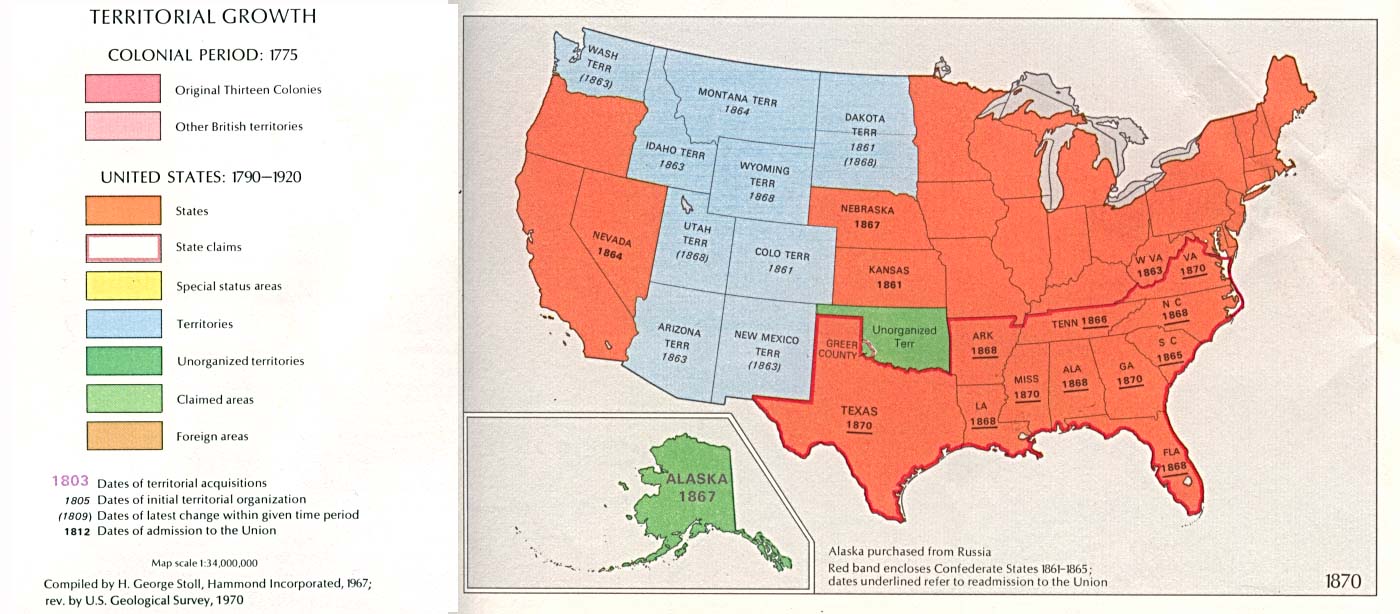
1939: Nelson Charles

On this date in 1939, Nelson Charles hanged for stabbing his mother-in-law to death in a drunken altercation.

Charles, an indigenous man and World War I veteran, was described by a retired U.S. Marshal who knew him as ” quiet, peaceful and polite person and I have never known him to even have an argument or get into trouble of any kind” — that is, when not drinking. Alas, both he and the victim, 58-year-old Cecilia Johnson, had an affinity for the stuff.

Though Charles committed this murder in “Indian Town” of segregated Ketchikan, Alaska, he hanged in the territorial capital of Juneau.

This was Juneau’s very first execution (previous Alaskan executions had occurred in Nome, Sitka, and Fairbanks), and the improvised gallows arrangement tucked into a stairwell pit under the outside staircase of the town prison is something to read about. One can do that in this here article of the Alaska Justice Forum.

The University of Alaska Anchorage also has a very moving essay written by the then-21-year-old cub reporter who was one of the dozen official witnesses:

Men have been stricken with fatal diseases and we have known they would die. We have held our buddies in our arms at the front and watched the last breaths spend themselves. But even then there had been hope, and when not hope, the awareness that death might stay away awhile. But none of that now; nothing less than a miracle could save this fellow and there are no miracles in this life. Soon he would be a stone.

From under his vest the marshal brought out the black hood. With the deputy standing on the other side, assisting him, he began to draw the thing onto the man’s head. I had not felt too bad until the priest had appeared in his long, black robes; I had seen those robes and tears had come. Nothing like tears came now, but still I hated the black, hated the hood. Take it easy now, you fool, I thought to myself. Look away for a few seconds. So I dropped my eyes and looked into the pit; then up again. They were having trouble with the hood. It was too small. Halfway on, its edge caught onto the man’s right ear.

“Fix my ear,” he said quietly. His last words. Like a small boy who is about to be punished and, with a half-sob, begs his parent to be careful not to break the toy in his pocket.

Read the rest of it here.

On this day..

1936: Arthur Gooch, the only execution under the Lindbergh Law

This date in 1936 marks the first and only occasion that the federal government hanged a (non-murdering) kidnapper under the Lindbergh Law.

Even before the notorious Lindbergh baby kidnapping case, the “snatch racket” of kidnappings for ransom had claimed a firm foothold among Depression-era America’s moral panics. The bill that would become known as the Lindbergh Law was actually introduced in Congress three months before little Charles Lindbergh, Jr. disappeared out the window of his New Jersey nursery. Its sponsors were Missouri lawmakers concerned that gang-ridden St. Louis was becoming a kidnapping hub, like the high-profile 1931 abduction of Dr. Isaac Kelley.*

The theory behind the bill — and this was particularly relevant to St. Louis, a border port right across from Illinois and accessible via the Mississippi River to the whole Midwest — was that kidnappers could more easily ply their nefarious trade by carrying their hostages over a convenient border and exploiting the respective states’ inability to coordinate with one another. By elevating interstate kidnapping to a federal felony, the idea was to put manhunts into the hands of the FBI, whose jurisdiction was the entire United States.

The Lindbergh case provided just the right impetus for Congress to advance into law a bill that might otherwise have died quietly in committee. There’s just something to be said for being the one with a plan at the right time … even though the Lindbergh baby was found dead four miles away from the house he was plucked out of, and probably never crossed a state line himself.

At any rate, the Lindbergh Law also made kidnapping alone a capital crime, even if the abductee was not harmed. And it is for this that Arthur Gooch ascended into barstool trivia.
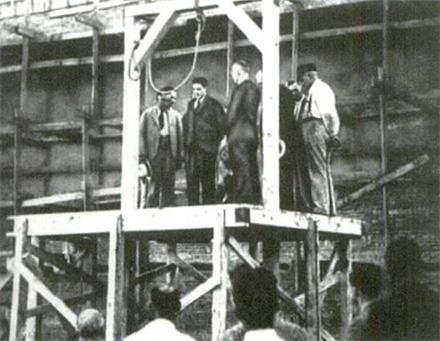
Gooch’s life and case are the focus of this 125-page Master’s thesis (pdf), but the long and short of it is that Gooch and a buddy named Ambrose Nix were on the lam after busting out of the Holdenville, Okla., jail, and ended up heading south to Texas.

They committed a robbery in Tyler, Texas on November 25, 1934. The next day, while stopped with a flat at a service station in Paris, Texas — close by the Texas-Oklahoma border — two policemen approached the suspicious vehicle. In the ensuing struggle, Nix managed to pull a gun on everyone and force the subdued cops into the back of their own patrol car, which the fugitives then requisitioned to high-tail it over the Oklahoma border. There they released their captives unharmed. There had never been a ransom attempt.

A month later, Gooch was arrested in Oklahoma — while Nix died in the shootout, leaving his partner alone to face the music.

Arthur Gooch was a career criminal, and the fact that he violated the Lindbergh Law was easy to see, but his crime also wasn’t exactly the scenario that legislation’s drafters had foremost in mind. In fact, Gooch also underscores one of the oft-unseen dimensions of the death penalty in practice: the discretionary power of prosecutors and judges at the intake end of the whole process.

Gooch attempted to plead guilty to his charge sheet, but his judge, former Oklahoma governor Robert Lee Williams, refused to accept it. Williams was explicit that his reason was that the Lindbergh Law’s language required a jury verdict to impose a death sentence.

By contrast, in October of 1934 — a month before the legally fateful confrontation at the Paris service station — a black farmhand named Claude Neal suspected of the rape-murder of a white girl was dragged out of protective custody in Alabama and taken across the adjacent Florida state line, where an angry mob lynched him. Despite the urging of the NAACP, FDR’s Attorney General Homer Stille Cummings completely refused to interpret Neal’s abduction as a Lindbergh Law kidnapping. The two cases even turned on the same phrase of the Lindbergh statute: interstate kidnapping “for ransom or otherwise.” While Cummings decided pre-emptively that “or otherwise” didn’t cover lynch law, one of his U.S. attorneys would go to the Supreme Court in January 1936 to argue for a broad interpretation of that phrase in the context of Gooch’s appeal.

But even without a comparison to Claude Neal’s murder, the justice of executing Arthur Gooch was hotly disputed by a vigorous clemency campaign. The chance intercession of a state line had elevated a small-time crime committed further to avoiding arrest into a capital offense, basically on a technicality. “It would be a rotten shame to hang that boy when a short jail term is his desert,” one Oklahoma City society woman argued to the Jeffersonian Club. “Gooch was given an application of the poor man’s law.” It seems clear that for Judge Williams as for President Roosevelt (who denied Gooch’s clemency appeal) the result was heavily influenced by the political exigencies of pushing a tough-on-crime standard, and by Gooch’s previous history as a crook. (He’d broken out of jail in the first place because he was a member of a group of local hoods in Okmulgee that committed several armed robberies.)

Gooch was philosophical at the end. “It’s kind of funny — dying,” he mused. “I think I know what it will be like. I’ll be standing there, and all of a sudden everything will be black, then there’ll be a light again. There’s got to be a light again — there’s got to be.” We can’t speak to what Gooch saw after everything went black, but it definitely wasn’t “all of a sudden”: Oklahoma’s executioner, Richard Earnest Owen, was an old hand with his state’s electric chair, but the federal execution method was hanging, which Owen had never before performed (and never would again). Gooch took 15 minutes to strangle at the end of the rope.


Arthur Gooch on the gallows

* The Kelley kidnapping, unsolved for several years, eventually traced to the strange character Nellie Muench. Readers (at least stateside ones) who follow that trailhead should be sure to keep an eye out for the cameo appearance of Missouri judge Rush Limbaugh, Sr. — grandfather of the present-day talk radio blowhard.

On this day..

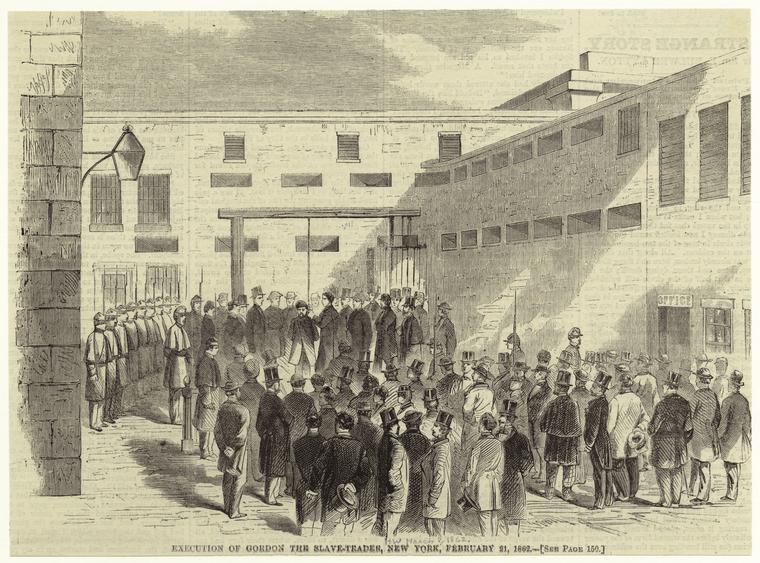
1862: Nathaniel Gordon, slave trader

On this date in 1862, the American commercial shipper Nathaniel Gordon was hanged at the Tombs for slave trading.

Importing slaves to the U.S. had been nominally illegal for over half a century, but had never been strongly enforced. In 1820, slaving (regardless of destination) had even been defined as piracy, a capital crime.

Importation of kidnapped Africans into the United States did significantly abate during this period, and that was just fine with U.S. slaveowners ever paranoid of servile rebellion.

But a voracious demand for conscript labor persisted elsewhere whatever the legal situation. About 3 million slaves arrived to Brazil and Cuba, the principal slave shipment destinations, between 1790 and 1860 — even though the traffic was formally illicit for most of this time.

Great Britain was endeavoring to strangle the Atlantic slave trade, but the diplomatic weight she had to throw around Europe didn’t play in the U.S. Washington’s adamant refusal to permit the Royal Navy to board and search U.S.-flagged ships made the stars and stripes the banner of choice for human traffickers profitably plying the African coast. “As late as 1859 there were seven slavers regularly fitted out in New York, and many more in all the larger ports,” one history avers.

Hanging crime? No slave-runner had ever gone to the gallows as a “pirate” — not until Nathaniel Gordon.

The U.S. Navy did mount its own anti-slaving patrols, but the odd seizure of human cargo was more in the line of costs of doing business than a legal terror for merchants.

So Gordon, son of triangle trade port Portland, Maine and a veteran of several known slaving runs, didn’t necessarily think much of it on August 8, 1860, when the Mohican brought Gordon’s ship to bear 50 miles from the Congo with 897 naked Africans stuffed in the hold, bound for Havana. Half of his slaves were children.

“The stench from the hold was fearful, and the filth and dirt upon their persons indescribably offensive,” Harpers reported.

Gordon chilled in very loose confinement in the Tombs, even enjoying family leave furloughs as he readied for the customary slap on the wrist.

But with Abraham Lincoln’s election in 1860, Gordon was promoted to demonstration case.

After a hung jury in June 1861, the feds won a conviction and death sentence on those long-unused piracy laws in November 1861.

Many New Yorkers were shocked at the prospect of such draconian punishment.

Abraham Lincoln found himself besieged by appeals public and private against the unprecedented judgment. “For more than forty years the statute under which he has been convicted has been a dead letter, because the moral sense of the community revolted at the penalty of death imposed on an act when done between Africa and Cuba which the law sanctioned between Maryland and Carolina,” Gordon’s counsel Judge Gilbert Dean wrote in an open letter to the President* — an argument that could hardly be more poorly calibrated to impress in 1862.

Despite Lincoln’s famous proclivity for the humanitarian pardon, he stood absolutely firm on the precedent Gordon’s hanging would set — especially in the midst of a bloody civil war driven by the very legal sanction Dean had cited so approvingly. As Lincoln wrote on February 4, 1862,

I think I would personally prefer to let this man live in confinement and let him meditate on his deeds, yet in the name of justice and the majesty of law, there ought to be one case, at least one specific instance, of a professional slave-trader, a Northern white man, given the exact penalty of death because of the incalculable number of deaths he and his kind inflicted upon black men amid the horror of the sea-voyage from Africa.

Gordon’s hanging was the one case — the only one ever.

* New York Times, Feb. 21, 1862.

On this day..

1903: Dora Wright, in Indian Territory

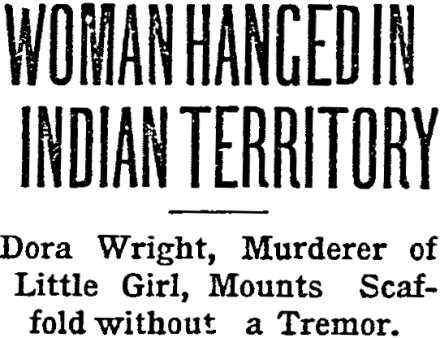
On this date in 1903, Dora Wright was hanged at McAlester in Indian Territory — the present-day U.S. state of Oklahoma.

Wright beat and tortured to death a 7-year-old orphan in her charge named Annie Williams. Wright tormented the little girl over several months until she finally succumbed to a thrashing in February 1903. It was, the local paper said, “the most horrible and outrageous” crime in memory in the area; Wright’s jury only needed 20 minutes’ deliberation to condemn her.

As Oklahoma was yet four years shy of statehood, “Indian Territory” jurisdiction — and with it any decision on executive clemency — fell to U.S. President Theodore Roosevelt. The inclination of the Rough Rider is aptly conveyed by the words of Attorney General Philander Knox‘s brief on the case to the President, which were released for press consumption:

The real facts in this case are that this woman tortured to death a little child seven years old, her niece, whom she was pretending to care for and support. She whipped the child most unmercifully with large switches, struck it about the hand and face so as to cause wounds sufficient to produce death, burned holes in its legs and thighs with a heated poker, and committed other nameless atrocities upon the person of the child. The testimony shows that the woman pursued a course of cruelty which was fiendish and barbarous … The only ground upon which her pardon is sought is that she is a woman, and that the infliction of the death penalty upon a woman would be a shock to the moral sense of the people in the community.

T.R. was incredulous at the feminine special pleading.

“If that woman was mean enough to do a thing like that,” Roosevelt said, “she ought to have the nerve to meet her punishment.”

Wright did have that nerve in the end, and was noted for the calm with which she comported herself on the scaffold. (She was hanged alongside another fellow, Charles Barrett, who shot a man dead in a robbery.)


From the Duluth (Minn.) News-Tribune, July 18, 1903.

On this day..

1835: Captain Pedro Gilbert and the Spanish Pirates

On this date in 1835, four Spanish pirates — it was supposed to be more — were put to death at Boston.

Their captain, the Catalan Pedro Gilbert, was chief among them in death as he was in life. Three years previous, he had commanded the buccaneer schooner with the deceptively cuddly name Panda out of Havana. It’s for Gilbert that “Gilbert’s Bar” is named, a historic sandbar off Stuart, Florida where the man reputedly liked to lure ships aground.*

Gilbert and his crew of forty or so souls — Spaniards, Portuguese, South Americans, half-castes, and at least one west African — waylaid the Salem, Mass. brig Mexican.

After hours ransacking the ship, relieving it of $20,000 in silver, the raiders locked the crew of their prize below decks and put the Mexican to the torch. After the Panda departed, those imprisoned unfortunates managed to break out of the death trap in time to control the blaze and return to port.

The incident thereby reported, the Panda would in due time be cornered off the African coast and sunk by a British ship. A dozen of the salty brigands fished out of the sea were eventually extradited to the U.S. for an eventful fourteen-day trial.


One of the crew of the Mexican, called upon to identify a member of the pirate crew who tried to drown him in a burning ship, strikes the accused corsair.

A defense lawyer laboring mightily in a half-lost cause managed to procure not-guilty verdicts for five of the crew on grounds of superior orders. The cabin boy (15 at the time of the raid) and the aforementioned west African were among these men spared.

The four who hanged today — Pedro Gilbert, Juan Montenegro, Manuel Castillo, and Angel Garcia — were meant to have been seven. Two of the seven received stays of execution; we’ll return to them in a moment.

The other man in the condemned party, Manuel Boyga, cheated his executioner, kind of, by exploiting a guard’s momentary inattentiveness to slash open his own carotid artery with a sharp bit of tin. He bled out too quickly for his executioners to “help” him, but because this efficient (near-?)suicide occurred immediately before the hanging, Boyga’s unconscious form was still borne in a chair to the scaffold and hung along with his four quick mates, just to make sure. Boyga might well have been dead already; if not, the hanging only hastened his demise by moments.

As to the other two: the ship’s carpenter Francisco Ruiz, it was thought, might have been crazy. But the Spanish-speaking physicians who eventually examined him would pronounce his ravings a simulation; he was accordingly hanged in a follow-up execution on September 12, 1835.

The last man was Bernardo de Soto, the first mate and the owner of the Panda.

De Soto’s pretty black-eyed wife back home caught wind of her man’s fate and made the Atlantic crossing to comfort her husband in prison … and to prostrate herself before the U.S. president Andrew Jackson who had the final say for clemency in this federal case. Duly smitten by this pleasing romantic flourish, Jackson did better than merely sparing de Soto’s life: he gave the condemned pirate a free pardon on July 6, 1835.

* Gilbert’s Bar today has the last remaining “House of Refuge”, once one of several standing 19th century encampments built to shelter any wayfarer who shipwrecked in the vicinity.

On this day..

1886: Joseph Jackson and James Wasson, at Fort Smith


St. Louis Globe-Democrat, January 31, 1886

America’s most notorious “hanging judge” Isaac Parker issued the sentences resulting in this date’s double hanging at Fort Smith, Ark.

A much more prodigious body count had been ordered initially by the court, but clemencies straight from the hand of U.S. President (and former hangman) Grover Cleveland averted five of seven death sentences on their eve of execution. All the killers under sentence, spared or no, committed their murders in Indian Country.

In February, 1886, seven men were sentenced to be hung on April 23, 1886, but before that day arrived the sentences of all but two had been commuted. The two unfortunates were Joseph Jackson, a negro, convicted of killing his wife at Oak Lodge, Choctaw Nation, on March 9, 1885, and James Wasson, a white man, who participated in the murder of Henry Martin in 1872, but was not apprehended until he took a hand in the killing of a man named Watkins in 1884.* (Source)

Jackson slashed his own throat with the shard of a vase in an unsuccessful bid to cheat the hangman, and sported a terrible gash on his neck when he hanged.

* According to the Atchison (Ks.) Daily Globe of April 30, 1885, Watkins was a cattle baron, whose widow wife then put a $1,000 price on Wasson’s head. The killer’s arrest ensued promptly. Although Wasson hanged for the earlier murder and not for that of Watkins, the aggrieved Texan woman “was here [at Fort Smith] every term of court after Wasson was brought in, and employed counsel to assist the District Attorney in prosecuting him, having, it is said, spent over $7,000 in bringing him to justice.” (St. Louis Globe-Democrat, April 24, 1886.)

On this day..

1963: Victor Feguer, by the feds

This date marks half a century since the hanging of Victor Feguer — the last man executed by the federal government in the 20th century. (And the last executed in the state of Iowa, period.)

A drifter holing up at a Dubuque, Iowa, boarding house, Feguer phoned up a random doctor claiming a woman needed medical attention.

Think about that the next time someone gets nostalgic for house calls.

Dr. Edward Bartels showed up only to be kidnapped by Feguer, and eventually murdered in Illinois. Feguer was picked up in Alabama, trying to sell the doctor’s stolen car; his motive for the whole affair was just to get whatever drugs the luckless physician had with him.

The cross-state crime spree put Feguer’s case in the hands of the feds. (It was not, however, a “Lindbergh Law” case, since Feguer was on the hook for capital murder independent of the kidnapping.)

Although Feguer spent his prison time at the federal lockup in Fort Leavenworth, Kansas, he was transported back to Iowa for execution — because that state’s penitentiary had a gallows available.

Iowa still had a death penalty on the books at this time, but it had a death penalty abolitionist for a chief executive; just two years hence, that Gov. Harold Hughes set his pen to the Hawkeye State’s death penalty abolition bill. Iowa hasn’t hanged, shot, electrocuted, poisoned, or otherwise judicially executed anyone since.

It was U.S. President John F. Kennedy, however, who had Victor Feguer’s life in his hands. Despite Gov. Hughes’s support for clemency, Kennedy turned the kidnapper down flat.

Feguer’s last meal, oddly, was a single olive. He tucked the olive’s pit into the new suit he wore to his dawn hanging.

As the death penalty waned into a formal abeyance in the 1970s in the U.S., the federal government stopped executing people for a long, long time. (And stopped hanging people altogether.) The next time a human being was put to death under federal auspices was 38 years later: Oklahoma City bomber Tim McVeigh.

On this day..

1929: Constantine Beaver, Alaskan native

On this date in 1929, Alaskan native Constantine Beaver hanged in Fairbanks, Alaska.

Described as a “woodsman”, Beaver shot his friend Egnatty Necketta during a drunken altercation the previous December.

Neither Beaver himself nor the several witnesses spoke or understood English, so much of the trial was conducted via interpreters. The jury, in finding him guilty, availed an option to remain silent as to the penalty, punting the decision to the judge — who went with hanging. Several jurors then protested, too late, that they hadn’t understood that was a possible outcome of their silent penalty decision.

In pre-statehood Alaska under federal governance, it was U.S. President Herbert Hoover 4,000 miles away in Washington who would have the final say in this affair — riding high, as it happened, at the very moment of the stock market peak right before the economic meltdown that would define his presidency.

Hoover said no.

Hopeful throughout the greater part of the night that a stay of execution would arrive Beaver bore himself with fortitude when informed that he must die. His only wish was that the intervening time might speed by so that his mental agony might be ended.

When Beaver reached the death chamber he broke into a tribal chant which continued until the floor opened beneath him.

It was “the saddest affair I’ve had to witness,” said a U.S. deputy who was present at the execution. And it was the last hanging ever conducted in Fairbanks.

Of possible interest: “American Indian Executions in Historical Context” by David V. Baker, a lengthy pdf.

On this day..

1875: Six in Fort Smith under Hanging Judge Isaac Parker

I have ever had the single aim of justice in view … ‘Do equal and exact justice,’ is my motto, and I have often said to the grand jury, ‘Permit no innocent man to be punished, but let no guilty man escape.’

Judge Isaac Parker

On this date in 1875, the most famous — or infamous, depending on your perspective — “hanging judge” of the American West dropped the trap on his noosing career with his first six hangings at Fort Smith, Arkansas.

Isaac Parker, around the time he arrived at Fort Smith

Isaac Parker had parlayed a legal career in Missouri into a congressional seat, when the fall of the Arkansas Republican party’s fortunes late in Reconstruction swept him out of office in 1874.

No problem: his co-partisan president, Ulysses S. Grant, appointed Parker to a federal judgeship in neighboring Arkansas. It’s upon that renowned tenure that the man’s reputation, uh, hangs.

Parker arrived at Fort Smith on May 4, 1875, the youngest federal judge in the west and a man whose jurisdiction included the lawless Indian Territory (present-day Oklahoma).

This expanse of land, the final destination of the Trail of Tears, had once been preserved for tribes forcibly “removed” from eastern North America.

But by the post-Civil War years, the frontier was sweeping past on iron wheels … and as long as Indian Territory remained (mostly) protected from white settlement, it remained a sparsely-populated refuge for outlaws.

Pandemonium in the Territory was only exacerbated by the Fort Smith court’s reputation for corruption and inefficiency; the office was open for Parker’s appointment because his predecessor had resigned to avoid impeachment.

Judge Isaac Parker came to clean up the place.

Fort Smith was an unusual portfolio for a federal judge. While most of Parker’s colleagues were confined to the tedium of interstate civil litigation, Parker was the court of first call for many regular criminal cases in the Indian Territory which in other jurisdictions would have been a state matter. He estimated in 1885 Congressional testimony that seven-eighths of his caseload came from Indian Territory.*

And in those cases he quickly established himself a reputation for severity.

“I never hanged a man,” Parker said of himself later in life. “The law hanged him. I was only its instrument.”

But make yourself the law’s instrument to the tune of 79 hangings, and folks are bound to sit up and take notice.


“they nearly hung me for stealin’ a horse
in Fort Smith Arkansas.

Judge Parker said guilty and the gavel came down
just like a cannon shot …”

At his court’s very first sitting in May 1875, Parker death-sentenced a murderer — Daniel Evans, who came straight from frontier central casting and had murdered a man for his boots.

As that year unfolded, he added enough condemned men to the bowels of the miserable jail nicknamed “Hell on the Border” — for an eight-strong hanging date to christen September.

One of the eight had his sentence commuted due to youth.

One was shot trying to escape.

And the other six were the debut crop for the mass-occupancy gallows that Parker ordered constructed at Fort Smith. (Its capacity was a full dozen.)


Modern replica at Fort Smith — today a national historic site — of Judge Parker’s gallows. (cc) image from photoguyinmo.

The clientele was six unconnected murderers, committing various atrocities for various motives and aptly embodying the region’s ethnic diversity.

  • Evans, white
  • James Moore, white
  • Samuel Fooy, quarter Cherokee
  • Smoker Mankiller, Cherokee
  • Edmond Campbell, black
  • John Whittington, white

And the audience? Five thousand or so reportedly on hand in Fort Smith this date, plus a national media audience … and posterity deep into the second century since this sturdy magistrate donned his first black cap and set about putting chaos into order with a rope in his hand.


New York Tmes, September 4, 1875.

Whatever one might have to say about his methods, Parker presents a magnetic personality, a figure so truly of his own time and place that he obligingly died just weeks after his court was finally relieved of its Oklahoman jurisdiction in 1896. He’d never hang around to jolt our anachronism meter by weighing in on trench warfare or cubism.

Parker is undoubtedly a more layered figure than his “hanging judge” reputation would suggest, and even his life’s project to bring his unruly jurisdiction to heel was more complicated than just being a hardass. (He had a significant administrative challenge to manage his chronically underfunded court, and he needed to foster the sense of communal reciprocity and legal integrity that would encourage fellow-citizens to turn up for jury duty and witness testimony that make the law’s everyday business possible.) The judge was famous for the long hours he kept, and capital cases were never more than a tiny fraction of his work.

Parker was notorious (slash-beloved, again depending on perspective) for his prosecution-friendly courtrooms, but even the tough sentences he handed down came in his mind from a place of tough love. He wrote late in life that

not one of [those he suffered to long prison terms for violent crimes], no matter how depraved, had entirely lost that better part of human nature …

The object of punishment is to revive, that in some cases, almost extinct spark, to lift the man up, to stamp out his bad nature and wicked disposition, that his better and God given traits may assert themselves.*

Still, whether you prefer him as the stern avatar of law on an outlaw plain or bloodthirsty yahoo, Parker’s ready amenability to latter-day Hollywood tropes will surely maintain his popularity in the cultural rookery of wild west cutouts.

Among numerous other reference points, the novel True Grit, and the 1969 and 2010 films based on it, use Judge Parker’s Fort Smith as the heroine’s embarkation point — with her dangerous journey carrying her into the untamed Indian Territory on his doorstep.

Pat Hingle’s “Judge Fenton” (from “Fort Grant”) in the Clint Eastwood western Hang ‘Em High also shows an unmistakable debt to the Judge Parker persona.

A few books about Judge Parker


Spare a thought, too, for the man operating the ropes and levers this date.

George Maledon, named Fort Smith’s official hangman just a couple of years before Isaac Parker’s appointment, would enforce the Hanging Judge’s hanging sentences into the 1890s: 60-plus executions in all, plus five other escaping prisoners he gunned down, all in a day’s work for an Arkansas lawman.

Maledon has a sad coda to this story, which wasn’t so upbeat to begin with.

The year after the veteran hangman hung up his hood and opened a grocery store, Maledon’s daughter was murdered. The bereaved father’s friend Judge Parker, still on the bench at that time, condemned the killer to die in a case we’ll suggest might have warranted a recusal by present-day standards. Nevertheless, a successful appeal balked Maledon’s successor of the malefactor, and the disgusted ex-executioner got his species of payback by taking the accoutrement of his late profession on the road as a traveling act.

There, under the billing of “the Prince of Hangmen,” Maledon lectured and exhibited old hanging ropes and pictures of the outlaws they had choked.

People of all classes flocked to the show grounds, crowded about the lecturer and filled the tent, viewing the gruesome relics and listening to the old hangman’s recital of soul-stirring events as he pointed out the…instruments of his vocation. (Source)

* See Mary Stolerg, “Politician, Populist, Reformer: A Reesamination of ‘Hanging Judge’ Isaac C. Parker”, The Arkansas Historical Quarterly, Spring 1988

Part of the Themed Set: Americana.

On this day..

1938: Anthony Chebatoris, in death penalty-free Michigan

This post was contributed by Andrew Gustafson, a writer and cartographer based in Brooklyn, NY. Andrew’s work can be found on his website, and he regularly blogs about New York City history and culture for Urban Oyster Tours.

On this date in 1938, Anthony Chebatoris was hanged at the federal prison in Milan, Michigan, becoming the only person executed in Michigan since it gained statehood in 1837.

Chebatoris and an accomplice, Jack Gracy, rolled into Midland, Michigan on September 29, 1937, with the intention to rob the Chemical State Bank. They never did get their hands on the cash, and only one of them would leave the town alive, though with a proverbial noose dangling from his neck. The two men, armed with a pistol and a sawed-off shotgun, entered the bank and approached the bank manager, Clarence Macomber, with guns drawn. In the ensuing scuffle, Chebatoris shot Macomber and another bank employee, Paul Bywater. Upon hearing the shots, Frank Hardy, a dentist whose office was next to the bank, grabbed the loaded deer rifle he kept handy and went to the window to see what the commotion was about. As Chebatoris and Gacy abandoned the botched robbery empty-handed, Hardy began firing at the fleeing robbers, hitting Chebatoris in the arm and causing him to crash the getaway car he was driving. As the wounded men looked for another escape route, Chebatoris spotted a uniformed truck driver named Henry Porter, whom he mistook for a police officer, and shot him. The men then tried to hijack a truck to make their escape, but as Gacy attempted to climb into the cab, the sharpshooter Hardy shot him in the head from 150 yards away, killing him instantly.* Chebatoris took off on foot and was apprehended a short distance away, exhausted and bleeding.

Chebatoris would survive his injuries, as would the bank employees Macomber and Bywater. But the innocent bystander Henry Porter put our convict on the road to the gallows: after two weeks in the hospital, Porter would succumb to his injuries, and murder would be added to the charges against the surviving bank robber. Michigan had outlawed the death penalty for murder in 1846, becoming the first U.S. state to do so. But Chebatoris found himself subject to a legal system that had been changed by New Deal politics and the public’s panic over escalating violence and criminality. Federal prosecutors took on the case, under the authority of the National Bank Robbery Act of 1934, which was passed in response to the rash of bank holdups across the country. The law gave the federal government the authority to prosecute anyone involved in the robbery of a bank that was a member of the Federal Reserve System or the newly created Federal Deposit Insurance Corporation. Unluckily for Chebatoris, Chemical State Bank was a member of both.

With a mountain of evidence against him, Chebatoris was easily convicted, and on November 30, 1937, he was sentenced to death by federal judge Arthur Tuttle. The case set off a political controversy in Michigan, one that would pit an anti-death-penalty governor against federal judges and prosecutors who wanted the sentence passed down and carried out in the state. Under the federal statute, federal death sentences could only be carried out in states that had their own death penalty. While Michigan had long abolished capital punishment for murder and other crimes, it still kept an obscure law on the books allowing execution for treason (which has never been exercised, as it is unclear how one would commit treason against the state of Michigan). This loophole allowed the federal capital prosecution and execution to proceed within the confines of the staunchly abolitionist state.

In response to the decision, Michigan Governor Frank Murphy said, “There hasn’t been a hanging in Michigan for 108 years. If this one is carried out in Michigan, it will be like turning back the clock on civilization.” Illinois, which had its own electric chair, offered to finish off Chebatoris, but Judge Tuttle ordered that the execution should proceed in Michigan, noting, “The just verdict having been returned, the law was mandatory in the three respects, namely that the penalty should be death, that it should be hanging, and that it should be within the state of Michigan. These last two requirements resulted from the fact that Michigan has one statute providing for the death penalty by hanging. If the sentence had been different in any one of these respects, it would have been unlawful. I have neither the power nor the inclination to change the sentence.”

Chebatoris was transferred from the Saginaw County Jail, where he had been held throughout his trial, to the federal prison in Milan. At 5 a.m. on July 8, 1938, he was brought to the gallows, and before 23 witnesses, including an inebriated hangman named Phil Hanna, he was hanged. In the middle of the night before the execution, Hanna had arrived at the prison demanding that his three drunken friends be admitted to the hanging. After an argument with the warden and a call to the director of the Federal Bureau of Prisons, Hanna was allowed to proceed with execution, and the warden acceded to his demands (though at the time of the execution, the warden barred the three friends from the proceedings, knowing that the room was too dark, and Hanna too drunk, for him to notice their absence).**

Chebatoris’ execution was both a unique event and a bellwether for things to come in the federal death penalty system. Since 1927, he is the only person to be executed for a murder committed in a state that does not have its own death penalty statute. After World War II, executions, both federal and state, went into a steep decline across the United States, culminating in the 1972 Supreme Court decision Furman v. Georgia, which struck down every capital punishment statute in the land. Four years later, the death penalty was revived in Gregg v. Georgia, and it took barely six months for states to resume executions. The federal government was slower, however, and the first post-Furman federal death penalty statute did not appear until 1988. Since that date, however, we have seen the steady expansion of the federal death penalty, building on the precedents set by the National Bank Robbery Act. Rather than targeting bank robberies, the federal government has used the death penalty to take aim at other perceived scourges, employing it is a weapon in the various domestic “wars” on crime, drugs, and terrorism.

In the past twenty years, the federal death penalty has been transformed from a seldom-used punishment for pirates and crimes committed in the territories to an expansive weapon that can be imposed in a wide range of jurisdictions, leading the Criminal Defense Network to conclude that “virtually every homicide occurring within federal jurisdiction is now death-eligible.”† The greatest expansion of the federal death penalty came with the 1994 Violent Crime Control and Law Enforcement Act, which greatly expanded federal jurisdiction and authorized the death penalty for nearly 60 different crimes. And the reach of the federal death penalty has continued to expand, even into states like Michigan that have rejected capital punishment.

There are currently 58 people sitting on the federal death row, nine of whom committed their crimes in states that either do not have a constitutionally valid state death penalty statute or have active moratoriums on the death penalty.‡ Interestingly, all of those nine were sentenced to death during the tenures of Attorneys General John Ashcroft and Alberto Gonzalez, and their decisions to pursue capital prosecutions marked a departure from the actions of their predecessors. Early in his term, John Ashcroft revised the U.S. Attorneys Manual and removed language about the Department of Justice’s policy towards seeking the death penalty in states that did not have their own capital punishment statutes. Previously the manual stated that in these states, “penalty-driven decisions to file federal charges are inappropriate.” That language was removed, and presumably this opened the door for the increase in prosecutions, convictions, and death sentences handed out in federal districts located within abolitionist states. Since Chebatoris’ execution, no one who falls into this category has been executed, and current Attorney General Eric Holder has signaled a return to the earlier practices, meaning the federal government will be less inclined to pursue these kinds of cases. Nevertheless, it is likely that at least one of these nine will eventually be executed.

When that happens, Anthony Chebatoris will no longer be a solitary historical footnote.

* Hardy was a hero, but he is not nearly as celebrated as another bank robbery foiler, Northfield, Minnesota’s Joseph Lee Hayward, who is remembered annually at the town’s “Defeat of Jesse James Days.” Perhaps Midland could build its own tourist attraction around Hardy?

** For a detailed account of the case of Anthony Chebatoris, read Aaron Veselenak’s article in the May/June 1998 issue of Michigan History Magazine, “The Execution of Anthony Chebatoris.”

† From Burr, Dick, David Bruck and Kevin McNally (2009). “An Overview of the Federal Death Penalty Process.” Capital Defense Network.

‡ These death row inmates are: Carlos Caro (WV), Donald Fell (VT), Marvin Gabrion (MI), Dustin Honken and Angela Johnson (IA), Ronald Mikos (IL), Alfonso Rodriguez (ND), Gary Sampson (MA), and Kenneth Lighty (MD). For a description of their cases, visit the Death Penalty Information Center. All are held in the Federal Correctional Complex in Terre Haute, IN, with the exception of Gary Sampson, who is being held in New Hampshire. For more information on these cases, visit the Death Penalty Information Center.

On this day..