1922: James Mahoney, Seattle spouse slayer

On this date in 1922, James Mahoney hanged in Washington’s Walla Walla penitentiary for one of Seattle’s most notorious crimes.

Two years prior, a 36-year-old Mahoney had been released from that same prison after serving time for assault and robbery, then moved into a Seattle boarding house with his mother and sister.

He soon struck up a romantic involvement with the house’s owner, Kate Mooers. She was 68 years young, but James Mahoney was broad-minded enough to admire her wealth.

On April 16, 1921, the night the two lovebirds were supposed to hop a train for their honeymoon in Minnesota, James Mahoney hired a company to move a steamer trunk to Lake Union, and load it into a rowboat. Kate Mooers was never seen again, but Mahoney resurfaced in Seattle ten days later claiming that she’d decided to extend her honeymoon with a long jaunt to Havana, Cuba. In the meantime, well, hubby would be looking after her affairs.

Alerted to the suspicious events by Mooers’s nieces, police kept Mahoney under surveillance for three weeks as he gobbled up his wife’s assets. He was finally arrested before he could skip town, but only on charges of forging documents during his embezzlement binge. For harder charges to stick, Kate Mooers had to be located.

According to a HistoryLink.org profile,

Captain [Charles] Tennant had a theory and ordered divers to begin searching the bottom of the northeast end of Lake Union near the University Bridge for a steamer trunk. Finally, having survived 11 weeks of criticism, the police found the trunk containing Kate Mahoney’s body. It bobbed to the surface on August 8, 1921, almost exactly where Captain Tennant said it would be. The autopsy revealed that Kate had been poisoned with 30 grains of morphine, stuffed in the trunk, then had her skull smashed with a heavy blunt instrument. Two days later, Jim Mahoney was charged with premeditated murder.

Resigned to his fate as his appeals dwindled away, Mahoney was reported to be in excellent spirits in his last days. He also made a written confession on the eve of his execution, forestalling his sister’s desperate attempt to claim the murder as her own in order to stay the hangman’s hand. (The sister still caught a jail term for forging Kate’s signatures.)

Now you must be brave and forget me. My whole life has been a torture to those who love me, and even as a little boy I used to dream of dying this way, and my dream has at last come true.

… If my soul can do you any good in the next world I will always be watching over you. Good-bye and God bless you all.

-Jimmie

On this day..

1889: Alfred Schaeffer, diabolical dynamiter, lynched near Seattle

From the Chicago Daily Inter Ocean, January 8, 1889 (paragraph breaks added for readability: the original had none at all):

A DIABOLICAL DYNAMITER.


After Killing Three Persons and Wounding Others He Is Barbarously Lynched

SEATTLE, Wash. T., Jan. 7. — Alfred Shaffer [sic], a Bohemian, fired a heavy charge of giant powder under the house of George Bodala, at Gilman,* thirty miles east of Seattle, at 4:30 o’clock this morning, instantly killing John and Michael Scherrick, and Anna, the 9-year-old child of Bodala, and badly wounding Bodala, his wife, and little son and daughter.

Last spring Bodala caused the arrest of Schaeffer on the charge of criminal assault upon his wife. Schaeffer was sentenced to a short term of imprisonment, and when he was released he made such serious threats against the life of Bodala that he was again arrested, and incarcerated in jail nine days.

When he was released he returned to Gilman, and since then he lost no opportunity attempting to injury Bodala, and this morning put his threats into execution. The two Scherricks and the little girl were instantly killed.

Bodala was brought to the Providence Hospital to-day, and is in a very bad condition. The other three will probably recover. Schaeffer was found by the people of Gilman at his own house. He was placed under arrest, and later in the afternoon, upon the arrival of the sheriff, turned over to that officer.

This afternoon while the Sheriff was at dinner a crowd of 100 broke open the door of the house where Schaeffer was confined, took him to a tree opposite the railroad depot, and strung him up, first trying to make him confess.

He refused, and was hanged.

After thirty seconds he was cut down again and given another chance to confess, still declining he was again elevated and cut down for a second time after forty-five seconds.

He was then very weak, and, efforts to make him confess failing, he was again pulled up, and left hanging until death ensued.

* Present-day Issaquah.

On this day..

1949: Jake Bird

(Thanks to Meaghan Good of the Charley Project for the guest post. -ed.)

Contrary to what all the slasher films would have you believe, an ax does not make a very good murder weapon. Axes are big. They are heavy. They are difficult to conceal. When used they create a big mess. And if you are caught with one, it’s hard to come up with a suitably innocuous explanation for it.

Nevertheless, this was Jake Bird’s weapon of choice on October 30, 1947, when he broke into Bertha Kludt’s home and killed her and her seventeen-year-old daughter, Beverly June.
Perhaps if he had used a different weapon, things would have turned out differently. As it was, the two women’s screams — and that’s another problem with the ax: unless you can wield it like Gimli, the victim is going to survive the first blow and start hollering — attracted two police officers, who apprehended Bird after a foot chase.

This excellent History Link article provides a thorough account of Bird’s life and crimes. 45 years old at the time of his arrest, he was a drifter and a ne’er-do-well with an extensive criminal record. He’d spent a third of his life in prison for various offenses. Bird openly confessed to the Kludt killings, saying the murders were the result of a botched burglary.

One of the police officers who testified at the trial admitted he beat the daylights out of Bird after his arrest. Naturally, the defense moved to throw out the murder confession on the grounds that it was obtained under force, but the judge ruled that the police brutality and Bird’s statements were “unrelated” and so the confession was admitted into evidence.

This was the attorney’s only attempt to defend his client; he called no witnesses and presented no evidence at the trial.

In all fairness, it must be said that Bird was spattered with gore when he was arrested, they found his fingerprints in blood at the crime scene and on the ax, and he’d left his shoes at the Kludt house. So the confession didn’t figure to be exactly decisive.

This would be a fairly unremarkable murder case, but shortly after his arrival on Death Row, Bird suddenly discovered he had an excellent singing voice. For the next several months he detailed 44 murders from all across the country which he claimed he’d committed during his wanderings. Most of his victims were women.

Bird’s claims, if true, would make him one of America’s most deadly serial killers, right up there with the much more famous Ted Bundy and the Green River Killer, Gary Leon Ridgway. One inevitably wonders if all of his statements were genuine. Henry Lee Lucas, another violent drifter much like Bird, admitted to hundreds of homicides and captivated police from all over the nation before it was discovered that many of his confessions were lies.

Police in several states did find Bird credible, though. Bird was calm and ready for his hanging, which went off without a hitch. He willed his estate, valued at $6.15, to his appeals attorney.

On this day..

1858: Qualchan

“Qualchan came to see me at 9 o’clock, and at 9:15 he was hung.”

George Wright

It was this morning in 1858 that the gaily dressed Yakama Indian guerrilla Qualchan turned himself in to his Anglo hunter, and was promptly put to death.

Wright was prosecuting the Yakima War in the Pacific Northwest — another characteristic Indian conflict featuring a formerly remote tribe suddenly cursed with valuable land by the discovery of gold.

Qualchan (sometimes “Qualchen”, “Qual-Chen”, or “Qualchien”) was among the Yakima chieftains resisting “encouragement” to give up that part of their territory most desirable to white settlers, and eventually, Qualchan killed encroaching white miners and made himself an outlaw.

For more than two years, the army hunted Qualchan in vain as he harried white settlers around Washington — or, as Wright put it,

Qual-Chen … has been actively engaged in all the murders, robberies, and attacks upon the white people since 1855, both east and west of the Cascade Mountains … committing assaults on our people whenever the opportunity offered.

Late in the game, the American military had been reduced to a Bushian with-us-or-against-us posture:

Kamiakin and Qualchan, cannot longer be permitted to remain at large or in the country, they must be surrendered or driven away, and no accommodation should be made with any who will harbor them; let all know that asylum given to either of these troublesome Indians, will be considered in future as evidence of a hostile intention on the part of the tribe.

The expedient that induced this potent commando to throw his own life away was the capture of Qualchan’s father, Owhi, rather dishonorably effected on an invitation to parley, then parlayed into a threat to execute the hostage lest the wanted Yakima produce himself.

“I thought then the worst that could happen would be a few months’ imprisonment,” remembered Qualchan’s wife (who was also present). “You may imagine my terror and consternation when I saw that they were making preparations to hang my husband. I first thought it was a huge joke, but when I saw the deliberateness of their preparations, the fullness of their treachery and cowardice became apparent.”

And since the U.S. was maintaining that draconian view of Qualchan’s collaborators, Wright followed up his triumph with summary hangings over the next several days of several more Palouse. By the month’s end, he was prepared to declare the Indians “entirely subdued.”

Wright’s rough peace caused the nearby creek in eastern Washington to be christened “Hangman’s Creek”, though there’s been a tendency to steer away from that frightful name in recent times. But what better way to honor an indigenous foe of colonial land conquest than by naming a golf course for him?

The unfolding fate of the Yakimas is further explored in the public-domain book Ka-mi-akin, the last hero of the Yakimas, whose title character was Qualchan’s uncle.

On this day..

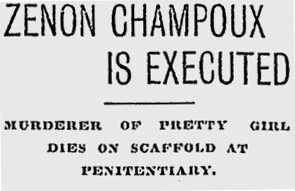
1904: Zenon Champoux, French degenerate

On this date in 1904, the state of Washington carried out its first execution under the auspices of a new law requiring that hangings be held in that state’s penitentiary in Walla Walla.*

Its subject was French-Canadian laborer Zenon Champoux, and his crime was as flamboyant as his moniker: publicly planting a knife in the forehead of a dance hall girl who did not return his affections.

The first man executed under the auspices of the Evergreen State, we admit, is a milestone that’s a bit on the smaller side.

But we think his name stands out admirably in the annals, especially paired with a characterization like the Seattle Star gave him: French degenerate.

“Zenon Champoux, French Degenerate” — it’s the scoundrel who’s rogering your girl, or else the branding on his designer condoms. On this date in 1904, it was just the guy at the end of his rope.

* Previously, hangings had been conducted by counties, in public. Laws removing them to the auspices of the state and behind the walls of a prison were in vogue at the time.

Washington went on to abolish the death penalty in 1913, only to reinstate it again in 1919.

On this day..

1993: Westley Allan Dodd, child molester

Just after midnight this date in 1993, Washington state carried out the first legal hanging in the U.S. since 1965.

Pornstached child molester Westley Allan Dodd is the textbook “incorrigible sex offender” case study. That’s certainly how Dodd himself asked us to interpret him.

“I have said all along the system does not work,” he wrote of his long career in pedophilia, notoriously unrehabilitated by the criminal justice system. “I knew what I was doing, I knew it was wrong. I knew I could get the death penalty if caught.”

From the usual humble beginnings in teenage child-groping, and despite several arrests over the years, Dodd devolved into abducting young boys to actualize horrific fantasies he did not scruple to jot in his journal.

Incident 3 will die maybe this way: He’ll be tied down as Lee was in Incident 2. Instead of placing a bag over his head as had previously planned, I’ll tape his mouth shut with duct tape. Then, when ready, I’ll use a clothespin or something to plug his nose. That way I can sit back, take pictures and watch him die instead of concentrating on my hands or the rope tight around his neck — that would also eliminate the rope burns on the neck . . . I can clearly see his face and eyes now…

He suspects nothing now. Will probably wait until morning to kill him. That way his body will be fairly fresh for experiments after work. I’ll suffocate him in his sleep when I wake up for work (if I sleep).

In short: not the nicest guy, though also a monster as much pathetic as diabolic.

Dodd pleaded guilty to his three sex murders, and fought for his own execution. The state of Washington obliged him in a speedy three years.

Although the Evergreen State had lethal injection on the books, Dodd also availed his right to select its holdover alternative method, hanging.

Those kids didn’t get a nice, neat painless easy death. Why should I?

Which justification’s nobility (such as it is) is considerably more socially gratifying than, say, a hankering for the gallows’ post-mortem priapism.

(He didn’t get everything, though: they turned down his request to televise the hanging.)

Not content with his headline-grabbing mode of departing the world, Dodd had a hand in a statutory milestone, too. His stranger-danger nightmare case surfacing in the fall of 1989 was part of the background that drove Washington to pass the nation’s first sexually violent predator law, the Community Protection Act of 1990.*

Trutv.com’s Crime Library has a good deal more about the mind of this particular maniac.

* It was really Earl Shriner’s crimes more than Dodd’s that led most directly to the new law, which licensed indefinite “civil commitment” of sexually violent predators after the completion of their criminal sentences.

On this day..

1858: Chief Leschi

On this date in 1858, Chief Leschi of the Nisqually tribe was controversially hanged at Fort Steilacoom (present-day Lakewood) in the Washington Territory.

Yankee officer Isaac Stevens only spent four years in the Washington Territory as Franklin Pierce’s appointed governor, but he left his stamp on the state.

And no project defined the tenure of this authoritarian executive like putting the screws to the native peoples. Growing white settlement in the Pacific Northwest was creating conflict with the Indians who already inhabited it. In time, that conflict would claim Leschi.

Late in 1854, Stevens summoned the chiefs of several tribes in the newly-minted Washington Territory for an offer they couldn’t refuse: pack up and move to reservations of a few square miles’ undesirable territory, ceding 2.5 million acres to white settlers.

Chief Leschi — and it was Stevens’ men who had designated him a “chief”, the operation upon an alien culture of a bureaucracy that required official spokesmen — allegedly refused to sign the Treaty of Medicine Creek, although the evidence is unclear. Whatever the truth of that matter, sufficient signatures were cajoled for the government to ratify an agreement for massive dispossession, and Leschi became a prominent voice in the growing Indian dissatisfaction once the extent of the hustle became clear.

An attempt to arrest Leschi, who increasingly feared white assassination, touched off the Puget Sound War in 1855, and with an analogous conflict brewing on the other side of the Cascade Mountains, all Washington was soon a conflict zone.

That story’s end is predictable enough, but Leschi’s fate was protested by both native and white contemporaries. Leschi was condemned for “murdering” a militiaman during hostilities, a charge whose logic flowed from the rights asserted by American authorities but whose fundamental injustice (even leaving aside the very doubtful factual evidence) seems manifest, as it did to the defendant.

I have supposed that the killing of armed men in wartime was not murder; if it was, the soldiers who killed Indians are guilty of murder too.

George W. Bush would’ve called him an illegal combatant. That was hardly common sentiment.

So much good will did Leschi enjoy among whites — with whom he had years of amicable relations prior to Gov. Stevens’ arrival — that a scheduled January 22 hanging was deviously put off by the sheriff charged with the task: he arranged to have himself arrested on a liquor charge while in possession of the death warrant shortly before Leschi was to have been hung, and the two-hour window allotted for the execution of the sentence elapsed before matters could be put right.

They carried the sentence out four weeks later — “I felt then I was hanging an innocent man,” executioner Charles Grainger would say, “and I believe it yet” — but that hardly put an end to Chief Leschi’s story. The Nisqually have pushed hard for Leschi’s official exoneration, and won a Washington Senate resolution to that effect and an “acquittal” (of no legal force) from a panel of state jurists. But even though it attached to a convicted murderer, Leschi’s was never a black name in the state; it adorns a Seattle neighborhood and a number of schools and other public places. (“Stevens” is similarly prominent.)

There’s an excellent summary of the Leschi case from Oregon Historical Quarterly, a Washington State Historical Society website, and a 1905 public domain book published to make the case for Leschi.

On this day..

1888: Jochin Henry Timmerman, “don’t let them take you alive”

On this date in 1888, Jochin Henry Timmerman was hanged across from the cemetery in Goldendale, Washington for the murder of a freight driver.

The account of this bit of local color in a territory still a year away from statehood comes from Washington’s HistoryLink website.

The page includes a lengthy account of the crime and capture of the only man ever hanged in Klickitat County. We excerpt here the affair’s climax.

Because Timmerman steadfastly maintained his innocence, the execution was scheduled to take place after the arrival of the April 6 daily overland mail stage. This was in case Territorial Governor Eugene Semple (1840-1908) sent a stay of execution. Early Klickitat Valley Days states “Friends of Timmerman had a skilled long distance rider with a swift saddled horse waiting at a railroad telegraph station (in) Grant, Oregon, 15 miles from Goldendale, across the Columbia River. A steam ferry tug waited on the Oregon shore, so the rider would not be delayed, if a coveted life saving yellow envelope was placed in his hands” (p. 78). Governor Semple sent no telegram, and the mail stage arrived without a letter of reprieve.

Timmerman, meanwhile, was given a quart of whiskey upon awakening and allowed to consume it all in preparation for his ordeal. The execution took place in Goldendale under Sheriff VanVector’s [sic] direction on a gibbet erected directly across from the town cemetery. The event drew a large crowd. Cora E. Van Hoy Ballou, who watched the execution as a young child, later remembered her mother calling to her and her sister on the morning of April 6, “Wake up children, pappy has gone to the barn to get the team. We’re going to town to see the hanging” (Early Klickitat Valley Days, p. 78). The Van Hoy family was not alone: The Washington Standard reported that more than 3,000 people witnessed Timmerman’s execution.

Timmerman rode to his execution in a wagon sitting up in his own coffin, reportedly smoking the cigar. He mounted the scaffold unassisted and tossed the cigar butt into the crowd, who fell upon it and fought for bits as souvenirs. Local tradition later told that just before his hanging Timmerman prophesied that Goldendale would soon be destroyed by fire, and indeed, on May 13, 1888, a little more than a month after Timmerman’s execution, seven blocks of Goldendale’s business district did burn down.

Timmerman went to his death maintaining his innocence. His last words are reported to have been this advice: “All I can say is that if you ever get caught in a scrape like this, don’t let them take you alive”

On this day..