On this date in 1894, Sante Geronimo Caserio was guillotined in Lyon, where he had assassinated the president of France two months before.
In the day when the terror stalking European order brandished the black flag of anarchy, the Italian immigrant Caserio (his first name can be rendered either Sante or Santo, and his middle name alternately as Jeronimo, Ironimo or Heironymus) escalated the “propaganda of the deed” into the nightmares of Europe’s executives.
Before the decade was out, the Prime Minister of Spain, the King of Italy and the Empress of Austria-Hungary would all likewise be murdered by Italian anarchists.
As one might imagine, Caserio played the role of cocksure martyr to the hilt: asked whether he repented, he vowed to kill another president if given a few minutes; he refused to pursue a mental illness defense or inform on comrades; and at the guillotine, he exhorted the onlookers, “Forza, compagni! Viva l’anarchia!” (The New York Times account of the beheading recounts Caserio’s background, from an obviously hostile class position.)
By the time Caserio lost his head, the propaganda of his deed had already provoked mass arrests of Italians, and a tightening of the lois scelerates (“villainous laws”) cracking down on dissidents.
But as always, one person’s evildoer is another’s hero, and Caserio has his online monuments — like this Italian page, or this blog entry, or this rendition of one of the several songs in his honor:
In an artsier vein, one can also follow the thread of the story to Les Bal des Innocents, a downloadable French production billing itself as “The first feature film under Creative Commons Licence.”
On this date in 1944, Nazi Germany’s juridical vengeance against Hitler’s near-assassins commenced.
Barely two weeks after Col. Stauffenberg‘s bomb had barely missed slaying the Fuhrer, eight of his principal co-conspirators stood show trials at the Volksgerichtshof (People’s Court) before hectoring prig Roland Freisler.
The outcome, of course, was foreordained.
Apparently orders had come down from on high to make the deaths as degrading as possible; this batch, convicted August 7-8, was hanged naked this day at Berlin’s Plotzensee Prison on thin cord (piano wire, say some sources, although it’s not clear to me whether this is literally true) suspended from meathooks while cameras rolled. Video and stills from the ghastly scene were shipped back to Hitler’s bomb-damaged Polish outpost for the edification of the powers that be.
Many hundreds more would follow, both at Plotzensee and throughout the Reich where persons distantly connected to the plotters and various miscellaneous resistance figures were swept up in the purge.
Minutes after midnight this date in 1944, four senior Wehrmacht officers who had come within an ace of murdering Adolf Hitler less than 12 hours earlier were summarily shot in Berlin — the first of thousands executed for the most famous assassination attempt on the Fuhrer.
One of those rare moments where historical epochs (arguably) turn on the minutest exigencies of chance, the so-called July 20 plot had seen Col. Claus Schenk Graf von Stauffenberg insinuate a bomb into Hitler’s conference room in modern-day eastern Poland, then fly back to Berlin to mount a coup d’etat.
Blam
Stauffenberg had every reason as he left Wolfsschanze to believe the devastating blast at 12:42 p.m. must have killed the Nazi dictator. Little did he know that another officer at the table where the high command was plotting strategy for the eastern front had, in the name of legroom, shifted the deadly satchel to the other side of a heavy oak table support — shielding Hitler from the brunt of the explosion.
Four men died. Hitler had hearing loss, an injury to his right arm, and one hell of a grudge.
Stauffenberg weaseled out of the confused bunker and flew back to Berlin, expecting that his confederates were even then launching Operation Valkyrie — a contingency plan for martial law in the case of civic disturbance that the conspirators intended to use to mount a coup.
Failure to Communicate
Control and distribution of information was not the least of the many threads in the tapestry of July 20, 1944. Hitler had risen to power on his artful grasp of propaganda; today, his headquarters’ mastery of communications would overpower the putschists’ rank amateurism.
While en route, Stauffenberg had no ability to communicate to the wider world. Landing in Berlin three hours after the not-quite-deadly-enough blast at Wolfsschanze, he must have been stunned to find that Valkyrie had not been launched. Apparently, fragmentary reports from the east were unclear as to whether Hitler had survived; everyone was reluctant about committing himself.
Frantically, Stauffenberg — already deeply committed — rallied his comrades and set the treasonable gears into motion. But by this time, communications with Hitler’s headquarters had been re-established and contradictory reports of the assassination attempt’s success were flying in Berlin. Stauffenberg’s sincere but incorrect eyewitness testimony of Hitler’s death became increasingly untenable. Compounded by the sluggish and ill-coordinated action of the conspirators, officers of a more opportunist bent soon began lining up with the bad guys.
Joseph Goebbels, the senior Nazi in Berlin and Hitler’s wizard of public relations, was inexplicably left unmolested for hours — long enough to phone the radio station (also never seized) an announcement of Hitler’s survival. “To think that these revolutionaries weren’t even smart enough to cut the telephone wires! My little daughter would have thought of that.”
Conspirators’ orders to military units around Berlin went out late, piecemeal, and far too often fell on ears already deaf to the appeals. In some cases, the proclamations that should have been queued up for inundating the airwaves instantaneously were with some other officer not on the scene, and consequently were haphazardly redrafted on the fly — for telex operators who had caught the day’s drift themselves and intentionally delayed or ignored them.
From the perspective of a radio editor it was tragic. Tragic because the way in which details were handled made it obvious that this revolt had had very lithe chance of succeeding. (Source)
The coup fell apart almost as soon as it began.
Fromm Here to Eternity
Most decisively of all, timely information had prevented any participation by Gen. Friedrich Fromm, Stauffenberg’s commanding officer and the head of the Reserve Army — it was that position that allowed his aide access to Hitler’s person, and it was under his authority that the putschists were issuing their Valkyrie orders.
Fromm fell in the “opportunist” camp, and would have been ready to strike had the Fuhrer been demonstrably killed. But a telephone connection straight from the scene of the crime assured him that Hitler had survived … and that his adjutant was a wanted man.
Fromm the potential collaborator quickly turned the tables on Stauffenberg and company late on the night of the 20th.
The Schwein Abides
Before advancing to our heroes’ foreordained fate, take a moment to appreciate this newsreel rushed into production to assure the German public that everything was under control. It’s an impressive advance on statist slick-talking from Germany’s World War I clunkers (like this):
Notice Hitler greeting Mussolini — the two had been scheduled to meet that day; it would be their last encounter in this world. His maimed right arm hanging concealed beneath a greatcoat, Hitler shakes left-handed.
Fromm … had quickly made up his mind to eliminate these men and not only to cover up the traces — for though he had refused to engage actively in the plot, he had known of it for months, sheltering the assassins and not reporting their plans — but to curry favor with Hitler as the man who put down the revolt. In the world of the Nazi gangsters it was much too late for this, but Fromm did not realize it.
He … announce[d] that “in the name of the Fuehrer” he had called a session of a “court-martial” (there is no evidence that he had) and that it had pronounced death sentences on four officers: “Colonel of the Genera Staff Mertz, General Olbricht, this colonel whose name I no longer know [Stauffenberg, his aide], and this lieutenant [Haeften].”
…
In the courtyard below in the dim rays of the blackout-hooded headlights of an Army car the four officers were quickly dispatched by a firing squad. Eyewitnesses say there was much tumult and shouting, mostly by the guards, who were in a hurry because of the danger of a bombing attack — British planes had been over Berlin almost every night that summer. Stauffenberg died crying, “Long live our sacred Germany!”
The courtyard of the Bendlerblock on modern-day Stauffenbergstrasse in Berlin, where Col. Stauffenberg and three compatriots were shot. Photo by Daniel Ullrich, licensed by CC-by-sa.
Minutes after they died, the SS arrived on the scene and forbade any further executions of potential witnesses.
Fromm’s gambit didn’t work any better than Stauffenberg’s had: he was arrested right away, and was himself later shot.
What If?
While the afternoon’s theatrics may have been doomed from the moment Hitler arose unkilled from the bomb’s debris, his miraculous escape from death — “confirmation of the task imposed upon me by Providence,” he told the nation in a radio address an hour after Stauffenberg’s execution — is an inexhaustible mine for historical hypothesizing.
That the bomb could have, and would have with the least change in the principle variables, slain the dictator is widely accepted; a 2005 reconstruction of the blast scene by the Discovery Channel supports that belief in the context of the cable-documentary-friendly format* of Adolf Hitler plus slow-mo explosives. (Parts 1, 2 and 3 of this series set up the episodes excerpted here with the plot’s historical background and the crew’s investigation into the precise dimensions of the blast space — a combination of file footage, modern recreation shots, talking heads, and tromping about the forest in the modern remains of Wolfsschanze.)
But that’s the easy what-if.
More problematic — and well into the realm of bar-stool dickering — are the questions of what would have happened if the explosive had hit its target.
Stauffenberg enjoys latter-day popularity in Germany — the street where he was shot bears his name — in no small measure because of the confessedly quixotic nature of the attempted murder. Indeed, he probably died at the height of his potential popularity for history.
But it’s not for nothing that this attempt (though it did have many botched antecedents) took place in the weeks when Germany’s military position went from desperate to disastrous. Over the preceding two months, Soviet offenses had pushed the front back to the prewar Polish border, and the Normandy landing had opened a rapidly expanding western front. The assassination had a healthy dose of self-interest … and therefore was at least potentially antithetical to other interests at play in the great conflagration.
The motivation of sparing the Fatherland the ravages of war on its own soil is not ignoble of itself, of course. But given this opposition circle’s years-long failure to take effective action against Hitler while he went from successful crime to successful crime, one might ask a little more than a late-breaking suicidal gambit for unreserved historical vindication.
The German military’s deal with the devil had seen Europe’s greatest armed forces squandered by its dumbest commander. The end result would bleed the Nazi state white at unspeakable human cost … but also, arguably, towards one of the better postwar outcomes imaginable.
And would the coup even have achieved the goal of leaving Germany unoccupied? It seems impossible to think that any outcome would have been worse than Hitler, and the last year of the war was also its bloodiest … but among the spectrum of counterfactual alternatives, the appealing possibilities mostly seem to work out in spite of the plotters, rather than because of them.
1. Civil War?
Countercoups, or even outright civil war, might very likely have erupted between rivals for succession. This might have worked out as the best-case situation — fragmenting German resistance and hastening the inevitable — but it might also have given Germany a leaner, meaner fascism with a path to enduring long-term. Predicting any particular arrangement of players to emerge from this black box is a just-so story, and any of them probably leads to one of the other three alternatives; certainly the plotters weren’t banking on their own subsequent overthrow.
2. Status Quo Ante?
The coup might have utterly failed to obtain peace. German was close to defeat; the Allies were demanding unconditional surrender, and the entire point of the plot was to surrender on better terms than that. Had no quarter been offered, the putschist government might then have fought on (either by choice, or by the compulsion of internal politics) to much the same end, although quite plausibly with much less gratuitous bloodletting in the camps. Accidentally abating the Holocaust would be a very significant plus, of course, but probably not what posterity has in mind when it goes naming streets for the man.
3. World War Against Russia?
The new government might have successfully made peace with the western Allies, which was its fervent hope. Under the circumstances of the summer of 1944, that practically implied the continuation of the global war with the capitalist and fascist powers aligning against the USSR. The horrors of the eastern front up to the summer of 1944 then would likely pale in comparison to what followed. You could tell the story so that it all works out in the end, but replacing the long Cold War with an immediate hot war, especially with the United States less than a year away from its first successful A-bomb test, isn’t exactly a presumptive improvement.
4. 1918 Redux?
In the all but unimaginable case that the post-Hitler government successfully sued for peace on both its fronts (or accepted unconditional surrender), it would have had to give up to a Soviet buffer zone much of what the Soviets ultimately conquered. Millions who died fighting for it, and millions more who died in concentration camps while the fighting played out, and millions of women raped by the conquering Red Army, would have considered that arrangement an improvement; still, the peace itself could have ensconced a less crazy and therefore more durable military dictatorship in central Europe, which wouldn’t necessarily seem like an altogether positive outcome vis-a-vis the actual postwar history. More worryingly, this might have horribly recapitulated the post-World War I scenario in which the liberal politicians who accepted defeat, and not the crazed reactionaries who caused it, were blamed for the loss, fueling the subsequent rise of some unattractive revanchist successor state. Precisely because that example would have been uppermost in the officers’ own minds, it’s hard to believe this least-bloodthirsty path would have been the actual consequence of the coup.
And so on …
Second-order effects from any of these possibilities generate a novelist’s trove of alternative histories. What would the map of eastern Europe have looked like? Whither European Jewry … and therefore the postwar state of Israel … and therefore the political chessboard in the Middle East? What would an early resolution in Europe have meant for the Pacific theater, or for the Chinese revolution? How would decolonization movements have been affected had the war concluded earlier, or had it transformed into a worldwide anti-Communist war?
Postscript
Somewhere in those alternate realities, staff at the re-education camp are bantering over happy hour about what would have happened if Stauffenberg had failed.
Who knows if “internally peacable European social democracies” are a bullet point for the pie-eyed optimists, or the incorrigible pessimists?
A few of the books about Stauffenberg and Operation Valkyrie
Poor Col. Stauffenberg is due to be played by a smirking Tom Cruise in the biopic Valkyrie, a role that has drawn some slightly overheated controversy in Germany over Cruise’s adherence to Scientology.
On a sweltering July 7, 1865, a mere 12 weeks after Abraham Lincoln was shot at Ford’s Theater, four of his assassin’s accomplices were hanged in the courtyard of the District of Columbia’s Washington Arsenal — present-day Fort McNair, and specifically its tennis courts.
Booth, on the far left, playing Marc Antony in Julius Caesar opposite his brothers. He had Brutus’ example in mind, as he wrote in his diary while on the run: “with every man’s hand against me, I am here in despair. And why? For doing what Brutus was honored for.”
The exact nature of the conspiracy against the man who had seen the North to victory in the Civil War has been debated ever since actor John Wilkes Booth lodged a ball from his one-shot Derringer behind Honest Abe’s ear. But it was a conspiracy — an astoundingly bold one.
Simultaneous with Booth’s successful attack upon Lincoln, there was an unsuccessful attempt to kill Secretary of State William Seward; it would emerge in the investigation that another man had been detailed to murder Vice President Andrew Johnson, but got drunk and chickened out. The apparent upshot: with the President and Vice President dead, new national elections would be required to replace the Senator who would become acting president — and with the Secretary of State dead too, there’d be nobody to implement them. Booth was trying to paralyze the North with its own constitutional machinery in some desperate hope of reviving the defeated South.
Ten Against D.C.
Hundreds were detained in the stunning assassination’s immediate aftermath, but ten would ultimately be the federals’ targets. A massive manhunt pursued Booth through southern Maryland and into Virginia, where he was killed in a shootout. John Surratt, who had conspired with Booth in an earlier plot to kidnap the president — that failed plot had been reconfigured into the assassination — escaped from the country.
The other eight were rounded up and stashed at the Arsenal to face a military tribunal. It was a highly controversial arrangement: the war had entered a gray area — Robert E. Lee’s surrender just days before the murder had effectively ended the war, but when the trial opened in May Confederate President Jefferson Davis was still at large, and the last Southern general wouldn’t lay down his arms until late June. The District of Columbia was still technically under martial law … so would it do to use a military court?
Military Tribunal
So the government asked itself: government, would you rather have looser evidentiary rules and a lower bar of conviction than you would have in civil court? The government duly produced for the government an opinion that the military characteristic of the assassination — that is, to help whatever southern war effort still obtained — licensed the government to use the military courts.
That didn’t sit well with everyone. One former Attorney General griped:
If the offenders are done to death by that tribunal, however truly guilty, they will pass for martyrs with half the world.
Indeed, a year later, the Supreme Court’s landmark ex parte Milligan ruling would forbid the use of military courts where civilian courts are open — which they were in Washington, D.C.
That, of course, was too late to help Booth’s comrades. It would be a military trial, with a majority vote needed for conviction and no right of appeal but to the president for the most infamous crime of the Republic. Everyone had a pretty good idea what the results would be.
Rogues’ Gallery
Two of the four today were doomed from the outset under any juridical arrangement imaginable: Lewis Powell (also known as Lewis Paine or Lewis Payne) had made the attempt on Secretary of State Seward; David Herold had guided him there with the getaway horse, and later escaped along with Booth. They were in way past their eyeballs. George Atzerodt, the schmo who couldn’t rise to the occasion of popping Andrew Johnson, looks a bit more peripheral from the distance of a century and a half, but in the weeks following the assassination he was much too close to the action to have any hope. All received death sentences.
Two others — Michael O’Laughlen and Samuel Arnold — had been involved in Booth’s earlier scheme to kidnap the president, but didn’t seem to have much to do with the murder. Still another two — Ned Spangler and Dr. Samuel Mudd* — were lesser participants. They all received long prison sentences for their pains, and the three of them still surviving were pardoned by Andrew Johnson as he left the presidency in 1869.
That left Mary Surratt, mother of the fugitive John and the only woman in the dock, the focus of attention and controversy. The 42-year-old widow owned a downtown boardinghouse, plus a tavern of sufficient importance at a Prince George’s County, Maryland, crossroads, that its community was called Surrattsville.**
The conspirators met frequently in her lodgings; Surratt maintained her innocence beyond that, but evidence and witness testimony began to pile up heavily against her … especially when Seward assailant Lewis Powell wandered into her place looking for refuge right while the police were questioning her. Booth and Herold turned out to have made a pit stop at her Surrattsville tavern to pick up a package of guns that Mary had prepared for them.
Though Surratt’s avowal of ignorance was not widely believed, a gesture of presidential mercy was anticipated — many thought (and think) she went on trial as a virtual hostage for her absconded son, who declined to take the bait. Strangely, five members of the nine-judge panel who condemned Mary Surratt turned around and asked President Johnson for clemency. Johnson claimed never to have seen the memo, but his mind seemed pretty made up — when Surratt won a habeas corpus stay on the morning of her scheduled hanging, he promptly “specially-suspended” the writ specifically to hang her:
I, Andrew Johnson, President of the United States do hereby declare that the writ of habeas corpus had been heretofore suspended in such cases as this; and I do hereby specially-suspend this writ, and direct that you proceed to execute the order heretofore given upon the judgment of the Military Commission.
Harsh treatment, and possibly well-deserved, for the first woman executed by the U.S. government. Even so, it does seem a curious thing when all is said and done that the mother of “the nest that hatched the egg” was worth a special suspension of the Great Writ, and even the stagehand who just held Booth’s horse for him caught six years, but old Jeff Davis — who apart from having figureheaded a treasonous four-year insurrection was implicated for giving Booth’s kidnapping plot official Confederate sanction — got to retire to write his memoirs.
The Surratt houses, by the way, are still standing. The Maryland tavern is kept as the Surratt House Museum by the Surratt Society. The downtown boarding house is a Chinese restaurant … marked with a plaque remembering more momentous doings than bubble tea.
* The panel voted 5-4 to hang Mudd, a Maryland doctor who not only set the leg Booth broke when he leaped onto the stage after shooting Lincoln, but then misdirected Booth’s pursuers. However, the rules for the trial said a two-thirds majority was required for execution.
** They changed the name after the unpleasantness. Today, it’s Clinton, Maryland.
On this date in 1882, America’s weirdest assassin recited fourteen verses of the Gospel of Matthew and (sans requested orchestral accompaniment) a poem of his own composition entitled “I am Going to the Lordy,” and was hanged in the District of Columbia jail for shooting forgettable Gilded Age president James Garfield.
Mad as a march hare, Charles Julius Guiteau had irritated the obscure reaches of the Republic near four decades, trying his hand at free love, law, newspapering* and evangelism. A contemporary account of his religious flimflammery survives:
Charles J. Guiteau (if such really is his name), has fraud and imbecility plainly stamped upon his (face). (After) the impudent scoundrel talked only 15 minutes, he suddenly (thanked) the audience for their attention and (bid) them goodnight. Before the astounded 50 had recovered from their amazement…(he had taken their money and) fled from the building and escaped.
Having failed at each characteristic American monkeyshine more comprehensively than the last, he naturally gravitated to politics; while today Guiteau might tilt with his psychoses on some vituperative blog, in 1880 he published and delivered as a speech a widely-ignored crackpot encomium** for his eventual victim. Guiteau reckoned the GOP carried the 1880 elections on the strength of such rhetorical thunderbolts as “some people say he [Garfield] got badly soiled in that Credit Mobilier transaction but I guess he is clean-handed.”
Stunned that his contributions did not earn him a diplomatic posting to France, Guiteau stepped out of obscurity and into this blog’s pages by shooting the ungrateful (and unguarded) executive in the back at a Washington, D.C. train station (since demolished, and today occupied by the National Gallery of Art).
“To General Sherman: I have just shot the President. I shot him several times as I wished him to go as easily as possible. His death was a political necessity. I am a lawyer, theologian, and politician. I am a stalwart of the Stalwarts. I was with Gen. Grant, and the rest of our men in New York during the canvass. I am going to the Jail. Please order out your troops and take possession of the Jail at once. Very respectfully, Charles Guiteau.” (Click for the full image.) From the Georgetown Charles Guiteau collection.
Thoughtfully, he had already hired a cab to take him to jail, where he expected to be liberated by General William Sherman.
Malpractice
The bugger of Garfield’s assassination is that Guiteau was no better at killing presidents than he was at electing them. Despite his exultation “Arthur is President now!”, he actually inflicted what could have been a non-fatal flesh wound that through ten-thumbed medical intervention became an agonizing eighty-day Calvary for the miserable Garfield.
Doctors jabbed unwashed hands into the the wound, failing to dig out the bullet they were looking for but successfully turning the three-inch wound into a crater, puncturing Garfield’s liver, and passing him Streptococcus. Alexander Graham Bell invented a metal detector to find the missile, but the damn thing gave a bad reading … because Garfield was lying on a bed with metal springs. His doctors, feuding with one another and with the press, instituted a regimen of rectal feeding — “Nutritive enemas — consisting of beef bouillon, egg yolks, milk, whiskey, and several drops of opium … Garfield’s flatulence became intolerable,” according to one biographer — that “basically starved him to death.”† He lost 100 pounds before succumbing; the autopsy concluded that Garfield probably would have lived if not for the medical attention, which didn’t stop the doctors from submitting a sizable invoice to the feds for services rendered.
Horribly hilarious, this American Absurdistan. “Except for the dead-serious details of his assassinating President Garfield and being in all likelihood clinically insane, Charles Guiteau might be the funniest man in American History,” Sarah Vowell put it.
Guiteau’s circus trial — with the defendant constantly interrupting to harangue participants, object to his own attorneys or converse with the spectators, plus the macabre appearance of the late Garfield’s actual vertebrae (now at Washington D.C.’s National Museum of Health and Medicine) as an exhibit — was for all that a landmark test of evolving law around criminal insanity.
Just as Garfield probably would have survived his injury had he been treated by the next generation’s medical norms, Guiteau probably would have survived his brush with the law if treated by the next generation’s legal norms.
Against an almost-too-strict-to-achieve earlier bar for legal insanity, a more accommodating jurisprudential norm called the M’Naghten Rules or M’Naghten Test was even then being adopted from English courts: essentially, did the “criminal” realize his act was wrong? Still the basis for legal insanity claims in much of the U.S. today, the first trial of a presidential assassin would be the M’Naghten standard’s trial by fire.
While the judge gave ample leeway for the defense to use M’Naghten, the legal standards it implied were still not widely understood and the medical testimony about Guiteau’s mental condition was (embarrassingly, for the profession) wildly contradictory. Ultimately, the judge cued the jury that “the law requires a very slight degree of intelligence indeed” on Guiteau’s part to impute him with sufficient criminal culpability to hang. There were cheers in the courthouse when the jury took an hour to decide that Guiteau had that very slight degree of intelligence indeed.
In the final analysis, as Charles Rosenberg observes in The Trial of the Assassin Guiteau: Psychiatry and the Law in the Gilded Age, the jurors’ prompt conviction of the widely hated, barking-mad defendant underscored the real-life constraints of dry legal theory as applied by an outraged community to a notorious offender:
[T]he Guiteau case demonstrated anew that the circumstances of a particular case had ordinarily as much to do with its disposition as the precise injunctions of rules of law … Many observers agreed after the trial that if an individual of Guiteau’s marked eccentricity had killed an ordinary man … he would almost certainly not have been convicted; very likely he would not even have been brought to trial. Similarly, while Garfield lay on his sickbed, it was commonly assumed that his assailant would be institutionalized if the President should survive. But if not, then not.
Reckoning the gesture could cost him the 1884 Republican nomination, Chester A. Arthur declined to spare his “benefactor” (“Arthur has sealed his own doom and the doom of this nation,” was Guiteau’s reaction, picturing fire and brimstone) and left Guiteau to his strange and lonely fate. The latter was talked out of an early plan to go to the gallows in the Christlike garb of only his undergarments, but did insist upon delivering his incoherent parting ramble in a high-pitched childlike tone (“the idea is that of a child babbling to his mama and his papa”).
Wrapping up this surreal historical episode in a neat little bow, Charles Guiteau got his own bluegrass tune:‡
* One of Guiteau’s failed newspaper ventures was to exploit the telegraph to reprint original content from other outlets. That one looks a lot less harebrained in retrospect: it’s a primitive model of the wire service, and latterly of RSS-based distributors like Google News.
‡ The “Charles Guiteau” ditty is actually a rather shameless knock-off of a murder ballad for James Rodgers, an Irish immigrant hanged in New York in 1858.
On this date in 1975, a Saudi prince knelt in the public square before Riyadh’s Great Mosque, and 10,000 onlookers watched a golden-hilted sword took off his head for regicide.
It is little enough to say that, twelve weeks before, Faisal ibn Musa’id (transliterated several different ways — ibn or bin; Musa’id, Musaid, Musaed, or Musad) had approached his uncle King Faisal and shot him three times at point-blank range.
The reason(s) why a prince of the realm should do such an extraordinary thing are the real issue. They were murky then, and remain so to this day.
Certainly, when the monarch of the world’s leading oil producer is slain shortly after denying his product to the world’s leading oil consumer … well, speculation is bound to happen, even if the oil embargo was wrapped up a year before the murder. The assassin had studied (lackadaisically) in the United States a few years before, fueling hypotheses of a CIA hit, but there’s not even much of a satisfying just-so story to go with that, to say nothing of supporting evidence.
Whatever reasons there were seem to have been internal — a personal vendetta arising ultimately from the kingdom’s uneven confrontation with modernity so sensitively treated in Abdelrahman Munif’s Cities of Salt novels.*
The prince’s brother Khalid (or Khaled) had been slain by Saudi Arabia’s security forces in 1965 after demonstrating against television’s entry into the kingdom, an innovation authorized by King Faisal to the chagrin of strict Wahhabists. Khalid remains a martyr figure to Islamic fundamentalists to this day, and the conventional supposition is that Prince Faisal shot King Faisal in vengeance served 10 years cold; some accounts have him announcing as much at the moment of the murder.
(The conspiratorial palace intrigue version suspects Prince Fahd (or Faud) of using the aggrieved young man as his instrument in a coup; a defector from the Saudi diplomatic corps also inculpated Fahd along these lines. King Faisal’s death made Fahd the de facto ruler of Saudi Arabia upon the accession of a politically disinterested brother; Fahd ascended the throne officially when that brother died in 1982 — the succession was passing brother-to-brother, rather than father-to-son — and had steered the ship of state for 30 years by the time of his own death in 2005.)
The official inquiry concluded, as such things do, that Faisal killed Faisal alone, and though early reports had the shooter mentally unbalanced, authorities eventually figured him sane enough for trial and the full measure of the law’s majesty.
Faisal ibn Musa’id remains the only royal prince judicially executed by the House of Saud.
* An assassination inspired by Faisal’s shows up in the second novel of the cycle, Trench.
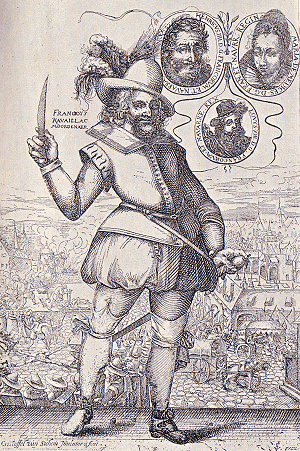
After decades of voluptuously indecisive Catholic-versus-Hugeunot slaughter, matters had finally been settled by the man upon whom French absolutism would erect its (ill-fated) edifice.
Henri IV, the first Bourbon monarch and a Huguenot, had unified the country by the sword, capped by his memorably politic conversion to Catholicism in 1593 to win over the holdout capital of Paris — the occasion of his understated declaration that “Paris is worth a mass”.
Let us tarry here to appreciate “the good king Henri” in a kaleidoscope of flattering artwork to the tune of Vive Henri IV, the monarchy’s unofficial anthem after its subject’s passing:
Did you catch that last image?
Henri’s fine gesture of sectarian triangulation and the reign of relative calm it inaugurated were naturally resented by godly partisans of both camps who either considered his conversion a betrayal or considered the king a closet Protestant.
Readers unconstrained by time may enjoy this Tolstoyan trek into the regicide’s mind and milieu, but it will suffice us to say that the modern shotgun-wielding postal clerk who just seemed like a quiet, harmless type to all his coworkers might like the cut of Ravaillac’s jib. A bit of a loner, a bit of a professional washout, with a penchant for religious visions and a passel of ill-arranged grievances … by this point in the movie, that’s about what you expect the police profiler to be reciting.*
It is only right that such a contemporary-sounding lone nut story ought to have a vigorous conspiratorial counternarrative.
There has always been a strong suspicion that behind Ravaillac’s hand was the work of the scheming Catholic Duc d’Epernon, perhaps even with the complicity of Henri’s wife Marie de’ Medici, who had conveniently been crowned as queen the day before the murder** and promptly teamed up with Epernon to cement an alliance with a traditional French rival, the ultra-Catholic Habsburgs.
all of [her] actions were prejudicial to France … Marie de’ Medici wasted the wealth amassed by Henri IV.; she never purged herself of the charge of having known of the king’s assassination; her ‘intimate’ was d’Epernon, who did not ward off Ravaillac’s blow, and who was proved to have known the murderer personally for a long time. … [T]he victory Richelieu at last won over her (on the Day of the Dupes) was due solely to the discovery the cardinal made, and imparted to Louis XIII, of secret documents relating to the death of Henri IV.
The historical jury is out on that question, presumably for good.
If Ravaillac was a conspirator, he proved to be a damned good one, denying under repeated torture that he had any accomplices. On this date, the tortures reached their crescendo and conclusion — to the horrible delight of the Parisian mob, as reported by Alistair Horne (via The Corner):
On 27 May, still protesting that he had acted as a free agent on a divinely inspired mission, Ravaillac was put to death. Before being drawn and quartered, the lot of the regicide, on the Place de Grève scaffold he was scalded with burning sulphur, molten lead and boiling oil and resin, his flesh then torn by pincers. Then his arms and legs were attached to horses which pulled in opposite directions. One of the horses “foundered,” so a zealous chevalier offered his mount; “the animal was full of vigour and pulled away a thigh.” After an hour and a half of this horrendous cruelty, Ravaillac died, as the mob tried to prevent him receiving last rites. When he finally expired,
“…the entire populace, no matter what their rank, hurled themselves on the body with their swords, knives, sticks or anything else to hand and began beating, hacking and tearing at it. They snatched the limbs from the executioner, savagely chopping them up and dragging the pieces through the streets.”
Children made a bonfire and flung remains of Ravaillac’s body on it. According to one witness, Nicholas Pasquier, one woman actually ate some of the flesh. The executioner, supposed to have the body of the regicide reduced to ashes to complete the ritual demanded by the law, could find nothing but his shirt.
Ravaillac was the last Frenchman drawn and quartered for a century and a half — but his punishment as a regicide formed the precedent for that handed down in 1757 to Damiens.
* No need, though, as Francois wasn’t hard to catch: he stepped up to Henri’s carriage when it was caught in a traffic jam on May 14, 1610, and stabbed the king to death plain as can be. He was lucky (sort of) to avoid a lynching.
Early this morning in 1941, a Swiss theology student had his head cut off at Berlin’s Plotzensee Prison for plotting to kill Adolph Hitler.
Maurice Bavaud, 25 at his execution, cuts one of the more quixotic (the link is French) of the many figures who schemed Hitler’s death — and also one of the more affecting, for at this early date he might have spared Europe most of the great war’s horror.
But Bavaud was also, fundamentally, a poor assassin.
Apparently motivated by pique at Germany’s repression of Catholicism — he’s most commonly cast as a lone gunmen, although there are also theories that he was affiliated with a wider network of students — Bavaud slipped into Germany in 1938 and spent the ensuing weeks knocking around Bavaria looking for a chance to do the thing.
That November, the chancellor turned up for the 15th anniversary of the Beer Hall Putsch* … to which Bavaud secured VIP seating. The aspiring assassin had only a low-caliber pistol, but as the Fuhrer passed his vicinity, a copse of saluting arms from the spectators around him obstructed any chance to shoot. November 9, 1938 instead became famous for other reasons.
One can appreciate at this juncture the young man’s discouragement and desire to leave Germany. One can understand that, penniless, he felt obliged to sneak aboard a passenger train. But one will strain very hard to imagine why even the most desperate straits should impel a man to do either of these things while still carrying the incriminating pistol and notes revealing his plans. When he was nabbed for skipping the fare, his situation quickly became catastrophic, with the help of Gestapo torturers. (One can see, in Bavaud’s own hand, a 1940 letter to his family informing them of his sentence here.)
Switzerland essentially exerted no diplomatic effort on behalf of their subject, and this fact informed the Swiss courts which, years after the war, posthumously reduced Bavaud’s sentence. Germany eventually paid reparations to the family of the man who tried to off their head of state.
The young man had kept his political affiliations rigorously secret from his close-knit bourgeois family. Little could he have suspected that the boy he shared a room with —
— would render his own passion a footnote in perhaps the 20th century’s epochal event.
Seventeen-year-old Vladimir Ilyich Ulyanov, years yet from the moniker “Lenin” by which history knows him, was supposedly fired by this event with a vow for vengeance and the politically mature resolve that “we will go another way!” — that is, another way than terrorism. Here’s the manful young Bolshevik* consoling his grief-stricken mother with revolutionary ardor:
But Lenin’s radicalization seems in fact to have not even begun as of this date, when he was consumed with studying for his exams (in a month’s time, he would graduate with a gold medal from a school headed by the father of Lenin’s future opponent during the Russian Revolution).
Though Lenin’s eventual political persona would comprehensively reject his brother’s tactics, the impression Alexander left upon him must have been profound. According to Tony Cliff in Building the Party: Lenin, 1893-1914, Vladimir Ilyich grappled with Narodism, Marxism and their proper relationship throughout his political development during his university years, and at least at certain moments Narodism appeared compelling to him.
Many of them [Russian Social Democrats] had begun their revolutionary thinking as adherents of Narodnaya Volya. Nearly all had in their early youth enthusiastically worshipped the terrorist heroes. It required a struggle to abandon the captivating impressions of those heroic traditions, and the struggle was accompanied by the breaking off of personal relations with people who were determined to remain loyal to the Narodnay Volya and for whom the young Social Democrats had profound respect.
Lenin mastered that struggle. In the end, he indeed went another way.
* Except there was no such thing yet, but never mind.
I am a woman who has awoken
I have arisen and become a tempest through the ashes of my burnt children
I have arisen from the rivulets of my brother’s blood
My nation’s wrath has empowered me
My ruined and burnet villages replete me with hatred against the enemy
O compatriot, no longer regard me as weak and incapable
My voice has mingled with thousands of arisen women
My fists are clenched with fists of thousands of compatriots
To break together all these sufferings, all these fetters of slavery
I am the woman who has awoken
I’ve found my path and will never return.
Meena was assassinated in Quetta in 1987 just shy of her 31st birthday; that her killer(s) be brought to justice was long one of RAWA’s key political demands, and the organization supported this day’s hanging.
RAWA itself — which enjoyed a brief turn at the height of worldwide vogue as the United States prepared to invade Afghanistan and found itself suddenly inspired by the plight of women under the mullahs — holds its fallen founder as a martyr and continues to agitate.

 In the day when the terror stalking European order brandished the black flag of anarchy, the Italian immigrant Caserio (his first name can be rendered either Sante or Santo, and his middle name alternately as Jeronimo, Ironimo or Heironymus) escalated the “propaganda of the deed” into the nightmares of Europe’s executives.
 While en route, Stauffenberg had no ability to communicate to the wider world. Landing in Berlin three hours after the not-quite-deadly-enough blast at Wolfsschanze, he must have been stunned to find that Valkyrie had not been launched. Apparently, fragmentary reports from the east were unclear as to whether Hitler had survived; everyone was reluctant about committing himself.


 Mad as a march hare,
 At the


