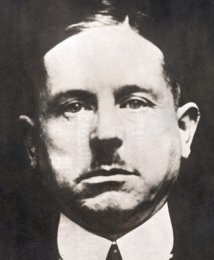
On this date in 1931, the “Vampire of Düsseldorf” was beheaded for that city’s most infamous serial murder binge.
It was, perhaps, the logical end of a terrible journey.
A factory moulder and World War I deserter in his late forties, Peter Kürten commenced a series of uncommonly bestial rape-murders in early 1929 … the harvest of a lifetime’s twisted brutality.
He’d been the oldest of 11 children stuffed in a hellish one-room apartment with a violent drunk of a father who battered the children and openly raped their mother. Well, “if they hadn’t been married, it would have been rape,” in Peter’s words.
The future vampire took his refuge turning his own abuse on younger siblings and, with the help of a degenerate dogcatcher in the neighborhood, on obliging animals he could lay his hands on — which creatures he was soon learning to torture, and to rape, alongside more conventional human delinquencies like arson and burglary.
Kürten is known to have strangled at least one ten-year-old prior to World War I (he would also claim to have surreptitiously drowned a couple of school chums in his boyhood) but it was on the far side of the Great War — which he’d spent mostly in miserable prisons, nursing increasingly twisted fantasies of vengeance — that the beast truly emerged.
The spree that carried him to these pages began in Febuary 1929, when he slew an eight-year-old, attacked a middle-aged woman, stabbed a mechanic to death. Kürten’s crimes were irregular, but distinguished by a fiendish wrath: he abducted one young woman and hammered her to death in the woods outside town; he stabbed a five-year-old to death with scissors as he achieved his orgasm; he asked a teenager to run off and get him some cigarettes, so he could use her absence to slit her younger sister’s throat; he stabbed strangers randomly.
“I derived the sort of pleasure from these visions” of mayhem and cruelty, he said, “that other people would get from thinking about a naked woman.”
Düsseldorf endured a year of terror, finally aborted when Kürten’s own wife — whom he seems to have loved genuinely — turned him in, at Kürten’s own request, for the reward money.
At a packed trial, the accused’s accumulated hatred for the sadistic world poured out in words just as it had done in deeds over the months preceding.
I said to myself in my youthful way ‘You just wait, you pack of scoundrels!’ That was more or less the kind of retaliation or revenge idea. For example, I kill someone who is innocent and not responsible for the fact that I had been badly treated, but if there really is such a thing on this earth as compensating justice, then my tormentors must feel it, even if they do not know that I have done it …
Never have I felt any misgiving in my soul; never did I think to myself that what I did was bad, even though human society condemns it. My blood and the blood of my victims will be on the heads of my torturers. There must be a Higher Being who gave in the first place the first vital spark to life. That Higher Being would deem my actions good since I revenged injustice. The punishments I have suffered have destroyed all my feelings as a human being. That was why I had no pity for my victims.
-Kürten
Amateurs though we are, we incline to doubt the sufficiency of the tit-for-tat explanation. Kürten might well have believed that about himself, but the “vampire” moniker gets at an essential, organic sensuality about his crimes whose roots go quite a bit deeper than revenge.
“Tell me,” the doomed murderer is supposed to have asked a prison doctor shortly before facing the guillotine, “after my head has been chopped off will I still be able to hear; at least for a moment, the sound of my own blood gushing from the stump of my neck?”
“That,” mused the killer, “would be the pleasure to end all pleasures.”
Kürten is one of several predatory sex-slayers — also see the likes of Fritz Haarman and Carl Grossman — who prospered in interwar Germany, and helped to inspire Fritz Lang’s cinematic classic M. (Kürten is often thought the most direct model for that movie’s murderer, played by Peter Lorre. Lang denied that was the case, but in some countries’ releases it went out under the title not of M, but of The Vampire of Düsseldorf.)
On this date in 1961, Czechoslovakian maternity ward nurse Marie Fikackova was hanged at Prague’s Pankrac Prison for murdering newborns in her care.
Fickakova, nee Schmidlova, was a well-liked 24-year-old with a failed marriage already at her back when she was arrested in February 1960 after two infants died of brain injuries the same night during her shift at the Sušice hospital.
Under lengthy interrogation, Fikackova finally confessed to having developed the habit of relieving the agitation of her menses (her story, not mine!) by permanently silencing newborns who bawled too much. We all have our personality quirks, but if hers was “homicidally enraged by crying babies” then it’s safe to say she was in the wrong line of work.
“When I was pressing little Prosserová’s head, I could feel my fingers sinking into it,” she described. “I did not feel any skull cracking at that time. I was just pressing the little head and my fingers got deeper and deeper. My anger faded away after a while and I could continue working.”
Fikackova proceeded to cop to ten-plus additional therapeutic attacks on children, but police had a very difficult time substantiating them relative to documented injuries and the nurses’ shift calendar. In the end, the courts hung her with the original two.
We have seen, in these pages, better-balanced subjects issue more outlandish auto-denunciations under less police pressure, so while we’re in no position to assert anything with certainty, we’re inclined to take the absence of corroborating evidence from an institution that ought to have plenty of it for the asking to suggest the strong possibility that Fikackova’s confessions tended to the fantastical.
Nevertheless, the public has been inclined to take the woman at her claim of double-digit homicides, and magnified Fikackova into a legendary mass murderer and the authoress of every neonatal abnormality in town. Even now she’s sometimes mentioned as Czechoslovakia’s most prolific serial killer, or blamed for the infirmities of any and all folks born in late-Fifties Sušice. (Both links in this paragraph are in Czech.)
For this staged demonstration of her baby-slaying technique, authorities even let Marie Fikackova put on the nurse outfit. (Source of the images)
On this date in 1903, the wife-poisoner George Chapman was hanged at Wandsworth Prison in the United Kingdom.
He had at least three deaths on his record … and, if you fancy, possibly quite a few more.
Chapman was born Severin Antoniovich Klosowski in the village of Nargornak, Poland on December 14, 1865, the son of a carpenter. At the age of fifteen he was apprenticed to a surgeon, and five years later he ended his medical studies in Warsaw. Just how much medical training he actually had is hard to determine, but the fact is that after he moved to the UK in 1887 or 1888, he worked not in the medical field but as a hairdresser’s assistant and later in his own barbershop.
In 1890, Chapman (still going by his birth name) married Lucy Baderski, having conveniently forgotten all about the wife he’d left back in Poland. His Polish wife found out about Lucy, however, and went to Britain to settle things. Bizarrely, for a short time the three of them all lived together, before Klosowski’s first wife threw up her hands and returned to Poland.
Klosowski’s relationship with Lucy Baderski was very troubled, and Klosowski was abusive. In one incident, he attacked her with a knife and threatened to cut her head off. Lucy was saved only because a customer suddenly came into the barbershop and Klosowski had to tend to him.
In 1892 she left him, although she was pregnant; they had emigrated to New Jersey by this time, and the beleaguered wife returned to England, where she had his daughter in May of that year.
Klosowski followed her back to England a few weeks later, but they separated for a final time not long afterward.
The following year, Klosowski took up with an Englishwoman named Annie Chapman. This, too, ran aground on Kloslowski’s violence and unfaithfulness, but he left her with daughter (whom he refused to support) and she left him with a surname (probably to assimilate and to escape his previous relationship entanglements).
From here on in, he goes by George Chapman.
Sometime after Annie left him, Chapman took up with Mary Isabella Spink, a woman who lived in the same boardinghouse. She was married and had a son, but her husband had deserted her.
They entered into a false marriage, like Chapman had done before with Lucy, and set up a successful barbershop with “musical shaves.” Mary would play the piano while Chapman did the barbering. For awhile they got a lot of money from the shop, but that didn’t stop Chapman from brutally beating Mary on a regular basis and even trying to strangle her. Eventually their barbershop failed and Chapman became a pub manager, living in the apartment upstairs.
Late in the year in 1897, Mary began suffering nausea and crippling stomach pains. Her husband stayed at her side constantly, tending to her needs and paying for a doctor, but Mary just got worse and worse and wasted to a skeleton. She finally died on Christmas Day. That morning Chapman found her dead, cried a little and went downstairs to open the pub.
The cause of death was listed as phthisis, or pulmonary tuberculosis. A few months later, Chapman sent Mary’s orphaned son to the workhouse.
Chapman needed help with the pub, so he hired Bessie Taylor, a former restaurant manager. What follows is familiar: a love affair, a fake marriage, and domestic violence. Then Bessie became sick, showing the same symptoms Mary Spink had. To avoid curious stares, Chapman moved them into London and leased another pub. Bessie was operated on but her condition didn’t improve.
Like Mary, she died on a holiday: Valentine’s Day in 1901. The cause of death was exhaustion from diarrhea and vomiting, secondary to an intestinal obstruction. Chapman made Bessie’s family pay for the funeral.
In August 1901, he hired the teenage Maud Eliza Marsh for a barmaid. They had another bogus marriage, but Chapman quickly grew tired of her. Maud got sick the same way his previous two wives had. Chapman got a doctor for her and mixed her medication himself. Her parents insisted that she be hospitalized.
Maud showed great improvement there and was released after a few weeks, only to become sick again once back at home with Chapman.
Her father, who had gotten suspicious, called in another doctor for a second opinion, but then Maud died quite suddenly. The doctor insisted on an autopsy, and found 693 milligrams of antimony in her body. The doctor determined that the final dose of poison had been more than 600 milligrams, an enormous amount — evidently Chapman had panicked when he realized Maud’s family suspected him.
Chapman was arrested and charged with murder.
Antimony is an almost perfect poison: odorless, colorless and nearly tasteless. However, it also acts as a preservative. When the authorities exhumed Mary Spink and Bessie Taylor, they saw both bodies were in much better condition than they ought to have been.
Mary had been in the ground five years, but one witness said her face was “perfect” and it looked like she’d been dead for less than a year. Bessie looked positively fresh.
Chapman was convicted of Maud Marsh’s murder in March 1903; the jury deliberated only eleven minutes.
He died without ever admitting his guilt. He never even admitted to being Severin Klosowski, although Lucy Baderski visited him after the trial.
There have been many poisoners, but most of the time the murderer has some tangible gain in mind, such as an inheritance or insurance policy. This doesn’t appear to have been the case with Chapman.
He liked money as much as anyone else, it’s true, and would stoop to crime to get it. (Once he torched his pub for the insurance money, but the police became suspicious when they found out all the furniture had been removed from the premises before the fire started. The insurance company refused to pay, and Chapman had to move, but for some reason he was not prosecuted.)
Still, he really didn’t gain financially from his wives’ deaths. Mary Spink gave him £500, but he let her live for a few years after that. Maud Marsh and Bessie Taylor left him nothing.
Chapman may simply have wanted the women out of the way so he could take up with someone else.
But in that case, he could have chosen better for a quick, clean murder. When a person is given antimony in a single large dose, they usually to expel it by vomiting, and are left relatively unharmed.
The way to murder someone using antimony is give it to them slowly and patiently in small doses over a period of weeks or months. It is a lingering, painful death — but it also taxes the discipline of the poisoner. Chapman wasn’t the slow-and-steady type.
Public interest in Chapman didn’t die with him and remains alive and well, because of the Jack the Ripper case.
This infamous and never-identified killer strangled and mutilated five prostitutes in London’s East End during 1888, and many hobbyists think Chapman and the Ripper may have been the same man.
Frederick George Abberline, who headed the Ripper investigation, had strong suspicions against him, summarized in an interview with the Pall Mall Gazette:
As I say, there are a score of things which make one believe that Chapman is the man; and you must understand that we have never believed all those stories about Jack the Ripper being dead, or that he was a lunatic, or anything of that kind. For instance, the date of the arrival in England coincides with the beginning of the series of murders in Whitechapel; there is a coincidence also in the fact that the murders ceased in London when Chapman went to America, while similar murders began to be perpetrated in America after he landed there.* The fact that he studied medicine and surgery in Russia before he came over here is well established, and it is curious to note that the first series of murders was the work of an expert surgeon, while the recent poisoning cases were proved to be done by a man with more than an elementary knowledge of medicine. The story told by Chapman’s wife of the attempt to murder her with a long knife while in America is not to be ignored.
Chapman was definitely living in London during the time of the Ripper killings, which cannot be said of other suspects such as Frederick Deeming or Michael Ostrog.
Chapman’s youthful medical apprenticeship would seem to supply him with the grisly surgical expertise the Ripper displayed.
Chapman approximately matched witness descriptions of the Whitechapel fiend.
Also, curiously enough, one of the Ripper victims was named Annie Chapman — the same name as his estranged lover.
Perhaps most importantly, Sugden points out, Chapman was not only violent and a misogynist but also a known killer: “There must have been few men, even in late Victorian London, capable of multiple murder. The Ripper was one. Chapman was another.”
Sugden thought Chapman was a much better Ripper candidate than any of the other suspects he discussed in his book, but that didn’t mean he was definitely or even probably the real Ripper: “That Chapman committed crimes of which we have no present knowledge I can well believe. That he was Jack the Ripper is another matter.”
The main problem with the Chapman-Ripper theory is the fact that he poisoned his wives, rather than use some more demonstratively violent method of homicide.
Serial killers’ methods do evolve and adapt, but rarely change that drastically. “To exchange knife for hammer, gun or rope, weapons of violence all, is one thing,” Sugden observes. “To forsake violence in favor of subterfuge, as is alleged of Chapman, is quite another.”
It is for that reason that John Douglas, when he talks about the Ripper murders in his book The Cases That Haunt Us, rules out Chapman as a suspect.
Whether Chapman was Jack the Ripper or not, he certainly was an evil, vicious bastard in his own right.
* This is not strictly accurate. There was one Ripper-type murder, of a prostitute named Carrie Brown, in a New Jersey hotel in 1891. Whether the Ripper actually committed the crime is open to speculation.
It’s the sesquicentennial of France’s beheading of Martin Dumollard, one of the earliest — some even venture the earliest — serial killers in the modern record.
This dull peasant spent at least the latter half of the 1850s (and maybe the first half, too) visiting Lyon where he would lure impecunious girls with the promise of good wages in a domestic position.
We know very well that there was no job awaiting these young women, but the twist is that Dumollard wasn’t a sex-killer, either — he just wanted to throttle his marks, drink their blood, and steal their poor clothes and meager possessions to re-sell them.
And in Second Empire France, with its haunting specters of Communism and nationalism, the migration of country bumpkins like Dumollard into urban areas, and the existential threat posed the entire polity by the rise of neighboring Prussia … in that France, Dumollard’s shocking spree really agitated the id of the respectable French bourgeoisie.
Relentless and grim — Dumollard had actually seen his own father put to death when the family fled as refugees to Italy during his boyhood — the illiterate, middle-aged murderer as presented to the public heedlessly stuffed his face with food while maintaining a near-total disinterest in the criminal case that would claim his head. He’d also shown no interest in subterfuge, leading the courts to castigate police for not detecting him years earlier even though several girls had escaped from him. His wife abetted the whole thing, dutifully washing out the victims’ stained clothes before market days. (She got a sentence of hard labor.)
Dumollard must have looked to his betters like some vengeful golem arisen from the soil, a homicidal automaton not even impelled by any recognizable human avidity, and a frightening warning of what might befall them.
According to Albert Borowitz, the unveiling a few months later of Jean-Francois Millet’s unnerving painting The Man with the Hoe raised hackles in France (and it did raise hackles) partly because of the farmer’s perceived resemblance to Martin Dumollard.
L’homme à la houe (The Man with the Hoe), by Jean-Francois Millet. “A monster without brow, dim-eyed and with an idiotic rictus, planted in the middle of a field like a scarecrow,” wrotePaul de Saint-Victor of this painting. “No trace of intelligence humanizes this brute at rest. Has he just been working, or murdering? Does he dig the land or hollow out the grave?
“The public voice has found his name: it is Dumollard, gravedigger of the good.”
On this date in 1906, still implausibly claiming his innocence, “Johann Otto Hoch” was hanged for the murder of his wife.
Though Hoch died “merely” for that one homicide, he was suspected of numerous others in a prolific career of avaricious bigamy.
Born as Jacob Schmidt in Germany a half-century or so before he hanged, Hoch immigrated to the U.S. in the 1880s and started wife-hopping for fun and profit, recycling names almost as frequently. (Hoch just happens to be the alias he was using when arrested: actually, it was the name of one of his victims, “a warped keepsake stored in an evil mind.”)
It’s a classicscam, really: woo, wed, and walk out — taking the spurned spouse’s assets with. Rinse and repeat. In 1905, Charlotte Smith of the Women’s Rescue League estimated that “no less than 50,000 women who have been married, robbed and deserted by professional bigamists.” (Chicago Tribune, Sept. 5, 1905)
“Marriage was purely a business proposition to me,” Hoch eventually admitted.
Sometimes Hoch was content to vanish with the cash (with nice twists, like a hat left by a riverbank to suggest drowning). Other times, he went above and beyond the standard in the professional-bigamy industry and availed the expedient of loosing the matrimonial bonds (and the purses of life insurers) by graduating himself to widowhood.
Precisely how many women he poisoned off with arsenic isn’t known exactly, but it’s thought to range into the double digits. And when he was on his game, he was known to churn through the ladies at breakneck speed. His last murder victim, and the one he hanged for, was Marie Walcker of Chicago … but as Marie lay dying of her husband’s expert ministrations, Johann, bold as brass, proposed to Marie’s sister Amelia. Those two “lovebirds” married a week later and within hours, the groom had disappeared, pocking $1,250.
Call Amelia doltish if you will, but she went straight to the police. It turned out it was Hoch who recklessly set himself up for capture with this whirlwind double-dip courtship, and the very freshly buried evidence of his recent malignity was easily retrieved from his late ex’s stomach. When arrested in New York, Hoch had a hollow pen full of arsenic.
Naturally, the marriage proposals poured in as Hoch awaited trial early in 1905.
Hoch was actually within moments of hanging in July 1905 when his defense team finally managed to raise the last $500 necessary to lodge an appeal. That’s right: justice with a co-pay. The legislature had considered, but had not passed, a law giving every death-sentenced person the right to appeal to the Illinois Supreme Court, and in lieu of such a measure, an appellant had to pony up for the privilege.
On this date in 1943, serial killer Jarvis Theodore Roosevelt Catoe was fried in the federal chair for the murder of Washington D.C. resident named Rose Abramowitz.
The 25-year-old victim, who had married only a month before, had hired Catoe to wax her kitchen floor.
Instead he raped and strangled her, left her sprawled on her bed and made off with $20.
Abramowitz wasn’t Catoe’s first victim and she would not be his last — although she was his first white victim; the previous ones had been black like Jarvis himself. This article summarizes Catoe’s career: homicides in New York City and Washington, beginning in 1935, as well as multiple robberies, rapes, indecent exposures and attempted kidnappings. To add insult to injury, an innocent man, James Matthew Smith, was convicted in his first murder and had already served several years of a life sentence by the time of Catoe’s arrest.
Time magazine called him a “one-man crime wave.” The D.C. police’s failure to catch him resulted in serious public embarrassment for the department and a dressing-down before Congress. Not bad for a killer so obscure his name isn’t even in Wikipedia.
Catoe’s last victim was Evelyn Anderson, a waitress in the Bronx. After he strangled her and left her body in an alley he took her purse and watch and gave it to a lady friend, who gave it to another friend, who gave it to a man who pawned it for $20. The New York Police, who had been checking the local pawn shops, found the watch and traced it through its various handlers, finally landing on Catoe, who had moved back to Washington by then.
He confessed to seven murders that he could remember, but reckoned the real body count was “about ten.” Most, but not all, of his victims had been sexually assaulted. A classic sexual sadist, Catoe stated he suffered from “spells” where he had an uncontrollable urge to kill. These spells tended to happen after he’d been reading detective stories and looking at pornography.
Catoe later retracted all his statements, saying he’d been “sick and weak” and the police and badgered him into making up stories. The jury didn’t buy it: in the Abramowitz trial, they were out for only eighteen minutes before voting for conviction and the death penalty.
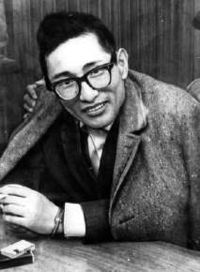
On this date in 1970, Japanese serial killer Akira Nishiguchi was hanged for murder.
Born in 1925, Nishiguchi (English Wikipedia entry | Japanese) spent the war years in juvenile detention but emerged in time to work as an interpreter for the U.S. occupation.
He was arrested repeatedly (Japanese link) as a con man during the 1950s. Police had him pegged as a nonviolent serial fraud artist, but in 1963 he killed two drivers to steal from them, then went on the run in Tokyo.
For 78 terrifying days, his face — those fraud convictions came with fingerprints that identified him as the killer — gazed out of wanted posters as Nishiguchi scraped by in cheap hotels and desperate disguises, committing three more murders in the process. Finally, an 11-year-old girl recognized him, posing as a lawyer.
On this date in 1960, South Africa conducted a mass execution of 15 miscellaneous criminals (14 black, one white) in Pretoria Prison.
The headline attraction was one of the 14 blacks: Phineas Tshitaundzi, the “panga man” or any number of related headline-worthy nicknames — the panga slasher, the panga maniac. (“Panga man” can also just be any old fellow with a panga, like an agricultural worker.)
A panga is a machete, and Phineas Tshitaundzi wielded this intimidating instrument during a 1950s spree terrorizing white lovers’ lanes around Johannesburg. “He would assault the men and rape the women — to whom, it was said, he then gave bus fare home,” wrote Jean and John Comaroff in Law and Disorder in the Postcolony.* “There could hardly have been a more intense figuration of the dark, erotically charged menace that stalked the cities in the white imagination.”
The assaults were non-fatal — panga man was the only one of the 14 blacks hanged this day not on the hook for murder — but the many survivors whose affairs were on the illicit side had injuries to cope with beyond those inflicted by the blade.
Tshitaundzi was finally caught as a result of fencing some of the proceeds of his crimes, whereupon it transpired that the terrifying perpetrator had been so difficult to capture because he’d been working as a mild-mannered 40-year-old “tea boy” at police headquarters itself, a position that allowed him to stay wise to various attempts to ensnare him.
On this date in 1440, the wealthiest man in France, a noble who had once fought under Joan of Arc‘s banner, was hanged for an outlandishly demonic crime spree.
This dashing Gilles opposite Milla Jovovich in The Messenger; you’d never think he would sodomize hundreds of children.
Rivaling Hungarian blood-bather Erzsebet Bathory for the reputation of most bewitchingly depraved aristocratic sex-killer of early modern Europe, Gilles de Rais (or de Retz) hanged for abducting numberless legions of anonymous young commoners (boys, mostly) for rape and murder.
It’s a rap sheet trebly astounding given that a decade before, de Rais’s reputation for posterity would have figured to be his role as Saint Joan’s chief lieutenant when she raised the siege of Orleans, culminating with elevation to the rank of Marshall of France on the very day Charles VII was crowned in Reims. Talk about a fall from grace.
A 1440 investigation triggered by de Rais’s attack on a priest during an intra-aristocracy dispute turned up a Gacy‘s floorboards’ worth of Nantes-area kids allegedly disappeared into the Marechal’s creepy castle. Remarkably detailed trial records preserve a heartbreaking cavalcade of parents who entrusted their children to de Rais’s service or just sent them out one morning never to be heard from again. “It is notorious,” one added, “that infants are murdered in the said chateau.” (Many of these depositions and other original trial records can be read here.)
that de Rais then raped [the typical captive] as he was hanged from a hook by the neck. Before the child died, Gilles took him down, comforted him, repeated the act and either killed him himself or had him slain.
Poitou testified that the child victims were murdered sometimes by decapitating them, sometimes by cutting their throats, sometimes by dismembering them, sometimes by breaking their necks with a stick …
Gilles de Rais rarely left a child alive for more than one evening’s pleasure, Poitou claimed.
Now, it needs to be said that the servants were induced to these confessions by the threat of physical harm — and that when de Rais reversed his own denials he had likewise been menaced with torture. Nobody had been tortured, mind. But they had been given to understand that they would be corroborating the witnesses with self-incriminating statments, and we can do this the easy way or the hard way. In a world without dispositive forensics, confessions were the evidentiary gold standard … and torturing to obtain them was standard operating procedure.
It’s for that reason that there has also long persisted a revisionist thesis that de Rais was actually innocent, framed up by elite rivals who cannibalized the man’s estates. A 1992 “rehabilitation tribunal” re-tried the affair, and returned an acquittal.
Arguably, the populace — font of all those damning accusations — did likewise on the day de Rais hanged with his two servants. A crowd one might expect to be frenzied with rage actually sympathized with the doomed noble, even rescuing his hanged body from the fire. A monument his daughter put up became an unsanctioned popular pilgrimage site until it was destroyed during the French Revolution.
Whether as fact or fable, there’s something gorgeously baroque about de Rais’s dungeon mastering — especially when considered vis-a-vis his historical casting call opposite the abstemious Maid.
As a text for our latter-day edification, de Rais appears a carnivore devoured by his own appetites (and not only sexual: he also blew through the gargantuan family fortune). Reduced from hero to beast, he’s almost a literal werewolf or vampire; he’s often cast as such in video games and the like.
And he transfixes us because he personifies this uncanny bridge from the atomized digital age with its iconic serial killers, alone and psychologically deconstructed, back into the medieval — feudal, irrational, communal, violent and physical but also suffused with an omnipresent alien-to-us paranormal spirit world. It is enough to glance to experience the pull of the abyss gazing back.
Sabine Baring-Gould anticipated the modern afterlife of Gilles de Rais in the mid-19th century Book of Were-Wolves — which incorporated an extended account of de Rais’s trial into a wider narrative of folklore shapeshifting.
De Rais himself shapeshifts even within the brief arc of his dramatic trial: from indignant defendant into contrite supplicant, every drop sincere so far as one can perceive. His very prosecutors, indeed his very victims, wept for the fallen Marechal, and the “monster” reversed with this display his excommunication. (This may have been the part of the punishment de Rais feared most: again, we encounter the alien cosmology.)
“Nothing seems to me to be more beautiful –- and farthest away from our mentality of today — than the crowd of parents of the victims praying for this soul’s salvation,” one modern observed. “That is spiritual nobility.”
Agonizing ecstacist Georges Bataille wrote a whole book about de Rais, characteristically taken by the intersection of repugnance and transcendence. For Bataille, Christianity even reconciles our prisoner’s stupendous villainy with his unfeigned anticipation of spiritual salvation that “ultimately summarize the Christian situation.”
“Perhaps,” Bataille mused, “Christianity is even fundamentally the pressing demand for crime, the demand for the horror that in a sense it needs in order to forgive.”
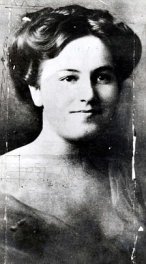
On this day in 1915, serial uxoricide George Joseph Smith was hung by the capable John Ellis at Maidstone Prison in the UK.
Smith had committed three murders and various forms of larceny as well; he’d earned his noose several times over.
Two things tend to trip people up when they’ve seemingly committed the perfect crime: either they brag about it to impress others, or they repeat the crime using the same methodology as before, since it worked so well the first time. Either of those actions greatly increases the risk of the criminal’s getting caught.
Smith made the latter mistake. He was in a sense a victim of his own success.
Smith was born on January 11, 1872. His criminal record began when he was sent to a reformatory at nine and served a seven-year sentence. In young adulthood he was in and out of prison on theft- and fraud-related convictions.
His complicated marital career began when he married Caroline Beatrice Thornhill, a domestic servant, in 1898. Smith persuaded her to steal from her employers. Caroline served time in prison as a result, and implicated her husband, who got two years for his role in the thefts.
After George Smith’s release, Caroline thought it wise to put a few thousand miles between herself and her estranged husband, and so she left the UK for Canada. She never filed for divorce, however.
Smith remained legally married to her for the rest of his life, so none of his numerous other marriages were legal.
Unlawfully Wedded …
The guy wasn’t good-looking, but he could charm like any good con artist. A year after his marriage to Caroline, Smith bigamously married another woman. He cleaned out her saving account and then deserted her.
Between 1908 and 1914, he married no fewer than seven additional women, usually under an alias, and deserted most of them after a short time, sometimes only a matter of days — but not before he helped himself to their possessions and bank accounts.
Smith initially limited himself to scamming gullible spinsters out of their life savings by luring them into bigamous marriages … The moment Smith had his hands on his new bride’s money, he would disappear. Usually telling her he was going out on an errand — to pick up a newspaper or buy a pack of cigarettes — he would never return. On one occasion, he brought his newlywed wife to the National Gallery of Art and, after viewing some paintings, excused himself to go to the bathroom. She never saw him — or her life savings — again.
That particular bride was named Sarah Faulkner. Smith had already plundered £350 in cash from her and her jewelry as well, and while she was waiting for him to return from the loo he was back at their hotel, swiping her clothing and the rest of her money.
The only wife that didn’t fit this pattern was Edith Pegler.
Smith was away from her side for months at a time on “business trips” and when he returned it was always to ask for money, but he never left her for good and they remained together for seven years. As to whether he actually harbored some form of affection for her or whether he just didn’t want to kill his cash cow while it was still milkable, we can only speculate.
Yet all these women were, in a sense, lucky.
Smith may have broken their hearts and taken their cash, but he left them their lives.
… ‘Til Death Do Us Part
The first unlucky wife was Bessie Mundy, whom Smith murdered on July 13, 1912.
They’d married in August 1910, but he left her after persuading her to give him £150 in cash. On the way out the door, he accused her of giving him a venereal disease.
Eighteen months later, Bessie ran into Smith on the street. Somehow, the charmer got his ex to forgive him and resume their relationship.
In fact, Smith wanted to get his hands on Bessie’s £2,500 inheritance, but it was in trust and he couldn’t touch it.
After their reunion, the couple drew up mutual wills, naming each other as beneficiaries. Bessie willed her husband £2,579. Less than a week later, she was mysteriously dead.
Smith rented a house for them in Herne Bay and had a new cast-iron bathtub installed. Tragically, Bessie drowned in the bath. Her husband said he’d been out buying dinner and returned to discover the body.
Since Smith claimed his bride suffered from epilepsy and that she’d had a seizure the day before she died, it was easy to believe she’d simply had an unfortunate accident.
In spite of his newfound wealth, Smith had Bessie consigned to a pauper’s grave and even returned the slightly-used bathtub to the ironmonger for a £1 17s. refund.
This, perhaps, is where Smith might have counted himself lucky and checked out of the homicide business — or at least thought about a different m.o. Instead, hubris and habit got him hanged.
The Brides of Bath murder victims: from left to right, Bessie Mundy, Alice Burnham, and Margaret Lofty.
Next to go was Alice Burnham, who was making a goodly living as a nurse. Smith married on November 4, 1913, and became her widower on December 13.
Alice and her new husband were honeymooning at a seaside boardinghouse in Blackpool when she drowned in the bathtub while he was supposedly out getting eggs.
Smith, who claimed she had a weak heart, had insured her life for £500. She too was buried on the cheap.
Margaret Elizabeth Lofty died in her London home a little over a year later, on December 18, 1914. Newspapers reported she had drowned in the bathtub while her husband — identified as Robert Lloyd — was out buying tomatoes. He and the landlady found the body. Lofty and “Lloyd” had married only the day before and, appropriately enough, the ceremony was performed in the city of Bath.
Although it was initially classified as death by misadventure, Margaret’s murder ultimately lead to Smith’s downfall.
Rotten luck, it was: Alice Burnham’s father read an account of her death in the newspaper and, even though the husband had a different name, he couldn’t help but notice that Margaret’s death was suspiciously similar to his daughter’s.
Joseph Crossley, who was the couple’s landlord at the time of Alice’s death, noticed the same thing. Since both the Burnhams and Crossleys had taken a dislike to Smith from the get-go, they both wrote the police, asking them to open an investigation.
Authorities quickly determined that George Joseph Smith and Robert Lloyd were the same man. They sure had the same playbook.
Margaret had made out a will just hours before she died, naming her husband the sole heir to her estate. She had also withdrawn her life savings from the bank the same day, and three days before she had taken out a £700 life insurance policy on herself, with her husband as the beneficiary. Ka-ching.
When the grieving widower showed up at the insurance office to collect on Margaret’s policy, he was arrested. Lloyd/Smith was initially charged with putting a false name on a marriage certificate, but bigamy and murder charges would follow fast.
When news of the arrest was published, a police chief from Kent read the story and told the London police about Bessie Mundy’s death, which was strikingly similar to the other two.
Forever Hold Your Peace
But how could he could have drowned the women in the tub, without leaving marks of violence on their body?
Margaret had only a small bruise on her elbow. For answers, the police turned to renowned pathologist Bernard Spilsbury. The first thing he did was exhume the bodies to determine whether the women had, in fact, drowned. They had.
After experimenting with the very same bathtub Margaret Lofty died in, he determined how it might have happened. John Brophy, a crime writer, describes it chillingly:
With honeymoon playfulness he would enter the room where his bride was already in the bath, admire her naked beauty, bend over her fondly, and, still murmuring endearments, hold her feet. Suddenly, he would tug her feet upward, jerking her head at the end of the bath, below the water, so that in a few moments she would be drowned with no bruises on the body or other signs of assault or resistance.
Effective. Actually, you can see why he stuck to his system.
When Smith went to trial, it was only for the murder of Bessie; British law didn’t permit him to be tried for multiple murders in one go. However, the prosecution wanted to bring evidence in the Lofty and Burham deaths into the trial, arguing that they indicated a criminal “system.”
The judge allowed it, setting a precedent that would be used in later criminal cases.
In pretrial investigations later described in court, Spilsbury demonstrated his murder theory using Bessie’s bathtub and a female police officer in a bathing suit. It worked all too well: she lost consciousness immediately and they had to drag her out of the tub and perform artificial respiration to revive her.
No wonder the jury was only out for twenty-two minutes before it delivered a guilty verdict.
Caroline Thornhill, Smith’s legal wife, returned to Britain for his trial. She married a Canadian soldier the day after his execution.
The “Brides in the Bath” case has remained vividly alive in British memory.
The historian Harold Nicholson compared Smith’s behavior to Adolf Hitler’s in his 1939 book, Why Britain is at War; Smith was mentioned in novels by Evelyn Waugh, Agatha Christie and Dorothy Sayers, and in 1952 the case was made into an episode for the true-crime radio show The Black Museum.

 It was, perhaps, the logical end of a terrible journey.


 Chapman was born Severin Antoniovich Klosowski in the village of Nargornak, Poland on December 14, 1865, the son of a carpenter. At the age of fifteen he was apprenticed to a surgeon, and five years later he ended his medical studies in Warsaw. Just how much medical training he actually had is hard to determine, but the fact is that after he moved to the UK in 1887 or 1888, he worked not in the medical field but as a hairdresser’s assistant and later in his own barbershop.


 Though
  The 25-year-old victim, who had married only a month before, had hired Catoe to wax her kitchen floor.
 Born in 1925, Nishiguchi (
 Rivaling Hungarian blood-bather
 On this day in 1915, serial uxoricide

.jpg)


