c. 1560: Dominique Phinot, queer composer

Jacob Bonfadius, a man otherwise not in the last place among the erudite, because of copulation with boys (a most vile and sordid thing), was beheaded in prison and publically burned. The French Dominique Phinot, a distinguished musician, was also killed in the same way for a very similar folly.

Gerolamo Cardano

This throwaway remark by the Italian Renaissance man Cardano is our only clue to the fate — indeed, to the very biography — of the composer Dominique Phinot. Based on the volume’s publication in 1561, it is thought that Phinot suffered for his folly around 1557-1560. We don’t even know the place.

Whatever damnatio memoriae obscured him in death, Phinot (English Wikipedia entry | French) was a prominent and highly regarded musician in his working life, acclaimed an expert in polychoral motets. Some 90 exemplars, and dozens of other compositions, survive; the 17th century Italian musicologist Pietro Cerone credited Phinot’s innovations with opening the way for Palestrina.

He emerges for posterity through those compositions; the earliest surviving date to 1538 and his publication locales (and the powerful men to whom they were dedicated) suggest a man for whom patrons in northern Italy (and across the Alps in Lyons) eagerly competed in the 1540s and 1550s. It is known that Phinot was retained by the Duke of Urbino for a period.

It is surely topical to notice that our correspondent Cardano was himself widely whispered to enjoy the same folly, too: a Venetian whose deep interest in music led him to “adopt” into his wifeless** household a number of boys with musical gifts, Cardano could hardly fail to court suspicion. “The rumor was being circulated everywhere that I was using my boys for immoral purposes,” Cardano reports autobiographically of one instance where he was threatened with exposure. Cardano appears never to have been formally charged as a sodomite, but it is remarkable — and even, he admits, “foolishness” — that his brushes with danger never caused him to reconsider the boy-keeping policy.†

As a proper Renaissance man, Cardano’s interests stretched far beyond pederasty and a good tune. He was, in the backhanded compliment of Sir Thomas Browne, “a great Enquirer of Truth, but too greedy a Receiver of it” and treatised profusely on philosophy, law, geology, astronomy, pedagogy, medicine, and mathematics. The latter two fields brought him his fame, but his musings flashed intermittent prescience across disciplines. Cardano argued for the full mental capacity of the deaf, and correctly inferred that mountains had once been underwater from the presence of seashell fossils upon them. A cryptographic technique, a puzzle, and a gear mechanism all bear the Cardano name. His mathematician’s sure grasp on probability also made him a deft gambler — and he published yet another volume on this subject as a young man.

Cardano the physician’s most famous patient was the Archbishop of St. Andrews, whom Cardano in 1553 cured of a debilitating asthma that had stricken the prelate speechless and was thought untreatable by contemporaries. Thanks to Cardano, Archbishop Hamilton became spry enough to get hanged for murder in 1571.

Yet Cardano the man had a still closer acquaintance with the executioner’s office through the person of his firstborn son … a topic for another day’s post.

* Opera Omnia, vol. 2, p. 354 (Theonoston seu de tranquilitate) Translation via Clement Miller in “Jerome Cardan on Gombert, Phinot, and Carpentras,” The Musical Quarterly, July 1972. The aforementioned Gombert was another composer who got busted for same-sex contact; he caught a term in the galleys.

** Cardano’s wife Lucia died in 1546.

† For more see Guido Giglioni, “Musicus Puer. A note on Cardano’s household and the dangers of music,” Bruniana & Campanelliana, vol. 11, no. 1 (2005).

On this day..

1888: Danny Driscoll, Whyo

On this date in 1888, New York City crime lord Danny Driscoll went to the gallows in the Tombs.

(Co-)leader of the Irish gang the Whyos — so named for a distinctive signaling hoot that once echoed through the Five Points — Driscoll inherited power when his predecessor Mike McGloin hanged in 1884.

This band emerged after the disruptions of the Civil War as Manhattan’s most powerful criminal syndicate. The Whyos’ run in the 1870s and 1880s marks a transitional phase from the wild and woolly Gangs of New York street-brawling era into the more businesslike mafiosos of the 20th century.

Like the Mos Eisley cantina, the Whyos’ seedy tavern of choice (aptly named The Morgue) was notorious for over 100 recorded homicides in gang shootouts and drunken brawls; like Jabba the Hutt, the gang also took a methodical approach to extortion, racketeering, and murder that put the “organized” in their crime. One goon answering to the colorful name Piker Ryan (and old time New York crooks are nothing if not flamboyantly named) was once arrested with an actual ultraviolence menu from which budget-conscious clientele could custom-order thrashings for delivery.

Punching $2
Both eyes blacked $4
Nose and jaw broke $10
Jacked out (knocked out with a Blackjack) $15
Ear chewed off $15
Leg or arm broke $19
Shot in the leg $25
Stab $25.00
“Doing the big job” (murder) $100 and up

These 1884 selections perhaps already represent a moderation from earlier methods; a previous Whyo hoodlum, “Dandy” John Dolan, was noted for the copper eye-gouger he wore on his thumb just in case he needed to — well, you know. Dolan hanged back in 1876.


Wait til they get a load of the clamps.

Driscoll kept a house with his young wife, and was charitable enough also to share it with a whore named “Beezie” Bridget Garrity — with whom Driscoll often caroused in the rough Whyo territory. One night in 1886 their alcoholic peregrinations brought them up against a brothel run by a tough named John McCart(h)y, against whom Driscoll had an existing grudge — and as they entered, Driscoll and McCarty wound up in a threshold gunfight. Beezie Garrity had the bad luck to catch a fatal bullet in the crossfire. Both men would blame each other for firing the shot that killed Garrity, and produce numerous witnesses of variously impaired credibility, but for the city there was no confusion at all: between the two, Driscoll was the man worth getting rid of.

“I’ve got a bad name with the police and they say ‘give a dog a bad name and we’ll hang him,'” Driscoll complained to the court. His criminal record reached back to childhood.

Newspapers in the run-up to the hanging were rife with stories of escape attempts and Whyo menace, but police correctly prophesied that the gang had not the numbers or vigor to make any real disturbance. A cordon of 150 gendarmes around the Tombs saw “small groups of young men with hard, wicked-looking visages whom the police pronounced remnants of the Whyo gang … among them were some of the brazen-faced young women of the class to which Beezie Garrity” belonged. (New Haven Register, Jan. 23, 1888) Driscoll died game, his neck efficiently snapped by a noose of white Italian hemp … which seems by retrospection an apt instrument for his passing.

After Driscoll and his fellow alpha male Danny Lyons both hanged in 1888, the Whyos shrank into memory. They would be overtaken in the 1890s by Monk Eastman‘s gang, one last dinosaur from a fading era of hardscrabble toughs; Eastman was in turn supplanted by the Five Points Gang — a more recognizably sophisticated operation to key the 20th century, composed predominantly of the growing Italian-American emigre demographic that would define organized crime for the Godfather era.

The venerable Bowery Boys podcast of Big Apple history covered the Whyos way back in March 2009.

On this day..

1922: Eleuterio Corral and Rumaldo Losano, escapees

(Thanks to Meaghan Good of the Charley Project for the guest post. -ed.)

On this day in 1922, Eleuterio Corral and Rumaldo Losano were hanged in New Mexico’s Grant County Jail in Silver City for the 1921 murder of a prison guard.


Corral (left) and Losano (right).

Losano and Corral were serving time in the Grant County Jail for robbery (Corral) and attempted larceny (Losano) in the spring of 1921. Losano had only fifteen days days left to go on his sentence. Nevertheless, on April 2, 1921, the two young men decided to make a break for it. The jailer, sixty-year-old Ventura Bencoma, had been sick with the flu and during the early morning hours he decided to have a lie-down. While Bencoma slept, Corral and Losano were able to get out of the cell they shared.

A nearby cell was unoccupied and used for storing coal and firewood, and had an ax. The two convicts sneaked up on Bencoma and brained him with the ax, took his gun and keys, and threatened to shoot the other prisoners if they made any noise. They tried to use the keys to release another prisoner, Jesus Rocha, but weren’t able to get the lock undone and gave up. As soon as the pair had run off into the darkness, the others started screaming for help and woke up the sheriff, who was also enjoying a siesta of his own up on the second floor and had missed the entire jailbreak.

Bencoma died within a few hours, as the sheriff and a posse of men were searching for Losano and Corral. On April 5, after a brief exchange of gunfire, the fugitives were captured hiding in a shack. Their statements are summarized in West C. Gilbreath’s Death on the Gallows: The Story of Legal Hangings in New Mexico, 1847-1923:

Both Eleuterio and Rumaldo bragged out loud of their escape and short freedom. Both men told Sheriff Casey it was Jesus Rocha who planned the escape and was to have joined them. Sheriff Casey learned from the two that after Jailer Bencoma’s keys and pistol were removed, they were to unlock the steel cell door to Jesus Rocha. Once he was released, the three were to go up to the second floor where Sheriff Casey’s quarters were and call him to the door. Once the Sheriff opened the door, he would be shot and killed with the jail’s pistol. The three would then arm themselves with the Sheriff’s rifles and ammunition. They planned to saddle the horses in the Sheriff’s corral and flee to Mexico. The plan began to fall apart after both failed to unlock the cell door to Jesus Rocha.

In light of this information, Jesus Rocha was charged with murder alongside his criminal colleagues. At trial, Losano and Corral recanted their statements about his involvement and claimed Rocha had not been a part of the escape plan. All three were convicted and sentenced to hang, but the Supreme Court of New Mexico subsequently reversed Rocha’s conviction, leaving Corral and Losano to face the noose without him.

Their families in Mexico pleaded for mercy, claiming that at the time of the murders, Corral was just sixteen years old and Losano seventeen. However, three physicians who examined them judged Corral was least nineteen and Losano was probably older than twenty.

A few days prior to the execution, the deputy warden conducted a surprise search of the condemned men’s cell. Both of their mattresses contained hacksaws and makeshift knives: they’d been planning another violent escape attempt. Unsurprisingly, the state governor, Merritt C. Mechem, refused to commute the sentences, telling Sheriff Casey, “Every guard’s life out there would be in danger with those two in the penitentiary.”

Officials set up the scaffold only about fifty feet from where Bencoma was murdered. Corral went first, then Losano. Both of them were calm and offered the standard prayers, apologies for their crimes and pleas for forgiveness.

On this day..

1894: John Hardy, desperate little man

On this date in 1894, West Virginia hanged before a crowd of 3,000 for a mining camp murder three months before.

Hardy was reportedly already at odds with Thomas Drews, a fellow laborer in the booming Appalachian coal industry, over their mutual pursuit of the same woman when Hardy lost big to Drews in a craps game on October 13, 1893.
While it’s true that twenty-five cents doesn’t really seem all that “big”, this sum could represent a decent slice of a day’s pay in the coal mining game, and that in an industry where downward wage pressure had generated a ferocious national strike only months before. Hardy was profoundly nonplussed to have to fork over the sweat of his brow to a love rival and, with the added incitement of whiskey, shot Drews dead. (Ten more spectators at his hanging wound up in stir themselves for drunk and disorderlies.)

Hardy’s execution has pride of place in Americana as the inspiration for the tune “John Hardy Was A Desperate Little Man”. (Or simply, “John Hardy”; as a folk figure, he has occasionally been confused or conflated with John Henry)

One of the most popular folk ballads in American history, the song has foggy origins but amazing reach: it has been performed, covered, and reinterpreted by a scores of artists including the Carter Family, Lead Belly, Duke Ellington, Woody Guthrie, Pete Seeger, and Bob Dylan with the Grateful Dead.

On this day..

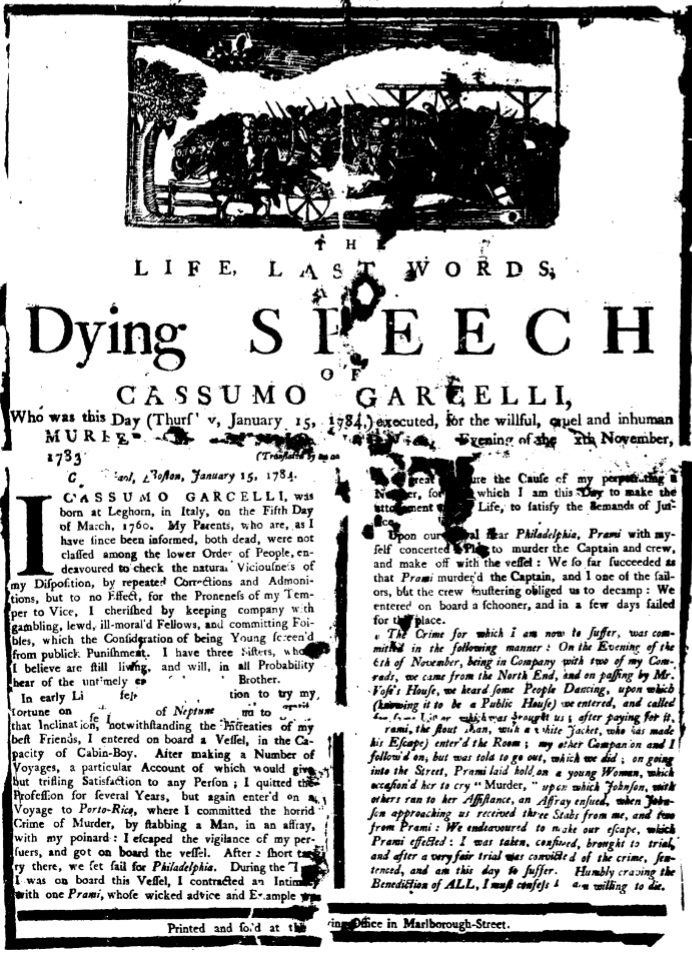
1784: Cassumo Garcelli, a Tuscan sailor on Boston Common

On this date in 1784, for a murder in a bar brawl he had committed with his hard-drinking cronies, Tuscan mariner Cassumo Garcelli was hanged on Boston Common.

To judge by the bog-standard broadsheet purporting to report the condemned man’s gallows’ shade contrition for his youthful vice and wicked examples, piratical Catholic seamen appear to have understood the spectacle of their public execution in a friendless foreign land in a manner quite suspiciously similar to the understanding likely to be held by a New England printer.

In the transcription that follows, I have made a few interpolations, and one outright elision, owing to sections of text obscured by printing faults on the preserved version of this document.


Click on the image to see the full original document.

Who was this Day (Thursday, January 15, 1784) executed, for the willful, cruel and inhuman murder of Mr. John Johnson on the evening of the sixth November, 1783.

I, Cassumo Garcelli, was born at Leghorn, in Italy, on the Fifth Day of March, 1760. My Parents, who are, as I have since been informed, both dead, were not classed among the lower Order of People, endeavoured to check the natural Viciousness of my Disposition, by repeated Corrections and Admonitions, but to no Effect, for the Proneness of my Temper to Vice, I cherished by keeping company with gambling, lewd, ill-moral’d Fellows, and committing Foibles, which the Consideration of being Young screen’d from publick Punishment. I have three Sisters, who I believe are still living, and will, in all Probability, here of the untimely [death of their] Brother.

In early Life […] to try my fortune … notwithstanding the Intreaties of my best Friends, I entered on board a Vessel, in the Capacity of Cabin-Boy. After making a Number of Voyages, a particular Account of which would give but trifling Satisfaction to any Person, I quitted the Profession for several Years, but again enter’d on a Voyage to Porto-Rico, where I committed the horrid Crime of Murder, by stabbing a Man, in an affray, with my poinard: I escaped the vigilance of my persuers, and got on board the vessel. After a short tarry there, we set sail for Philadelphia. During the Time I was on board this Vessel, I contracted an Intimacy with one Prami, whose wicked advice and Example was in a great Measure the Cause of my perpetrating a Number [sic], for [one of?] which I am this Day to make the attonement of my Life, to satisfy the demands of Justice.

Upon our arrival near Philadelphia, Prami with myself concerted a Platt to murder the Captain and crew, and make off with the vessel: We so far succeeded as that Prami murder’d the Captain, and I one of the sailors, but the crew mustering obliged us to decamp: We entered on board a schooner, and in a few days sailed for this place.

The Crime for which I am now to Suffer, was committed in the following manner: On the Evening of the 6th of November, being in Company with two of my Comrads [sic], we came from the North End, and on passing by Mr. Vose’s House, we heard some People Dancing, upon which (knowing it to be a Public House) we entered, and called for some Liquor, which was brought to us, after paying for it.

Vami, the stout man, with a white Jacket, who has made his Escape, enter’d the Room; my other Companion and I follow’d on, but was told to go out, which we did; on going into the Street, Prami laid hold on a young Woman, which occasion’d her to cry “Murder,” upon which Johnson, with others ran to her Assistance, an Affray ensued, when Johnson approaching us received three Stabs from me, and two from Prami: We endeavoured to make our escape, which Prami effected: I was taken, confined, brought to trial, and after a very fair trial was convicted of the crime, sentenced, and am this day to suffer. Humbly craving the Benediction of ALL, I must confess [and am] willing to die.

On this day..

1528: Leonhard Schiemer, Anabaptist pacifist

Forasmuch then as Christ hath suffered for us in the flesh, arm yourselves likewise with the same mind: for he that hath suffered in the flesh hath ceased from sin.

1 Peter 4:1, a verse very dear to this date’s principal*

Anabaptist Leonhard Schiemer was beheaded on this date in 1528 at Rattenberg.

Schiemer abandoned a Franciscan monastery, preferring to set his table with honest labor as a tailor, and to succor his soul with that that new heresy minting martyrs in northern Europe.

In 1527, Schiemer was both a vigorous missionary and an eloquent proponent of the pacificism for which the sect would eventually become known. In Schiemer’s time, before the catastrophe of Münster’s Anabaptist theocracy, this was quite naturally a hot dispute among the persecuted adherents trying to determine how to make their way in a world where they were considered heretical even by the other heretics: turn the other cheek, or come like Christ with a sword?

Schiemer’s answer was for the true Christian to give himself to the ordeal of Christ’s cross.

[The Holy Spirit] teaches no one, however, unless he despaired of all human comforting and wisdom first. He does not comfort or strengthen anyone unless he feels a horror and turns away from all comforting and power of man. This is why the Lord says, “Do not be called masters.” But this master, Christ, does not accept anyone as His pupil or disciple, unless he renounces and hates everything that he has, and follows Him and carries his cross daily. In doing this, one has to trust in the Lord’s comforting and keep still, as the Scriptures say in many passages, particularly in the Psalms, the Prophets, most of all in Isaiah and the Lamentations of Jeremiah.

The strength of all Christians consists in keeping still, by not forsaking the words of the Lord so quickly, by not losing courage so soon, but by being patient, waiting for the comfort of the Holy Spirit, in the midst of the greatest desolation and misery. This is true weakness of which the Scriptures speak, in particular Paul when he says, “For when I am weak I am strong.”

He also says, “For as we share abundantly in Christ’s suffering, so through Christ we share abundantly in comfort too.” That is what Christ means when He says, “A little while and you will see me no more, again a little while and you will see me.” And when the apostles asked Him what He meant by this, He answered, “Truly, truly, I say to you, you will weep and lament, but the world will rejoice; you will be sorrowful, but your sorrow will turn in to joy … Indeed the hour is coming when whoever kills you will think he is offering service to God.

The Threefold Grace

It is often suspected that Schiemer’s execution on January 14 might have inspired the Rattenberg grandee Pilgram Marpeck to convert — for he was dismissed from a post as a mining magistrate on January 28, and thereafter became an influential, itinerant Anabaptist “wandering citizen of heaven” crisscrossing southern Germany.

* According to an essay on Schiemer in The Anabaptists and Contemporary Baptists: Restoring New Testament Christianity.

On this day..

2015: Laila Bint Abdul Muttalib Basim, filmed

Last year on this date, Saudi Arabia’s execution wave consumed a Burmese woman named Laila Bint Abdul Muttalib Basim.

Condemned for the murder and sexual abuse of her seven-year-old stepdaughter, Basim went to her public beheading protesting her innocence and resisting in whatever way she could — which we know, because a cell phone recording of the execution attained worldwide dissemination. In it, the black-shrouded condemned shrieks over and over, “I did not kill! This is unjust!” She denounces her executioners, invokes the Shahada … until her throat is horrifically emptied of its last protest by the blade.

Warning: This is the on-camera death of a human being from just a few meters’ distance, obtained via Liveleak. It’s awful.

Thanks to the outrage this video spawned, a “human rights organization” underwritten by the Saudi government demanded the arrest of the person who recorded the video … which did indeed occur.

On this day..

1899: Bailer Decker, Theodore Roosevelt’s first

This report of the New York Times, Jan. 10, 1899, concerns the forgettable murderer whose electrocution was approved on his first day in office by New York’s new governor — Theodore Roosevelt, soon to become President of the United States.

SING SING, N.Y., Jan. 9 — Bailer Decker, the negro wife murderer of Tottenville, Staten Island, died to-day in the electric chair in Sing Sing Prison. The curren was twice turned on, each time with a voltage of 1,780. He was pronounced dead five minutes after the first shock.

Decker met death without flinching. Just before he started from his cell to the execution room he requested of Warden Sage that the other four murderers in the condemned cells be permitted to sing “Comrades.” The Warden granted the request, and Decker joined in the singing with a clear tenor voice.

The witnesses to the execution included H.F. Bridges, Warden of the Massachusetts State Prison, at Charlestown. That State, it is said, is likely to adopt the electric chair. Mr. Bridges expressed himself as pleased with the method of the execution.*

The crime for which Decker was executed was the murder of his wife, a white woman, on May 25 last. Decker was an oysterman, but spent much of his time in saloons. He was jealous, and shot the woman while in a drunken rage. He then fired a bullet into his own abdomen with suicidal intent.

* Indeed, Massachusetts did adopt the electric chair in 1900: it would eventually use this device to kill Sacco and Vanzetti in 1927.

On this day..

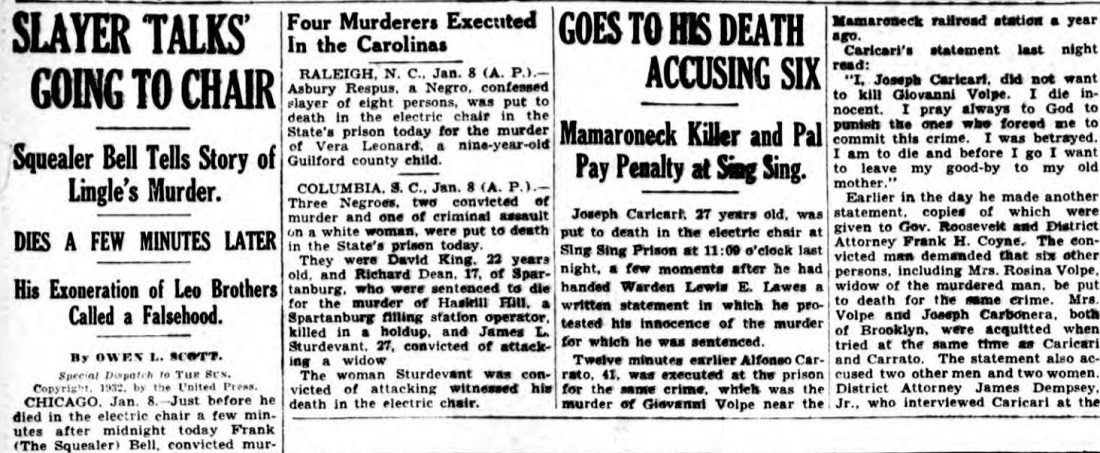
1932: Asbury Respus, North Carolina serial killer

(Thanks to Meaghan Good of the Charley Project for the guest post. -ed.)

On this date in North Carolina, a middle-aged man named Asbury Respus was executed for the murder of nine-year-old Vera DeWitt Leonard.

And that wasn’t all: though virtually forgotten today, Respus was a serial killer with eight confessed murders to his name.

He claimed that he fell from a barn rafter as a youth and was never quite the same after that, being prone to “spells” of homicidal rage. This story may well have been true; he had a noticeable indentation in his skull.

According to Respus’s confession, he killed his first and second victims in Northampton County in the early 1900s. Their names were Lizzie Banks, whom he shot, and Zenie Britt, whom he beat to death with a stick. The third victim was Becky Storr, killed in Boydton, Virginia around 1910; she too had been bludgeoned with a stick.

These early murders are attested only by Respus’s own confession; the first verifiable homicide by his hand took place in 1912. Sentenced to 15 years for manslaughter in the shooting death of a Northampton County man named Ed D. Wynne, Respus escaped from a road gang in 1916 and began life as a drifter.

They can’t have hunted this fugitive very hard. He never went far, always staying in the vicinity of Greensboro, North Carolina.

All four victims prior to his incarceration had been African Americans, as was Respus himself. On January 14, 1918, Respus crossed the color line to axe to death a 56-year-old white woman named Jennie Brown in her home, which he then burned to the ground. So thoroughly did his arson consume the premises that no evidence of a crime remained … leaving Respus free to continue his murder spree. From here on out, by whatever happenstance, all victims were white.

On July 22, 1920, he came across a little boy named Robert Neal Osborne and drowned him in a stream, just for kicks. Again he got lucky: little Robert’s death was recorded as accidental. On July 17, 1925, he murdered 80-year-old widow Eunice Stephenson by striking her on the head and hanging her body from a ceiling beam. This homicide was recognized as such but went unsolved for years.

Vera Leonard was Respus’s youngest female victim and his undoing. Respus may have killed her with rape on his mind. As it was, he went with his old standby, a blunt instrument to the head; afterwards, he burned her body “to a char.” He did not blame his “homicidal spells” for Vera’s murder but instead said he’d been out of his mind on drugs.

Respus expressed gratitude that he was going to his death. “I’d rather he dead and in heaven,” he said, “than here on earth being tormented to death.”


It was a busy day for U.S. executioners. Headlines from the Jan. 8, 1932 edition of the New York Sun.

On this day..

1945: Robert E. Folkes, the first condemned man to see the Oregon gas chamber

(Thanks to Robert Elder of Last Words of the Executed — the blog, and the book — for the guest post. Fans of this here site are highly likely to enjoy following Elder’s own pithy, almanac-style collection of last words on the scaffold. -ed.)

“I have nothing to say except that I am innocent. It’s easier to convict a Negro than a white person. So long everybody.”

Robert E. Folkes, convicted of murder, gas chamber, Oregon.
Executed January 5, 1945

Folkes, age twenty-three, was convicted of slashing a woman’s throat on a Southern Pacific train while working as a cook. The Associated Press described him as “the first condemned man to see the chamber,” as Folkes was the first prisoner to ever walk into the Oregon gas chamber without a blindfold on.

On this day..