1861: The Bascom Affair hangings, Apache War triggers

The retaliatory executions a U.S. Army lieutenant carried out on this date in 1861 helped set in motion a decade-long war with the Apaches.

Three years out of West Point and brand new to Arizona’s Fort Buchanan, George Bascom in retrospect was probably not the ideal ambassador to send out with orders to retrieve a young half-Apache boy kidnapped from a ranch by an Indian raid. (Along with all the cattle.)

Since nobody was present at the time, the identity of the raiders just wasn’t known — but someone’s suspicions affixed on the wily and dangerous* Chiricahua warrior Cochise. The Chiriachuas were just one group among the Apache peoples; they ranged from Mexico to southeastern New Mexico and southwestern Arizona, and were divided into many small local groups each with their own leader — like Cochise.

Lt. Bascom would be killed in a Civil War engagement a year after the events in this post without leaving posterity his memoirs, so his understanding of Apache society can only be guessed at. But his on-the-make bullheadedness is universal to every time and place where young men can be found. “Bascom was a fine-looking fellow, a Kentuckian, a West Pointer, and of course a gentleman,” Arizona frontiersman Charles Poston later remembered. “But he was unfortunately a fool.”
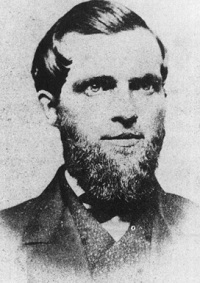

Lt. Bascom and Cochise.

The greenhorn lieutenant rode out with 54 cavalrymen to Apache Pass and lured Cochise to a confabulation. Cochise showed up with his brother, wife, and children — clearly expecting some sort of social call.

Cochise was entirely unaware of the kidnapping, and unaware that Bascom considered him the kidnapper. He offered to find out about it and retrieve the boy from whomever had him.

Bascom, whose troops had surrounded the tent during the parley, accused Cochise of lying to him. Cochise had twice the impertinent lieutnant’s years and at least that multiple of Bascom’s sense, and must have been affronted by his opposite number’s behavior — but when Bascom announced that he would be taking Cochise and his companions as prisoners pending the return of the raiders’ spoils, the Apache commander whipped a knife out of its sheath and instantly slashed his escape route through the wall of the tent. Bursting past the shocked troops (they were as inexperienced as their officer), Cochise escaped into the twilight. This “Bascom Affair” (to Anglos) is remembered more evocatively by Apaches as “Cut Through The Tent”.

But the tent-knifing was only the start of it.

Cochise’s party did not manage to follow his escape, so Bascom now held Cochise’s brother, wife, son, and two other warriors. The Apache tried to put himself in a negotiating position by seizing hostages of his own — first a Butterfield stagecoach stationmaster named Wallace, and later three white men seized from a passing wagon train.

Nor were the hostages’ the only lives at stake. Cochise’s band, including the soon-to-be-legendary Geronimo, had assembled and their campfires burned menacingly in the hills around the little stage station where Bascom’s force fortified themselves. Bascom could have defused it all with a hostage swap, but the kid had his orders and stubbornly refused to make the trade unless it included the one hostage Cochise didn’t have: that little boy from the ranch.

At length, reinforcements for the beleaguered cavalry began arriving, one such party bringing three other Apaches captured en route and entirely unrelated to Cochise. “Troops were sent out to search for us,” a much older Geronimo recalled in his memoirs. “But as we had disbanded, it was, of course, impossible for them to locate any hostile camp … while they searched we watched them from our hiding places and laughed at their failures.”

Despairing now of seeing his family again, Cochise had his hostages killed and dispersed, leaving the mutilated remains to be discovered by his antagonists with the help of circling buzzards. When they did so, they retaliated in fury — releasing only Cochise’s wife and child, but hanging the six other hostages, including Cochise’s brother. In the narration of Sgt. Daniel Robinson,

After witnessing the fiendish acts committed by the Apaches, the minds of our officers and men were filled with horror, and in retaliation, it was decided in Council, that the captive Indians should die. On the 19th we broke camp to return to our respective posts leaving a Sergeant and eight men to take charge of the station until relieved. We halted about half a mile from the station where there was a little grove of Cedar trees. The Indians were brought to the front with their hands tied behind their backs, and led up to the trees. Noosed picket ropes were placed around their necks, the ends thrown over the limbs of the trees and manned by an equal number of willing hands. A signal was given and away flew the spirits of the unfortunate Indians — not to the happy hunting grounds of Indian tradition. According to their ideas or belief in a hereafter, those who die by hanging can never reach that region of bliss. I was in an ambulance with the other Sergeant, and must confess it was a sad spectacle to look upon. An illustration of the Indians sense of Justice: “That the innocent must suffer for the guilty.” And the white man’s notion — “That the only good Indians are dead ones.” Whatever it may be, I do not think it was much worse than the present policy of penning them up on Reservations and starving them to death. (See Cochise: Firsthand Accounts of the Chiricahua Apache Chief.)

A devastating decade-long war against Cochise and his equally able father-in-law Mangas Coloradas ensued, and right when the army most needed its military resources for the Civil War. The conflict claimed hundreds or thousands of lives, crippled mining and ranching, and depopulated fearful white settlements around Apache country in favor of “gravestones … by the road-side like sentinels, bearing the invariable description ‘Killed by the Apaches'”.

A fort near the Texas border was later named for Bascom. The kidnapped boy was never recovered and grew up in a different Apache tribe.

The events of, and following, the Bascom Affair were depicted on the silver screen in the 1950 Jimmy Stewart western Broken Arrow and its 1952 prequel Battle at Apache Pass — among many other cinematic adaptations.


Tom Jeffords (Jimmy Stewart): “Cochise didn’t start this war! A snooty little lieutenant fresh out of the east started it. He flew a flag of truce which Cochise honored, and then he hanged Cochise’s brother and five others under the flag.”

* Cochise was officially at peace with the Americans at this point and hostile to Mexicans. In “Cochise: Apache War Leader, 1858-1861,” in the Journal of Arizona History (Spring 1965), Barbara Ann Tyler argues that the reality of the situation was that his warband flexibly shifted between temporary peace and opportunistic small raids, moving north and south of the Mexican border as convenient.

On this day..

1526: Guillaume Jobert, Genevieve-blasphemer

Guillaume Jobert, one of the first Reformation martyrs in Paris, had his tongue bored through on this date in 1526,* then was burned at the stake at the Place Maubert.

Jobert, the young gentleman son of the avocat du roi of La Rochelle, incurred this ghastly punishment by making some impious cracks about the faith and in particular the devotions given St. Genevieve.

Genevieve was no one to be trifled with. She was supposed to have stopped Attila the Hun dead in his tracks with her prayerful intercession and saved Paris from the sack in 451, in remembrance of which feat she had become honored as the patron saint of Paris.

Genevieve’s cult really took off in the High Middle Ages, the period when a burgeoning Paris firmly established itself as the hub of all France. So powerful was the Parisian devotion to the saint (and the saint’s devotion to Paris) that her cult became a defining marker of the community — and when that community was ruptured by the Reformation, affinity for the cult came to mark the community’s boundaries. To the extent that Genevieve was identified with Paris, with France, with the sacraments, with the royal family — and she was identified with all these things — the Protestant skepticism of saints posing as divine intercessors with demigod-like spheres of influence positioned reformers in opposition to a good many things more than “merely” theology. There is a secular echo of this same critique from centuries later in Voltaire:

The girl that was born in the stubble fields of Nanterre,
Has become a saint that is implored by hollow and stupid people …
But a good citizen should be devout only to you.

As Moshe Sluhovsky notes in “The Politicizations of Sainte Genevieve”, a chapter of his Patroness of Paris: Rituals of Devotion in Early Modern France, the Protestant Reformation in particular

challenged the sacrality of Paris, the identity of France, and the cult of the saints. It was therefore necessary to reaffirm the city’s Catholicity by redefining it in opposition to heresy. Sainte Genevieve was used to delineate who should be included in the sacred social body and who should be excluded from it.

Overtly blaspheming Genevieve certainly put Joubert in the “exclusion” category.

While we have little specific detail about Joubert, some sense of the gravity of his offense might be gleaned from an event that ensued a decade after his tongue-boring execution, when the Affair of the Placards sparked a furious Catholic backlash against religious dissidents. One week later, six Protestants were burned at the stake following a monumental procession through the city meant to reaffirm France’s devotion to the Catholic faith.

For the occasion, St. Genevieve’s relics were removed from her sacred abbey and marched along with all that abbot’s canons and the king himself. These 1,000-year-old remains never appeared in these sorts of ceremonies “without grette and urgent causes,” an English Protestant observer remarked. Notably, accrding to Sluhovsky, the reliquary on this occasion crossed the Seine to the Right Bank for the first time ever.

* Date from this public-domain French journal.

On this day..

1527: Georg Wagner

On this date in 1527, apostate Catholic priest Georg Wagner went to the stake in Munich.

Called “Carpentarius”, Wagner renounced a comfortable pastorship in Emmeringen, espousing the unacceptable tenets that his office was not empowered by Scripture to forgive sins, nor to transubstantiate bread and wine into Christ’s own body, nor to perform baptism on infants. He’s claimed as a martyr both by Anabaptists and Lutherans.

Wagner was a worthy enough man in his time and place that the propaganda coup of his defection drew urgent efforts at re-converting him by his former co-religionists — and even, allegedly, the Duke of Bavaria himself. He spurned them all, insisting only “that, as long as I can open my mouth” in the fires that would devour him, “I will confess the name of Jesus Christ.”

The Martyrs Mirror account of Wagner’s martyrdom credits God with, hours after the execution, smiting dead the sheriff who brought Wagner to the pyre.

On this day..

1545: Cornelis Appelman and Willem Zeylmaker, Batenburgers

On this date in 1545, the leaders of the violent Anabaptist Batenburgers were burned at the stake in Utrecht.

We know Anabaptists best as peaceniks, but the Batenburgers were the dead-end trail to a wholly different reputation. Named for a former Dutch mayor named Jan Van Batenburg, these Zwaardgeesten (“sword-minded”) Anabaptists answered the annihilation of their brethren’s Münster commune by doubling down on revolutionary struggle.

Batenburgers rejected the blandishments of David Joris to lay down the impolitic swords. Their numbers and their philosophies are hard to know with certainty owing to their secrecy, but they’re thought to have maintained the radical Munsterite teachings on polygamy and property.

Van Batenburg himself was caught and executed in 1538, and with that the Batenburgers — who had been living secretly in regular Catholic and Protestant communities — took to the wilderness under the leadership of a Leiden weaver named Cornelis Appelman. For the next ten years or so (even outlasting Appelman’s own death) this band of a couple of hundred desperate men made their way as marauders. We’d probably just call them terrorists today.

Appelman was even more extreme than his predecessor, verging right into crazy cult leader territory with his dystopian insistence on being called “The Judge” and readiness to mete out the severest penalties for any breach of obedience — to say nothing of the arsons, the church-sackings, and the summary executions dealt out to unbelievers. He was finally caught and put to death with his aide Willem Zeylmaker. Batenburger remnants, however, persisted for several more years with at least one splinter continuing until around 1580.

On this day..

1528: Ambrosius Spittelmayr

On this date in 1528, Anabaptist Ambrosius Spittelmayr was beheaded in Cadolzburg, Bavaria.

Baptized by Hans Hut only the year before, Spittelmayr propounded his outlaw adult-baptism creed as a wandering preacher in Upper Austria and southern Germany before his arrest.

The energetic Spittelmayr left his interrogators a 3,000-word confession of faith that has been of great value to scholars probing Hut’s own theology, which was deeply influential in southern Germany. Spittelmayr’s confession emphasizes a Godly life, including a version of primitive communism that called on the faithful to share their worldly effects — a prominent feature in much Anabaptist thought that helped certainly raised the hackles of those with property to protect.

Nobody can inherit the kingdom unless he is poor with Christ, for a Christian has nothing of his own; no place where he can lay his head. A real Christian should not even have enough property on earth to be able to stand on it with one foot. This does not mean that he should go and lie down in the woods and not have a trade, or that he should not have fields and meadows, or that he should not work, but alone that he might not think they are for his own use and be tempted to say: this house is mine, this field is mine, this dollar is mine. Rather he should say it is ours, even as we pray: Our Father. In summary, a Christian should not have anything of his own but should have all things in common with his brother, that is, not allow him to suffer need. In other words, I will not work that my house be filled, that my larder be supplied with meat, but rather I will see that my brother has enough, for a Christian looks more to his neighbor than to himself. Whoever desires to be rich in this world, who is concerned that he miss nothing when it comes to his person and property, who is honored by men and feared by them, who refuses to prostrate himself at the feet of his Lord … will be humbled. (Via)

On this day..

1612: Bishop Conor O’Devany and Father Patrick O’Loughran

On this date in 1612,* Bishop Conor O’Devan(e)y and Father Patrick O’Loughran were hanged, drawn, and quartered as traitors at George’s Hill outside of Dublin.

In the wake of the Gunpowder Plot, Ireland’s Catholics found things increasingly uncomfortable under King James.

In 1607, reacting to a squeeze on their incomes and prerogatives, two native noblemen fled to the continent hoping to make arrangements with the Spanish for a reconquest that would never come. This Flight of the Earls spelled the end of Ireland’s homegrown Gaelic aristocracy and set the stage for the Plantation of Ulster, the settler statelet that formed the germ of present-day Northern Ireland.

O’Loughran’s crime was very simple: already on the continent himself, he had administered the sacraments to those attainted fugitives, later having the boldness to return to Ireland.

There, the charge of collaborating with Bishop O’Devany was also laid to his shoulders.

While O’Loughran was in the summer of his natural life, O’Devany was around eighty years old. Consecrated a bishop in Rome in 1582, he had returned to the north of Ireland and been briefly detained in the post-Spanish Armada security scare.

In the 1600s, O’Devany’s protector had been Hugh O’Neill, Earl of Tyronne, and unfortunately this man was one of the earls in the aforementioned Flight.

He wasn’t a difficult man to target, but the somewhat gratuitous decision by England’s viceroy to do so was not widely supported even by the English and Protestant factions. O’Loughran’s conduct could perhaps be stretched to resemble treason; O’Devany was just an old man being persecuted for his faith. Going to his glory, the bishop did not fail to play that angle up under the eyes of a sympathetic Gaelic crowd.

Far from being cowed by the bishop’s butchery, those onlookers swarmed the gallows, touching the spilled blood and the quartered flesh as holy relics. “Some cut away all the hair from the head, which they preserved for a relic; some others gave practice to steal the head away … the body being dissevered into four quarters, they neither left finger or toe, but they cut them off and carried them away … with their knives they shaed off chips from the hallowed gallows; neither could they omit the halter with which he was hanged, but it was rescued for holy uses.” (Barnabe Rich)


This image counterposes O’Devany and O’Loughran (background) with the sufferings of 16th century martyr Archbishop Dermot O’Hurley (foreground).

Days after the executions, that aforementioned aggressive viceroy, Lord Chichester, reported to London how “a titular Bishop and a priest being lately executed for treason merely are notwithstanding thought martyrs and adored for saints.”

Thanks to the counterproductive outcome, the British laid off the policy of martyring Catholic priests thereafter (at least until Cromwell, but that’s another story).

Both men were beatified in 1992 among the Irish Catholic Martyrs.

* The date was February 1 according to the Julian calendar still in use by England at the time; it was February 12 according to the Gregorian calendar. England occupied Ireland through the period of the new Gregorian calendar’s initial 16th century adoption by Europe’s Catholic countries, so the official date in Ireland was February 1 … even though the padres’ boss in Rome would have considered it February 12.

On this day..

1745: Eve, her smoke visible throughout the country

On this date in 1745, Orange County, Virginia was darkened by the smoke from a stake where a slave named Eve died for poisoning her master, Peter Montague.

As accused, Eve, “not having God before her eyes nor considering the obedience to the said Peter Montague, her master, but led and seduced by the instigation of the Devil … with force of arms and her malice forethought, feloniously and traitorously did mingle and poison milk … did give it to the said Peter Montague, which he did taste, eat, drink and swallow down … and did languish until the 27th day of December. Eve falsely, traitorously and feloniously of her malice forethought with the poison … did kill, poison and murder.” (Quoted here.)

Eve asserted her innocence to no avail at her trial on January 23. The court condemned her to “be drawn upon a hurdle to the place of execution and there to be burnt.”

Upon the execution of that sentence — “the smoke of the burning of Eve was visible over a large extent of the country” — the Montague estate was compensated £50 by the Commonwealth of Virginia for the destruction of its human property.

On this day..

1538: Anna Jansz, Anabaptist

Dutch Anabaptist Anneke Esaiasdochter (better known as Anna Jansz; this was the surname of her husband*) was executed in Rotterdam on this date in 1538.

Anna (English Wikipedia entry | German) is a key martyr of the fragmented Anabaptist movement following the destruction of Anabaptis’s “New Jerusalem” in Münster.

This catastrophe hurled Anabaptism into the desert, where rival leaders pointed the way to different horizons. Would it double down on revolutionary political aspirations, along the lines of Münster? Would it become a pacificist, spiritual movement without secular aspirations?

Anna Jansz, at least as she appears in the readings others have given her, somewhat personifies these conflicting directions — and not incidentally, the also-open question of women’s role in the Anabaptist movement.

Though she appears in the Martyrs’ Mirror as a model feminine sufferer, the “Trumpet Song” she composed has in at least some versions a distinctly apocalyptic tone. One historian called it the Marseillaise of Anabaptist hymns:

Wash your feet in the godless blood

This is shocking imagery, but it’s also far from clear that it’s actually what Anna herself wrote — or if its surface interpretation is what the author intended to convey. Anabaptism’s fast-evolving strains published different versions of the “Trumpet Song” in the 16th century, whose slight alterations dramatically shade its meaning — especially so in view of the possible scriptural allusions. Here’s a version of the same line in which the verb wash (wascht) is replaced with watch, or mind (wacht), and it now advises the true Christian to leave punishment of the persecutors to God:

You true Christians be of good cheer
Mind dipping your feet in blood
Because this is the reward which those who
robbed us will receive

As Timothy Nyhof details in this paper (pdf), her image is ultimately quite elusive to us,** and filtered through the texts of interlocutors like the great Anabaptist fugitive David Joris, rumored to have been Anna’s onetime lover. Joris published the version of the “Trumpet Song” excerpted just above — the cautious one.†

In the end, a fixed conclusion as to whether Anna was a firebrand later softened for public consumption, or the reverse, or a more nuanced character entirely, is beyond the reach of posterity. In any guise, she was an exponent of the call to spiritual purity and anticipation of the Lord that fortified a proscribed faith in its wilderness sojourn.


Detail view (click for the full image) of Anna Jansz en route to her January 24, 1538 execution from the Martyrs’ Mirror.

* Anna’s husband Arendt Jansz fled to England to escape the persecution of Anabaptists, which is why he doesn’t figure in this story.

** Nyhof ultimately situates Anna Jansz among the Melchiorites. Although that philosophy’s namesake had gone down backing the Anabaptist commune, his post-Münster followers turned Melchior Hoffman’s eschatology towards personal redemption instead of political violence. (Source)

† I’m certain it must exist out there, but I have not been able to find online a complete version of any of the “original” versions of Anna’s famous song, either in Dutch or in translation. Profiles of Anabaptist Women: Sixteenth-Century Reforming Pioneers gives the last three of its 13 stanzas thus:

At Borsa and Edom, so the author has read
The Lord is preparing a feast
From the flesh of kings and princes.
Come all you birds,
Gather quickly
I will feed you the flesh of princes.
As they have done, so shall be done to them.
You servants of the Lord, be of good cheer.
Wash your feet in the blood of the godless.
This shall be the reward for those who robbed us.

Be pleased therefore, rejoice and be glad.
Play a new song on your harps;
Delight in our God
All you who foresee vengeance.
The Lord comes to pay
And to revenge all our blood.
His wrath is beginning to descend.
We are awaiting the last bowl.

Oh bride, go to meet your Lord and King.
Arise, Jerusalem, prepare yourself.
Receive all your children alike.
You shall spread out your tents.
Receive your corwn, receive your kingdom.
Your King comes to deliver.
He brings his reward before him.
You shall rejoice in it.
We shall see his glory in these times.
Rejoice, Zion, with pure Jerusalem.

On this day..

1476: Israel, the last execution of the Trent blood libel trial

We have covered in these pages the horrific blood libel trial that sent most of the Jews of Trent to execution for the supposed ritual murder of the child Simon of Trent.

The moral panic (and torture-aided interrogation) that broke out when Trent’s Jews were suspected of having killed a Christian child led to a batch of executions in June 1475. But that was only the first act of a drama that would reach all the way to the courts of popes and emperors in the subsequent months … a conflict that would not end even when the last “murderer”, Israel, was broken on the wheel on January 19, 1476.

Trent lay at the southern fringe of the Habsburg Holy Roman Empire,* literally halfway from Vienna to Rome … and Trent’s ambitious prince-bishop Johannes Hinderbach was likewise beholden to both those poles of authority.

The sitting pope, Sixtus IV, was pretty sympathetic to Jews in general and very definitely not okay with Hinderbach’s theater of torture and execution. Sixtus was certainly also feeling plenty of pushback from other Jewish communities in Europe to make sure Trent wouldn’t be a precedent for similar freakouts in the future, and from Christian elites who didn’t want muddleheaded fanatics running around.

In Trent, “the Jews” meant literally three households — a tiny handful of people. By contrast, in cosmopolitan, humanist Rome, Jews were prominent among the intelligentsia and their presence taken for granted. Sixtus had Jewish “advisors and physicians in the papal court. They were teachers of music, theater, and science. Rome was a center of Hebrew literature and publishing … Sixtus IV, like most of his predecessors, took his role as a defender of Jews from violence more or less for granted.”**

Sixtus ordered the proceedings halted “because many and important men began to murmur,” and instituted an apostolic commission to investigate.

But Hinderbach and the Trentini refused to cooperate (Italian link) with the investigation. Hinderbach, for his part, was all-in on the Simonino story: just like today, nobody on the hook for a wrongful execution is going to advance his career by acknowledging that fact.

Resentfully, Hinderbach put his unwelcome papal visitor Battista Dei Guidici up in a crappy room, and “many people, moved more by furor than reason, temerity than devotion, threatened to kill the commissioner in the streets of the city, if he did not confirm the miracles and the asserted martyrdom” of little Simon. If anyone in Trent thought otherwise, he did not dare make it known to the closely-watched investigator.

Trent still had Jews in prison at this point, but Hinderbach resolutely prevented the pope’s agent from interviewing with them. “It was to be feared,” Hinderbach said, “that if he talked to them, he or his men could give some sign to the Jews, who would be rendered more obstinate, since they were always saying, ‘A man will come to free us.'”

Book CoverThese quotes are via R. Po-Chia Hsia’s Trent 1475: Stories of a Ritual Murder Trial, which is likewise our guide for the tense diplomatic battle ensuing over the autumn of 1475.

After having bribed a servant to deliver word to the imprisoned Jewish women that they had an advocate, Dei Guidici relocated to nearby Venetian territory — “where innocent people are not killed, where Christians do not plunder Jews, as it was in Trent” — and papers started flying.

Dei Guidici appealed to — and eventually ordered — Hinderbach to release the remaining Jews in his custody, while the pope sent out directives quashing any preaching on Simon’s “martyrdom.” Italian Jews poured into Dei Guidici’s offices appealing for their fellows and attesting that they could not travel through Trent for fear of mob violence.† A verse from a Veronese rabbi dating to late 1475 curses the nearby city: “Hills of Trent, may you not have rain or dew / Seven times may you fall and not rise.”

Hinderbach, for his part, sent his own envoys to German cities that had persecuted Jews for ritual murder in the past to get his own paper trail establishing that, yes, the Hebrew liked a good drink of Christian blood. More significantly, as a prince-bishop, Hinderbach also sent his own appeals up the Holy Roman Empire’s secular chain of command, objecting to the ecclesiastical meddling.

Hinderbach’s only concession to his apostolic scold was to release the children he had in custody. In October 1475, his political machinations with the Habsburgs yielded authorization from the powerful Tirolean Archduke Sigismund to resume judicial proceedings against “the Jewish men and women you have in prison” and “render justice as it should be, and let the death sentences be carried out.”

Interrogations for six Jewish men still in custody resumed on October 25, again with the aid of the horrible strappado to confirm and elaborate upon the already-determined official story of Simon’s martyrdom.

Denial — or even confessing, but guessing the wrong detail to “admit” — was not an option, as this October 26 interrogation record indicates.

He was asked whether he saw the murdered boy.

JOAFF [one of the Jewish households’ servants]: In the ditch.

PODESTA: Think again.

JOAFF: In the antechamber of the synagogue.

PODESTA: Anywhere else?

JOAFF: No.

He was ordered stripped, tied by the rope, and hoisted up.

JOAFF: Let me down, I’ll speak the truth.

PODESTA: Speak it on the ropes.

JOAFF: I have never done anything evil.

He was hoisted up and dropped.

This continues until Joaff has been dropped enough times to agree that he saw Simon’s body on Saturday night, on a bench in the synagogue. They knew that was the truth because it confirmed what they already wanted to hear.

This would be the end of Trent’s Jewish men in January 1476.

Israel, a 23-year-old copyist, was the last to die, and his fate is particularly poignant.

He had half-escaped the pall of death by accepting baptism the previous spring, and lived freely during the following months under the name Wolfgang. Dei Guidici interviewed him, one of the few productive sessions the pope’s man was able to arrange in Trent, and learned thereby of the details of Hinderbach’s interrogations.

Once Dei Guidici withdrew to Venetian soil, Jews of that principality would begin reaching out to “Wolfgang” in their efforts to communicate with the remaining imprisoned Jews.

This skullduggery came came apart when the persecution fired back up in October, and Israel was re-arrested, and put again and repeatedly to the rope. He was a man bound to be crushed by the legal machinery arrayed against him, but it was not only that. As Israel was well-traveled, he was tortured for information about ritual murders in other German cities; his forced denunciation of 14 named Jews in Regensburg initiated a blood-libel proceeding in that city that was only aborted by intervention from the Emperor himself.

And while Israel struggled to portray himself as a faithful convert and appeal to little Simon for an exculpatory miracle that never came, he at least once threw aside the mask to give his tormenters a piece of his mind.

PODESTA: What did he think of the Christian faith?

ISRAEL: He wants to say the truth. He does not believe in anything of the Christian faith … It is a joke to say that God came down from heaven to earth, walked around and lived among men. He believes only in God and nothing more. He believes also that the Jewish faith is right and holy.

PODESTA: Does he believe that it is right, according to Jewish law, that Jews kill Christian children and drink and eat their blood as he himself had said.

ISAREL: He believes firmly that it is right that Jews kill Christian children and eat their blood. He wants to have Christian blood at Easter, even now that he is baptized he wants to die a Jew.

Four other Jews from Trent died by hanging earlier in January 1476. The last one put to death was Israel on January 19 — “thief, eater and drinker of Christian blood, poisoner, blasphemer, traitor, and an enemy of Christ and Godly majesty.”

Even his death did not finally put a stop to the affair, for the women of the Jewish community were still in prison, and still being tortured as late as March. They would eventually accept baptism as the price of their release.

Meanwhile, Hinderbach and Dei Guidici carried their scrap to the curia. Hinderbach’s dogged advocacy of his burgeoning cult of Simon — and the odd ad hominem against his foe here and there — won some allies against Dei Guidici’s protests against “the peril which would be incumbent on the Christian religion, on account of the dealings in Trent, and the lies that would reach the ignorant.”

In the end, the Church decided it on political grounds. It could not encourage more Trents; neither could it invite the scandal of disavowing the one that had already taken place. It upheld Hinderbach’s conduct while also reiterating standing prohibitions against blood-libel trials or oppressing the Jews.

Hinderbach very naturally took this as vindication and spent the balance of his life propagating the Simonino cult. Artwork throughout northern Italy, some of it still visible in situ today in its original public monuments and chapel frescoes, attested to his success.


The Martyrdom of Simonino, by Gandolfino d’Asti.


The Martyrdom of Saint Simonio, from the Trento school of Nicklaus Weckmann. (Via)

Indeed, the city of Trent itself‡ still has a street-viewable bas-relief depiction of Simonino’s ritual murder, with the Latin inscription:

In the dungeons of these buildings, where once a synagogue stood, and now a shrine, the blessed martyr Simon of Trent, in his 29th month of life, was killed with excruciating pain by the Jews in the deep of the night of April 10, 1475 A.D.

The Simon of Trent cult — never the face of Christianity that the institutional church really wanted to feature — was only officially suppressed in the 20th century with the Second Vatican Council.

* Trent’s position on the frontier of the Italian and German worlds is also the reason the next century’s major anti-Reformation Council of Trent was held there.

** Sixtus wasn’t all good news for Jews. More from political necessity than affirmative desire, he also authorized the Spanish Inquisition and appointed Torquemada.

† During this time, Dei Guidici also managed to extract a Trent resident named Anzelino Austoch. Under Dei Guidici’s torture, Austoch accused the man named der Schweizer, “the Swiss” — the very man who had suggested that the Jewish homes be searched for Simon’s body — of committing the murder. Dei Guidici clearly believed that either the Schweizer, or Austoch, or both, had actually killed Simon and intentionally framed the city’s Jews.

‡ Trent does not, of course, still avow the legitimacy of these proceedings; the city has elsewhere put up plaques apologizing for it.

On this day..

1900: Geronimo Parra and Antonio Flores, the last hanged in El Paso

The last-ever hanging in El Paso, Texas, on this date in 1900* was distinguished by an astonishing attempted fight to the finish by the two doomed men.

Despite what Hollywood would have one believe, the dramatic bodily escape from the executioner is really never a thing. (Well, hardly ever.) Yet even if Geronimo Parra and Antonio Flores could not effect their escape that day, they would have been content, as Flores bellowed while brandishing his shank, if “You shall all go to hell with me!”

Parra, by far the more notable character in this drama, was long an infamous desperado in the borderlands. Though known for all manner of outlawry, he was specifically hunted by the Texas Rangers for slaying one of their number, John Fusselman, in a mountain ambush way back in 1890.

Parra was in jail in New Mexico for an unrelated robbery under an assumed name when he was recognized as the wanted murderer. Texas Ranger John R. Hughes cut a deal with the Sheriff of Dona Ana County, New Mexico — a lawman you might have heard of by the name of Pat Garrett.** Garrett wanted a fugitive hiding out in Texas, and arranged to extradite Parra in return if Hughes could find the man for him.

The second man doomed to die with Parra, Antonio Flores, was an altogether more everyday criminal: an avidity for a Smeltertown woman who would not have him led him to stab her to death, crying — as if he had not already done enough to poor Ramona Vizcaya without sending her to the next world with an eye-rolling banality — “If I cannot have you then no other man shall!”

Flores’s, shall we say, passion would prove an asset for the desperate duo on their final day.

The gallows had only a single trap, so the two men were to hang consecutively. When guards came to retrieve Antonio Flores, however, both he and Parra raced out of the open cell door wielding homemade blades — steel wire twisted and sharpened into makeshift daggers.


Dallas Morning News, January 6, 1900.

With the certainty of immediate death upon them, the prisoners made a desperate melee in the little hall.

Flores planted his cruel dirk into the stomach of a deputy named Ed Bryant, while Parra scored glancing blows on two men before he was shoved back into the cell. While the rustler looked on helplessly from behind bars, the available toughs piled onto Parra and subdued him.

Parra was trussed hand and foot and dragged straight to the scaffold for instant execution. On pain of prospective death by the constables’ revolvers, Parra too submitted when his turn came, and satisfied himself with declaring his innocence on the gallows — after which the noose nearly ripped the man’s head clean away.


San Antonio Express, January 6, 1900.

Spare a thought for these long-lost frontiersmen when next visiting the gorge where Ranger Fusselman caught that fatal bullet from Parra’s gang of cattle rustlers: Fusselman Canyon.

* Some sites give January 6 for the execution date. The primary sources here unambiguously show this is incorrect.

** Famous for shooting Billy the Kid. Pat Garrett served only a single term as sheriff of Lincoln County; his reputation for excessive violence and shady associations helped to give his career in New Mexico and Texas a somewhat vagabond quality.

On this day..