1926: Melton Carr

In contemporary America, it would be next to unthinkable to schedule an execution for New Year’s Day — and asking the associated team of wardens, guards, executioners, witnesses, lawyers, and journalists to ditch New Year’s Rockin’ Eve and do a ball drop to a lethal chemical injection would be a complete nonstarter.

But the First of January, especially prior to the age of widespread telecommunication, was not always so sentimentally held. The Espy File of historical American executions records none whatsoever for Christmas Day, but several have occurred on New Year’s. We’ve previously profiled some of them in these grim annals, like Sylvester Henry Bell and Archilla Smith.

January 1 of 1926, “just 15 minutes after the arrival of the New Year” in the words of the Associated Press report, was the occasion in Huntsville, Texas for electrocuting African-American Melton Carr for raping a white woman in Walker County.

I have found hardly any information pertaining to this case online, but the detail that Carr was reprieved from an earlier execution date “on a petition from officials and citizens of Walker county” — implicitly, white citizens — might be a suggestive indicator for a crime so incendiary under other circumstances. We have seen that detail before in the case of Tom Joyner’s ancestors, who had broad clemency support because the racial politics of the time made an open judicial exploration of their actual innocence impossible.

Hours later, the first-ever radio broadcast of the Rose Bowl introduced another New Year’s Day tradition to the national consciousness — and just by the by, changed the South forever.

After that game, there would be only more January 1 execution date in American history: the 1943 double gassing of Rosanna and Daniel Phillips.

On this day..

1821: Ketaukah and Kewahiskin, the first hangings in the Michigan Territory

From the Salem (Mass.) Gazette, Jan. 18, 1822.

Executions — Two Indians,* Ketaukah and Kewahiskin [elsewhere given as Kewaubis -ed.] were hanged at Detroit on the 27th ult. the former for the murder of Dr. W.S. Madison, the latter for the murder of Charles Ulrick.

The criminals (says the account) often acknowledged the justice of their sentence,** and in their way they had prepared themselves to meet its execution.

For several weeks past they appeared very anxious to obtain presents of tobacco, pipes, &c. none of which they used, but carefully laid them aside as an offering to the Great Spirit on the day of their death.

They had contrived a sort of drum, by drawing a piece of leather over the vessel that contained their drink, and often engaged in their solemn death dance. On the night previous to their execution, they continued their death dance to a very late hour, and commenced it again early in the morning.

They had been presented, among other things, with some red paint — with this they painted on the wall of their cell numerous figures of men, quadrupeds, reptiles, &c. — on their blankets were also painted many figures — among the rest, an Indian, hanging by the neck, was observed.

From the jail they were taken to the Protestant Church, where an appropriate discourse was delivered to the assemblage by Mr. J.S. Hudson (one of the gentlemen belonging to the Mission family).

They appeared throughout the whole of the solemn preparatory steps to be perfectly collected — they walked firmly to the gallows, and previously to ascending to the drop, shook hands with the Rev. Mr. Juvier, Mr. Hudson, the Sheriff and Marshal, and several other gentlemen who stood near them.

They ascended the steps of the drop in a manner peculiarly firm — after which, they asked, through the interpreter, the pardon of the surrounding spectators, for the crime they had committed.

They then shook hands and gazed for a few minutes on the assemblage and on the heavens, when their caps were drawn over their faces, and they were launched into eternity.

* Ketaukah was of the Ojibwe (Chippewa) people, while Kewahiskin was a Menominee. (Source) The two men were not associates of each other prior to their shared condemnation, and their crimes were completely unrelated.

** Be that as it may, Ketaukah tested the jurisdiction of the Territorial Court (Michigan had not yet been admitted to statehood). He argued (like Tommy Jemmy in New York) that Anglo juries had no jurisdiction over his crime, which had been committed against a white doctor on Winnebago land. He also demanded the inclusion of Indians on the jury; complications of a potential language barrier within the jury pool, and the matter of whether an interpreter’s presence at jury deliberations would vitiate the verdict, defeated that motion. (For the jurisdictional question, see American Indians and State Law: Sovereignty, Race, and Citizenship, 1790-1880. For the jury composition, see the footnote on page 123 of this masters thesis.)

On this day..

1879: Swift Runner, wendigo

The first legal hanging in Alberta, Canada, took place on this date in 1879. Generations later, it’s still remembered as one of the province’s worst, and strangest, crimes.

The hanged man was a native Cree known as Swift Runner (Ka-Ki-Si-Kutchin) — a tall and muscular character with “as ugly and evil-looking a face as I have ever seen,” in the words of an Anglo Fort Saskatchewan officer. Whatever his comeliness, Swift Runner was on good terms with the frontier authorities, who trusted him as a guide for the North West Mounted Police. That is, until the Cree’s violent whiskey benders unbalanced him so much that the police sent him back to his tribe … and then his tribe kicked him out, too.

He took to the wilderness to shift as he could with his family in the winter of 1878-79: a wife, mother, brother, and six children.

But only Swift Runner himself would return from that camp.

When police were alerted to the suspicious absence of Swift Runner’s party, the former guide himself escorted investigators to the scene.

One child had died of natural causes, and was buried there.

The eight other humans had been reduced to bones, strewn around the camp like the set of a slasher film.*

They had all been gobbled up by a wendigo.

The wendigo (various alternate spellings, such as windigo and witiko, are also available) is a frightful supernatural half-beast of Algonquin mythology, so ravenous it is said to devour its own lips — and human flesh too. For some quick nightmare fuel,* try an image search.

The revolting wendigo was mythically associated with cannibalism, so closely that humans who resort to anthropophagy could also be called wendigos. According to Swift Runner, the ferocious spirit entered into him and bid him slaughter and eat all his relations.

Swift Runner is the poster child for the “Wendigo Psychosis”, a mental disorder particular to the Northern Algonquin peoples. In the psychosis, diagnosed by the early 1900s but hotly disputed in psychological literature, people are said to have experienced themselves possessed by the wendigo and wracked by violent dreams and a compulsion to cannibalism. It’s importantly distinguished from famine cannibalism: though it was the wilderness during winter, Swift Runner had access to other food when he turned wendigo. The author of a 1916 report on the phenomenon said he had “known a few instances of this deplorable turn of mind, and not one instance could plead hunger, much less famine as an excuse of it.”**

The disorder, whatever it was, was nevertheless surely bound to the precariousness of life in the bush; wendigo cases vanish in the 20th century as grows afflicted populations’ contact with the encroaching sedentary civilization.

For Canadian authorities in 1879, however, there was no X-File case or philosophical puzzle: there was a man who had shot, bludgeoned, and/or throttled his whole family and snapped open long bones to suckle on their marrow.

But if the verdict and sentence were clear, the logistics were less so: hangings were virgin territory for the Fort Saskatchewan bugler put in charge of orchestrating the event. Swift Runner, by this time repentant, had to wait in the cold on the frigid morning of his hanging while the old pensioner hired to hang him retrieved the straps he’d forgotten, to pinion his man, and fixed the gallows trap. “I could kill myself with a tomahawk, and save the hangman further trouble,” Swift Runner joked

* In the Stephen King novel Pet Sematary (but not in its cinematic adaptation) the master adversary behind the reanimation of murderous household pets is a wendigo. For a classical horror-lit interpretation, Algernon Blackwood’s 1910 The Wendigo is freely available in the public domain.

** Cited by Robert A. Brightman in “On Windigo Psychosis,” Current Anthropology, February 1983.

On this day..

1888: Tsimequor, indigenous Snuneymuxw

(Thanks to Meaghan Good of the Charley Project for the guest post. -ed.)

On this date in 1888, Tsimequor, a member of the Snuneymuxw First Nation, was executed in Nanaimo, British Columbia for a bizarre murder that clashed Aboriginal and white Canadian cultures.

What happened is explained in Jeffrey Pfeifer and Ken Leyton-Brown’s book Death By Rope: An Anthology of Canadian Executions:

The matter that brought Tsimequor to public attention arose out of a tribal custom designed to help members of the community better deal with grief following the death of a child. The custom dictated that when a child died, it was the practice for all other persons in the tribe who bore the same name to immediately change their names. In this way, relatives of the deceased child would be less likely to be reminded of their loss.

Tsimequor’s son Moses died in 1888 and, as per custom, all the Snuneymuxw who were named “Moses” changed their names to something else.

But there was one little boy in the community whose name was Moïse — “Moses” in French — and Tsimequor demanded that he change his name as well. The four-year-old’s parents refused, and days later somebody killed their son.

Had it been solely in the hands of the Snuneymuxw, the crime might have been forgiven. But to the Canadian legal authorities killing a four-year-old because of his name was unambiguously capital murder, and so Tsimequor was arrested and brought to trial. He maintained his innocence, but was convicted on November 7, 1888 and sentenced to death.

Pfeifer and Leyton-Brown record:

Surprisingly, there was considerable sympathy for Tsimequor expressed in the local newspaper, which pointed out that the crime had been committed “through superstition” and noting that Tsimequor had had no legal counsel to defend him at the trial. According to one newspaper report, “a sentence designed to educate Aboriginal people would be more appropriate.” There was however no doubt which tradition would be followed in this case.

Tsimequor was hanged in the Nanaimo Gaol five weeks after his trial.


Privy Council minutes determining that ‘law should be allowed to take its course’ with the hanging of the indigenous man Tsimequor in 1888

On this day..

1917: Lation Scott lynched

(Thanks to Meaghan Good of the Charley Project for the guest post. -ed.)

On this date in 1917, 24-year-old black farmhand Lation (or Ligon) Scott died a horrible death in Dyersburg, Tennessee.

For the two years prior to his extrajudicial “execution” by a lynch mob, Scott had worked as a farmhand for a white family, doing the farm chores while the husband worked at his job in Dyersburg.

He got on well with the family and was fond of the two children. He seemed like an ordinary enough man and a good worker, according to the NAACP journal The Crisis:

Accounts as to his intelligence vary widely. One report asserts that he was almost half-witted. Others attribute to him the intelligence of the average country Negro… He had the reputation of being a splendid hand at doing general housework, or “spring-cleaning,” and…had done this sort of work for a prominent woman of Dyersburg. She states that she was alone in the house with him for two days.

No trouble resulted.

In addition to farming and the doing of odd jobs, he was a preacher. On November 22, 1917, however, he allegedly raped the farmer’s wife while her husband was at work. He threatened to kill her if she reported what he had done. He then fled, leaving his victim bound and gagged inside the farmhouse.

The woman was able to free herself and identify her attacker, and the community took swift action, searching extensively for Scott and offering a $200 reward for his apprehension. Scott was able to elude capture for ten days, though, making his way fifty miles to Madison County. There, a railroad worker recognized him and he was arrested.

The sheriff’s deputy for Dyer County, along with some other men (including, presciently, an undertaker), picked up the accused man and started off back to Dyersburg by car in the wee hours of the morning. They didn’t bother taking an indirect route for the purpose of their journey.

Hundreds, perhaps thousands, of people gathered along the road and waited for their quarry.

And when he appeared, they forced the car off the road and made the officers turn over their prisoner.

These people were not typical of the average lynch mob: rather than stringing him up on the spot, they drew up a list of twelve “jurors” and, at noon, after church let out, drove Scott to the county courthouse for a “trial.”

Scott was ordered to stand up and asked, “Are you guilty or not guilty?”

Scott admitted he was guilty, and the “jury” voted for conviction.

Although one “prominent citizen” asked the people not to be barbaric, because it was Sunday and because “the reputation of the county was at stake,” both the rape victim and her husband wanted Scott to be burned alive rather than merely hanged.

The Crisis‘s description of what happened is not for the faint-hearted.

The Negro was seated on the ground and a buggy-axle driven into the ground between his legs. His feet were chained together, with logging chains, and he was tied with wire. A fire was built. Pokers and flat-irons were procured and heated in the fire… Reports of the torturing, which have been generally accepted and have not been contradicted, are that the Negro’s clothes and skin were ripped from his body simultaneously with a knife. His self-appointed executioners burned his eye-balls with red-hot irons. When he opened his mouth to cry for mercy a red-hot poker was rammed down his gullet. In the same subtle way he was robbed of his sexual organs. Red-hot irons were placed on his feet, back and body, until a hideous stench of burning flesh filled the Sabbath air of Dyersburg, Tenn.

Thousands of people witnessed this scene. They had to be pushed back from the stake to which the Negro was chained. Roof-tops, second-story windows, and porch-tops were filled with spectators. Children were lifted to shoulders, that they might behold the agony of the victim.

It took three and a half hours for the man to die.

Margaret Vandiver wrote in Lethal Punishment: Lynchings and Legal Executions in the South, “The lynching of Lation Scott was the most ghastly of all those I researched.”

This spectacle of horror took place in broad daylight, and no one in the mob wore masks.

Nevertheless, no one was ever prosecuted.

According to The Crisis,

Public opinion in Dyersburg and Dyer County seems to be divided into two groups. One group considers that the Negro got what he deserved. The other group feels that he should have had a “decent lynching.”

A “decent lynching” was defined as “a quick, quiet hanging, with no display or torturing.”

One local citizen remarked that he thought the people who tortured and killed Lation Scott were no better than the rapist himself. Another simply commented, “It was the biggest thing since the Ringling Brothers’ Circus came to town.”

Lation Scott’s was the last lynching in Dyer County history.


Wire report in the Salt Lake Telegram, Dec. 3, 1917.

On this day..

1865: The Jacksonville Mutineers

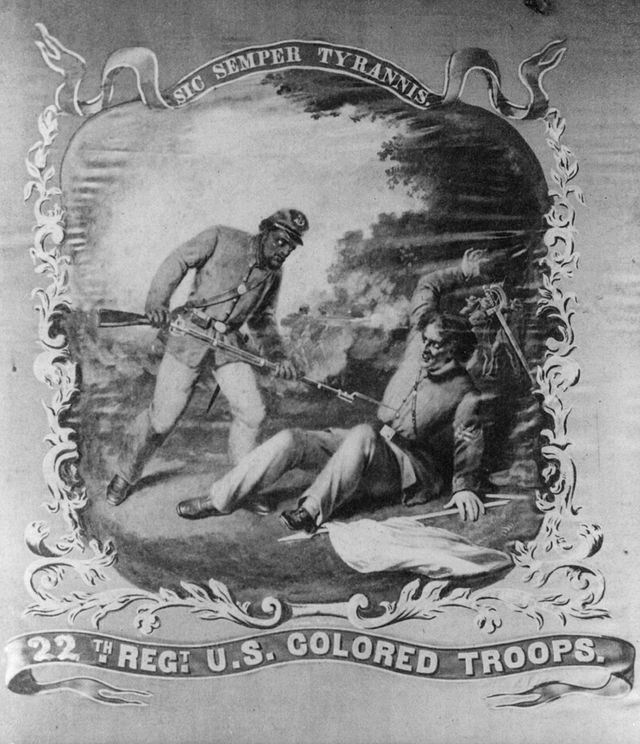
On this date in 1865, six African-American infantrymen were shot in Fernandina, Florida, for the Jacksonville Mutiny.

Formed in 1863, the 3rd Infantry Regiment, United States Colored Troops served in the trenchworks around Fort Wagner — the grinding siege in the summer of 1863 that followed the bloody attempt to storm the fort immortalized in the 1989 film Glory.

The Third was subsequently transferred to Union-occupied Jacksonville, Florida for duty garrisoning a conquered town of the Confederacy whose white citizens chafed doubly at their presence. But the unit had weathered both the boredom of the garrison and the hostility of white Floridians, and was set to muster out and return home on Halloween of 1865.

All U.S. Colored Troop regiments were officered by white men, putting an inevitable racial tinge on the inherent potential tension between enlistees and their commanders — the triggering event in our story. Heading the Third was a fellow named John L. Brower, Lieutenant Colonel by rank courtesy of his political connections but of nearly no actual military experience.

Ohio National Guard Judge Advocate General Kevin Bennett, in his 1992 article about the mutiny,* calls Brower a “martinet”; elevated to command of the Third on September 12 for what should have been a mostly ceremonial interim, Brower delighted in enforcing stringent wartime discipline months after Appomattox. While no man welcomes the taste of the lash when he’s one foot out the door back to civilian life, excess discipline meted out by cruel white overseers was particularly bad form for Colored Troop regiments.

From the standpoint of black Americans, the war had been all about destroying slavery; they had practically had to force this objective, and their own presence,** into the conflict. Being strung up by the thumbs for petty theft — Brower’s decreed punishment for one of his charges on October 29 — was far too evocative of the hated Slave Power.

“Inexperienced officers often assumed that because these men had been slaves before enlistment, they would bear to be treated as such afterwards,” one white Colored Troop commander later remembered. “Experience proved to the contrary. Any punishment resembling that meted out by the overseers caused irreparable damage.”†


The inclination of black troops to reject servile treatment and the anxiety that this provoked among their officers and the larger white community must surely be read in view of the perplexing new conditions following the Civil War.

Even among whites who supported it in principle, slavery abolition meant an unsettling and uncertain rearrangement of civilization — or at least, it potentially meant that. Would the economy continue to function without slavery? Would the daily conventions and assumptions that had sustained whites north and south have to be entirely renegotiated?

“Once let the black man get upon his person the brass letter, U.S., let him get an eagle on his button, and a musket on his shoulder and bullets in his pocket, there is no power on earth that can deny that he has earned the right to citizenship,” Frederick Douglass had proclaimed. Now that the war had finished, what else did those musket-toting sable fellows think they had earned the right to?

Press reports over the course of 1865 show a continuing theme of “Negro mutinies”: it is for wiser studies than this post to determine whether the trend such stories represent is disturbances among the black soldiery, or an exaggerated preoccupation among their white countrymen. In either event, Jacksonville was very far from unique even if the punishments were exemplary.


From the June 16, 1865 Cleveland Plain Dealer, concerning black soldiers on a steamer bound for Texas calling at Fort Monroe who, chagrined at the assignment, refused to permit the steamer’s resuming its journey.


From the June 19, 1865 Philadelphia Inquirer, concerning a company refusing to embark for Texas. “Certain evil disposed persons put it into the heads of these credulous colored soldiers that they were to be sent to Texas as servants for the white troops,” runs the report. “Doubtless some secret enemies of the Government instilled similar subtle falsehoods into the simple minds of the blacks who were disarmed at Fortress Monroe a few days ago.”


From the September 30, 1865 Daily National Intelligencer (Washington, D.C.), concerning a mutiny reported near Hilton, N.C.


From the Oct. 1, 1865 Daily Constitutionalist (Augusta, Ga.), reporting a disturbance begun when a black regiment demonstrated against a court-martial for one of their comrades accused (and acquitted) of stealing a hat.

In the midst of all of this — right about the time of the incident in this post, in fact — bulletins reached American shores of the Morant Bay Rebellion, a bloody rebellion of black laborers in British-controlled Jamaica. Slavery had been abolished on that Caribbean island more than 30 years prior: what did that uprising augur for the races in these United States?


Subtext becomes text: the Norwich (Conn.) Aurora, December 23, 1865. “The African released from restraint, and the passion of the savage provoked, will realize the scenes formerly witnessed in Hayti.” (The full article (pdf))

For our case, the name of the man punished like a slave is lost, but we do know what he did: steal some molasses from the kitchen. That’s how six of his comrades ultimately wound up looking down the barrels of their executioners.

A Lt. Greybill caught the greedy nosher and decreed a rough summary punishment, which the arriving Brower arrived helped to enforce on the resisting prisoner. “Tying up by the thumbs” was a brutal and humiliating treatment that lifted the man by those digits (often dislocated in the process) until only his toes remained on the ground, barely supporting his weight, and left him there for hours. In the film 12 Years a Slave, we see a man subjected to this sort of tiptoeing, but with a rope about the neck instead of about the thumbs.

Other enlisted men gathered around this pitiful scene, complaining about what they saw. A Private Jacob Plowden, who will eventually number among our day’s six executees, cried out that “it was a damn shame for a man to be tied up like that, white soldiers were not tied up that way nor other colored soldiers, only in our regiment.”

Plowden announced that “there was not going to be any more of it, that he would die on the spot but he would be damned if he wasn’t the man to cut him down.” Another private, Jonathan Miller, joined the incitement — “Let’s take him down, we are not going to have any more of tying men up by the thumbs.” A number of the black soldiers, 25 to 35 or so, began advancing on Brower and the hanging molasses-thief. Brower drew his sidearm and fired into them, wounding a man and sending the soldiers scurrying — some dispersing, but other dashing off to tents to arm themselves.

Several non-lethal fights now occurred in various spots around the camp between soldiers and officers, and eventually between the disaffected soldiers and arriving brethren from Company K, who had been summoned to calm the situation.

Lt. Col. Brower exchanged shots with several of the men who armed themselves, and in a bit of symmetry with the distasteful punishment that had started the whole mess, he had his thumb shot off in the process. One of the privates who had been heard complaining of the thumb-hanging, now playing peacemaker, grabbed the injured officer and escorted him to a safe building, warning some men who tried to pursue them to “stop their damn foolishness.”

Elsewhere, a Lt. Fenno sabered a protestor, and got bashed over the head with a fence-post in response. Neither injury was life-threatening to its recipient. Some shots were exchanged elsewhere in camp and/or fired demonstratively into the air, again to no fatal effect. And a Private James Thomas cut down the post where the source of all the disturbance, the fellow who just wanted an extra ration of molasses, was hanging.

This was the whole of the commotion, which Company K reinforcements soon quelled.

In a speedy series of court-martials lasting from Oct. 31 to Nov. 3, thirteen men were convicted of mutiny in this affair, and a fourteenth of conduct prejudicial to good order (his offense: not during the mutiny but after all was over, saying of Brower, “the God-damned son of a bitch, he shot my cousin. Where is he? Let me see him.”) A fifteenth man was acquitted. All 15 accused mounted their own defense, without counsel or aid — generally endeavoring to show that they had either not armed themselves or (and this was the decisive factor for the six whose conviction carried a death sentence) not fired their weapon.

The trial itself posed interesting procedural dilemmas, which Bennett explores at length in his article: first, because it was a mutiny case, the white officers of the Third who comprised the jurors were also, awkwardly, the brother-officers of the witnesses who testified against the mutineers.

And second, although the Civil War was over, Florida still technically remained in a state of rebellion, and this enabled the unit to convene a general court-martial, issue death sentences, and even carry them out without allowing any appeal to Washington. General John Foster gave the final approval to the sentences and transmitted case files to Washington after the fact; that was all the six condemned had by way of legal or executive review.

On December 10, he received a telegraph ordering him to suspend one of the death sentences in response to an inquiry raised by U.S. Senator Edgar Cowan: Cowan had been contacted by one of his constituents, who represented that Private David Craig, whom the constituent had raised from childhood, had written him complaining of his wrongful conviction. According to Sen. Cowan, the allegation was that Craig had been directed to collect arms from the mutineers as the disturbance came to an end, but was thereafter arrested in the confusion for being armed with the weapons he collected. But December 10 was nine days too late, and the late Private Craig’s case file disturbingly seems to have been lost from the National Archives.

The other five shot by musketry this date were:

  • Joseph Green
  • James Allen
  • Jacob Plowden
  • Joseph Nathaniel
  • Thomas Howard

Lt. Col. Brower only testified at one of the courts-martial, and was sent home almost immediately afterwards. He’d lost his thumb for his adventure as an officer and a gentleman, but between the original provocative punishment that he helped enforce, and then inflaming a tense situation by shooting at his soldiers, the brass was probably just as pleased to see him go as were his subordinates.

The non-executed mutineers who received prison terms (up to 15 years) had their sentences commuted following a review in 1866. The rest of the regiment mustered out as scheduled at the end of October, two days after the Jacksonville Mutiny.

* B. Kevin Bennett, “The Jacksonville Mutiny”, Civil War History, Volume 38, Number 1, March 1992. Bennett’s article is the source of all of the quotes in this post not otherwise cited.

** See I Freed Myself, or this podcast interview with its author, David Williams.

† See here for a fascinating instance of this at sea in June 1865, by the author of Becoming American under Fire: Irish Americans, African Americans, and the Politics of Citizenship during the Civil War Era

On this day..

Feast Day of St. Andrew

Now after that John was put in prison, Jesus came into Galilee, preaching the gospel of the kingdom of God, and saying, The time is fulfilled, and the kingdom of God is at hand: repent ye, and believe the gospel.

Now as he walked by the sea of Galilee, he saw Simon and Andrew his brother casting a net into the sea: for they were fishers. And Jesus said unto them, Come ye after me, and I will make you to become fishers of men. And straightway they forsook their nets, and followed him.

Mark 1:14-18

“Walks on the Water” by the Russian band Nautilus Pompilius
Translation from friend of the blog Sonechka; alternate version here

Apostle Andrew was fishing from a wharf.
While the Savior was walking on the water.
Andrew was pulling fishes from the sea,
While the Savior – fallen men.

Andrew cried out: “I will leave the wharf,
If you reveal the secret to me.”
And the Savior answered: “Be calm, Andrew.
There is no secret here.

“You see, yonder, on the mountain
Towers a cross,
Underneath are a dozen soldiers.
Hang on it for a while.
And when you get bored,
Return back here
To walk on the water with me.”

“But, Master, the helmets are adorned with glistening horns,
A black raven circles the cross.
Explain to me now, take pity on the fool,
And leave the crucifixion for later.”

The Messiah gasped and with ire
Stamped his foot on the smoothness of water.
“You are indeed a fool.” — And Andrew in tears
Shuffled off home with his fishes.

November 30 is the feast date of St. Andrew the Apostle, Christ‘s very first disciple along with his brother St. Peter.

Andrew gets pretty short shrift in the New Testament compared to his brother, even though the Gospel of John actually credits our man with being the first of the two boys to cotton to the Nazarene’s preaching.

Despite playing such a minor role in the sacred texts, he has a cultural footprint far in excess of fellow apostolic extras like Saint Bartholomew.

After the master’s crucifixion, Andrew is supposed to have preached in Turkey and Greece. Romanian and Kievan Rus’ traditions posit that he wandered even further north to make the first Christian inroads among their pagan forebears; as a consequence, Romania, Russia, and Ukraine are all among the countries that count Andrew as a patron saint, along with the place of his martyrdom, Greece.

The most recognizable such patronage, of course, is Scotland.

The story has it that a legendary Roman monk in the fourth century brought three fingers, an arm bone, a kneecap, and a tooth formerly comprising the saint from Patras, where Andrew died, to a monastery on the coast of Fife. The subsequent settlement has been known as St Andrews for over 800 years, so if you like that might make Andrew the patron saint of golf, too.**

Scotland’s flag, the ☓-shaped heraldic saltire pictured above, evokes Saint Andrew’s distinctive execution device, the aptly-named (and kink-friendly) St. Andrew’s Cross.

Like his brother’s physiologically improbable upside-down execution, this is supposed to have represented the disciple’s own unworthiness to die the same death as the Savior, and Roman executioners’ surprising accommodation of such scruples.

St. Andrew’s Day is an official holiday in Scotland. In many other countries of central and Eastern Europe, the vigil preceding St. Andrew’s Day has long been associated with folk magic for divining the identity of an unmarried maid’s future husband.


Detail view (click for the full image) of Henryk Siemiradzki’s 1867 painting Siemiradzki Noc-Andrzeja.

Andre, Andrei, or Andreas are equivalents; it’s thanks to a November 30 christening that San Andreas Lake got its name, and in turn conferred same on the associated continental fault that keeps Californians employed making disaster movies about their own selves going the way of Atlantis.

* There is also an apocryphal Acts of Andrew, whose original text has been lost but is known in summation indirectly through other authors. It is thought to date to the third century.

** It was Archbishop James Hamilton — later executed — who gave the residents of St Andrews standing access to golf’s Holiest of Holies, the Old Course at St Andrews.

On this day..

2006: Sanjaya Rowan Kumara, with “signs of life”

Sri Lankan national Sanjaya Rowan Kumara was hanged on this date in 2006 at Kuwait’s Central Prison for murdering a woman while robbing her house.

He was pronounced dead and cut down within eight minutes. But …

medics who transported his body to a morgue said they noticed he was still moving, Al-Qabas daily reported.

Forensic experts were immediately called to examine the body and they confirmed that “there was some weak pulse in his heart,” the daily said.

The examination was repeated several times and each time “the dead body showed some signs of life,” Al-Qabas quoted unnamed medical sources as saying.

“They eventually pronounced him completely dead at 1400 hours local time,” five hours after his hanging, the sources said.

The justice ministry refused to comment on the report but head of the criminal execution department, Najeeb al-Mulla, who supervised the hanging, told Al-Watan newspaper the report was “baseless.”

On this day..

1895: Jesus Vialpando and Feliciano Chavez, desperados

On this date in 1895, two outlaws hanged publicly at Las Vegas, New Mexico, for killing a rancher during a raid on his cattle earlier that year.

We will come soon enough to Jesus Vialpando and Feliciano Chavez, but their story and ours properly begins a bit earlier … with a gentleman named Vicente Silva.

From the San Francisco Call, July 3, 1898 (via)

Silva had struck silver and cashed his claim in for the proprietorship of a saloon in Las Vegas, NM where he tolled the vices of later prospectors and of the ranchers and herders who peopled the area.

In the 1880s the deposits were drying up and with them the tumblers at Silva’s well. Ever the enterprising businessman, he procured a remote ranch to use as the base for a fresh initiative: running by night a secretive gang that terrorized San Miguel county and neighboring Guadlupe, Mora, and Santa Fe counties, too. For a couple of years these villains had the run of unsettled territory’s rural places, and waylaid travelers or rustled livestock with near impunity — murdering when necessary and even brazenly “disappearing” some ranchers known to be too vigorous about defending themselves.

The Silva gang came unglued in the winter of 1892-93. Suspecting one of its number of preparing to expose him, Silva ordered the man done to death — and Pat Maes was efficiently lynched to a bridge in a driving snowstorm. Silva himself fled his legitimate persona in Las Vegas and embraced outlawry as a fugitive in the bush.

Having already proven his willingness to slay his own followers, Silva soon had to go even farther than that: in February 1893 he demanded that his cronies murder his (Silva’s) wife, and the wife’s brother — again for fear of betrayal. The men so tasked did carry out their orders, but, wary of the Robespierrian trend betokened by these purges, they also took the opportunity to murder Silva himself.

That scattered his associated desperadoes to the desert winds. Pursued by rewards on their heads — and no longer in mortal terror of the chief’s vengeance should they turn stool pigeon on their former mates to collect — many of the gangsters were rounded up in the years to come.

Our two characters, Vialpando and Chavez, numbered among Silva’s dispersed marauders and had managed to escape the most recent instance of a tattling comrade. Come the winter of 1894-95, two years on from Silva’s exit stage 6 feet under, these ex-henchmen still had their former liberty … and none of their former ease.

Staggering through another blizzard like the one that had fallen on poor Pat Maes so many moons before, they* came upon Lorenzo Martinez’s land and trespassed with famished gusto. They had soon made of one of Martinez’s cows a much-needed repast, but as they huddled around a fire to devour it in warmth, the rancher’s son Tomas arrived on the scene. Who knows but with what suspicion these parties eyed one another, and what guarded words they exchanged. Later Vialpando would explain through an interpreter that, catching glimpse of the man’s cartridge belt “I became afraid of him that he might be the owner of that animal that we had killed there,” and with familiar glances to Feliciano made a silent impromptu pact to kill Martinez before the rancher got a drop on them.

Four days later, Martinez’s faithful dog Gallardo — whom the raiders had also shot, but not managed to kill — turned up back at the family homestead half-frozen and matted in its own blood and all but dragged Martinez’s brother to the spot where Tomas’s cremated remains mingled with the carcass of the dead cow. The discovery was quick enough to put authorities on the right track, and they had Vialpando and Chavez in custody within a fortnight.

They offered only a feeble attempt at spinning the admitted homicide as “self-defense”. At the prisoners’ request, Governor William Thornton met personally with them in jail a few days before their hanging, where the doomed men begged for mercy “without pretending to give any reason why he should” grant it. (New Mexican, Nov. 14, 1895)

Around 6 o’clock on the morning of November 19, Vialpando was escorted alone to a one-man public gallows at an arroyo north of town. Wan and terrified, Vialpando had all he could do to keep his composure and made no statement before he was efficiently executed.

By 7 o’clock the sheriff’s party had returned to the jail for Chavez. Less unmanned by the occasion, Chavez had a rambling 18-minute address to the crowd from the gallows, translated on the fly from his Spanish by a handy interpreter, the substance of which was to vaguely distribute among the rest of his party enough responsibility for Martinez’s murder that he could complain about taking the punishment for it. At last, with the parting cry of “Adios, todos!”, Chavez too was hanged at 8 o’clock.

The men’s bodies were shipped a few miles down the way to their families in Romeroville, along with a few dollars in nickels they had accumulated from well-wishers while awaiting execution. A public subscription covered the cost of their burial.

* The party was four in all. Zenobia Trujillo and Emilio Encinias were present when Martinez found their party but were sent away before he was murdered; they were charged as accessories after the fact.

On this day..

1700: Jamie Macpherson, Highlander

The legendary Highlands freebooter Jamie Macpherson was hanged on this date in 1700 in Banff.

Macpherson is said to be an illegitimate half-Gypsy child with every talent necessary to live larger than life — and if gigantism can be inferred from the size of his enormous alleged sword, that would be extremely large indeed.

Besides his elite SPARQ score, Macpherson was blessed with complementary gifts for making music and sweet sweet love, and plundered livestock and merchandise and maidenheads as he sprang through the vicinities of Banff and Aberdeen. Despite living by his prowess with the sword every source concurs that he never used it to harm anyone that the audience would sympathize with.

But he outraged the local grandees, and at length he was apprehended (as befits his outsized tale) by a fellow with the improbable name “Duff of Braco” — then was duly condemned to hang on market-day (“Forasmeikle as you James McPherson, pannal are found guilty by ane verdict of ane assyse, to be knoun, holden, and repute to be Egiptian and a wagabond” etc.).

In the week before his hanging, Macpherson reportedly composed an air variously described as “Macpherson’s Lament” or “Rant” or “Farewell” which he then performed on the gallows.

In the most picturuesque version, he played his own fiddle in this exit performance, then dramatically smashed the instrument. As Chambers’s Journal observes, it seems hard to accept that the sheriff would have given this veritable Goliath the free use of his hands at such a desperate moment. Indeed, local legend has it that the authorities were so afraid that a reprieve might arrive that upon catching sight of an approaching rider on the horizon, they put the town’s clocks 15 minutes forward.

At any rate, several versions of the Lament/Rant/Farewell survive and one can follow its evolution in this open-source Annals of Banff. Robert Burns’s eventually immortalized the verse with this gloss on it from the late 18th century:

On this day..