1941: Mirjam Sara P., T4 victim

(Thanks to Meaghan Good of the Charley Project for the guest post. -ed.)

On or about this day in 1941, a twenty-two-year-old woman known only as Mirjam Sara P. was executed/murdered by means unknown, probably gassing.

The notice of her death was postmarked “Cholm Insane Asylum.” However, as psychiatrist Robert Jay Lifton notes in his book The Nazi Doctors: Medical Killing and the Psychology of Genocide, there was no such place: “As far as can be determined, the Cholm Insane Asylum was a fiction.”

Yes, Mirjam was Jewish. This certainly could not have helped her case, but she was actually killed as part of another genocide: the T4 program, the Nazi policy of involuntary euthanasia on people suffering from deformities, incurable illness, mental illness or anything else that made them into “useless eaters.”

Begun in 1939 with the killing of five-month-old Gerhard Kretschmar, who’d been born blind and missing two or three limbs, the T4 program would end the lives of over 200,000 people, about two-thirds of them after the program officially ended in 1941.

T4 had six death institutions, called “state nursing homes,” which were equipped with gas chambers. The operation was supposed to be a secret, but it was too big to be concealed and before long the German people thought they had a pretty good idea what was happening to their disabled loved ones.

Open criticism of a fascist government is not advisable if you like your life, so the families were limited to publishing heavy hints in their relatives’ newspaper obituaries.

Perhaps the saddest part of Mirjam’s story is that she should have survived. Of course, none of the T4 victims should have been killed, but Mirjam had excellent odds of surviving the Nazi era … until a particularly boneheaded decision by Child Welfare Services and the immigration authorities in Palestine in October 1936.

What’s Palestine got to do with it, you ask? Mirjam P.’s story is told in Tom Lampert’s documentary history, One Life, and it begins in 1933:

This Adolf Hitler guy made Mirjam’s mother uneasy, and she decided to get her family to safety as soon as possible. Mirjam, fifteen years old, long considered a “difficult child,” had been staying in a juvenile reformatory school and sanitorium for the past eighteen months when her mother called her home. She had been sent there after she stole money from her mother and ran away from home.

Mirjam, her mother and her stepfather emigrated to the city of Tel Aviv in Palestine in September 1933, nine months after Hitler was sworn in as chancellor of Germany.

Palestine didn’t agree with Mirjam; she hated the weather and had trouble learning Hebrew and Arabic. A year after her arrival, she went to live with her father in Haifa. She left after only a couple of days, however, returned to Tel Aviv and embarked on a spree of petty crimes. Her mother asked for help from Child and Welfare Services, who had two doctors examine Mirjam.

The first doctor pronounced that Mirjam had

… an advanced case of severe psychopathy with pronounced ethical defects. She lies, incurs debts, and has stolen repeatedly from her mother and her friends. She has run away from home multiple times … She roams the streets and is in danger of becoming morally depraved as a result of her strong sexual drives. In order to avoid further violations of the law, she must be admitted to a mental institution as quickly as possible. Since such an institution does not exist here, it is absolutely essential that she be sent back to Germany immediately.

The second doctor agreed:

P. is a psychopath with severe ethical defects and insufficiently developed powers of judgement. She tends to thievery and vagabonding, incurs debts, and has already developed the traits of a swindler … In order to avoid the threat of moral depravity, it is urgent that she be admitted to a remedial educational home … I know that no such institution exists in Palestine or in the neighboring countries. Therefore, it is absolutely necessary that the patient be sent back to Europe without delay …

Child Welfare Services provided a private tutor for Mirjam, then sent her to a group home for girls, but she didn’t fit in there and was sent back to her mother. Very quickly she fell back into her old habits. She was arrested and put on probation, but she just got arrested again. In a remarkably stupid move by the authorities, she was expelled from the country and sent back to Germany in October 1936. Perhaps Palestine thought they’d given her enough chances.

Back to Germany.

The same country she had fled from to escape Hitler. The same country where by now, under Hitler’s regime, Jews had been banned from public high schools, universities, the civil service, the army and the medical field, where Jews had been deprived of their citizenship and the rights that went with it, where Jewish-owned businesses were boycotted, where things showed every sign of becoming worse and did.

To Germany Mirjam had been sent, to prevent “serious damage to … herself, to her family, and to society as a whole.” She was eighteen years old.

Mirjam spent a few weeks with her grandmother in Berlin, but she left because she was afraid (justifiably so) that the Nazis would put her in an “education camp.”

For the next several weeks she traveled around Europe, going to Luxembourg, Belgium, the Netherlands and Switzerland. She tried to find a job but she lacked the necessary papers. In March 1937, she was arrested in Zurich for borrowing money under false pretenses and not repaying it. After twelve days in jail, the Swiss dropped her off at the German border.

Back at square one, Mirjam got into trouble again for petty crimes and served eight months in prison. Then she confessed to having sex with a German boyfriend, in violation of the Law for the Protection of German Blood and Honor. Mirjam’s boyfriend was prosecuted and claimed he hadn’t known she was Jewish; Mirjam stated she had told him shortly after she met him. He was acquitted in December 1937.

After her release from jail, Mirjam was admitted to the Heckscher Psychiatric Hospital and Research Institute in Munich. She had her intelligence tested and performed poorly. Nurses at the hospital stated Mirjam was a demanding patient, she was lazy, she left her room a mess, she would not take responsibility for her mistakes, and she didn’t have realistic expectations for the future.

After three weeks there, the hospital sent a report to the Jewish welfare office in Munich, which indicated she hadn’t changed much since she was evaluated in Palestine:

In our judgment, P. is a mediocre but normally endowed, weak-willed, unrestrained, and asocial psychopath. Predominant are her physical urges, her limited powers of judgment and insight, and above all her lack of ethical and moral inhibitions. She is incapable of leading a responsible and purposeful life … External compulsion might gradually teach her the value of regular, long-term work and an orderly, honest life.

The evaluator suggested Mirjam be sent to the work unit of the State Mental Institution and Nursing Home.

A 21st-century reading of these evaluations suggests Mirjam was suffering first from Conduct Disorder and then its adult equivalent, Antisocial Personality Disorder. Conduct Disorder is noted “by a pattern of repetitive behavior wherein the rights of others or social norms are violated. Symptoms include verbal and physical aggression, cruel behavior toward people and pets, destructive behavior, lying, truancy, vandalism, and stealing.”

Antisocial Personality Disorder is diagnosed only in adults and is defined as “a pervasive pattern of disregard for, and violation of, the rights of others that begins in childhood or early adolescence and continues into adulthood.”

Both disorders are marked by impulsivity, recurring trouble with the law, persistent stealing and lying, and lack of empathy for other people, all traits Mirjam had. These conditions, while serious, would not by themselves merit inpatient psychiatric treatment today — although, in these days of managed care, almost nothing does.

In April 1938, Mirjam escaped from the psychiatric hospital and quickly found herself in jail — petty theft again. Writing from jail during her pretrial detention in May, she asked to be expelled from Germany so she could go live with her father in Palestine, because “as a Jew it is impossible for me to amount to anything here.”

Instead she was sentenced to fourteen months in prison. After her release, in mid-June 1939, the court committed her to the Philippshospital in Goddelau. It was her next-to-last stop on the road

On February 1, 1941, the Charitable Ambulance Service (a tool of T4) picked up 29 Jewish patients from Philippshospital. On February 4, 67 Jews, including the 29 Philippshospital patients, were registered in the logbook at the T4 death institution Hadamar.

Their names were not recorded, but chances are Mirjam was among the group. At Hadamar,

Up to 100 victims arrived in post buses every day. They were falsely told to disrobe for a medical examination. Sent before a physician, instead of examining them he assigned one of a list of 60 fatal diseases to every victim, then marked them with different-colored band-aids for one of three categories: Kill; kill and remove brain for research; kill and break out gold teeth.

Ten thousand people would die there before the end of the war, through gassing, starvation and deliberate drug overdoses.

The district attorney’s office inquired as to her whereabouts and received a death notice from Cholm Insane Asylum: “We wish to inform you that the patient Mirjam Sara P. died here on May 27, 1941. Heil Hitler!”

In fact, she was probably killed earlier than this; the death dates of T4 patients were often pushed forward so the institutions could continue to charge fees for their care.

On this day..

1911: Laura and Lawrence Nelson lynched

A century ago today* Laura Nelson and her son Lawrence were lynched outside Okemah, Oklahoma.

“Two weeks ago,” mused the May 26, 1911 Tulsa World “Deputy Sheriff George H. Loney went to the Nelson home in search of some stolen meat. He found it and started to make an arrest when he was shot and killed. Both the Nelson woman and her son at first claimed to have fired the fatal shot, but it was later admitted that it was the son who fired it.”

So Laura found her way into the annals of lynched women by that most quintessentially maternal act: attempting to protect her child.

The bodies were posted partway down the road to a nearby all-black township — one little incendiary signpost en route to Oklahoma’s coming racial explosion.

As is typical in lynchings, the perpetrators remained permanently wink-wink “unknown”; indeed, the resulting investigation contributed some outstanding exemplars of racist patronizing — like the investigating judge’s charge to his grand jury of “the duty devolv[ing] upon us of a superior race and of greater intelligence to protect this weaker race from unjustifiable and lawless attacks.”

Thanks?

At least that compared favorably on the sympathy scale to the state’s governor, who slated the NAACP for stoking mob violence when the latter pressed for more vigorous anti-lynching action.

If your organization would interest itself to the extent of seeing that such outrages as this [i.e., the appointment of black federal officials in the state] are not perpetrated against our people, there would be fewer lynchings in the South than at this time, and you can do a great deal more to aid the Negro by seeing that other people of our section of the country are considered in these matters than you can issuing abusive statements against this country when a crime of this kind is committed.

Actually, a tweak here and there and that paragraph could go right into a present-day stump speech. The past, as they say, is not even past.


View Larger Map
The site of the lynching: present-day Route 56 where it crosses the North Canadian River west of Okemah.

One face in the crowd — his exact role in the lynching seems to be unknown — was a local real estate hustler by the name of Charley Guthrie.

This blustery conservative southern Democrat would, the next year, name his third child for the Confederate-friendly academic Woodrow Wilson, who was then making a run for the White House that would see the U.S. to the nadir of its race relations.

Young Woodrow Wilson Guthrie — you know him as Woody — grew up with some different principles from dad; the counterculture folk troubadour was sufficiently haunted by his father’s proximity to this horrific exercise of mob justice to expiate it in song.

* Many web sites give the date as May 23, but the primary sources are unequivocal; the correct date is May 25.

On this day..

1942: Shimon Cohen, ladykiller

(Thanks to Meaghan Good of the Charley Project for the guest post. -ed.)

On this date in 1942, at close to 11:00 p.m., Shimon Cohen was shot to death in the village of Kalesnik, Lithuania.

A barber by trade, he had somehow managed to evade the roundup and mass shooting of all the Jews in the area eight months before. But he could only postpone capture and death for so long.

The details of Shimon’s death were recorded in the diary of 22-year-old Abelis Veinsteinas, later known as Aba Gefen, a fellow Jew who was also hiding in the area. Gefen and his brother were staying in the home of the Matulevich family in exchange for payment.

On May 18, Gefen wrote:

[Two days ago] Shimon Cohen was caught at friends of his. A fight broke out between the wife of the farmer who was hiding him and the farmer’s sister. One of the women informed on Shimon to the mayor of the village, who told the police. Shimon and the farmer were arrested. They say Shimon asked a priest to come and convert him, because he knows that he will die and he wants to die a a Catholic. I am very sorry to hear that — that he’ll die as a traitor to his people.

Shimon, it seems, was quite the ladies’ man, juggling multiple romantic partners at the same time. As often happens in these cases, it came back to bite him in the ass:

It seems that Shimon was betrayed by Marta, his mistress. When the Germans began to remove Jews from the town, Marta suggested that he hide with her family in the country. He agreed and lived with her at her brother’s house. But Marta’s sister-in-law also fell in love with him. Jealousy and hatred got the better of the two women. Shimon thought he would be able to save his life by declaring his love for both of them. But Marta was furious that he was making love to her sister-in-law and turned him in.

It would be kind of a funny story if it didn’t involve Nazis and death.

As Gefen recorded in subsequent diary entries, one of Shimon’s lady friends tried to save him by pulling some boards loose from the wall of the prison outhouse so he could escape. Shimon did indeed run away, but the authorities quickly caught him and he wasted no time in selling out the woman who had facilitated his escape attempt. (She was arrested, but her ultimate fate is unrecorded.)

In the days prior to his death, Shimon took religious instruction from a priest and was baptized.

At great risk, Gefen would occasionally leave his attic hideout and go to the village to retrieve some more of his family’s valuables to give to the Matuleviches.

He wrote in his diary that he was out on one of those surreptitious excursions, tiptoeing in the dark in his stocking feet, when he heard Shimon Cohen being executed:

When Mrs. Matulevitch and I went to Kalesnik at night and crossed the railroad tracks not far from the road that leads there, we heard shots … Today, when Mrs. Matulevich came back from the village, it turned out that those shots were bullets that killed Shimon Cohen, a Jew who converted just before his death. May Shimon rest in peace — but it was still no way to die.

[…]

Piletsky the partisan shot him. He had shot Jews before. In fact, they say he’s shot seventeen Jews. Now he’s killed Shimon, and he got 15 German marks for his trouble.

Gefen and his brother survived the war, staying with various villagers and occasionally in the fields. He moved to Israel in 1948. He published his diary under the title Hope in Darkness.

On this day..

1965: Eli Cohen, Israel’s man in Damascus

On this date in 1965, Israel’s greatest spy suffered an ignominious public hanging in Martyrs Square, Damascus.


The signage swaddling the body denounces his crimes.

Eliahu Ben Saul Cohen — you can call him Eli(e) — was an Egyptian Jew who got recruited by Israeli intelligence to put his Arabic credentials to use in the cloak and dagger game.

You could say he’d found his calling.

After a spell establishing his cover story credentials in Argentina, he “returned” to Syria posing as a prodigal returning emigrant. There, he became the Zionist Richard Sorge.

Brazenly infiltrating the ascendant Ba’ath party and Syrian elite circles as wealthy businessman “Kamel Amin Thaabet”, Cohen piped years of high-quality intelligence to Israel from the very pinnacle of its enemy’s power structure.

(As described in this account, Eli’s own brother, another Mossad agent, was at one point charged with deciphering the spy’s communiques — thereby accidentally catching up with the family business.)


The trusted Eli Cohen in a snapshot with Syrian officials in the Golan Heights, overlooking Israel.

Cohen’s information on Syrian positions in the Golan has been credited with helping Israel win the Six-Day War in 1967.

But he wasn’t around to see it.

By that time, Syrian and Soviet intelligence had finally traced the damaging radio transmissions to “Kamel’s” apartment. He was purportedly — the matter is disputed, and smacks of hagiography — so influential and well-trusted at that point that he was on the verge of being named Deputy Minister of Defense.

Instead, he had a future in the martyr business.

A few books about Eli Cohen

After Cohen’s January 1965 arrest, events moved with implacable dispatch, and neither spy swaps nor diplomatic arm-twisting would avail an agent so embarrassingly, damagingly accomplished. Thousands turned out to cheer the spy’s public hanging, or gawk at the body as it remained hanging throughout the morning. Thousands more watched the live telecast of the execution.

(Six Syrians drew prison sentences for their parts in Cohen’s spy ring.)

Israel is still on about getting his body back from the Syrians. Whether or not that ever happens, the man lives on as a hero for his side. His story is the subject of the 1987 TV movie The Impossible Spy.

On this day..

1691: Jacob Leisler, “a Walloon who has sett at the head of the Rable”

On this date in 1691, Jacob Leisler was executed in New York, a New World casualty of the Glorious Revolution back in the mother country.

In an era when transatlantic communication moved at the speed of a galleon, the 1688 overthrow of England’s Stuart monarchy initiated an agonizing period of political uncertainty in Albion’s far-flung American provinces.

And to the question of who was really in charge were appended the many local political issues of the colonies — religious, economic, political.

One of the empire’s dominant fault political fault lines in the foregoing years had been the succession to follow England’s last Catholic monarch, James II. For Calvinists whose dynastic champion was the House of Orange, the marriage of their guy William III to James’s daughter raised the prospect of an eventual claim on the English throne. Those hopes seemed dashed when James fathered a son, to the elation of Catholics who now aspired to a lasting Catholic line.

When word reached New York, still a majority-Dutch city thanks to its original mother country, of the ascent of that their countryman William III and England’s Protestant establishment had forcibly disinherited the infant prince and his dad, it did not take long for local Dutch factions to run off the former King James’s plenipotentiaries. (An irony, since New York was named for that very same now-deposed King James: he’d been the Duke of York when it was seized for the Dutch in the 1660s.)

That ex-monarch’s brief reign had seen the establishment of a much-resented Dominion of New England, welding together everything from New Jersey to Maine into a super-colony whose high-handed boss was arrested by a Boston mob. (He sailed for England.) That gentleman’s lieutenant, in New York, likewise absconded as his own authority crumbled … a sort of American Glorious Revolution shadowing the one across the pond.

The Frankfurt-born Leisler was a colonial mercantile magnate, one of the 17th century’s wealthiest New Yorkers, notable for his Orangist sympathies and Calvinist religious inclination. It was to this important private citizen (who was also a militia captain) that de facto executive power fell in the New York colony — and it was indeed the New York colony specifically, since the reassertion of local prerogatives and pre-1685 administrative units had been one of the immediate consequences of the shakeout in America.


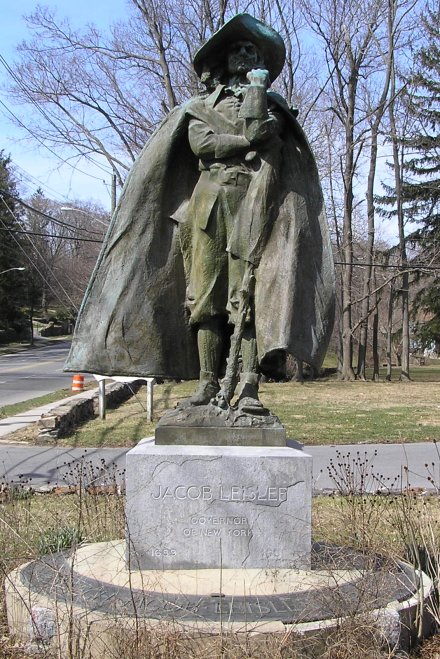
Statue of Jacob Leisler in New Rochelle, N.Y. — which Leisler helped create as a settlement for refugee Huguenots.

And once in the saddle, the Dutch Calvinist Leisler essentially ran a populist administration against the colonial oligarchy, which replied by vilifying him as a “usurper” and “rebel”.

Internal politics in New York and its neighbors during those months make fascinating reading.* Quakers and Catholics aligned against Protestants. Albany aligned against New York, until Leisler brought the former to heel. Clergy chose up sides. Leisler summoned a sort of proto-continental congress of colonial representatives (all the way to the West Indies) to hash out their situation.

And what was that situation? There had been a revolution, after all, and there was no agreed-upon representative of the royal authority present in New York. An assembly of militia leaders had asked Leisler to assume leadership, so was he really outside his rights to treat as his the London dispatches addressed to “such as, for the time being, take care for preserving the public peace and administering the law in New York”?

It’s a moment whose ferment of democratic energy can be read to presage the next century’s (proper) revolution.

Yet it was also not a revolution in the Cromwellian, world-turned-upside-down sense. For the English polity, and certainly for the conduct it preferred in its frontier possessions, continuity was the order of the day. Even in England herself, William and Mary were more than pleased to govern with Tories who could see their way to releasing their fealty to the Stuarts.

There was an empire to run, after all.

From that standpoint, Leisler’s anti-oligarchical policies and fractious disputes with other colonial elites were a bad business. There’s no sense in letting France make inroads because your governors are bickering over predestination or some such.

So formally, the realm’s new rulers continued all non-Catholic personnel in their posts. With the Dominion governors ejected, it was just a matter of dispatching fresh executives to take over. It’s just that this process required months … during which Leisler was managing New York the way he figured it ought to be managed, and his enemies were consequently painting him as a rebel.

Leisler pronounced himself, this whole time, anxious to submit his authority to the new governor upon the production of proper credentials. If he was surprised that the new monarchs tendered appointees of the very same factions recently expelled,** Leisler showed it only in his exactitude for procedure: because of a logistical cock-up, an aide to the new colonial governor arrived first, and when Leisler refused to hand over his fort without the royal warrant, a tense standoff ensued. It was resolved when the real governor, Henry Sloughter of ominous name, finally showed up.

Sloughter had his “predecessor” immediately arrested, along with others of his circle and harshly tried for treason and murder by a court stacked with anti-Leisler political enemies.†

Ultimately Leisler was condemned to die along with his secretary and son-in-law Jacob Milborne, but even Sloughter was loath to enforce the sentence. The story goes that Leisler’s most implacable foes had to get Sloughter drunk to put his signature on the death-warrant. (Sloughter died a couple of months later himself, for maximum operatic effect.)

On Saturday morning, May 16, 1691, the largest crowd ever gathered in New York City stood, rain soaked and weeping, all eyes fixed as a limp body was cut from the gallows and placed on the block. With a clean blow, the executioner’s ax cut off the head of the “halfe dead” Jacob Leisler — loyal lieutenant governor or rebel tyrant, depending on one’s point of view. Amid the “shrieks of the people,” fainting women (some “taken in labour”), and tumultuous jostling for “pieces of his garments” and strands of his hair, as “for a martyr,” the newly arrived and unfortunately named royal governor, Henry Sloughter, worried that his decision to execute Leisler might not, after all, end the “diseases and troubles of this Government.” Indeed, for years afterward New Yorkers bitterly divided over Leisler and the 1689 uprising that, in the wake of England’s Glorious Revolution, had led to his assumption of power in the provincial government.

-David Voorhees, who elsewhere contends that these divisions “continue to inform American politics to the present day.”*

A few years later, a more Leisler-friendly Parliament restored the dead man’s estate to his heirs, a sort of implicit admission that the whole head-chopping thing might have been a bit much.

This character figures to bear more historical consideration than he has heretofore enjoyed; further to that end, there’s a Jacob Leisler Papers Project devoted to marshaling at New York University the primary documents connected with Leisler.

* See, for instance, David Voorhees in “‘to assert our Right before it be quite lost’: The Leisler Rebellion in the Delaware River Valley” in Pennsylvania History, Winter 1997 — and, Voorhees again in “The ‘fervent Zeale’ of Jacob Leisler,” The William and Mary Quarterly, July 1994.

** Literally so: Francis Nicholson, whom Leisler ousted from New York, tried to get himself appointed governor; he was instead sent to Virginia and continued in royal service in the colonies for decades to come.

† e.g., Joseph Dudley, one of Leisler’s judges, whose penchant for authoritarian justice has been noted elsewhere in these pages.

On this day..

1730: James Dalton, Hogarth allusion

On this date in 1730, career criminal James Dalton was executed at Tyburn.

Detail view (click for full image) of James Dalton’s wig box depicted in the boudoir of prostitute Moll Hackabout in Hogarth’s A Harlot’s Progress.

Crime ran in the family for young master Dalton; his father hanged upon the information of notorious (and himself eventual gallows-bird) Jonathan Wild. According to the Ordinary of Newgate’s report, our day’s principal “went between his Father’s Legs in the Cart, to his fatal Exit at Tyburn.”*

Who knows but what naughty urchins (or parents) in the throng were deterred by that affecting spectacle. For the Daltons, it was more like Take Your Child to Work Day.

While the elder Dalton’s skills ran towards card-sharping, young master James went in for the more conventional varieties of larceny — both those practiced by stealth, and those practiced by force.

These pursuits saw him twice transported to America, for which we have to thank the English judiciary on account of Dalton’s resultant biography at Early American Crime.

(In)famous for his many dalliances, Dalton’s exploits could move copy in their day — and their author transgress the lines between the underworld and “legitimate” celebrity.

“In the height of all our Robberies” [Dalton] and his companions “used to go to the Playhouse, dressed like Gentlemen,” and that once, while watching The Beggar’s Opera, “Captain Macheath’s Fetters happening to be loose,” one of them “call’d out, Captain, Captain, your Bazzel is undone.” The real thieves, having shown up the actors with their superior knowledge of both irons and cant, then retired in style to an alehouse, “in four Chairs, with six Lights before each Chair.”**

Just another hanged thief.

Except, also not — because while his career in malefaction would undoubtedly have added up to a death sentence, his condemnation was secured upon the word of a perjurer upon a very doubtful charge.

A character named John Waller, an “affidavit man” whose profession was supplying bogus testimony to hang whomever could be hanged where a reward was available, insisted that Dalton had robbed him upon the roads. Dalton vigorously denied (and even rebutted with evidence) this charge even while admitting his general life of crime, but it was upon this dubious offense against Waller that he stretched his neck. Dalton died at Tyburn with three others, though a fifth member of their party, one Hugh Norton or Haughton, managed to cheat the executioner by hanging himself in his cell.†

It was the rough justice of the 18th century, a time frequently admitting opportunity to repay tit for tat.

In this case, the professional perjurer who hanged Dalton was two years later convicted himself after making a bogus accusation of highway robbery. Waller was condemned by the court to stand in the pillory at the Seven Dials — a dangerous punishment cousin to the era’s death penalty, inasmuch as the mob violence thereby invited not infrequently proved fatal.


John Waller bombarded with refuse in the pillory.

Waller had quite a reputation, but the fury of the crowd was nothing next to that of James Dalton’s brother, Edward — who, with a confederate, brazenly climbed onto the platform, wrenched the “assize man” out of his pillory, and savagely beat him to death.

* Cited in this impressive compendium of Dalton-related primary sources.

** Andrea McKenzie, “The Real Macheath: Social Satire, Appropriation, and Eighteenth-Century Criminal Biography,” Huntington Library Quarterly, Vol. 69, No. 4 (December 2006), with the quotes supplied by a 1730 publication called “The Life and Actions of James Dalton (the Noted Street-Robber)”

† Norton/Haughton was posthumously hanged in chains the next day.

On this day..

1744: Jan, of Johonnes Van Houten

From the Proceedings of the New Jersey Historical Society, only one small instance of the “terrible example” in store for the Garden State’s “large body of slaves to be kept in subjection.”

May 10, 1744 — The negro man “Jan,” of Johonnes Van Houten, was tried “for poysoning and attempting to do the same to several blacks at the township of Bergen; to wit, the negro man of Arent Toers, named Lowis, and has some time past poysoned two wenches of Garret Ross, of the same precinct, and attempted several more.” Convicted and sentenced to be hanged May 11, between 10 and 12, at Bergen; “at the suitablest place, where Peter Marselis and Michel Vreeland shall think proper.”


Was it the slave trade that capitalized the Van Houten cracker empire?

On this day..

1951: Willie McGee

As of today, it is sixty years since the Laurel, Mississippi execution of Willie McGee for rape — a lightning rod for controversy over race, crime, and justice in one of the Cold War’s principal antagonists.

McGee died silent in the state’s portable electric chair, rigged up in the very courtroom of his trial, right in front of the box from whence his all-white jury had retired two and a half minutes before convicting him. Fifty or so observers were there with him — plus those of the hundreds of local residents milling around outside intrepid enough to scale a tree for an illicit view through the courthouse windows.*

(Given the setting, some sources call this a “public execution,” which is not technically correct. This courtroom tableau was actually a standard deployment for the mobile electric chair.)

But McGee’s own silence hardly muted global outrage: for years, appeals for McGee’s life had deluged Mississippi and the White House from Europe, the Soviet Union, and what was quaintly known as “Red China.”

Oh, yes. The Reds.

Willie McGee’s case popped out of backwoods obscurity when he got from the pinko Civil Rights Congress a leftist young attorney — future U.S. Congresswoman Bella Abzug.

Once it got out there, it became the Free Mumia case of the nascent civil rights movement and the nascent Cold War. Its appeal to communist countries and cadres only raised the hackles of American establishment types. This was a Negro raping a white housewife literally and metaphorically.


Author Jessica Mitford (The American Way of Death) campaigning to save Willie McGee’s life. William Faulkner, Albert Einstein, and Josephine Baker also publicly supported McGee.

Whether there actually was a literal rape is the enduring mystery — the enduring Rorschach blot — of the McGee case. The accused himself remained silent on the matter for years; eventually, he claimed that the two were having a consensual but forbidden interracial affair and that he had been brutalized into a confession.

McGee’s defenders believed that the “victim” herself initiated the affair, and

threatened to cry rape if he refused her flirtatious advances … McGee reluctantly went [along] with Hawkins, fearing the tragic consequences of turning her away. “People who don’t know the South don’t know what would have happened to Willie if he told her no,” [Willie’s wife] Rosalee told a friend. “Down South you tell a woman like that no, and she’ll cry rape anyway. So what else could Willie do?”

At the Dark End of the Street: Black Women, Rape, and Resistance

(In this version, the manipulative Hawkins executed the threat when her husband — who later witnessed McGee’s electrocution — found out. McGee’s cited reason for changing his story was the very plausible fear of lynching.)

A Laurel African-American who was then a child remembers being taken by his family to view the body, and impress upon him the lesson of its electrical burns: “Don’t mess with white girls.”

McGee’s persecutors considered all that miscegenation stuff so much subversive rubbish, a “revolting insinuation,” in the words of the Mississippi Supreme Court.**

And if at its apex the controversy generated more heat than light, its historical fade to embers has not sufficed to resolve the factual questions.

McGee has benefited from a recent rediscovery — one that indicates such memories of the McGee case as persevere in Laurel still divide starkly along racial lines.

Explore this case and its many resonances (without the Perry Mason big reveal) in Alex Heard’s 2010 The Eyes of Willie McGee (review); and, in a spellbinding NPR series on “My Grandfather’s Execution” by Bridgette McGee-Robinson, which is exactly what it sounds like. (Direct links to several Radio Diaries mp3 episodes can be found from the RSS feed here.)

Both were facilitated by a recording of execution-night radio news coverage fortuitously preserved by a young Hattiesburg reporter.

Book Cover

* New York Times, May 8, 1951.

** McGee did at least win two retrials in Mississippi; federal courts gave him short shrift, with anti-civil rights judge Sidney Mize — later memorable for fighting the legal rearguard against integrating Ole Miss — lecturing Abzug in a last-ditch appeal that McGee’s “guilt is plain” and that “courts ought to rise up and defend themselves.” (Source)

Taken as an obvious given: “actually guilty” or not, a defendant executed for rape in the American South is certainly a black man with a white accuser.

On this day..

1830: The slave Jerry, the last American execution by burning?

On this date in 1830,* a slave named Jerry was executed in Abbeville, South Carolina … by burning to death.

The slave was the property of a Miss Elizabeth McQuerns, a schoolteacher who hired him out — in which capacity he raped the wife of his subcontracted master.

This case is treated in an April 1990 piece for The South Carolina Historical Magazine by Lowry Ware, titled “The Burning of Jerry: The Last Slave Execution by Fire in South Carolina?” But in addition to being the last execution by fire in South Carolina, it might well be the last in the United States. (The quotes below are all via Ware.)

“Judicial,” for slaves, was of course something less than a robust vindication of the defendant’s rights — and burning sentences imposed in colonial and antebellum America were almost universally used against black slaves. One pictures a context not unlike that of extrajudicial burnings to follow in the decades yet to come.

According to a copy of the trial transcript McQuerns later filed for compensation (the original trial record is lost, Ware says),

the Court acquainted [Jerry] that they were to proceed immediately upon trial and would hear his answer to the charge against him and whatever witnesses he had to produce in his behalf as well as against him.

The witness produced to support the charge against the prisoner was heard and examined and there being no witness in behalf of the prisoner, the court after mature consideration of the case found the prisoner guilty … [and was condemned to] be sent to the Gaol of the said District and there remain until the first day of May next and then be brought back to an old field above West Donald still house, and there burnt to death between the hours of twelve and two o’clock.

But previous to awarding and ordering said sentence to be executed appraised and valued said Negro slave man named Jerry at four hundred dollars and direct the sum of ____ to be paid to Elizabeth McQuerns the owner of said Negro and the remainder of the sum of ____ dollars to ____ agreeably to the Act of Assembly made and provided.

Such a dramatically anachronistic sentence surely made its impression.

As remembered, decades later, by a minister named Samuel Leard who witnessed the execution as a teenager,

thousands of men, women and children, both white and colored, assembled together in an old field not far from the residence of Mr. Donald to witness the execution of a beastly criminal by burning alive at the stake. The crime cannot with propriety be named — the name and the memory of the criminal ought to be consigned to eternal oblivion. But there sat the prisoner, the waiting impatient crowd, the immense pile of pitch pine logs and kindling wood scattered around, the sheriff and his posse, the temporary platform for the preacher … for it was determined that the fiendish criminal should hear his own funeral sermon pronounced … As the poor doomed man ascended the pile, he began to pray audibly and this was kept up continuously during the process of chaining him to the stake, and until the mounting flames deprived him of a wretched life. This was the last execution by fire ever seen in South Carolina.

Abbeville Press & Banner, July 2, 1879

In 1833, the Palmetto State humanely legislated that “that “on the conviction of a slave, or a free person of color, for a capital offence, the punishment shall be by hanging, and not otherwise.”

* The scanty documentation remaining of this case leaves the date less than completely ironclad, but the one issued in sentence attested in this piece will have to do.

On this day..

1951: Ospan Batyr, Kazakh freedom fighter

On this date in 1951, Kazakh national hero Ospan Batyr was executed in Urumqi.

Ospan — the second name is an honorific, not a family name — hailed from an ethnic Kazakh region in China’s eastern Xinjian region, noted today for its still-robust Uighur separatist movement.

Executed Today does not envy any ethnic group attempting to sort out its national aspirations on the frontiers of great powers, and this was the dangerous matter to which our day’s principal applied himself.

The powers in question here are the Soviet Union and China; their degree of sway over Xinjiang (or “East Turkestan”) shapes the parameters of the struggle.

During the early 1940’s, the Soviets’ dire wartime position gave them less weight to throw around; accordingly, the formerly Soviet-allied local warlord Sheng Shicai — an ethnic cleanser of Kazakhs from way back — made nice with the Koumintang.

As Moscow gained the upper hand over Berlin, however, it had leave to tend its eastern ambitions as well.

Since Sheng’s attempt to sell out to Stalin failed, he left Xinjiang with 50 trucks full of loot, and retired to Taiwan to write this 1958 volume on his erstwhile demesne.

When Sheng got bounced from his post trying to re-defect to the victorious Soviets, Ospan Batyr (alternatively, Osman or Uthman Batur) led Kazakh forces in a multi-ethnic Muslim rebellion that established a short-lived East Turkestan Republic, allied with the Soviet Union.

But what the political expediency of great powers giveth, it also taketh away.

The postwar partition of the globe left Xinjiang in China’s sphere of influence, drawing down the East Turkestan Republic’s Soviet support. When that state-like entity became involved in a border conflict with Soviet-backed Mongolia, Osman and the Kazakhs lined up with the Koumintang — not Russia.

As a matter of straight realpolitik, this was an inauspicious moment to get with Chiang Kai-shek since he was on the verge of finally losing China’s long civil war. But it’s a move that would be subsequently vindicated by the way Kazakhs voted with their feet under Mao.

Ospan Batyr had to settle for the judgment of history when the People’s Liberation Army absorbed Xinjiang, and in 1950 finally corralled the remnants of his Kazakh resistance. He repelled demands under torture that he sign on with the Reds and make an appeal to his people in their name: “I can give a life. My nation will continue the struggle.”


Ospan Batyr awaits execution.

Most of the information readily available online about this Kazakh martyr is not in English, and a good deal of it tends to the hagiographical — like this Turkish-language page, lavishly illustrated.

On this day..