1655: Massacre of Waldensians

On this date in 1655, Catholic forces under the Duke of Savoy carried out a notorious massacre of Waldensians* in the Piedmont.

This interesting, excommunicate sect had persisted for centuries in those hard-to-reach places in Alpine foothills, intermittently ignored and hunted. After Martin Luther, many Protestants inclined to see them as a proto-Reformation movement, or even a counter-papal apostolic succession reaching back to ancient Christianity.

At any rate, they sure weren’t Catholic.

And our friend the Duke decided — perhaps piqued by the murder of a missionary Catholic priest, or for whatever other reason — to mount one of those heresy-extirpating sorties and make them Catholic in 1655.

On April 17, the Marquis of Pianezza appeared with an overwhelming force of mixed Piedmontese, French, and Irish** troops. They conducted a few skirmishes, then made nice with the Waldensian civic leaders and induced them to quartering their troops temporarily further to some expedient pretext.

Alas! alas! these poor people were undone. They had received under their roof the executioners of themselves and their families. The first two days, the 22d and 23d of April, passed in peace, the soldiers sitting at the same table, sleeping under the same roof, and conversing freely with their destined victims …

At last the blow fell like a thunderbolt. At four of the clock on the morning of the 24th April the signal was given from the Castle of La Torre. But who shall describe the scenes that followed? On the instant a thousand assassins began the work of death …

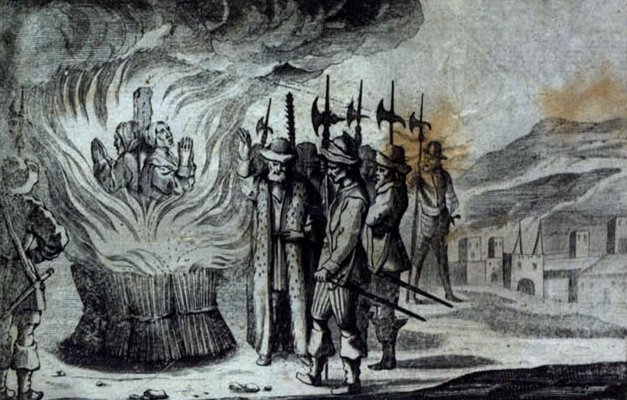
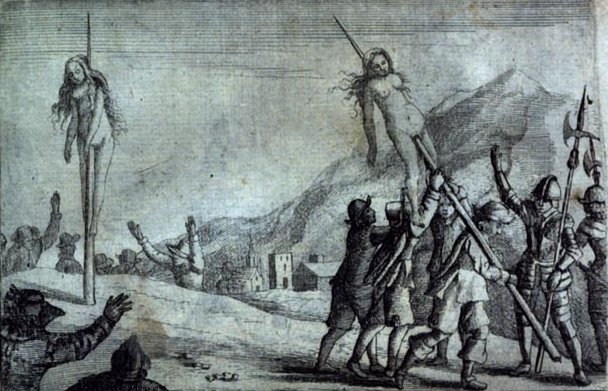
Little children were torn from the arms of their mothers, and dashed against the rocks; or, more horrible still, they were held betwixt two soldiers, who, unmoved by their piteous cries and the sight of their quivering limbs, tore them up into two halves. Their bodies were then thrown on the highways and the fields. Sick persons and old people, men and women, were burned alive in their own houses; some were hacked in pieces; some were bound up in the form of a ball, and precipitated over the rocks or rolled down the mountains … Some were slowly dismembered, and fire applied to the wounds to staunch the bleeding and prolong their sufferings; some were flayed alive; some roasted alive; others were disembowelled; some were horribly and shamefully mutilated, and of others the flesh and brains were boiled and actually eaten by these cannibals.

Source, whose atrocity accounts channel those in this French tome

Without doubting the capacity of man’s inhumanity to man, the cannibalism charge reminds that we’re dealing with propaganda alongside historiography. And what great propaganda — like, babies-torn-from-incubators great.

Thumbnails (click for a larger, disturbing view) of selected images of this date’s atrocities from Samuel Morland’s The History of the Evangelical Churches of the Valleys of Piedmont

And there’s little doubt as to the overall savagery of the affair, which could well have become the opening salvo in a full-scale sectarian cleansing campaign. (A later addendum to Foxe’s Book of Martyrs narrates the ensuing Piedmontese armed struggle, petering out before any definitive resolution in the field.)

Outrage at this hecatomb spread in Protestant Europe — which would also refer to the day’s doings as the “Bloody Easter,” since it corresponded with the eve of that celebration as reckoned by the Julian Calendar (source).

It was felt especially in Protectorate England, which intervened diplomatically.

A “day of solemn fasting and humiliation” was promulgated in Albion, along with collections for the relief of the survivors. Oliver Cromwell personally put £2,000 into the kitty.

More importantly, he dispatched diplomat Samuel Morland† to force the House of Savoy to lay off the persecution; in fact, he threatened to disrupt high statecraft between England and France unless the French twisted arms on behalf of the Waldensians.

Written correspondence for Morland’s diplomatic tour addressed to Louis XIV of France and various other continental potentates, as well as a fiery bit of oratory that Morland delivered to Savoy, all seem to have originated from the pen of Republican scribbler John Milton — the future author of Paradise Lost.‡

Milton, for whom the whole thing was more than just a day job, was further moved to put his umbrage at the slaughter into sonnet form:

Avenge O Lord thy slaughter’d Saints, whose bones
Lie scatter’d on the Alpine mountains cold,
Ev’n them who kept thy truth so pure of old
When all our Fathers worship’t Stocks and Stones,

Forget not: in thy book record their groanes
Who were thy Sheep and in their antient Fold
Slayn by the bloody Piemontese that roll’d
Mother with Infant down the Rocks. Their moans

The Vales redoubl’d to the Hills, and they
To Heav’n. Their martyr’d blood and ashes sow
O’re all th’ Italian fields where still doth sway

The triple Tyrant: that from these may grow
A hunder’d-fold, who having learnt thy way
Early may fly the Babylonian wo.

* The Waldensians in question here are interchangeably known as the Vaudois for their geographic region, actually above the Piedmont and abutting the Swiss region also known as Vaud. (These pages have visited the latter.)

** Fresh from being on the receiving end of another infamous massacre.

† Morland is more regarded for his post-Restoration labors as an inventor; he created an early calculator and internal combustion engine.

‡ The speech in particular is not definitively attributed; see Robert Fallon, “Milton in Government: Denmark and Savoy,” Milton Quarterly, May 1989.

On this day..

Feast Day of St. George

This is the feast date, and the traditionally-ascribed execution date in 303, of St. George — legendary dragon-slayer and patron saint of half the world and darn near everything that the original apostles didn’t nail down.

Saint George is supposed to have been a well-favored officer in Diocletian‘s army who suicidally announced his Christian faith during the latter’s persecutions, and refused every sop and entreaty to renounce it. He was martyred at Nicomedia.

Pretty standard persecution fare — and there’s next to nothing that can be reliably verified about his life — but George did well by his future cult to get into the martyr’s game right before Christianity’s official triumph. Still, at the end of the day, it’s one of those unaccountable accidents of history that this particular fellow ended up as perhaps Christendom’s most widely venerated champion.

He’s most immediately recognizable for the story of having slain a dragon, a plain metaphor for paganism (and usable metaphor for anything and everything else) that’s been depicted in all its scaly corporeality by innumerable artists.

England has liked him jolly well ever since his suitability to the chivalric ethos positioned him to supplant Edmund the Martyr as that realm’s patron saint during the Middle Ages. The red cross on the English flag is a St. George’s cross.

And so there he is, too, in one of Shakespeare’s most rousing patriotic monologues:

I see you stand like greyhounds in the slips,
Straining upon the start. The game’s afoot:
Follow your spirit, and upon this charge
Cry ‘God for Harry, England, and Saint George!’

But George gets around, and England has to share him.

That St. George’s Cross also adorns the flag of Georgia (the country, that is: it’s so hard core that it’s named for the guy), and he’s claimed as a sponsor throughout Orthodox Christendom: Serbia (which celebrates a major holiday when April 23 hits on the Julian calendar); Bulgaria; Greece; Ethiopia; the city of Constantinople and its heir, the city of Moscow, and Russia generally. There were two George’s [Yuri’s] Days on Old Russia’s calendar, and the autumn one was marked as the one time in the year that serfs were permitted to change their landlords, at least until Boris Godunov canceled the privilege and left Russian with the idiom “so much for Yuri’s day!” to mark an expectation disappointed.

George is big in Spain, and even bigger in Portugal; through its Portuguese heritage, he’s also venerated in Brazil, where he’s the patron saint of the Corinthians football club. He’s the sponsor (via that dragon connection) of the snaky Hungarian military order that gave Vlad the Impaler the immortal sobriquet of Dracula.

There are other countries and any number of cities who also trust the dragon-slayer’s patronage; George accepts the further devotions of saddle-makers, lepers, animal husbandmen, shepherds, Crusader knights, butchers, the Maltese, gypsies, farmers, archers, syphilis-sufferers, cavalrymen and therefore also armored tankmen, Palestinian Christians, and the Boy Scouts of America. He’s generally got a stupendous worldwide collection of churches, art, legends, and devotional rites dedicated to his name.

On this day..

1783: Philip, a negro slave of Henry Garrett

From the Chronicles of the Scotch-Irish settlement in Virginia

Called Court on Philip, a negro slave of Henry Garrett, and formerly property of Major Thomas Johnston, of Louisa County, charged with murdering Alexander Hunter, of Augusta County, and wounding the wife of Samuel Henry.–Guilty and to be hanged on 16th April next at 10 o’clock a. m. His value is fixed at £65.

On this day..

1967: Aaron Mitchell, Ronald Reagan’s first and only execution

On this date in 1967, Aaron Mitchell was gassed in California on the authority of a governor holding his first elected office — Ronald Reagan, future U.S. president and emerging avatar of conservative white ressentiment in the turbulent 1960s.

It was only 23 days after California’s last previous execution, in January 1963, that Mitchell killed a white cop during a shootout occasioned by his abortive bar robbery. He’d been on death row fighting execution ever since, with a few dozen others who had been there even longer.

That gummed-up death penalty process, for which the Golden State is so well-known today, was most vividly symbolized at the time by the 12-year death row odyssey of Caryl Chessman.

And it had been among the many grievances catalyzing a conservative backlash against the civil rights movement, the Great Society, anti-war protesters, permissive social mores … the whole aspect of Sixties counterculture and American liberalism.

Ronald Reagan was born to wield the sword against it all. The sword, or some little cyanide pellets.

Reagan, a film actor, had cut his political teeth as a spokesman for General Electric and against commie plots like Medicare.

After famously backing the failed 1964 presidential bid of Barry Goldwater, Reagan emerged as the favored son of the New Right, and in his first foray into electoral politics, steamrolled over incumbent Democrat Edmund Brown in California’s 1966 gubernatorial election.

Reagan had an undoubted gift for packaging the sometimes unpalatable ennui of his potential constituencies into soundbites that respectable people could repeat in public, which talent proved essential to his bright political future.

“Why is it,” he demanded during the campaign, “that no street in our city is safe for women after dark?” (Los Angeles Times, September 21, 1966) Stung by Republican attacks on rising crime rates, Gov. Brown had vainly pushed a tough-on-crime platform of his own in 1966.

Too little. Too late.

“Mr. Reagan is outspokenly in favor of capital punishment and he has just been elected by a tremendous majority,” said Jesse James Gilbert, 41, who has languished on Death Row for two years.* “If the courts begin to reflect his thinking, he will be in a position to become the greatest butcher governor in history.”

Los Angeles Times, Dec. 4, 1966

What a different world it was from today’s that a major paper unabashedly used a death row prisoner’s own voice for analytical comment. Still, that same article noted (not in Gilbert’s voice, but as a plain fact on the ground) that “even a single execution could endanger Reagan’s chances for reelection or stifle voices which are beginning to urge him to seek the Republican Presidential nomination in 1968 or 1972.” A different world indeed.

Reagan had outspokenly run on capital punishment, however, and there’s such a thing as feeding your base. He surely was not going to execute nobody.

Mitchell was the man in line, and he certainly fit that not-safe-to-walk-the-streets-at-night angle, if you catch the drift. In an Ebony (June 1967) profile of his last days, Mitchell emerges at once radicalized and resigned, his four years awaiting death spent “researching and studying the race problem.”

“Every negro ever convicted of killing a police officer has died in that gas chamber,” Mitchell said on the day of his death. “So what chance did I have?”**

When the aide in charge of the clemency application is overtly pro-Scrooge future Attorney General Edwin Meese … not much chance, no.

So on this date, and in spite of an energetic protest outside San Quentin, a suicide attempt inside it, an open line to the governor’s office just in case, and a hysterical mother (who fled Mitchell’s clemency session in tears two days before, complaining that it was “a sham hearing”), Mitchell became the 501st person put to death since the state moved all executions from county auspices into state prisons.†

The 502nd would not take place until another quarter-century had elapsed.

Cold comfort to Mitchell, but Reagan himself did not vindicate Jesse Gilbert’s worst fears, and did not present the execution rubber-stamp of a later political generation; for his time and place, being visibly willing to approve some executions amply proved his credentials. (Newsweek called the governor a “man of conviction” after the Mitchell execution. (Source) Mission accomplished.)

Reagan would stay the next death date on his watch, that of Daniel Allen Roberts, over questions of mental competency; later in 1967, he would do the same for Robert Lee Massie just hours ahead of execution so that Massie could testify in another trial, inadvertently providing a bullet point in the conservative critique of death penalty squeamishness.

And in the event, the Great Communicator would be spared any great need to answer for a significant slate of individual clemency decisions. It was judicial activity far more than executive reticence that stayed the hand of California’s executioner; only one more execution after Mitchell’s took place in all of the U.S. before the country slipped into a complete death penalty moratorium from which it would not emerge for another decade.

And when the Reagan-appointed California Chief Justice Donald Wright authored a 1972 opinion striking down that state’s death penalty laws, it emptied death row outright.‡ (Sparing, among over 100 others, Charles Manson and Sirhan Sirhan.)

Capital punishment is impermissibly cruel. It degrades and dehumanizes all who participate in its processes. It is unnecessary to any legitimate goal of the state and is incompatible with the dignity of man and the judicial process. Our conclusion that the death penalty may no longer be exacted in California consistently with article I, section 6, of our Constitution is not grounded in sympathy for those who would commit crimes of violence, but in concern for the society that diminishes itself whenever it takes the life of one of its members. Lord Chancellor Gardiner reminded the House of Lords, debating abolition of capital punishment in England: “When we abolished the punishment for treason that you should be hanged, and then cut down while still alive, and then disembowelled while still alive, and then quartered, we did not abolish that punishment because we sympathised with traitors, but because we took the view that it was a punishment no longer consistent with our self respect.”

California v. Anderson

That would not stand as the final word on capital punishment in California, but by the time other condemned prisoners had come to the end of their appeals, they were the concern of different governors.

Reagan left the California governor’s mansion in 1975 during the death penalty’s long hiatus; as U.S. president from 1981 to 1989, the death penalty was only just coming back online from that period, and that at the state level. Beyond platitudinous approval of the trend, Reagan never had to put his own signature on a federal death warrant.

So as it turned out, Aaron Mitchell was the first, last, and only man so distinguished.

And Reagan’s minuscule career execution count was hardly the anomaly that it might now appear. Prior to Reagan, the last Chief Executive who had actually entered the White House having previously forwarded any fellow to the executioner was … Dwight Eisenhower.

* Gilbert is the appellant in the 1967 U.S. Supreme Court decision Gilbert v. California, reversing his conviction because of a police lineup identification unconstitutionally obtained without his lawyer’s knowledge.

** The cop-killing Mitchell wasn’t getting any love from the beleaguered Brown administration, either; Brown almost had a shot to pull a Ricky Ray Rector with Mitchell during the campaign, but the prisoner won a judicial stay just 24 hours from execution in May 1966.

The now-former governor was quoted after Mitchell’s actual 1967 execution expressing general support for Reagan’s non-clemency in spite of Brown’s own philosophical opposition to capital punishment.

† A journalist who witnessed the gassing later described it as something less than a triumph of the killing arts.

as the gas hit him, his head immediately fell to his chest. Then his head came up and he looked directly into the window. For nearly seven minutes he sat up that way, with his chest heaving, saliva bubbling between his lips. He tucked his thumbs into his fists, and finally his head fell again … I believe he was aware many minutes … He appeared to be in great anguish

‡ “A mockery of the constitutional process,” fumed (pdf) Reagan, who claimed that Wright had told him he backed capital punishment. (See Governor Reagan: His Rise to Power)

On this day..

1918: Robert Prager lynched during war hysteria

On this date in 1918, German coalminer Robert Prager was lynched near Collinsville, Ill., for making disloyal utterances against the United States as his adoptive country entered World War I.

Basically the most visible and famed victim of patriotic anti-German bellicosity, Prager ironically is rather difficult to reconstruct as an unambiguous anti-war activist. After his mob execution, a baker would even come forward to say that he had been thrown in the clink when Prager accused him … of badmouthing a patriotic display. Prager himself had tried to enlist in the Navy and been rejected for medical reasons.

“Prager was, in fact, as loyal to the United States as any native-born citizen, and his innocence was attested to by many who knew him,” according to Donald Hickey in the summer 1969 Journal of the Illinois State Historical Society. “Two of the men with whom he boarded attested to Prager’s loyalty. One said that although Prager was a radical socialist, he had said he was ‘all for the United States’ when this country entered the war.”

But he was a socialist, and a German, and seems like the sort whom others might have found personally unpleasant. It is in the midst of a tiresome local dispute with a union leader (the union also rejected him) that Prager came to the unwelcome attention of the rabble: the union leadership accused him of being a spy, which led Prager to post handbills around town denouncing this lot for their scurrilous accusation. This obviously did him more harm than good and as the public conviction that Prager was disloyal took hold, it overran the halfhearted efforts of the town’s putative authorities to keep a semblance of order.

A mob on April 4 captured Prager at his home, paraded him, made him kiss the flag — momentarily rescued and hustled off to jail by police and a mayor who tried to talk the mob out of its design — then shanghaied from his “protective” custody cell and taken to the outskirts of Collinsville for hanging on a tree.

Eleven men stood trial for the affair over three weeks. Once the matter was finally rested with the jury, they were instantly acquitted.

There was wild applauding and cheers from ‘most everyone present. Relatives, friends and acquaintances rushed toward the bar to shake hands with the defendants. …

There was a peculiar coincidence at the trial Saturday. The Jackie Band was in Edwardsville for a patriotic demonstration.

When a shower of rain came up the musicians were sent to the court house where it had been arranged to give a program. At 2:40 o’clock judge Bernreuter ordered a recess after the completion of arguments and before reading the instructions.

Then word was sent that the band might play until court re-convened. The first number of all concerts is the Star Spangled Banner and it was played Saturday.

The strains from the Jackie Band caused tears to flow down the cheeks of Riegel. He was still crying when he returned to the court room.

As the jury came in with its verdict the band was at the head of a procession of draft boys and in passing the court house played “Over There.”

While Prager’s murder stands as the most emblematic event of anti-German intimidation during America’s months in the Great War, it was far from the only one: many others nearly as ugly stopped just this side of homicide. Papers were rife with reports of German immigrants being made to kiss the flag; clapped in jail for suspect utterances; of being menaced by mobs.

Outrageously, Germany made propagandistic use of these events, which the virtuous Entente powers would certainly never do.


Washington Post, April 11, 1918.

A number of federal lawmakers, as well as former presidents William Howard Taft and Theodore Roosevelt, condemned the lynching, mostly in the familiar coded terms with which lynchings were opposed in those days: one would rather let justice take its course. Mob rule is itself disloyal. Etc. (See Hickey)

But the right-thinking potentates of the war party were also finding themselves relieved that a polity which had re-seated the current president on the slogan “he kept us out of war” would so pliably turn towards bellicosity. This charade so mechanically familiar in our time was still an arcane and uncertain art in America’s imperial adolescence.

“The recent lynching of a German in Illinois and violent outbreaks of the same character in other parts of the country,” intoned the Washington Post, “have awakened the Department of Justice to the need of a law which will enable government officers to prosecute pro-Germans rather than leave them to be dealt with by mob law.”

Oh. Danke very much.

An unsigned editorialist in the paper’s April 12 edition opined so nauseatingly brutal and specious that in another age it would have earned its author an immediate contract with Fox News:

Stamping Out Treason

The question whether or not the laxity of the laws against treasonable utterances has been responsible for the people’s acts in taking the law into their own hands has been much debated of late.

While sedition may have been encouraged to some extent because of the comparatively mild risks involved, it is quite probable that the pro-German intrigues would have been carried on if the risk had been greater. This suggests the thought that other reasons must be looked for to account for the general revulsion of public sentiment against the treason spreaders and the prompt punishment meted out to them in so many instances.

A plausible explanation is found in the fact that the open and ingenuous American mind had been fed up on German lies to the point where it broke out in fierce revolt. At the beginning of the war, and even after the entrance of America into it, there remained debatable points in many minds. Though of a minor nature and scarcely affecting the larger issue, these points were emphasized by enemy agencies which had been at work from the beginning. But as the truth has been laid bare the indignation of the people has grown stronger. The fact that the rounding-up process has been most vigorously conducted in the middle West tells its own story in this respect. It was that section which was slowest to wake up. There the enemy propaganda apparently worked with most success. So it is there that the people have arisen unitedly in their righteous wrath against the treason talkers.

The comparative absence of outbreaks of this character in the East is explainable on the same theory. In the East the public mind toward the war was much earlier divested of errors. Consequently the enemy agents were more wary in their utterances, not because of any greater stringency of the law, but because of their appreciation of the temper of the people.

In spite of excesses such as lynchings, it is a healthful and wholesome awakening in the interior part of the country. Enemy propaganda must be stopped, even if a few lynchings may occur. The people know what they want. They are not seeking to subvert law and order.

Other powerful institutions were not quite so sanguine as the Post: the lynching was discussed hours after it occurred in the U.S. cabinet, no doubt mindful that it was also being denounced in the German Reichstag. And indeed all concerned marshaled these animal spirits of the populace towards killing men by the thousands under the auspices of the state rather than singly by drunken small-town mobs.

Fears of German reprisals against American prisoners never seem to have materialized; neither is there any other documented lynching in the short course of America’s World War I involvement that was conducted on unambiguously “patriotic” grounds.

* Any number of other papers joined the Post in this campaign, including the St. Louis Post-Dispatch and the Chicago Tribune. A few weeks later, they got their wish — the Sedition Act, under which the Socialist Eugene Debs was arrested for speaking against the war.

On this day..

1942: Not Hersh Smolar, saved by Genesis

(Thanks to Meaghan Good of the Charley Project for the guest post. -ed.)

On this day in 1942, the Nazis issued an ultimatum to the Judenrat of the Minsk Ghetto in Belarus: turn over Hersh Smolar for torture and execution by noon, or they would all face execution themselves.

Smolar, a dedicated Communist who was a writer and editor in civilian life, had been a problem for the Germans for quite some time. He was a leader in the resistance of the Minsk Ghetto, and that resistance was a force to be reckoned with. Smolar and others like him formed an underground organization that printed leaflets about Soviet successes in the war, occasionally hid non-Jewish Communists and escaped Russian prisoners of war within the ghetto (the infectious disease ward of the hospital was a great hiding place: the Germans never went there), and above all tried to save the lives of as many Jews as possible.

The Minsk Ghetto underground formed links with underground resistance organizations on the outside and they worked together. Unlike the rest of Eastern Europe, the general population of Belarus was as a whole sympathetic and helpful to the Jews. The result was that Jews were able to escape the ghetto and join partisan groups in the forest by the thousands, surviving and taking out Nazis at the same time.

The Minsk Ghetto leaked like a sieve. By the time it was liquidated, 10,000 of its residents had joined partisan groups in the forest.

Smolar, of course, had tried to keep his activities a secret from the Nazis, but he couldn’t avoid their attention forever. Unfortunately the Minsk Ghetto Underground wasn’t very good at keeping itself a secret and twice it was decimated by mass arrests.

By the spring of 1942, Smolar was a hunted man, and in hiding. On April 1 he was in the hospital’s infectious disease ward, disguised as a typhus patient, meaning his face could be covered. (Typhus patients suffer extreme sensitivity to light.) The Judenrat paid him a visit and told him about the Nazis’ ultimatum.

Some of the Judenrat members were prepared to turn Smolar in, so only one person would have to die. Of course, the ideal solution would be where no one would die. They turned to the Tanakh for guidance, specifically the story of Joseph. When Joseph’s brothers sold him into slavery in Egypt and told their father he had died, they dipped his coat in the blood of a kid and presented this as proof of his death.

Displaying the sincerest and brassiest form of flattery, one of the Judenrat members took a blank passport, filled it out with Smolar’s photograph and details, smeared it with blood from a recent Nazi victim, and took it to the Gestapo officers. He explained that they had apparently gotten Smolar in a random shooting, as the passport had just been found on a mutilated body at the cemetery.

And the Germans actually fell for this. April Fools!

Barbara Epstein’s excellent book The Minsk Ghetto 1941-1943: Jewish Resistance and Soviet Internationalism records the rest of the story: Smolar remained in hiding in the hospital for another four months. Eventually he left the infectious disease ward and moved to a specially constructed hiding place in the attic chimney, which was only large enough to stand in.

Presumably he was very happy in August 1942, when the time came for him to leave the ghetto and join a partisan group in the forest. He survived the war … as did about 4,500 other Jewish partisans from the Minsk Ghetto.

Smolar wrote a memoir about his experiences and the Minsk Ghetto Underground in general, titled The Minsk Ghetto: Soviet-Jewish Partisans Against the Nazis. He died in Israel in 1993, age 88.

On this day..

1733: John Julian, pirate and slave

On this date in 1733, a rebellious slave named Julian the Indian was hanged for murdering a bounty hunter who pursued his escape.

Julian the Indian is generally believed to be John Julian (or Julien), a mixed-race African-descended Mosquito Indian from central America who was among the crew of the egalitarian pirate Samuel Bellamy. Julian appears to be the first recorded black pirate in the New World.

Julian was one of only two pirates who survived the wreck of Bellamy’s Whydah off Cape Cod in 1717 (Bellamy himself was lost in the incident), and was jailed in Massachusetts. There, he apparently becomes the “Julian the Indian” purchased that same year by colonial pol John Quincy.

The “unruly” Julian gave his owner no end of escape attempts and was sold on to another owner, from whom he made one escape attempt too many.

There’s a gallows pamphlet, “The last speech and dying advice of poor Julian: who was executed the 22d of March, 1733. for the murder of Mr. John Rogers of Pembroke,” but there’s no juicy buccaneer adventure in it, or even slave escape adventure — just a lot of generic pabulum about having forsaken God, not unlike the generic woodcut illustrating it.

You’d have to say, a sad end for a multinational swashbuckler left over from the vanished Golden Age of Piracy who had seen things these New Englanders wouldn’t believe, and shattered his own life hurling it against his fetters.

A noble soul, as we may reckon, destined to wind up meat for some wet-behind-the-ears colonial physician.

According to the (factual) epilogue of the (historical novel) Master of the Sweet Trade: A Story of the Pirate Samuel Bellamy, Mariah Hallett, and the Whydah,

It was common for the unclaimed bodies of executed prisoners to be given to medical students for dissection, and according to an article in The Boston Newsletter, on March 30, 1733 John’s corpse was used for this purpose. The article goes on to tell us that, “The Bones are preserv’d in order to be fram’d into a Skeleton”. This may be the source of the idea that the skeleton is in the collection of the Warren Anatomical Museum at Harvard Medical School in Cambridge, Massachusetts. Current research at the museum says this is untrue, and that neither the skeleton, nor the bag made from the skin of a pirate, also in the collection, are believed to belong to John Julian.

John Quincy’s great-grandson, the American President John Quincy Adams, became a staunch slavery abolitionist.

On this day..

1244: Two hundred-plus Cathars at Montsegur

On this date in 1244, over two hundred Cathar heretics submitted themselves to the stake rather than submit to the Catholic church.

Though not literally the last of the Cathars, that outlawed dualistic sect in the south of France whose extirpation occupied the papacy for much of the 13th century, this date was the last great stand and the signature massacre of the Albigensian Crusade. Afterwards, only minor outposts and isolated individuals would remain available for mop-up duty.

Heretical holdouts, fleeing a malevolent Inquisition established in the Languedoc by victorious Catholic armies, holed up at a few Cathar strongholds of which the most impressive was the mountain citadel of Montsegur.


The spectacular attraction of Montsegur tourists see today is not the legendary Cathar castle — which was razed by its conquerors — but a subsequent rebuild. (cc) image from SarahLouiseHathaway

Finally in 1243-1244, a massive Catholic army invested Montsegur; one can’t help but compare this hopeless confederation of fearless zealouts ranged against the mighty temporal powers to the Jews at Masada — and as with Masada, it were death to succumb to the besiegers.

When Montsegur finally surrendered, two hundred-some — the reported counts differ slightly — were burned at the stake for refusing to renounce their faith; many of them had actually taken sacred vows in the days before Montsegur fell.

They were Nazis, Dude?

The National Socialists’ weird quest to outrace Indiana Jones for mystical artifacts also brought the swastika to Montsegur, under the direction of the occult medievalist Otto Rahn.

Rahn thought the Holy Grail may have been secreted at Montsegur under Cathar protection, a half-literal, half-metaphorical secret goblet carrying the heretics’ forbidden gnostic wisdom from the day of Mani.

(Other Nazis, allegedly including Heinrich Himmler himself, favored the similar-sounding Spanish fortress of Montserrat. Dan Brown prefers the Knights Templar, who could have laid their gauntlets on the cup of Christ when a few Cathars allegedly slipped through Montsegur’s encirclement carrying some unidentified mysterious secret.)

On this day..

2005: A gay couple in Saudi Arabia

Stay classy, Saudi Arabia.

RIYADH—A gay couple was beaded in a public execution Sunday [March 13, 2005] in Saudi Arabia after being convicted of killing a blackmailer. If they had been exposed as gay they could have been executed anyway.

Homosexuality is punishable by flogging, lengthy prison terms or death under Sharia Islamic law.

The Saudi Interior Ministry issued a statement Sunday announcing the execution. It said that Ahmed al-Enezi and Shahir al-Roubli, both Saudis, ran over Malik Khan in their car, beat him on the head with stones and set fire to his corpse “fearing they would be exposed after the victim witnessed them in a shameful situation”.

The term “shameful situation” is regularly used by the government to refer to homosexual acts.

The ministry said the two men were executed in the northern town of Arar, near the Iraq border.

The Saudi government routinely rounds up people suspected of being gay. All that is needed is a complaint from someone. In some instances men who are not gay who have been arrested were picked up on the complaint of a neighbor following a dispute.

The kingdom also, on a number of occasions, has blocked access to the only gay Arab news and information site on the internet.

On this day..

1816: Five Boers for the Slachter’s Nek Rebellion

“All those who know anything of the history of South Africa,” writes Ian Colvin, “have heard of Slachter’s Nek. (English Wikipedia entry | the more detailed Afrikaans)

“The very name has something of evil omen about it, and it is the gallows-tree on which the ravens of discord have sat and croaked ever since the five rebels were hanged in the memorable year of Waterloo.”

You’ve got to admit that a place like “Slachter’s Nek” (or Slagtersnek) definitely ought to be associated with a hanging. Luckily for this site, it is.

Though subsequently a grievance for the Dutch-descended Boers — a monument was erected in the hanged men’s honor on the centennial of their execution — this particular evil omen barely even registered when it came to British colonial disturbances.

A farmer, one Frederik Bezuidenhout, started the trouble by defying an order to appear in court for his maltreatment of a native; the Brits hunted him to a cave and killed him in a shootout.

This led to a very slightly wider spasm of resistance which one could very generously account “Quixotic”: a few dozen other Afrikaner farmers bent on driving out the “tyrants”, most of whom wisely threw in the towel when the tyrants’ military showed the colors. (With the literal boots-on-the-ground support of the colony’s preponderance of Dutch burghers.)

Thirty-nine stood trial, with a half-dozen death sentences meted out. In defiance of a widespread expectation of clemency, only one was spared.

Four of the five hanging ropes broke. Still no reprieve: fresh nooses were procured.

On this day..