Sixty years ago today, Timothy Evans was hanged at Pentonville Prison still protesting his innocence of murdering his wife and daughter — three years before a neighboring tenant was revealed to be a serial killer.
A drunkard with a tempestuous marriage, Timothy Evans didn’t look like a compelling innocence case when he walked into a police station and confessed to killing his wife while attempting to administer an abortifacient.
Evans’s confession didn’t add up, and he kept changing it — to indicate the involvement of neighbor John Christie. The “botched abortion” angle got complicated when the Evans’s older, un-aborted daughter also turned up dead: like her mom, she’d been strangled.
But the dim suspect’s iterative interpretations of how his family wound up throttled had left his credibility in tatters by the time he came to trial insisting that the confession was wrong. And you’d have to admit that the looming shadow of Executioner Pierrepoint presented a compelling reason to disbelieve his latest revisions.
The jurors disbelieved.
Evans swung.
Three years later, that very Christie who had so smoothly inculpated Timothy Evans, was arrested for a killing spree that turned out to have lodged at least six corpses hidden on the same premises at 10 Rillington Place.
Here was a man desperately and (to the public) implausibly implicated by a convicted murderer recently hanged: that this man subsequently turned out to be a prolific serial killer did a job to undermine public confidence in the death penalty.
Christie himself hanged for his own crime spree in 1953. He admitted to murdering Beryl Evans, Timothy’s wife, though never to killing daughter Geraldine.
Little more than a decade after that, England’s gallows fell into disuse.
On February 27,* 1623, the Dutch East India Company beheaded twenty who had been waterboarded into confessing to a terrorist plot.
English prisoner suffering “waterboarding” faux-drowning torture, published under the name “A true relation of the unjust, cruell, and barbarous proceedings against the English at Amboyna in the East-Indies 1624”.
The torturers “poured the water softly upon his head until the cloth [wrapping his head] was full, up to the mouth and nostrils, and somewhat higher, so that he could not draw breath but he must suck in all the water.” More nasty description.
As in modern times, this scenario originated with resource competition in the Muslim world … in this case, competition for spice, in Indonesia.
European colonialism had pitted the Dutch East India Company against its British counterpart on the archipelago, both scrabbling after the lucrative trade in cloves and pepper, with garnishes of nutmeg, cinnamon, mace, and ginger.
The two rival powers had, as we lay our story, recently come to a tense truce, dividing the commerce between them — and swapping mutual accusations of violating that pact. The arrangement basically gave the Dutch a bigger slice of the pie, so we’ll find them when the cloves hit the fan having the balance of power on their side.
Terrorists
We’re going to oversimplify to set the scene.
On Ambon Island, one of the very “Spice Islands” (i.e., the Moluccas) — at the Dutch-controlled fortification of a trading post also shared by the English — the Dutch merchant-governor Herman van Speult heard that a Japanese mercenary had asked about the Dutch fortifications.
The security-conscious van Speult ordered that unfortunate soldier interrogated under torture.
As tends to happen when the interrogators in such a case are convinced of a ticking time bomb situation, the torture uncovered a ticking time bomb situation.
The mercenary got the Dutch to stop burning and drowning him by “revealing” a highly implausible** English plot to seize the Dutch fort, with 20 guys or so and no prospect of imminent outside aid. Wouldn’t you know it: when the supposed confederates named by the mercenary were similarly tortured, they too admitted the plot. Van Speult’s English opposite number, Gabriel Towerson, was one of them.
The Amboyna Massacre followed anon, with Towerson and nine other British East India Company employees beheaded, along with nine Japanese mercenaries and one Portuguese. (The latter ten worked for the Dutch East India Company, not the British. A fifth column!)
They went to their deaths protesting their innocence, and many smuggled out written recantations to that same effect: “tortured … with that extream Torment of Fire and water, that Flesh and Blood could not endure it, and we take it upon our Salvation, that they have put us to Death Guiltless.”
Anger in the English Street
That last quote comes from Karen Chance, “The Amboyna Massacre in English Politics, 1624-1632,” in Albion: A Quarterly Journal Concerned with British Studies (Winter 1998).
As the title of that piece suggests, the Amboyna Massacre outraged Towerson’s countrymen and -women once word finally made it back to the mothership. (In addition to the torture/wrongful execution dimension, the legal authority of the Dutch trading concern to impose judicial punishment on their English counterparts was questionable at best.)
English demands for satisfaction against the perpetrators continued to complicate Dutch-English relations into the reign of Charles I and beyond. Even Oliver Cromwell required, as the price of peace for the First Anglo-Dutch War in the 1650s, punishment of any surviving offenders. (Which was apparently nobody at all.)
And still later, the burgeoning British Empire’s propaganda arm reached for the Amboyna narrative to justify seizing New Amsterdam on the grounds that the Dutch had attempted to spring a massacre on English settlers — “their Amboyna treacherous Cruelty extended itself from the East to the West Indies, and pursued thus the straight channel of Dutch blood”.
As for the trade-jockeying: the Netherlands’ commanding position in Indonesia ultimately squeezed the English out.** But don’t fret for Old Blighty: she turned attention to gobbling up India, and made a lot more bank than did the Dutch spice racket.
* February 27 was the date according to the Julian calendar in use at this time by the British. By the Gregorian calendar the Dutch were using, the massacre took place on March 9.
** For more on both the fanciful nature of the supposed plot, and the economics of the East Indies trade as it unfolded in the 17th century, see D.K. Bassett, “The ‘Amboyna Massacre’ of 1623”, Journal of Southeast Asian History, September 1960.
This date’s observance marks the systematic execution by (West) Pakistani forces of the intellectual class of East Pakistan at the end of the civil war which would detach the east as the independent nation Bangladesh — an unavenged war crime as cynical as it was brutal.
Executed intellectuals in the Dhaka Rayerbazar, 1971.
This was not a single discrete massacre, but a continuing policy during the March-December 1971 war. December 14, just two days before the Pakistani army surrendered, was the peak date of a dreadful endgame paroxysm that saw hundreds of scholars, teachers, lawyers, doctors, artists, writers, engineers, and the like rounded up and summarily executed in a bid to decapitate the new Bengali state’s intelligentsia.
Though the martyrs were subsequently venerated in Bangladesh, the higher-stakes regional geopolitics have always made effective redress a nonstarter.
On this date two years ago, seven civilians were apparently summarily executed by Niger security forces in that country’s long-running internal conflict with its Tuareg population.
Extrajudicial executions have been a recurring event (among the other usual charms of warfare) in Niger’s fight against the Mouvement des Nigériens pour la Justice (MNJ).
Amnesty International charged that these were among 13 civilians executed in a four-week span, possibly in retaliation for MNJ armed attacks.
A close relative of one of the dead told Amnesty International: “We were waiting for our relatives in Agadez when we saw their vehicles arrive driven by soldiers. We asked them where our relatives were. They refused to answer and then, as we insisted, they agreed to drive us to the place where the seven were buried.”
The people who identified the bodies said that they saw numerous signs on the victims of cigarette burns and whipping as well as many bullet wounds to the face and chest.
The nomadic Tuareg people of Niger’s (and neighboring Mali’s) northern Sahara territories have a long-running history of rebellion against the southerly federal government stretching back into the colonial period. (There’s a very detailed pdf paper on the subject here.)
These executions, which also swept up Arab businessmen, were part of the most recent (as of this writing) incarnation, a 2007-2009 campaign that seems ostensibly to have simmered down for now.
But the lucrative, contentious, and damaging (to the Tuareg) uranium mining industry that fuels the conflict (and that put Niger in the American news for the Bush administration’s duplicitous attempt to impute nuclear ambitions to Iraq in order to justify invading) still remains … and that fact seems to promise more bloodshed yet to come.
On this date* in 1534, a crippled shoemaker’s son went to the stake … the harbinger of many a pyre that would swallow many a French soul in the internecine struggle over religion that lay ahead.
A relatively chilled-out start to the Protestant Reformation under the tolerant King Francis I had the moderate reformers thinking go-along, get-along.
But churchbound Frenchmen and -women on Sunday, Oct. 18 in Paris and a number of towns around France found that someone had engineered the simultaneous posting of incendiary anti-Catholic placards denouncing the “idolatrous rite” of mass. In an ominous breach of security, one was even left outside the monarch’s own bedchamber.
The Affaire des Placards was a public relations master stroke by any standard … and it got Catholic France up in arms against the heretics in its midst. Overnight, every evangelical had become a terrorist.
[R]umors spread like wildfire throughout the city. Some said that the heretics were going to burn down the churches and massacre the faithful during mass; others that the Louvre would be sacked. Foreigners, especially those who spoke German, were targeted by frightened Parisians, and a Flemish merchant was lynched by a mob.
Many with the means and the prudence fled; it was this event drove John Calvin from Paris to Switzerland, there to root out heresies of his own.
Those that stayed saw several of their number burn.
Milon (didactic French link), paralyzed from the waist down, was the first. He had been found with the treasonable poster in his possession.
As the martyrology filled in the years ahead and France hurtled towards the Wars of Religion that would shape the 16th century, the Affair of the Placards in retrospect came to mark** a decisive turning point for the House of Valois towards an ultimately self-defeating violent repression of Protestantism.
* Some sources (this one French) give November 12 as Milon’s execution date.
** Perhaps somewhat glibly; the state’s wavering policies on the day’s religious conflict tracked the everyday vicissitudes of statecraft — competing factions in the court; competing geopolitical priorities abroad.
On this date* in 1796, France enacted what was long held to be one of its most notorious miscarriages of criminal justice by cutting off the head of Joseph Lesurques.
Lesurques was taken for the one of a gang who had sensationally robbed and murdered a mail courier early in 1796, and on the basis of slight eyewitness testimony condemned to die. The only reason he was associated with the crime in the first place was because his friend had been mistakenly accused, and then released, and Lesurques accompanied him to the court to retrieve the friend’s papers where he was “recognized.”
Eyewitness testimony having juridical pull far in excess of its dependability,** this “recognition” was worth the man’s life.
The famous French Revolution executioner Sanson was still in the game at this point, and his grandson (not yet born at this time) used the family notes to pull together this quasi-firsthand account in Memoirs of the Sansons. It’s a tale familiar to any present-day wrongful conviction scenario, of bad evidence snowballing, a blinkered prosecutor intent on conviction, pettifogging appellate authorities, and grim, relentless bureaucratic momentum.
(The names the Memoirs render as “Courriol” and “Dubosc” are also given as “Couriol” and “Dubosc” in other sources.)
the instructing magistrate … instead of imitating the prudence of his Parisian colleague and trying to discover the truth, applied himself to the collection of proofs of the guilt of the prisoners …
Fifteen witnesses on behalf of the defence proved an alibi in favour of Lesurques, eighty-three others spoke highly of his well-known respectability; but their evidence went for nothing in opposition to those who, with singular pertinacity, maintained that Lesurques was one of those who had been seen lurking near the scene of the murder on the night when it was committed …
On hearing his condemnation, Lesurques, who had been firm and collected throughout the trial, lost his self-possession, and raising his hands to heaven he exclaimed:
“The crime which is imputed to me is indeed atrocious and deserves death; but if it is horrible to murder on the high road it is not less so to abuse the law and convict an innocent man. A day will come when my innocence will be recognised, and then may my blood fall upon the jurors who have so lightly convicted me, and on the judges who have influenced their decision!”
…
On the 9th of Brumaire, year 5 (October 30, 1796), my grandfather and father proceeded to the Conciergerie, and found the convicts in the hall, through which so many had passed during the Reign of Terror. David Bernard† was in a state of utter prostration; Courriol, on the contrary, was excited. As to Lesurques, he was as calm and fearless as ever. When he saw my grandfather, whose white hair sufficiently designated him as the chief executioner, he stepped up to him, and said, holding out a sealed letter:
“Citizen, I hope for the honour of human justice that your functions do not often compel you to shed the blood of a guiltless man; I hope, therefore, that you will grant the last request of a man who is about to suffer for what he has not done. Be good enough to keep this letter, which may hereafter contribute to the restoration of the honour of my wife and poor children, whereof they have been so unjustly deprived.”
While one of his assistants was cutting the unfortunate man’s hair, my grandfather read the paper Lesurques had just given him. It was a letter addressed to Dubosc, the man in whose place he was condemned. It ran as follows:
“To Citizen Dubosc.
“Citizen Dubosc, — I do not even know you, and I am going to suffer the death which was reserved for you. Be satisfied with the sacrifice of my life. Should you ever be brought to account, remember my three children and their mother, who are disgraced for ever, and do not prolong their agony. Confess that you are the man.”
…
All preparations were now concluded. Lesurques, of his own choice, was dressed in spotless white, symbol of his innocence. He was the first to take his place in the cart; Courriol followed him, and Bernard, who had fainted, was deposited on the straw. Then began the most dismal and extraordinary journey that ever was made from the Conciergerie to the Place de Greve. Lesurques and Courriol stood in front. At every turn of the wheel, Courriol exclaimed in a piercing voice:
“I am guilty! Lesurques is innocent!”
And for twenty minutes, that is during the whole way to the guillotine, he perseveringly repeated his awful protest against justice. The crowd was horrified, and there were few who did not believe the murderer who confessed his crime, but who proclaimed his companion’s innocence. Courriol again repeated his words at the foot of the scaffold with extraordinary energy and vehemence, and the thump of the knife but just covered his supreme shriek:
“Lesurques is innocent!”
…
The judicial authorities have perseveringly refused to recognise this flagrant miscarriage of justice. And yet the innocence of Lesurques was amply demonstrated a short time after his execution: all the real murderers of the courier of Lyons designated by Courriol were captured; Dubosc himself, whose fatal resemblance to Lesurques was the cause of the latter’s death, was taken and tried … he was executed just four years after Lesurques …
The Lesurques heirs were left paupers by the state’s punitive confiscation of the “bandit’s” effects; after a quarter-century (during which the widow died in a madhouse), they were at least able to recoup their material loss, but although repeatedly challenged, the conviction itself was never reversed.
Judicial and literary skirmishing over the Lesurques matter continued for decades, gradually forming into a general consensus (whatever the courts might admit) that the man was wrongly accused.
As a result, Lesurques remained a potent symbol of capricious criminal justice overreach throughout the 19th century and into the 20th: this 1874 reader, Famous Cases of Circumstantial Evidence, has a full chapter on the case; a popular Victorian play titled The Lyons Mail was translated into a now-lost 1915 silent film and a 1931 talkie … albeit with a happy ending.
To a certain, inevitably well-represented, authoritarian demographic, any credence given to the self-evident proposition that wrongful convictions happen smacks of effrontery towards betters, and the Lesurques case was no exception … especially when paired with the coincident low ebb of public esteem for Power during the Dreyfus affair, which hit while The Lyons Mail was in vogue.
An advert insert in an unrelated 1903 book plumps a “Lesurques was guilty” position, riffing on the then-current Dreyfus controversy (“recent efforts in France to bring about the revision of a celebrated case”). This book is listed, but unavailable, on Amazon.com.
L’ affaire Lesurques never (so far as I can determine) reached a resolution; it simply faded away, 140 years or so after its namesake lost his head.
A late (1930) review of its particulars in the Journal of the American Institute of Criminal Law and Criminology (“The Moving Story of the Lyons Stage,” by Max Radin of UC-Berkeley, May 1930) proceeds with ingenuousness embarrassingly unbecoming a professor of the law.
Judicial errors do not occur in the United States. [!!!] Under these circumstances, we can look with some satisfaction on times and places in which this happy condition did not prevail. If in the cycle of existences our perfection should ever become visibly tainted, it may happen that we shall hang men or electrocute them and subsequently regret the fact. Perhaps some one will then recall the moving story of the Lyons stage.
Sounds like it’s ready for a revival.
* A few sources say March 10, 1797, but the most and best clearly lean to October 30, 1796.
** “Juries have an unfortunate faith in the accuracy of eyewitnesses,” William Davis Gross observes. “The propensity for blunder is so great that it is nearly equal to all other forms of error combined.” (“The Unfortunate Faith: A Solution to the Unwarranted Reliance Upon Eyewitness Testimony,” Texas Wesleyan Law Review, spring 1999)
† Bernard is a footnote in the story, but he seems to have received a raw deal himself: he was the liveryman who procured the horses for the highwaymen, but did not participate in the crime. Sanson passingly refers to Bernard as “but slightly guilty.”
On this date in 1666, a hapless French watchmaker was hanged at Tyburn for starting the Great Fire of London — his obstinate confession in the face of all other evidence making him the convenient fall guy for an accidental cataclysm.
though the Chief Justice told the King, ‘that all his discourse was so disjointed that he did not believe him guilty;’ nor was there one man who prosecuted or accused him: yet upon his own confession … the jury found him guilty, and he was executed accordingly. And though no man could imagine any reason why a man should so desperately throw away his life, which he might have saved, though he had been guilty, since he was only accused upon his own confession; yet neither the judges, nor any present at the trial, did believe him guilty, but that he was a poor distracted wretch weary of his life, and chose to part with it this way. Certain it is, that upon the strictest examination that could be afterwards made by the King’s command, and then by the diligence of Parliament, that upon the jealousy and rumour made a Committee, who were very diligent and solicitous to make that discovery, there was never any probable evidence, (that poor creature’s only excepted,) that there was any other cause of that woeful Fire, than the displeasure of God Almighty.
More Great Fire images, including a map of the destroyed area, here.
Was London lucky to have the Great Fire?
Yes, I suppose so. Lots of people have sort of argued that London missed an opportunity to make more changes, but they just didn’t have the money to do them at the time.
There were a lot of improvements made. They widened the streets. The city was rebuilt in brick instead of wood, although that rule was in place from before 1666. The regulations were restated and extra ones were added in; a lot of people think that it was because of the Great Fire that people started building in brick, but that regulation already existed from earlier in the 17th century.
You’ve got acres and acres and acres of land that have been reduced to rubble during the Great Fire, and en masse, all these new buildings are going up. But yes, it made life more healthy & more pleasant in the city. You had pavement put in for the first time. All these little things you wouldn’t think of, like the houses had to have gassers for the first time, as opposed to just spouts that would spray water on you if you walked down the street. The Great Fire gave people the opportunity to get rid of all those inconveniences.
And they were able to do other things, like the slope down to the River Thames was quite steep, and they were able because of all the rubble to ease the slope.
How did it reshape London? What might have been different about the subsequent life of the city if it had never occurred?
Within days of the fire going out, various architects like Christopher Wren were supplying architectural plans to rebuild London, perhaps around an American grid plan, or European-looking piazzas.
What they really wanted to do was get people moving back into London and rebuilding their houses as quickly as possible, so they kept the medieval street plan and instituted new regulations, like the streets had to be widened, and they could no longer build the houses hanging into the street. The size of the house you could build was proportional to the size of the street you were on, so if you lived on a main boulevard instead of a small lane
Where’s the best place in London to catch a glimpse of that world, as it looked then?
It’s kind of a hidden thing because of course we were bombed in the Second World War, but there are places, like behind St. Paul’s Cathedral, in Amen Court.
So who is Robert Hubert?
He’s a French watchmaker from Rouen, and he was seized in Essex apparently attempting to flee the country. There were various other foreign people who were seized as well, but Hubert confessed to starting the fire.
But his evidence* was very conflicting; he kept changing his mind of what he’d done. He said he’d been part of 23 conspirators and put a fireball through the window of the bakery where the fire started. The baker himself said there wasn’t a window there.
The jury really thought that Robert Hubert was mad, but he was so insistent that he’d done it.
The following year, they discovered that he hadn’t actually arrived in London until two days after the fire started.
Lucky for the baker! He didn’t end up catching any blame for burning down the city?
Hubert was a very convenient scapegoat, and Thomas Farynor** of the bakery was incredibly relieved. Right from the start, Farynor had said “I put my oven out that night, it can’t possibly be me, it must be arson.”
I’ve had a little look at the records of Pudding Lane to see whether he rebuilt his house, and he did.
One of the interesting resources on your site deals with the going fear of “Catholic incendiarism” (pdf), and the use of the Great Fire as a touchstone for the succession conflicts of the 1680’s. Would it have been conventional wisdom by that time, a generation or so after the event, that the Great Fire was a Catholic plot?
It becomes all caught up in the contemporary politics of the time, so it’s really got nothing to do with the fire. It’s people not liking James II for being a Catholic. It’s the fictional Popish Plot, completely fabricated. It’s probably not a coincidence that at the height of the Popish plot that they put up the plaque on the side of the bakery saying that the Fire came from “the malicious hearts of barbarous Papists.”†
Given the combustible material all about, why wasn’t something like the Great Fire a more regular occurrence?
There were six serious fires in the 17th century before the Great Fire happened; one of them was a great explosion of gunpowder.
Fires were sort of a common hazard. The thing about the Great Fire was that there was sort of a whole load of circumstances. There was a drought, so it was dry; there were storm winds coming in from the east, so it blew the fire on faster than it would have; it started at 1 o’clock in the morning, so people were in bed. I think the problem is that it’s all these circumstances combining together. Maybe if it happened at 3 o’clock on Monday when it was raining, it wouldn’t have gone beyond the block.
Logistically, how did the society and the state handle the mass homelessness and unemployment that followed? Where did all these people live right after the fire, and how smoothly were they reintegrated?
People were camping out in the fields outside of London; others were moving into areas that were unburnt but having to pay hugely inflated rents. Some people had to move into other towns. There was evidence that people were still living in shantytown tented accommodations up to eight years after the fire, because there’s another rebuilding regulation in the 1670s that addresses that.
In the first year after the fire, only 150 houses are rebuilt; the rebuilding happens over 10 years, though some houses took up to 30 years. Some people were in very desperate circumstances, so formerly very wealthy people who had lived off their rents might now be working as servants. People coped, a lot of times in reduced circumstances from what they were used to.
There was a particular man you can read about in Samuel Pepys’ diary, and he threw himself into a pond in an attempt to commit suicide because he was so indebted.‡
As curator of an exhibit, what do you hope visitors take away from London’s Burning?
One thing that I really wanted people to understand as they go around the exhibition is the effect on people. You learn about it at school, but you don’t really focus on how people cope and how they rebuild.
There’s also a lot of urban myths about the Great Fire, like the ‘fact’ that the fire is supposed to have ended the Great Plague, which is not the case (pdf); those are things we wanted to dispel.
* There’s some original documentation from the examination of Hubert and others after the Fire here.
** Also spelled Thomas Farriner — or Faryner, or Farryner.
Christopher Wren’s monument to the Great Fire of London.
† An inscription on the base of the Great Fire monument itself (only chiseled out in 1830), once read:
This pillar was set up in perpetual remembrance of the most dreadful burning of this protestant city, begun and carried on by the treachery and malice of the popish faction, in the beginning of September, in the year of our Lord, 1666, in order to the carrying on their horrid plot for extirpating the protestant religion, and old English liberty, and introducing popery and slavery. (Source)
Alexander Pope savaged this civic pamphleteering with the couplet,
Where London’s column, pointing at the skies,
Like a tall bully, lifts the head and lies.
Poets and elites might think what they like, but Lord Clarendon recorded a popular anti-foreigner freakout as England reached
a universal conclusion, that this Fire came not by chance … the wicked authors … were concluded to be all the Dutch and all the French in the town, though they had inhabited the same places above twenty years. All of that kind, or, if they were strangers, of what nation soever, were laid hold of; and after all the ill usage that can consist in words, and some blows and kicks, they were thrown into prison. And shortly after, the same conclusion comprehended all the Roman Catholics, who were in the same predicament of guilt and danger … In the mean time, even they [the King’s Privy Councilors], or any other person, thought it not safe to declare ‘that they believed that the Fire came by accident, or that it was not a plot of the Dutch and the French and Papists, to burn the City;’ which was so generally believed, and in the best company, that he who said the contrary was suspected for a conspirator, or at best a favourer of them. (Source)
the story is that it seems on Thursday last he went sober and quiet out of doors in the morning to Islington, and behind one of the inns, the White Lion, did fling himself into a pond, was spied by a poor woman and got out by some people binding up hay in a barn there, and set on his head and got to life, and known by a woman coming that way; and so his wife and friends sent for. He confessed his doing the thing, being led by the Devil; and do declare his reason to be, his trouble that he found in having forgot to serve God as he ought, since he come to this new employment: and I believe that, and the sense of his great loss by the fire, did bring him to it, and so everybody concludes.
Although the man survived the drowning, he caught his death from the attempt and died in bed; Pepys intervened to see that the desperate suicide’s remaining estate would not be confiscated from his widow for his “self-murder.”
The aged woman had evidently taken in the fugitives John Hickes and Richard Nelthorpe as a humanitarian gesture when they happened to show up at her door; despite her late husband’s part in the regicide of Charles I, Alice Lisle doesn’t seem to have been the political type.
So the fact that Lisle was charged with treason was a national (indeed, transatlantic) controversy … and the fact that she was the first of the thousand-plus rebel prisoners tried set the tone for the legal circuit this month that became remembered as the Bloody Assizes.
In an attainder later reversed under William and Mary, Lisle was convicted and condemned to burn (the sentence was commuted to beheading) by notorious hanging judge Lord Jeffreys.
If Lady Alice knew her guests to have been concerned in the insurrection, she was undoubtedly guilty of what in strictness is a capital crime … [t]he feeling which makes the most loyal subject shrink from the thought of giving up to a shameful death the rebel who, vanquished, hunted down, and in mortal agony, begs for a morsel of bread and a cup of water, may be a weakness: but it is surely a weakness very nearly allied to virtue … no English ruler who has been thus baffled, the savage and implacable James [II] alone excepted, has had the barbarity even to think of putting a lady to a cruel and shameful death for so venial and amiable a transgression.
Odious as the law was, it was strained for the purpose of destroying Alice Lisle … [T]he witnesses prevaricated. The jury, consisting of the principal gentlemen of Hampshire, shrank from the thought of sending a fellow creature to the stake for conduct which seemed deserving rather of praise than of blame. Jeffreys was beside himself with fury … He stormed, cursed, and swore in language which no wellbred man would have used at a race or a cockfight …
The jury retired, and remained long in consultation. The judge grew impatient. He could not conceive, he said, how, in so plain a case, they should even have left the box. He sent a messenger to tell them that, if they did not instantly return, he would adjourn the court and lock them up all night. Thus put to the torture, they came, but came to say that they doubted whether the charge had been made out. Jeffreys expostulated with them vehemently, and, after another consultation, they gave a reluctant verdict of Guilty.
Lisle was the only victim of the Assizes at Winchester, but her death would preview the wholesale slaughters to follow.
Jeffreys reached Dorchester the next day and his pitiless tribunal began its work of sentencing hundreds to the various modes of English execution, or else to convict transportation — a fate more lucrative for the crown, but little less terrible to its victims.
“More than three hundred prisoners were to be tried,” Macaulay noted. “The work seemed heavy; but Jeffreys had a contrivance for making it light. He let it be understood that the only chance of obtaining pardon or respite was to plead guilty.”
For all that, the Assizes greatly injured the Stuart cause, precisely because of indiscriminately butchering the likes of Alice Lisle.
Judge Jeffreys’ reputation as a vicious, politically-motivated jurist landed him in the Tower of London by 1689, when he, er, injudiciously stuck around after James II fled the country; reportedly, Jeffreys was lucky to make it to the Tower under guard from the mob that wanted to tear him apart.
To Tyburn thee let carrion Horses draw,
In jolting Cart, without so much as straw;
Jaded, may they lye down i’ th’ road, and tyr’d,
And (worse than one fair hanging, twice bemir’d)
May’st thou be maul’d with Pulchers Sexton’s Sermon,
‘Till thou roar out for Hemp-sake, Drive on Car-man.
Pelted and Curst i’ th’ road by every one,
E’ne to be hang’d may’st thou the Gauntlet run.
Not one good Woman who in Conscience can
Cry out,–‘Tis pitty,–Troth, a proper Man.
Stupid and dull, may’st thou rub off like Hone,
Without an open, or a smother’d groan;
May the Knot miss the place, and fitted be
To plague and torture, not deliver thee;
Be half a day in Dying thus, and then
Revive like Savage, to be hang’d agen.
In Pity now thou shalt no longer Live,
For when thus satisfy’d, I can forgive.
Yikes. Jeffreys actually succumbed to a kidney disease a few months into his captivity. Close enough.
(Thanks to Jonathan Shipley of A Writer’s Desk for the guest post. -ed.)
Like father like son … unfortunately, in this case.
It was around this date that Ptolemy XV Philopator Philometor Caesar, “Caesarion” to his pals, the son of Julius Caesar and Cleopatra, was put to death by orders of the autocratic Octavian.
Cleopatra and Caesarion walk like Egyptians at the temple of Dendera, Egypt.
Caesarion (“Little Caesar”) was the only known son of Julius Caesar. Octavian, whose claim to power proceeded from his status as Caesar’s adoptive son, became the Emperor Augustus after eliminating the dangerous rivalry of his “brother”.
While most of us at the age of three were putting Matchbox cars in our mouths and eating macaroni and cheese, little Ptolemy XV was co-ruler of Egypt with his famous mom. King in name only, he must have seen his mother still grieving because of Caesar’s assassination March 15, 44 B.C.
The little tyke, though born in Egypt, spent the first couple of years in Rome with Caesar and his mother. Then his dad was stabbed, repeatedly, and Cleopatra took the boy home to Egypt. Proclaimed “King of Kings,” little Caesarion couldn’t realize at his young age the power struggles roiling around him and his mother.
Indeed, things were a little tense outside the family home. (And inside.)
There was some wrestling going on, and not Greco-Roman. No, there were men who wanted power. Lots of power.
There was Mark Antony, Cleopatra’s lover and a Roman General. He was Julius Caesar’s second cousin.
There was the patrician Marcus Lepidus, Caesar’s, for lack of a better word, deputy dictator.
Then, the aforementioned Octavian (Julius Caesar was his great uncle).
Together, the three were the Second Triumvirate, a dream team of Roman political heavyweights. Supreme rule they had. Ambition, sometimes, makes a mess of things. Only one of the three would stand victorious at the end, and there’d be casualties, like Caesarion.
Lepidus was driven into exile to Circeii. At least he died peacefully years later, securely ensconced as the Triumvir You’re Most Likely To Forget.
Conflict between Octavian and Antony climaxed at the Battle of Actium, one of history’s signal events.* (Its anniversary is next week, September 2.)
Octavian won the battle.
Antony escaped to Egypt, but as Octavian’s legions closed in the following year, Antony committed suicide by stabbing himself with a sword. He died in Cleopatra’s arms. Cleopatra’s arms would be cold with death soon after when she committed her famous (supposed) suicide-by-asp on August 12, 30 B.C.
Before the Queen died, she sent her son Caesarion away from the political tumult.
Now 17, Caesarion bolted to the Red Sea port city of Berenice. Things were looking bleak for the young man. Octavian controlled Alexandria in early August, annexing Egypt to the Roman Empire. Antony died. His mother died. His father had been dead most of his young life. And now Octavian — making an offer he couldn’t refuse — was asking for the lad, the closest living blood relation to Caesar, to come to Alexandria. He was to be spared. There was nothing to fear. Mercy would be heaped upon Caesarion.
It was not to be. “Two Caesars are too many,” Octavian declared … so Caesarion was subtracted. No documentation has been discovered about his death; because of his young age, it is thought he died of strangulation.
Octavian assumed absolute power, became known as Augustus, and died of illness August 19, AD 14. While Augustus, during his reign, was proclaimed a god by the Senate, Caesar’s only known son became a footnote in history, long dead and buried.
On this date in 1628 was burned in Bamberg (former) Burgomaster Johannes Junius, a civic official caught up in the frenetic witch-hunts of Bavaria in the Thirty Years’ War.
Fellow townspeople under torture accused him; Junius eventually did the same, copping to the stock stuff witch trials knew just how to use:
there had come to him a woman like a grass-maid … And thereafter this wench had changed into the form of a goat, which bleated and said, “Now you see with whom you have had to do. You must be mine or I will forthwith break your neck”. Thereupon he had been frightened, and trembled all over for fear. Than the transformed spirit had seized him by the throat, and demanded that he should renounce God Almighty, whereupon Junius said, “God help me”, and thereupon the spirit vanquished through the power of these words. Yet it came straightway back, brought more people with it, and persistently demanded of him that he renounce God in Heaven and all the heavenly host, by which terrible threatening he was obliged to speak this formula: “I renounce God in Heaven and his host, and will henceforward recognize the Devil as my God”.
After the renunciation he was so far persuaded by those present and by the evil spirit that he suffered himself to be baptized by the devil in the evil spirit’s name. The Morhauptin had given him a ducat as dower-gold, which afterward became only a potsherd.
He was then named Krix. His succubus was called Vixen (Füchsin). Those present had congratulated him in Beelzebub’s name and said that they were now all alike.
Etc.
What survives of him among the thousands of similar unfortunates is the illicit letter in his own hand describing those tortures in detail … a reminder (regrettably current) of the reality of crippled limbs and ripped flesh and the meager limits of human hardiness that surround a word like “torture”.
July 24, 1628
Many hundred thousand good-nights, dearly beloved daughter Veronica. Innocent have I come into prison, innocent have I been tortured, innocent must I die. For whoever comes into the witch prison must become a witch or be tortured until he invents something out of his head and – God pity him – bethinks him of something.
I will tell you how it has gone with me.
When I was the first time put to the torture, my brother-in-law, Dr. Braun, Dr. Kotzendorffer, and two strange doctors were there. Then Dr. Braun asks me; “Kinsman, how come you are here?” I answer, “Through falsehood and through misfortune”. “Hear, you,” he retorts, “you are a witch. Will you confess it voluntarily? If not, we’ll bring in witnesses and the executioner for you”. I said, “I am no witch; I have a pure conscience in the matter. If there are a thousand witnesses, I am not anxious, but I’ll gladly hear them”.
Then the Chancellor’s son was set before me, who said he had seen me. I asked that he be sworn and legally examined, but Dr. Braun refused it. Then the Chancellor, Dr. George Haan, was brought, who said the same as his son. Afterward Höppfen Ellse. She had seen me dance on Hauptsmorwald, but they refused to swear her in. I said: “I have never renounced God, and will never do it – God graciously keep me from it. I’ll rather bear whatever I must”.
And then came also – God in highest Heaven have mercy – the executioner, and put the thumbscrews on me, both hands bound together, so that the blood spurted from the nails and everywhere, so that for four weeks I could not use my hands, as you can see from the writing.
Thereafter they stripped me, bound my hands behind me, and drew me up on the ladder. Then I thought heaven and earth were at an end. Eight times did they draw me up and let me fall again, so that I suffered terrible agony. I said to Dr. Braun, “God forgive you for thus misusing an innocent and honorable man”. He replied, “You are a knave”.
And this happened on Friday, June 30, and with God’s help I had to bear the torture. When at last the executioner led me back into the cell, he said to me, “Sir, I beg you, for God’s sake, confess something, whether it be true or not. Invent something, for you cannot endure the torture which you will be put to; and, even if you bear it all, yet you will not escape, not even if you were an earl, but one torture will follow another until you say you are a witch. Not before that,” he said, “will they let you go, as you may see by all their trials, for one is just like another”.
Then came George Haan, who said the commissioners had said the Prince-Bishop wished to make such an example of me, that everybody would be astonished.
And so I begged, since I was in wretched plight, to be given one day for thought and a priest. The priest was refused me, but the time for thought was given. Now, my dearest child, see in what hazard I stood and still stand. I must say that I am a witch, though I am not – must now renounce God, though I have never done it before. Day and night I was deeply troubled, but at last there came to me a new idea. I would not be anxious, but, since I had been given no priest with whom I could take counsel, I would myself think of something and say it. It were surely better that I just say it with mouth and words, even though I had not really done it; and afterwards I could confess it to the priest, and let those answer for it who compel me to do it . . . And so I made my confession, as follows; but it was all a lie.
Now follows, dear child, what I confessed in order to escape the great anguish and bitter torture, which it was impossible for me longer to bear.
Then I had to tell what people I had seen (at the witch sabbat). I said that I had not recognized them. “You old knave, I must put the torturer at your throat. Say – was not the Chancellor there?” So I said yes. “Who besides?” I had not recognized anybody. So he said: “Take one street after another. Begin at the market, go out on one street and back on the next”. I had to name several persons there. Then came the long street (die lange Gasse). I knew nobody. Had to name eight persons there. Then the Zinkenwert – one person more. Then over the upper bridge to the Georgthor, on both sides. Knew nobody again. Did I know nobody in the castle – whoever it might be, I should speak without fear. And thus continuously they asked me on all the streets, though I could not and would not say more. So they gave me to the torturer, told him to strip me, shave me all over, and put me to the torture. “The rascal knows one on the market-place, is with him daily, and yet won’t name him”. By this they meant Burgomaster Dietmeyer: so I had to name him too.
Then I had to tell what crimes I had committed. I said nothing. . . “Hoist the knave up!” So I said that I was to kill my children, but I had killed a horse instead. It did not help. I had also taken a sacred wafer, and had buried it. When I had said this, they left me in peace.
Now, dearest child, here you have all my acts and confession, for which I must die. And they are sheer lies and inventions, so help me God. For all this I was forced to say through dread of the torture beyond what I had already endured. For they never leave off with the torture till one confesses something; be he ever so pious, he must be a witch. Nobody escapes, though he were an earl. If God send no means of bringing the truth to light, our whole kindred will be burned. God in heaven knows that I know not the slightest thing. I die innocent and as a martyr.
Dear child, keep this letter secret, so that people do not find it, else I shall be tortured most piteously and the jailers will be beheaded. So strictly is it forbidden. . . . Dear child, pay this man a thaler. . . . I have taken several days to write this: my hands are both crippled. I am in a sad plight. . . .
Good night, for your father Johannes Junius will never see you more.
Junius adds, in the margin, a touching gesture towards posthumous healing by asking no bitterness be kept against his false accusers.
Dear child, six have confessed against me at once: the Chancellor, his son, Neudecker, Zaner, Hoffmaisters Ursel, and Hoppfens Elsse–all false, through compulsion, as they have all told me, and begged my forgiveness in God’s name before they were executed. . . . They know nothing but good of me. They were forced to say it, just as I myself was. . . .
Haan, Junius’s accuser, was also burned at the stake.
Their mutual inquisitor, Dr. Braun, was arrested in 1629 — tortured — confessed — and burned as well. (Source)

 A drunkard with a tempestuous marriage, Timothy Evans didn’t look like a compelling innocence case when he walked into a police station and confessed to killing his wife while attempting to administer an abortifacient.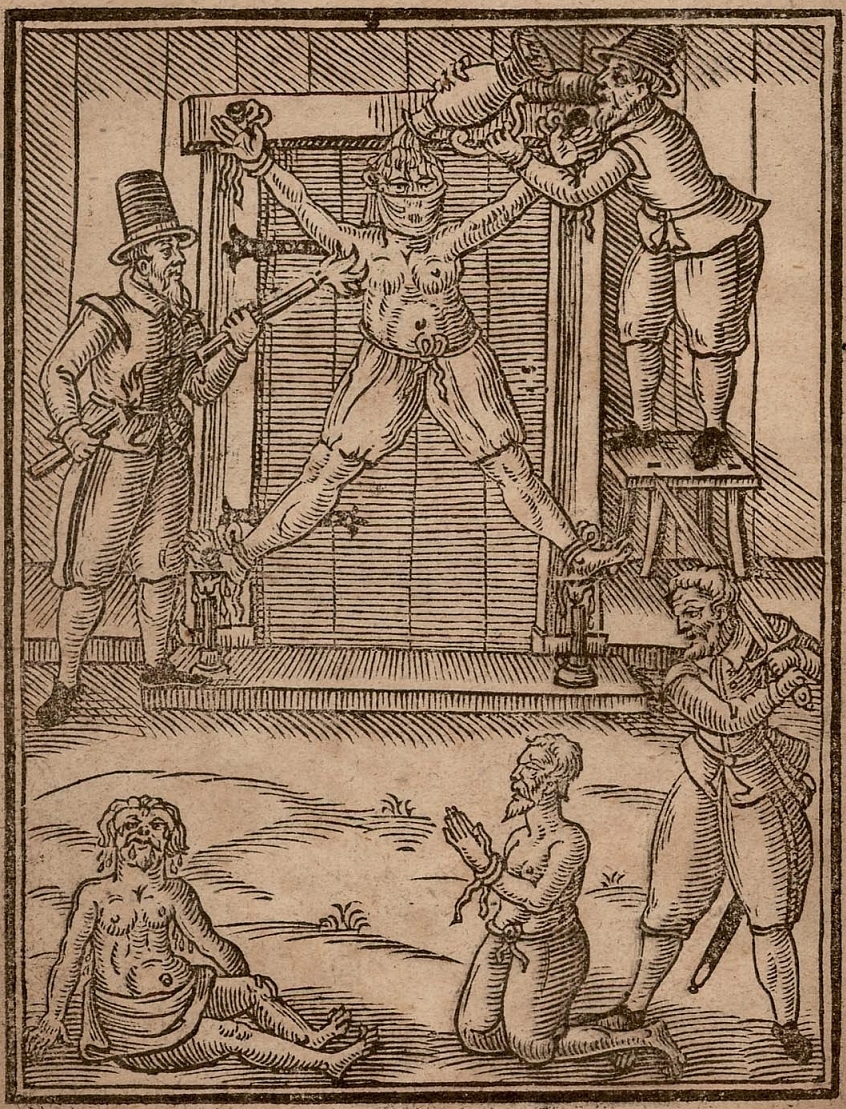

 Lesurques was taken for the one of a gang who had sensationally robbed and murdered a mail courier early in 1796, and on the basis of

 So who is Robert Hubert?


