1909: Les Chauffeurs de la Drome

At daybreak this date in 1909, three French rural bandits dubbed “Les Chauffeurs de la Drôme” were publicly guillotined in Valence to the hurrahs of a great crowd.

Most of the (plentiful) information online about these charmers is in French; in their day about 1905 to 1908 they enjoyed quite a lot of notoriety in southern France for their bloody crime spree, comprising at least 11 murders amid numerous home invasion burglaries. They were a throwback gang whose niche the 20th century would eradicate as surely as they themselves. In the time before ubiquitous mass communication and high-speed transport, a sufficiently bold band of robbers could have their way with a rural residence miles from any possible aid: this was one of the great terrors of Europe, and early crime broadsheets from centuries previous dwell often on the terrors of an isolated farmer or miller made prey in his own home by a band of cutthroats.*

The root of the word chauffeur is the French verb “to heat” — think stoking an engine, for the word’s familiar meaning of professional driver — and the specialty of the Chauffeurs de la Drome was torturing their hostages by scorching their feet with hot irons until the sufferers yielded up the hidey-holes of whatever treasure they had on premises. Their trial was a fin-de-siecle circus, and their executions likewise to a discomfiting degree. Though nothing specifically scandalous occurred as the chauffeurs were snuffed out on a public street, there are a number of pictures of this event, some of them made into postcards and circulated.

This was a trend not very much appreciated by the French government, but of course such images make arresting historical artifacts.

We’re here featuring select images of Octave David. When David walked the few steps through a sea of early-rising spectators to the portable guillotine erected on the streetcar tracks directly in front of the prison gates, his companion Pierre Berruyer had already been beheaded. (The chauffeurs were nos. 126 through 128 in the prolific Anatole Deibler’s career.)

He would have glimpsed Berruyer’s headless trunk already rolled into the large box that would soon receive his body as well. (The box had accommodations for four.) And while the execution team washed down the blade between uses, the grotesque bloody puddles and remains of fresh gore were a constant source of complaint. All three executions were completed in a six-minute span; it’s safe to assume that the smell and the feel of Pierre Berruyer’s violent death surrounded David as he walked to the used chopper. As the events here transpired, the third robber Urbain Liottard still awaited his own turn just inside the prison walls — in a few moments, Liottard would see two steaming neckless corpses stacked up in the rude bin gaping to receive him.


Looking alarmingly Christlike, the half-naked form of the condemned murderer emerges from the prison’s maw amid a throng of indistinct, black-clad voyeurs.


David reaches the guillotine; the assistant executioners are about to tip him onto the board that will carry him into place. The identification on these photos is from Bois de Justice, an invaluable site on the history of the guillotine; I’m unsure from my own observation whether to equate the figure in these pictures with the one in the first, above.


One of the beheadings (I’m not certain that it’s David’s) has been completed; the body and head are being transferred to their receptacles. Again, Bois de Justice has details on this scene.


Following one of the beheadings, the visibly stained blade is raised for cleaning before the third criminal is brought out.

* For some examples, see Joel Harrington’s The Faithful Executioner, a book we’ve previously profiled.

On this day..

1939: Six assassins of Armand Calinescu

On this date in 1939, Romanian Prime Minister Armand Calinescu was gunned down on a Bucharest street in an ambush by the Iron Guard. (Romanian link)

Before the day was out, six of members of the hit squad were lined up and machine-gunned on the very same spot.

Armand Calinescu

Calinescu was a conservative politician trying to fight off the rising fascist movement in his country — that aforesaid Iron Guard — and preferred to keep Romania in politic neutrality and friendly with England and France rather than hitching its fate to Nazi Germany.

This entailed an increasingly acrimonious struggle throughout the 1930s against the fascists. Calinescu once called the Guard “an association of assassins,” and the prospect of taking a bullet from them can’t have been far from his mind. Calinescu’s fingerprints were all over press closures, pre-emptive arrests, and still worse offenses to outrage the far right. After years in the cabinet working hand-in-glove with the hated-by-fascists King Carol II, Calinescu finally became Prime Minister in March of 1939. Carol hoped he could be the bulwark against a Legionary takeover.

If by his enemies ye may know a man, know that Calinescu was taken seriously enough for a multilateral meeting between representatives of the Iron Guard, fascist Italy, and Nazi Germany in order to make the arrangements for his murder. But Calinescu would probably have just as soon have preferred his life to this tribute of his foes.

Upon news of the assassination, Calinescu’s place was immediately filled by Gen. Gheorghe Argesanu, whose one week as head of government was distinguished by a ruthless crackdown on his country’s homegrown terrorists.* The very next day’s British papers, in the same stories reporting the assassination, carried news “of an exemplary punishment” delivered within hours: “Last night, under the glare of powerful arc lamps, the murderers were publicly executed by machine-gun on the spot where the crime had been committed.” (London Times, September 22, 1939)

Nor was that the last exemplar.

The Times reported on September 25th that the ensuing days had seen “more than 300 former Iron Guards were shot” all around the country, including many “in the open street as a public example, on the pattern of the machine-gun executions in public at the scene of the crime.”

The “example” did not have the intended effect: in the span of another year, a fascist-aligned government had control of Bucharest and King Carol had hightailed it to Mexico, never to return.

* The Iron Guard would pay back Argesanu a year later by killing him during the Jilava massacre of its political prisoners.

On this day..

1631: Anna Katharina Spee

On this date in 1631, Bruchhausen vintner Anna Katharina Spee was burned at the stake for witchcraft.

She’s notable for being the remarried widow (German link) of Robert Spee, who was kin to* Friedrich Spee.

Spee is an honorable figure in the sad history of 17th century witch-hunting. This very year of 1631, he published — anonymously at first — his Caution Criminalis (Precautions for Prosecutors). This seminal volume took a heretical-for-the-time stance against the widespread contemporary practice of judicial torture. Spee argued, heatedly, that it was great at extracting confessions but not so reliable when it came to extracting accurate confessions.

Torture chair-illustrated title page of Hetty Kemmerich’s study of German witchcraft prosecutions, with Anna Spee’s plaintive titular cry. Sagt, Was Ich Gestehen Soll! has not been translated from German, but is available from Amazon.de.

“Why do we search high and low for wizards?” Spee jeered his contemporaries. “I will show them to you no matter where. Torture the Capuchins and Jesuits; they will confess … Torture the prelates and canons of the Church; they will confess … If you want still more, then torture you yourselves, and then torture me.”

There’s no known connection between Spee’s work and the fate of poor Anna Katharina, but she could certainly serve as a case in point.

In vain did she deny intercourse with the devil in September 1631 until she could withstand her interrogators no longer and gave them what they demanded of her. A German book about the witch hunts takes its title from Anna Spee’s plea to her tormenters: Sagt, was ich gestehen soll! Tell me what I should say next!

* Robert Spee was either a brother or a cousin of Friedrich Spee. According to the Spee family’s German Wikipedia page, she’s also a distant ancestor of singer Wolfgang Niedecken.

On this day..

1729: Jephthah Big, ineffective extortionist

On this date in 1729, Jephthah Big was hanged at Tyburn — “so ill at the place of execution, that he could not attend the devotions proper for men in his calamitous situation,” according to the Newgate calendar.

This member of the all-name team got his from an Israelite warrior-judge noted for the human sacrifice of his daughter. The sin of Jephthah Big was much the smaller.

When Big’s brother got hired as a London gentleman’s coachman, Jephthah decided to make a quick hundred guineas of his own off the guy by sending him “such a letter as would make the gentleman tremble.”

The difficulty in this scenario is always in actually taking possession of the boodle without exposing oneself to capture.

Jephthah’s big plan was to ask for the money to be delivered to the Black Boy ale-house in Goodman’s Fields, but while his confederate Peter Salter was holding down a bench there day after day waiting for the windfall, Salter chanced to read a newspaper advert taken out by the target himself offering a reward for busting the shakedown. When a porter turned up asking for their extortionist alias, Salter sagely opted not to answer to it and instead left the tavern … but the porter had his own suspicions, and when he saw Salter by chance again a few days later, he had him arrested.

Salter got out of the scrape by turning crown’s evidence against Jephthah Big, who was hanged as the instigator of the whole mess.

On this day..

1953: Louisa May Merrifield, elder abuser

(Thanks to Meaghan Good of the Charley Project for the guest post. -ed.)

On this date in 1953, housekeeper Louisa May Merrifield, the so-called Blackpool Poisoner, was hanged at Machester’s Strangeways Prison for killing her employer.

She was the third-last woman hanged in Britain and the very last woman to be executed at that particular prison, which now houses only men; the job was performed by Albert Pierrepoint.

Born in 1906, Louisa had already served prison time for ration book fraud by the time of the murder, and she lost custody of her four children due to her excessive drinking and neglect.
She couldn’t seem to hold on to a man (she was married three times) or a job (she had 20 in three years).

She took her final position on March 12, 1953, after she and her husband of one month, 71-year-old Alfred Edward Merrifield, became housekeepers and live-in companions to Sarah Ann Ricketts, a spinster who was nearly eighty years old. Sarah Ricketts owned a bungalow at 339 Devonshire Road, North Shore, Blackpool.

The Merrifields indulged in elder abuse and neglect, and Sarah Ann complained she didn’t get enough to eat and that her housekeepers swilled rum on her dime. Meanwhile, Louisa was going around boasting that she’d inherited a £3,000 house.

When someone asked her who had died, she answered, “She’s not dead yet, but she soon will be.”

Louisa’s prophecy was eerily accurate: Sarah Ann Ricketts expired on the night of April 14, 1953, only a month after she’d hired the Merrifields and three days after Louisa’s prediction … but not before drafting a new will which left her bungalow to the Merrifields.

Louisa didn’t call a doctor until the next morning. She said that, as the old woman was clearly beyond help, she didn’t want to drag anyone out of bed in the middle of the night.

The suspicious GP refused to sign a death certificate and insisted on an autopsy, which revealed the cause of death as phosphorus poisoning, administered in the form of a rat poison called Rodine.

Although a police search of the bungalow didn’t turn up any Rodine, a check at the local pharmacy showed Louisa had recently purchased the stuff and signed the poison register.

The Merrifields found themselves charged with murder. Louisa was arrested first, two weeks after Sarah Ricketts died, and Alfred a few days later.

At their trial in July 1953, Louisa was convicted and sentenced to hang. The judge called her crime “as wicked and cruel a murder as I ever heard tell of.”

The jury couldn’t reach a verdict on Alfred, however, and the district attorney decided not to prosecute again. He was released and in due time inherited a half-share in Mrs. Ricketts’s bungalow. He died in 1962 at the age of 80.

Louisa Merrifield’s ghost is said to haunt the cell she once inhabited at Strangeways Prison.

On this day..

1814: Vicente Salias, Venezuelan national anthem author

On this date in 1814, the Venezuelan doctor and writer Vicente Salias was shot in San Felipe castle at Puerto Cabello by the Spanish who meant to run the place.

Salias (English Wikipedia entry | Spanish) was a founding member of the Sociedad Patriotica de Caracas and editor of the nationalist publication El Patriota de Venezuela.

He worked for the First Republic of Venezuela, a short-lived (1810-1812) attempt to break away from a Spanish empire preoccupied by the Napoleonic Wars. In 1810, Salias is said to have* composed the lyrics for Gloria al Bravo Pueblo (Glory to the Brave People),

Captured attempting to escape the approaching royalist forces of Jose Tomas Boves, Salias was shot with the spectacularly defiant last cry of “God Almighty, if the Heavens admit Spaniards, then I renounce the Heavens!”

* There are some revisionist hypotheses postulating other authors.

On this day..

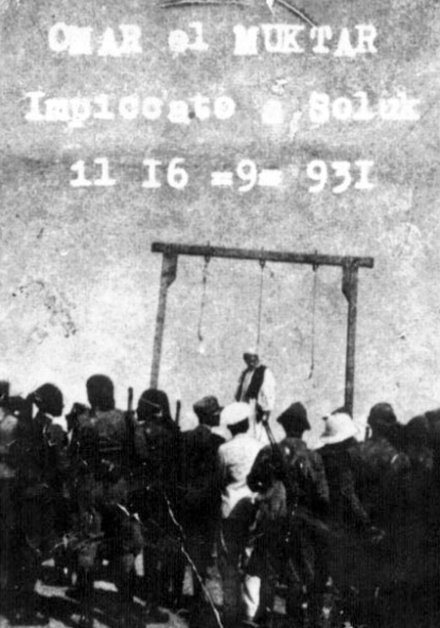
1931: Omar Mukhtar, Libyan revolutionary

On this date in 1931, Libyan independence martyr Omar [al-]Mukhtar was publicly hanged by the Italians at their concentration camp in Suluq.

Mukhtar (English Wikipedia entry | Italian) was born an Ottoman subject back in 1858 and had lived long enough to see his native Libya seized in the 1911-12 Italo-Turkish War.

Mukhtar, a religious teacher and follower of the Senussi movement, became the leader of the Libyan resistance that dogged the Italian occupation. Mukhtar proved an energetic and successful desert guerrilla fighter, and he had to be given the Italians’ mechanized military.

The Italians executed an estimated 4,000 Libyans in the 1920s, and drove hundreds of thousands into concentration camps, and gradually, only gradually, gained the upper hand on their adversaries.

Captured in battle after he abandoned a 1929 truce, Mukhtar was denied prisoner-of-war status and subjected to a snap military tribunal in one of the small coastal enclaves actually controlled by Italy — “a regular trial and consequent sentence, which will surely be death,” as the Italian general directed. It surely was.

He’s played by Anthony Quinn in the 1981 film Lion of the Desert — a better movie than you might think given that it was bankrolled by Muammar Gaddafi.

A national hero for contemporary Libyans across any social divide you’d care to name, Omar Mukhtar was valorized by the rebels who recently overthrew the aforementioned Gaddafi (here’s Mukhtar on a billboard in rebel-held Benghazi). “The whole world knows what Omar al-Mukhtar did,” Mukhtar’s 90-year-old son told media during the civil war. “That’s where they get their energy from. Ask the youth, they’ll tell you they are all the grandsons of Omar al-Mukhtar.”

His steely profile can be seen on Libya’s 10 10 dinar note.

On this day..

1939: Charles McLachlan

(Thanks to Meaghan Good of the Charley Project for the guest post. -ed.)

On this date in 1939, 57-year-old Charles Augustine McLachlan was gassed at San Quentin State Prison in California. He’d murdered a six-year-old neighbor girl at his home in Downey, California the previous year.

McLachlan was a widower who was half Irish-American and half Mexican by descent but described as white. A master painter and decorator, he owned a plot of land with a few houses he’d built himself.


Mugshot of perp; newspaper sketch of victim.

McLachlan lived alone in the smallest of the houses, an eight-by-twelve-foot shack; the largest building was occupied by his son and daughter-in-law, Joe and Carmen, and their child. The parents of the victim, Jennie Moreno (her name is spelled “Jenny” in many accounts), had known McLachlan for about thirty years. Although he was occasionally seen drunk, he had a reputation as a kind, likeable man.

That is, until April 14, 1938.

At 10:00 that morning, Jennie Moreno and her younger sister went to give a magazine to Carmen McLachlan.

Jennie’s parents last saw her at 11:00 a.m., while she was getting ready to go to church. When she didn’t return home at noon as expected, her parents began searching for her. At some point a neighbor smelled a strange odor and noticed smoke pouring out the windows of McLachlan’s shack, which had no chimney or flue.

The police were summoned. They arrived at his house at midnight and found bloodstained, partially burned clothing belonging to both Jennie and McLachlan lying on a sheet of metal on the floor of the shack. The floor had been washed and was still sopping wet.

A search of the premises turned up Jennie’s shoes and a bloodstained hammer. McLachlan’s mattress was saturated with blood and there was blood on the floor beneath the bed as well. He was arrested on the spot.

At the same time the sheriff’s deputies were arresting McLachlan, a search party that included Jennie’s father and uncle found her partially nude body concealed among the weeds in the vacant lot next to McLachlan’s property.

When they saw McLachlan being led away in handcuffs, they guessed he must be the murderer. Jennie’s uncle struck McLachlan in the face and several others in the crowd called out, “Lynch him!” But the police were able to disperse these aspiring vigilantes without too much difficulty.

McLachlan, who had been drinking wine and whiskey since 9:00 a.m., was quite drunk at the time of his arrest and at first said he had no memory of what happened. He ultimately made a confession to murder. McLachlan stated he’d been lying in bed resting with the door open when little Jennie wandered inside. He took her into the bed and began to fondle her, then struck her in the head with a hammer after she screamed. He waited until after dark, and then carried her body to where it was later found.

Jennie’s body showed evidence that she had in fact been violently raped, something McLachlan never admitted to.

He would go on to repudiate his entire statement, saying the police had kept him in jail without sleep or food and coerced the confession. He pleaded both not guilty and not guilty by reason of insanity, waived his right to a jury trial and was heard by a judge.

McLachlan claimed he heard “witches” speaking to him and said the voices “say most anything.” While in jail he would refuse to eat or speak for days at a time, and he refused to cooperate with his defense. A psychiatrist hired to examine him found “evidence of pre-senility and psychic pain” but believed he was feigning mental illness.

Found both guilty and sane, he was condemned to death. The judge to whom McLachlan had entrusted his fate called Jennie Moreno’s murder “one of the most brutal and horrible ever perpetrated in Los Angeles County.”

Charles McLachlan walked into the gas chamber at 10:10 a.m., eighteen months after his crime. “Twisting and straining against the straps that bound him,” he took seven minutes to die.

On this day..

1459: Pietro di Campofregoso, former Doge of Genoa, stoned to death

On this date in 1459, the former Doge of Genoa Pietro di Campfregoso was stoned to death by his city’s enraged populace.

This Pietro (English Wikipedia entry | Italian) succeeded his cousin to the merchant oligarchy’s head in 1450. Genoa resided in a crab-bucket of rival peninsular and Mediterranean powers, and Pietro was distinctly out-scuttled in the 1450s.

Genoa unsuccessfully supported the Byzantine Empire when it was decisively conquered by the rising Ottomans in 1453, and the Genoans found themselves consequently rousted from a number of Aegean and Black Sea possessions. Meanwhile, fickle Italian fortune brought Neapolitan troops to the walls of Genoa and eventually forced Pietro to submit to a humiliating French protectorate under Charles VII.*

By this point, Genoa was also in the sights of Francesco Sforza, and when Pietro had to abdicate and blow town he went to the protection of the the great condottiero in Milan. There he joined a Sforza-backed plot to pull Genoa out of the French orbit and into that of the Duke of Milan, which coup utterly failed and got Pietro di Campofregoso lynched/murdered/summarily put to death near the Porta Soprana.

If only he’d been able to avoid that fate, he would have seen the plot come to fruition: when the French-supported Duke of Calabria left Genoa to attempt to re-establish his family’s foothold in Naples, Sforza’s agents got hold of the city and installed yet another Fregoso cousin, Spinetta, as the Milanese puppet.

The Campofregosos (or simply Fregosos) were far from finished with their misadventures in power. Pietro’s predecessor and kinsman Lodovico found his way back into office after Spinetta, but in 1462 the Genoan archbishop Paolo Fregoso (also kin!) arrested the sitting doge, and replaced him in office with his own self. Paolo was doge briefly in 1462, and again 1463-64, and then once again in the 1480s, being repeatedly deposed and exiled in between shifts.

* That’s the king at the end of his life whom Joan of Arc rallied to when he was a mere dauphin.

On this day..

1896: Chief Uwini of the Maholi

This date in 1896 during the Second Matabele War saw the execution by field court-martial of the rebellious Chief Uwini.

This war, in present-day Zimbabwe, featured a revolt of the Matabele (Ndebele) people against Cecil Rhodes’s* British South African Company.

In the field, it was a short-lived affair.

Ndebele rebels slew over 200 white settlers in Matabeleland and Mashonaland during the first week of the surprising rising in March 1896. But most settlers were able to hunker down in he town of Bulawayo behind makeshift breastworks.

Up to 15,000 Ndebele warriors menaced this little citadel, but were deterred from storming it by the settlers’ modern weapons — artillery and the legendary Maxim gun** — until relieved in May. (Rhodes himself led one of the relief columns.) At that point, the rebels retreated to their strongholds, fragmented from one another, and generally got picked off or bought off group by group over the ensuing months.

One of the men arriving with Rhodes’s relief column was Robert Baden-Powell, an army scout who will bring us to this date’s feature execution.

Baden-Powell was dispatched with a squadron of cavalry to pacify the area northeast of Bulwayo. When he arrived there, one of the main rebel chiefs in the Somabula Forest, Chief Uwini, had just been taken prisoner.

“He was badly wounded in the shoulder, but, enraged at being a prisoner, he would allow nothing to be done for him; no sooner had the surgeon bandaged hi than he tore the dressings off again. He was a fine, truculent-looking savage, and boasted that he had always been able to hold his own against any enemies in this stronghold of his, but now that he was captured he only wished to die.”

-Baden-Powell (Source)

This prisoner put Baden-Powell in a conundrum. He had written orders to turn prisoners over to the Native Commission for civil handling (whether trial or otherwise).

Uwini had been induced to surrender by another officer’s promise to spare his life. However, this wounded chief could not be escorted five days back to Bulawayo by a force large enough to protect against the likely rescue attempt by his followers without abandoning his mission. Neither could Uwini be brought along on the patrol.

Something had to give.

Baden-Powell decided it would be the safe-conduct promise.

“I have taken another step, which I hope you will not disapprove of — viz. — trying Uweena by Court Martial,” Baden-Powell wrote his superiors on September 13. “He is the big chief of this part, we have lots of evidence that he instigated rebellion and murders of whites, he is badly wounded, we cannot send him to Buluwayo, and I must be leaving this with some of the senior officers tonight. So if the court find him guilty and sentence him to be shot I shall take on myself the responsibility of confirming it. The effect too should be very good for being carried out promptly and at his own stronghold — and we have a good number of rebels, prisoners and refugees, here to witness it & report it to the remainder.”

Another letter dated later that same day confirmed that the expected sentence had indeed been rendered, and Uwini had been ceremoniously shot that evening at sunset before the walls of the enemy fortress, in the presence of as many witnesses as Baden-Powell could find.

This quasi-juridical field execution put Baden-Powell in front of a court of inquiry after the fact. The court exonerated him, citing the circumstances and the purported effect of the execution in cowing the local insurgents.

Despite leaving the court of inquiry “without a stain on my character,” in Baden-Powell’s own words, this incident can’t help but throw a morally questionable shade for later observers. And this agent of empire does have later observers — because Lord Baden-Powell (as he eventually became styled) would go on to found the Scout Movement.† His 1907 boys scouting camp and subsequent book laid the foundation for the ensuing decades’ Anglo scouting tradition.

And this very Matabele War contributed crucial parts of the scouting backstory. It was in the course of this campaign that Baden-Powell became acquainted with the American scout and adventurer Frederick Russell Burnham. The two struck up a lifelong friendship, and Baden-Powell cribbed notes from the ranger’s guile (like wood “scoutcraft”) his counterpart had picked up on the dwindling American frontier. It was also in Rhodesia that Baden-Powell first wore the Stetson hat and neckerchief combination that would become a distinctive look both for Baden-Powell himself, and for the scout movement he launched.

* As of this story’s setting, the place in question had just begun to be called Rhodesia.

** It is in the context of Great Britain’s colonial adventures in Africa in this period (though not specifically just those of Matabeleland) that Hilaire Belloc published his 1898 poem “The Modern Traveller”. In it, a character named “Blood” gave this early machine gun its definitive literary tribute: it’s the couplet highlighted below, but the larger excerpt may be illuminating.

Blood understood the Native mind.
He said: “We must be firm but kind.”

A Mutiny resulted.
I never shall forget the way
That Blood upon this awful day
Preserved us all from death.
He stood upon a little mound,
Cast his lethargic eyes around,
And said beneath his breath:

“Whatever happens we have got
The Maxim Gun, and they have not.”

He marked them in their rude advance,
He hushed their rebel cheers ;
With one extremely vulgar glance
He broke the Mutineers.
(I have a picture in my book
Of how he quelled them with a look.)
We shot and hanged a few, and then
The rest became devoted men.

And here I wish to say a word
Upon the way my heart was stirred
By those pathetic faces.
Surely our simple duty here
Is both imperative and clear;
While they support us, we should lend
Our every effort to defend,
And from a higher point of view
To give the full direction due
To all the native races.
And I, throughout the expedition,
Insisted upon this position.

† Baden-Powell also counseled scouts to be unflinching should the “duty” arise to hang a man.

On this day..