1897: The Bicol martyrs of Philippines independence

On this date in 1897, eleven pro-independence Filipinos were shot at Manila’s Bagumbayan execution grounds.

These eleven,* together with one who was tortured to death on a prison brig and three others who died exiled to prisons elsewhere in the Spanish empire, comprise the Fifteen Bicol (or Bikol) Martyrs.

Spanish suppression of the unfolding Philippine Revolution was in full martyr-making; just days before, the same site had seen the execution of Dr. Jose Rizal. (A few days after this, it made still another batch of martyrs.)

“They died bravely,” a Filipino newspaper reported. “They died like those who are sustained by a sacred ideal.”

They were.

This date’s victims had been rounded up on September 16 at Naga City in the Bicol Region. It was the aftermath of Spain’s discovery of the anti-colonial Katipunan secret society, and mass arrests followed by torture-aided interrogation were the order of the day.

These would not, in the end, avail.

As a result, the “Quince Martires” are still commemorated in independent Philippines every January 4, which is a public holiday in Naga City … and commemorated throughout the year at that city’s Plaza Quince Martires, and its monument.


(c) image courtesy of Wally Ocampo.

* Rev. Fr. Gabriel Prieto; Gabriel’s brother, Thomas Prieto; Rev. P. Severino Diaz; Rev. P. Inocencio Herrera; Manuel P. Abella; Manuel’s son, Domingo I. Abella; Camilo Jacob; Florencio Lerma; Macario Valentin; Cornelio Mercado; and Mariano Melgarejo.

On this day..

1761: Jacinto Canek, Mayan revolutionary

On this date in 1761, King Canek Chan Montezuma was torn apart in the main square of Merida.

This august regnal name was asserted by a shaman previously known as Jacinto Uc de los Santos (English Wikipedia entry | Spanish). “Canek” echoed the history of the Mayan Itza kings, but it was Jacinto in using it for a single month’s insurrection that fixed its immortality.

“Memory is not just a tool of the spirit for calling up the past. Rather it is a skill which allows us in a moment to see what is in its essence outside of time. Memory allows us to rise to a state, not available to the mind alone, where everything is present.”

Jacinto Canek’s life followed by just a few decades Spain’s final conquest of the last independent Mayan peoples, the Itza, in the 1690s, complete with the usual religious assimilation, political control, and enslavement.

Canek, a commoner (perhaps an orphan) with some education, mounted in November 1761 a surprise revolt at the village of Cisteil (or Quisteil). There he deposed the parish priest and preached from the Catholic pulpit in the Mayan tongue:

My beloved children, I know you yearn to throw off the heavy yoke you have labored under since the Spanish subjugation … Spanish rule [brings] nothing but suffering servility.

About this same time, a Spanish merchant on his routine business rolled into town, blithely unaware of the gathering rebellion. Canek found the interloper insolent, and had him killed.

Crowned the new Mayan king and asserting semi-divine powers, Canek rapidly gained the support of neighboring towns. Within a week, he fielded 1,500 Mayan soldiers to defend Cisteil against a Spanish force sent to suppress them. Hundreds died in a bitter hand-to-hand battle on November 26, 1761, and Cisteil burned … but the Spanish won, and Canek, following a short flight, was captured with his remaining followers.

The Spanish governor of Yucatan, Jose Crespo (Spanish link), ordered Canek to a tortuous execution: tortured, broken, burned, and his ashes scattered. Many of his other followers were also put to death in various ways around the same time.


Mural of Jacinto Canek’s torture by Fernando Castro Pacheco at the Palacio de Gobierno in Yucatan, Mexico. (cc) image from Yodigo.

The Spanish hadn’t heard the end of this.

In the next century, Canek’s name was on the lips of Mayan descendants and mixed-blood Mestizos when they revolted again in the long-running (1847-1901, or even later: Quintana Roo maintained itself semi-autonomous until the 1910s) Caste War against domination by the European-identifying peoples of what was now the independent state of Mexico.

For decades, large areas of the Mayan Yucatan remained deadly to enter for any white-skinned outsider.

Today, it’s safe to check out the monumental tribute to Jacinto Canek on the Merida boulevard that bears his name.

On this day..

1922: Four anti-Treaty Irish Republicans

On this date in 1922, Irish Republicans Rory O’Connor, Liam Mellows, Richard Barrett and Joe McKelvey were shot.


Stagey-looking fake propaganda photo of Rory O’Connor’s (very real) Dec. 8, 1922 execution.

These four were militant foes of the 1921 Anglo-Irish Treaty, which was to the Troubles as the Apple of Discord was to the Trojan War.

Furious at the betrayed dream (and, briefly, reality) of a united Irish republic, they were among those who occupied central Dublin’s Four Courts in April 1922, hoping to draw Britain into a counterproductive intervention.

It was a move straight from the playbook of tragic guerrilla-cum-statesman Michael Collins … except that Collins was on the other side in 1922. Collins, then Chairman of the Provisional Government for the new Irish state (and negotiator of the hated treaty) spent that spring trying to convince the Four Corners occupiers to back off, but also not intervening to force their garrison out.

Noninterference came to an end after some other Irish militants assassinated British Field-Marshal Sir Henry Wilson in June 1922. London put the political screws to Michael Collins, leading to the anomalous sight of the onetime anti-British revolutionary turning British-lent artillery against Dublin republicans.


Times change.

The Four Courts guys, imprisoned from July, would provide an even more poignant illustration of Ireland’s heartbreaking house-divided history.

For it was the Provisional Government’s Minister of Justice Kevin O’Higgins who ordered the executions — a man who had once been so tight with the executed Rory O’Connor that O’Connor was in his wedding party. (Where they toasted the Easter Rising martyrs.)

What could turn men so tight against one another? On December 7, anti-Treaty gunmen killed Sean Hales, an IRA man whom Collins had brought over to the pro-Treaty side. In a ruthless reprisal, Higgins approved the summary execution of his former comrades.

According to the official announcement* — which was bitterly denounced as lawless by the Free State’s Labour parliamentarians —

The execution took place this morning at Mountjoy Gaol of the following persons taken in arms against the Irish Government: — Rory O’Connor, Liam Mellowes, Joseph McKelvey, and Richard Barrett, as a reprisal for the assassination on his way to Dail Eireann on December 7 of Brigadier Sean Hales, T.D., and as a solemn warning to those associated with them who are engaged in a conspiracy of assassination against the representatives of the Irish people.

Bloody ironies would stack one upon the other. The rest of Sean Hales’s family had remained staunchly anti-Treaty, and publicly denounced the executions.

Sean’s own brother Tom Hales had famously withstood British torture in 1921. But Tom is even more famous for a different deed: in August 1922, Tom Hales led the republican column that ambushed and killed Michael Collins.

Many more bodies lay ahead.

* Quoted in the December 9,1922 London Times, along with some of the opposition firestorm that ensued in the Dail. “Mr. Cathal O’Shannon, shouting indignantly at the Government, said they were not fit to govern, and described the executions as the greatest crime, without exception, committed in Ireland in the last ten years. ‘You have no authority,’ he said, ‘to execute these men. You murdered them.'”

On this day..

1871: Gaston Cremieux, Marseilles Commune leader

On this date in 1871, Gaston Cremieux was shot at Marseilles for his role in that city’s lately-destroyed Commune.

Cremieux (French Wikipedia page: most external links in this post are also in French) was a gifted young lawyer with a social conscience who was known for taking on indigent-defense cases and working-class causes.

Given his prominence in radical circles, Cremieux was naturally thrust into leadership when word of the Paris Commune brought Marseilles, too, into a popular rising.

Lissagaray called Cremieux “an elegant and effeminate speaker … a mild enthusiast, who beheld the revolution under rather a bucolic aspect.” His admirable principles were not those of bloody revolutionary will, and he was accordingly viewed (or disdained) as a moderate.

The Marseilles Commune lasted only a fortnight: neighboring towns did not rally to it, and elsewhere in the south Toulouse and Narbonne communards were crushed within days.

When troops of the bourgeois Versailles government — the city to which it had fled from Paris — took Marseilles, according to Lissagaray, they “arrested at random, and dragged their victims into the lamp-stores of the station. There an officer scrutinized the prisoners, made a sign to one or the other of them to step out, and blew out his brains. The following days there were rumours of summary executions in the barracks, the forts and the prisons. The number of dead the people lost is unknown, but it exceeded 150.”

Cremieux’s own conscience was pretty clean in all this — he’d even advocated against keeping hostages. (Unsuccessfully, but Marseilles did not kill its hostages, unlike Paris.) “Show me those whom Cremieux has shot,” his lawyer would later protest to the military tribunal called to try him.

Cremieux’s own shooting would have to suffice. He died crying “Vive la République!” as the firing squad emptied its barrels into his torso … as per Cremieux’s request to preserve his face lest his parents be too shaken by his corpse. Just call him a family man.

A posthumously-published French volume of Cremieux’s work contains verse, a play about Robespierre’s fall, and his “Impressions of a Condemned Man”.

On this day..

1868: Giuseppe Monti and Gaetano Tognetti, by the Papal guillotine

On this date in 1868, Italian revolutionaries Giuseppe Monti and Gaetano Tognetti were guillotined in Rome.

Theirs was a passion of the Risorgimento, the 19th century drive to unify as a single nation the peninsula’s quiltwork of minor kingdoms, duchies, and city-states.

Following the Third Italian War of Independence, this had largely been accomplished … with the notable exception of the Papal States surrounding Rome. You can hardly have Italy without the Eternal City.

So national liberator Giuseppe Garibaldi gathered a force under the slogan Roma o morte and prepared to march … while Pope Pius IX began receiving reinforcements from the sympathetic French emperor Napoleon III.

Inside Rome, Monti and Tognetti prepared a little morte of their own. Intending to mount a fifth-column uprising to coincide with the arrival of Garibaldi’s army, the two detonated a couple barrels of gunpowder under the Serristori barracks, killing 23 French zouaves and four Roman civilians. (All links in this paragraph are Italian.)

Unfortunately for the bombers, no general rising ensued, and the Papal and French armies subsequently repulsed Garibaldi at the Battle of Mentana on Nov. 3, 1867 — extending the papal enclave’s lease on life only slightly, but just enough to deal with Monti and Tognetti.

Their fate at the hands of the civil and religious authorities (one and the same, at this time), is dramatized in the 1977 Italian film In Nome Del Pap Re. (This Google books freebie purports to relate their final days.)

The triumph, such as it was, was short-lived for the Papal States: these were the very last executions by guillotine in Rome; the Papal States polity as a whole had time for only two more executions in its history before the Italian nationalist army completed the risorgimento by capturing Rome in 1870.

The two are memorialized in a celebratory ode by Giosue Carducci.

PER GIUSEPPE MONTI E GAETANO TOGNETTI
MARTIRI DEL DIRITTO ITALIANO

I
Torpido fra la nebbia ed increscioso
Esce su Roma il giorno:
Fiochi i suon de la vita, un pauroso
Silenzio è d’ogn’intorno.

Novembre sta del Vatican su gli orti
Come di piombo un velo:
Senza canti gli augei da’ tronchi morti
Fuggon pe ‘l morto cielo.

Fioccano d’un cader lento le fronde
Gialle, cineree, bianche;
E sotto il fioccar tristo che le asconde
Paion di vita stanche

Fin quelle, che d’etadi e genti sparte
Mirar tanta ruina
In calma gioventù, forme de l’arte
Argolica e latina.

Il gran prete quel dì svegliossi allegro,
Guardò pe’ vaticani
Vetri dorati il cielo umido e negro,
E si fregò le mani.

Natura par che di deforme orrore
Tremi innanzi a la morte:
Ei sente de le piume anco il tepore
E dice – Ecco, io son forte.

Antecessor mio santo, anni parecchi
Corser da la tua gesta:
A te, Piero, bastarono gli orecchi;
Io taglierò la testa.

A questa volta son con noi le squadre,
Né Gesù ci scompiglia:
Egli è in collegio al Sacro Cuore, e il padre
Curci lo tiene in briglia.

Un forte vecchio io son; l’ardor de i belli
Anni in cuor mi ritrovo:
La scure che aprì ‘l cielo al Locatelli
Arrotatela a novo.

Sottil, lucida, acuta, in alto splenda
Ella come un’idea:
Bello il patibol sia: l’oro si spenda
Che mandò Il Menabrea.

I francesi, posato il Maometto
Del Voltèr da l’un canto,
Diano una man, per compiere il gibetto,
Al tribunal mio santo.

Si esponga il sacramento a San Niccola
Con le indulgenze usate,
Ed in faccia a l’Italia mia figliuola
Due teste insanguinate. –

II
E pur tu sei canuto: e pur la vita
Ti rifugge dal corpo inerte al cuor,
E dal cuore al cervel, come smarrita
Nube per l’alpi solvesi in vapor.

Deh, perdona a la vita! A l’un vent’anni
Schiudon, superbi araldi, l’avvenir;
E in sen, del carcer tuo pur tra gli affanni.
La speme gli fiorisce et il desir.

Crescean tre fanciulletti a l’altro intorno,
Come novelli del castagno al piè;
Or giaccion tristi, e nel morente giorno
La madre lor pensa tremando a te.

Oh, allor che del Giordano a i freschi rivi
Traea le turbe una gentil virtù
E ascese a le città liete d’ulivi
Giovin messia del popolo Gesù,

Non tremavan le madri; e Naim in festa
Vide la morte a un suo cenno fuggir
E la piangente vedovella onesta
Tra il figlio e Cristo i baci suoi partir.

Sorridean da i cilestri occhi profondi
I pargoletti al bel profeta umìl;
Ei lacrimando entro i lor ricci biondi
La mano ravvolgea pura e sottil.

Ma tu co ‘l pugno di peccati onusto
Calchi a terra quei capi, empio signor,
E sotto al sangue del paterno busto
De le tenere vite affoghi il fior.

Tu su gli occhi de i miseri parenti
(E son tremuli vegli al par di te)
Scavi le fosse a i figli ancor viventi,
Chierico sanguinoso e imbelle re.

Deh, prete, non sia ver che dal tuo nero
Antro niun salvo a l’aure pure uscì;
Polifemo cristian, deh non sia vero
Che tu nudri la morte in trenta dì.

Stringili al petto, grida – Io del ciel messo
Sono a portar la pace, a benedir –
E sentirai dal giovanile amplesso
Nuovo sangue a le tue vene fluir…

In sua mente crudel (volgonsi inani
Le lacrime ed i prieghi) egli si sta:
Come un fallo gittò gli affetti umani
Ei solitario ne l’antica età.

III
Meglio così! Sangue dei morti, affretta
I rivi tuoi vermigli
E i fati; al ciel vapora, e di vendetta
Inebria i nostri figli.

Essi, nati a l’amore, a cui l’aurora
De l’avvenir sorride
Ne le limpide fronti, odiino ancora,
Come chi molto vide.

Mirate, udite, o avversi continenti.
O monti al ciel ribelli,
Isole e voi ne l’oceàn fiorenti
Di boschi e di vascelli;

E tu che inciampi, faticosa ancella,
Europa, in su la via;
E tu che segui pe’ i gran mar la stella
Che al Penn si discovria;

E voi che sotto i furiosi raggi
Serpenti e re nutrite,
Africa ed Asia, immani, e voi selvaggi,
Voi, pelli colorite;

E tu, sole divino: ecco l’onesto
Veglio, rosso le mani
Di sangue e ‘l viso di salute: è questo
L’angel de gli Sciuani.

Ei, prima che il fatale esecutore
Lo spazzo abbia lavato,
Esce raggiante a delibar l’orrore
Del popolo indignato.

Ei, di demenza orribile percosso,
Com’ebbro il capo scuote,
E vorria pur vedere un po’ di rosso
Ne l’òr de le sue ruote.

Veglio! son pompe di ferocie vane
In che il tuo cor si esala,
E in van t’afforza a troncar teste umane
Quei che salvò i La Gala.

Due tu spegnesti; e a la chiamata pronti
Son mille, ancor più mille.
I nostri padiglion splendon su i monti,
Ne’ piani e per le ville,

Dovunque s’apre un’alta vita umana
A la luce a l’amore:
Noi siam la sacra legion tebana,
Veglio, che mai non muore.

Sparsa è la via di tombe, ma com’ara
Ogni tomba si mostra:
La memoria de i morti arde e rischiara
La grande opera nostra.

Savi, guerrier, poeti ed operai,
Tutti ci diam la mano:
Duro lavor ne gli anni, e lieve omai
Minammo il Vaticano.

Splende la face, e il sangue pio l’avviva;
Splende siccome un sole:
Sospiri il vento, e su l’antica riva
Cadrà l’orrenda mole.

E tra i ruderi in fior la tiberina
Vergin di nere chiome
Al peregrin dirà: Son la ruina
D’un’onta senza nome.

On this day..

1930: Yang Kaihui, Mao Zedong’s wife

(Thanks to Meaghan Good of the Charley Project for the guest post. -ed.)

On this date in 1930, Yang Kaihui was executed in Changsha, China.

The 29-year-old mother of three was beheaded for her refusal to renounce the Chinese Communist Party and Mao Zedong. She was technically Mao’s second wife; a previous marriage had been arranged for Mao by his parents, but he and the woman never lived together and the marriage was never consummated.

Yang and Mao grew up together in Changhsa — she was the daughter of one of his teachers — and fell in love as young adults. Yang, like Mao, was an enthusiastic Communist. She joined the CCP in 1921, becoming one of its earliest members. She never held any official position in the CCP, however, and wasn’t terribly active in the movement, since she had to raise the children.

Mao and Yang truly loved one another. Phillip Short, in his biography of Mao, writes of this period: “Perhaps for the only time in Mao’s life, he had a truly happy family to come home to … It was a surprisingly traditional Chinese household.”

But Mao became more and more absorbed in dangerous revolutionary work, and he and Yang were often separated when he traveled. The last time she saw her husband was in 1927, the year the Chinese Civil War started and Mao became a guerrilla leader, hiding in the mountains, far from his family. They maintained sporadic contact after that, but often what little she knew about his activities came from the papers.

During the final years of her life, Yang missed her husband desperately and had thoughts of suicide. “No matter how hard I try,” she wrote once, “I cannot stop loving him.”

Yang predicted she might meet with a violent death. She was right: on October 24, 1930, a warlord loyal to the nationalists captured her and one of her sons.

She did not break under threats and torture, and refused to give in and publicly repudiate her husband and Communism, even though her captors offered to spare her life if she did so. She became one of the CCP’s earliest martyrs.

Yang was executed more for being Mao’s wife than she was for anything she’d done herself. She wasn’t the only woman who would be killed for being married to a prominent member of the CCP; the wife of Zhu De had met with the same fate in 1929.

Mao, who had always called Yang his true love, was reportedly devastated by her death and wrote, “the death of Kaihui cannot be redeemed by a hundred deaths of mine!” He wrote a poem about her in 1957 that suggests he still grieved for her even then. But it must be noted that he never tried to rescue her or his sons when he knew their home had turned into a battleground and their lives were in danger.


Propaganda poster of Yang and Mao.

Tragedy followed the lives of Yang and Mao’s three sons.

The youngest boy, Anlong, died of dysentery in Shanghai at the age of four, soon after his mother’s execution. The oldest, Anying, was killed in the Korean War. Middle child Anqing lived to be 83, but perhaps as a consequence of watching his mother being put to death as a youth, he suffered bouts of mental illness throughout his life. He died quietly in China in 2007.

On this day..

1848: Robert Blum, German democrat

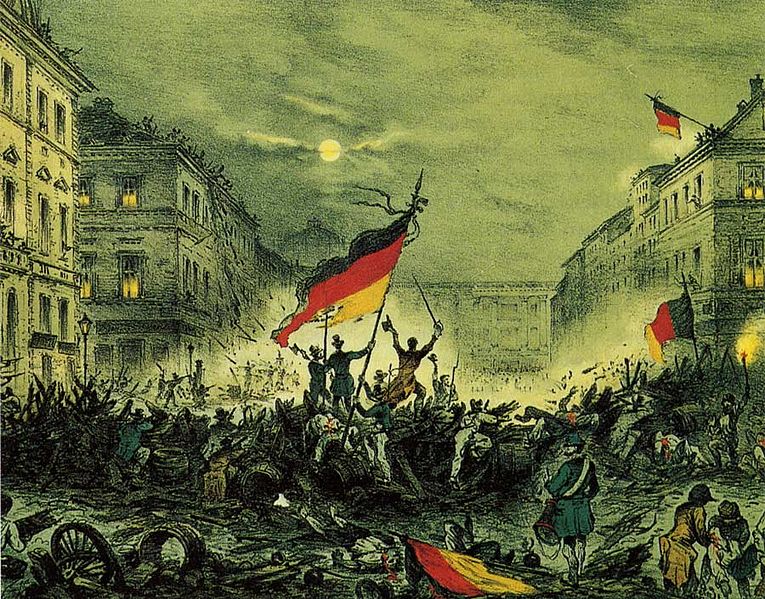
On this date in 1848, a day short of his forty-second birthday, the German revolutionist Robert Blum was summarily shot in Vienna — a tragic victim of Germany’s Revolutions of 1848.

Marker at Robert Blum’s birthplace in Cologne reads “I die for the German liberty that I fought for. May the fatherland remember me.” (cc) image from Elke Wetzig.

Blum grew up in a penniless proletarian family but drifted into the literary set. He spent the 1830s penning liberal-minded plays, poetry, newspaper correspondence. He uncovered a magnetic personality and a gift for organization.

By the 1840s he was a — maybe the — preeminent left-liberal in the Kingdom of Saxony: pro-parliamentary democracy, anti-violence, for a wide grant of civil liberties and mass education.

The pressures, both liberal and radical, pushed to the brink the small realms in the German Confederation, as well as the neighboring Austrian Empire. Both struggled to handle even the liberals’ demands like expanding the franchise and freedom of the press, with old hereditary polities that might not be up to changing times. Germany, Marx and Engels wrote in the Communist Manifesto (1847), “is on the eve of a bourgeois revolution.”

Right on cue…

That pregnant year of 1848 found Blum in the Frankfurt parliament, and his neither-fish-nor-fowl leftism — a little too out there for mainstream liberals; a little too bourgeois for real radicals — made Blum the perfect pick for a solidarity mission.

When in September 1848 the Austrian army was defeated trying to crush a Hungarian rebellion, the Habsburg capital of Vienna took the example and mounted a revolution of its own, putting the government to flight.

Blum was sent as sympathetic delegate to this abortive Viennese commune, but found himself trapped in the city when the Austrian army encircled it in late October.

The Austrians, when they caught him, sent their own message back by denying him any form of deference for his parliamentary rank. Blum’s direct condemnation was a stark warning by the Habsburg state to agitators, but also to their putative brethren dreaming of a Greater Germany. Austria wasn’t buying what the Großdeutsche people were selling.


Detail view (click for the full image) of Carl Steffeck’s painting of Robert Blum’s execution. Here’s a YouTube recreation (in German).

Blum went on to a posthumous career as a star liberal martyr among the German circles who had use for such a character.

Blum’s seven-year-old son Hans grew up to follow his father’s literary footsteps … but from quite the other side of the aisle. He was a pro-Bismarck nationalist.

On this day..

1812: Claude-Francois de Malet and his conspirators

Two centuries ago today,* the author of one of the weirdest attempted coups in history was shot with his co-conspirators.

Picture Valkyrie in Napoleonic Europe.

Claude-Francois de Malet (English Wikipedia entry | French) had spent the years of his confinement for republican sensibilities painstakingly readying bogus orders and decrees for the eventual rollout of the most audacious putsch you’d ever want to putsch.

While Bonaparte was off on campaign trashing Russia, Malet broke out of his sanitarium and went to work.

Donning a general’s uniform, Malet on Oct. 23, 1812 presented a forged announcement of the Emperor’s recent demise … and started issuing orders. He bluffed the release of imprisoned allies, and got a legitimate general to order the arrest of Napoleon’s most prominent deputies in Paris. (It’s a good job that general obeyed Malet, because when one officer asked to kindly see the arrest warrant Malet was using on him, Malet responded by shooting him in the face.)

For a few hours that morning the Malet conspirators almost put themselves in control, almost normalized their sudden rearrangement of authority with its reassuringly familiar official paperwork. Later, when interrogated for the identities of his accomplices, Malet would retort, “You, yourself, Sir, and all of France — if I had succeeded!”

But the attempted coup which aimed so high ultimately made for little but tantalizing counterfactual history. Officers with clearer heads soon realized that they had received communiques from the Emperor dated after his purported October 7 death; one of those officers arrested Malet.

A tribunal was constituted later that same date. It had little difficulty condemning 14 (French link) during the small hours of the morning on Oct. 29. They were shot later that same day (at least, most of them were; there are oddly conflicting accounts on this point). This public-domain French text preserves a first-person narration of the scene, in which Malet himself — usurping authority to the very last — commands the firing platoon that’s lined up to shoot his comrades.

120 bullets riddled these unfortunates, who fell all except Malet. He stood on his hands and knees and raised his hands to his chest as he was only wounded, and retreated to the wall on which he leaned:

“And me, my friends!” cried he, “You forgot me!”

(One of the executed fellow-officers was Gen. Victor Lahorie. Lahorie’s lover was Sophie Trebuchet, and his lover’s son, Victor Hugo, was about to catapult himself to literary fame.)

While the Malet plot failed on its own terms, it got quite a lot farther than it had any right to expect — and this fact rightly alarmed the Corsican.

“Bad News From France”, by Vasily Vereshchagin, depicts a retreating Napoleon — bunking in an Orthodox church — finding out about Malet.

Was his position that precarious? And why, if some officers genuinely believed him dead, did nobody hail as emperor his infant son and designated heir?

Napoleon had already begun his catastrophic retreat from Russia when he got word of Malet’s attempted coup d’etat; the struggling Grande Armee was dwindling daily under the battering of cold, desertion, and Russian snipers. Now this?

Upon discovering his late narrow escape from a homefront conspiracy, Napoleon left his miserable troops under the command of Murat* and raced ahead of them back to Paris to secure his own position.

This new confluence of domestic vulnerability and foreign defeat marks the beginning of the end for Napoleon. Europe ganged up on the weakened French, and less than 18 months after Malet faced his executioners, France’s own generals forced Napoleon to abdicate.

* Murat soon ditched the army himself to try to preserve himself as King of Naples. (That didn’t end well.) The once-gigantic army’s remnants finally straggled home under the third-string leadership of Eugene de Beauharnais — the capable son of Josephine’s guillotined first husband.

On this day..

1865: Paul Bogle

On this date in 1865, Baptist deacon Paul Bogle was hanged at the Morant Bay courthouse for his part in that locale’s eponymous rebellion.


Third World’s “1865 (96 degrees in the shade)” celebrates Paul Bogle: “Today I stand here a victim the truth is I’ll never die”

Bogle helped lead of the protests-cum-riots that became that rebellion.

Baptists played an essential role in the affair, which has led some to call it the “Native Baptist War”. And indeed, Baptism had long intertwined with underclass resistance: Jamaica’s most famous slave rebel, Samuel Sharpe, was also a Baptist deacon. A previous royal governor in Jamaica had once warned that “the worst evil which hangs with a menacing aspect over the destinies of this island is the influence exercised with baneful effect by the majority of Baptist missionaries.”

From the standpoint of the powerful in Jamaica and Britain, 1865 would vindicate that warning.

A (white) Baptist missionary named Edward Underhill had penned a January 1865 letter bemoaning the miserable condition of most Jamaicans and starkly disputing received wisdom that blacks were just too lazy to work: “The simple fact is, there is not sufficient employment for the people; there is neither work for them, nor the capital to employ them.” (Underhill later wrote a book on the events, The tragedy of Morant Bay, a narrative of the distrubances in the Island of Jamaica in 1865.)

Underhill’s letter got into public circulation and as a result there were a number of “Underhill meetings” perhaps comprising an “Underhill movement” on the island in 1865 — essentially a going social campaign that rooted deeply in Jamaica’s native Baptist communities. Though “native Baptists” is a vague term, it distinguishes not only black from white but, in the words of Mary Turner, a whole “proliferation of sects in which the slaves developed religious forms, more or less Christian in content that reflected their needs more closely than the orthodox churches, black or white.”

William Gordon had switched his religious allegiance to native Baptist and was known to speak at Underhill meetings: that’s part of what got him hanged.

Likewise, our day’s focus, Paul Bogle, was a native Baptist minister, in the St. Thomas-in-the-East parish — and it was the protest of Bogle and his supporters against an unjust prosecution that started the whole rebellion off.


Statue of a militant Paul Bogle (that’s a sword in his hands) outside the Morant Bay courthouse where all the trouble started. (cc) image from dubdem sound systems.

There was, accordingly, an immediate reward out on Bogle’s head, and an immediate demonization in the respectable English press. There, he was “the notorious Paul Bogle,” in the words of one letter to the editor (London Times, Nov. 18 1865), in whose Baptist chapel rebellious “panthers” wantonly “drank rum mixed with gunpowder and the brains of their victims.”

By the time that letter had been dispatched, Bogle’s purported orgies had long since been interrupted: captured by Maroons, he was delivered to custody, instantly tried, an hanged that very day in a batch of 18 rebels.

A horror to Victorian planters, Bogle has won the reverence of posterity as a freedom fighter and national hero.


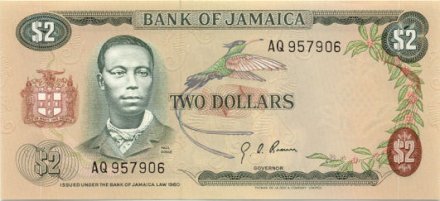
Paul Bogle on the (now out-of-circulation) Jamaican two-dollar bill.

On this day..

1865: An unnamed Obeah man

From William James Gardner’s (public domain) A History of Jamaica:

On the 21st a circumstance occurred which created much controversy. A reputed Obeah-man was tried by court-martial and convicted. One of the favourite assertions of these people has been that “Buckra can’t hurt them.” Colonel Hobbs directed him to be placed on a hill-side, about four hundred yards from the firing party. The bullets caused almost instantaneous death, and it is stated that the effect on the minds of the prisoners was so great, that the colonel felt at liberty to release a considerable number then in his camp, many of whom were heard to say they never would believe in Obeah again.

On this day..