Daily Quintuple: The Morant Bay rebellion

In 1865, British-controlled Jamaica faced an economically-driven revolt that altered its history.

Though slavery had been abolished in the British empire during the 1830s, emancipation had not come with land reform. Ex-slaves and their descendants remained desperately poor. Indeed, Britain’s near-simultaneous liberalization of the sugar trade had cratered prices for Jamaica’s top export — and with it, cratered most of the Caribbean economy.

To a petition early in 1865 for access to crown lands to relieve these dire conditions, Queen Victoria had extended a familiar classic of cruel and condescending economic catechism: shut up and work.

“The prosperity of the Labouring Classes, as well as of all other Classes,” quoth the piece that would be published as “The Queen’s Advice”,

depends, in Jamaica, and in other Countries, upon their working for Wages, not uncertainly, or capriciously, but steadily and continuously, at the times when their labour is wanted, and for so long as it is wanted; and if they would use his industry, and thereby render the Plantations productive, they would enable the Planters to pay them higher Wages for the same hours of work than are received by the best Field Labourers in this country; and as the cost of the necessaries of life is much less on Jamaica than it is here, they would be enabled, by adding prudence to industry, to lay by an ample provision for seasons of drought and dearth; and they may be assured, that it is from their own industry and prudence, in availing themselves of the means of prospering that are before them, and not from any such schemes as have been suggested to them, that the must look for an improvement in their condition; and that her Majesty will regard with interest and satisfaction their advancement through their own merits and efforts.

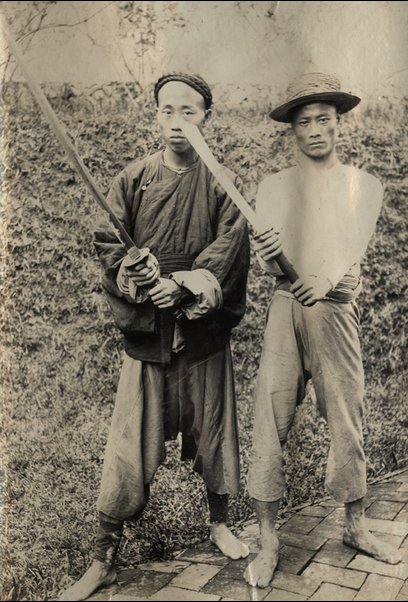
So your average Jamaican fieldhand’s “merits and efforts” became so much dry tinder accumulating, just waiting for the spark. (Note: Princeton has an album of photographs from this period here.)

In October 1865, flint struck steel with the prosecution of a poor black laborer for trespassing onto unused land.

The ensuing protest mushroomed into the Morant Bay rebellion: a scuffle with police, leading to proscriptions, leading to a more confrontational mob, an outnumbered and trigger-happy militia, and a full-fledged riot that seized the town of Morant Bay and proceeded to attack nearby plantations.

Dreadful reports, more terrifying for their scantiness and uncertainty, went abroad in those days, of “atrocities revolting to human nature.” That’s the New York Daily News, which ran a letter from Kingston, Jamaica, reporting “the whites who have fallen into the hands of these savages have been doomed to slaughter without distinction of age or sex. They tear out the tongues of their victims, cut off the breasts of women, strangle and mutilate little children.”*

Fearing a Haiti-like general revolution, Jamaican Governor Edward John Eyre — once an Australian explorer, which is why you can find his name on a New South Wales wine label — bloodily crushed the uprising.

Hundreds were put to death, either summarily in the field or after proceedings that would have wanted twice the deliberation to rise to the level of perfunctory. Hundreds more, including pregnant women, were flogged. Being in the wrong place at the wrong time without a demonstrable alibi ready to hand was liable to be worth a body’s life.

We note over the next five days two famous cases and three obscurities that may give a sense of how things were in those days — though Morant Bay depredations could in fact sustain several numbing weeks in these pages. For instance, a missive dated October 19 reports in passing the capture of “a number of prisoners from the rebel camp. Finding their guilt clear, and being unable either to take or leave them, I had them all shot. The constables then hung them upon trees, eleven in number.”

One officer** who showed excessive (read: any) exactitude for process was ordered in writing to emulate a comrade “doing splendid service … shooting every black man who cannot account for himself.”

Nelson at Port Antonio hanging like fun by court martial. I hope you will not send any black prisoners.

All this “fun” would put Governor Eyre in the eyre of a storm back in the home country.

These executions — but most especially that of colonial assemblyman George William Gordon — had little or no color of law, and spurred many English liberals to demand Eyre himself be prosecuted for murder. Nor was this merely an elite predilection: English working classes then in the midst of their own push for representation rallied in support of the Jamaicans, even burning Gov. Eyre in effigy. British Tories and propertied Jamaicans called Eyre a hero.

Ultimately, this furious “Eyre Controversy” proved insufficient to generate an actual criminal procedure against an agent of the empire, which would have entailed clearing a very high bar indeed. Recourse to the civil courts produced a landmark 1870 decision, Phillips v. Eyre whose upshot was to validate a law Eyre had the Jamaican assembly hastily enact retroactively legalizing his behavior and thereby rule out the prospect of a tort claim.

That Jamaican assembly was spooked enough that in 1866 it renounced its own power and made Jamaica into a Crown Colony directly governed by its British executive.

But if the need of the moment was to suppress the uprising, the need of history was to celebrate it — and the hero for posterity would not be Governor Eyre. The Morant Bay insurgents, a bare few of whom we will meet over the next days, have been valorized as slave rebels even if they weren’t quite literally slaves, and generally occupy an honored place in Jamaica.

* Cited in London Times, Nov. 13, 1865 — by which time the actual revolt was well over.

** That reluctant officer complied with his orders, but threw himself into the sea when recalled to England for subsequent the parliamentary inquiry.

On this day..

1817: Gertrudis Bocanegra, Mexican independence heroine

On this date in 1817, Mexican War of Independence heroine Gertrudis Bocanegra was publicly shot in her native town of Pátzcuaro for treason.

Bocanegra (English Wikipedia entry | Spanish), a literate Enlightenment woman was already 45 years old when the rebellion against the Spanish empire broke out.

Her husband and son joined Hidalgo‘s forces, in which service they would lay down their own lives.

Gertrudis Bocanegra kept a safe house, gathered supplies and money, shuttled messages … until Spanish authorities arrested her in 1817 and tortured her for information. (Need one even ask if the noble Bocanegra informed on her compatriots?)

She’s known as La Heroína de Pátzcuaro and is the namesake for, among other things, a plaza in that city and the striking Biblioteca Gertrudis Bocanegra, where one can find this:


(cc) image from eperales depicts Juan O’Gorman‘s monumental Historia de Michoacan. We’ve seen this monument before, as it depicts the Spanish burning to death the last native Tarasco ruler.

Bocanegra’s own execution is also shown in the mural — in the lower right, obscured by the bookshelves in the photograph above, but captured in detail in this Spanish blog post.

On this day..

1975: The last executions under Franquismo

Though Spain’s last execution is often misremembered as that of handsome anarchist Salvador Puig Antich in 1974, that milestone actually occurred with the shooting of five anti-Franco terrorists in three different cities on September 27, 1975.

It was an ugly coda to an ugly regime and a 40-year history of political killings.

Gen. Francisco Franco had the previous year been forced by his failing health to hand over power, raising hopes for a democratic transition. But after surprisingly recovering, Franco surprisingly took back his strongman role — and anti-Franco revolutionary movements that had been biding their time greeted the return of Franquismo with a wave of bombings and assassinations.

Spain’s cabinet met in September 1975 to consider eleven death-sentenced prisoners — three Basques of the separatist ETA, and eight members of the communist revolutionary organization FRAP. It upheld five of those sentences, all involving the killing of policemen. (Two women, who both claimed to be pregnant, were among those reprieved.)

The five who ultimately died were (and these are all Spanish Wikipedia links):


Headline from the London Times, September 27, 1975. The garrote was not, in fact, used for any of the executions.

The shootings met angry — often violent — reaction throughout Europe. Spanish embassies in the Netherlands and Turkey were attacked; several countries recalled their ambassadors; and French protesters rioted on the Champs Elysees. The EU predecessor entity EEC (Spain was not then a member) voted to freeze its trade relations with Spain.

And it was about more than just the five humans shot to death.

They had all been condemned within a month before their deaths, by military tribunals requiring harsh mandatory death sentences for crimes against public order. As the unsettled situation on the ground implied quite a lot of disorder and anti-government violence, observers worried that the regime’s willingness to actually carry out those sentences would unleash a “death machine” of unstoppable condemnations, met with inevitable reprisals, and still more unstoppable death sentences. Satans mördare, in the words of outspoken Swedish Prime Minister Olof Palme. Devilish murders.

The devil had plans for a different soul.

The ailing Franco succumbed to Parkinson’s Disease on November 20, 1975, once again introducing the period of relative calm and stability that Spain could have been enjoying for the previous year had the late caudillo just stayed in retirement. Spain abolished the death penalty under its post-Franco constitution.

Spanish-speakers may enjoy this documentary focusing on one of this day’s victims: parts 1 | 2 | 3 | 4 | 5. Indeed, this gruesome parting Franco made with his mortal coil has inspired many remembrances up the present day, especially given the martyrology-friendly anti-fascist credentials of the five. There’s also a 1991 film called The Longest Night and the Luis Eduardo Aute song “At Dawn”:

* This man’s widow Silvia Carretero, who was herself arrested and tortured (while pregnant!) under Franco, pushed an unsuccessful 2010 lawuit for her husband’s execution.

On this day..

1763: Gabriela Silang

On this date in 1763, the mestiza Philippines national hero Maria Josefa Gabriela Carino Silang was captured and summarily hanged — along with a number of the soldiers she had led against the Spanish.


Monument to Gabriela Silang in Makati City, Philippines. (cc) image from Jun Acullador.

Gabriela took primary leadership of a 2,000-strong rebel army after its co-leader, her husband Diego, was assassinated by his enemies in May 1763.

Said enemies were the Spanish colonial authorities, whom Diego and his helpmate Gabriela had raised revolt against and with an army wielding homemade muskets and blowguns, driven from the capital of Ilocos Sur. It was Great Britain’s occupation of the Philippines during the Seven Years War that opened the opportunity for the rebellion: the British even appointed Diego Silang governor of the province his army was in the process of conquering. They just didn’t actually help him.

Spain’s assault on the rebels, once organized, was sufficiently overwhelming to drive Gabriela Silang out of the city of Vigan, and then to repel her counterattack — the occasion for her capture and her death.

Gabriela Silang is memorialized in a number of monuments and place names in the Philippines; the women’s organization GABRIELA also engineered its acronym to pay tribute to her.

On this day..

1895: The Vegetarian perpetrators of the Kucheng Massacre

On the morning of September 17, 1895, in the presence of the British and American consuls, seven perpetrators of a Chinese massacre of western Christian missionaries were beheaded at Foochow.

Anticipating the better-known Boxer Rebellion by four years, the Kucheng Massacre (there are many other transliterations of “Kucheng”) was likewise a response to the Celestial Empire’s frustrating second-class status as against European interlopers.

Christian missionaries had been a point of friction in China for decades. Though their rights to proselytize had been guaranteed in a hated treaty dictated to China by force of arms, they often met resentment or worse on the ground.

“You bring incense in one hand, a spear in the other;” one evangelist reported being told: that is, however honorable the immediate intentions of many individual missionaries, their presence looked like a stalking horse for less reputable western interventions like the opium trade. (That’s how it looked to many Chinese. Professional western diplomats themselves found the impolitic preachers a hindrance to their statecraft, according to Ian Welch’s 2006 paper “Missionaries, Murder and Diplomacy in Late 19th Century China: A Case Study” (pdf).*)

On August 1, 1895, these frustrations unleashed a river of blood at the village of Huashan in Gutian County, where a Buddhist secret society — known as “Vegetarians” in the western press for their characteristic dietary vow — fell upon a group of vacationing British Anglican missionaries still abed at dawn and ruthlessly slaughtered eleven of them. (There are some 1890s books paying tribute to the fallen available online: Robert and Louisa Stewart: In Life and in Death, and The sister martyrs of Ku Cheng : Memoir and Letters of Eleanor and Elizabeth Saunders (“Nellie” and “Topsie”) of Melbourne.)

“The attack came,” said a physician from a nearby town who was summoned to the bloody scene, “like a thunderbolt from a clear sky, not one of the victims having received the slightest intimation of the intended assault.”

Word of the carnage struck western powers with similar force.

Incensed newspaper-readers literally demanded** gunboat diplomacy, and literally got it, especially when Chinese authorities drug their feet on the condign punishment the missionaries’ countrymen were clamoring for.

All this put British diplomacy on a sticky wicket, which Welch (pdf) deals with in detail. To satisfy the domestic audience, the government had to be seen to be taking a hard line on avenging the outrages; at the same time, London was wise to the Chinese state’s shakiness and wary that a “barbarous holocaust” perpetrated against the Vegetarians would trigger a mass backlash and bring the whole thing down.

An obdurate Chinese viceroy impeded the quick resolution everyone was after by making inflammatory public proclamations against Christians, and releasing without explanation six of the thirteen men who had initially been condemned to death in the month of August. The seven who were executed on this date were therefore only the vanguard of 26 humans ultimately put to death for their involvement in the atrocity.

Some of the execution photographs that follow are Mature Content. They’re obtained via Visual Cultures in East Asia; some also available at USC Digital Library.


Raids and investigations to bring the Vegetarian movement to heel continued for several months thereafter, and the whole affair ultimately was quelled without doing any of the wider damage that might have been feared — not even to missionaries who continued pouring into China.

And that, effectively, kicked the can down the road on the anti-foreigner sentiments afoot in the land … sentiments that would find much costlier expression a few years later when another secret society kicked off the Boxer Rebellion.

* I’ve relied heavily on Welch for this post. He’s also collected a massive trove (over 1,200 pages) of primary documents from this incident available in a series of pdfs (some quite large) from the Australian National University website:

** This was not universally so. The wife of missionary Stephen Livingston Baldwin, who knew some of the victims of the attack, urged a “charitable” response and sensitivity that “the Chinese feel that all the world is against them, and they are not far from right.” (New York Times, Aug. 10, 1895) In letters responding to intemperate coverage elsewhere, she acidly compared (pdf) western editorialists’ high dudgeon to their look-forward-not-back dismissal of recent stateside anti-Chinese violence.

It was ten years yesterday since more Chinese were killed, and burned alive and left to die wounded, in one hour, at Rock Springs, Wyoming (the very same Territory in which the recent massacre occurred) than have been Americans and English in China in the thirty-four years I have personally known that land, being a resident there twenty years and closely connected with it ever since. Ten years yesterday since that awful Rock Springs massacre, and up to date no one arrested, much less punished! The anti-Chinese papers of the town and neighbourhood gloating over the awful details and assuring all that there would be “no Congressional investigation,” and no waste of “enterprising newspaper eloquence” over the woes of the Chinese, “though their blood flow like rivers, as they had no votes and no friends.” In less than four weeks after the Ku-Cheng massacre, arrest, investigation and execution have all taken place for the Ku-Cheng massacre. Would that our colored, red and yellow brethren, so helpless in our so-called civilized and Christian land, had some power behind them to bestir Ministers Plenipotentiary, wave flags, and run gunboats to the front, to bully, if necessary, our pusillanimous Government into some sort of civilization — I will not say Christian justice!

On this day..

1866: Dmitry Karakozov

On this date in 1866 (September 3 O.S.; September 15 N.S.), Russian revolutionary Dmitry Karakozov was hanged in Peter and Paul Fortress for attempting to assassinate Tsar Alexander II.

Karakozov was a son of noble stock — the self-hating variety, obviously, and suicidally disturbed into the bargain. He supposedly hailed from a terrorism cell branding itself “Hell”, although this was bandied about by the police afterwards and conveniently supported a hunt for radicals.

Karakozov, at least, considered the state of tsarist Russia positively infernal, and on April 4, 1866, he went to scourge it — firing a shot at the monarch at St. Petersburg’s Summer Garden. He missed.

The tsar’s guards tackled him as he fled, and the unharmed Alexander walked up to the gunman and asked him, “What do you want?” He may have been genuinely bewildered: Alexander was the guy trying to liberalize Russia. Just a few years before, he had freed the serfs.

“Nothing,” Karakazov replied. “Nothing.”

A statement of implacability: no progress would be bargained with even the most progressive despot. The despotism itself must go. A manifesto addressed to “Friends-Workers” was found in his pocket underscoring the point; it read in part (translated from p. 21 of this Russian pdf):

I have decided to destroy the wicked Tsar, and to die for my beloved people…

If I accomplish this deed, I will die with the thought that in death I did something good for my dear friend, the Russian peasant.

If I do not accomplish it, then others will follow my path. Where I fail, they will succeed, and my death will be their example and inspiration.

Others would follow him, and in time successfully murder Alexander II after all.

Karakozov himself, the first Russian revolutionary to attempt regicide, didn’t seem to have revolutionary satisfaction on his mind at the end. He converted to Orthodox Christianity in prison, sought “as a Christian, of a Christian” his prospective victim’s clemency … and multiple newspaper accounts report him kneeling to kiss a cross presented to him on the scaffold by the priest. (All via Odd Man Karakozov, which argues that all this need not imply such a reversal of conscience as it might appear.)

What certainly did happen — more immediately than those copycat assassinations — was a reactionary wave of national chauvinism, whose more wretched manifestations will not be unfamiliar to the present day. The patriotic Glinka opera Ivan Susanin was staged a few days later at the Bolshoi in Moscow. According to an eyewitness account of Tchaikovsky quoted in Romanov Riches: Russian Writers and Artists Under the Tsars, this salute to a Russian peasant’s sacrifice for the Romanov dynasty went a little bit off-script.

I think the Moscow audience went beyond the bounds of sense in their outburst of enthusiasm. The opera was not really performed, for as soon as the Poles appeared onstage, the whole theater shouted, “Down with the Poles!” and so on. In the last scene of Act 4, when the Poles are supposed to kill Susanin …

… the actor playing him started fighting the chorus members who played Poles, and being very strong, knocked down several of them, while the rest of the extras, seeing that the audience approved this mockery of art, truth, and decency, fell down, and the triumphant Susanin left unharmed, brandishing his arms, to the deafening applause of the Muscovites.

If true, that is little short of fantastic.

The apparatus of state went so far as to build up a new Susanin for the occasion at hand, hyping a questionable story that a young peasant named Osip Komissarov — who was from Susanin’s own province of Kostroma — had jostled Karakozov just as he took the shot, causing it to go awry. The good-natured bumpkin was rewarded with summary ennoblement as “Komissarov-Kostromskoy” and eye-rollingly terrible poetic tributes from the likes of Vyazemsky and Nekrasov. However, Komissarov’s embarrassing stupidity and want of manners would eventually necessitate Komissarov-Kostromskoy’s being packed out of polite society to country estates on a generous pension to bankroll his ample appetite for liquor.

So Dmitry Karakozov did do something for the Russian peasant after all.

On this day..

1987: Moses Jantjies and Wellington Mielies, after the Langa massacre

On this date in 1987, Moses Jantjies and Wellington Mielies — “political prisoners” in the estimation of their supporters — hanged along with five common criminals at Pretoria for the murder of Ben Kinikini and five others.*

The killing of Kinikini occurred in an environment of bitterly escalating hostilities in the eastern cape city of Uitenhage and especially the KwaNobuhle township. Anti-apartheid school boycotts dating back to September 1984 (part of a spreading revolt in the townships at that time) had metastasized into violent confrontations when protesters were denied meeting space by the black KwaNobuhle councillors.

Kinikini was such a councillor, and he and the others had been under popular pressure to resign, and even had their homes stoned, since the last weeks of 1984.

Protesters stoned vehicles. Riot squads roamed the streets. Police shootings became everyday events, and more enraged crowds gathered at the resulting funerals of their victims.**

On March 21, 1985,† police opened fire on one such funeral procession, slaying some 20 people in a single go — the Langa Massacre.


Coffins of the Langa Massacre’s victims. (cc) image from United Nations Photo Library. Also see this, this, this and this.

And then it really hit the fan.

Riots erupted following the Langa massacre, and it was on March 23 that Kinikini was dragged from his house and murdered: black township councillors were liable to be seen as apartheid collaborators. Defense witnesses for Jantjies and Mielies were quite a bit more specific, slating Kinikini with direct links to murderous vigilantes who liked to beat up and rape protesters in the creepy privacy of Kinikini’s apt personal business, a mortuary.

And as one memoir of the period puts it, “the government knew black councillors would not participate in a democratic charade unless their lives and property were protected and avenged. Some two and a half thousand black councillors, policemen and informers, real and rumoured, had been killed in the unrest that had begun in 1984.”

For South African president and white-rule stalwart P.W. Botha, those were far more pressing constituencies than mercy appeals from usual suspects like black activists and the West German government. These were also the first two township-rising convicts to come up for execution, out of some 33 then on death row, so their treatment figured to set the precedent for even higher-profile cases on the horizon like the Sharpeville Six. (In the event, apartheid collapsed before the Six could actually be hanged.)

The message was hardly lost on its internal audience.

“We have come to terms with the fact that the enemy has declared war,” Winnie Mandela told a Johanessburg memorial service for Jantjies and Mielies hanged. “We accept the challenge. The blood of the comrades has not flowed in vain.”

* Ben Kinikini, his four sons and nephews, and one other person were stabbed and burned to death. Some reports term at least Ben Kinikini’s killing a “necklacing” — the brutal method of popular execution that arose in the 1980s in which the “jewelry” was a rubber tire filled with flaming petrol. It sounds from the widow’s secondhand description as if this could indeed characterize it, though the fact that the Truth and Reconcilation Commission called a July 1985 killing the country’s first necklacing might indicate otherwise. News stories suggest that photographs and video exist of, if not the murder, at least the aftermath: perhaps these are dispositive on the point.

** See Thole Majodina, “A Short Background to the Shooting Incident in Langa Township, Uitenhage,” Human Rights Quarterly, August 1986.

† March 21 also happened to be the very anniversary date of one of apartheid South Africa’s most infamous police atrocities, the 1960 Sharpeville Massacre. Thanks to Sharpeville, this first day of spring is the International Day for the Elimination of Racial Discrimination, as well as the date on which South Africa marks Human Rights Day.

On this day..

1908: Khudiram Bose, teenage martyr

The investigations following upon the recent raids on Anarchist dens here prove the existence of a revolutionary plot on a vast scale and show that there was a systematically organized “college” … where bombs were manufactured and instruction in explosives was given … The prisoners talk freely of their “heroic conduct” and “noble design,” while refusing to impart any informaton incriminating those working behind the scenes and furnishing the funds. They all confess, however, that their minds have been fired by writings in the Press and speeches on platforms.

London Times

It’s a timeless story, really; with a tweak here or there, the excerpt above could do for reportage on seditious movements by the hundredfold. As it happens, its dateline is May 11, 1908 — Calcutta.

Separatist stirrings on the subcontinent were then manifesting themselves in the explosive revolutionary language of the day, and the chief magistrate of that ancient city of Calcutta — Kingsford by name, as in charcoal — was a character notorious for his harshness toward the movement. The year before, he’d had a 15-year-old flogged for trying to stop a British soldier beating Indian activists.

Among the more militant types excited to wrath against Kingsford was an 18-year-old Bengali who would have the privilege of martyrdom for the cause of national self-determination.

Khudiram Bose sought the judge out in Muzaffarpur and, with another young revolutionary, attempted to assassinate him in April 1908 by tossing a couple of bombs into Kingsford’s carriage.

Minor problem: it was the wrong carriage.

Instead of popping the nefarious judge, the bombs killed the wife and daughter of a barrister.

The other assassin committed suicide when cornered by police, but Bose would meet his end via the judiciary.

Bose played his patriotic martyr’s role to the hilt in the few brief weeks before his hanging, and found himself on the leading edge of a growing movement of anti-British bombers. “People are prepared to do anything for the sake of swarajya [home rule] and they no longer sing the glories of British rule,” one contemporary newspaper (quoted here) put it. “They have no dread of British power. It is simply a question of sheer brute force.” The editor was convicted of seditious libel.

One can now find plentiful Khudiram Bose hagiographies celebrating the youthful freedom fighter … regardless of his target selection.

On this day..

1849: Ugo Bassi, nationalist priest

Measure thy life by loss instead of gain;
Not by the wine drunk, but the wine poured forth
For love’s strength standeth in love’s sacrifice;
And whoso suffers most hath most to give.

-From Harriet King‘s poem “Ugo Bassi’s Sermon in the Hospital”

On this date in 1849, the Garibaldian priest Ugo Bassi was shot in Bologna along with fellow-nationalist Count Livraghi.


Statue of Ugo Bassi at Bologna’s via Ugo Bassi.(cc) image from Biblioteca Salaborsa.

Detail view (click for full image) of Bassi and Livraghi being escorted to execution.

Bassi was a penniless Barnabite priest famous for his powerful oratory* and his national enthusiasms. He signed right up for Garibaldi‘s national movement in the heady liberal revolutions of 1848-49.

“Italy is here in our camp,” he would say of the Garibaldian forces readying their (ultimately unsuccessful) defense of the Roman Republic.** “Italy is Garibaldi; and so are we.”

Alas, in this engagement, Italy had a lot fewer guns than the French.

The new French ruler Napoleon III, who had himself been in youth a revolutionary carbonaro in Rome, saw foreign policy advantage in backing the exiled Papacy and overthrew the Republic.†

Garibaldi escaped to exile, but many of his subalterns did not. Bassi was captured unarmed — he didn’t even bear arms in battle — and Pius IX, once thought a fellow-traveler by the liberals, did not hesitate to hand him to the Austrians for punishment. The Habsburgs stood equally to lose from any gains of the Risorgimento, and accordingly gave Bassi a perfunctory military trial, then had him shot immediately in Bologna.

For crowning his open-hearted life with this sacrifice, Ugo Bassi instantly became, from that day to this, one of the best-honored Italian patriots.

He possessed at once the simplicity of a child, the faith of a martyr, the knowledge of a scholar, and the calm courage of a hero … If ever Italy comes to be united may God restore her the Voice of Ugo Bassi … The name of Ugo Bassi will be the watchword of the Italians on the day of vengeance!

Garibaldi

* Anecdote associated with Bassi once he came to firing up the Bolognese for Garibaldi: a poor girl who could give nothing to the cause spontaneously chopped off her own hair and handed it to him. This is the event depicted by Bassi’s fellow-Bolognese Napoleone Angiolini, Ugo Bassi sui gradini di San Petronio.

** Topical incidental: the Roman Republic lasted only a few months, but its constitution abolished the death penalty … so it can count as the first nation to abolish capital punishment in constitutional law.

† Earning Napoleon III the permanent wrath of Italian nationalists.

On this day..

1798: Anthony Perry and Mogue Kearns, Protestant and Catholic

On this date in 1798,* two Irish rebels — a Catholic and a Protestant — were hanged side by side at Blundell Hill, Edenderry for their parts in that year’s Irish Rebellion.

Their biographies were a study in contrast: Anthony Perry, “a Protestant gentleman of independent fortune, liberal education, and benevolent mind”; Mogue Kearns, the brooding and ordained stock of Catholic farmers. Legend has it that Kearns even survived a mob lynching in Paris during the French Revolution.**

If so, it didn’t dampen his revolutionary ardor.

The two men were major movers in the Wexford Rebellion, one of the more successful and (to the British) surprising centers of insurrection in 1798. Perry, still half-broken by British torture,† returned to the field to help rout the Brits at the Battle of Tuberneering, obtaining the nickname “the Screeching General” for his barbaric vociferations in battle.

But after this successful ambush, the United Irishmen were driven from pillar to post — a failed attack on Arklow followed by the rebels’ defeat at their Vinegar Hill encampment.

A few weeks later, the multiconfessional leaders were captured, and quickly hanged at Edenderry, with “benefit” only of a summary court-martial.

Perry was extremely communicative, and while in custody, both before and after trial, gratified the enquiries of every person who spoke to him, and made such a favourable impression, that many regretted his fate …

Kearns was exactly the reverse of his companion — he was silent and sulk, and seldom spoke, save to upbraid Perry for his candid acknowledgments … [he had] an hypocritical and malignant heart, filled with gloomy and ferocious passions — He seemed rather to be an instrument of Hell, than a minister of Heaven, for his mind was perpetually brooding over sanguinary schemes and plans of rapines, while he assumed the sacred vestments of a servant of Christ!

Their capture marked the final collapse of Wexford’s rebellious “republic”; by September of that same year, all Irish disturbances had been definitively, and bloodily, quelled.

* Some sources have July 12, an apparent transposition of the correct date; both men appear to have skirmished in Clonard on July 11 and again at Knightstown Bog on July 14, and only captured thereafter, followed by several days’ captivity before hanging.

** “The history of the Priest is somewhat extraordinary — he had actually been hanged in Paris, during the reign of Robespierre, but being a large heavy man, the lamp-iron from which he was suspended, gave way, till his toes reached the ground — in this state he was cut down by a physician, who had known him, brought him to his house, and recovered him.”

† Perry’s troops happened to capture two men involved in Perry’s torture in early June. He had his ex-tormenters executed.

On this day..