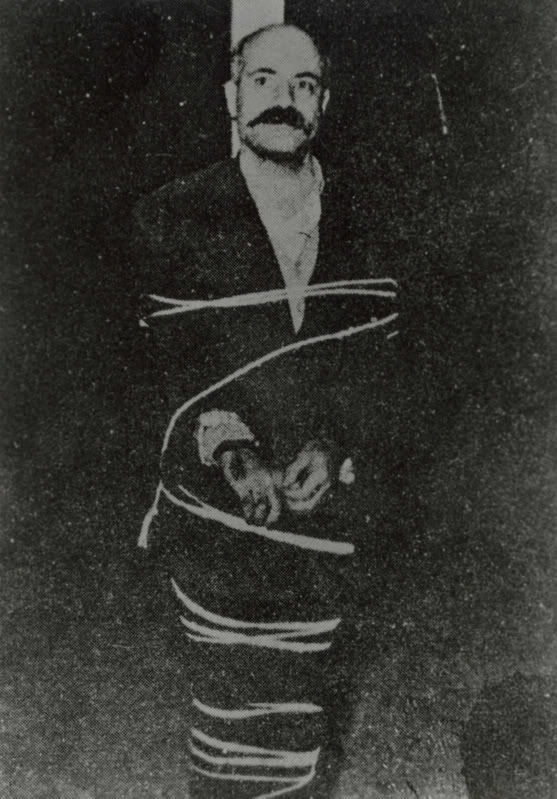
On this date in 1978, peripatetic Communist intellectual Hu Nim vanished into Khmer Rouge Cambodia’s charnel house along with 126 others at Tuol Seng.
The child of a poor peasant’s family, Nim was a gifted young state worker who studied in Paris in the 1950s, where he met several future Khmer Rouge leaders.
Nim charted an independent — some might say hypocritical — course over the next two decades, serving uneasily as a leftist parliamentarian in Prince Sihanouk‘s nationalist coalition government, fleeing ahead of a conservative purge into the bush to join Communist guerrillas, then returning once more to Sihanouk’s now-leftist Chinese-backed government-in-exile. It’s a period whose interests and alliances don’t map straightforwardly onto the familiar Cold War axis.
Hu Nim’s stature as Minister of Information in the government-in-exile transitioned directly to that same portfolio when the Khmer Rouge came to power.
Maybe those old ties to the ancien regime did him in — Vietnam, after invading Cambodia, would seize on the late minister’s reputation for independence to damn the Khmer Rouge for purging a moderate socialist — but there was no ideological talisman for safety during those terrible years. Hu Nim’s longstanding pro-Chinese position was also a dangerous association come 1977, and Phouk Chhay, a fellow officer of the Khmer-Chinese Friendship Association, was among the batch of prisoners shot along with Hu Nim this date.
Early in 1977, a massive internal purge shook the regime; as many people (some 1,500) went to Tuol Sleng from mid-February to mid-April of that year as had gone in all of 1976.* Almost every one of these humans would be, in the terrible bureaucrat-ese of the security apparatus, “smashed.”
Hu Nim was one of these, a denunciation wrung from a local commander leading to his April 10, 1977 arrest. Under repeated torture over the ensuing three months, the ex-Minister of Information would write and re-write his confession, fashioning himself “a counterfeit revolutionary, in fact … an agent of the enemy … the cheapest reactionary intellectual disguised as a revolutionary,” a stooge of the CIA since the high school, and a skeptic of the disastrous forced agricultural collectivization who had swallowed his doubts lest “I would have had my faced smashed in like Prom Sam Ar.” The confession ultimately tallied 200-plus pages. (Here’s some of it.)
Four days after his arrest, Hu Nim submitted the first of seven draft “confessions” to his interrogator, who appended a note to Deuch, saying: “We whipped him four or five times to break his stand, before taking him to be stuffed with water.” On April 22, the interrogator reported: “I have tortured him to write it again.” Five weeks later, Hu Nim was abject: “I am not a human being, I am an animal.” (Source
* Official count for all of 1977: 6,330 “anti-party” types tortured and executed at Tuol Sleng, as against “only” 2,404 in 1975-1976 combined.
On this date in 1804, royalist counterrevolutionary Georges Cadoudal was guillotined in Paris with eleven of his chouan brothers-in-arms.
Cadoudal (English Wikipedia entry | the much more detailed French) was the French Revolution’s ultimate antagonist, a Breton notary (and commoner, obviously) who obstinately resisted the bloody progress of those years to the last of his strength.
His decade of royalist adventures (French) reads* like an adventure novel, a mind-bogglingly perilous series of revolts, captures, escapes, rappelling, martial exploits, diplomatic intrigue, terrorist plotting, high principles, low politics … a desperately heroic (or anti-heroic) struggle using every resource of a changing world to claw back the lost age of Bourbons.
After that dynasty’s last (up until then) king was guillotined in 1793, the intrepid Cadoudal staked his life to the 1793 Vendee rising, mounted an insurrection at Brest, and became one of the principal leaders of the anti-revolutionary Chouannerie fighting les bleus around northwest France through the 1790s.
Beaten but not bowed, Cadoudal took refuge in England when those campaigns came to grief following the royalist debacle at Quiberon, but he was never one to retire to the exile social circuit. Cadoudal remained an active schemer against the France of a rising Napoleon Bonaparte, and he was backed now by Britain’s statecraft … and her gold.
Spurning a proffered arrangement with the Corsican — who, say what one will, could recognize ability when he saw it — Cadoudal instead oversaw a dramatic 1800 assassination attempt on Napoleon that didn’t get the dictator but blew a bunch of Parisian bystanders to smithereens.
This effort having failed, our persistent intriguer slipped back into France to attempt an even bolder venture to kidnap Napoleon and elevate the Duke of Enghien — the going Bourbon candidate, who lurked on the French frontier to rush into the power vacuum.
This didn’t work either. As outlandish as the idea seems with benefit of hindsight, it was hardly a crackpot plan — as attested by the credentials of its participants.
“All Europe laughs at the conspiracy in Paris; it was, however, a well-built machine. Men, money, everything was ready. Bonaparte was to be taken alive and carried out like lightning from one post to the sea and the English fleet … I am inconsolable that it missed its mark. Those who criticize the French princes that they do not risk themselves while others fight for them, they will be the first to cry: What madness! How childish! [that d’Enghien risked himself] That is how men are made.”
Which is a long way of saying that it still comes down to wins and losses.
Having lost, the Bourbon pretender (he’s a pretender because he lost, of course) d’Enghien was arrested and immediately shot for his trouble; Cadoudal, taken on the streets of Paris,** was around long enough to see the hated Bonaparte take sufficient warning from the conspiracies against him to vest his governance in the imperial dignity. That was proclaimed on May 18. (The famous coronation wasn’t until December.)
“We have done better than we hoped,” the doomed Cadoudal remarked caustically from his dungeon. “We intended to give France a king, and we have given her an emperor.”
He was rock-ribbed in his royalism to the very last.
He’d met Napoleon face to face years before in an abortive parley — when Cadoudal was offered, and rejected, the bribe of a lucrative Republican military commission — and now Cadoudal’s proposed victim let it be known to him that mercy was his for the asking. The indignant Breton scorned as dishonorable the very idea of supplicating Napoleon, even when the invitation was refreshed as he underwent the fatal toilette on his final day. His dozen-strong party went to their deaths this date taking heart from following the very footsteps of their martyred king.
The Execution of Georges Cadoudal, by Armand de Polignac … who portrayed several scenes of the conspirators.
A very lovely mausoleum in his native village of Kerleano preserves Cadoudal’s remains (reburied honorably there after his Bourbon Restoration finally came to pass), and his memory.
On this date in 1915, twenty activists of the Armenian Hunchakian political party were publicly hanged in Istanbul’s Beyazit Square.
A couple of other very grainy (newspaper?) images are here.
These unfortunates had participated in a 1913 convention that resolved — secretly, so they thought — upon treating to a programme of political assassinations of the nationalist Young Turks then driving belligerent policy against Armenians.
Unfortunately for them, the Sublime Porte had sublime ears.* It pounced on the prospective terrorists at the first opportunity, and gave them a couple of years in a dungeon before a wartime show trial days just days after Armenian genocide had commenced.
Paramaz, who’s probably the most individually famous of the twenty, has a recently-erected monument in Meghri. He’s also credited with a movingly humane exchange with an Ottoman judge, each reflecting on their respective impasse vis-a-vis nationhood and self-determination.
“The attributes of history in our reality are arranged in such a way that what constitutes ‘patriotism’ for one is viewed as destructive treason by the other,” quoth the judge (!!!) to the defendants.
And thus the mutual relations between nations living together amount to the negation of international law and social concepts. Today is the last session of these trials … There was something unusual and unqualifiable in these trials. Unqualifiable because neither you nor us had enough wisdom to penetrate each other’s [worlds].
…
You cannot imagine, effendis, that it is with such grief that I will pronounce the depth of my conviction regarding the patriotism accumulated in you. What can be more heartbreaking tht warm blooded beings like you full of life have sacrificed logic to sentiments … What great deeds vigorous individuals like you could have accomplished, if the ideal of a common welfare had been pursued under one banner … What benefits could have been borne from a mutual understanding that eluded [us], the other end of which is sad and dark. You languished with the idea that you are struggling against injustice; while have felt, every minute, that the rules of the world are abasing higher tendencies under the weight of cruel necessities.
This reflection led Paramaz, who today is an Armenian national hero for his martyrdom at the Turks’ hands, to reciprocate:
I, who has never cried in my life … I am not ashamed to say that I was deeply moved by the sincerity of [the judge] Khurshid Bey’s speech … and I cried, I, Paramaz, because Khurshid Bey put his finger on the wound when he stated, ‘What good deed could have been accomplished …’ I cried because in those words I found the brilliance of truth.
[Yet] we would be asking the same question, and add, What was left that we did not do for the welfare of this country. We accepted such sacrifices, we spilled so much blood and spent so much energy to bring about the brotherhood of Armenians and Turks; we lived through such suffering to elevate each other through trust. And what did we see? Not only did you condemn our gigantic efforts to sterility but also consciously pursued our annihilation …
Gentlemen, judge people by their work, by their traditions, within the realm of their ideas. I am not a separatist from this country. On the contrary it is [this country] that is separating itself from me, being incapable of coming to terms with the ideas that inspire me.
Mutual empathy notwithstanding, the end for these twenty was indeed sad and dark.
* An Armenian informant named Arshavir Sahagian attended the conference and finked out its design. He was killed for his troubles on December 25, 1919, according to Raymond Kevorkian.
We take this story from the dispatch filed the same day for the London Telegraph and reprinted in the New York Times. Paragraph breaks have been added for readability.
Dilatory as the French authorities are in bringing culprits to trial, they dispatch them with terrible haste so soon as their guilt has been certified by the final Court of Appeal. No public notice is ever given of an execution, and few people ever hear of it until it is all over.
A paragraph appeared in an evening paper last night to this effect: “The Commission of Pardons has commuted the sentenced passed on PASCAL and LUCIPIA; the appeals of SERIZIER, BOIN and BOUDIN have been rejected.” To the world at large this paragraph conveys no hint as to the date of execution; the initiated read between the lines that on the following morning, dawn will rise on a dismal military pageant on the plains of Satory.
There is, nevertheless, a certain amount of uncertainty in the matter, so very closely are all such secrets kept in France; and it was only on the receipt of a hint from a high authority that some time after midnight I determined to start with a friend for Satory. The impression made upon me by the ghastly spectacle I shall try to describe in the plainest possible language.
SATORY.
A finer exercising ground than the plain of Satory it is not possible to imagine. The ground is as flat as a billiard-table, and it is not devoid of a certain beauty — the thick turf being singularly fresh, and he vast square plain surrounded by a belt of fine trees.
Troops are marching in companies to take up their appointed positions on the ground. A raised battery is a prominent object, and opposite to it, at some distance, is a huge earthen mound, against which a target stands out distinctly in black and white. The troops are forming in three sides of a square, which is completed by this butt.
It is not until you get quite close to the mound that you perceive on the lower ground immediately in front three white sticks ranged in a line, each about four feet high and five feet apart. These are the poteaux against which the culprits are to stand.
A good many soldiers, not on duty, have turned out en amateur to see the show; they collect on the top of a mound near the butt, but they are driven down by the artillery sentinels and mounted police, who, dressed in a little authority, canter about with superfluous fidgety zeal.
The morning air is chill, and everybody on duty or off duty tries to comfort himself with a smoke. “Nous avons encore trente-cinq minutes,” says a sergent-de-ville, in a grumbling, querulous tone. And the condemned men? They only had thirty-five minutes, and methinks they had as much reason to complain.
A soldier proceeds to work at the target, sqwing it off short; he is going to take it away, perhaps, that it may not divert the soldiers’ aim; and one feels irritated with him for being so slow.
One wonders, too, that they have allowed the red signal flag to remain at the top of the butt. Would not a Communist see an omen or an augury in the accident?
An engineer close to me is coolly fashioning wedges, in preparation for the artillery practice, which is to begin “aussitot que cette affaire est finie.”
Another protests impatiently that he wants his breakfast. Three dogs, which are perpetually frightening the horses of the mounted police, as well as the riders, excite continual merriment. There are scarcely more than a dozen civilians present, but I observe two women.
One — a brazen-looking creature, with a black mustache, and wearing that peculiar kind of hooded cloak which you see constantly in Belgium — was laughing a hoarse, harsh laugh, that chilled one’s blood. The other was charmingly dressed in black silk, and looked like a lady; she spoke to nobody; her face was deadly pale; her eyes were large with tears, and yet there was a strange compression about the lips that told of intesnse firmness of purpose. Her bearing was rigidly calm, but I fancied that the stick of her dainty black parasol was snapped in two.
What had that woman to do at such a scene? I know not; but, assuredly, it was not curiosity that brought her there. There was now a slight diversion. A cart drove up covered with black cloth, and hid itself away to the left of the poteaux.
THE EXECUTIONERS AND THE CONDEMNED.
Then the pelotons or firing parties marched in and piled arms opposite the same slim sticks about which everything in that huge plain seemed to gather of its own accord.
The pelotons were taken, one from the line, two from the Chasseurs de Vincennes. Hardened though they must be by this time and embittered though they are against the Communists, I do not think, to do them justice, that they liked their duty. They looked pale, they were perpetually falling out, and they smoked with suspicious eagerness.
I tried to impress on my own mind that these fellows were murderous ruffians who had slain unoffending fellow-creatures in cold blood. SERIZIER and BOIN, Colonel and Lieutenant in the Communist army, had tortured and killed the very priests who had devoted themselves to the task of tending the wounded on both sides, for no reason but that they were good men. BOUDIN had actually shot down a chemist in the Rue Richelieu because he protested against his son, a mere lad, being impressed into working at a barricade.
But, with the best will in the world, I could not persuade myself that it was right and proper for 5,000 soldiers to be brought out under arms for the mere sake of killing three defenceless wretches. Meanwhile the minutes passed on; the officers rolled up cigarettes, compared watches, and consoled each other with the reflection, “Soyez tranquille, mon cher, ca sera l’heure militaire.”
And so it was; for just as the first silvery tones of a distant church clock were wafted across the heath, striking the hour, the trumpets rang, the drums beat Aux champs, the troops dressed up, and the three ambulance wagons dashed into the square at a sharp trot.
The prisoners had not been apprised of their appeal hvaing been rejected until four o’clock in the morning, but they seem to have accepted their fate with singular philosophy. They had all eaten and drunk, and SERIZIER had asked for a “pipe of tobacc” for the last time. In driving along he said to the two gendarmes by whom he was accompanied, “Wat a mistake I made to quit Belgium! Quelie belle affaire j’ai fait la. C’est egal, je saurai bien mourir.”
Strangely enough, he confessed to a Dominican, a priest of the ver order against which he had shown such diabolical hatred.
Each man was accompanied by two gendarmes. And here I cannot help noting one of the strange peculiarities of an over-excited state of mind. When the drums beat “Aux champs,” the merely dramatic feeling of the scene was intensely moving.
And yet when, a moment later, I first caught sight of the tops of the jack-boots of the first tell gendarme who appeared at the ambulance doors, I was so forcibly reminded of “Le Petit Faust,” and scores of other pieces wherein these functionaries are held up to ridicule, that I almost burst out into hysterical laughter.
The tragedy, however, soon proved too terrible, for the gendarme was closely followed by BOIN, who had scarcely touched the ground before he exclaimed, waving his hat in the air, “Vive la Commune!”
The three men walked quickly to the poteaux, and placed themselves in position as coolly as though it were the most natural thing in the world. They then, as though with one accord, flung their hats or caps into the air, and shouted several times in thrilling tones, “Vive la Commune!”
They all three were smoking. SERIZIER threw away his pipe, but BOIN kept his cigar in his hand, and BOUDIN was actually smoking as he fell. The face of the latter was so covered up by the handkerchief with which he alone allowed his eyes to be bandaged that his features could not be discerned.
SERIZIER, who was in the middle, indignantly threw down the handkerchief with such force as to cast it far beyond him. BOIN also refused the bandage wherewith the soldier stationed beyond him offered to cover his eyes, and by an involuntary action he put it into his pocket.
BOUDIN was coarsely clad; and SERIZIER, an undersized man, with heavy sensual features, looked like the type of a London rough. BOIN was a tall, well-built man, having good, clean-cut features and black mustaches. He was dressed in a light-brown velvet coat, Garde Nationale trousers, and a colored-scarf round the waist.
THE EXECUTION.
The priest, going up to each in turn, kissed him on both cheeks, in what seemed to me a hurried and perfunctory manner.
Then, while the sentence was being read to the prisoners in a quick, low, quite inaudible tone, BOIN made a long harangue, much of which was lost in the perpetual rolling of those ghastly drums.
But one could distinguish snatches of sentences such as “Soldiers, you are children of the people as we are, and we will show you how children of the people can die. Nous mourons innocents,” and then opening wide his light coat — he wore no waistcoat — he offered his white shirt-front for a mark, and, striking his heart with his open palm, he exclaimed: “Portez armes en joue! feu! tirez au coeur!”
This he repeated several times, and while he was yet speaking, standing out clear away from the poteaux and looking death at ten paces literally in the face, a sword flashed in the sun, and the three men leaped from the ground only to fall to it in horrible contortions.
The smoke and the report were unheeded, for all the senses of the horrified spectator were arrested by the awful spectacle of writhing limbs and twisting hands.
BOIN seemed to be rewarded for his bravery by suffering less than the others, but SERIZIER literally rolled over, and BOUDIN also moved. The surgeon then went up, examined BOUDIN first, and then directed one of the sergeants in reserve to give the coup de grace in the ear. Then SERIZIER was examined and treated in the same way; and lastly, after a considerable interval, BOIN was dragged into position and dispatched.
I cannot give you any idea of the sickening impression produced by this seemingly deliberate butchery.
I say seemingly, for the men may have been dead, but, in any case, surely if the coup de grace must be given, it should be done at once. I did not time the proceedings, but, long as my description is, I believe that not more than two minutes elapsed from the time that the ambulance wagons came on to the ground to the time that the volley was fired.
Several more minutes, however, elapsed before the dull thud of the last coup de grace delivered a bout pontant right into the poor wretch’s ear struck upon the ground. I have seen something of the horrors of war at Sedan and Strasbourg; I have witnessed the degradations of a public hanging in England, but have never seen anything so horrible as this supplemental butchery of the coup de grace.
AN AFTER SCENE.
When the surgeon and his attendants retired fro the poteaux, it became evident that painfully long as the interval had been, he had not been sparing of trouble. For with an eye to dramatic effect, he had disposed the bodies symmetrically, so that their feet should point towards the defiling troops.
Then the trumpets struck up a lively tune, and all the troops present — three batteries of artillery, carbineers and other caalry, four or five battalions of the line, engineers, &c. — some five thousand men — marched at quick step before the stark, stiff, staring bodies.
I cannot think that such a sight can have any other effect than that of exciting sympathy for the guilty. To see a man lying on his back there, his head a shapeless mass and the large red spot on his breast growing every moment larger and larger, and to think that not ten minutes ago he was speaking with passionate eloquence — this tended rather to make one forget his crimes than to remember his cruelty.
Yet I am bound to confess that this feeling is not shared by all, for when the troops had passed by, and the black van had driven up and unladen its dreadful burden of plain coffins, I saw an officer point with his foot at the yet warm brains of BOIN, and I heard him say, “C’est avec celui qu’il a fait son discours.”
Further to that body’s sanguinary campaign against papal political domination, they authored an attempted kidnapping and/or assassination of the Vatican’s Romagna enforcer, Cardinal Rivarola. Rivarola had recently issued mass condemnations against carbonari.
Which is very nice. But they didn’t get the Cardinal.
Ubiquitous 19th century papal executioner Mastro Titta conducted the executions — the 266th through 269th of his career (he’d also done Gaetano Montanari’s better-known brother Leonida three years before) — and devoted a chapter of his memoirs to the occasion. You can call the carbonari terrorists if you wish, but the Ravenna populace’s fearsomely cinematic display of solidarity with the doomed makes eloquent historical testimony on their behalf.
The execution took place on May 13 on a large square in Ravenna, occupied by the military so that nobody could not approach the gallows other than the executioners, the soldiers, and the prisoners. The windows and doors of the city and the shops were all closed and many were hung with black. Not a person was seen on the streets. Ravenna seemed transformed into a necropolis. All attempts to convert them were vigorously rejected by the prisoners, who did not want confession nor religious comforters, and protested against the accompaniment of two friars ordered by the Cardinal.** The wagon crossed streets deserted and silent, all surrounded by soldiers on foot and horseback riding at a brisk trot. Arrived at the foot of the gallows, the condemned went down with a firm step, and one by one they boldly climbed the stairs of the gallows, and before the gallows clutching their necks shouted in a voice strong and fearless:
– Viva Italia! Down with the papacy!
The execution was conducted rapidly. I departed with my aide that night under guard, because it was rumored that the conspirators wanted to skin us.
* It appears to me — although it’s not completely clear from what I’ve seen — that a fifth man, a Jewish poisoner named Abramo Isacco Forti (aka “Machino”), was also executed in this group, for collaborating with the carbonari on a different murder. He’s listed on Titta’s roster of victims without date or explanation, but specifically named in, e.g., this Italian book’s roster of death sentences handed out by that same court.
Thousands were arrested, and brutally tortured into betraying their comrades. While most weren’t put to death, Roozbeh was both a true militant — he opposed moderates’ attempt to make common cause with the liberal Mossadegh government that the Shah had deposed — and the organizer of a network of military infiltrators. The British embassy called him the “Red Pimpernel” for his uncanny talent for slipping traps and getting about in disguise. But that act never has a long shelf-life.
Roozbeh was finally winged in a 1957 shootout and taken into custody, where he was tortured into his own confessions (e.g., that he had assassinated Tudeh members who were too willing about their police collaboration). After spending his last night on this planet putting NaNoWriMo to shame by cranking out a 70-page political manifesto, he’s supposed to have met his executioners defiant to the last, refusing a blindfold and crying “Long Live the Tudeh Party of Iran! Long Live Communism! Fire!”
But the volley that silenced Roozbeh’s cry can be seen in retrospect to mark the definitive elimination of communism from Iran’s political stage, the piece de resistance for SAVAK’s campaign of suppression.
After Roozbeh, Tudeh slipped into irrelevancy (Spanish link) … leaving little but the outsized myth of its most renowned martyr.
On this date in 1956, the British hanged two members of Cyprus’s nationalist resistance underground, the EOKA
Andreas Dimitriou (left) and Michalis Karaolis.
Michalis Karaolis murdered a local constable; Andreas Dimitriou (or Demetriou) hadn’t managed to kill his target, and only injured the British intelligence agent he shot. This, however, occurred two days after the enactment of draconian emergency regulations to counteract EOKA terrorism, under which merely possessing a firearm could be a hanging offense, never mind discharging it into someone.
The two of them weren’t connected to one another save in their common support for expelling the British from the Mediterranean island and reuniting it to the Greek mainland. It was a longtime, long-frustrated Hellenic dream.
Great Britain, even while the death penalty was eroding domestically, spurned international appeals for clemency — the Greek government made history by filing the first state-vs.-state petition to the European Commission of Human Rights a few days before the execution — reckoning that its credibility as a hard line against terrorism was at stake.
In Nicosia, where the hangings took place, schools were shuttered, armed paratroopers patrolled streets barred to traffic, and newspapers operated under a censor’s requirement not to inflame the populace.
In Athens, beyond the reach of the crown, the soundness of this policy was unpleasantly confirmed. Seven deaths and hundreds of injuries resulted from the ensuing brickbats with police. (The mayor of Athens personally smashed up a tributary plaque to Queen Elizabeth II.) And in retaliation, the EOKA subsequently executed two British soldiers it had captured, Gordon Hill and Ronnie Shilton … although British skepticism over this claim required an additional statement clarifying the matter.
The five Anarchists sentenced to death for complicity in the dynamite outrages here during the Corpus Christi procession last year were shot at 5 o’clock this morning in the moat of Monjuich Castle. The troops intrusted with the carrying out of the sentence fired repeated volleys at the criminals, who all met their doom calmly, their eyes fixed on the public, who were kept at a distance by a large force of soldiers. The condemned men, who all had their hands tied behind them, bowed to the public as they arrived at the scene of execution. Mas asked the firing party to come nearer. Nogues, Molas, and Alsina exclaimed: — “We are innocent! This is murder!” Just before the first volley was fired all cried together: — “Long live Anarchy! Long live Revolution!” Molas then gave the word for the soldiers to fire. Four of the prisoners fell dead immediately, but Alsina remained on his knees not even wounded. At the second volley he fell, but was not killed outright, and it was not till a third volley had been fired that he was pronounced to be dead. (London Times, May 5, 1897)
The “outrage” that occasioned the executions this date in 1897 was the previous June’s bombing of a Catholic processional, attributed by police to an unidentified anarchist and by anarchists to a police agent provocateur.*
Whoever chucked that egalitarian explosive triggered an outrage of the law, els procesos de Montjuic — wherein the wholesale arrest of hundreds of accused “terrorists” under a general suspension of civil liberties resulted not only in this day’s five executions but in countless tortures courtesy of the Inquisitorial equipment still on hand in the venerable Montjuic dungeons.
It was not only anarchists but liberals and republicans who felt the effects of this right-wing crackdown; 87 people were tried in camera by drumhead military tribunals under emergency antiterrorist legislation. Notary Salvador Dali Cusi, father of the famous painter, appeared as a defense witness in one trial, successfully persuading the court that one of his lefty friends nevertheless sported impeccable patriotic credentials and required “merely” exile.
The upshot of it all was to smash up the militant Catalan working class.
Said smashing notably failed to settle the small matter of who actually threw the bomb. As per their dying proclamations, it almost certainly had nothing to do with Lluís Mas, Josep Molas, Antoni Nogués and Joan Alsina — men who were alleged by the state to have been party to an ambitious bombing campaign all over the city. This campaign never went off and the only evidence supplied for its existence came from men tortured to describe it.
Tomas Ascheri, a militant anarchist whose confession helped get the others shot, has long been suspected a police plant, a hypothesis at odds with Ascheri’s shared presence at the wrong end of the firing squad this date. Occam’s Razor — and somebody probably used an Occam’s Razor on Ascheri in between the thumbscrews and the strappado — suggests that the guy’s betrayal was likewise nothing but an inability to withstand “enhanced interrogation.” (Nogues and Mas also signed “confessions” under torture. This public-domain Spanish text by another post-Corpus Christi torture victim denounces that nation’s methods both in Montjuic and in thePhilippines.)
Over in England, the Italian anarchist Michele Angiolillo was incensed by the executions, and the tortures suffered by Spanish refugees who had fled to England. “Angiolillo saw, and the effect surpassed a thousand theories,” wrote Emma Goldman. “The impetus was beyond words, beyond arguments, beyond himself even.”
* The argument for a false flag operation is a circumstantial one: the parade included a number of high muckity-mucks, like a right-wing general and the Bishop of Barcelona, detested by anarchists … and yet the bomber managed to let all the VIPs pass and attack only a knot of common people at the tail end of the train.
According to this book, a French journalist later reported that one of his countrymen by the name of Jean Girault, a genuine albeit “misguided” anarchist, did the deed. Girault fled to France and eventually to Argentina.
On this date in 1861,* a peasant rebel was shot for demanding a little too much emancipation.
The scene is a village — aptly named Bezdna, which is Russian for abyss — in the Kazan Province, and the time is the critical reign of tsar Alexander II.
This reformer, who ascended the throne in 1855, saw his historic task as modernizing and liberalizing Europe’s most backward great power (fresh off a salutary clock-cleaning at British hands in the Crimean War). Ultimately, he wouldn’t advance Russia’s feudal despotism far enough, fast enough before revolutionaries murdered him, and his descendants suffered the consequences.
Here in 1861, all that bloodshed remains many years to the future, and a young Alexander is reordering Russia with the landmark emancipation of the serfs.
But, you didn’t really think the power and property interests that nobles held in their serfs were just going to be thrown over willy-nilly, did you?
Quite the contrary. Emancipated serfs got small plots of land** along with obligations to pay off their lords, restrictions on using lands designated to aristocrats, and new bureaucracies to answer to. In short, this wasn’t exactly the freedom of the open road. This was swapping an old set of onerous legal encumbrances for a new set. Sort of tsarist Russia’s 40 acres and a mule moment.
The Bezdna unrest started when a charismatic local peasant named Anton Petrov started convincing his neighbors that the the local officials interpreting the new reforms were lying, and that volya, a true open-ended liberty, had been proclaimed. One should bear in mind here that most serfs were illiterate, and both depended upon and distrusted the legal interpretations bandied about by literate country squires who also happened to be directly interested parties in the law they were announcing. Russia had some issues.
Some form of this grumbling must have been common throughout the Empire, but in Bezdna it became even more serious than that. Transported by Petrov’s “perverse interpretation” of the law, emancipated serfs refused to fulfill their alleged obligations to nobles or recognize the legal authorities who were those nobles’ handmaidens.
Klavdy Lebedev‘s painting of Alexander II personally announcing emancipation to serfs. Maybe it’s a good thing he didn’t actually do that.
This experience of volya was as short-lived as it was intoxicating. Within days, troops arrived to “emancipate” the peasantry properly.
On April 12 (April 24 by the “New Style” Gregorian calendar), thousands of unarmed and peaceful ex-serfs were confronted by a detachment of the Russian army. According to a report to the Minister of Internal Affairs translated and excerpted in Daniel Field’s Rebels in the Name of the Tsar, the troops demanded Petrov’s surrender — but
the people kept replying the same thing: “We will not surrender him, we are united for the tsar, you will be shooting at the Sovereign Alexander Nikolaevich himself.” The soldiers, drawn up in ranks, made five or six volleys; they shot the first few without aiming, so that at a distance of 300 paces [only] three or four men fell, but then they became outraged by the peasants’ stubbornness, and hit with every shot on the fourth volley. The poor people stood motionless like a wall and continued to shout, “We will not yield, it is the tsar’s blood that is flowing, you are shooting at the tsar.” After the last volley they wavered and fled, and then Anton Petrov appeared, holing the [Emancipation] Statute on his forehead, and was arrested.
It must have been a riveting spectacle, to see this peaceable and resolute mass of humans fired by the promise of freedom, absorbing volley after volley from their savior tsar’s own foot soldiers. Well over 50 civilians died.
These people, at least, did not endure the last volley of a judicial massacre. Petrov only was punished, lashed to a telegraph pole and shot in public.
Publishing from exile in England, Russia socialist Alexander Herzen lamented the martyred serfs’ suicidal adherence to that venerable myth of the good tsar.
If only my words could reach you, toiler and sufferer of the land of Russia!… How well I would teach you to despise your spiritual shepherds, placed over you by the St. Petersburg Synod and a German tsar…. You hate the landlord, you hate the official, you fear them, and rightly so; but you still believe in the tsar and the bishop … do not believe them. The tsar is with them, and they are his men. It is him you now see — you, the father of a youth murdered in Bezdna, and you, the son of a father murdered in Penza…. Your shepherds are as ignorant as you, and as poor…. Such was another Anthony (not Bishop Anthony, but Anton of Bezdna) who suffered for you in Kazan…. The dead bodies of your martyrs will not perform forty-eight miracles, and praying to them will not cure a tooth ache; but their living memory may produce one miracle — your emancipation.
* The officer sent to suppress the revolt reported that “the military court passed sentence on April 17, I confirmed it the same day, and it was carried out on the 19th” — referring to the Julian dates, which correspond to April 29 and May 1, respectively. However, this is quoted by Field, who believes that officer is himself mistaken about the 19th; since I don’t have access to the primary documents which lead him to that conclusion, and all the secondary sourcing on the execution date is pretty squishy, I’m just going with the self-reported April 19/May 1 date.
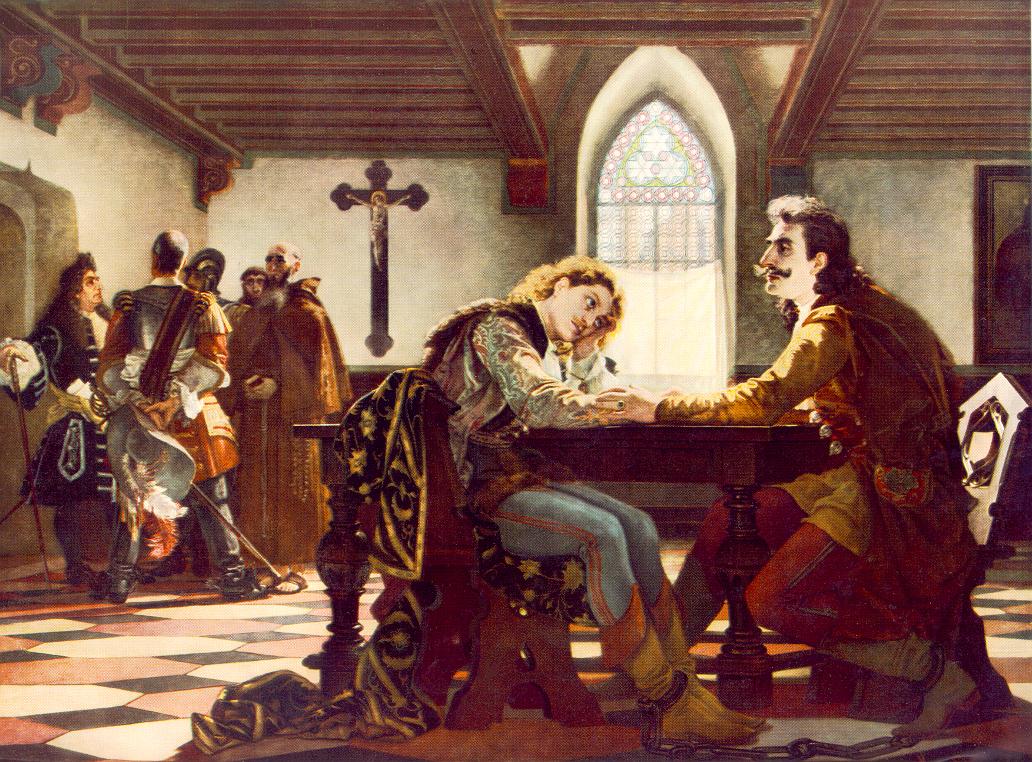
The Zrinski-Frankopan Conspiracy — or Magnate Conspiracy — was the product of great powers chess in central Europe … and specifically, of the frustration of these lords in the frontier zone between the Austrian and the Ottoman Empires at being a sacrificial pawn.
Instead, they’d take control of their own destiny and be a self-sacrificial pawn.
Croatia and Hungary had been on the perimeter of Hapsburg authority for generations, and seen the rising Ottomans push well into Europe.
In the latest of innumerable wars, the Austrians had trounced the Ottomans, potentially (so the Croats and Hungarians thought) opening the door for reconquest of lost territory. Croatia in particular had been nibbled away by Ottoman incursions into a “remnant of a remnant.” Emperor Leopold I thought otherwise: he had Great Games to play in western Europe as well and didn’t find this an auspicious moment to go all in in the east.
Rather than following up his victory by trying to run the Turks out of their half of divided Hungary, or out of Transylvania, Leopold just cut an expedient peace on status quo ante terms quite a bit more favorable to Istanbul than the latter’s military position could demand.
The aggrieved nobles started looking around for foreign support to help Hungary break away.
This scheme never came to anything all that palpable, perhaps because the operation’s leading spirit Nikola Zrinski got himself killed by a wild boar on a hunt, and definitely because no other great powers wanted to get involved in the mess.
The boar-slain’s younger brother Petar, his wife Katarina, and Katarina’s half-brother Fran Frankopan, also better litterateurs than conspirators, inherited the scheme’s leadership, and its penalty.
Zrinski and Frankopan in the Wiener-Neustadt Prison, by Viktor Madarasz (1864)
Royal vengeance against the plot shattered two mighty noble houses: the Zrinskis were all but destroyed by the seizure of their estates. The Frankopans — an ancient and far-flung family whose Italian Frangipani branch was even then about to yield a pope — were done as major players.
After these executions, anti-Hapsburg sentiment metastasized in Hungary into outright rebellion.
But in what was left of Croatia, the loss of the two largest landholders spelled the end of effective resistance until the era of 19th century romantic nationalism — when our day’s unfortunates were recovered as honored national heroes.
Zrinski and Frankopan are pictured on modern Croatia’s five-kuna bill, and were both reburied in Zagreb Cathedral after World War I finally claimed the Austrian Empire. (They also got memorial plaques in Wiener-Neustadt) Their mutual relation Katarina Zrinski, who avoided execution but was shut up in a convent, was a writer as well, and has ascended to the stars of founding patriotess, seemingly the go-to namesake for most any Croatian women’s civic organization. (Dudes honor the House of Zrinski by slapping the name onto sports clubs.)

 The child of a poor peasant’s family, Nim was a gifted young state worker who studied in Paris in the 1950s, where he met several future Khmer Rouge leaders.
 Cadoudal (