1931: Omar Mukhtar, Libyan revolutionary

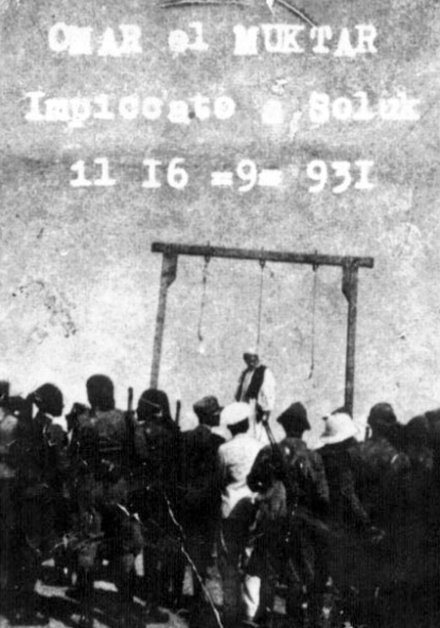
On this date in 1931, Libyan independence martyr Omar [al-]Mukhtar was publicly hanged by the Italians at their concentration camp in Suluq.

Mukhtar (English Wikipedia entry | Italian) was born an Ottoman subject back in 1858 and had lived long enough to see his native Libya seized in the 1911-12 Italo-Turkish War.

Mukhtar, a religious teacher and follower of the Senussi movement, became the leader of the Libyan resistance that dogged the Italian occupation. Mukhtar proved an energetic and successful desert guerrilla fighter, and he had to be given the Italians’ mechanized military.

The Italians executed an estimated 4,000 Libyans in the 1920s, and drove hundreds of thousands into concentration camps, and gradually, only gradually, gained the upper hand on their adversaries.

Captured in battle after he abandoned a 1929 truce, Mukhtar was denied prisoner-of-war status and subjected to a snap military tribunal in one of the small coastal enclaves actually controlled by Italy — “a regular trial and consequent sentence, which will surely be death,” as the Italian general directed. It surely was.

He’s played by Anthony Quinn in the 1981 film Lion of the Desert — a better movie than you might think given that it was bankrolled by Muammar Gaddafi.

A national hero for contemporary Libyans across any social divide you’d care to name, Omar Mukhtar was valorized by the rebels who recently overthrew the aforementioned Gaddafi (here’s Mukhtar on a billboard in rebel-held Benghazi). “The whole world knows what Omar al-Mukhtar did,” Mukhtar’s 90-year-old son told media during the civil war. “That’s where they get their energy from. Ask the youth, they’ll tell you they are all the grandsons of Omar al-Mukhtar.”

His steely profile can be seen on Libya’s 10 10 dinar note.

On this day..

1896: Chief Uwini of the Maholi

This date in 1896 during the Second Matabele War saw the execution by field court-martial of the rebellious Chief Uwini.

This war, in present-day Zimbabwe, featured a revolt of the Matabele (Ndebele) people against Cecil Rhodes’s* British South African Company.

In the field, it was a short-lived affair.

Ndebele rebels slew over 200 white settlers in Matabeleland and Mashonaland during the first week of the surprising rising in March 1896. But most settlers were able to hunker down in he town of Bulawayo behind makeshift breastworks.

Up to 15,000 Ndebele warriors menaced this little citadel, but were deterred from storming it by the settlers’ modern weapons — artillery and the legendary Maxim gun** — until relieved in May. (Rhodes himself led one of the relief columns.) At that point, the rebels retreated to their strongholds, fragmented from one another, and generally got picked off or bought off group by group over the ensuing months.

One of the men arriving with Rhodes’s relief column was Robert Baden-Powell, an army scout who will bring us to this date’s feature execution.

Baden-Powell was dispatched with a squadron of cavalry to pacify the area northeast of Bulwayo. When he arrived there, one of the main rebel chiefs in the Somabula Forest, Chief Uwini, had just been taken prisoner.

“He was badly wounded in the shoulder, but, enraged at being a prisoner, he would allow nothing to be done for him; no sooner had the surgeon bandaged hi than he tore the dressings off again. He was a fine, truculent-looking savage, and boasted that he had always been able to hold his own against any enemies in this stronghold of his, but now that he was captured he only wished to die.”

-Baden-Powell (Source)

This prisoner put Baden-Powell in a conundrum. He had written orders to turn prisoners over to the Native Commission for civil handling (whether trial or otherwise).

Uwini had been induced to surrender by another officer’s promise to spare his life. However, this wounded chief could not be escorted five days back to Bulawayo by a force large enough to protect against the likely rescue attempt by his followers without abandoning his mission. Neither could Uwini be brought along on the patrol.

Something had to give.

Baden-Powell decided it would be the safe-conduct promise.

“I have taken another step, which I hope you will not disapprove of — viz. — trying Uweena by Court Martial,” Baden-Powell wrote his superiors on September 13. “He is the big chief of this part, we have lots of evidence that he instigated rebellion and murders of whites, he is badly wounded, we cannot send him to Buluwayo, and I must be leaving this with some of the senior officers tonight. So if the court find him guilty and sentence him to be shot I shall take on myself the responsibility of confirming it. The effect too should be very good for being carried out promptly and at his own stronghold — and we have a good number of rebels, prisoners and refugees, here to witness it & report it to the remainder.”

Another letter dated later that same day confirmed that the expected sentence had indeed been rendered, and Uwini had been ceremoniously shot that evening at sunset before the walls of the enemy fortress, in the presence of as many witnesses as Baden-Powell could find.

This quasi-juridical field execution put Baden-Powell in front of a court of inquiry after the fact. The court exonerated him, citing the circumstances and the purported effect of the execution in cowing the local insurgents.

Despite leaving the court of inquiry “without a stain on my character,” in Baden-Powell’s own words, this incident can’t help but throw a morally questionable shade for later observers. And this agent of empire does have later observers — because Lord Baden-Powell (as he eventually became styled) would go on to found the Scout Movement.† His 1907 boys scouting camp and subsequent book laid the foundation for the ensuing decades’ Anglo scouting tradition.

And this very Matabele War contributed crucial parts of the scouting backstory. It was in the course of this campaign that Baden-Powell became acquainted with the American scout and adventurer Frederick Russell Burnham. The two struck up a lifelong friendship, and Baden-Powell cribbed notes from the ranger’s guile (like wood “scoutcraft”) his counterpart had picked up on the dwindling American frontier. It was also in Rhodesia that Baden-Powell first wore the Stetson hat and neckerchief combination that would become a distinctive look both for Baden-Powell himself, and for the scout movement he launched.

* As of this story’s setting, the place in question had just begun to be called Rhodesia.

** It is in the context of Great Britain’s colonial adventures in Africa in this period (though not specifically just those of Matabeleland) that Hilaire Belloc published his 1898 poem “The Modern Traveller”. In it, a character named “Blood” gave this early machine gun its definitive literary tribute: it’s the couplet highlighted below, but the larger excerpt may be illuminating.

Blood understood the Native mind.
He said: “We must be firm but kind.”

A Mutiny resulted.
I never shall forget the way
That Blood upon this awful day
Preserved us all from death.
He stood upon a little mound,
Cast his lethargic eyes around,
And said beneath his breath:

“Whatever happens we have got
The Maxim Gun, and they have not.”

He marked them in their rude advance,
He hushed their rebel cheers ;
With one extremely vulgar glance
He broke the Mutineers.
(I have a picture in my book
Of how he quelled them with a look.)
We shot and hanged a few, and then
The rest became devoted men.

And here I wish to say a word
Upon the way my heart was stirred
By those pathetic faces.
Surely our simple duty here
Is both imperative and clear;
While they support us, we should lend
Our every effort to defend,
And from a higher point of view
To give the full direction due
To all the native races.
And I, throughout the expedition,
Insisted upon this position.

† Baden-Powell also counseled scouts to be unflinching should the “duty” arise to hang a man.

On this day..

1941: Alexander Svanidze, Stalin’s brother-in-law

On this date in 1941,* Stalin’s own brother-in-law was shot in the gulags.

In 1906, a whole lifetime before, the Georgian Alexander Svanidze introduced young Joseph Dzhugashvili to his, Svanidze’s, sister, Kato. She and Dzhugashvili wed that year, and Kato soon bore her husband’s firstborn, Yakov.

Stalin was already a wanted Bolshevik revolutionary at this time, but so was Svanidze. Kato was a homebody with no known political interest, and sufficient piety to force her communist groom to say his vows in an Orthodox church. Afterwards, his priorities reasserted themselves.

While Stalin agitated, propagandized, and politicked against Menshevism in the wild oil boom city of Baku,** his pretty wife kept an empty apartment tidy and fretted the omnipresent danger of her husband’s arrest. “When he was involved, he forgot everything,” fellow-Bolshevik Mikheil Monoselidze remembered. Many revolutionaries’ wives walked similarly lonely roads.

Kato did not have to walk hers very long: she contracted a horrible stomach/bowel disease and wasted rapidly away late in 1907. Stalin’s own indifference might have been the ultimate cause, for when she was unwell the young cadre took her on a sweltering 13-hour train ride back to Tiflis that greatly worsened her condition — all so that her family could care for her, and free Stalin’s time for his plots. Kato died in Stalin’s arms, but only when he had been urgently summoned back from Baku with word that her condition had become dire.

Whatever his actions said about him as a family man, the future dictator really loved his neglected wife. He “was in such despair that his friends were worried about leaving him with his Mauser,” writes Simon Montefiore in Young Stalin.

“This creature,” [Stalin] gestured at the open coffin [at her funeral], “softened my heart of stone. She died and with her died my last warm feelings for humanity.” He placed his hand over his heart: “It’s all so desolate here, so indescribably desolate.”

At the burial, Soso’s habitual control cracked. He threw himself into the grave with the coffin. The men had to haul him out. Kato was buried — but, just then, revolutionary konspiratsia disrupted family grief. Soso noticed some Okhrana agents sidling towards the funeral. He scarpered towards the back of the graveyard and vaulted over the fence, disappearing from his own wife’s funeral — an ironic comment on his marital negligence.

For two months, Stalin vanishes from the record. “Soso sank into deep grief,” says Monoselidze. “He barely spoke and nobody dared speak to him” … “He cried like a brat, hard as he was.”

Stalin’s deep grief did not change his life’s work. If anything, he would seem in later years almost too aghast by the whole experience (and his uncharacteristic bout of sentiment) to grapple with it. He abandoned little Yakov to the Svanidzes, and would curiously dislike his son so much that he eventually permitted Yakov to die as a German POW during World War II rather than exchange prisoners for his release.

By the time of the great purges, then, being Stalin’s brother-in-law was of little help to Alexander Svanidze. It might have been an outright detriment; certainly Svanidze’s own prominence — he had served as People’s Commissar for Finances of the Georgian SSR, and founded a scholarly journal in his capacity as a historian — were of a kind with Old Bolsheviks who had also attracted denunciations.

In 1937, most of the beloved Kato’s family was arrested: Alexander Svanidze, but also Alexander’s wife Maria, and opera singer, and his sister Mariko. Svanidze defiantly refused NKVD blandishments to confess to spying for Berlin to save himself, perhaps realizing that such a deal would merely sell his pride for a mess of pottage. “Such aristocratic pride!” Stalin is supposed to have tutted upon hearing the way Svanidze went to his execution still insisting he had done nothing wrong. (Svanidze’s ancestors were petty nobility.)

Svanidze’s son, Johnreed† — named for the American radical who chronicled the Bolshevik Revolution in Ten Days That Shook The Worlddenounced his doomed father to save his own skin, but was sent to the gulag just the same. Johnreed was released, and Alexander posthumously rehabilitated, after Stalin’s death in 1953.

* There are some other dates out there for Svanidze’s execution. I’ve had difficulty identifying a primary source for any of them, but am prepared to be corrected if an alternative possibility can be strongly documented.

** They moved to Baku from Tiflis, where Stalin had helped to orchestrate a huge bank robbery.

† Revolutionary Russia produced a number of similarly curious neologisms on birth certificates, such as “Vladlen” (blending “Vladimir Lenin”), and even the outlandish “Electralampochka” (“light bulb”, inspired by the Soviet electrification campaign).

On this day..

1930: 13 Viet Nam Quoc Dan Dang cadres, for the Yen Bai mutiny

June 17 is an honored day in Vietnam for the sacrifice under the French guillotine this date of 13 early martyrs for national independence.

These were members of the nationalist Viet Nam Quoc Dan Dang (VNQDD, or Viet Quoc). Not averse to the propaganda of the deed, these revolutionaries labored secretly under onerous French pressure following the previous year’s assassination of a labor recruiter.*

A year later (almost to the hour), with the movement crippled by arrests, the VNQDD tried an audacious gambit to revive its fortunes and trigger a general rising against the French.

The Yen Bai mutiny — named for the Tonkin city where it transpired** — saw 40 or 50 Vietnamese riflemen of the Fourth Régiment de Tirailleurs Tonkinois† and a like number of civilian sympathizers attacked the regiment’s officers in concert.

Alas, most of the other Vietnamese tirailleurs declined to join the rising, and it was suppressed within a few hours.

Over 1,000 accused revolutionaries stood trial for the Yen Bai mutiny, and the top leadership paid the top penalty this date — but as quietly as the French could manage. They were whisked out of their cells on the preceding evening and taken by secret convoy on a four-hour ride to the Yen Bai execution grounds, where a guillotine had been covertly erected.

We are going to go to pay our debt for the country. The flag of independence must be dyed with blood. The flower of freedom must be sown with blood. The country needs more and more sacrifices of its people. The revolution would meet success finally. We want to say goodbye to all of you with our respects.

-Nguyen Thai Hoc, taking his final leave of imprisoned VNQDD comrades

From 4:55 a.m. at Yen Bai, the thirteen men one by one were each lashed to the plank. One by one, each of their necks were fixed by the lunette under the blade. One by one, each cried out “Vietnam!” as the blade fell.

  • Bui Tu Toan
  • Bui Van Chuan
  • Nguyen An
  • Ha Van Lao
  • Dao Van Nhit
  • Ngo Van Du
  • Nguyen Duc Thinh
  • Nguyen Van Tiem
  • Do Van Su
  • Bui Van Cuu
  • Nguyen Nhu Lien
  • Pho Duc Chinh, who allegedly asked (it’s unclear to me whether it was granted) to be guillotined face-up — perhaps a show of bravado
  • The founder of the VNQDD Nguyen Thai Hoc, whose name now graces a major street in the heart of Hanoi

The VNQDD at this point was organizationally shattered, and many of its un-arrested cadres fled to China — whose sponsorship would revive it and return it to Vietnam in the 1940s.

By then, the communists were in the saddle in Vietnam. In 1946, Ho Chi Minh purged the VNQDD from the national independence coalition. Its remnants would wind up in South Vietnam; today the Viet Quoc persists mostly in exile.

* The labor recruiter is only tangential to the Yen Bai story, but their function, to dragoon Vietnamese peasants into brutal plantation work on terms next door to slavery, made them particularly hated characters. More about that racket in this 1930 text (pdf) by an outraged Frenchman.

** A few other minor secondary incidents occurred elsewhere in the area, but the epicenter of the rising was always Yen Bai.

† After the mutiny, the French army tried to reduce its dependence on Vietnamese recruits.

On this day..

1913: Bonnot Gang members, anarchist illegalists

A century ago today, Raymond Caillemin, Elie Monnier and André Soudy were guillotined in Paris for their exploits with Third Republic France’s most celebrated band of anarchist bank-robbers, the Bonnot Gang.

It was actually not Bonnot but Octave Garnier who was the original moving spirit for the gang, which took shape in 1911 around a core of anarchist adherents to the philosophy of illegalism — criminality as resistance. The outlaws were revolutionaries, vegetarians, working-class. Though respectable anarchist communists fled from them, the philosophy bit wasn’t a pose.

“It’s because I didn’t want to live this life of present-day society, because I didn’t want to wait and maybe die before I’d lived, that I defended myself against the oppressors with all the means at my disposal,” Garnier wrote in a memoir discovered after he was killed in a police shootout.

To Garnier the gang owed its signature innovation of using automobiles: they were the first ever to use this novel machine to flee the scene of a crime after knocking over a Paris bank in December 1911. Between their internal combustion engine and their repeating rifles, they had a decided technological advantage on the police who pursued them.

For obvious reasons they were initially dubbed the “Auto Bandits.” But Jules Bonnot stole the marquee by marching into the office of La Petit Parisien in January 1912 to indignantly correct some of its reporting. The newspaper gave him an interview, and started branding the outlaws the “Bonnot Gang” (La bande a Bonnot), a name which has stuck for posterity and titles a 1968 film about them.

And the “Bonnot Gang” moved plenty of papers.

For the next three months, they would repeatedly crash the headlines on either side of the French-Belgian border by stealing cars to perpetrate new robberies, often shooting policemen and bank tellers into the bargain.

Meanwhile, they magnetized admirers and enemies alike with their Gallic intrepidity and self-confessedly impossible struggle. Garnier mailed his fingerprints to the police chief. Ground-down proletarians fell into their orbit, cracking bitter fatalistic jokes. Under the pen name La Retif, a young writer extolled the masculine, doomed outlaws: he was the Russian expatriate Victor Serge, at the start of a long revolutionary career.*

To shoot, in full daylight, a miserable bank clerk proved that some men have at least understood the virtues of audacity.

I am not afraid to own up to it: I am with the bandits. I find their role a fine one; I see the Men in them. Besides them I see only fools and nonentities.

Whatever may result, I like those who struggle. Perhaps it will make you die younger, or force you to experience the man-hunt and the penal colony; perhaps you will end up beneath the foul kiss of the guillotine. That may be! I like those who accept the risk of a great struggle. It is manly.

Besides, one’s destiny, whether as victor or vanquished, isn’t it preferable to sullen resignation and the slow interminable agony of the proletarian who will die in retirement, a fool who has gained nothing out of life?

The bandit, he gambles. He has therefore a few chances of winning. And that is enough.

The bandits show strength.

The bandits show audacity.

The bandits show their firm desire to live.

By April and May the authorities were finally overcoming the audacious bandits, though desires to live showed firm to the last: both Bonnot and Garnier were overcome and killed only after holding off protracted sieges against overwhelming numbers.

Although the headline attractions were gone, the ensuing massive trial soon fitted four for death:

  • Raymond Callemin, Serge’s own friend and reading-companion since childhood
  • Elie Monier (or Monnier), the onetime refugee draft-dodger whose will grandiloquently bequeathed to the Paris library his copy of Darwin, and to the Paris museum the pistol he was arrested with, provided it be engraved with the phrase “Thou Shalt Not Kill”
  • The sickly Andre Soudy, reckless in his outlaw adventure since tuberculosis that he was too poor to fend off already had him coughing his way to an earl grave
  • The joiner Eugene Dieudonne, a friend and compatriot of the gang members but not an actual bank-robber himself. Dieudonne was reprieved on April 20th and dispatched instead to the French penal colony at Devil’s Island

Other prison sentences from a few years up to a lifetime at hard labor were meted out to various other Bonnot gang members and fellow-travelers, several of whom showed themselves dedicated enough to their heroic fatalism to take their own lives. One who attempted an escape only to find himself stymied when he attained the roof of the prison worked fellow-inmates into a frenzied chant of Viva l’anarchie as he hurled slate shingles at the guards who treed him, then wrapped up the performance by hurling himself off the roof, too.

“I would have liked to eat black bread with black hands,” that man’s last testament read. “But I was forced to eat white bread with red hands.”

* Serge got himself in some hot water as an anti-Stalinist in the Soviet Union. Serge’s mature (1945) appraisal of his youthful infatuation with the Bonnot gang, as well as his first-person recollections of the Bonnot gang trial (which got Serge himself a five-year sentence) can be read here

On this day..

1882: Stepan Khalturin, Winter Palace bomber

On this date in 1882* Stepan Khalturin** was hanged in Odessa, Ukraine … but not for his most (in)famous crime.

Khalturin (English Wikipedia entry | Russian) came from a well-off peasant family near the city of Vyatka (today, Kirov; it was renamed for an assassinated Bolshevik). As a young carpenter in 1870s St. Petersburg, he fell in with revolutionary circles and became a distinguished propagandist and organizer. Khalturin helped found the first political labor labor organization in Russia, the “Northern Russian Workers’ Union”.

He’s said by other leftist agitators who knew him to have “persuaded his student workers with tears in his eyes to continue propagandizing, but in no event go down the path of terror. From this, there is no return.”

If that used to be his sentiment, Khalturin’s thinking … evolved.

By February 1880, Khalturin was for all intents and purposes in on the terrorism strategy. He took advantage of a workman’s gig at the Winter Palace to pack the cellar full of dynamite,† two floors below the imperial dining room.

But Tsar Alexander II and party had not yet returned when it blew. Eleven people, mostly guardsmen in the intervening room below the dining hall, died in the blast; dozens of others were injured.

Khalturin watched in frustration from the iron gates of the Winter Palace, and slipped away — never detected. His co-conspirator Zhelyabov consoled him with the prospects of mass recruitment sure to be unleashed by this spectacular propaganda of the deed. “An explosion in the king’s lair — the first attack on the autocracy! Your deed will live forever.” (Russian source)

The tsar, at any rate, was running out of luck.

A year later, Narodnaya Volya finally succeeded in assassinating Alexander II in St. Petersburg. Zhelyabov and five others hanged for that.

Khalturin wasn’t involved in that plot: he had escaped to Odessa.

There, he shot a police officer named Strelnikov. He was captured and hanged under a bogus alias, nobody realizing that they were also executing the mysterious Winter Palace bomber.

Unusually considering Lenin’s distaste for terrorism and Narodnaya Volya, Khalturin was elevated in post-Soviet times into an officially-approved revolutionary exemplar. The street Millionnaya running to the Winter Palace in St. Petersburg was cheekily renamed for him (it’s subsequently been changed back). Public monuments went up for the bomber, especially in the environs of his native soil around Kirov.


(cc) image from Zeder.

* April 3 by the Gregorian calendar; March 22 by the Julian calendar still in use in 19th century Russia.

** Appropriately given Khalturin’s Winter Palace work, khaltura is Russian for an item of shoddy construction. The word has no etymological connection to our man, however. (Linguistic tip courtesy of Sonechka.)

† He was able to manage the feat by bringing in explosives little by little and secreting them in the room where he bunked on-site.

On this day..

1968: Veyusile Qoba, the last of the Langa Six

On this date in 1968, the black South African revolutionary Veyusile Qoba was hanged for his role in the murder of a policeman six years before.

Four men before him had gone to the gallows the previous Halloween for this crime; a fifth hanged separately for a different policeman’s killing late in 1967. Together with Qoba, they constituted the “Langa Six”.

The color line, of course, was the beef of the Six — and not only that, but the divide within the anti-resistance movement between the African National Congress (ANC) and the Pan Africanist Congress (PAC).

The Langa Six belonged to the latter entity’s military wing, Poqo (later to develop into the Azania People’s Liberation Army, but we’ll use the period-appropriate original nomenclature here). After police response to a PAC-organized 1960 protest against South Africa’s notorious racial passes turned into the Sharpeville Massacre,* Poqo girded for violent struggle against a violent state.

With the alleged slogan “one settler, one bullet,”** Poqo mounted an aggressive terrorist campaign that did not scruple to target white civilians, or black civilians perceived as collaborators. (The ANC’s simultaneous Nelson Mandela-led terrorist campaign had a more selective attitude.)

And this, in turn, spurred a further crackdown, as Pretoria banned both the ANC and PAC, and enacted a Sabotage Act — the law under which Nelson Mandea was jailed for life.

Poqo and PAC operatives were likewise arrested by the thousands in the troubled 1960s.

In March 1962, five of the Langa Six attacked police vehicles in the Cape Town suburb, killing a police Sgt. Moyi.

According to [policeman] Basson, some 50 Bantu attacked his vehicle when he tried to start the engine … he found that one of the petrol bombs set the vehicle alight and they were compelled to jump out — they were dragged out of the vehicle. It was at this stage that Sgt Moyi was set upon, pulled to the ground, and stabbed to death. Det-Sgt Josiah Moss was also injured and knocked unconscious but owing to that he fortunately escaped with his life. (Source)

(South Africa’s post-apartheid Truth & Reconciliation Commission found that this event was an impromptu, local ambush, rather than a centrally-planned operation.)

* The date of that massacre, March 21, is now honored as Human Rights Day in South Africa; it’s also the United Nations’ International Day for the Elimination of Racial Discrimination.

** As Sartre put it in his notes to Fanon’s 1961 Wretched of the Earth, “to shoot down a European is to kill two birds with one stone, to destroy an oppressor and the man he oppresses at the same time: there remain a dead man, and a free man.” PAC spokespeople have denied that “one settler, one bullet” was an actual party slogan or policy, however.

On this day..

1946: Cristino Garcia, Spanish Republican and French Resistance hero

On this date in 1946, ten* Spanish Republicans were shot — most famously including Cristino Garcia.

Garcia, a Communist veteran of the Spanish Civil War, had put his guerrilla skills to good use by joining the French Resistance during World War II.

Garcia ultimately held the rank of Lieutenant Colonel in the Resistance, and was perhaps the most individually famous of the numerous Spaniards** who fought as maquisards. His unit broke out hundreds of people before potential deportation to German death camps, and Garcia helped orchestrate the guerrilla-led liberation of Foix in August 1944. (There’s a lengthier roundup of Garcia’s career in the field in Spanish, here.)

The French had nothing but good feelings for this guy, but Garcia wasn’t looking to take a pension from De Gaulle and settle down in a vineyard. As France fell to Allies, Garcia — going on ten years a professional leftist revolutionary — headed back to Spain (Spanish link) to carry on the fight against fascism closer to home.

His tasks over a few months in 1945 ran to the less legendary: bank attacks and the like, blurring the line between “ordinary” and “political” crimes. Garcia was also detailed as a result of intra-party politicking to murder fellow-Communist Gabriel Leon Trilla (Spanish link).†

Garcia and his group were arrested shortly thereafter and faced a military tribunal on January 22, 1946. (Spanish source)

As an agent of the Spanish Communist Party, which was backed by a French Communist Party riding high on its World War II heroics, Garcia’s situation became a national cause celebre. French left parties uniformly protested the planned execution, and the government made repeated diplomatic overtures to Madrid to stay the sentence. Editorialists protested floridly.

Have we forgotten that fascism exists at our border; Was it not against all fascisms that Cristino Garcia and thousands of our Spanish brothers fought with us on our soil? Did they not fall beside us, as at the Eysses prisons, under the same Nazi bullets, for France? And today will we disown their sacrifice, their blood and their martyrdom because the fight against fascism has moved to the other side of the Pyrenees? (from the Franc-Tireur, quoted here

Incensed when Franco ignore their appeals and shot the men anyway, France retaliated by closing its border with Spain on March 1, 1946. Spain did not neglect to point out the irony that, during the war years, innumerable resistance fighters and others fleeing Naziism or the Vichy regime had taken refuge by crossing that very border. (Less stress was understandably laid on the Francoists’ onetime demand — not honored by Paris — that France close its border against escaping Republicans in 1939.)

* I believe from press reports that there were 12 total executions of Republicans Feb. 21-22, 10 of which took place on Feb. 21. However, I might be mistaken about the overall numbers or their distribution by dates. Garcia’s, certainly, took place on Thursday the 21st.

** The Resistance was blessed by with no small amount of foreign blood. (French)

† Garcia delegated this task to two subalterns, one of whom (Francisco Esteban Carranque) was shot with him on this date. The other man, Jose Olmedo, was arrested in 1947 and executed in 1948.

On this day..

1645: Conor Macguire, Lord Baron of Enniskillen

On this date in 1645, Conor Ma(c)guire, Lord Baron of Enniskillen, was drawn, hanged, and quartered at Tyburn.

Lord Macguire’s offense had occurred three-plus years earlier during the Irish Rebellion of 1641 — a bloody Catholic-Protestant civil war that would start the ball rolling towards Cromwell‘s depredations.

If the grievances of the latter are still well-remembered, English and Scottish Protestants had their own bill of particulars from the Irish Rebellion over Catholic-perpetrated slaughters like the Portadown Massacre. (Irish Catholics had their grievances from spending the preceding decade suffering land grabs for English settlers under the authoritarian rule of Thomas Wentworth. And on it goes.)

Actually, in the wake of the Irish Rebellion, there was a systematic project to collect witness testimony (not all of it reliable) about Catholic-on-Protestant violence. This codex would come in handy for Cromwell’s subsequent statecraft; it’s freely available online in an enormous searchable database.

Such beyond-the-pale doings took place literally beyond “the Pale” around Dublin, and outside similar fortified spots where the English holed themselves up.

These outposts gave the foreign heretics quite a bit of leverage, which Macguire and some other lords contrived to reverse via a plot to seize Dublin castle, kill its English lords, “and to put all the Protestants there likewise to the sword.” It was the lynchpin of an audacious coup that involved similar actions at English strongholds all around the island.

While some other fortresses did succumb, the plot against Dublin failed when Macguire’s co-conspirator Hugh “the Stereotype” MacMahon got drunk the night before and blabbed about it to his Presbyterian brother-in-law. Thus narrowly preserved, Dublin authorities arrested MacMahon and Macguire. (MacMahon was drawn and quartered in November 1644.)

The personal was very much political here, with the loss of lands and revenues under Wentworth stoking national and religious resentments against the English lords and settlers. Macguire described the recruiting pitch made by one of the rebellion’s leading spirits, Rory O’Mo(o)re: “[O’More] began to lay down to me the case that I was in then, overwhelmed in debt, the smallness of my estate, and the greatness of the estate my ancestors had, and how I should be sure to get it again, or at least a good part thereof.” (Source)

Whatever rank greed held in Conor Macguire’s motivations, however, he was constant to his horrific end. This interesting account of the scene on the scaffold will hardly fail to move the most ardent Orangeman to a bit of pity for the poor bastard enduring in his last moments on earth an endless badgering by the London sheriff to endorse a policy statement on intersectional strife.

On Thursday, February 20th, he was drawn on a sledge from the Tower, through London, and so to Tyburn; when being removed into a cart, he kneeled and prayed awhile; after which Sheriff Gibbs spake to him, representing the heinousness of his crime, and the vast numbers who had been murdered by that conspiracy, for which he was to suffer, and, therefore, exhorted him to express his sorrow for it: to which he answered, ‘I desire Almighty God to forgive me my sins.’

Sheriff Gibbs.—Do you believe you did well in those wicked actions?

Macg.—I have but a short time, do not trouble me.

Sher.—Sir, it is but just I should trouble you, that you may not be troubled for ever.

Macg.—I beseech you, Sir, trouble me not; I have but a little time to spend.

Sher.—I shall give you as much time after as you shall spend to give satisfaction to the people; I do require you, as an instrument set in God’s hands here, to make an acknowledgment to the people, whether you are sorry for what you have done or no; whether it be good or no.

Macg.—I beseech you do not trouble me; I am not disposed to give you an account. Pray give .me leave to pray.

Dr. Sibbald.—Give glory to God, that your soul may not be presented to God with the blood of so many thousand people.

Sher.—You are either to go to heaven or hell. If you make not an ingenuous confession your case is desperate. Had you any commission or not?

Macg.—I tell you there was no commission that ever I saw.

Sher.—Who were actors or plotters with you? or, who gave you any commission?

Macg.—For God’s sake give mo leave to depart in peace. They then asked him if he had not some pardon or bull from the Pope for what he did? to which he only answered, ‘I am not of the same religion with you.’ And being further urged about a bull, or pardon, said, ‘I saw none of it; all that I knew I delivered on my examinations; all that I said on my examinations are true; all that I said is right. I beseech you let me depart in peace.’ And so not returning them any answer to their question, he continued mumbling over a paper, which he had in his hand, as he had done from his first coming. The sheriffs commanded his pockets to be searched, whether ho had no bull or pardon about him, but they found in his pocket only some beads and a crucifix, which were taken from him. And then Dr. Sibbald said to him, ‘Come, my Lord, leave these, and acknowledge your fault to God and the world: one drop of the blood of Jesus Christ is able to purge you of all the heavy load that is upon you; it is not your Ave Marias nor these things will do you any good, but it is Agnus Dei qui tollit peccata Mundi.’ The Lord Macguire seemed not to regard his discourse, but read out of his paper to the people as followeth:

Since I am here to die, I desire to depart with a quiet mind, and with the marks of a good Christian; that is, asking forgiveness first of God, and next of the world. And I do forgive, from the bottom of my heart, all my enemies and offenders, even those that have a hand in my death. I die a Roman Catholick, and although I have been a great sinner, yet I am now, by God’s grace, heartily sorry for all my sins; and I do most confidently trust to be saved, not by my own works, but only by the passion, merits, and mercy of my dear Saviour Jesus Christ, into whose hand I commend my soul.

And then added, ‘I beseech you, gentlemen, let me have a little time to say my prayers.’

Sher.—Sir, if you answer ingenuously to those questions we shall ask you, you shall have time afterwards; whether do you account the shedding of Protestant blood to be a sin or not, and whether do you desire pardon of God for that sin?

Macg.—I do desire pardon of God for all my sins: I cannot resolve you in anything for my part.

Sher.—You can tell what your conscience dictates to you. Do you think it was a sin or not?

Macg.—For my part I cannot determine it.

Sher.—Then now it seems nothing to you to kill so many.

Macg.—How do you mean killing of them? to tell you my mind directly, for the killing, I do not know that, but I think, the Irish had a great cause for their wars.

Sher.—Was there any assault made upon you? Had you not entered into a covenant? Had you not engaged yourselves by oath to the king?

Macg.—For Jesus Christ’s sake, I beseech you, give me a little time to prepare myself.

Sher.—Have pity on your own soul.

Macg.—For God’s sake have pity on me, and let me say my prayers.

Sher.—I say the like to you, in relation to your own soul, whether do you think the massacre of so many thousand Protestants was a good act? For Jesus Christ’s sake have pity on your soul.

Macg.—Pray let me have a little time to say my prayers.

All this time his eye was mostly on his papers, mumbling something out of them to himself. Whereupon one of the sheriffs demanded these papers from him; he flung them down; they were taken up and given to the sheriff. They asked him further, whether they were not some agreement with the recusants in England? Whereunto he answered, ‘I take it upon my death, I do not know that any man knew of it;’ and after some other such like talk, the sheriff bidding him prepare for death, he said: ‘I beseech all the Catholics here to pray for me. I beseech God to have mercy on my soul:’ and so was executed.

On this day..

1892: Four anarchists in Jerez

On this date in 1892, four anarchists named Burique, Lamela, Lebrijano and Zarzuela were publicly garroted on a large stage in front of the prison at the Andalusian city of Jerez (or Xeres).

Spain, like many other European states, grappled with anarchists in the late years of the 19th century.

Revolutionary peasants made the rich agricultural lands of Andalusia among the anarchist strongholds: the shadowy La Mano Negra, the “Black Hand”, had been smashed up with a number of executions in the early 1880s. This was not the end of agitation, however: its successor movement, Los Desheredades, “the Disinherited,” continued to grow.

On the night of January 9, 1892, a band of several hundred agricultural workers boldly raided Jerez in an attempt to free some anarchist prisoners. They were driven off after a night’s fearful fighting — a prototype “anarchist outrage” for headlines the world over. It was, for Federico Urales, “an act of dreams. Sticks and sickles to beat the well-fed lords of Jerez, from the men who starved to keep to keep their lands.” (Source, in Spanish)


From the Melbourne, Australia Argus, Jan. 11, 1892

“We know what the workers are: wicked people! With them, one has the bread in one hand, and the garrote in the other.” -from Vicente Blasco Ibanez’s La Bodega, in which the Jerez mutiny is a central theme. It’s available in the public domain in the original Spanish

Dozens of “outragers” were captured in hot pursuit that next morning. The investigation quickly honed in on the four ringleaders, who were put to death this date. One allegedly left a written statement conveniently renouncing anarchy. Another spoke from the platform, and “declared that he died in the cause of the working classes, and he appealed to the crowd not to respond by expressing sympathy.”*

But many others would suffer lengthy, non-capital sentences on evidence perhaps more expedient than rigorous. The poet Fermin Salvochea spent most of his fifties in prison on a spurious accusation of having conspired in the Jerez attack.

And these executions scarcely quelled Spain’s unrest. Angry cadres demonstrated (or rioted) against the executions throughout Iberia, provoking the familiar cycle of more police raids, more outrages, more martyrs … for years to come, and culminating in the indiscriminate arrests and mass torture of Barcelona anarchists in that city’s Montjuic Castle in in 1896-97

* From the Feb. 11, 1892 New York Times, which proceeds to describe the distinctive execution method thus:

[The garrote] is a brass collar, which is contracted by means of a screw in the back. As the screw is turned the collar shuts upon the neck of the condemned, and at the same time the sharpened steel point of the screw enters the spinal marrow where it joins with the brain, causing instantaneous death.

On this day..