1902: Privates Edmond Dubose and Lewis Russell, deserters to the Philippine Resistance

“Hello, nig. Didn’t know you’d come. What do you think you’re going to do over here!”

“Well, I doan know, but I ruther reckon we’re sent over hah to take up de White Man’s burden.”

-Exchange between a white and a black soldier (respectively) deployed to the Philippines.*

On this date in 1902, two African-American U.S. Army privates were hanged before a crowd of 3,000 at Guinobatan, Philippines for deserting to the anti-occupation insurgency.

The 7,000 black soldiers deployed to put down Philippine national resistance against the American occupation faced an obvious conundrum: they were second-class citizens back home, fighting a savage war to keep Filipinos second-class citizens abroad.

Men in such situations have been known to square that circle by going over to join their fellow downtrodden.

In the Philippines,

Each black soldier resolved for himself the quandary caused by service against the insurrectos. Some, like Lieutenant David Gilmer, believed their unswerving dedication would ultimately improve the lot of all black people. Others simply reasserted their faith in America: “all the enemies of the U.S. government look alike … hence we go along with the killing, just as with other people.” But the Filipinos recognized the existence of the black soldier’s dilemma by advocating racial solidarity against white oppressors and by offering commissions to defectors.**

Here’s an example appeal the Philippine resistance made to black U.S. troopers (source):

It is without honor that you are spilling your costly blood. Your masters have thrown you into the most iniquitous fight with double purpose — to make you the instrument of their ambition and also your hard work will soon make the extinction of your race. Your friends, the Filipinos, give you this good warning. You must consider your situation and your history; and take charge that the blood of … Sam Hose [a recent lynch mob victim] proclaims vengeance.

It was very small numbers actually induced by such messages to go so far as desertion. Leave hearth and home behind forever to fight a guerrilla resistance on the far side of the world against an overwhelming empire liable to kill you on sight? That’s a difficult sell.

But there were some buyers. Some 29 known African-American deserters are known, according to E. San Juan, Jr., most famously David Fagen, an enlisted man in the U.S. Army commissioned a captain in the Filipino resistance. And others not prepared to go all the way over nonetheless understood the appeal. One African-American soldier wrote to a Filipino friend lamenting the sight of white Americans “establish[ing] their diabolical race hatred in all its home rancor in Manila … the future of the Filipino, I fear, is that of the Negro in the South.”

When the letter was found, its author, Sgt. Major John W. Galloway, was demonstratively busted to private and dishonorably discharged.

“One ever feels his twoness,” W.E.B. DuBois mused of the black American experience at about this time in The Souls of Black Folk. “An American, a Negro; two souls, two thoughts, two unreconciled strivings; two warring ideals in one dark body.”


Soldiers of the 9th Cavalry on Luzon Island.

Edmond† Dubose and Lewis Russell, whose firsthand voice we do not have, must have felt those unreconciled strivings, too. These two enlisted men slipped out of the 9th Cavalry‡ in August 1901 while that regiment was conducting anti-insurgency operations in Albay, and were next seen fighting with those same insurgents.

Captured, they were among approximately 20 U.S. soldiers death-sentenced for desertion.

General Adna Chaffee, a veteran of the U.S. Indian Wars and latterly fresh from crushing China’s Boxer Rebellion, approved the hangings — as did the U.S. President, Theodore Roosevelt. (Roosevelt later announced that future desertion cases would not be capitally punished, so Dubose and Russell were the only two executed for that crime during the U.S. war against Philippine independence.)

* Army and Navy Journal, XXXVII (Nov. 11, 1899)

** Michael C. Robinson and Frank N. Schubert, “David Fagen, An Afro-American Rebel in the Philippines, 1899-1901,” Pacific Historical Review, Vol. 44, No. 1 (Feb., 1975)

† Also called “Edward” by at least one press report.

‡ The 9th Cavalry was one of the original “Buffalo Soldiers” units.

On this day..

1862: Samuel Calhoun, antebellum serial killer

On this date in 1862, Private Samuel H. Calhoun of the 2nd Kentucky Infantry was executed by the Union Army in Bardstown, Kentucky, for murdering a local farmer.

(Calhoun had previously killed the farmer’s pig, and the farmer had Calhoun arrested. So this was settling the score.)

“I shall pass away, the moral wreck of a degenerate age,” he signed off in his published confession, dictated to Jonathan Harrington Green. “Adieu.”

If the confession is to be believed the farmer was just the last of maybe dozens of Calhoun’s victims, slain remorselessly everywhere from North Carolina to Mexico over the preceding years. But is this unverifiable

Read on for the full story in a post at Civil War Medicine guest-authored by one of our favorite crime-history bloggers, Robert Wilhelm of Murder by Gaslight.

On this day..

1816: Four sodomite sailors of the Africaine

On this date in 1816, four British sailors on the HMS Africaine were hanged for buggery. One other crewman suffered 200 lashes; a second, a 17-year-old sentenced to 300, had the flogging stopped at 170 stripes by a surgeon who feared the youth’s life was in danger.


The Africaine: it was a French ship originally, captured in 1810 by the British.

“The Africaine had a reputation as a ‘man-fucking ship’ long before evidence of sodomitic practices came to the attention of Captain [Edward] Rodney,”* Arthur Gilbert explained in his seminal study published in the very first (volume 1, issue 1 — 1976) edition of the Journal of Homosexuality. “There were several reports of ‘uncleanliness’ on the ship early in 1815 and, on one occasion, two seamen were punished for ‘lying on a chest together one night’.”

Late in 1815, Captain Rodney determined to crack down on the man-fucking and by threatening them with “dreadful consequences” coerced two of the crew into implicating themselves and a great many others in a buggery ring. As the Africaine made its way back to Portsmouth that autumn, it was scene to an ever-widening investigation.

Out of about 220 to 230 men aboard, some 50 members of the crew would ultimately be involved in the investigation, 23 of them charged or implicated with a wide variety of riffs on “the unnatural crime”: one Raphael Seraco was seen “with his yard actually in the posterior of John Westerman”; another sailor “placed his yard between [my] thighs and in that position effected an emission”; still another had “his yard against the backside of the boy Christopher Jay and … in quick motion as if he was committing the unnatural crime”; one of the ship’s boys “being much hurt sung out ‘Oh'” during an attempted rape; and someone had been rogered “on the flag stones of the Galley.”

While seabound sodomy was hardly unheard-of, the practitioners among the Africaine‘s crew had seemingly grown unusually (and dangerously) bold about practicing it without a modicum of concealment, “copulating in plain view like dogs.”

“God must put it into men’s heads to commit the unnatural crime of buggery,” an accused boatswain’s mate had allegedly declared. “If God was to put it into his head to fuck a man, [I] would as soon do it as fuck a woman.”

The sheer number of men rolled up in accusation and counter-accusation made across-the-board death sentences inconceivable. And among those implicated, it was extremely difficult to ascertain truth when fear and favoritism and innuendo were so thick in the air — “terrified as we were,” as one accused man later recounted, “in the idea of being prosecuted for the horrible crime imputed to us, dismayed and alarmed … in the duress of our situation, our minds and feelings every moment distorted by hope and fear without a friend to counsel us.”**

Blackstone had long before noted that the witch-hunt potential of a charge of sexual deviance demanded “that the accusation should be clearly made out.” To Rodney’s credit, he didn’t start stringing people up from the yardarm while the Africaine was at sea.

In port, Captain Rodney gave the matter over to the Admiralty with what one imagines was probably no small relief. In the grand tradition of prosecutorial discretion, the court-martial board proceeded to break down the many accused into those who would be charged and those who would cut deals to implicate the charged.

Seraco and Westerman, mentioned above, were the first sentenced to death, and then Seraco again condemned along with another partner, John Charles. (Seraco had been implicated by several people during Captain Rodney’s seaside inquiry, and Seraco in turn had accused no fewer than 14 of his mates in a vain attempt at self-protection.)

One of the other (uncharged) seamen giving against Seraco offered this juridically damning and sociologically interesting testimony:

Seraco put the question to me whether I would let him fuck me. I told him I did not much mind. He connected with me forward on the Starboard side. He entered my backside — I did the same with him three times. John Charles the prisoner was the first who mentioned the thing to me or I should never have had such a thought in my head.

Testimony of this nature, Gilbert says, posed a problem of jurisprudence: this was evidence not directly bearing on the charge that the defendant committed a specific act of sodomy with the other defendant. Legally, unless the Seraco-Charles liaison had been the charge at the bar, this testimony was extraneous. The Attorney General opined that, in a like civilian trial, he would have advised against executing a death sentence that had been obtained with such evidence — and that fact may have helped procure a pardon for a sailor named Joseph Tall.

Raphaelo Treake (Troyac), condemned with Tall, got the same favor — but Treake was immediately re-tried for a different act of buggery and re-condemned. Treake was another Italian, and Albert notes that their common crime was popularly euphemized as le vice Italien and considered a characteristically Mediterranean indulgence. “All the scandalous behavior in the Africaine has been owing to Treake and Seraco. They are the origin of the whole of it,” another crew member — a Spanish Morisco — testified.†

As January 1816 unfolded, several others went before the court martial and received prison sentences (or in the odd case, acquittal) as the great sodomy-and-uncleanliness audit proceeded.

By month’s end, it was all finished but the noosings.

On February 1, the four condemned “died truly penitent acknowledging the justice of their sentences and admonishing their shipmates to take warning from their unhappy fate not to be guilty of such detestable practices.” The ship’s clipped log entry tersely recorded that unhappy fate.

a.m. Fresh breezes and cloudy … employed getting ready for punishment. At 9 made signal [with] a gun. At 11 executed Seraco, Westerman, Charles, and Treake [for] a breach of the 29th article of war, and punished alongside [John] Parsons … with 200 lashes and [Joseph] Hubbard with 170 lashes for a breach of the 2nd article of war as sentenced by a court martial.

p.m. … sent the bodes of the executed to the hosptal. Read articles of war to the ship’s company.

On that same date as the poor buggers of the Africaine suffered their various corporal punishments, the Portsmouth commander Admiral Edward Thornborough appointed three captains to lead an inquiry into whether this floating Sodom was the fault of Captain Rodney’s soft discipline. The investigators heard good testimony all around among the ship’s junior officers to the conduct of Captain Rodney, and within days exonerated all the higher-ups, only pausing to complain that there could have been more frequent religious services and readings of the Articles of War.

And that was that … even for the ship itself. By mid-February, the HMS Africaine was being stripped down at a Thames dock. She would be officially decomissioned and broken up that year.


How exceptional were the Africaine sodomites in the British navy as the 18th century gave way to the 19th?

Dr. Richard Burg, author of Boys at Sea: Sodomy, Indecency, and Courts Martial in Nelson’s Navy as well as a 2009 Journal of Homosexuality article on the Africaine case (see †), was generous enough to offer his insights into this elusive subculture.

I’d like to start with a question about the historiography. Arthur Gilbert brought this incident to wide public view in the 1970s, and you’ve written about it much more recently. How has the scholarly sense of homoeroticism in the British navy, or in western militaries generally, evolved in the past forty years or so?

Its evolution has paralleled the gay rights movement that began with the Stonewall riots. Generally, scholars have come to realize that homoeroticism in the ranks is more than an isolated phenomenon. Most research on the matter, however, has centered on the persecution of gay service members or the rights of gays to serve openly: can it be allowed, what problems would it create, how military personnel and the public might deal with it, etc. Scholarly interest in the historical dimension of military homoeroticism has been confined to an isolated handful of researchers. Most scholars are dealing with more contemporary and more relevant aspects of the subject.

How widespread were same-sex trysts in the Royal Navy at this time?

No idea. This is, of course, what everyone wants to know, and there is simply no data that even suggests a guess let alone an answer.

What was it about the case of the Africaine that resulted in this sizable court-martial and multiple hanging, when at least some other incidents of “buggery” and “uncleanliness” over the years appear to have been dealt with quietly or discreetly ignored?

What made the Africaine different? The number and conspicuousness of the Africaine business meant it had to be dealt with. All other known incidents that produced courts martial or even summary punishment involved only pairs of mariners. Admittedly, some mariners were involved with multiple partners, but the relationships were dyadic rather than involving multiple partners simultaneously.

Do we know if men who engaged in homosexual behavior within the navy also did so on terra firma, or is that an “identity” most took on specifically to adapt to their confined all-male environment at sea? Is there any connection or analogue we can speak to between these cases and the simultaneous molly culture?

I have only run across mention of one or two navy sodomites who took their proclivities with them on land. This does not mean it didn’t happen. It is just that it is almost impossible to follow sailors once they leave their ships. They leave almost no evidence of their individual activities when not signed on board navy ships. No, I see no parallels or connections to eighteenth-century molly culture.

This is a a tangential point, but I was struck by your remark relative to the Italian Rafael Seraco that “sodomy, Popery, and Italy were inseparably linked in the minds of eighteenth-century Englishmen.” Why was that?

Sodomy, Popery, and Italy were linked in the minds of Englishmen long before the eighteenth century. Sodomy arrived in England as an Italian import according to popular views prevalent at least since the early seventeenth century, and probably earlier. The pope and the Catholic Church were also considered the handmaidens of sodomy at the same time. Part of this is due to raging anti-Catholicism in England dating from the Reformation of Henry VIII. Another part of it is the human tendency to blame the “other” for real or perceived ills: Jews, Communists, Fundamentalists, Liberals, whoever is handy. Catholics and sodomites were easy targets for Englishmen from the sixteenth century onward.

* Captain Rodney was the youngest son of Admiral George Brydges Rodney, a famed commander during the American Revolution. It’s thanks to Admiral Rodney’s career that the name Rodney became popularized as a first name.

** Midshipman Christopher Beauchamp. This was his explanation for why he had (falsely, he said) confessed to the lesser offense of (non-penetrative) “uncleanliness”.

† Quoted in B. R. Burg, “The HMS African Revisited: The Royal Navy and the Homosexual Community,” Journal of Homosexuality, 56:2 (2009).

On this day..

2010: Chemical Ali

On this date in 2010, American-occupied Iraq hanged Ali Hassan al-Majid — Saddam Hussein‘s cousin and longtime aide, better known as Chemical Ali.

Ali Hassan al-Majid as the King of Spades in the U.S. invasion force’s playing-card deck of wanted Iraqis.

Al-Majid acquired his chilling nickname for the notorious March 1988 attack on the Kurdish city of Halabja.

That day, after an appetizer of conventional bombing, Iraqi jets dropped a cocktail of multiple chemical weapons — mustard gas, sarin, tabun, and VX, give or take — killing up to 5,000 people.

“It was life frozen. Life had stopped, like watching a film and suddenly it hangs on one frame,” wrote the ethnically Iranian BBC correspondent Kaveh Golestan,* who arrived on the scene after the bombardment.

“It was a new kind of death to me. You went into a room, a kitchen and you saw the body of a woman holding a knife where she had been cutting a carrot. (…) The aftermath was worse. Victims were still being brought in. Some villagers came to our chopper. They had 15 or 16 beautiful children, begging us to take them to hospital. So all the press sat there and we were each handed a child to carry. As we took off, fluid came out of my little girl’s mouth and she died in my arms.”

It was the most emblematically ghastly event in a running ethnic cleansing campaign of the late 1980s, also headed by al-Majid.

The Halabja attack was the last of four separate death sentences Chemical Ali racked up after the U.S. invasion of Iraq, and it was handed down just a week before he stood on the gallows. The larger Kurdish genocide campaign as a whole was a separate death sentence from Halabja; there were also two others for his brutal suppressions of Shia uprisings in the 1990s.

He met all his tribunals defiantly, refusing to enter a plea and then openly embracing the atrocities imputed him. “I am the one who gave orders to the army to demolish villages and relocate villagers,” he once spat in court. “I am not defending myself, I am not apologizing. I did not make a mistake.”

* Himself a casualty of the Iraq War: Golestan was killed when he stepped on a landmine in 2003.

On this day..

1861: Christopher Haun, potter and incendiarist

Christopher Alexander (“Alex”) Haun was perhaps the finest potter in antebellum Tennessee. He never had the chance to become the finest in post-bellum Tennessee because he was hanged in Knoxville this date in 1861 as an incendiarist.

While Tennessee seceded with the Confederacy in the U.S. Civil War, East Tennessee was a Union stronghold. This was the native soil of pro-Union “War Democrat” (and future U.S. President) Andrew Johnson.

Soon after the war began, Unionist east Tennesseans started slipping over the border to northern-controlled Kentucky, where they hatched a plot to burn railroad bridges throughout East Tennessee.

Hand of Bridge

Besides being good fun, the conspiracy promised an effectual blow against the Confederacy inasmuch as the East Tennessee & Virginia and East Tennessee & Georgia lines constituted the South’s most reliable rail and telegraph link between its capital at Richmond, Va., and the Deep South. This plan’s author, Rev. William Carter, went to Washington and had his scheme personally approved by President Abraham Lincoln, Secretary of State William Seward, and Gen. George McClellan.

The rest of the plan called for the Union army to invade East Tennessee on the heels of the bridge-burnings and occupy the area. Just a few months before, McClellan’s troops had similarly occupied the pro-Union western mountains of secessionist Virginia, which is why there’s a state of West Virginia today.

But there’s no state of East Tennessee, is there?

The bridge-burning conspiracy would go down as one of the great, failed guerrilla operations of the war.

Burning Your Bridges

With authorization straight from the top, the conspirators got going. A Captain David Fry** was tasked with targeting the Lick Creek bridge, located in northeastern Tennessee† near the settlement of Pottertown, so named for the ceramics craftsmen attracted to the area’s excellent clay.

After dark fell on Nov. 8, 1861, the local Union sympathizers recruited to the plot — Christopher Haun among them — gathered at the house of a local landowner, Jacob Harmon, Jr. There they took a dramatic lantern-lit oath on the Union flag, each to “do what was ordered of him that night and to never disclose what he had done.”

Then a party of some 40 to 60 mounted raiders stole out for the Lick Creek bridge two miles distant.

Around 2 a.m., they overpowered the small Confederate sentry detail assigned to Lick Creek, and forced the sentries to watch as they fired the bridge. That same night, several other parties elsewhere along the line all the way down to Alabama also burned, or tried to burn railroad bridges and cut telegraph lines.

These “deep-laid schemes … by an organization of Lincolnite traitors” (as the Knoxville Register accounted matters) brought a predictably furious Confederate response — and the audacious saboteurs would discover only after the fact that the planned East Tennessee invasion had been aborted by William T. Sherman without alerting his pyrotechnic fifth-column allies.

A Bridge Too Far

Within three days of the “treason,” East Tennessee had been clapped under martial law. A number of bridge-burners were also arrested (although many others escaped), and here the Lick Creek men would pay dearly for their recklessly humane decision to release their captured sentries. (pdf) As a result, several of them were captured in the days following their attack.

Confederate Secretary of War Judah P. Benjamin had a ruthless order for East Tennessee’s military authorities.

I now proceed to give you the desired instruction in relation to the prisoners of war taken by you among the traitors of East Tennessee.

First. All such as can be identified in having been engaged in bridge-burning are to be tried summarily by drum-head court-martial, and, if found guilty, executed on the spot by hanging. It would be well to leave their bodies hanging in the vicinity of the burned bridges. [emphasis added]

Second. All such as have not been so engaged are to be treated as prisoners of war, and sent with an armed guard to Tuscaloosa, Alabama, there to be kept imprisoned at the depot selected by the Government for prisoners of war.

Two men, William Hinshaw (often called “Hensie” in the period’s reports) and Henry Fry, were condemned by such a tribunal on Nov. 30 and immediately hanged — their bodies left exposed at the Greeneville Station for a day or more, until the stench became overpowering.

Haun was condemned on Dec. 10.‡ Confederate Brigadier General William H. Carroll telegraphed Benjamin for Jefferson Davis‘s confirmation of sentence.

The court-martial has sentenced A.C. Haun [sic], bridgeburner, to be hung. Sentence approved. Ordered To be executed at 12 o’clock tomorrow. Requires the approval of the President. Please telegraph.

Benjamin replied within hours, telling Carroll to make with the noosing.

Execute the sentence of your court-martial on the bridge-burners. The law does not require any approval by the President, but he entirely approves my order to hang every bridge-burner you can catch and convict.


Haun takes leave of his pregnant wife and four children before execution. Illustration from this 1862 propaganda volume by the Unionist publisher of the Knoxville Whig.

Six days after Haun hanged at Knoxville, the landowner who hosted the conspirators, Jacob Harmon, also went to the gallows, along with his son Henry. It seems someone in the incendiary party had carelessly dropped the name “Harmon” in conversation while the bridge sentries were in custody within earshot.

(Several others only narrowly avoided execution, or lynching, for the conspiracy. Given hundreds of other arrests of even merely suspect East Tennesseans and the very nasty feelings engendered by the Unionists’ attempt, it’s something of a wonder that only five were executed.)

Water Under the Bridge

Today, the Harmons are buried at Pottertown Harmon Historic Cemetery in rural Green County, Tenn., where a hexagonal monument commemorates all five executees (with an extra panel for summary text). There’s an annual ceremony there to commemorate the East Tennessee bridge burners.

Or, pay your respects any time by using the cemetery as the trailhead for the Civil War Bridge Burners’ Bike Ride (pdf). You’ll find the spot just off Bridge Burners Blvd.


View Larger Map

All the hanged incendiarists were posthumously enrolled in Company F of the 2nd Tennessee by Congress in 1862, a gesture of appreciation which also conferred on their heirs the right to survivors’ benefits.

In addition to the resources linked here, see Donahue Bible’s “Shattered like earthen vessels,” Civil War Times, Dec. 1997.

* Later to become the East Tennessee, Virginia & Georgia Railway, and then the Southern Railway, and then a big band hit.

**The intrepid Captain Fry would escape immediate capture, gather a few hundred Unionists as a guerrilla band, and eventually get caught, sent to Georgia, and condemned to death as a spy. Fry escaped by breaking out on the eve of his Oct. 15 hanging, in the company of some of the men arrested for the Great Locomotive Chase. He rejoined Union forces, was captured again, and survived the war, finally dying in 1872 … when he was hit by a train.

† The other bridges successfully torched by the conspiracy included two over the Chickamauga in southeastern Tennessee, and the theme of Civil War bridge-burning in that sector can’t help but suggest Ambrose Bierce’s “Occurrence at Owl Creek Bridge”. (The other details are nothing alike, so Bierce’s story clearly isn’t about this incident.)

‡ The railroad bridge at Lick Creek was back in action by this time.

On this day..

1727: An Irish deserter at Gibraltar

This account of an incident during the 1727 Spanish siege of Gibraltar, where the British army garrisoned, comes from an unknown soldier who signed himself only

December 9th. Last night a deserter clambered up within a little of Willis’s battery and was assisted by a ladder of ropes by our men. When the officers came to examine his face, they found him to have deserted out of the Royal Irish two months ago. Asking the reason of his return, he said he chose rather to be hanged than continue in the Spanish service, so is to have his choice.

It is not positively stated that the hanging itself did take place on this date. Since we concern ourselves in these doleful pages with the circumstances under which life becomes dispensable, an assortment of other anecdotes from this same soldier’s journal helpfully illustrate the life of British soldiery at the Pillars of Hercules.

March 9th. Came a deserter who reports that while our guns were firing at them an officer pulled off his hat, huzzaed and called God to damn us all, when one of our balls with unerring justice took off the miserable man’s head and left him a wretched example of the Divine justice.

April 12th. A recruit refused to work, carry arms, eat or drink was whipped for the fifth time, after which being asked by the officer he said he was now ready to do his duty.May 7th. This morning Ensign Stubbs of Colonel Egerton’s regiment retired a little out of camp and shot himself.

June 17th. Today two corporals of the Guards boxed over a rail until both expired, nobody can tell for what reason.

October 11th. One of Pearce’s regiment went into the belfry of a very high steeple, threw himself into the street, and broke his skull to pieces.

October 16th. Will Garen, who broke his back, was hanged.

January 2 1728. Here is nothing to do nor any news, all things being dormant and in suspense, with the harmless diversions of drinking, dancing, revelling, whoring, gaming and other innocent debaucheries to pass the time — and really, to speak my own opinion I think and believe that Sodom and Gomorrah were not half so wicked and profane as this worthy city and garrison of Gibraltar.


Model of a soldier being flogged on present-day display in the remains of Gibraltar’s fortifications. The adjacent explanatory placard reads: “Under siege conditions, the mixture of tension, boredom, hunger and alcohol meant that discipline had to be strict if order was to be preserved. One of the most common forms of punishment was flogging with a nine tailed whip. A drummer in a regiment, which later became the Lancashire Fusiliers, achieved fame as the most flogged man in the British Army. In his first years here [in Gibraltar] he received 30,000 lashes, of which 4,000 were administered in a single year.”

On this day..

1922: Four anti-Treaty Irish Republicans

On this date in 1922, Irish Republicans Rory O’Connor, Liam Mellows, Richard Barrett and Joe McKelvey were shot.


Stagey-looking fake propaganda photo of Rory O’Connor’s (very real) Dec. 8, 1922 execution.

These four were militant foes of the 1921 Anglo-Irish Treaty, which was to the Troubles as the Apple of Discord was to the Trojan War.

Furious at the betrayed dream (and, briefly, reality) of a united Irish republic, they were among those who occupied central Dublin’s Four Courts in April 1922, hoping to draw Britain into a counterproductive intervention.

It was a move straight from the playbook of tragic guerrilla-cum-statesman Michael Collins … except that Collins was on the other side in 1922. Collins, then Chairman of the Provisional Government for the new Irish state (and negotiator of the hated treaty) spent that spring trying to convince the Four Corners occupiers to back off, but also not intervening to force their garrison out.

Noninterference came to an end after some other Irish militants assassinated British Field-Marshal Sir Henry Wilson in June 1922. London put the political screws to Michael Collins, leading to the anomalous sight of the onetime anti-British revolutionary turning British-lent artillery against Dublin republicans.


Times change.

The Four Courts guys, imprisoned from July, would provide an even more poignant illustration of Ireland’s heartbreaking house-divided history.

For it was the Provisional Government’s Minister of Justice Kevin O’Higgins who ordered the executions — a man who had once been so tight with the executed Rory O’Connor that O’Connor was in his wedding party. (Where they toasted the Easter Rising martyrs.)

What could turn men so tight against one another? On December 7, anti-Treaty gunmen killed Sean Hales, an IRA man whom Collins had brought over to the pro-Treaty side. In a ruthless reprisal, Higgins approved the summary execution of his former comrades.

According to the official announcement* — which was bitterly denounced as lawless by the Free State’s Labour parliamentarians —

The execution took place this morning at Mountjoy Gaol of the following persons taken in arms against the Irish Government: — Rory O’Connor, Liam Mellowes, Joseph McKelvey, and Richard Barrett, as a reprisal for the assassination on his way to Dail Eireann on December 7 of Brigadier Sean Hales, T.D., and as a solemn warning to those associated with them who are engaged in a conspiracy of assassination against the representatives of the Irish people.

Bloody ironies would stack one upon the other. The rest of Sean Hales’s family had remained staunchly anti-Treaty, and publicly denounced the executions.

Sean’s own brother Tom Hales had famously withstood British torture in 1921. But Tom is even more famous for a different deed: in August 1922, Tom Hales led the republican column that ambushed and killed Michael Collins.

Many more bodies lay ahead.

* Quoted in the December 9,1922 London Times, along with some of the opposition firestorm that ensued in the Dail. “Mr. Cathal O’Shannon, shouting indignantly at the Government, said they were not fit to govern, and described the executions as the greatest crime, without exception, committed in Ireland in the last ten years. ‘You have no authority,’ he said, ‘to execute these men. You murdered them.'”

On this day..

1864: Retaliatory executions by John Mosby

Though executioners don’t quite bat 1.000 — who does, at any human endeavor? — the field on the whole succeeds more often than not.

On this date in 1864, the Confederate guerrilla John S. Mosby had seven Union prisoners executed, but he only managed to kill three of them — an efficiency very well below the Mendoza Line for the executioner’s trade.

It was a rare competence gap for the brilliant cavalryman.

The irregulars Mosby commanded in the Shenandoah Valley had frustrated for six months the consolidation of rampant northern armies, thereby preserving the Confederate capital of Richmond and extending the Civil War.

The situation had quick become intolerable for the Union, and Gen. Ulysses Grant emphasized (pdf) to Gen. Phil Sheridan the cruel anti-insurgent tactics he would countenance for “the necessity of clearing out the country so that it would not support Mosby’s gang. So long as the war lasts they must be prevented from raising another crop.”

By way of example-setting, the Union army had summarily executed six of Mosby’s rangers at Front Royal in September — followed by a seventh who was captured in early October in Rappahanock County.

Incensed, the Confederate “gray ghost” began stockpiling blue bodies from the offending command of George Armstrong Custer — yes, the Little Bighorn guy; he was perceived by Mosby to be responsible for the atrocity, although the actual paper trail on the execution order seems to be a little sketchy.

Mosby, who fancied himself the genteel sort who would closely abide the laws of war when fighting for the right to maintain human chattel, sent a lawlerly appeal up the chain of command seeking permission “to hang an equal number of Custer’s men.” General Robert E. Lee and Confederate Secretary of War James Sedden granted it.

Twenty-seven captives were therefore assembled and subjected to a lethal lottery. Jay Simson’s Custer and the Front Royal Executions of 1864 recounts this horrible affair in an excrutiatingly page-turning narration.

The preparations began innocently enough on a quiet Sunday morning (November 6, 1864) when 27 Union prisoners of war were ushered with no explanation about what was happening out of a brick storehouse located in Rectortown, Virginia …

[They] were then marched to the banks of Goose Creek, about half a mile away. some, but definitely not all, of this specially selected pool of 27 prisoners belonged to Custer’s commands both past and present … [but] of the seven men eventually selected to die on Mosby’s orders only two were actually members of the Michigan Cavalry Brigade.

All 27 of the prisoners were lined up along Goose Creek and then made to draw slips of paper from a hat. Twenty of those slips of paper which were part of the macabre lottery were simply that, blank pieces of paper. The other seven — one for each of Mosby’s men executed at Front Royal and in Rappahanock County — were marked with a number …

Of the men who were forced to draw those slips of paper, some of them simply stared into space. Others, once they understood what was happening, prayed. There were a few of them who simply broke down.

Among the prisoners was a young drummer boy … who broke down completely, sobbing … He drew a blank slip and immediately proclaimed: “Damn it, ain’t I lucky!” When a second drummer boy was found to be unlucky enough to have drawn one of the marked slips of paper, upon the request of the men who had been spared, Mosby personally ordered the boy to be released from the seven condemned prisoners and the 18 remaining prisoners (excluding the first drummer boy) drew from the slips of paper for a second time.

Then one of the seven adults also got himself swapped out of the scrap by flashing a Masonic sign at a Confederate lodge member. The things that stand between life and death.

Out of the nine to come under death’s pall and the seven who were actually marched overnight to the place of execution (as close to Custer’s camp as Mosby dared) only three were there successfully ushered past death’s threshold.

At 4 a.m. on Monday, November 7, 1864 (the day before the election which would give Abraham Lincoln his second term in the White House and would therefore become the signature on the death warrant of the Confederacy), the Rangers and their prisoners reached the execution site in Beemer’s Woods, a mile west of Berryville, and the executions were carried forward. However, everything did not go exactly according to plan.

In the pre-dawn darkness and confusion (either through carelessness or lack of caring for their orders, since none of the prisoners had actually been involved in depredations against Confederate civilians) the Rangers allowed two of the seven prisoners (one of whom, G.H. Soule, 5th Michigan Cavalry Regiment, punched out a guard) to escape outright. Two other prisoners were apparently shot in the head, but surviving, having only been grazed, also escaped since they pretended, and were apparently believed, to be dead. The remaining three prisoners were hanged. The identities and whether or not these three prisoners were members of either Custer or Powell’s commands are unknown. Lt. Thompson, in accordance with his orders attached a placard to one of the hanged men (just as similar placards had been attached to the bodies of all three of Mosby’s hanged men). Mosby’s placard read: “These men have been hung in retaliation for an equal number of Colonel Mosby’s men hung by order of General Custer at Front Royal. Measure for Measure.”

Believing his purpose accomplished, or at any rate close enough for rebel government work, Mosby then wrote to Union General Sheridan justifying the action and assuring him that future “prisoners falling into my hands will be treated with the kindness due to their condition, unless some new act of barbarity shall compel me, reluctantly, to adopt a line of policy repugnant to humanity.”

The letter, and the 3-out-of-7 reprisal, actually worked — with no further measures exacted for measure or tits given for tat. For the waning months of the war the rival forces confined themselves to killing one another on the battlefield, and not in the stockade.

Well, mostly: one of the conspirators in the plot to assassinate Abraham Lincoln in April 1865 — which did assassinate Lincoln, but was really a wider attempt to decapitate the entire northern government — was a former Mosby’s ranger named Lewis Powell aka Payne. Lincoln killer John Wilkes Booth also seemed to flee in Mosby’s direction (Mosby’s units were still in the field, not covered by the April 9 Appomattox surrender.) There exists an unproven but delicious speculative hypothesis that the hand of John Mosby was among those behind an exponentially more ambitious “line of policy repugnant to humanity.”

Be that as it may, Mosby actually became a Republican after the war — for which he received some Southern death threats — and lived fifty eventful years. Among other things, the aged Mosby regaled the young George Patton (whose father Mosby knew) with Civil War stories.

On this day..

1812: Claude-Francois de Malet and his conspirators

Two centuries ago today,* the author of one of the weirdest attempted coups in history was shot with his co-conspirators.

Picture Valkyrie in Napoleonic Europe.

Claude-Francois de Malet (English Wikipedia entry | French) had spent the years of his confinement for republican sensibilities painstakingly readying bogus orders and decrees for the eventual rollout of the most audacious putsch you’d ever want to putsch.

While Bonaparte was off on campaign trashing Russia, Malet broke out of his sanitarium and went to work.

Donning a general’s uniform, Malet on Oct. 23, 1812 presented a forged announcement of the Emperor’s recent demise … and started issuing orders. He bluffed the release of imprisoned allies, and got a legitimate general to order the arrest of Napoleon’s most prominent deputies in Paris. (It’s a good job that general obeyed Malet, because when one officer asked to kindly see the arrest warrant Malet was using on him, Malet responded by shooting him in the face.)

For a few hours that morning the Malet conspirators almost put themselves in control, almost normalized their sudden rearrangement of authority with its reassuringly familiar official paperwork. Later, when interrogated for the identities of his accomplices, Malet would retort, “You, yourself, Sir, and all of France — if I had succeeded!”

But the attempted coup which aimed so high ultimately made for little but tantalizing counterfactual history. Officers with clearer heads soon realized that they had received communiques from the Emperor dated after his purported October 7 death; one of those officers arrested Malet.

A tribunal was constituted later that same date. It had little difficulty condemning 14 (French link) during the small hours of the morning on Oct. 29. They were shot later that same day (at least, most of them were; there are oddly conflicting accounts on this point). This public-domain French text preserves a first-person narration of the scene, in which Malet himself — usurping authority to the very last — commands the firing platoon that’s lined up to shoot his comrades.

120 bullets riddled these unfortunates, who fell all except Malet. He stood on his hands and knees and raised his hands to his chest as he was only wounded, and retreated to the wall on which he leaned:

“And me, my friends!” cried he, “You forgot me!”

(One of the executed fellow-officers was Gen. Victor Lahorie. Lahorie’s lover was Sophie Trebuchet, and his lover’s son, Victor Hugo, was about to catapult himself to literary fame.)

While the Malet plot failed on its own terms, it got quite a lot farther than it had any right to expect — and this fact rightly alarmed the Corsican.

“Bad News From France”, by Vasily Vereshchagin, depicts a retreating Napoleon — bunking in an Orthodox church — finding out about Malet.

Was his position that precarious? And why, if some officers genuinely believed him dead, did nobody hail as emperor his infant son and designated heir?

Napoleon had already begun his catastrophic retreat from Russia when he got word of Malet’s attempted coup d’etat; the struggling Grande Armee was dwindling daily under the battering of cold, desertion, and Russian snipers. Now this?

Upon discovering his late narrow escape from a homefront conspiracy, Napoleon left his miserable troops under the command of Murat* and raced ahead of them back to Paris to secure his own position.

This new confluence of domestic vulnerability and foreign defeat marks the beginning of the end for Napoleon. Europe ganged up on the weakened French, and less than 18 months after Malet faced his executioners, France’s own generals forced Napoleon to abdicate.

* Murat soon ditched the army himself to try to preserve himself as King of Naples. (That didn’t end well.) The once-gigantic army’s remnants finally straggled home under the third-string leadership of Eugene de Beauharnais — the capable son of Josephine’s guillotined first husband.

On this day..

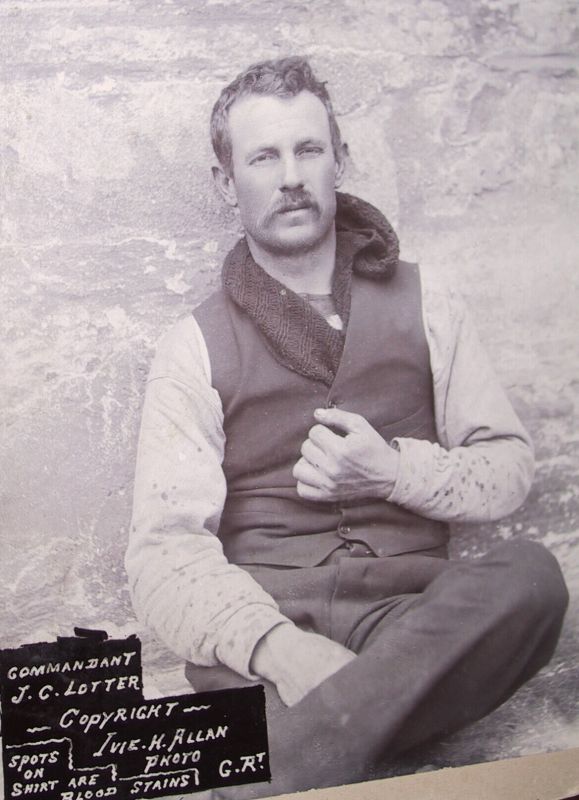
1901: Johannes Lotter, Boer War “rebel”

On this date in 1901, Commandant Johannes Lotter was shot at Middelburg.

Along with Gideon Scheepers, Lotter is one of the most famed Boer guerrillas from the Second Boer War.

Regarded by the British as one of their most nettlesome adversaries in that dirty guerrilla war, Lotter was captured in a bloody early September ambush when matters were well into an unpleasant scorched-earth endgame.

This was cause for much slapping of backs among the Union Jack set, and earned for his captor an immediate promotion.


Lotter’s captured men being jubilantly escorted into Graaff-Reinet.

Lotter almost immediately found himself in the dock for — well, all the things one does in a dirty guerrilla war.*

And one other thing: sedition.

The British charged Lotter as a rebellious subject of the British Cape Colony — rather than a resident of one of the independent neighboring Boer states — who owed allegiance to the British crown; upon this premise things like “killing troopers in war” became “murdering troopers”.

Lotter’s trial hung on his papers.** The defendant “pleaded that he was a Free State burgher, and, as such, entitled to the usage of civilised warfare and a legal combatant’s privileges.”

But he was in a bit of a pickle when it came to proving that the “Commandant Lotter” the British discovered on voting rolls for the Cape Colony city of Colesburg was a different guy. Innocent Blood: Executions During the Anglo-Boer War (its title telegraphs its Boer sympathies) summarizes:

his Free State citizen document was in a small case, which was lost or destroyed theday of surrender. Witnesses for the defence gave evidence that they had seen these papers. British intelligence stated that it could find no proof of his Free State citizenship in Bloemfontein. Lotter responded by asking how he could prove his citizenship when all his witnesses were still on commando and that he had been granted no time to call upon them.

Hey, the guy had six whole weeks from capture to execution to sort it all out.

A “Chair Monument” — there’s a picture of it on this page — commemorates Lotter and his fellow commando Pieter Wolfaardt at the place outside Middelburg where they were shot together on Oct. 12, 1901.

A number of additional prisoners from Lotter’s command taken with him in that same ambush were also eventually executed.

* Specifically: murdering two native spies; killing three British soldiers; blowing up railway lines; and sjamboking loyalist civilians.

** When the British later captured Scheepers, who was unquestionably not a Cape rebel, they simply charged his similar conduct as war crimes to the same capital effect.

On this day..