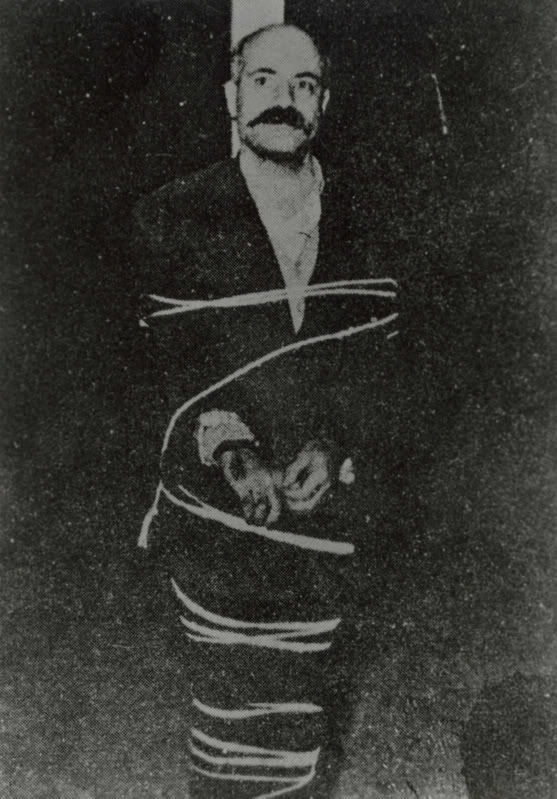
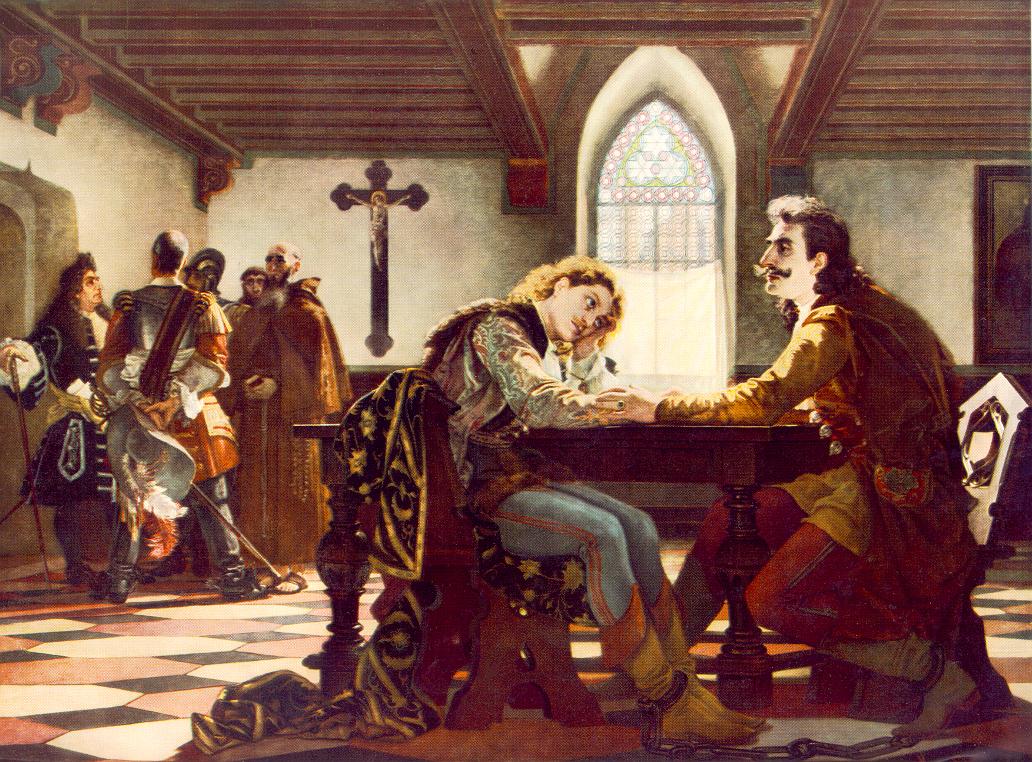
On this date in 1474, Peter von Hagenbach was tried in a remarkable judicial proceeding in the Rhine city of Breisach, found guilty, and publicly beheaded by the end of the day.
This Alsatian knight in the train of Charles the Bold had been installed by that Burgundian duke as his satrap in in the Upper Rhine, in lands that Burgundy held on lease from the Habsburgs.
He made a legendary villain of himself in the early 1470s:
His regime of arbitrariness and terror extended to murder, rape, illegal taxation and wanton confiscation of pivate property, and the victim[s] of his depredations included inhabitants of neighbouring territories as well as Swiss merchants on their way to and from the Frankfurt fair … the outrages of Hagenbach, remarkable even by the standards of the late fifteenth century, greatly contributed to forging what, until then, had been considered impossible, that is, alliances against Burgundy by all her neighbours: Austria, Berne, France, and the towns and knights of the Upper Rhine, all formerly at loggerheads with one another.
After overturning Burgundian authority in the Upper Rhine, that unique alliance aired its many grievances with Hagenbach at a unique tribunal. There, the ex-knight was prosecuted before judges drawn from the several Germanic and Swiss principalities who had allied against him.
 Breisach: seems like a nice place to oppress. (cc) image from Routard5.
This unusual procedure gained a special prominence in the 20th century postwar era as historical precedent for “war crimes” prosecutions. Since that time, there’s been a going debate over just what kind of precedent it really makes.
Executed Today is pleased to welcome Prof. Gregory Gordon of the University of North Dakota law school — a rising star in international human rights law.
Gordon wrote a 2012 paper re-examining the Hagenbach case attempting to reconcile both the legal and historiographical perspectives on Peter von Hagenbach.
ET: You characterize the present-day understanding of the Hagenbach case as proceeding from Georg Schwarzenberger‘s recovery of the incident further to providing legitimizing precedent for the Nuremberg tribunals. Between 1474 and World War II, did anyone think of this case as one with a wider import for jurisprudence? (And if not, do we know anything about how Schwarzenberger unearthed it?)
GG: To the extent anyone did, from my research, it would have been historians, not jurists per se. Hagenbach was the object of a fair amount of historical scholarship but that had evolved over the years. In the initial period after the trial, Hagenbach was portrayed as the quintessential bogeyman. But over the centuries, historians began to view him in a different light. By 1945, a more nuanced view of Hagenbach had been established. I have not researched Schwarzenberger’s biography in great detail. So I’m not sure how his eureka moment arose. What is clear is that the Nuremberg trial caused him to focus on Hagenbach (my sense is that Hagenbach was fairly well known in Europe — his supposed mummified head was on display in an Upper Alsace museum, for example — but given the absence of anything resembling Nuremberg before Nuremberg, people tended to ignore the details of the Hagenbach legal proceedings).
And my sense is that Schwarzenberger had an agenda — he realized the case could help legitimize what many would claim to be illegitimate ex post facto law at Nuremberg. So he relied on the earlier historical accounts of the Hagenbach case (it seems he based his seminal Manchester Guardian article primarily on the account of French historian Prosper de Barante). And thus he created a fissure between legal scholars and contemporary historians.
Who tried Hagenbach, under what authority, and how were the different interested parties formally represented? Whose idea was all this? What can we tell of the public atmosphere surrounding the trial — was there bottom-up pressure to do this?
After the League of Constance (consisting of various regional polities fed up with Hagenbach) paid off his debt for him, Archduke Sigismund of Austria resumed control over the Upper Alsace territory mortgaged to Charles the Bold. And thus Sigismund made the decision to have Hagenbach tried by the international ad hoc tribunal (another inexplicable link in the chain: Hagenbach escaped lynch-mob justice on Easter Sunday, April 10, 1474 — only thanks to Breisach resident Friedrich Kappelar’s decision to arrest him and await instructions from Sigismund).
Sigismund’s decision to convene an ad hoc international tribunal was utterly remarkable for the time. And it is not clear how or why Sigismund came up with it (although historians suggest it had something to do with the prominent position Hagenbach held as representative of the Duke of Burgundy).
Numerous representatives of sovereigns from around the region, twenty-eight in all — including sixteen knights, sat as part of this international ad hoc tribunal.
Eight of the judges were nominated by Breisach, and two by each of the other allied Alsatian and Upper Rhenanian towns [Strasbourg, Sélestat, Colmar, Basel, Thann, Kenzingen, Neuburg am Rhein, and Freiburg im Breisgau] as well as by Berne, a member of the Swiss Confederation, and Solothurn, allied with Berne.
In fact, each sovereign represented a member of the League of Constance (Berne being the only representative of the Swiss cantons).
Thomas Schutz, the chief magistrate of Ensisheim, was designated as the tribunal’s presiding judge. The nominal trial prosecutuor was the new Alsatian bailiff chosen by Sigismund to replace Hagenbach — Hermann von Eptingen. Eptingen, for his part, chose Heinrich Iselin, one of the commissioners from Basel (one of the League of Constance’s members), to present the prosecution’s case to the court. The other representative from Basel, Hans Irmy, took on Hagenbach’s representation. At some point later in the trial, Iselin resigned because, as the evidence came in, he felt the case lacked merit (and even made a motion to withdraw the charges). He was then replaced by Hildebrand Rasp. Hagenbach also requested additional attorneys and the tribunal assigned him two attorneys — one from Colmar and one from Selestat.
The trial was held in open air before the Breisach mayor’s residence and was attended by “a multitude” of people from Breisach and surrounding towns. It appears as if it were somewhat of a circus atmosphere.
Is there a degree to which the pre-modern characteristics of the belligerents — Burgundian duchies, Swiss cantons, the Holy Roman Empire patchwork — set a contradictory precedent for the postwar world?
Let me quote my paper:
Nothing in history leading up to that moment in 1474 would have suggested the remarkable course of action taken by Sigismund. It is tempting to see that decision as an historic anomaly that would not be repeated for centuries to come. But on closer inspection, Sigismund’s choice to hold a trial before an international court fits well within the historical narrative of that era.
It was a time of religious and political disintegration. The Holy Roman Empire was fading into irrelevance and the Catholic Church was on the verge of losing its European hegemony. It was the eve of the nation-state — a unique moment when the old collective structures were dying and the new ones had yet to be born. Given the interstitial political turbulence, the time was ripe for a plural approach to law enforcement in the cosmopolitan geographic center of Europe. Hagenbach’s inter-regional depredations, which helped forge a rare pan-Germanic consensus, provided the perfect forum to experiment with international justice during that fragmented time. The Westphalian order, already on the horizon, would foreclose any such future experiments until Nazi brutality put a chink in the Westphalian armor and inspired an unprecedented transnational justice operation in the wake of a truly global war. In that sense, although on much different scales, Breisach and Nuremberg have much in common. And should the nation-state ever manage to reassert its absolute supremacy again, Breisach will undoubtedly be on the lips of future international jurists seeking, as before, to end impunity at the expense of sovereignty.
You discuss a revisionist thesis about Hagenbach that essentially says he wasn’t a monster, and even that he was a forward-thinking but star-crossed reformer. Why do you think that we can, in fact, conclude that there’s something to the claim that Hagenbach was tyrannous or criminal? What do you consider the most credible charges, and the ones that to his judges would have distinguished Hagenbach from a run-of-the-mill brutal lord or military commander?
What evidence supports the view that the good burghers of Alsace were the victims of Sir Peter’s violence? Their treatment of the wayward knight after his arrest is most revealing in this regard.
While torture may have been commonplace in ordinary criminal inquisitions of the time, the severity of torment inflicted leads one to believe it was inspired by and directed at the kind of mass, depraved criminality of which Hagenbach has traditionally been accused. Significantly, in this regard, in addition to enduring horrific torture, he was stripped of his knighthood. Degradation of knighthood was exceedingly rare in the Middle Ages and reserved only for the most extreme and infamous crimes.
And there is other evidence to suggest Hagenbach’s culpability for atrocities. Most telling perhaps is the trial record itself.
Hans Irmy, it must be remembered, mounted a valiant and spirited defense to the very end. And yet the record does not reveal his even attempting to refute the charge that Hagenbach planned to exterminate the citizens of Breisach or that he murdered the four petitioning residents of Thann. At most, he offered the rejected defense of superior orders. Nor did Irmy (or Hagenbach, for that matter), directly deny the rape charges (merely objecting that taking women in this fashion was common practice and/or he had paid for services rendered). Rape, as opposed to murder, appears to have been Hagenbach’s preferred weapon of terror and atrocity.
And there is a plausible explanation for why Hagenbach would have wanted to murder the citizens of Breisach.
Hagenbach was aware of other towns that had plotted to kill him during the previous year and, when requesting entry to create defensive fortifications in anticipation of an attack by the League of Constance, he had already been denied admittance with his troops into Thann and Ensisheim. He was only able to gain entry into Breisach because his mercenaries were already present there. Given the animosity shown him in these other towns and the previous conspiracy to kill him, Hagenbach did not want to take any chances. Killing Breisach’s citizens would have permitted him to use the town as a defensive fortification without the risk of an uprising from its citizens.
Did Hagenbach slaughter thousands of innocent civilians in concentrated liquidation campaigns? There is no evidence to suggest he did — he was not a fifteenth century proto-Nazi. But the record suggests that he terrorized the local population by murdering civilians, raping numerous women and conspiring to commit a large-scale massacre in Breisach. It should be noted that the rape charges are the most persuasive as there are numerous examples and they were never directly refuted.
And Hagenbach’s back story further validates this view of him. He was the product of a Burgundian ducal culture that was steeped in and glorified violence — the reflection of its bellicose chief, Charles the Bold (known to his enemies as Charles the Terrible). The duchy was in almost a permanent state of war with one enemy or another during Charles’s reign. Charles the Bold’s Burgundy was in the practice of laying siege to towns and routinely killing civilians who resisted — Liege, Dinant, Neuss — all were subjected to horrific violence by Burgundian troops, and Hagenbach played a leading role in the first two. And within that violent culture, Hagenbach was Charles’s fiercest, most loyal lieutenant. In that regard, Sir Peter’s steadfast reliance on superior orders at trial speaks volumes.
And it is not to be overlooked that a criminal disposition was apparent even before Hagenbach cast his lot with Charles the Bold. The reported kidnapping of Marquard Baldeck, the Swiss banker for whom Hagenbach demanded ransom, is telling in that regard. As noted previously, Hagenbach supposedly demanded ransom from Baldeck’s family and the scheme was scuttled only when Philip the Good ordered Baldeck released without any extortion payment. Hagenbach also seems to have fabricated a murder plot against Charles the Bold, which he falsely pinned on a court rival to have him eliminated.
Add to this Hagenbach’s contempt for the emerging bourgeoisie and townspeople, as well as a deep animosity toward the Swiss, and his stewardship of the Upper Rhine represented the perfect storm. By 1474, he had indeed become the scourge of the Sundgau. In this regard, it is interesting to note Burgundy expert Richard Vaughan’s insight that, in fact, it may have been Hagenbach driving policy and tactics in Charles’s Alsatian territory, not the other way around:
Many of Hagenbach’s activities were undertaken at [Charles’s] express command, though often as a result of representations made to him by Hagenbach in the first place. It is possible, for example, that Charles only agreed to sign the treaty of St. Omer on Hagenbach’s persuasion. In the duke’s letters to Hagenbach of 8 August 1470 he orders him to undertake the siege and conquest of Ortenberg castle, ‘in accordance with your memorandum (advertissement)’, which seems to imply that Charles was here acting on detailed advice to take Ortenberg sent him by Hagenbach. As to other mortgaged places, the bailiff wrote to Charles describing how he had seized possession of Landser and seeking the duke’s approval, which was given on 6 January 1474. . . . On 26 December 1470 he wrote congratulating Hagenbach on taking Ortenberg . . .”
Finally, it should be pointed out that Hagenbach may be responsible for atrocities in the region, even if he personally did not commit or order or was unaware of all of them. In particular, the Picard and Wallon mercenaries he hired toward the end of his reign had a well-known reputation for being unruly, violent and hostile toward the local Alsatian population. French historian Emile Paul Toutey, for example, describes Picard soldiers engaging in mass rape of Breisach’s women toward the very end of 1473. These troops may have acted on their own initiative but Hagenbach was their superior and, at the very least, he bore command responsibility. And this may also have contributed toward the writing of Hagenbach’s black legend.
Did the Hagenbach case, in your opinion, actually break new legal ground relative to what had occurred up through 1473? Does it have any analogues you’re aware of over the next century or two, prior to the advent of the Westphalian system?
In my opinion, nothing in the historical record up through 1473 suggests the possibility (certainly not the likelihood!) of what actually took place in 1474.
Eminent German historian Hermann Heimpel does note that the contemplated trial was consistent with other legal actions in late fifteenth century Swabia. What must have seemed entirely unprecedented, though, was the make-up of the court that would sit in judgment of Peter von Hagenbach. He was not to be tried by a local judge. Instead, numerous representatives of sovereigns from around the region, twenty-eight in all — including sixteen knights — would sit as part of an international ad hoc tribunal. Nothing after this, until the Versailles Treaty’s Article 227 contemplated international ad hoc tribunal trial of Kaiser Wilhelm II post-World War I (which never took place since the Dutch refused to extradite), even suggested such a procedure.
Hagenbach tried to raise a “superior orders” type of defense, claiming that Charles the Bold had ordered him to do the nasty things that were imputed to him. The dismissal of this defense does sound pretty modern, but was it mere expedience on the part of the court since it had no way to compel evidence from Charles the Bold?
That’s a great question! I don’t think so. Why? Because Hans Irmy asked for a trial continuance to contact Charles the Bold to appear before the tribunal and corroborate Hagenbach’s claims of superior orders. The tribunal flatly denied the motion for continuance. There was not even an attempt to contact the Duke of Burgundy. Like the decision to try Hagenbach before an ad hoc international tribunal, the decision to deny the motion (and flatly reject the defense) seems nothing other than ground-breaking. In short, it was an epochal precedent.
What interpretive conflicts does this case raise for you when considering it as a legal scholar, versus as a historian? How do you think people today should understand Peter von Hagenbach’s prosecution?
Again, I quote from my paper:
My piece attempts to identify and resolve certain vertical and horizontal dissonances in Hagenbach scholarship. With respect to the former, this has amounted to an exercise in historiographic and historical archeology. The recent attention lavished on the case by international criminal law (ICL) experts is informed by a cartoonish conception of the defendant — an ultra-violent, sexually depraved monster who ran amok for years along the Upper Rhine and terrorized its population. Consistent with that interpretation, the authorities who captured and tried him engaged in a righteous and visionary justice enterprise. They came out on the winning side of a Manichean struggle that gave birth to ICL and ennobled its pedigree.
Digging deeper, though, one finds a very different narrative developed initially by nineteenth century historians and embraced by most of their twentieth century confreres. They saw Hagenbach as a would-be administrative reformer whose efforts were thwarted by xenophobic subjects and a parsimonious superior. In trying to transform a fragmented archipelago of city-states into a cohesive governmental entity, Hagenbach was despised because he threatened an ingrained culture of seigneurial privilege and parochial complacency. In his efforts to redeem property put in hock by Sigismund, he likely reinforced views of Burgundy as excessively acquisitive and bent on conquest (this was exacerbated by Charles’s own efforts to accede to the imperial throne). And in levying taxes to pay for good government, Hagenbach stoked local fears of financial servitude and ruin. But in doing the Duke’s bidding, he did not have the Duke’s support. And so he was left to flounder, his undoing hastened by his admitted crass and prurient behavior. They point out that his trial, a marketplace spectacle based on torture-extracted confessions, was little more than drumhead justice. It was akin to executing Charles the Bold in effigy. Peter von Hagenbach may not have been the most adroit governor and perhaps he did manifest contempt for the rising merchant and urban classes. But, the revisionists would contend, his final deserts were not just at all.
Digging deeper still, the bottom layer of historiography consists of the journalistic rough draft and the first generations of historians that followed. It is largely consistent with the modern ICL expert view but without the larger historical perspective and legal focus. And it is more regionally tinged and archaic. This layer is at once more reliable, given its comtemporaneity or relative proximity, and less reliable, given the inherent biases of its initial chroniclers and the disproportionate influence they exerted on sixteenth through eighteenth century historians.
But my piece demonstrates that each layer is not necessarily inconsistent with the others. In fact, there are many points of convergence. And it is there that a unified, coherent narrative can be stitched together. Hagenbach was coarse and confrontational. But he was also hardworking and loyal and wanted to do right by his master. His entire career had been built on pleasing Charles the Bold. He undoubtedly meant to reform and upgrade the administration of his Alsatian fiefdom. And consequently resentment of the bailiff grew over the years as he pushed while the Alsatians pulled. Hostilities boiled over in 1473 and matters came to a head in 1474. Charles’s loyal lieutenant with a criminal past and odd sexual predilections felt increasingly boxed in and he eventually lashed out. The almost exclusive procedural focus of his defense at trial strongly supports accounts of the resulting crime spree.
It should also be noted that modern Hagenbach scholarship is characterized by a certain horizontal dissonance as well — between jurists and historians. Given the historical points of convergence just noted, however, these two schools ought to find common ground too. Certain views of the revisionist historians concerning the Hagenbach judicial proceedings are not without merit. The Breisach ad hoc tribunal may not have been a kangaroo court but it bears no resemblance to the well-oiled machine of modern international criminal justice administration. The defendant was hideously tortured for days before the trial. He was given no notice of the charges or allegations against him in advance of the hearing. He had no time to speak with a lawyer before standing in front of the judges. The proceeding itself was held on a market square in a circus atmosphere and concluded within a matter of hours. He was not able to call his most important (and only) witness to the stand – Charles the Bold. And there is no indication of a high burden of proof or that any such burden even rested with the prosecution. The Breisach Trial was certainly not the paragon of due process.
On the other hand, this was the late Middle Ages — centuries removed from our modern notions of due process. Torture was part of standard pre-trial procedure at that time. And the trial itself seems relatively fair for that era. Hagenbach was represented by a zealous advocate in Hans Irmy and he was given two additional lawyers of his choice. There is as well a flip side to the “public spectacle” aspect of his trial — transparency. Hagenbach could have been summarily condemned in front of a secretive Star Chamber but his trial was held in public (and that was consistent with local custom). He was able to confront witnesses called against him. He had twenty-eight finders of fact (compared to twelve in the modern jury system). And Charles the Bold, his sole designated witness, was not allowed to testify because the defense of superior orders was rejected ab initio. As well, the proceedings lasted from early in the morning until late at night — which could equate to two or three modern court days. There seems to have been significant deliberation among the twenty-eight judges suggesting that a consensus was cobbled together after carefully sifting through the evidence. In an age of witch-hunts, trials by ordeal, the Star Chamber, and the Inquisition, this was an exceedingly fair trial.
And in many ways it seems inappropriate to use twenty-first century ICL terminology to analyze a fifteenth century judicial proceeding. But if that terminology is used, this piece has demonstrated that the Breisach Trial has many of the hallmarks of a modern international atrocity adjudication. As a threshold matter, regardless of anything else, it is the first recorded case in history to reject the defense of superior orders. In itself, that distinction invests the trial with universal historic importance in the development of atrocity law.
On this day..


 Inigo Campioni (
 The “Russian

 However, tragedy for the sizable Rebreanu family was a boon to world literature.