1915: The Ghadar Mutineers

Prior to the war certain European nations, and especially those now ranged against us, regarded our Easern Dependency as a country where the great Mutiny would be surpassed in horror by the upheaval that would inevitably follow the entanglement of Britain in a great war, and at the outset of the conflict the German Press confidently relied upon trouble in India as a large factor on their side. Even among a not inconsiderable section of our own countrymen, too, there seemed to be a feeling of doubt. The moment Germany threw down the gauntlet, however, his Majesty’s dusky subjects forgot their little quarrels, closed their ranks, and offered all they possessed in defence of the Empire to which they are all so proud to belong, and with which their future prosperity and advancement are bound up.

–Devon and Exeter Daily Gazette, Dec. 31, 1915

One century ago today, seven of his Majesty’s “dusky subjects” submitted to the noose at Lahore Central Gaol in preference to submitting to his Majesty.

These partisans of the two-year-old expatriate Ghadar party — the word means “revolt” — had been cogitating the subcontinent’s independence since its founding two years prior in the United States.

With the onset of World War I, the Ghadarites began returning to India by the thousands with a view towards ejecting the British Raj. For an ambitious objective, an ambitious plot spanning multiple interlocking conspiracies and reaching to the sepoy bunkers of Singapore.

The project was a logistical nightmare: no surprise considering the distances and communications lags involved. German-supplied munitions arrived late or (when intercepted in North America) not at all. The movement was penetrated by counterintelligence, and many of its adherents arrested.

Full of the desperate recklessness of patriotism, the remains of the conspiracy tried to go ahead with a rising in February 1915: this too was compromised, and easily squelched.

The resulting Lahore Conspiracy Case saw nearly 300 who were not quite so proud to belong to the Empire as the crown had hoped — seven of whom hanged on November 16:

The last in particular, only 19 years old when he hanged, has attained wide recognition as a Punjabi martyr.

On this day..

1863: William Griffith, for the Marais des Cygnes massacre

One of the signal outrages of Bleeding Kansas was avenged with a hanging on this date in 1863.

“Bleeding Kansas” was the guerrilla war over slavery in the late 1850s that presaged the conflagration about to consume the Republic; here on the frontier, pro- and anti-slavery partisans traded atrocities in their respective campaigns to secure Kansas’s imminent entry to the Union as either a slave or a free state. The stakes, had America continued her antebellum course, were vital Congressional votes on which the continuance of the peculiar institution might one day hang.

The naked brutality of the conflict shocked its contemporaries; as one particularly notorious example, the sons of abolitionist crusader John Brown executed pro-slavery captives with broadswords.

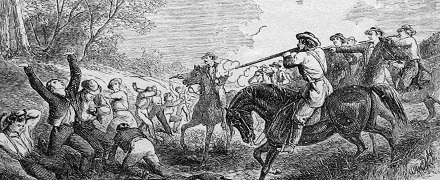
The Marais des Cygnes massacre was one of the last major horrors of that conflict: a party of 30 or so pro-slavery men led by Charles Hamilton seized 11 Free-Staters. They were mostly people who knew Hamilton personally, and seem to have gone along without resistance not anticipating what he had in store for them.

But Hamilton had told his men that on this campaign, “we are coming up there to kill snakes, and will treat all we find there as snakes.” (Source)

Much to their chagrin, these “snakes” were driven into a narrow ravine and lined up before Hamilton’s men’s guns. The volleys they delivered before fleeing back over the porous border into equally restive Missouri “only” killed five of their hostages: the other six survived by playing dead.


(Via)

Five years later, one of those survivors, William Hairgrove, supplied the identification that damned William Griffith — whose claim that he only helped capture the Marais des Cygnes victims, and didn’t help shoot them was an especially lame offering at the height of the Civil War.

According to Legal Executions in Nebraska, Kansas and Oklahoma Including the Indian Territory: A Comprehensive History, Griffith paid the forfeit for his role in the massacre “in a wood west of [Mound City, Mo.] on the opposite bank of Little Sugar Creek” before a crowd of thousands. There,

[a] little after noon Griffith was conveyed to the wood where he stepped onto the wooden platform a few inches above the ground. His wrists, knees and ankles were bound and the noose was adjusted. The black cap was pulled over his face at 1:07 p.m., and in but a moment William Hairgrove, one of the survivors of the massacre, cut the restraining rope with a hatchet; the four hundred pound weight dropped, jerking Griffith upward. The body rebounded and hung motionless while the attending physicians monitored his vital signs, and in twenty-five minutes they pronounced him dead.

Today, the site of the massacre is a U.S. National Historic Landmark. Quaker abolitionist poet John Greenleaf Whittier also memorialized the blood that was shed there in a poem titled “Le Marais du Cygne”:

A blush as of roses
Where rose never grew!
Great drops on the bunch-grass,
But not of the dew!
A taint in the sweet air
For wild bees to shun!
A stain that shall never
Bleach out in the sun!

Back, steed of the prairies!
Sweet song-bird, fly back!
Wheel hither, bald vulture!
Gray wolf, call thy pack!
The foul human vultures
Have feasted and fled;
The wolves of the Border
Have crept from the dead.

From the hearths of their cabins,
The fields of their corn,
Unwarned and unweaponed,
The victims were torn,—
By the whirlwind of murder
Swooped up and swept on
To the low, reedy fen-lands,
The Marsh of the Swan.

With a vain plea for mercy
No stout knee was crooked;
In the mouths of the rifles
Right manly they looked.
How paled the May sunshine,
O Marais du Cygne!
On death for the strong life,
On red grass for green!

In the homes of their rearing,
Yet warm with their lives,
Ye wait the dead only,
Poor children and wives!
Put out the red forge-fire,
The smith shall not come;
Unyoke the brown oxen,
The ploughman lies dumb.

Wind slow from the Swan’s Marsh,
O dreary death-train,
With pressed lips as bloodless
As lips of the slain!
Kiss down the young eyelids,
Smooth down the gray hairs;
Let tears quench the curses
That burn through your prayers.

Strong man of the prairies,
Mourn bitter and wild!
Wail, desolate woman!
Weep, fatherless child!
But the grain of God springs up
From ashes beneath,
And the crown of his harvest
Is life out of death.

Not in vain on the dial
The shade moves along,
To point the great contrasts
Of right and of wrong:
Free homes and free altars,
Free prairie and flood,—
The reeds of the Swan’s Marsh,
Whose bloom is of blood!

On the lintels of Kansas
That blood shall not dry;
Henceforth the Bad Angel
Shall harmless go by;
Henceforth to the sunset,
Unchecked on her way,
Shall Liberty follow
The march of the day.

On this day..

1862: Ten Confederate hostages in the Palmyra Massacre

On this date in 1862, Union Gen. John McNeil had ten Confederate soldiers shot in what history has recorded as the Palmyra Massacre.

The Slave Power’s northern salient, Missouri was surrounded to the east, north, and west by free soil — which made it an antebellum flashpoint since the days of the Missouri Compromise.*

In the 1850s, the Missouri conflict spilled into neighboring Kansas as the enemy sides of the slavery question fought to determine whether Kansas would enter the Union as slave state or free. The Missouri borderlands of Bleeding Kansas was where the radical abolitionist martyr John Brown made his name, commanding free state militia in a guerrilla war that presaged the coming clash of North and South.

By the time we lay our scene in 1862, John Brown has exited courtesy of Virginia’s gallows, and the dragon’s teeth sown in Missouri and Kansas and everywhere else had sprung to horrible life. Missouri’s own civil war pitted neighbor against neighbor throughout the state in a bushwhacking conflict that extended locally for many years after Appomattox.**

The nastiness of the years to come is aptly suggested by this date’s events.

Like neighboring Kentucky, Missouri was a border state with a Union government, albeit one contested by a rival Confederate government. From the standpoint of the North, all Confederate activity there was behind its lines and the perpetrators therefore potentially subject to treatment (up to and including execution) as spies, saboteurs, and the like.†

Joseph Chrisman Porter, a Confederate officer, was one such possible client of this here site, tapped as he was for recruiting and raiding operations in northeast Missouri. His Union adversary Gen. John McNeil saw Porter as basically a terrorist. In August of 1862, Porter’s aide Frisby McCullough fell into McNeil’s hands: the Union general had McCullough shot.

On September 12, Porter raided the town of Palmyra, where McNeil held a number of Confederate prisoners. In the course of the raid, he kidnapped Andrew Allsman, a 60-year-old Palmyra resident. “It was said of him that he was able to inform the military authorities of certain movements of the enemy, and that he gave definitive information as to the homes and whereabouts of many men of Confederate leanings,” in the words of this pro-Confederate 1902 pamphlet on the incident. “Naturally, this placed him in disfavor with the Southern sympathizers and those who were fighting in that cause.”

What happened next — though it was not known to the Union at the time — was that Allsman was shot. The pamphlet just cited attempts to obfuscate this event into the fog of war and not really Porter’s fault. The bare fact is that his raiders had gone out of their way to seize an aged non-combatant and then summarily executed him.

Not knowing Allsman’s fate, McNeil responded with an ultimatum to his opposite number.

Palmyra, Mo., Oct. 8, 1862.

To Joseph C. Porter.

Sir: — Andrew Allsman, an aged citizen of Palmyra and a non-combatant, having been carried away from his home by a band of persons unlawfully arraigned against the peace and good order of the State of Missouri, and which band was under your control, this is to notify you that, unless Andrew Allsman is returned unharmed to his family within ten days from date, ten men, who have belonged to your band, and unlawfully sworn by you to carry arms against the government of the United States, and who are now in custody, will be shot as a meet reward for their crimes, amongst which is the illegal restraining of said Allsman of his liberty, and if not returned, of presumptively aiding in his murder. Your prompt attention to this will save much suffering.

Yours, etc.,

W.R. Strachan
Provost Marshal General Northeast District of Missouri
By order of Brigadier General commanding McNeil’s column

The Confederates, of course, could not produce Allsman.

So, on the evening of Oct. 17, five rebel prisoners in the Palmyra stockade plus five more held in Hannibal were informed that they would be shot the next afternoon, in ruthless enforcement of the threat.

The men who died this date in 1862 by a volley of musketry at the Palmyra fairgrounds were:

  • Captain Thomas Sidenor
  • William T. Baker
  • Thomas Humston
  • Morgan Bixler
  • John McPheeters
  • Hiram Smith
  • Herbert Hudson
  • John Wade
  • Marion Lair
  • Eleazer Lake

Their names adorn the base of a monument erected in Palmyra in 1907 commemorating the so-called “Palmyra Massacre”. The state of Missouri as a digital archive of original documents relating to the affair available here.

* Missouri was where the slave Dred Scott lived; his owner taking him to the neighboring free state of Illinois and thence points north occasioned the notorious Supreme Court case that bears his name.

** Frank and Jesse James were Confederate partisans for William Quantrill in the Missouri war; they segued directly into their more celebrated career in outlawry right after the war ended — robbing banks whilst settling scores with pro-Union men for the rest of the 1860s, before branching out to other points on the frontier.

† The Union might obviously have chosen to treat the entire Confederacy as a treasonable enterprise rather than a legitimate enemy belligerent. As a historical matter, it did not take this perspective.

On this day..

1923: Jesus Saleta and Pascal Aguirre, Terrassa anarchists

On this date in 1923, two anarchists were garroted in the Catalan city of Terrassa.

Terrassa was unwillingly under new management, having been occupied by the Captain-General of Catalonia Miguel Primo de Rivera* upon the latter’s coup just days prior to the events in this post.

In historical periodization, Primo de Rivera’s six-year dictatorship marks a last stage of the Restoration, a decades-long social struggle bridging the span between Spain’s twilight years in the imperial-powers club and the onset of the Spanish Civil War.

Spain and especially the notoriously insurrectionary Catalonia had been riven by conflict in the first years of the 1920s. One of our principals for this day’s execution, Jesus Saleta, had been a leader of the intermittently outlawed anarchist trade union CNT,* whose gunmen fought ferocious street battles with police and company enforcers.

He was not averse to dirtying his own hands. In 1922, Saleta had stood trial (he was acquitted both times) for running a bomb factory and for orchestrating an attack on businessman Joan Bayes. After the murder of CNT executive Salvador Segui early in 1923, Saleta helped organize the reprisals. Tension and bloodshed rose throughout the year.

On September 18, he committed the crime for which he would die less than a week later: together with Pascual Aguirre and several other anarchists, he robbed a bank to finance his underground operations; a man was shot dead in the process. Saleta, Aguirre, and a third collaborator, Joaquin Marco, were arrested in the ensuing chase.

Marco was acquitted — he had not been identified clearly enough — but both Saleta and Aguirre were condemned to the firing squad, a sentence the military unilaterally amended to the garrote on the grounds that shooting was too honorable a death for these terrorists.

Both went boldly to the scaffold on this date. (There’s a full narration of proceedings in a Spanish newspaper (pdf) here, and a plain-text equivalent here) “This is the way anarchists die!” a proud Saleta exclaimed to the executioner as he was seated.**

The cry “Viva anarchy!” was the last thing each man uttered as the metal ring wrung the life from his throat.

* We’ve already met Primo de Rivera’s Falangist son in these pages.

** The two were garroted by longtime executioner Gregorio Mayoral Sendino, assisted by Rogelio Perez Vicario [or Cicario]. The latter was assassinated in revenge by Barcelona anarchists on May 7, 1924.

On this day..

1914: Eugene Odent, the mayor of Senlis

On the second of September in 1914, the mayor of Senlis, France, was shot by the occupying Germans in the opening weeks of World War I.


Detail view (click for the full image) of a map of the British Expeditionary Force’s retreat in northern France during the first days of World War I.

The beautiful ancient town, where the Carolingian dynasty met its end (King Louis V was killed in a hunting accident there in 987, enabling Hugh Capet to take the throne), unhappily found right in the path of the German army smashing its way towards Paris as France and her allies gave way.

German troops reached Senlis by the first of September, and overwhelmed the city in a minor battle.

On guard from the experience of being picked off by franc-tireur snipers during the Franco-Prussian War many years before, the Germans entered this urban skirmish with far more concern for the safety of their troops than for that of noncombatants. A number of civilians were seized for use as human shields by the Germans as they moved through the streets, and some others reportedly executed summarily. Numerous buildings were torched.

In doing all this, the occupying army considered itself entitled not to suffer the resistance of its new (if ever so temporary) subjects — indeed it insisted upon the point with lead. On September 2, the German firing squads shot several French civilians accused of firing at German soldiers. The French Wikipedia page on the affair gives these names:

  • Romuald-Emile Aubert, 52
  • Jean-Stanislas Barber, 66
  • Cottereau Arthur-Lucien, 17
  • Pierre Dewert, 45
  • Mégret Gabriel, 52
  • Jean-Baptiste Pommier, 67
  • Rigault Arthur, 61
  • Louis Simon, 36

Hours later, the town’s mayor Eugène Odent heroically shared their fate. He had been accused by the Germans of orchestrating “terrorist” civilian resistance — shuttering buildings for the convenience of snipers, failing to demand orderly submission from his neighbors, and generally inconveniencing the new boss. (Most of Senlis’s 7,000 residents had fled town ahead of the approaching attack, presumably shuttering up in the process.)

The stunning German attack seemed on the brink of capturing Paris at this point, but just days later the disordered French “miraculously” — it’s literally known as the Miracle of the Marne — threw the invaders back at the Battle of the Marne.

This battle crushed Berlin’s dream of a knockout victory and allowed the combatants to settle in for four bloody years of miserable trench warfare. It also enabled the French to recapture Senlis, whose horrors — Eugene Odent and all — were collected for early entry into the war’s annals of barbaric-Hun propaganda.

On this day..

1990: Sam Cayhall in Grisham’s “The Chamber”

In John Grisham’s The Chamber, it is on August 8, 1990 that the titular enclosure receives its victim in a cloud of lethal gas.

In The Chamber, Sam Cayhall, a Ku Klux Klansman who had long avoided conviction for bombing a Jewish civil rights lawyer in 1967, has at last been condemned in Mississippi twenty years later.

The action centers around the futile and increasingly hopeless efforts of Cayhall’s grandson Adam Hall to save the old man working pro bono for a Chicago law firm.

Adam comes to learn that his grandfather has a long and bloody Klan history, even killing children. (We also find that the missing link in this generational drama, Adam’s father, committed suicide after Sam was sent to death row.)

But Sam is in no way a good guy: still an unreconstructed racist, he refuses to inform on any ex-confederates. As grandpa wends his way towards his date with the executioner, Adam’s torrent of judicial appeals go nowhere and the politically sensitive nature of the case makes executive clemency a non-starter. (When The Chamber was published in 1994, the death penalty was at an acme of popularity.) This is to be expected, of course; as Chekhov might observe, you can’t call the book The Chamber if someone isn’t going to go sit in said chamber by the end.

This bestseller was made into a 1996 film starring Gene Hackman as the grizzled Klansman. (In the film version’s execution scene, the date is changed to April 13, 1996.)

There’s an excerpt of the novel available on Grisham’s site here.

On this day..

2014: Thirteen Xinjiang terrorists

One year ago today, China executed as terrorists 13 separatist militants.

According to Xinhua, the 13 were condemned in 7 different cases from Aksu, Turpan and Hotan — all prefectures of the western Xinjiang region.


Xinjiang. By TUBS [CC BY-SA 3.0], via Wikimedia Commons

Muslim Uighurs comprise a near-majority of that province’s population, and although Xinjiang is formally an “autonomous region” many Uighurs find it not nearly autonomous enough. Going tension has fomented a separatist movement that has appeared to gain strength — or at least visibility — during the past decade, including multiple spectacular and deadly terrorist attacks as well as several riots.

“The execution of criminals involved in terrorist attacks and violent crimes answers the calls of all ethnic groups, deters criminal activities, and demonstrates the resolve of the Communist Party of China and the government in cracking down on terrorism,” a Chinese court spokesman said, speaking of three of this date’s condemned who were sentenced together for a series of attacks in Lukqun (Turpan prefecture) that slew 24 police officers.

The executions on this day were surely coordinated for their demonstrative effect, days after Chinese authorities announced a “one-year crackdown” in Xinjiang one day after two SUVs bombed a market in Ürümqi, killing 43 people and injuring over 90 others.

Notwithstanding China’s strenuous attempt to frame the “crackdown” as one targeting only terrorists, security measures have bled insensibly into a crackdown on Muslims, targeting conservative Islamic cultural markers like veiled faces. It’s a sure bet that we haven’t heard the last of this flashpoint.

On this day..

1879: Alexander Soloviev, bad shot

On this date* in 1879, would-be regicide Alexander Soloviev was hanged

Soloviev (English Wikipedia entry | Russian), a Narodnik revolutionary, was one of the less competent assassins to have a go at Tsar Alexander II.

Surprising the undefended sovereign on the latter’s morning constitutional near Winter Palace, Soloviev couldn’t connect with his revolver from four meters’ distance. As Alexander fled, Soloviev gave chase, firing four more times in the process to no effect before the gathering crowd wrestled him to the cobblestones.

Soloviev admitted the crime — the admission was hardly necessary — and hanged before a crowd of 70,000 souls. Despite the ensuing police crackdown on subversives (resulting in still more executions), many of those 70,000 surely numbered among the gawkers two years later for the hanging of the Narodnaya Volya terrorists who at last successfully assassinated Alexander.

* May 28 was the local (Julian calendar) date for the execution; by the Gregorian calendar prevailing outside Russia, it was June 9.

Part of the Themed Set: Terrorism.

On this day..

1925: The Sveta Nedelya bombers

Three perpetrators of Europe’s most spectacular terrorist attack were hanged on this date in 1925 in Bulgaria’s capital Sofia — after each stood on the gallows for forty minutes while the names of their victims were read to them.

Those 40 minutes of victims had unknowingly begun their path to Calvary two years before, when the Bulgarian military overthrew the post-World War I civilian government.

Though the Communist party stayed out of this putsch — it was a peasants‘ party that was toppled from power — the reds responded a few months later with their own countercoup: the September Uprising.


Septemvri 1923, by Ivan Milev. Perhaps topical to the horrible events yet to come in this post, also check out his 1926 Our Mothers Are Always Dressed In Black.

The eventual Cold War Communist government of Bulgaria would officially regard September 1923 as “the first anti-fascist uprising” — an ex post facto interpretation that would be aided by the Bulgarian dicator‘s eventual affinity for the World War II axis, and by the “White Terror” unleashed by the military after it routed the Communist revolt.

Harried and hunted, and their underground leadership succumbing to assassinations, the Communists conceived a punchback as devastating as it was contrary to the standard Leninist line on terrorism.

On April 14, 1925, a Communist agent assassinated Gen. Konstantin Georgiev.


Memorial marker for Konstantin Georgiev. Photograph by Miko (Own work) [CC BY-SA 3.0].

Shocking as this murder was, it was only the overture — and Gen. Georgiev was only the bait.

Two days later — Holy Thursday — a huge crowd turned out for the general’s funeral in Sveta Nedelya Church, perhaps Bulgaria’s most important cathedral. Unbeknownst to them, they shared the sacred vault with 25 kilograms of explosives packed into a column under the church’s dome.

When detonated during the service, it brought the dome down on the congregation.

“A tremendous explosion occurred and all became dark,” a former War Minister told the London Times correspondent. “Fortunately, I was standing almost below a pair of arches and I escaped without injury, not even losing my balance. A minute later the fumes began to disperse and, with six or seven others, I found myself standing while every one else was lying on the ground. Fragments of masonry were falling from the walls and the roof.”

One hundred fifty people died and another 500 were injured when Sveta Nedelya’s roof fell in — though amazingly, none of the many top state officials attending were killed. (And Tsar Boris III was not even in attendance.)


Sveta Nedelya after the explosion.

Like Samson, the bombers brought the walls down on their own heads, too.

Already none too lenient with the subversive element, the dictatorship directly implemented martial law and began rounding up suspected fellow-travelers, “disappearing” hundreds in the process. (One notable victim was poet Geo Milev, who never returned from a May 15 police interview; his remains were discovered 30 years later in a mass grave.)

The lucky ones managed to escape to Yugoslavia and thence to the Soviet Union. But three men* implicated in the plot remained to face the more decorous vengeance of the judiciary: Lieutenant-Colonel Georgi Koev, Marko Fridman, and Petar Zadgorski. The last of these was a sexton at Sveta Nedelya whose role as the inside man was essential to infiltrating the deadly package into the sanctuary.

* There were actually eight death sentences at this proceeding, but five of them were delivered in absentia … an absentia caused, for three of the five, because they had already been murdered during the post-bombing crackdown.

Part of the Themed Set: Terrorism.

On this day..

1868: Michael Barrett, the last public hanging in England

England held its last-ever public execution on this date in 1868, and made it big game indeed: Fenian Michael Barrett, whose Clerkenwell Prison bombing long remained one of the most infamous atrocities of the Irish nationalist cause.

The bill certifying the end of that distinctive institution, the public hanging, would be finalized three days hence, so the occasion’s milestone was anticipated in advance. Elites increasingly disdained the boorish carnivals that unfolded under the gallows, like Dickens who complained that “no sorrow, no salutary terror, no abhorrence, no seriousness; nothing but ribaldry, debauchery, levity, drunkenness, and flaunting vice in fifty other shapes” redeemed the 1840 hanging of Courvoisier.


“The Great Moral Lesson at Horsemonger Lane Gaol”, Punch magazine’s view of the notoriously rowdy mob at Frederick and Marie Manning execution.

“The crowd was most unusually orderly,” ran the Times‘ report of Barrett’s death — a sort of dual eulogy — “but it was not a crowd in which one would like to trust.”

It is said that one sees on the road to the Derby such animals as are never seen elsewhere; so on an execution morning one see faces that are never seen save round the gallows or near a great fire. Some laughed, some fought, some preached, some gave tracts, and some sang hymns; but what may be called the general good-humoured disorder of the crowd remained the same, and there was laughter at the preacher or silence when an open robbery was going on. None could look on the scene, with all its exceptional quietness, without a thankful feeling that this was to be the last public execution in England. Towards 7 o’clock the mass of people was immense. A very wide open space was kept round the gallows by the police, but beyond this the concourse was dense, stretching up beyond St. Sepulchre’s Church, and far back almost, into Smithfield — a great surging mass of people which, in spite of the barriers, kept swaying to and from like waving corn. Now and then there was a great laughter as a girl fainted, and was passed out hand over hand above the heads of the mob, and then there came a scuffle and a fight, and then a hymn, and then a sermon, and then a comic song, and so on from hour to hour, the crowd thickening as the day brightened, and the sun shone out with such a glare as to extinguish the very feeble light which showed itself faintly through the glass roof above where the culprit lay. It was a wild, rough crowd, not so numerous nor nearly so violent as that which thronged to see Muller or the pirates die. In one way they showed their feeling by loudly hooting a magnificently-attired woman, who, accompanied by two gentlemen, swept down the avenue kept open by the police, and occupied a window afterwards right in front of the gallows. This temporary exhibition of feeling was, however, soon allayed by coppers being thrown from the window for the roughs to scramble for. It is not right, perhaps, that a murderer’s death should be surrounded by all the pious and tender accessories which accompany the departure of a good man to a better world, but most assuredly the sight of public executions to those who have to witness them is as disgusting as it must be demoralizing even to all the hordes of thieves and prostitutes it draws together. Yesterday the assembly was of its kind an orderly one, yet it was such as we feel grateful to think will under the new law never be drawn together again in England.

Michael Barrett’s ticket to this last assembly was punched by a different execution six months previous — the hanging of the Manchester Martyrs. This trio of Irish patriots were part of a mob who liberated some comrades from a police van, shooting a policeman in the process — though it was far from certain that any of these three actually fired shots.

Of importance for our purposes today was the crackdown on other Fenians occasioned by the Manchester affair. In November of 1867, a Fenian agent named Richard O’Sullivan Burke was arrested with his companion Joseph Casey in London purchasing weapons for the movement. They were clapped in Clerkenwell Prison pending trial.

The bombing that brought Michael Barrett to the gallows was a bid to liberate these men … and it did not pause for subtlety. The conspirators simply wheeled a barrel of gunpowder up to the wall of the facility when they expected the inmates to be at exercise in the adjacent yard. The explosion blasted a 60-foot gap in the wall; the inward-collapsing rubble might easily have been the death rather than the salvation of the prospective beneficiaries, except that they weren’t actually in the yard at all — nobody was there, and nobody escaped Clerkenwell.

But numerous working-class families lived in little tenements opposite the prison and were there, and in fact Clerkenwell had a reputation for political radicalism and Fenian sympathy. This monstrous new “infernal machine” tore through Clerkenwell homes, leaving 12 people dead and numerous buildings near to collapse, while windows and chimneys shivered to pieces all up and down the block.


Improvised struts shore up damaged buildings opposite the wall of Clerkenwell Prison reduced to rubble by the December 13, 1867 Fenian bombing.

Karl Marx, a strong supporter of the Irish cause, despaired this counterproductive turn towards terrorism: “The London masses, who have shown great sympathy towards Ireland, will be made wild and driven into the arms of a reactionary government. One cannot expect the London proletarians to allow themselves to be blown up in honour of Fenian emissaries.”

English reformer Charles Bradlaugh agreed. “The worst enemy of the Irish people could not have devised a scheme better calculated to destroy all sympathy,” he wrote.


Punch magazine depicts the Clerkenwell bomber(s) as the “Fenian Guy Fawkes“.

Considering the magnitude of the crime, someone would have to pay for it. That Barrett was that someone did not sit well for many.

Five men and a woman stood trial at the Old Bailey in April for the Clerkenwell outrage, but Barrett was the only one of them convicted, a terribly inadequate investigation/prosecution outcome given the infamy of the crime.

That conviction stood on the basis of disputed eyewitness identifications: Barrett produced witnesses who said he was in Glasgow when the bomb went off, while the crown found others who would swear he was actually in London. (The length of Barrett’s whiskers on specific dates in late November and early December forms a running subplot of the dueling testimonies.)

The reliability and even the good faith of all such winesses might well be impugned. A highly questionable stool pigeon named Patrick Mullany who ducked prosecution by turning crown’s evidence, charged that Barrett personally set off the ordnance.

Despite his certain doom, Barrett eloquently vindicated himself at his sentencing

To give me credit for such an undertaking is utterly absurd; being, as I am, a total stranger to acts of daring, and without any experience which would in any way fit me for engaging in such an enterprise. Is it not ridiculous to suppose that in the City of London, where … there are ten thousand armed Fenians, they would have sent to Glasgow for a party to do this work, and then select a person of no higher standing and no greater abilities than the humble individual who now stands convicted before you? To suppose such a thing is a stretch of imagination that the disordered minds of the frightened officials of this country could alone be capable of entertaining.

…

If it is murder to love Ireland more dearly than life, then indeed I am a murderer. If I could in any way remove the miseries or redress the grievances of that land by the sacrifice of my own life I would willingly, nay, gladly, do so. if it should please the God of Justice to turn to some account, for the benefit of my suffering country, the sacrifice of my poor, worthless life, I could, by the grace of God, ascend the scaffold with firmness, strengthened by the consoling reflection that the stain of murder did not rest upon me, and mingling my prayers for the salvation of my immortal soul with those for the regeneration of my native land.

Benjamin Disraeli’s government could not in the end realistically entertain the agitation from liberal and radical circles for sparing Barrett, because that would mean that nobody would hang for Clerkenwell. But as the next day’s edition of Reynold’s News noted, “Millions will continue to doubt that a guilty man has been hanged at all; and the future historian of the Fenian panic may declare that Michael Barrett was sacrificed to the exigencies of the police, and the vindication of the good Tory principle, that there is nothing like blood.”

Three months after Barrett made that expiation, England officially began its era of fully private hangings behind prison walls.

* James Joyce hung out with a (much-older) Joseph Casey in Paris in the early 20th century. Yes, that’s in Ulysses too: “He prowled with Colonel Richard Burk, tanist of his sept, under the walls of Clerkenwell and crouching saw a flame of vengeance hurl them upward in the fog. Shattered glass and toppling masonry. In gay Paree he hides, Egan of Paris, unsought by any save by me.”

Part of the Themed Set: Terrorism.

On this day..