1981: El Mozote Massacre

On this date in 1981, the El Salvador military perpetrated the El Mozote massacre.

It was conducted by the U.S.-trained and -armed death squad, the Atlacatl Battalion, which on December 10 of that year entered the northern village of El Mozote in search of FMLN* guerrillas.

There weren’t any there — just townsfolk whose numbers were swollen by peasant refugees from the brutal civil war. After ransacking the town and interrogating and robbing the residents, the Atlacatl Battalion sent everyone home and bivouaced down for the night in the town square.

Dawn’s light the next morning would bring the unspeakable horror.

The battalion forced the entire population to the town square, divided men from women, and set about murdering men with gunshot, machetes, and worse — and raping and murdering the women — and then slaughtering all the children, too.

More than 800 civilians died. The next month, a Washington Post journalist described “dozens of decomposing bodies still seen beneath the rubble and lying in nearby fields, despite the month that has passed since the incident … countless bits of bones — skulls, rib cages, femurs, a spinal column — poked out of the rubble.”

A few survivors did manage to reach neighboring villages and the story of what had occurred at El Mozote worked its way out to the wider world over the days and weeks to come. It made little matter to the government in San Salvador where bloodbath was policy, openly espoused by the likes of the man who was about to be elected president of the Constituent Assembly.

In Washington, where the checks were written, destroying Latin American peasant guerrilla movements was a Cold War lodestar and so Orwellian denial of this atrocity soon became the virtual law of the land. After heroically risking his life venturing into the conflict zone to collect evidence, the New York Times reporter Raymond Bonner was tarred and feathered by America’s foreign policy apparatchiks and eventually driven off the Times foreign policy beat while the U.S. continued pumping money to the murderers. The Atlacatl Battalion in particular would author several more notorious atrocities in the course of the 1980s dirty war.

A U.N.-backed Truth Commission convened after the conflict finally ended in 1992, investigated the affair and agreed that

There is full proof that on December 11, 1981, in the village of El Mozote, units of the Atlacatl Battalion deliberately and systematically killed a group of more than 200 men, women and children, constituting the entire civilian population that they had found there the previous day and had since been holding prisoner… there is [also] sufficient evidence that in the days preceding and following the El Mozote massacre, troops participating in “Operation Rescue” massacred the non-combatant civilian population in La Joya canton, in the villages of La Rancheria, Jocote Amatillo y Los Toriles, and in Cerro Pando canton.

The El Salvador government officially apologized in 2011. Nobody has ever been prosecuted for the slaughter.


Memorial to the massacre. (cc) image by Amber.

* The Frente Farabundo Marti para la Liberacion Nacional, named for a famous executed Salvadoran peasant rebel.

On this day..

1915: Cordella Stevenson lynched

(Thanks to Meaghan Good of the Charley Project for the guest post. -ed.)

On this date in 1915, a mob visited Cordella Stevenson’s cabin, dragged her out, and lynched her.

The good citizens of Columbus, Mississippi, found her body the next day, hanging from a tree limb. The site of her lynching was only 50 yards north of the Mobile and Ohio Railroad, and rail passengers who came in and out of the city that day saw her corpse thus displayed. She had been “maltreated” (that is, raped) and stripped naked before being strung up.

Several months before, Gabe Frank, a local white man, lost his barn to fire. Although there was no direct evidence to implicate him and he had not been seen in the area for months prior to the fire, Cordella and Arch Stevenson’s son came under suspicion of arson.

The parents were respectable people who had worked for the same white employer for over a decade, but the son had a “worthless” reputation. Frank tried tracking the young man with bloodhounds, but was unsuccessful. The local police arrested Cordella and kept her locked up for several days, hoping she might know something of her son’s whereabouts, but they eventually released her without charge.

The Stevensons thought or hoped that would be the end of the matter.

Arch and Cordella had already gone to bed that Wednesday night in December when, at about 10:00 p.m., they heard someone pounding on their door. Before they could get to the door to answer it, the vigilantes had broken it down. They seized Cordella, pointed their rifles at Arch, and threatened to shoot him if he moved. At some point he managed to flee, bullets whizzing miraculously past him in the dark, and he ran to town for help. Arch knew what was good for him; after reporting what happened to the authorities, he fled the area for parts unknown. Meanwhile, somewhere out there in the night, the mob fell on his wife.

Kerry Segrave recorded in his book Lynching of Women in the United States: Recorded Cases, 1851-1946:

Sheriff Bell telephoned to Justice of the Peace McKellar to hold an inquest. He was out of town and did not return until Thursday night. As a result, the naked body was left hanging in view of the “morbid” crowd that came to see it until Friday morning when it was cut down and the inquest was held. That inquest jury returned a verdict that Cordella Stevenson came to her death at the hands of persons unknown.

The Chicago Defender, a (still-extant) black newspaper noted for its accurate reporting of Jim Crow era violence, bitterly editorialized, “This these southern culprits did. No law below the Mason and Dixon line that would cause them to fear. No officer in the police department that would dare to do his duty. No man in the government circles in Washington that has enough backbone to enforce the Constitution of the United States. This mob knew and they went on with their ghastly work.”

A century later, Cordella Stevenson’s ghastly death has still not been forgotten. In 2013, a poem for her, titled “What the Dark Said”, was published in the collection Ain’t No Grave, by Tennessee poet TJ Jarrett.

On this day..

1781: Margaret Tinkler, abortionist


British Evening Post, Nov. 27-29, 1781

On this date in 1781, midwife Margaret Tinkler hanged at Durham.

Tinkler had care of Jane Parkinson who wished to rid her belly of a pregnancy. The reader might well guess that procuring an abortion in 18th century England was a frightful procedure; in Parkinson’s case it took her life thanks to (as the court found) Tinkler’s “thrusting and inserting 2 pieces of wood into & against the private parts & womb of the said Jane giving the said Jane diverse mortal wounds punctures and bruises of which she languished from 1st to 23rd July & then died.” (Source) All that “languishing” gave the dying Parkinson time to accuse Tinkler; the midwife’s insistence that she had merely counseled her patient how to contrive an abortion rather than performing that abortion fell on deaf ears. (Tinkler maintained that story to her last confession.)

As a murderer, Tinkler was posthumously anatomized. The surgeons discovered “two long black double wire pins, as used at that time in women’s hair … in her belly, which it was supposed she had swallowed to destroy her life.”

On this day..

1544: Maria von Beckum and her sister-in-law Ursula

From the Martyrs’ Mirror catalogue of Anabaptists

In the year 1544, there was a sister in the Lord, named Maria van Beckum, whom her mother had driven from home on account of her faith. This having become known in the Bishopric of Utrecht, and reported to the Stadtholder, he sent one Goossen van Raesveldt with many servants, to apprehend this maiden at her brother’s, John van Beckum, whither she had fled: She was compelled to rise from her bed, and accompany them; and when she saw the great number of people who had come on her account, she asked Ursula, her brother’s wife, whether she would go with her and keep her company.

The latter answered, “If John van Beckum is satisfied, I will gladly go with you, and we will rejoice together in the Lord.” When Maria put this request to her brother, he consented, and Ursula went with her. Here love was stronger than death, and firmer than the grave. Cant. 8:6.

Her mother and sister had come from Friesland to see her; but this could not move her, she took leave of them, for she chose to suffer affliction, rather than to have worldly joy; hence she went with her sister Maria. They were together brought to Deventer. There blind leaders came to them, who with subtlety sought to win them to human institutions. But they answered, “We hold to the Word of God, and do not regard the dictates of the pope, nor the errors of the whole world.” Friar Grouwel also sought to teach them much, but was not able to prove his assertions by the Scriptures.

Now as he could not overcome them, he said “The devil speaks through your mouth, away with them to the fire.”

They greatly rejoiced that they were worthy to suffer for the name of Christ, and to help bear His reproach. Acts 5:41.

They were then brought to the house at Delden; where many efforts were made to cause them to apostatize, yet all in vain. A commissary came from the court of Burgundy, who greatly extolled the mass and all the institutions of the pope; but he could not prevail against the Scriptures which they adduced.

He then asked them whether they were rebaptized. They replied, “We have been baptized once according to the command of Christ and the practice of the apostles; for there is but one true baptism, and he who receives it, has put on Christ, and leads an unblamable life through the Holy Ghost; in the answer of a good conscience.” Eph. 4:5; Gal. 3:27; I Pet. 3:21.

He also asked them, whether they believed that Christ was wholly present in the sacrament. This they considered a blind question, and said, “God will have no likeness or image, neither in heaven nor on earth (Exodus 20:4); for He says through the prophet: ‘I, even I am the Lord; and beside me there is no Saviour.’ Isa. 43:11. But as regards the Supper, we find that Christ left it as a memorial of His death, with bread and wine; as often as we commemorate it, we are to show forth His death till He come.” I Cor. 11:26.

Now as Maria and Ursula regarded all the institutions of the pope as heresy, they were brought into open court at Delden, on the thirteenth of November, before the children of Pilate and Caiaphas, where they were sentenced to death, in which they rejoiced, praising God. When they were led to the stake, many of the people, seeing their steadfastness, wept. But they sang for joy, and said, “Weep not, on account of what is inflicted upon us.”

“We do not suffer,” said Maria, “as witches or other criminals, but because we adhere to Christ, and will not be separated from God; hence be converted, and it shall be well with you forever.” [See Paul Friedland on the implications of this behavior by Protestant martyrs -ed.]

When the time of suffering drew nigh, Maria said, “Dear sister; heaven is opened for us; for what we now suffer for a little while, we shall forever be happy with our bridegroom.” They then gave each other the kiss of peace.

Thereupon they prayed together to God; that He would forgive the judges their sins, since they knew not what they were doing; and that as the world was sunk in blindness, God would have compassion on them, and receive their souls into His eternal kingdom: They first took Maria; who entreated the authorities not to shed any more innocent blood. Then she fervently prayed to God, and also prayed for those who put her to death; whereupon she joyfully arose, and went with such great gladness to the stake, that it cannot be told, saying, “To Thee, O Christ, I have given myself; I know that I shall live with Thee forever. Therefore, O God of heaven, into Thy hands do I commend my spirit.”

The executioner swore because the chain did not suit him; but she said, “Friend, consider what you are doing; my body is not worthy that you should blaspheme Christ on account of it; repent, lest you burn for it in hell.” The preacher, a teacher at Delden, turned Ursula around, but she turned back again, and urgently said, “Let me behold the end of my sister, for I also desire to receive the glory into which she shall enter.”

After Maria was burned, they asked Ursula, whether she would not yet apostatize. “No,” said she, “not for death; I will not thus forsake the eternal riches.” They would also honor her with the sword, but she said, “My flesh is not too good to be burned for the name of Christ.”

To one of her relatives she said, “Bid John van Beckum good night, and tell him to serve God, to whom I am now about to be offered.” When she came to the wood, she clasped her hands, and said, “Our Father which art in heaven.” “Yea,” said the priest, “there you will find Him.” “Because I seek Him there,” she said, “I must die this temporal death. If I should confess Him in the bread, I might live longer.”

When she stepped upon the wood, her foot slipped. “I think I am falling off,” she said. “Stop,” cried the tyrant; “she means to apostatize.” “No,” said she, “the block slips from under me; I will not faint in the Word of God, but constantly adhere to Christ.” Thus both remained steadfast unto the end, and sealed the Word of God with their death, in great patience and boldness, leaving us a good example.

A subsequent entry in the Mirror reveals that Maria at her execution called on believers to witness that “this stake at which I am to be burned [will] grow green, by which you may know that it is the truth for which we here suffer and die” — a prophecy that proved to be accurate.

On this day..

1895: Emma Williams, Frank Tinyana, and Jackey

From The Advertiser (Adelaide, SA), Nov. 5, 1895:

Melbourne, November 4.
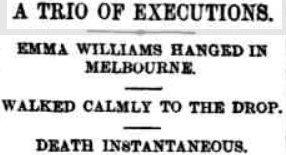
Emma Williams, who was convicted of the murder of her child at Port Melbourne on August 13 last, was executed in Melbourne Gaol this morning in the presence of about a dozen persons.

Public excitement was aroused over the murder when it was first discovered owing to the callous and unfeeling way in which the deed was done and the careless attitude of the mother afterwards. The victim, who was only two years of age, was taken by its mother to the pier in the Sandridge Lagoon, where she tied a stone to its body and pushed it into the water.

After her conviction the Anti-Capital Punishment League made strenuous efforts to obtain a reprieve, chiefly because the condemned woman alleged that she was pregnant.

Medical examinations did not support that statement, and it was discovered on Friday last that the condition which lent color to the woman’s statements was produced artificially.

At first Williams treated her terrible sentence with apparent unconcern, being buoyed up with the hope of reprieve; but when that expectation had passed she became most devout and earnest in her attentions to the ministrations of the gaol chaplain (the Rev. H. F. Scott), by whom she was attended to the scaffold. She expressed great sorrow for the crime she had committed and for the loose life she had led.

She remained in that frame of mind to the end.

When the sheriff demanded the body of the prisoner from the governor of the gaol at the door of the little cell alongside the gallows this morning she walked calmly on to the drop, but her face was blanched and wore a terrified expression.

In answer to the usual questions from the sheriff as to whether she wished to say anything Williams answered “No,” in a low but firm voice.

The white cap was immediately drawn over her face and the rope adjusted, and then, as Roberts, the hangman, turned to pull the lever, she exclaimed, “Oh, Lamb of God, I come.”

The next moment the drop fell, and at that moment Williams uttered a nervous, plaintive exclamation that was not quite a scream. Then all was over. The whole of the proceedings did not occupy more than a quarter of an hour, and death was instantaneous.

The dead woman had a very eventful career, having been married when she was 14 years old. At 15 she bore a daughter, who is still living. Her husband left her, and afterwards died in the Melbourne Hospital, while the widow continued a career of dissipation. Her daughter was adopted by a friend of her husband, and the child which she drowned was born after his death.

She was born in Launceston, Tasmania, where her mother still lives.

Brisbane, November 4.
A double execution took place at the Boggo Road Gaol this morning.

Jackey, an aboriginal, was hanged for the murder of a Javanese, Jimmy Williams, at Mount Morgan, and Frank Tinana [or Tinyana -ed.], a Dative of Manila, was executed for the murder of Constable Conroy, on Thursday Island. The men behaved well in prison. Jackey was able to recite prayers taught him by the Bey. Mr. Simmonds, and Father Dorrigan attended Tinana, who admitted having committed murder. He said he bad a jealous quarrel with another colored man, in which Constable Conroy attempted to arrest him. He then stabbed Conroy to death.

During the past few days both condemned men ate and slept well, and this morning they partook of breakfast. When they came upon the scaffold Tinana was agitated and seemed afraid. Neither man spoke.

The preliminaries were quickly arranged and the bolt was drawn. Death, in each case was apparently instantaneous. When Jackey, whose height was nearly 6 ft, fell blood burst from his nose and stained his white cap.


Diagram from an 1880 memorandum the British government sent to colonial authorities in Queensland detailing procedures for the cutting-edge long drop hanging method.

No colored men were present to witness the execution, which was carried out in the presence of the usual officials. Jackey left a letter to a woman who is looking after his child, telling her to take great care of the infant, to bring it up as a white man’s, and not to let it drink rum or go to the blacks’ camp. Tinana left a letter coached in terms of great affection to his wife.

On this day..

1883: Margaret Harris

(Thanks to Robert Elder of Last Words of the Executed — the blog, and the book — for the guest post. This post originally appeared on the Last Words blog. Fans of this here site are highly likely to enjoy following Elder’s own pithy, almanac-style collection of last words on the scaffold. -ed.)

“I am going to tell the truth before God. I am innocent of the charge…My kin people brought me to this, and I want them to pray to meet me in heaven. I have heard they said hanging was too good for me, that I ought to be burned…I hope this poor man will be released, as he is innocent before God.”

(Turning to her sister on the scaffold:)

“I want to be buried by the side of my mother, but they will not allow it. They don’t care what becomes of my body. Good-bye! Sister, good-bye!”

— Margaret Harris, convicted of murder, hanging, Georgia.
Executed October 19, 1883

Servant Harris, age eighteen, was accused of poisoning the family she worked for in order to leave and live with David Dukes, her alleged accomplice, whom she referred to as “this poor man.” Prosecutors said she first added the poison to coffee, which only sickened her mistress, widow Nancy Barnwell, and Barnwell’s two grandchildren. She then added poison, procured from Duke, to rice, killing one of the grandchildren. A commutation was requested from the governor, but it was refused “as there has lately been a perfect avalanche of poisoning cases and an example needed to be made of it,” according to the Chicago Daily Tribune. At the hanging, “In the Sweet By-and-By” was sung by the four clergymen attending. The condemned and spectators joined in the song.

On this day..

1937: Panfiliya Tanailidi, Azerbaijani actress

On this date in 1937, Azerbaijani actress Panfiliya Tanailidi (various other transliterations are possible) was purged during Stalin’s terror.

Born in a tsarist governorate to Greek emigres, Tanailidi (English Wikipedia entry | Azerbaijani) was treading the Caucasus boards as a teenager in the pregnant century’s first decade.

She became an accomplished stage and screen actress, starring in 1930s silents Ismet and Almaz.

Come the Stalin years when any pretext was enough to destroy a body, the pretext against Tanailidi was apparently her affiliations with an Iran then taking a concerted anti-Soviet line: the actress had toured Iran in 1917 and had friends like Govhar Aliyeva who had fled the Soviet Union for Iran. This was more than enough to cast the pall of espionage about her.

On this day..

1793: The slave Nell

Original from the Calendar of Virginia State Papers and Otner Manuscripts:

Champion Travis to the Governor

Sir:

Enclosed is a statement of the evidence which appeared against Daphne and Nell, two negroes convicted for the murder of Joel Garthright, which would have been sent sooner had the Attorney been in Town.

And am,
Your humble servant.


The evidence against Daphne and Nelly, two Slaves belonging to Col. Champion Travis, who were tried and convicted by the court of James City County in the month of June, for the murder of Joel Gathright, Col. Travis’s overseer, as well as my memory enables me to state it, was in substance follows:

It was proved in plain and positive terms by two negro boys, who were present and saw the greater part of the transaction, that Daphne and Nelly, the two criminals now under condemnation, were at work with ploughs on the day on which the overseer was killed, and the boys themselves leading the oxen to the ploughs.

Gathright, the overseer, came at his usual time to the field where these women were working, and blamed Nelly for suffering the fence to be left open, which had exposed the corn growing to be cropped by the sheep.

Nelly denied the charge and used some impertinent language, which provoked the overseer to strike her. This he did repeatedly with a small cane, till Nelly quitted her plough and ran; the overseer pursued and struck her on the ground after she had fallen.

Nelly recovered from her fall, and immediately engaged him. The woman Daphne, who was at a small distance off, as soon as she saw Nelly closely fighting with the overseer, ran to the place where they were engaged, and together they seized and threw him to the ground. They beat him on the ground with their fists and switches with great fury a considerable time.

The overseer made frequent efforts to raise himself up and get from them in vain, and demanded to know if they intended to kill him.

At length he ordered one of the boys, the witness, to go to a remote part of the field where the negro men were at work, and call one of them to his assistance; after some time, he sent the other boy.

The boys executed their orders, and soon returned to the place they had left; when they returned, the women, Daphne and Nelly, had fled, and an old negro man belonging to Col. Travis assisted to raise the overseer from the ground, who soon after expired.

It was proved by an old negro man, who kept a mill in the neighborhood of Col. Travis’s plantation, that these two women, Daphne and Nelly, in the afternoon of the same day on which they killed the overseer, passed the mill on their way to Williamsburg; and being asked by the old fellow where they were going, and what was the matter — seeing some disorder in their appearances, they replied that they had whipped their overseer, and were going to town to their master.

They were urged by the miller to go on, lest the overseer should overtake them; they observed that they had left him unable to move, and Daphne asked the old man if a woman could be hanged for killing a man.

Several white men who came to the place shortly after the scene was closed, and who were Jurors in the inquest held on his body, proved the violence committed on the body, and a fracture of the skull, which they imagined was made by a stone found a few feet from the head of the unfortunate man.

The Criminals, Daphne and Nelly, were tried separately, and the boys closely and rigidly examined; on each trial they delivered the same clear and unequivocal testimony. The criminals were undefended, but asked themselves many questions of the witnesses, which, as well as I remember, were answered strongly against them.

Ro. Sanders.
Attorney for James City County
July 26, 1793

Elsewhere in antebellum human chattelry: this from the Columbian Gazetteer, Oct. 28, 1793.

The full court record ensues in these same papers, demonstrating the same circumstances. Daphne was duly hanged on July 19, but “it being suggested to the court that the said Nelly is quick and big with child, it is commanded the Sheriff of this county that he cause execution of the above Judgement to be done on Friday the fourth day of October next. The Court also valued the said Nelly at fifty pounds Current money.”

(The timeline here implies that Nelly would have been about six to seven months pregnant when overseer Gathright began thrashing her for leaving the fence gate ajar.)

Nelly’s fate moved enough tender-hearted white neighbors to petition for her reprieve, a petition that was rebutted by a furious confutation with vastly more numerous signatories noting that “not a single circumstance appeared in alleviation of the horrid offence.” Can’t think of a one!

At any rate,

She has been delivered of her child some weeks, and now awaits the Execution of her sentence. We have heard with great emotion and concern that much Industry has been exerted to get signatures to a petition to your Excellency and the Hon’ble Board of Council to obtain a Pardon for the said negro woman, Nell; when we consider the alarming commotions which have lately existed among the negroes in this neighborhood, and the dangerous example of such a murder, we humbly conceive it necessary for the public peace that the course of the law should have its full effect in this instance.

And it did.

On this day..

1568: Leonor de Cisneros, chastised wife

On this date in 1568, Leonor de Cisneros was burned as a heretic in Valladolid — nine years late, by her reckoning.

Leonor de Cisneros (English Wikipedia entry | a token Spanish Wikipedia entry | the much more detailed German) and her much older husband Antonio Herrezuelo* were among the first converts to the Lutheran circle in Valladolid funded by Don Carlos de Seso. The Inquisition got its hands on these wrongthinkers in the late 1550s and the result was an auto de fe on October 8, 1559 at which King Philip personally witnessed the Christlike suffering of Don Carlos and 12 of his adherents.

However, while 13 died, dozens of others succumbed to the Inquisition’s pressure to recant, and live. Leonor de Cisneros was one of them.

The monstrous spectacle of the auto de fe featured an elaborate symbolic language encoded for the spectators in the ritual sanbenitos in which the accused were made to parade, such as the example pictured at right.** Different patterns denoted which heretics were bound for the stake, and which had reconciled to a wary Church … and it is said that when Antonio, en route to his pyre draped in illustrations of hellfire to represent his fatal obduracy, beheld his wife in the colors of a penitent, he savagely reproached her cowardice.

Obviously shaken, Leonor returned to her prison with a prayer in her soul and a flea in her ear. Soon enough she had relapsed into her heresy, and this time no punishment or exhortation could move her — knowing as she well did that in her stubbornness she solicited her martyrdom.

* Leonor was born in the mid-1530s, so would have married and converted to Protestantism around the age of 18. Antonio was born about 1513.

** Source: this public-domain volume on the notorious Inquisitor Torquemada.

On this day..

1675: Katharina Paldauff, the Flower Witch

It was likely on, and certainly about, this date in 1675 that the Riegersburg Castle keeper’s wife was burned as the “flower witch”.


Riegersburg Castle. (cc) image from Tobias Abel.

This dramatic keep roosting atop a volcanic crag in southeast Austria today hosts a Witch Museum exhibiting the treatment meted out to those infernal agents.

This castle had perhaps become identified as a hostelry of sorceresses by dint of its long management under the Countess Katharina Elisabeth Freifrau von Galler, an iron-willed noblewoman who did not fear to assert prerogatives of power more commonly reserved for male hands — not least of which from the standpoint of posterity’s tourism industry was much of the castle construction one beholds there today.

“The bad Liesl” — one of her chiding nicknames — died in 1672 and coincidentally or not a witch hunt swept the surrounding region of Styria from 1673 to 1675.

The best-remembered of the accused was the commoner who almost literally personified the Bad Liesl’s fortress: Katharina Paldauf (English Wikipedia entry | German), the wife of Riegersburg Castle’s chief administrator.

She was ensnared in the usual way, when accusations from other defendants, who were being tortured for the identities of their witches’ sabbath affiliates, compounded against her. These charges credited Paldauf with the power to conjure foul weather from the depths of hell, as well as murdering children and pitching them into the castle well. In a more grandmotherly vein (Paldauf was 50; older women appear to have been disproportionately vulnerable to witch charges) she’s said to have had the power to pluck blooming flowers even in the dead of winter — the source of her Blumenhexe repute, although this legend, er, stems from folklore rather than anything in the documentary record.

Torture broke her.

On this day..