1741: John Hughson, Sarah Hughson and Peggy Kerry, “so abandoned to confederate with Slaves”

On this date in 1741, “John Hughson, Sarah his wife, and Margaret Kerry, were executed according to sentence” for the slave conspiracy to burn New York.

They were the first white people executed in the affair, and when their 16-year-old indentured servant Mary Burton first described a plot to fire the city hatched by thronging slave conclaves at the Hughsons’ tavern, the by the account of the court’s officer Daniel Horsmanden, it “was most astonishing to the Grand Jury … that any white People should become so abandoned to confederate with Slaves in such an execrable and detestable Purpose.”

Whether there ever really was an execrable and detestable Purpose or whether white New Yorkers convinced of the arson plot were just chasing ghosts, nobody can say with certainty. But the Hughsons most definitely did confederate with slaves. The keeper of a dockside tavern on the Hudson, Hughson catered to the colony’s lower strata: both blacks and poor whites frequented the place, and for the criminal element among them Hughson kept up a side business as a small-time fence of stolen goods.

Back in 1738, the Hughsons had moved to that location from the South Ward — driven, one infers, by complaints of a previous neighbor that they “kept a very disorderly House, and sold Liquor to, and entertained Negroes.” Three of those Negroes were the slaves Caesar, Prince and Cuffee, who in January of 1738 had been busted for breaking into another tavern in town and carrying away the gin … an incident that by 1741 their prosecutors were characterizing as the germ of a years-long plot to orchestrate the annihilation of New York.*

The keystone to the 1741 wave of prosecutions — the break in the case, from the standpoint of the court — occurred on April 22, when Burton provided the Grand Jury a damning description of her master and mistress as the kingpins of a murderous cabal. Burton swore

That Caesar, Prince, and Mr. Philipse’s Negro Man (Cuffee) used to meet frequently at her Master’s House, and that she has heard them (the Negroes) talk frequently of burning the Fort; and that they would go down to the Fly(d) and burn the whole Town: and that her Master and Mistress said, they would aid and assist them as much as they could.

That in their common Conversation they used to say, that when all this was done, Caesar should be Governor, and Hughson her Master should be King.

That Cuffee used to say, That a great many People had too much, and others too little; That his old Master had a great deal of Money, but that, in a short Time, he should have less, and that he (Cuffee) should have more.

That at the Meetings of the Three aforesaid Negroes, Caesar, Prince, and Cuffee, at her Master’s House, they used to say, in their Conversation, That when they set Fire to the Town, they would do it in the Night, and as the white People came to extinguish it, they would kill and destroy them.

Up until that point, the court had a suspicion of an arson campaign, based on a series of fires that looked like a pattern but might have been coincidental. Burton’s deposition gave that suspicion tangible shape, and structured all the proceedings to follow. And in her telling, it all started with Hughson, Hughson, and Kerry.

It was a story that fit what the judges would know or believe about them: besides the Hughsons’ underclass and criminal connections, the Hughsons’ Irish lodger Peggy Kerry was Caesar’s lover and the mother of his infant son. “She was a person of infamous character, a notorious prostitute, and also of the worst sort, a prostitute to negroes,” Horsmanden sneers in the introduction he wrote to his compendium of proceedings.

“Here is laid the foundation of the characters of Hughson and his family, which will afford frequent occasion of enlarging upon; and from such a hopeful earnest the reader may well expect a plentiful harvest.”

Peggy Kerry, that “Newfoundland Irish beauty,” now came under relentless pressure to corroborate Mary Burton. Prostitute to Negroes or no, she was badly needed to add credibility (and legal certainty) to Burton’s charge.

Jailed and facing the prospect of execution, she nevertheless stubbornly refused every blandishment to adhere to Mary Burton’s version of events — a version that would surely doom her friends the Hughsons and her lover Caesar.

She paid the last price or her obstinance. Arthur Price, the jailhouse snitch who eventually doomed Cuffee, entered the case by telling investigators that Peggy said to him all the stuff they wanted her to say to them.

[Price asked] What, Peggy; were you a going to set the Town on fire? And she made Answer, She was not; but said, by God, since I knew of it, they made me swear: Upon which the Deponent asked her, Was John and his Wife in it? (meaning John Hughson and his Wife) And she answered Yes, by God, they were both sworn as well as the rest. Then the Deponent asked her, if she was not afraid that the Negroes would discover her? And she said, No; for Prince, Cuff and Caesar, and Forck’s [Vaarck’s] Negro [Caesar] were all true-hearted Fellows.

And by the way, she added,

for your Life and Soul of you, you Son of a Bitch, don’t speak a Word of what I have told you.

Whether or not Peggy Kerry really did say all this incriminating stuff to her fellow dungeon denizen, Price’s report laid her in the magistrates’ trap. Now she was already the second witness, via Price — and without the benefit of leniency that she could have procured by talking herself. The pending conspiracy charge dangled over her head.

Finally, on May 7, she made a too-little, too-late grab at mercy by describing plotters meeting not at the Hughsons’, but at the house of a nearby cobbler, John Romme. Heartbreakingly, she put the father of her son into the scene: she had abandoned any hope of saving him.

This half-confession, as the magistrates saw it, only redounded against her for upon interrogation Elizabeth Romme denied everything (John Romme had left, or fled, town). Romme’s place was a dead end in the investigation but Kerry’s saying it confirmed that she was privy to something about the plot — something she might still be withholding. “From what had hitherto come to Light concerning this Mystery of Iniquity, it was scarce to be doubted, but Peggy had it in her Power to unfold a great deal more,” Horsmanden remarks in his entry for May 14. “Though what Peggy had already disclosed seemed to merit something; yet it was not altogether satisfactory; and ’twas thought proper she should be arraigned upon the Indictment for the Conspiracy, upon the Supposition that this Step might probably be a Means of bringing her to a Resolution of making a full Discovery of what she knew.”

For the next weeks, the court routed around the intransigence of its would-be star witness, and increasingly made her prospective evidence irrelevant. There was Arthur Price’s deposition, to begin with; to this crown’s evidence was added witnesses we have already met in the trials of the other other men: Sandy, Sarah, Fortune. There were the desperate “confessions” extorted from Quack and Cuffee at the stake.

John Hughson, who was being fitted for the halter, could see what was up. With his wife and now his daughter as well both in jail, Hughson asked on June 1 to see Daniel Horsmanden, “to open his Heart to them, and they should know more.” What deal was he hoping to cut? Could he extricate himself? Would he trade his own life to save his family?

We don’t know, because Horsmanden made it clear in their interview that not John Hughson nor Sarah Hughson nor Peggy Kerry had an ounce of leverage remaining.

[I] reproached him with his wicked Life and Practices, debauching and corrupting of Negroes, and encouraging them to steal and pilfer from their Masters and others; and for shewing his Children so wicked an Example, training them up in the High-Way to Hell: He further observed to him, that his Wife, and Peggy, then stood convicted of a Felony for receiving stolen Goods of Negroes; and that now nothing remained but to pass Sentence of Death upon them, and to appoint a Day for their Execution for that Fact; but that it was now determined, that he, his Wife and Daughter, and Peggy, should also be tried for being confederated in this most horrible Conspiracy; that the Evidence would appear so strong and clear against them in this Particular, that there was little doubt of their being all convicted upon that Head also; that it would appear undeniably that he was a Principal, and head Agent in this detestable Scheme of Villany; the chief Abettor, together with the rest of his Family, of this execrable and monstrous Contrivance for shedding the Blood of his Neighbours, and laying the whole City in Ashes, upon the Expectation of enriching himself by such an inhuman and execrable Undertaking: He therefore admonished him, if he would entertain the least Hopes of recommending himself to the Mercy of God Almighty, before whose Tribunal he must soon appear, that he would ingenuously tell the Truth, and lay open the whole Scene of this dark Tragedy, which had been brooding at his House; and discover the several Parties he knew to have been engaged in it; in doing which he would make some Attonement for his past Villanies, by preventing that Slaughter, Bloodshed and Devastation which he and his Confederates had intended.

Disabused of any hope, Hughson “put on a soft smiling Air of Innocence” and “declared, he knew Nothing at all of any Conspiracy; and called God to witness his Protestations, that he was as innocent with respect to that Charge as the Child unborn, and also his Wife, Daughter, and Peggy for aught he knew.” He would go to trial with those three on June 4.

That proceeding was a walkover, as Horsmanden had predicted. Mary Burton was the star witness against her former master and mistress, with Arthur Price’s account of Peggy Kerry’s confessions thrown in for good measure.

Following these came a litany of the Hughsons’ current and former white neighbors who damned the Hughson house as a regular haunt of the city’s black population — that “a Cabal of Negroes” was frequently entertained, that Peggy had been seen serving them and both the Hughson mother and daughter danced shamelessly with them, that “whole Companies of Negroes [were] playing at Dice there.”

The real evidence here still rested only upon Mary Burton’s allegation as supported by Arthur Price. But from the trial preceding the court had already fixed that story through the flesh of other men. That others who had hanged and burned already were known to congregate at the Hughsons’ did the necessary work to finish John Hughson, “whose Crimes have made him blacker than a Negro; the Scandal of his Complexion, and the Disgrace of human Nature!”

Such a Monster will this Hughson appear before you, that for sake of the Plunder he expected by setting in Flames the King’s House, and this whole City, and by the Effusion of the Blood of his Neighbours’ — He — Murderous and Remorseless He! — counselled and encouraged the Committing of all these most astonishing Deeds of Darkness, Cruelty, and Inhumanity. — Infamous Hughson! —

Gentlemen,

This is that Hughson! whose Name, and most detestable Conspiracies will no doubt be had in everlasting Remembrance, to his eternal Reproach; and stand recorded to latest Posterity, — This is the Man! — his, that Grand Incendiary! — That Arch Rebel against God, his King, and his Country! — That Devil Incarnate! and chief Agent of the old Abaddon of the infernal Pit, and Regions of Darkness.

These are the rhetorical fulminations of the prosecuting attorney, William Smith, who surely deserves a plaque in that profession’s hall of fame for bridging the distance from some NIMBYing neighbors to the logic and the rhetoric of a witch trial. Hell … just the fact that Hughson had the effrontery to show up and defend himself only went to show what a monster he was.

Was not this Hughson sunk below the Dignity of human Nature — Was he not abandoned to all Sense of Shame and Remorse! — To all Sense of Feeling the dreadful Calamities He has brought on this City, and his fellow Creatures; He would from a Consciousness of his own Guilt. — His monstrous Guilt! — be so confounded, as not able to look up, or stand without the greatest Confusion of Face, before this Court and Audience; but would openly confess his, and the Rest of his wretched Confederates Guilt, and humbly ask Pardon of God, the King, and his injured Country.

And so they died. Of course they died.

Sarah Hughson, the 17-year-old daughter, was spared her sentence. Over the next weeks her orphaned life would be a litany of execution dates imposed and then delayed, trading time for cooperation that Sarah was very reluctant to provide. In whatever combination her age, her sex, and her skin — for as a white person, her evidence had privilege over the allegations of “pagan Negroes” in trials yet to come — would eventually procure her pardon.

But on June 12, her parents and their misfortunate friend Peggy Kerry all went to the gallows. (Not to the pyre, the fate of the black slaves convicted for the conspiracy.) Horsmanden spares for these major trophies a longer narration of their Passion, though this turns out to consist in large measure of Horsmanden complaining one last time how Peggy Kerry didn’t spare any of her last moments to finally give him what he wanted.

The under-sheriff had often advised John Hughson, to make a cofession about the conspiracy, but he always denied he knew any thing of the matter; said he had deserved death for receiving stolen goods. The wife was ever sullen; said little or nothing, but denied all.

The sheriffs observed John Hughson, when he was brought out of jail to be carried to execution, to have a red spot on each cheek, about the bigness of a shilling, which at that time thought very remarkable, for he was always pale of visage: these spots continued all along to the gallows. Amongst other discourse it seems he had said, he did not doubt but some remarkable sign would happen to him, to show his innocence; concerning which more will be observed upon hereafter.** He stood up in the cart all the way, looking round about him as if expecting to be rescued, as was by many conjectured from the air he appeared in: one hand was lifted up as high as his pinion would admit of, and a finger pointing, as if intending to beckon.

At the gallows his wife stood like a lifeless trunk, with the rope about her neck, tied up to the tree; she said not a word, and had scarce any visible motion.

Peggy seemed much less resigned than the other two, or rather unwilling to encounter death; she was going to say something, but the old woman who hung next to her, gave her a shove with her hand, as was said by some, so Peggy was silent.

But they all died, having protested their innocence to the last, touching the conspiracy.

This old woman, as it has been generally reported, was bred a Papist; and Peggy was much suspected of the same persuasion, though perhaps it may seem to be of little significance what religion such vile wretches professed.

From the scanty room in the jail for the reception of so many prisoners, this miserable wretch, upon her conviction with the Hughsons for the conspiracy, was put in the same cell with them; which perhaps was an unfortunate incident; for though she had to the time of their trial screened them from the charge of the conspiracy; yet there was reason to expect, that upon the last pinch, when she found there was no hopes of saving her own life if she persisted, the truth as to this particular would have come out; and indeed it was upon this expectation, that she was brought upon trial for the conspiracy; for her several examinations before set forth, and what Arthur Price had sworn to have dropt from her in accidental talk in jail, had put it beyond doubt, that she was privy to many of the Hughsons’ secrets concerning this detestable confederacy; but when she was admitted to the Hughsons, under the circumstances of conviction and condemnation for the conspiracy, they most probably prevailed with her to persevere in her obstinacy, to the end to cover their own guilt, since they were determined to confess nothing themselves; and they might drive her to desperation by subtle insinuations, that the judges she saw after they had picked all they could but of her, whatever expectations she might have raised from her confessions, or hopes she flattered herself with of saving her life upon the merit of them; yet after all, she was brought to trial and condemned for the conspiracy, as well as they; and why should she expect pardon any more than they: and by such like artifices it is probable they might stop her mouth, and prevent her making further discovery; and not only so, but then of course prevail with her to recant, as to what she had confessed already.

John Hughson endured the posthumous indignity of being gibbeted in chains, on an island† alongside the already-rotting corpse of his former boon companion Caesar — who had hanged fully a month before.

As an unseasonably hot summer emerged in the weeks ahead, Horsmanden would later report how “Hughson’s Body drip’d and distill’d very much, as it needs must, from the great Fermentation and Abundance of Matter within him,” bloating to “Gigantick” proportions until at last “Hughson’s Corps unable to contain its Load, burst and discharged Pails full of Blood and Corruption” to the disgust of some nearby fishermen “to whom the Stench of it was very offensive.” The progress of this revolting fermentation was one reason guessed by “amused” New Yorkers for a queer phenomenon, that as they dangled in their manacles,

Hughson was turned Negro, and Vaarck’s Caesar a White; and when they came to put up York in Chains by Hughson (who was hung upon the Gibbet three Weeks before [and not yet exploded from his fermentation -ed.]) so much of him as was visible, viz. Face, Neck, Hands and Feet, were of a deep shining Black, rather blacker than the Negro placed by him, who was one of the darkest Hue of his Kind; and the Hair of Hughson’s Beard and Neck (his Head could not be seen, for he had a Cap on) was curling like the Wool of a Negro’s Beard and Head; and the Features of his Face were of the Symmetry of a Negro Beauty; the Nose broad and flat, the Nostrils open and extended, the Mouth wide, Lips full and thick, his Body, (which when living, was tall by the View upwards of six Feet, but very meagre) swell’d to a Gigantick Size; and as to Caesar (who, tho’ executed for a Robbery, was also one of the Head Negro Conspirators, had been hung up in Chains a Month before Hughson, and was also of the darkest Complexion) his Face was at the same Time somewhat bleach’d or turned whitish; insomuch that it occasion’d a Remark, That Hughson and he had changed Colours.

* In New York Burning: Liberty, Slavery, and Conspiracy in Eighteenth-Century Manhattan, Jill Lepore — who believes that the “plot” was fictitious — unpacks a confusing part of the 1737-1738 backstory that might help us straddle the space between reality and fantasy in this strange case.

Lepore suggests that the city’s controversial Freemasons club, which was then prominent enough for active parody in the city’s press, led John Hughson to form a mock secret society at his cronies’ saturnalias whose joke “initiations” had downtrodden friends and even casual acquaintances boozily (but jestingly) vow to torch the city. During the (actual or perceived) arson wave of 1741, New York’s court would read a far more sinister intent to this sort of talk, and there are consequent references in the trial records to a “three-year conspiracy.”

** Much later in his narrative, Horsmanden gets around to an indeterminate speculation that the red spots on John Hughson’s cheeks might have been the product of his attempting to cheat the executioner with an insufficient poison. Evidently this was a rumor abroad in New York, though Horsmanden doubted the truth of it.

† The gibbet stood “near the powder-house,” which places it on a small island — long since gobbled up by the metropolis — within the marshes of Collect Pond. That’s around the present-day park named for Thomas Paine, which is just south of what’s now Collect Pond Park and at the time stood outside of the city’s main settlement.

Once an essential source of fresh water for Manhattanites, Collect Pond soon became overtaxed by the growing population and polluted by its use as a common sewer, devolving into a foetid slough. This public health hazard was destined for a grand future in New York’s crime annals, for once it was filled in the streets above it became New York’s legendary underworld nest, the Five Points. They were also the original site of The Tombs prison, which had structural problems from its outset due to land subsiding into the buried quagmire.


The Powder House, marked on a 1766 map of New York. (See large original version here.)

Part of Corpses Strewn: New York’s Slave Conspiracy of 1741.

On this day..

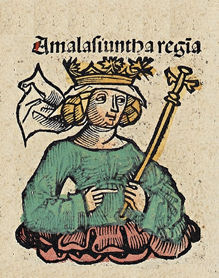
535: Amalasuntha, daughter of Theodoric

On or around this date in 535,* the Ostrogothic queen Amalasuntha was put to death in the Italian lake island of Martana (You can also find her name rendered Amalasountha and Amalaswintha.)

The Roman-educated princess had inherited rulership of the Ostrogothic Kingdom, a successor state to the lately fallen Roman Empire, from its redoutable founder Theodoric. Technically the crown had passed to Amalasuntha’s 10-year-old kid; ruling as regent in a perilous situation, mom cultivated an alliance with the Byzantine emperor Justinian.

Her son took to boozing and carousing and died as a teenager, so Amalasuntha sought a new male imprimatur for her reign by the expedient of marrying a wealthy cousin, Theodahad. Though the nuptial deal had been for Theo to butt out of actual governance, he immediately strove to convert his power from titular to actual and became his wife’s deadliest rival — and then clapped her in prison. From the History of the Wars of Byzantine scribbler Procopius:

Theodahad, upon receiving the supreme power, began to act in all things contrary to the hopes she had entertained and to the promises he had made. And after winning the adherence of the relatives of the Goths who had been slain by her — and they were both numerous and men of very high standing among the Goths — he suddenly put to death some of the connections of Amalasuntha and imprisoned her, the envoys not having as yet reached Byzantium. Now there is a certain lake in Tuscany called Vulsina, within which rises an island, exceedingly small but having a strong fortress upon it. There Theodatus confined Amalasuntha and kept her under guard.

A Roman diplomat named Peter had already been dispatched by this time from the court of Constantinople to do some routine statecraft with the Goths, and he learned of the surprise reshuffling of power when he met Theodohad’s envoys on the road.

Procopius says — or does he? — that Byzantium tried to twist the Goths’ shaggy arms in support of their matronly ally, but could not prevail against the vengeance of the deposed queen’s foes.

When the Emperor Justinian heard these things, he formed the purpose of throwing the Goths and Theodahad into confusion; accordingly he wrote a letter to Amalasuntha, stating that he was eager to give her every possible support, and at the same time he directed Peter by no means to conceal this message, but to make it known to Theodatus himself and to all the Goths. … Now when Peter arrived in Italy, it so happened that Amalasuntha had been removed from among men. For the relatives of the Goths who had been slain by her came before Theodahad declaring that neither his life nor theirs was secure unless Amalasuntha should be put out of their way as quickly as possible. And as soon as he gave in to them, they went to the island and killed Amalasuntha, — an act which grieved exceedingly all the Italians and the Goths as well. For the woman had the strictest regard for every kind of virtue … Theodahad, such was his stupid folly, while still holding the slayers of Amalasuntha in honour and favour kept trying to persuade Peter and the emperor that this unholy deed had been committed by the Goths by no means with his approval, but decidedly against his will.

The “stupid folly” helped to trigger Justinian’s war against the Goths, which resulted in Byzantium’s conquest of Italy and (temporary) reunification of the empire. It also led Amalasuntha’s son-in-law Vitiges to depose and murder Theodahad in his own turn: just another turn of the wheel among backstabbing aristocrats.

Speaking of which: despite the pious good faith Procopius presents for Byzantium in his history above, his gossipy Secret History rewrites the story to attribute Amalsuntha’s fall not to the Ostrogoths’ internal political rivalries but to a catty assassination by Byzantine empress Theodora, whose low-born origin shows through here in murderous insecurity:

At the time when Amalasuntha, desiring to leave the company of the Goths, decided to transform her life and to take the road to Byzantium, as has been stated in the previous narrative, Theodora, considering that the woman was of noble birth and a queen, and very comely to look upon and exceedingly quick at contriving ways and means for whatever she wanted, but feeling suspicious of her magnificent bearing and exceptionally virile manner, and at the same time fearing the fickleness of her husband Justinian, expressed her jealousy in no trivial way, but she schemed to lie in wait for the woman even unto her death. Straightway, then, she persuaded her husband to send Peter, unaccompanied by others, to be his ambassador to Italy. And as he was setting out, the Emperor gave him such instructions as have been set forth in the appropriate passage, where, however, it was impossible for me, through fear of the Empress, to reveal the truth of what took place. She herself, however, gave him one command only, namely, to put the woman out of the world as quickly as possible, causing the man to be carried away by the hope of great rewards if he should execute her commands. So as soon as he arrived in Italy — and indeed man’s nature knows not how to proceed in a hesitant, shrinking way to a foul murder when some office, perhaps, or a large sum of money is to be hoped for — he persuaded Theodahad, by what kind of exhortation I do not know, to destroy Amalasuntha. And as a reward for this he attained the rank of Magister, and acquired great power and a hatred surpassed by none.

* The allusion to April 30 comes from Procopius but is ambiguously presented. When it comes to the age of antiquity, however, we’re typically grateful to get any date whatever.

On this day..

1895: A quintuple lynching in Greenville, Alabama

(Thanks to Meaghan Good of the Charley Project for the guest post. -ed.)

On this date in 1895, three black women and two black men were lynched in Greenville, Alabama for the murder of Watts Murphy, white.

Watts was a “young man of great prominence” who was said to be the nephew of Alabama’s former governor, Thomas H. Watts. He was killed on April 17, aged about thirty. When he failed to arrive home, his family began looking for him. Finally, one of the family servants confessed to what he knew: Watts had been working in the field with six black people, three men and three women, and one of the men hit him on the head with a tree limb. The others beat him unconscious and carried his body to a secluded area, where the women gathered loose brush, piled it on top of Watts’s body, and set the heap ablaze.

Newspapers reported grisly details about the crime, saying that the murderers kept piling wood on the fire until there was nothing left but the victim’s teeth, his heart and his liver, which “for some unknown reason failed to burn.”

Just why the murder happened has been lost to history, and various contradictory rumors floated around. According to one story, one of the men planned to kill him in revenge for “an imaginary wrong of a trivial nature.” In another account, it was an impulsive act of violence, the result of an argument.

Daily Inter Ocean (Chicago, Ill.), April 22, 1895

Zeb Caley or Calley, Martha Greene, Alice Greene, Mary Deane, and John Rattler were arrested on April 20 near Butler Springs, Alabama, and charged with murder. (The third man who was implicated, left unnamed in press reports, got away.) A group of men was charged with transporting the five prisoners sixteen miles to the security of jail in Greenville. They set off at 11:00 p.m. At 3:00 a.m., while the party was en route, a mob of approximately 100 men brandishing Winchester rifles surprised the party on the road, surrounded them and took the prisoners away.

The members of the mob tied each person’s hands, lead them one by one to the side of the road, and hanged them from trees. Later that day the bodies were seen by people passing by on their way to church.

On April 29, the sixth suspect in the crimes, who has never been identified, was found hanging from a tree in the same general area as the other ones. He had been dead for about a day.

On this day..

316 BCE: Olympias, mother of Alexander the Great

On an unknown date about the spring of 316 BCE, Alexander the Great’s snake-worshipping mother Olympias surrendered to the siege of the former regent’s ambitious son — whereupon she was put to summary death.

The Epirote princess married Philip II of Macedon. Though Philip had put her aside for a younger queen, Olympias adroitly maneuvered her brilliant son* Alexander to the throne from which he conquered Babylonia and Persia, and history is not confident that she stopped short of regicide to secure Alexander’s precedence.

Olympias was famed for her snake-handling: Plutarch says that Philip’s interest in her waned when he beheld “a serpent … lying stretched out by the side of Olympias as she slept,” which led him to fear “that she was the partner of a superior being.” Sigmund Freud, eat your heart out.

Sired by the gods or no, Olympias’s son certainly outstripped his father — but once Alexander’s coruscating star burned itself out, Olympias had another kind of snakepit to contend with: the conqueror’s former generals jockeying for preeminence in their engorged empire.

The patina of dynastic legitimacy Olympias maintained as Alexander’s kin was not sufficient to prevent the situation collapsing into war; indeed, we have met this this civil strife previously in these pages, when Olympias had the upper hand in a battle in 317 BCE and ordered the execution of Alexander’s mentally disabled half-brother. Olympias gets her share of stick as old time Macedonia’s deadly ophiomormous femme fatale, but this was cruelty with a purpose: the addled king was the catspaw in whose name her foe Cassander (as his father Antipater before him) claimed power as “regent”.

Cassander, a mate of Alexander dating back to their Aristotle study group days, was not captured in this affair, nor was he driven from the field by it. Soon thereafter he turned the tables and trapped Olympias in Pydna, where she was obliged to surrender to his discretion. That same logic of murder in statecraft turned now against the queen. First century (BCE) Greek historian Diodorus Siculus:

Although Cassander had shut Olympias into Pydna in Macedonia, he was not able to assault the walls because of the winter storms, but by encamping about the city, throwing up a palisade from sea to sea, and blockading the port, he prevented any who might wish to aid the queen from doing so. And as supplies were rapidly exhausted, he created such famine among those within that they were completely incapacitated. In truth, they were brought to such extreme need that they gave each soldier five choenices of grain per month, sawed up wood and fed the sawdust to the imprisoned elephants, and slaughtered the pack animals and horses for food. While the situation of the city was so serious and while Olympias was still clinging to hopes of rescue from outside, the elephants died from lack of nourishment, the horsemen that were not in the ranks and did not receive any food whatever nearly all perished, and no small number of the soldiers also met the same fate. Some of the non-Greeks, their natural needs overcoming their scruples, found flesh to eat by collecting the bodies of the dead. Since the city was being quickly filled with corpses, those in charge of the queen’s company, though they buried some of the bodies, threw others over the city wall. The sight of these was horrible, and their stench was unbearable, not merely to ladies who were of the queen’s court and addicted to luxury, but also to those of the soldiers who were habituated to hardship.

As spring came on and their want increased from day to day, many of the soldiers gathered together and appealed to Olympias to let them go because of the lack of supplies. Since she could neither issue any food at all nor break the siege, she permitted them to withdraw. Cassander, after welcoming all the deserters and treating them in most friendly fashion, sent them to the various cities; for he hoped that when the Macedonians learned from them how weak Olympias was, they would despair of her cause. And he was not mistaken in his surmise about what would happen: those who had resolved to fight on the side of the besieged forces changed their minds and went over to Cassander; and the only men in Macedonia to preserve their loyalty were Aristonoüs and Monimus, of whom Aristonoüs was ruler of Amphipolis and Monimus of Pella. But Olympias, when she saw that most of her friends had gone over to Cassander and that those who remained were not strong enough to come to her aid, attempted to launch a quinquereme and by this means to save herself and her friends. When, however, a deserter brought news of this attempt to the enemy and Cassander sailed up and took the ship, Olympias, recognizing that her situation was beyond hope, sent envoys to treat of terms. When Cassander gave his opinion that she must put all her interests into his hands, she with difficulty persuaded him to grant the single exception that he guarantee her personal safety. As soon as he had gained possession of the city, he sent men to take over Pella and Amphipolis. Now Monimus, the ruler of Pella, on hearing the fate of Olympias, surrendered his city; but Aristonoüs at first was minded to cling to his position … [until] Olympias wrote to him demanding his loyalty and ordering him to surrender, he perceived that it was necessary to do as ordered and delivered the city to Cassander, receiving pledges for his own safety.

Cassander, seeing that Aristonoüs was respected because of the preferment he had received from Alexander, and being anxious to put out of the way any who were able to lead a revolt, caused his death through the agency of the kinsfolk of Cratevas. He also urged the relatives of those whom Olympias had slain to accuse the aforesaid woman in the general assembly of the Macedonians. They did as he had ordered; and, although Olympias was not present and had none to speak in her defence, the Macedonians condemned her to death. Cassander, however, sent some of his friends to Olympias advising her to escape secretly, promising to provide a ship for her and to carry her to Athens. He acted thus, not for the purpose of securing her safety, but in order that she, condemning herself to exile and meeting death on the voyage, might seem to have met a punishment that was deserved; for he was acting with caution both because of her rank and because of the fickleness of the Macedonians. As Olympias, however, refused to flee but on the contrary was ready to be judged before all the Macedonians, Cassander, fearing that the crowd might change its mind if it heard the queen defend herself and was reminded of all the benefits conferred on the entire nation by Alexander and Philip, sent to her two hundred soldiers who were best fitted for such a task, ordering them to slay her as soon as possible. They, accordingly, broke into the royal house, but when they beheld Olympias, overawed by her exalted rank, they withdrew with their task unfulfilled. But the relatives of her victims, wishing to curry favour with Cassander as well as to avenge their dead, murdered the queen, who uttered no ignoble or womanish plea.

Such was the end of Olympias, who had attained to the highest dignity of the women of her day, having been daughter of Neoptolemus, king of the Epirotes, sister of the Alexander who made a campaign into Italy, and also wife of Philip, who was the mightiest of all who down to this time had ruled in Europe, and mother of Alexander, whose deeds were the greatest and most glorious.

Cassander would emerge from all this mess in a sturdy enough position to declare himself king. His sons, however, were unable to sustain the family in power and this particular general proved merely the precursor of a different general‘s more successful post-Alexander dynasty.

A monumental tomb recently discovered in the Kasta burial mound at Amphipolis — said to beggar the gorgeous Vergina tomb in scale and grandeur — has been speculatively associated with Olympias and/or Alexander. (“Hopefully” might be the better word, since the bare hint of such a link would be a boon for the tourism sector.) The site is still being excavated, and is not yet open to the public.

* Legend holds that Olympias gave birth to Alexander on the same day Herostratus torched the Temple of Artemis.

On this day..

1725: Maria Romberg, her lover, her maid, and her witch

Infamous Swedish murderer Maria Romberg and three accomplices were beheaded in the city of Boras on this date in 1725.

Romberg (English Wikipedia entry | Swedish) was the daughter of a magistrate in that town and given in an arranged marriage to a merchant 27 years her senior. Anders Boberg was said to be an abusive drunk; it’s a sure bet that even at his best he had quite a bit less in common with his wife than did her childhood friend Haqvin Wijndruf. These two carried on a years-long affair heedless of appearances; when later implicated in murder, numerous servants and confidantes were availiable to paint the adulterers in scarlet, as did the 500-odd love letters that they had helped the pair shuttle back and forth.

By December 1724, Maria and Haqvin had been trying for going on two years to get rid of the sot. Once again evincing a mind-boggling want of discretion, they had enlisted two other outsiders into the plot: a maid named Karin Andersdotter, and a folk magician named Romans Ingeborg (who was initially hired to bewitch Haqvin to his death, but got to stay in the game even when her sorcery proved unequal to assassination).

Three days after Christmas, the three women in the conspiracy — Maria, Karin, and Romans — simply crept into Anders’s bedroom and battered him to death as he slept, afterwards positioning the body in an attempt to make it look like he had simply fallen near the fireplace and cracked open his head.

Forensic science wasn’t exactly CSI quality in the 1720s, but it was good enough to see through that story. The lovers and killers had not the wit or steel to throw up a veil of silence, and at the first cock of an inquisitorial eyebrow, they all started blabbing and pointing fingers.

According to this Swedish blogger, the site where they all lost their heads is a placid hill on a biking path near Lake Ramnasjön.

On this day..

1546: Alice Glaston, age 11

(Thanks to Meaghan Good of the Charley Project for the guest post. -ed.)

On this date in 1546, one Alice Glaston was hanged in the town of Much Wenlock in Shopshire, England together with two other prisoners.

The court records for that time and place have been lost, so so the crime for which Alice was hanged is not known. We do know one thing about her, though: she was, at eleven years old, the youngest girl to be executed in England’s history. (But not the youngest person. That honor goes to eight-year-old John Dean, who was hanged for arson in Abingdon in 1629.)

In 2014, Paul Evans released a radio play about Alice’s death titled The Spirit Child.

On this day..

1947: Louise Peete, Tiger Woman

Louise Peete died in the Caliornia gas chamber on this date in 1947.

Stock of “cultured, educated people” — her words — she turned teenage delinquent, got kicked out of her private school, and commenced a colorful career as an itinerant prostitute and scam artist. Her gallantries — and larcenies — are supposed to have driven two early husbands to suicide, though given her subsequent career one can’t help but wonder.

Lofie Louise Preslar (as she was born) or Louise Gould (as she came to style herself) got the surname by which she is best known from a Denver salesman named Richard Peete. Though this pair fought wantonly and soon separated, Louise still bore his name when her wealthy lover Jacob Denton mysteriously went missing, days after Louise moved into his Los Angeles mansion. Eventually, he turned up … under the floorboards. Louise had been signing checks in his name, and when her bad forgeries were noticed concocted a cockamamie alibi about a “Spanish woman” who had got the man’s arm amputated.

This wasn’t even the murder that Ms. Peete was executed for, but it made her a national celebrity: a black widow who had preyed on a magnate from the shadow of yellow journalism’s newbuilt Xanadu.

American Newspapers (Hearst and otherwise) from sea to sea ran breathless updates from the trial of the “Tiger Woman”, and local interest in Tinseltown — well, it was intense.


Olympia (Wash.) Daily Recorder, Jan. 19, 1921.

In a 2½-week trial, Peete was convicted of Denton’s murder, but the all-male jury declined to hang her and ordered a life sentenced instead. While she served it, a despondent Richard Peete — who continued to profess his absconded wife’s innocence — shot himself. She just had some way with men.

Paroled for good behavior in 1939, Louise proved that prison had not sapped her gift for attracting convenient deaths to her proximity.

The notorious Tiger Woman, now nearing 60, was a sensation of the past but Peete still had advocates who believed in her innocence, worked for her release, and took her in when she was paroled. Peete went to work for one of those advocates as her housekeeper (until the advocate died), and then got the same gig for her parole officer (until the officer died), and then moved in as the live-in caregiver for two more of her jailyears advocates, Arthur and Margaret Logan.

This couple had actually taken in Peete’s daughter for a time during her prison sentence, and in gratitude, Peete reprised for them all her greatest hits.

In June 1944, Margaret Logan disappeared (just like Mr. Denton had); then, posing as his sister, Peete had the dementia-addled Arthur committed.

Living now in the victims’ house (as with Denton’s), Peete began plundering their assets (as with Denton’s). Eventually (as with Denton) someone noticed the forged signature, and when that happened the inquiry brought Tiger Woman into the light yet again: Margaret Logan’s corpse was mouldering away in the back yard.

First as tragedy, then as farce. Even her new lover when all this stuff broke proceeded to commit suicide.

She still claimed innocence — sans “Spanish woman” this time — but the evidence at hand coupled with the suspicious pall of violent death that had always seemed to shadow her career made that an impossible sell. A jury of mostly women sent her to death row.

She was the second (of four) women gassed in California.

A few books about Louise Peete

On this day..

1698: Katharina Sommermeyer, Beierstedt witch

The last witch executed in the Saxon city of Braunschweig — Brunswick, in English — burned on this date in 1698.

Hers was a distinction that was long thought to adhere to the much better-documented Tempel Anneke, who suffered back in 1663. The eventual discovery in city archives of records for at least three later trials — Lucke Behrens in 1671, Elizabeth Lorentz in 1671, and our Katharina Sommermeyer in 1698 — corrected the record.

Unfortunately, only sketchy details are known about any of these women. Sommermeyer, the subject of our date’s small milestone, was a young woman of about 20, hailing from the tiny nearby village of Beierstedt. (Present-day population, according to Wikipedia: 386.)

On this day..

1785: Three at Shrewsbury, in depraved times

The assize model we’ve been featuring this week surely underscores during the Bloody Code days the law as a wholesale instrument.

For a site like this which prefers to zero in on a story for the day, the phenomenon is most discomfiting. But even if executions in the Anglo world have for the past century or two mostly unfolded as individual tragic stories arcing from beginning through middle and end, they have still merely sat atop a legal machine that grinds up lives by thousands.

The specter of the noose perhaps highlights the trend in a way that “mere” terms of years does not quite dramatize for us. Even so, now as then, no small number of convicts prefer the hemp to the life-destroying “mercy” of a lengthy prison sentence or penal transportation overseas.

All of this is mere commentary for today’s hanging trio, who are criminals of no consequence with misdeeds but scantily attested; their trials, like most in that period, would have spanned only minutes or at most a couple of hours, and been determined by gentlemen already looking ahead to the next case. “The hungry judges soon the sentence sign, and wretches hang that jurymen may dine”: Alexander Pope had set that line down in The Rape of the Lock more than 70 years before.

“The capital convictions of the late Lent assizes, exhibit a most melancholy picture of the depravity of the times,” lamented the Leeds Intelligencer taking stock on April 5, 1785 of that season’s legal bulletins. “The following short list will prove it; — at Shrewsbury 11, York 7, Derby 6, Lincoln 9 (executed), Gloucester 11, Nottingham 4, (executed) Stafford 3, (executed) and Dorchester 5. There were 112 tried at Gloucester.”

Shrewsbury split its sentences, five for the scaffold and six for reprieve; the last three of the doomed lost their lives on this date in 1785 for various property crimes. These few words on the Salopean assizes were printed in several newspapers, and are quoted here from The British Chronicle, or, Pugh’s Hereford Journal, March 31, 1785:

At the assizes for Shropshire, which ended at Shrewsbury on Wednesday night last, John Green, for the wilful murder of his wife Elizabeth Green, by shooting her through the head, in a cellar in his own house, at Bromfield near Ludlows, and Ann Hancock, for the wilful murder of her male bastard child, at her lodgings in the Castle-foregate, in Shrewsbury, being fully convicted, received sentence of death, and were on Friday [March 18, 1785] executed at the Old Heath, pursuant thereto, and their bodies were delivered to the surgeons to be anatomized. At the place of execution Ann Hancock comfessed the fact for which she suffered, but Green did not.

Here the Shropshire narrative breaks, consigning the remaining death sentences to the newspaper’s dregs.

Image: 'For the Remainder of these Pests, see the last Page.'

… where we find:

The nine following persons were also capitally convicted, and received sentence of death, viz. William Williams, for burglariously stealing 130l. and upwards, the property of Mr. Edw. Jeffreys; Edward Edwards, for burglariously stealing a considerable sum of money, the property of Robert Pemberton, Esq; Sarah Davies, for housebreaking; William Griffiths, for stealing a black mare; Mary Davies, Rich. Pyfield, Mary Boulton, alias Bolton, William Evans, and William Hotchkins, for burglaries. The six latter were reprieved; and William Williams, Edward Edwards, and Sarah Davies, left for execution.

The hangings took place on March 26.

Part of the Themed Set: Shropshire.

On this day..

1752: Helen Torrence and Jean Waldie

Helen Torrance and Jean Waldie were executed this day, for stealing a child, eight or nine years of age, and selling its body to the surgeons for dissection. Alive on Tuesday, when carried off, and dead on Friday, with an incision in the belly, but sewn up again.

Tolbooth’s log for March 18, 1751/2*

This date in 1752 marks a milestone in the mutation of the Enlightenment’s piercing medical gaze into the beginnings of a macabre and sordid niche industry that kept doctors well-supplied with cadavers into which to gaze.

The March 18 hanging in Edinburgh of Helen Torrence and Jean Waldie appears to be the first known execution for an anatomy murder.

In the bad old days when dissection subjects were so hard to come by that medical students were known to snatch fresh bodies from the grave like Dr. Frankenstein, the Scots Magazine reported that the two women “frequently promised two or three surgeon-apprentices to procure them a subject” in exchange for a small fee. That fee really was quite small: two shillings, and a few extra pence they haggled for, not at all a favorable rate to sell one’s soul and maybe little more than enough to cover their costs.

Torrence and Waldie were supposed to obtain the subject while sitting on a ceremonial death watch with a dead child, but having no such deceased moppet to hand and really needing a couple of shillings, the ladies went the far more perilous route of snatching a real live eight-year-old while his parents were away. They plied little John Dallas with ale and suffocated his breath away, and Torrence even schlepped the cadaver to the apprentice surgeons in her own apron for an added tip.

The prisoners’ hair-splitting defense, a masterpiece of legal black comedy, was that they could only be shown guilty of kidnapping a living child and then selling a dead child — and neither of these acts constituted a capital crime. Considering the deep-rooted public loathing of resurrectionists’ grave-raiding, the court readily made free to infer from the juxtaposition of these circumstances the hated women’s culpability for John Dallas’s demise.

* 1752 was the last year that England maintained the old Julian calendar, and with it, the recognition of New Year’s Day on Lady Day (March 25) rather than January 1, so the documents of the time make this execution March 18, 1751. The change to the Gregorian calendar took place that summer.

On this day..