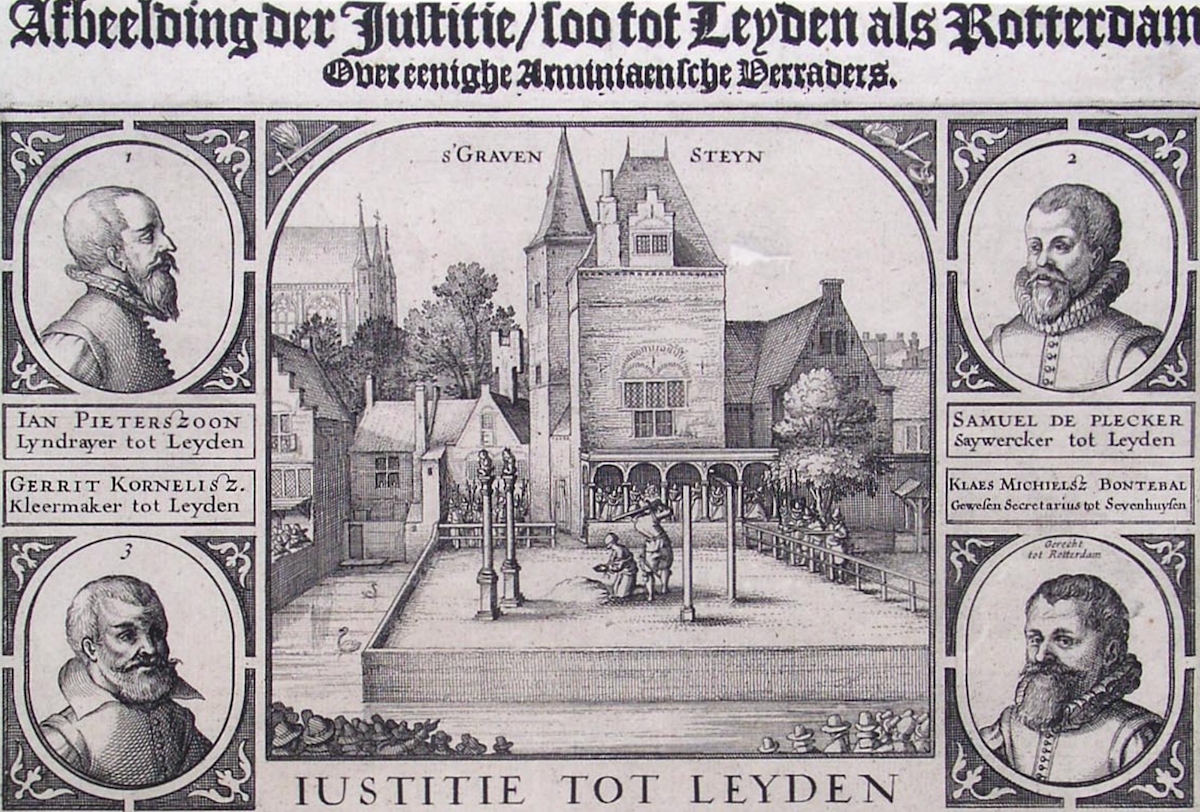
1623: Claes Michielsz Bontebal, Maurice murder moneybags

We’ve previously addressed in these pages the 1623 execution of Reinier van Oldenbarnevelt for attempting to assassinate Maurice, Prince of Orange in revenge for his, Maurice’s, 1619 execution of Oldenbarnevelt’s father.

Well, the scheme here was to hire a number of assassins for the attack, a plan which guaranteed that someone would blab and blow the whole deal. But before the blabbing and the blowing, the hiring required a vast cash outlay — 6,000 guilders to be precise.

Claes Michielsz Bontebal (English Wikipedia entry | Dutch) was one of the financiers who did the hiring, and got caught in the blowback after the blabbing. He was executed with three other conspirators


Detail view of a 1623 print reporting the beheading (click for a larger view with portraits of Bontebal and his collaborators).

On this day..

1350: Tidericus the organist

On or very near this date in 1350,* the plague-ravaged city of Visby burned a man remembered as Tidericus (Diderik) the organist.

The Gotland capital at this point stood at the fore of the Hanseatic league; the medieval maritime Laws of Wisbuy reflect its influence. The arrival in this year of the Black Death would begin Visby’s passage from merchant power to its present-day station as the “City of Ruins”. (The beautiful remains of its medieval grandeur make Visby a UNESCO heritage site.)

Small wonder that the city took its abrupt fall from greatness as an infernal conspiracy, the dimensions of which posterity decodes from a few surviving bits of correspondence.

In the midst of the plague, Gotland arrested nine itinerants as well-poisoners. For people struggling to cope with the sudden, inexplicable ravages of Pesta the inference of a malevolent hand ruining the water supply was a natural one; it emerges frequently during pandemics.

Tidericus the organista — either an organ-builder or an organ-player or both — is the only one of the Visby nine whose name we know; it seems that “with no prior coercion, [he] clearly admitted how he would poison all the wells in the cities of Stockholm, Vasteras and Arboga, and every lake, fresh water source, and various wells as he travelled around Sweden, everywhere poisoning away with his concoctions.” See, all they had to do was ask him.

What’s more, at the same time he [Tidericus] admitted that there are many who belong to a certain society which consisted of rich merchants and all the kinds of people who hold office all over the world, as many people know they do, and each of them goes around with silver belts, and they are all half mad or crazed in some other way. Also, they are all marked with a letter written in Greek or Hebrew. In his last moment he said “Need I say more? All Christendom has been poisoned by us villains and the Jews.”

It seems the well-poisoning mission had been funded by merchant-Jews in Germany named Aaron and Moses. A few different letters between Hanseatic cities around this time attest to a similar fear of Semitic contagion, possibly hinting at a wider panic outside the scanty lines of primary documentation. One letter from Lübeck (cited here) mentions a person named Keyenort who burned at the stake after confessing to pocketing three solidi from Jewish agents who wanted him to poison wells across northern Germany and Prussia; another from Torun has a more ambiguous reference to an apparent mass arrest of “baptized Jews”.

A few years after this organist’s coda, the Danes defeated Visby on the battlefield; Danish control would persist until the 17th century and consigned the once-proud Hanseatic port to a distinctly lesser stature. By century’s end, Visby would be the haunt of the Victual Brothers pirates.

* Citations are split between July 1 and 2; the sources are few, indirect, and barely dated so even the outline of events in this post is somewhat inferential.

On this day..

1896: The Rufus Buck Gang, heaven-dream’t

On this date in 1896, the Rufus Buck Gang was hanged at Fort Smith, Arkansas for a two-week spree of violence against white Oklahoma settlers.

More about this novelization is available on this companion website.

After doing a 90-day turn in Judge Isaac Parker‘s jail for selling liquor, the half-Creek, half-Black teenager Rufus Buck emerged violently politicized — “enraged by what he considered the theft of Indian lands. He decided it was his duty to rid the land of those who, in his eyes, did not belong”

If his theory of resistance was naive, the grievance was real enough. Earlier that century the Creeks of the American Southeast had been made to quaff humiliation by the emerging United States, and expelled with many other indigenous peoples from their ancestral lands to present-day Oklahoma; in Buck’s own lifetime, this remnant Indian Territory was itself being positioned for takeover by white settlement.

Buck gathered four other youngsters to his banner and from July 28, 1895 — when they slew a U.S. marshal — until their capture on August 10 they gave vent to rage and despair in a spree of robberies, murders, and rapes consciously directed at white settlers. This hopeless paroxysm of violence, almost precisely contemporary with suppression of the Ghost Dance movement and the official closing of the American frontier, marks the passage of an era; even the famous Judge Parker was in his dotage and would pass away a few months after the Buck gang’s own execution.

After the young men went to the gallows for rape on July 1, 1896, a poem was discovered in Buck’s cell, scribbled on the back of a photograph of his mother.

Mi dreAM —
i, dremP’T i, wAs, in, HeAven,
Among, THe Angels, FAir:
i, d, neAr, seen, none, so HAndsome,
THAT TWine, in goLden, HAir:
TheY, Looked, so, neAT,
And; sAng, so, sweeT
And, Play, d, THe, THe, golden, harp
i, was, ABouT, To, Pick, An Angel ouT,
And, TAke, Her, To, mY HeaRT:
BuT, THe, momenT, i, BegAn
To PLea,
i, THougHT, oF, You, mY, Love,
THere, Was, none, I, d seen
so, BeAuTiFul,
On, eArTH, or, HeAven, ABove.
gooD! By, My Dear, Wife..anD MoTHer
All. so. My SisTers.
Rufus, Buck
Youse Truley

On this day..

1497: Nicholas II of Niemodlin

On this date in 1497, the Polish Duke Nicholas II of Niemodlin was executed in Nysa.

During a summit to dispel tensions with Casimir II, Duke of Cieszyn, our Nicholas tried to murder both Casimir and a mediator bishop.

After a failed attempt to claim sanctuary, the grandees in attendance decided to have him speedily beheaded rather than accept his large gold bribe in settlement.

This very nearly triggered a wider war when Nicholas’s brother, also a duke, began preparing for a retaliatory military expedition; deft diplomacy by the king of Bohemia defused the crisis.


(cc) image from Jacek Halicki.

On this day..

1567: Captain William Blackadder, Darnley patsy

On this date in 1567, the Scottish soldier Captain William Blackadder (or “Blacketer”) died a scapegoat at Edinburgh.

Being dragged on a hurdle to Mercat Cross where he was hanged and quartered, and his remains nailed up in Scotland’s principal cities, was undoubtedly the worst thing that ever happened to Captain Blackadder but posterity finds his severed tendons and ruined viscera only a lesser subplot in the psychodrama of that august future Executed Today fixture Mary, Queen of Scots.

Mary’s famously terrible marriage to the monstrous Lord Darnley produced the eventual King James VI and I, at the cost of utterly ruining Mary’s reign. Please reference the great many more learned and erudite sources that will dwell on the innumerable faults of this grasping English lord who immediately upon achieving wedlock began maneuvering against his wife for power in Scotland. He’s notorious as a drunk, a lech, a murderer, and in general an obnoxious and arrogant shit.

Until, 18 months and change into the marriage, a huge explosion rocked Kirk o’ Field, Edinburgh … and when the debris cleared, there lay the bodies of the obnoxious consort and his servant. Strangely they were dead in a nearby orchard, suspiciously unsinged by the Gunpowder Plot-like pyrotechnics.


Drawing of the crime scene made for the English Secretary of State William Cecil

The particulars of Darnley’s murder have puzzled posterity for the ensuing 450 years, precipitating as it did Mary’s own fall from her throne — a moment manifested by Mary’s humiliating surrender when her dwindling and dispirited supporters melted away instead of fighting at the “Battle” of Carberry Hill. Mary had the humiliation in that June of 1567 of being led through Edinburgh by rebel lords to imprisonment, under the jeers of a hostile crowd.

But since these rebels were rising against Mary’s post-Darnley fling, putatively in the name of Mary herself, they also proceeded to conduct a disingenuous search for Darnley’s assassins in these days, landing on this luckless son of a declining house who had presented himself under Mary’s colors at Carberry Hill. Nobody since and probably nobody then really thought he had “art and part” in Darnley’s death; nevertheless, the diarist Birrel noted, “the 24 day of Junij Captane Villiam Blacketer was drawn backward, in ane cairte, from ie Tolbuith to the Crosse, and ther wes hangit and quartred, for being on the King’s Murther.”

We could not in good conscience miss the opportunity afforded by this distinctive name to cite topical-to-us content from the BBC sitcom Blackadder.

On this day..

2013: The Hawalli monster

On this date in 2013, Egyptian Hajjaj Saadi was hanged with countryman Ahmad Abdulsalam al-Baili at a car park in Kuwait.

Photographers were on hand to record the public execution, just the second in Kuwait since breaking a six-year moratorium on hangings. Saadi in particular was a reviled criminal, dubbed the “Hawalli monster” for the expat district of Kuwait City where he lived — and where, his prosecutors alleged, Saadi lured some 17 or 18 young children, both boy and girls, to rape.

Saadi strenuously denied the charges at trial, insisting that his confession was extracted by torture. No doubt it was. He also said he got no aid from the Egyptian embassy.

Ahmad Abdulsalam al-Baili murdered an Asian couple by torching their flat, and unsuccessfully tried to do the same to an Egyptian couple.

Caution: Mature content. The video in particular shows the actual hanging moment itself; it’s evident that Saadi, a muscular bodybuilder, survived the drop, and in the video he struggles against the rope.


Ahmad Abdulsalam al-Baili


Hajjaj Saadi

On this day..

1779: Manuel, burned for witchcraft in the USA?

(Thanks to the late University of Illinois history professor Clarence Walworth Alvord for the guest post, which originally appeared in an essay he wrote for the centennial of the Land of Lincoln‘s 1818 statehood. For context to this 1779 execution, the area comprising the future U.S. state of Illinois had been attached by the British crown to its own recently annexed province of Quebec, formerly French and Catholic. Illinois had then been seized during the Revolutionary War by Virginia, which at this moment (and only a few years thereafter) maintained it as Virginia’s own “Illinois County”. Notwithstanding Dr. Alvord’s rebuttal, the slave Manuel is still frequently described down to the present day as having been burned for witchcraft. -ed.)

The secret of writing true history depends upon the collection of all the contemporary evidence bearing on the case. The reason that people complain of the changing interpretations of history is that new material is found as society demands a broader and broader interpretation of the phenomena of the past. There was a time when history consisted in what we call to-day the drum and fife history; the doings of the great political leaders, events of military glory; and almost no other phenomena of changing society were noted. To-day the task of the historian, however, is far greater; and he is obliged to cast his net far afield in order to collect the material for the social development of the past …

“it must be remembered that the Creoles were very ignorant and superstitious, and that they one and all, including, apparently, even their priests, firmly believed in witchcraft and sorcery. Some of their negro slaves had been born in Africa, the others had come from the Lower Mississippi or the West Indies; they practised the strange rites of voudooism, and a few were adepts in the art of poisoning. Accordingly the French were always on the look-out lest their slaves should, by spell or poison, take their lives …

At this time the Creoles were smitten by a sudden epidemic of fear that their negro slaves were trying to bewitch and poison them. Several of the negroes were seized and tried, and in June two were condemned to death. One, named Moreau, was sentenced to be hung outside Cahokia. The other, a Kaskaskian slave named Manuel, suffered a worse fate. He was sentenced “to be chained to a post at the water-side, and there to be burnt alive and his ashes scattered.” These two sentences, and the directions for their immediate execution, reveal a dark chapter in the early history of Illinois. It seems a strange thing that, in the United States, three years after the declaration of independence, men should have been burnt and hung for witchcraft, in accordance with the laws and with the decision of the proper court. The fact that the victim, before being burned, was forced to make “honorable fine” at the door of the Catholic church, shows that the priest at least acquiesced in the decision. The blame justly resting on the Puritans of seventeenth-century New England must likewise fall on the Catholic French of eighteenth-century Illinois.

-Theodore Roosevelt, The Winning of the West

An example of how easy it is to misinterpret a past event, provided all the material available is not collected, and how easy is that interpretation after the material has been found, has come under my observation … About forty years ago Edward G. Mason, at that time secretary of the Chicago Histori[c]al Society, found the record book kept by the county Lieutenant, John Todd,* in the year 1779, when Todd came to govern the territory that had been occupied by George Rogers Clark and his Virginians during the Revolutionary War. In this record book Mason found the copy of a warrant for the death of a negro, named Manuel, by burning at the stake, which burning was to take place after consolation to the criminal had been given by the parish priest. The copy of the warrant had been crossed out by drawing lines through it. Please bear this fact in mind, since it should have suggested a correct interpretation. Naturally this warrant aroused the imagination of Mr. Mason, and he vegan to search for an explanation and discovered that about this time there was an outbreak of voodooism among the Illinois slaves and that two slaves had been put to death. He drew the natural conclusion therefore that Manuel had been burned at the stake for the practice of witchcraft. Basing his interpretation upon Mr. Mason’s find, a well-known ex-president, Theodore Roosevelt, who among other occupations has dabbled in history, wrote at some length upon this episode and drew a comparison between eighteenth century Catholic Illinois, where for the practice of witchcraft men were burned at the stake with the sancttion [sic] of the parish priest and in accordance with French Catholic law, with a similar episode in the history of Puritan Massachusetts in the seventeenth century.

Fortunately there has come into my hands a full record of the court’s proceedings by which Manuel was condemned; and I find that the judges in the case, although they were obliged to listen to the superstitious accusations of negro slaves, were careful to determine the fact that Manuel and another negro had been guilty of murder by poisoning their master and mistress, Mr. and Mrs. Nicolle, and that it was for this act the two negroes were condemned to death. I then looked up the law of the land. Naturally it might be supposed as Roosevelt did that this was French law, but there was another possibility, namely that Virginia law in criminal cases would be used by a Virginian magistrate, such as John Todd. I found that the Virginia law in the case of murder of a master by a slave was death by burning at the stake so that in the case of Manuel you see that the condemnation was strictly in accordance with Virginia law and not with French law. Another document of even greater interest in the case also came to my hands. It certainly was a surprise. This was another warrant for the death of Manuel, issued at a later hour in the day, but by this later warrant the death penalty was changed from burning at the stake to hanging by the neck. To summarize then: Manuel was not condemned for witchcraft but for murder; he was not condemned to be burned at the stake in accordance with French law, but in accordance with Virginia law; and finally he was not burned at the stake at all, but was hung by the neck. This is an excellent example of the danger of drawing inferences in regard to historic events upon too narrow information. There was one fact which both Mr. Mason and Mr. Roosevelt ignored in their interpretation of the warrant. The copy of the warrant was found in a carefully kept record book, and was crossed out by lines being drawn through it. That fact should have made them suspicious of their own interpretation. Records such as this condemnation to death would not be lightly erased by the keeper of a record book. An historical Sherlock Holmes would not have been misled.

* Todd’s brother Levi was grandfather to eventual U.S. First Lady Mary Todd Lincoln. -ed.

On this day..

1884: Seven anarchists of La Mano Negra

On this date in 1884, seven alleged terrorists of the Black Hand* were garroted in Jerez (Xeres), Spain.

This frightening organization was announced to the public via Spanish police discovery of documents purporting to outline their murderous perfidy and conveniently justifying a crackdown on restive Andalusia, then plagued (so the crown saw it) with a burgeoning labor movement.

Whether La Mano Negra (English Wikipedia entry | Spanish) truly existed as an organization has been subject to debate from that day to this, but anarchist worker militants had undoubtedly moved in 1881-82 towards overtly violent confrontation with landowners — bread riots during an agricultural crisis paired with robbery and arson. It was by no means merely adventurism. A Madrid newspaper reporting the sack of a bakery saw for the starving looters only three options: “O la limosna, o el robo, o la muerte” … alms, theft, or death.

Three thousand or more of protesting workers would be arrested in those months, and bound over to be used at the discretion of torturers; in the main, they affiliated to the labor union FTRE rather than anything so exotic as a Black Hand. But several murders that took place during or at least proximate to the Andalusian labor disturbances would be attributed to that sinister appendage and bring seven men controversially to execution in Jerez’s market squae on June 14, 1884.

As for others made to prefer alms or theft, hundreds were burdened with judicial penalties of various sorts and deported to Spanish colonies. A successful clemency campaign in the early 1900s reversed a number of those sentences, finally permitting these anarchists or “anarchists” to return to Spanish soil.

* This fell moniker refers to a number of distinct movements with a violent cast of mind sufficient to expose them to the predations of this very blog — notably, the Serbian terrorists who assassinated Archduke Ferdinand

The successors of the Jerez Black Hand that is the subject of this post also paid their own subsequent notable visit to the scaffold in the 1890s.

On this day..

2010: Melbert Ray Ford, abusive partner

Melbert Ray Ford was executed by lethal injection in Georgia on this date in 2010, for murdering his ex-girlfriend and her niece.

On tilt from when Martha Chapman Matich broke up with him several weeks prior to the March 1986 crime, Ford had menaced her repeatedly by phone while openly fantasizing to friends about murdering her execution-style after forcing her to beg for mercy. It did not require the benefit of hindsight to know that this was more than idle talk; Ford had a previous conviction (from 1978) for making terroristic threats and criminal trespass. He’d also been violently abusive to Matich during their relationship of more than a year.

On March 6, Ford hired an unemployed teenager to drive him to the Newton County grocery where Matich worked, just after closing. (That driver, Roger Turner, got a prison sentence and was paroled in 1991.) Matich was working alone there — another employee had gone home sick — accompanied only by her 11-year-old niece Lisa.

As the terrified woman sounded the store’s alarm, Ford blasted his way through the locked glass door, then shot his former lover thrice. As for the little girl, “Lisa was at the store playing with the minnows and crickets sold as bait and didn’t want to leave her aunt alone at the store. According to the March 23, 1986 edition of The Covington News, Turner confessed that ‘Ford described killing Lisa Chapman in the bathroom at the grocery. Turner said that Ford told him that she was crouched by the toilet staring at him, so he felt he had to shoot her.’ ‘She was begging him not to do it in the bathroom where she went to hide,” said [Lisa’s mother Cindy] Chapman-Griffeth.”

Ford fled the store with a sack of loot and left the scene with his confederate — the last night he would spend at liberty on this earth. Police responding to the store alarm rolled up minutes later, to find Martha Matich dead behind the counter and Lisa Chapman convulsing on the restroom floor with a mortal gunshot wound to the head.

On this day..

1895: John Eisenminger, forgiven

From the Harrisburg (Pa.) Patriot of June 7, 1895.

On this day..