1946: Ten at Hameln for killing Allied POWs

On this date in 1946, the British hanged 10 convicted war criminals at Hameln Prison, notably including seven for the “Dreierwalde Airfield murders” of four Allied prisoners of war.

Picture from this book about RAF POWs in wartime Germany, which also supplies the unknown names: A.W. Armstrong and R.F. Gunn of the RAF; B.F. Greenwood and J.E. Paradise of the RAAF.

In that case, two British and three Australian airmen had been captured after bailing out during a March 21 raid. Taken to the nearby aerodrome between Dreierwalde and Hopsten in Westphalia, they were marched out the next day ostensibly for transport to a POW compound. Instead, they all ended up shot by their guards — although Australian Flight-Lieutenant Berick was able to escape, wounded, and survive the war.

The nub of the case was whether the guards cold-bloodedly murdered their prisoners (prosecutors’ version), or whether there was an escape attempt by the airmen that caused the guards to start shooting (defense version).

Berick’s affidavit to the effect that no escape had been attempted weighed very heavily here — that nothing was afoot until he suddenly perceived the guards cocking their weapons. Karl Amberger would testify on behalf of himself and his men that the five had been suspiciously taking their bearings as they marched and suddenly broke off running in different directions.

The defense counsel’s attempt to reconcile these accounts in the haze of war was not fantastical — “saying that the cocking of the action of a weapon by one guard was not unnatural given the fact that five prisoners had to be guarded in a lane in the growing dusk … [while] Berick and the other prisoners probably regarded it as likely that they were to be shot, as others in their position had been, and began to run when it was not necessary.” But it did not carry the day.

Three other Germans joined this bunch on the scaffold, for similar but unrelated POW abuses.

  • Erich Hoffmanm, condemned by a joint British-Norwegian court in Oslo for the murder of Allied POWs in occupied Norway.
  • Friedrich Uhrig, for murdering a downed Royal Air Force pilot at Langlingen.
  • Franz Kircher, for killing three airmen at Essen-West.

On this day..

1920: Rickey Harrison, Hudson Duster

On this date in 1920, Rickey Harrison of the Greenwich Village “Hudson Dusters” went to the electric chair for a murder committed in the course of an armed robbery.

As befits a gaggle of old time New York hoodlums this crowd was rife with colorful nicknames — Goo Goo Knox, Circular Jack, Ding Dong — and hired out its thrashings in service of Tammany Hall‘s rude electoral manipulations. Their signal achievement was earning a popular doggerel tribute that rang in the streets in its day, by beating senseless a beat cop who’d had the temerity to arrest some of their number.

Says Dinny [patrolman Dennis Sullivan], “Here’s me only chance
To gain meself a name;
I’ll clean up the Hudson Dusters,
And reach the hall of fame.”*
He lost his stick and cannon,
and his shield they took away.
It was then he remembered,
Every dog had his day.

At their peak the Hudson Dusters could rank as one of the brighter stars in the dizzying constellation of Big Apple crooks. Herbert Asbury’s classic The Gangs of New York notes that “perhaps fifty small groups … operated south of Forty-second street [and] owed allegiance to the Gophers, Eastmans, Five Pointers, Gas Housers, and Hudson Dusters … Each of these small gangs was supreme in its own territory, which other gangs under the same sovereighty might not invade, but its leader was always responsible to the chieftain of the larger gang, just as a prince is responsible to his king.” Allegedly future Catholic social justice activist Dorothy Day, then a teenage radical journalist just moved to New York City, enjoyed carousing with the Dusters in the 1910s.

Despite political pull through Tammany (and heavenly pull through Dorothy) arrests and gang wars dusted the Dusters over the first two decades of the 20th century.

Our man Rickey Harrison, a pipsqueak Irishman with a substandard nickname (“Greenwich Village Terror” … lame), led a gangland raid on a high-stakes poker game at the Knickerbocker Waiters Club on September 7, 1918, and shot dead a Canadian soldier who refused to give up his boodle. Harrison would go to his grave insisting that it was not he who fired the fatal shot, although he was markedly less scrupulous about accounting the undetected and unprosecuted crimes of his career.

As a last indignity, Harrison and another murderer named Chester Cantine — who preceded the gangster to the electric chair — had to brace themselves for eternity within earshot of a raucous Sing Sing vandeville show where prisoners and 800 visitors were “applauding and roaring with laughter in an improvised theatre a few feet away … comic sketches [and] jazz music resounded throughout the prison.” (New York Times, May 14, 1920)

Harrison’s last sentiment — “Let us hope and pray they will never do this thing to another man, innocent or guilty” — still awaits fulfillment a century later.

* The apparent allusion is to the Hall of Fame for Great Americas, a civic pantheon opened in 1900 that is now part of Bronx Community College. This outdoor colonnade, still extant but largely forgotten, imported its busts-of-great-men concept from Bavaria; the Hall’s popularity in its time makes it the ancestor of the innumerable Halls of Fame that have since come to litter the North American civic landscape.

On this day..

1775: William Pitman, for murdering his slave

(Thanks to Meaghan Good of the Charley Project for the guest post. -ed.)

On this date in 1775,* plantation owner William Pitman was hanged for murder in King George County, Virginia.

Pitman had a reputation as a brutal man and was no stranger to the Virginia courts; he had been making appearances since the 1750s. So perhaps it was not surprising that he got strung up eventually.

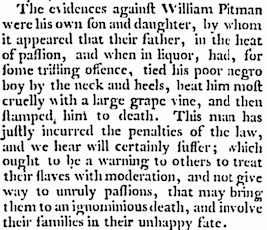
Virginia Gazette, Apr. 21, 1775

What is surprising, indeed perhaps unprecedented, is that the murder victim was one of his own slaves.

The Virginia Gazette, which published the sole surviving account of the incident, says that Pitman, “in liquor” and “in the heat of passion” lost his temper, “tied his poor negro boy by his neck and heels,” and beat him with a large grapevine before stomping him to death.

Pitman can hardly have been the first, or the last, slaveowner to slaughter his own “property” but it was usually impossible to get a conviction because blacks were not allowed to testify against whites in court. In this case, however, two white people — Pitman’s own son and daughter — sealed the case by giving evidence against their father.

The Gazette, writing on April 21, said Pitman had “justly incurred the penalties of the law” and said hopefully that the story might be “a warning to others to treat their slaves with moderation, and not give way to unruly passions, that my bring them to an ignominious death, and involve their families in their unhappy fate.”

* Pitman’s hanging “yesterday” is reported in the Saturday, May 13 issue of the Virginia Gazette — a different Virginia Gazette from the one quoted in this post, as it happens: three competing papers used this same branding; the report in this post’s body on the circumstances of Pitman’s conviction comes from Dixon and Hunter’s Gazette, while the May 13 item establishing the hanging date is from Alexander Purdie’s Gazette.

Purdie’s May 13 edition further adds that when the sheriff came to fetch him on the fatal day, “Pitman made some resistance, but was soon overpowered; he behaved with decency at the place of execution, and attributed his unhappy fate to the effect of intemperate drinking.”

On this day..

1887: Charles Smith

(Thanks to Meaghan Good of the Charley Project for the guest post. -ed.)

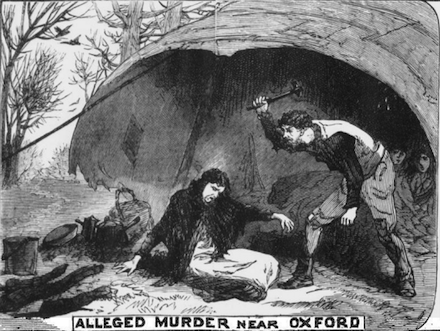
On this date in 1887, 63-year-old Charles Smith was judicially hanged at Oxford Castle Prison by James Berry. He’d brutally murdered his wife in front of their children that February.

The Smith family were Gypsies: Charles, his wife Lucy, their 17-year-old daughter Oceana (known as Oshey) and their 11-year-old son Prince Albert. As Nicola Sly notes in her book Oxfordshire Murders,

The lifestyle of Gypsy families in 1887 was not one to be envied. The traveling people were at the mercy of the weather all year round, whether the heat of summer or the bitter cold of winter. Forced to scratch a living any way they could, many supplemented their meager income with a little poaching or petty theft. Thus they were very rarely welcomed in any area and were always in fear of the local police who almost invariably moved them on wherever they tried to settle.

According to this account, Lucy had borne many children, but only four lived long. By the time of the murder, one of the children had died and one, a daughter named Elizabeth, had grown up and left home.

Charles’s siblings regularly got in trouble with the law, and at least one of his siblings was transported for sheep theft. He and Lucy, however, were somewhat more fortunate: Lucy possessed a valid peddler’s license. In the 1881 censuses, both had their occupations listed as “hawker.” Charles made baskets, skewers, roasting forks, meat stands and pegs which his wife sold.

Throughout their lives Charles and his family traveled around Oxfordshire, pitching a tent wherever they could find a place, and in February 1887, they were camped on public land near Headlington. They’d been there before and were friendly with some of the local residents, including a couple coincidentally also named Smith.

Charles was a violent man who regularly beat his wife and children; Oshey stated he beat his wife every day, and Prince Albert would later testify, “He has been knocking my mother about nearly all his life.”

At one point the domestic violence had gotten so bad that Lucy had gone so far as to take out a formal complaint against her husband for cruelty. She never followed up on it, though.

On the 18th of February, Kate and George Smith, who lived in a nearby cottage, visited the tent and noted Lucy was visibly bruised. They asked Charles why he’d beaten her and he wouldn’t give a reason, but said it was over something that happened thirty years before.

The visitors advised him to forgive and forget, but Charles acted surly and hostile for the rest of the day. Lucy was so frightened of him that for a long time she stayed outside the tent in the bitter cold, and only partially dressed, rather than go inside where her husband was. At bedtime she finally came in.

In the early hours of the next morning, Charles began shouting at his wife, waking the children. As Oshey and Prince Albert watched in horror, their father picked up a hammer and attacked Lucy, beating her on her head, back and legs until he was too tired to do it anymore. Then he laid down and went peacefully asleep.

Mortally wounded, Lucy crawled out of the tent to get some water from a nearby stream. She never returned, and eventually Oshey went out to check on her and found her dead.

When Charles realized what he’d done, he sank to his knees beside Lucy’s battered corpse and sobbed, crying, “My wench, my wench!”

Oshey and Prince Albert ran for help, going to the same neighbors who’d visited the night before. When Kate Smith answered the door, Oshey blurted, “My Mammy’s dead. He’s been and killed her with the hammer.”

Kate and George rushed to the scene of the crime. Charles had dragged Lucy’s body into the tent and lain it out on some straw. He told them Lucy had “fallen down” and died. George told everyone he was going to fetch a doctor, but instead he went to the police, returning with two constables. By then Charles had calmed down and said casually, “Good morning. I have got a dead ‘un this morning.”

One of the constables searched the tent and found the bloodstained hammer concealed under some straw. Charles, whose coat was also bloodstained, was placed under arrest for the willful murder of his wife. The autopsy showed she’d died of a fractured skull; Charles had hit her head with the hammer three or four times.

At the ensuing trial in April, Oshey was the star witness against her father, although Charles kept shouting that she was telling lies and was a “nasty, wicked wretch.” Prince Albert testified also, as did Kate and George Smith.

The defense argued that Charles had no intention of killing his wife and there was no motive, and so it was a case of manslaughter. However, the jury returned a verdict of murder.

After he was condemned to die, Charles turned to religion for solace, praying with the prison chaplain. Some of his relatives came to visit, although Oshey and Prince Albert stayed away. His eldest daughter Elizabeth made the strange observation that “when he was a drunkard there was not a kinder man living, that something or somebody turned him into a teetotaler, and from that time he had been a cruel wretch.”

While walking to the scaffold, Charles fainted on the trapdoor just before James Berry drew the bolt. The hanging went smoothly and it was judged he died quickly and painlessly.

As for the orphaned Oshey and Prince Albert, it was recorded that “through the noble hearted philanthropy, of Miss Skene, of this City, the girl Oceana has been placed in a Home in York, and boy the Prince Albert, through the same thoughtfulness, will also be brought up to acquire the means of earning an honest livelihood.”

On this day..

1900: James Nettles

From the St. Louis Republic, July 9, 1898

James Nettle has Partly Confessed.

Suspect in the Mann Murder Case Admits All but the Shooting.
Caused the Arrest of His Double in Order to Confuse the Several Witnesses.

James Nettle, the negro who is accused of the murder of Conductor Edward Mann of the Suburban Railway, on the night of July 4, after emphatically declaring his innocence and even going so far as to bring about the arrest of his “double,” Esbree Manley, a negro ventriloquist, as a suspect in the case, yesterday began to show signs of weakening, and at a late hour last night had confessed everything but the firing of the three shots which proved fatal to Mann.

The arrest of Manley on Nettle’s statement that he had overheard a conversation in the calaboose that a ventriloquist had a hand in the shooting, proved to be Nettle’s undoing. When confronted by Manley, Nettle was unable to carry out his well-laid plans. The striking similarity in the physique of the two negroes would have rendered it almost impossible to pick out the real culprit, but Manley met Nettle and the police with such a straight story of his whereabouts at the time of the tragedy that the former burst into tears and admitted after a little coaxing that he was in the street car fight in which Conductor Mann was slain.

He told his story between sobs, for he broke down completely under the strain. He declared that Mann had ordered him off the car and had returned his fare, in order to hasten his departure, when the fight started. He did not recall how they began fighting, but he said the conductor and motorman tackled him and forced him off the platform, threatening to do him violence.

Even after he had left the car, he said, the conductor followed him several steps. At this point the shooting was done, but all efforts to make the negro Nettle relate these further details have proven futile. In order to avoid the cross-fire of questions from Chief Desmond, the negro complained of being ill and had to be given medicine by the Dispensary physicians. Afterward he said he would not talk further on the murder until to-day.

The negro Manley was released last night after he had established an alibi.


From the St. Louis Republic, Dec. 16, 1898

Testimony Finished.

James Nettles’ Fate Will Be Decided To-Day.

To-day the fate of James Nettles, colored, charged with murder in the first degree, probably will be decided in Judge Tally’s court, after 10 hours’ argument by the attorneys for the State and the prosecution. At 11 a.m. yesterday the State rested and the defense was through at 6 p.m., having tried to establish an alibi.

Thomas L. Brown, the motorman of the car on which Conductor Samuel W. Mann was mortally wounded on the night of July 4 last, was the first witness for the State. He told how the negro boarded the St. Louis and Suburban car at Jefferson avenue, quarreled over car fare, and at Garrison avenue shot the conductor as he retreated from the car. He identified Nettles. Others testified that they were sure Nettles was the assassin.

For the defense, Michael White, a negro, with whom Nettles lived at No. 1321 Linden street, was the main witness. His testimony was that he and the defendant were together all day on July 4, and that Nettles was not at any time near the scene of the murder. He testified that they went to Kirkwood in the morning, returning to their home about 7 p.m., where there was an entertainment, at which both Nettles and White were present until 11:30 p.m. In corroboration of this testimony many witnesses were introduced.

In rebuttal, the State introduced Frederick Brunesman of No. 2641 East Prairie avenue, the motorman of the car which immediately preceded Conductor Mann’s car on the night of the killing. Brunesman identified Nettles as the negro who tried to board his car that night at Jefferson avenue, but was so drunk he fell off. Detective John Gallagher and Policeman Thomas Mahon told of an interview they had with Nettles on the day following his arrest. On that occasion, they testified, Nettles said he assaulted Conductor Mann because Mann rebuked him for misconduct.


From the St. Louis Republic, Dec. 17, 1898

Nettles Found Guilty

Jury Decides That the Negro Murderer Must Hang.

Had James Nettles, a negro, been informed that his dinner was ready, he could not have displayed less concern than when told the jury had found him guilty of murder in the first degree and that he must be hanged. Death seems to have no terrors for him and he smiled at his fate in the same indifferent manner with which he greeted the onslaught of the State’s witnesses. Never through the long trial has he ever manifested even a moderate interest in the proceedings. If he is guilty of the foul murder of Conductor Mann before his wife and children on July 4, he did not show it yesterday.

The cases on both sides were rested on Thursday evening and for four hours yesterday the attorneys for the State and the defense fought an oratorical battle before the jury. Finally, a few minutes before 2 o’clock, the case was given to the jury.

Then, for three hours the jurors debated the case, finally coming to a decision at 5 o’clock. Several of the jurors, it was learned, stood for a life sentence, but were converted to capital punishment on the ground that executive clemency might intervene to cut short the term.

The State had many witnesses who were on the car and identified Nettles as the assassin; while, on the other hand, the defense had nearly a score of negroes to establish an alibi. The State’s attorneys held that it was an alibi for the occasion and made efforts to break it down. One of the defense’s witnesses, who said he was with Nettles at a dance on the night of July 4, testified that there was a roaring fire in the parlor. Other similar statements served to weaken the alibi.

When the verdict had been rendered, Attorneys Van Patten and Morroll, for the defense, declared they would ask for a new trial, and in case it were refused, would appeal.


From the St. Louis Republic, April 5, 1900

Respite for Nettles

Governor Grants the Condemned Man Another Thirty Days

Governor Stephens last night granted a thirty day’s respite to James Nettles, the negro who has been condemned to be hanged for the murder of Conductor Samuel W. Mann on a St. Louis and Suburban car, near Leffingwell avenue, on the night of July 4, 1898. He was to have been hanged a month ago, but a reprieve of thirty days was granted in order to give the Governor time to examine into the merits of the appeals for clemency.

The death watch was placed on Nettles yesterday morning at 6 o’clock and has not yet been removed, as Sheriff Pohlmann has not received official notification of the respite. He expects a letter from the Governor to-day.

Nettles was not in the least perturbed yesterday. When the Reverend Mr. Hurzburger of the German Evangelical Church called at the jail last night with Sheriff Pohlmann and notified the condemned man that the Governor had granted a respite of thirty days, the negro, without any apparent emotion, thanked him for what he had done in the matter and reiterated his assertion of innocence.


From the St. Louis Republic, April 26, 1900

A QUESTION OF WHISKERS — Another attempt is being made to get Governor Stephens to commute the death sentence of James Nettles, the negro who was convicted of the murder of Conductor Sam W. Mann on the night of July 4, 1898. Governor Stephens has granted two stays of execution to allow himself time to investigate the application and petitions. At the trial some of the witnesses testified that Mann’s assailant wore side whiskers. Attorney Maurer had several barbers examine Nettles’s face, and he says that they will make affidavit that he could not raise side whiskers.


From the St. Louis Republic, May 6, 1900

To Be Hanged To-Morrow

Death Watch Placed on the Negro James nettles.

Chief Deputy Sheriff Pohlman yesterday for the third time placed the death watch on James Nettles, the negro who is under sentence of death for the murder of Conductor Samuel W. Mann. Nettles will be hanged at 6 o’clock to-morrow morning unless Governor Stephens stays the execution. Twice Nettles has been within the shadow of the gallows, with the death watch set, when each time the Governor granted reprieves that he might look further into the applications for clemency.

Nettles has all but lost hope. When Deputy Sheriffs Parcel and Hoefer escorted him from his cell on the second tier to cell No. 46 on the round floor, he said he guessed this was the last time. The cell to which he was transferred is the one occupied by all St Louis murderers during the last hours before their execution. Nettles was restless Friday night, alternately reading the Scriptures, praying and singing. When the deputies came in he seemed somewhat relieved. He walked between them up and down the exercise yard until 7 o’clock, when he went into his new cell, where he ate a hearty breakfast. At dinner and supper it was the same way; he seemed to take a last pleasure in ordering what he wanted to eat. He still protests his innocence.

He was convicted of the murder of Conductor Sam W. Mann on the night of July 4, 1898. Nettles got on Mann’s car at Jefferson and Franklin avenues. He refused to pay his fare and Mann ordered him from the car. A scuffle followed and Nettles fired a shot which struck Mann in the abdomen, causing his death a few hours afterwards. Mrs. Mann and two little daughters of the conductor were on the car at the time and witnessed the killing.


From the St. Louis Republic, May 8, 1900

James Nettles, the negro convicted of the murder of Conductor Samuel W. Mann of the Suburban Street railway, was hanged yesterday morning. The drop fell at 6:07 o’clock, and nineteen minutes afterwards the doctors pronounced him dead. Nettles met his death bravely and declared his innocence with almost his last breath.

The execution was conducted with precision and dispatch, but without unnecessary haste. About 250 spectators were present, but they were more orderly than those present at previous hangings.

Nettles was restless throughout the night preceding his execution, and did not sleep any. A number of friends called to bid him good-by early in the night. The Reverend Mr. Sachs, Nettles’s spiritual adviser, the Deputy Sheriffs on the “death watch,” and a few newspaper men remained with him throughout the night. At 3 o’clock in the morning the Century Quartet called at the jail and sang several favorite hymns.

Early in the morning Nettles retired to his cell with the Reverend Mr. Sachs, where they read the Scriptures and prayed until the arrival of Sheriff Pohlman.

At 6 o’clock Sheriff Pohlman read the death warrant to Nettles. The prisoner’s arms were then bound and he was led to the scaffold. Nettles did not falter, although he was a trifle nervous. After his legs and arms had been securely bound Sheriff Pohlman asked him if he had anything to say before he died. In a clear, resonant voice he said,

I am about to die for another man’s crime. The Lord knows I am innocent, and I go to meet him with a clear conscience. I love you and I hope to meet you above. I am innocent!

Then the black cap was pulled down over his head, the noose adjusted and Chief Deputy Sheriff Pohlman sprung the lever. Nettles’s body, after the drop, hung perfectly still. Nineteen minutes later the physicians pronounced him dead and his body was cut down and taken into the morgue. An examination revealed that his neck was broken.

Nettles shot and killed Conductor Mann on his car in Franklin avenue near Leffingwell avenue on the night of July 4, 1898. The negro got on the car and refused to pay his fare. While Mann was ejecting him he pulled a revolver and fired. Mrs. Mann and two little children were on the car and witnessed the murder.

On this day..

1725: John Coamber

The Dublin hanging of John Coamber on this date in 1725 for the previous year’s notorious mugging/murder of a city counselor named Richard Hoar(e) arrives to us, as have several previous posts, via James Kelly’s Gallows Speeches From Eighteenth-Century Ireland.

In this instance, Kelly gives us two rival “last speeches.” It’s a genre that he says was exploding in the 1720s, with the burgeoning of print culture and the importation of similar purported gallows unburdenings.

And as we saw in a 1726 exemplar from the same book, the publishers who flooded this burgeoning market were at daggers drawn with one another over precedence for inside information and autobiographical authenticity. This is another case where one of the documents — Cornelius Carter’s — takes space to take a shot at the rival tract.

We also see here in Carter’s more detailed (and here, sarcastic) narrative that two different, innocent, men were hanged for the murder some time before one of the three real killers saved his own neck by shopping Coamber.


The Last Speech, Confession and Dying Words of

John Comber

who is to be Hang’d and Quarter’d this present Wednesday, being the 5th, of this Inst. May 1725. Near St. Stephen’s-Green; for Murdering Councellor Hoar, in January last.

Good Christians,

My Heart has been so hard hitherto, that I had no Manner of thought of either Soul or Body, but now I seeing Death plainly before my Face, causes me to consider of my latter End; and praise God for giving so much Grace so to do; therefore I am resolv’d to make a Publick Confession of my past Life and Conversation, which is as follows.

As to my Birth and Parentage, it is but a folly to relate, yet I can say I came from very honest Parents, who took what Care they could to bring me up in the Love and Fear of God, but I contrary to the Laws of God and Man, have gon [sic] astray, and follow’d Loose Idle Company, which brought me to this untimely Death; and how it came to pass was thus.

I being Entimitly Acquainted with one Patrick Freel, and David McClure, with whom I went to a House in New-street, where we then (after several meetings) made a Plot to get Money, by reason it was scarce with us, at length we Consulted the 19th, of January last, to Robb the first we wou’d meet with, and being over perswaided by the Devil, I went to the House of Mr. Carter and meeting a Child of his, bid him fetch his Dady’s Pistol, and I would fetch him some sweet things, upon the same promise, the Child brought me a Pistol, and then I, in Conjunction with the above Named Persons, went towards Stephen’s-Green, where we met with Mr. Kennedy, Mr. Leeson’s Clerk, whom we Robb’d of a Ten Peney Piece, from that we proceeded to Henry-street, where we met the Deceased Gentleman, to whom I went up, and Demanded his Money, with that he moving his Arm, and I having the Pistol Cock’d, caused the same to go off, tho’ as I shall Answer my God I did not think of being his Butcher; and when I found the Pistol went off, I never staid to know whether he had Money or no, but took to my Heels as fast as I could.

Then I went to the Sign of the Black Swan in Mary’s-Lane, where I and my Comrads met; from that my Prosocuter Patrick Freel and I, went to the Country where we staid for some small Time, then I came back, and as God, who never suffers Murder to be Conceal’d, I was soon Apprehended and put to Goal, upon Suspission, where I lay as good as a Month, but a Proclamation being Isued out, concerning the Murder, he came in and made Oath that I was the Person that Shot the Councellor, which to my sorrow is True.

Having no more to say but beging the Prayers of all good Christians, I die a Roman Catholick, and in the 22d. Year of my Age, and the Lord have Mercy on my poor Soul Amen.

Dublin: Printed by C.P. 1725.


The Last Speech, Confession and Dying Words of

John Coamber

who is to be Hang’d, Drawn and Quarter’d this Day, being the 5th of this Instant May 1725. For the Murder of Councellor HOAR in Henry Street the 19th of Jan. last.
Deliver’d to the Printer hereof C. CARTER the 5th of May, and to no other, By me John Coamber. And All others are Imposing on the Publick.

All you my Spectators,

This is to give you the following Account, I was born in the Town which is Call’d Thurles, in the County of Tipperary in Munster, of very honest Parents, that brought me up in the fear of God, and Wou’d give me good Learning, but I was too Head-strong, and wou’d not be Rul’d or Guided by my tender Parents, but left ’em and went to serve a Tobacco-twister, which I work’t at for about 5 years, being weary of that I came for Dublin, being a stranger, I turn’d Porter about Cork-hill, where I stood and follow’d that business for near 3 years, all this time I behav’d my self very honestly, and was well belov’d by all that knew me, especially in the above Neighbourhood, being weary of that, I took a fancy to Cry News about this City, which in a little time, I began to get a great many pence by it, and in sometime after, I became Acquainted with Idle and loose Company, Viz. and in the process of time I came to be acquainted with particular Persons and some others who first brought me in Company among Whores to Drink and spend my Money &c. Which was the first Cause of my Destruction.

Afterwards I went of my own Accord, and follow’d the said Evil Custom and other ill Actions, then I became as obdurate and as Wicked as the worst of my Ring-leaders.

I have Reason to Curse them Idle fellows which made me first acquainted with the whores and Pick-pockets in this City, of which there is abundance too many.

But finding Money not Answering to keep the above Company, being acquainted with one David McClure who was my chief Comrade, and who made his Escape to France after the Murder was Committed, he and I stuck together, and followed a very Idle Course of Life, and we Committed several ill Facts in this City and Liberties thereof.

All our shifts not Answering, I, McClure, and Patrick Freel (who was the first Evidence against me) Resolv’d to turn Robber, but never did design to be Guilty of Murder, and did design when we got a Sum of money that was worth While, to leave the Country.

I confess, that Patrick Freel, David McClure and I went on the 19th of January last at Night, to Henry Street, with a Design to Rob, or Plunder the first Gentleman that came that way; which was the luck of that worthy honest Gentleman Councellor Hoar, though I declare before God I did not design to hurt him, or any Man else that time.

I do also Confess that I did own to the Blind Boy, Lawrence Dugan, (who was the t’other Evidence against me) that Patrick Freel, David McClure and I myself, were all Guilty of the Murder for which I now suffer, but I wonder he did not Discover, it when one Pitts and another one Hand, had like to suffer for this Murder. (emphasis added -ed.)

I further Declare, tho’ it was falsely and Scandalously Publish’d in Print, by one Mrs. Needham and her Son Dickson; that I had got Mr. Carter’s Pistols from his young Son about 8 years of Age, (we had but one Pistol among us) and as I am a Dying Man I got no such thing from the said Child, nor none of his Family, neither did I steal any such thing out of his House in my Life time.

I accused one Daniel Field and Michael Tankard falsly, which I am heartily sorry for, but it was by the Advice of Winfred Dunn and Patrick Dunn the 2 Informers, that swore against Pitts and Hand that was Try’d the last Term for this Fact.

I beg of my great God to forgive my Prosecutors, and all my Enemies, as I do forgive them from the bottom of my heart.

I hope this my untimely End will be a Warning to my Comrades, and also to all young Men, which I pray to God it may. For my own part I own I am Guilty of the Fact for which I Die, And I hope the Lord of his infinite Goodness, will have Mercy on my Soul and forgive me.

I am about 19 Years of Age I dye a Roman Catholick, and Desires the Prayers of all Good Christians, and the Lord have Mercy on my poor Soul. Amen.

JOHN COAMBER

DUBLIN: Printed by Corn. Carter. 1725.

On this day..

1691: William Macqueen, the Irish Teague

On this date in 1691, 11 hanged publicly at Tyburn.

From the Ordinary’s Account they make a fairly typical, if voluminous, assortment: an infanticide, a drunken murderer, and thieves and highwaymen of various descriptions.

Two of these rude knights of the road were “William Selwood alias Jenkins, condemned with William Mackquean a Papist,” the latter also called “Bayley, alias the Irish Teague.” Condemned for robbery on the road, Macqueen confessed to having previously murdered a soldier in a similar encounter; they were “Old Offenders” who had previously “been Reprieved, but would not take warning.”

For the veteran robber Macqueen we have a fine instance of the facts-be-damned mythmaking characteristic of the early Newgate Calendar: his entry credits him with stealing the mace of the Lord Chancellor, an outrageous caper that different criminals really did pull off many years before. Not accidentally, our rewrite version from the Whig ascendancy also edits the identity of the Lord Chancellor involved, who perforce must seem ridiculous to have lost the emblem of his station in this manner — replacing the true victim, the moderate and forgettable Earl of Nottingham, with that hated late-Stuart bete noir (and notorious hanging judge), Lord Jeffreys.

The implicit parable of the Glorious Revolution is reinforced by what must surely be a fanciful vignette in which Macqueen mugs the Lady Auverquerque, the wife of one of the Dutch commanders who invaded England with William of Orange in 1688. Both parties involved are foreigners on English soil, and their awkwardness in that most naked transaction of gunpoint robbery has comedic effect. Presented with a confusingly veiled demand for a “loan,” the mistress seeks clarification: “I believe you had as good tell me at once you are come to rob me; for this is an odd way of borrowing.” Macqueen/Teague apologizes and manages crudely but effectively to the convey the point: “I am a stranger in this country, and so if I don’t know the difference between robbing and borrowing, you must excuse me; for all I mean is, to have your money.”

On this day..

1909: A triple execution in Chalco

The composed image in this date’s post would almost lead one to believe it posed, but Mexican campesinos Arcadio Jiménez, Hilario Silva, and Marcelino Martínez really were all shot together at Chalco on this date in 1909, for killing a policeman during the tense twilight of dictator Porfirio Diaz, on the verge of the Mexican Revolution. It’s believed to have been taken by Augustin Casasola.


From this lengthy dissertation pdf. (See the 384th page of the pdf, or page 354 as numbered within the document.)

According to Photographing the Mexican Revolution: Commitments, Testimonies, Icons, the event was luridly covered by the magazine El Imparcial, which described the execution in these words:

The bodies fell simultaneously, slowly backward, and a hoarse whisper flowed from either the enormous holes made by the bullets or their tightly pressed lips. The clothing smoked from the gunpowder, and their contractions denoted an extraordinarily cruel suffering. A death rattle, like that of a sheep with its throat cut, escaped from the three bodies. Their families sobbed, and their cries filled the countryside. Those of us who were present will never forget it.

On this day..

1896: Carl Feigenbaum, the Ripper abroad?

On this date in 1896, New York City electrocuted Carl Feigenbaum.

He’d been convicted of slaying the widow from whom he rented a room at eight cents per day … but many at the time suspected his homicidal exploits might also have traced to Whitechapel, under the dread sobriquet Jack.

We can only really be sure of the one murder: on September 1, 1894, he attacked 56-year-old Julianna Hoffman in her room on East Sixth Street, for the possible reason of robbing her. One ferocious slash with his long bread knife nearly decapitated the landlady; the disturbance roused Hoffman’s 16-year-old son who burst in on the assailant — reportedly just as Feigenbaum had his blade poised to begin horribly gouging the corpse. Both killer and witness grappled briefly and then fled from each other; Feigenbaum was arrested before the day was out.

Today you’d call the part of town East Village but back in the 1890s it was Klein Deutschland, with one of the world’s largest concentrations of Germans abroad.

Probing his client for material to use for an insanity defense,* Feigenbaum’s attorney elicited his client’s self-diagnosis that “I have for years suffered from a singular disease, which induces an all-absorbing passion; this passion manifests itself in a desire to kill and mutilate the woman who falls in my way. At such times I am unable to control myself.” That seems interesting.

It emerged that Feigenbaum had left Germany as a merchant mariner, and that profession had possibly seen his boats tied up in the Thames during the pivotal months when the Whitechapel murders took place.

In the Big Apple, the idea of modern crime’s great bogeyman throwing his demonic shadow across their very own dungeons appealed irresistibly, to nobody moreso than Fiegenbaum’s own attorney William Lawton, who reveled in his hypothesis of proximity to evil and made a silly bid for celebrity on that basis. Lawton claimed to have hit upon the Ripper idea as he pondered the meaning of Feigenbaum’s professed impulse to mutilate women.


From the St. Albans (Vt.) Daily Messenger, April 28, 1896.

The very day after his client’s electrocution, Lawton explicated the suspected connection to the press, “stak[ing] my professional reputation that if the police will trace this man’s movements carefully for the last few years their investigations will lead them to Whitechapel.” (Lawton is also the sole source of Feigenbaum’s alleged self-incrimination, quoted above: to everybody else Feigenbaum insisted on his innocence far past any possible stretch of plausibility, and even carried that insistence to the electric chair.)

Regrettably, Feigenbaum’s pre-Hoffman movements are obscure to the point where Lawton’s theory is essentially immune to corroboration (or refutation). Even when Lawton dropped his intended bombshell did his hypothesis come in for some public ribbing; the New York Tribune scoffed on April 29 of that year that Feigenbaum now being indisposed to object, all the city’s most troublesome unresolved homicides ought to be attributed to this empty cipher.

Despite the surface similarities of his aborted disemboweling to the infamous London crime spree, Feigenbaum’s case for Ripper immortality doesn’t enjoy much of a constituency today. (Trevor Marriott’s 2005 Jack the Ripper: The 21st Century Investigation is a notable exception to the skepticism.)

* Feigenbaum, who had been literally caught red-handed, ultimately did not pursue the insanity defense that was probably his only hope of avoiding the chair because he did not have enough money to hire the expert alienists who would be required to present such a case to the jury. But for a guy supposedly resource-constrained, Lawton does seem to have gone to some trouble to research the possible Ripper connection.

On this day..

1859: Oscar Jackson lynched, precipitating the Wright County War

(Thanks to Meaghan Good of the Charley Project for the guest post. -ed.)

The story of what would become known as the Wright County War began on September 21, 1858, when Henry A. Wallace was found lying dead in a clump of willows on his own farm, his head bashed in. He had last been seen alive on August 27, twenty-five days earlier.

Wallace’s employee, Oscar F. Jackson, was the prime suspect in his murder. Jackson had agreed to help Wallace reap his hay crop in exchange for a portion of the harvest, and on August 27 the two men had been seen working together in the fields near where Wallace’s body was later found.

Jackson showed a curious lack of concern about his boss’s disappearance. He never even bothered to tell the authorities he was missing, and when neighbors noted that Wallace hadn’t been seen in weeks and decided to launch a search, Jackson declined to join in. An impoverished sharecropper, Jackson also seemed to have become suddenly flush with cash — an oddity because like most of the residents of Wright County, Jackson was poor, still struggling to recover from the Panic of 1857. Wallace was comparatively well-off.

A grand jury indicted Jackson for his employer’s murder, but the case against him was incredibly feeble. At the trial, Jackson’s attorneys pointed out that no one had seen the murder or could even determine the day it took place, and suggested any number of people could have visited Wallace and killed him at any time during that three-and-a-half-week period that he was missing.

The jury quite rightly gave Jackson the benefit of doubt and acquitted him on April 3, 1859, after eighteen hours of deliberation.

That night, a lynch party of fifteen men chased him into the woods. Fearing for his life, Jackson fled to St. Paul.

The local citizenry — among them Henry Wallace’s brother, Hiram — were not prepared to let the matter rest. And, horrifyingly, neither was the Wright County Sheriff, George M. Bertram,* or the justice of the peace, Cyrus Chase Jenks.

Five days after Jackson’s acquittal, the three men went to find the presumed murderer in Hennepin County. There, Hiram Wallace swore out a complaint against Jackson accusing him of theft, and Jenks issued a warrant for his arrest. Never mind that Jenks did not have jurisdiction outside of Wright County: Sheriff Bertram delivered the warrant to Alfred Brackett, the deputy sheriff of Hennepin County, and asked him to serve it.

Walter N. Trenery wrote in his 1962 book, Murder in Minnesota,

Brackett found Jackson in St. Paul’s Apollo Saloon the next day. Handcuffing his prisoner, the deputy set out with him for St. Anthony by buggy. Jackson pleaded for time to call his attorney, but at first Brackett would not allow it. On the ride Jackson insisted that his arrest was based on a false charge, the purpose of which was to get him back to Rockford [in Wright County] where he would be murdered… Brackett reconsidered. When the two men reached St. Anthony, he sent word to Jackson’s counsel and persuaded the Wright County sheriff to spend the night in town before starting back to Rockford.

The implacable Sheriff Bertram

Jackson’s lawyer hastily drew up a writ of habeas corpus and before the day was out he’d served it to Sheriff Bertram. The Hon. Isaac Atwater, a Minnesota Supreme Court justice, ordered Jackson’s release on April 11. He was immediately re-arrested, however, as by then Jenks and Bertram had realized their error, gone back to Wright County and drawn up a second warrant. Jackson’s attorney responded with a second writ of habeas corpus, and on April 13, the man was ordered released again.

His friends had pooled their money and come up with enough for him to leave Minnesota forever, but for some reason Jackson returned to Rockford instead of skipping town. The residents of Wright County still wanted to lynch him, and to that end a neighbor swore out yet another phony complaint against him and yet another justice of the peace issued yet another warrant for his arrest.

A mob virtually tore Jackson’s cabin and its contents to pieces and set several fires. They surrounded the home of Jackson’s father-in-law, George Holdship, where the fugitive was reported to be hiding, and set more fires.

On April 24, Sheriff Bertram arrived at Holdship’s residence, and after he swore Jackson would not be harmed, arrested Jackson and took him away.

According to John D. Bessler’s book Legacy Of Violence: Lynch Mobs And Executions In Minnesota,

Less than half a mile from the house an armed mob overtook Sheriff Bertram’s procession. The sheriff relinquished power without resistance and rode off with the deputies, failing to even report the incident. After taunting Jackson throughout the night, the mob strung him up, even as his wife arrived to plead for mercy. Her pleas ignored, she was sent away distraught and empty-handed. The bloodthirsty mob hauled Jackson up and down times, failing to get Jackson to confess but successfully mangling his neck. Only when Jackson was hoisted up for a third time, at 2:00 P.M. on April 25, did his neck break. Jackson’s body was left dangling from a beam that protruded from Wallace’s cabin.

A coroner’s jury was called on the same day Jackson died and decided he had met with his death at the hands of some person or persons unknown. “The jury was not likely,” Trenery noted dryly, “to accuse its own members.”

But the story didn’t end there.

At the time of Oscar Jackson’s lynching, Minnesota had been a state for less than a year; it was admitted to the Union on May 11, 1858. Their first state governor, Henry Hastings Sibley, was anxious to maintain the rule of law, which had been besmirched by the Jackson outrage. One newspaper said, a tad melodramatically, “Wright County will be painted black upon the map of Minnesota — a patch of loathsome leprosy upon the fair surface of the land.”

Sibley offered a $500 reward for the arrest and conviction of anyone concerned with the lynching. It went unclaimed and the lynching started to slip away into obscurity, until July, when Oscar Jackson’s wife spotted Emery W. Moore (called “Emory” or “Aymer” in some accounts) at a gathering in Minnehaha Falls. Moore had been a member of the lynch mob, and it was his warrant that lead to Jackson’s arrest at his father-in-law’s house.

Mrs. Jackson alerted St. Paul’s chief of police, who arrested Moore for murder, and he was sent to Rockford to stand trial.

What followed, as Trenery describes it, was something of a solemn farce:

To prevent further collusion among local officials, the governor directed Charles H. Berry, the state’s attorney general, to conduct the prosecution in person. Berry opened the preliminary examination in Monticello on July 31, 1859, with an angry mob swarming about the building, shouting and threatening the agents of law enforcement. Mrs. Jackson, testifying for the prosecution, clearly and unequivocally named the leaders of the lynch mob and described the circumstances under which her husband had died. When the Wright County sheriff took the stand to explain how the mob had overwhelmed him and took Jackson from his custody, the attorney general found the sheriff’s explanation so unsatisfactory that he ordered Bertram arrested and held as an accomplice in the lynching. Berry then discovered that certain prosecution witnesses had mysteriously disappeared before they could testify, and he was forced to adjourn the hearing before it had been in session a full day.

To add insult to injury, that evening the vigilantes descended on the place where Emery Moore was confined, set him free, and melted into the darkness.

Berry returned to St. Paul and reported all this to the governor.

Fed up, Sibley declared Wright County to be “in a state of insurrection” and sent in the state militia to put a stop to mob justice and force the county officials to do their damn jobs. Three units — the Pioneer Guards, the St. Paul City Guards and the Stillwater Guards — marched in, aided by 35 special policemen.

The results were mixed. At first the militia was unable to find any members of the lynch mob, the locals just shrugged their shoulders when asked where they had gone, and the sheriff and other officials refused outright to cooperate. Only when they found out Governor Sibley was on his way over to personally take charge did the county officials “find” and arrest three suspected lynchers: Emery Moore, Hiram S. Angell, and J.E. Jenks.**

Satisfied, the governor sent the state militia home. The three-day occupation was later facetiously dubbed the Wright County War. It was a bloodless war.

The arrested men were almost immediately set free on a $500 bail, and in October, a grand jury refused to indict them. In the end, no one at all was punished for Oscar Jackson’s death, and Henry Wallace’s murder was never officially solved.

Charles Bryant groused in his History of the Upper Mississippi Valley,

And so the drama ended; the curtain fell; and the so-called “Wright county war” was a thing of the past. Its effects, however, long remained in the enormous expense incurred, which, with other criminal cases of less magnitude, created an indebtedness almost resulting in bankruptcy, and depreciating county orders to less than thirty-five cents on the dollar.

Of the principals involved in this story:

  • Sheriff Bertram left office in 1860 and was succeeded by W. Smith Brookins.
  • Cyrus Jenks died in Meeker City, Minnesota in 1897. He was almost 90 years old.
  • Governor Sibley stayed in office until 1860, and did not seek reelection. In 1862, he was appointed colonel of the Minnesota Militia and led them against the Native Americans in the Dakota War.
  • Charles Berry was later appointed as a judge in the Idaho Territory. He died in 1900.
  • Alfred Brackett fought in the Civil War, leading what would become Brackett’s Battallion, which served longer than any other Minnesota unit. The unit fought against the Confederates between 1861 and 1864, then became part of the Northwestern Indian Expedition in the Dakota Territory.
  • Hiram Angell also fought in the Civil War, with the Third Minnesota Volunteer Infantry Regiment. He died in St. Louis, Kentucky on April 5, 1862.
  • J.E. Jenks got elected to Minnesota’s House of Representatives in the 1870s and served for a year.

Nearly twenty years after Henry Wallace’s death, first his gold watch and then his rifle were found near the former site of Oscar Jackson’s cabin.

* Wright County boasts a Bertram Chain of Lakes, named for Sheriff Bertram.

** J.E. Jenks was probably Cyrus Jenks’s son; records note that Cyrus had a son named John Edwin Jenks who would have been about 22 years old in 1859, which matches J.E.’s first name and age.

On this day..