Thanks to Thomas Kanyak of @ModernConflict for the guest post. -ed.
On this date in 1962, Organisation Armee Secrete (OAS) Delta commando leader Roger Degueldre was executed by firing squad at Fort d’Ivry, near Paris, France.
Degueldre, 37 years old at his death, was one of only three OAS men executed by France for the terrorist excesses in the end game of the Algerian War in 1961 and 1962. Fittingly, that conflict wrenched to a conclusion five days before Degueldre’s death by musketry, with a referendum confirming Algeria’s independence from France. After the January 1960 “Barricades Week” revolt failed, Degueldre swore he “took an oath to keep Algeria French. As far as I’m concerned the oath will be kept. I’ll go to the limit.” He certainly did.
Like many men who joined the French Foreign Legion, Degueldre was the product of a murky past: either a Belgian who joined the SS Wallonie and fought on the Russian front, or a Frenchmen who served in the Resistance in occupied France.
What is known is, he joined the regular Army towards the end of the war, and then enlisted in the Foreign Legion under a nom de guerre. He served in Indochina and was wounded at Dien Bien Phu. In Algeria, he assumed his real name. After being suspected of taking part in the December 1960 riots during President de Gaulle’s visit to Algeria, Degueldre deserted from 1er REP, the French Foreign Legion parachute Regiment, in early 1961. The French Army, after crumpling against Germany, losing in Indochina and being humiliated at Suez, was determined to make a stand in Algeria. But the army’s resolve proved to greatly exceed the nation’s.
As France’s commitment to the fight against the Moslem rebel FLN began to crack, the army’s simmering resentment turned into open revolt, culminating in the failed Generals Putsch of April 1961 and the formation of the Secret Army Organization (Organisation Armee Secrete or OAS) that spring. It was comprised of disaffected soldiers and pieds noirs (black feet, a nickname for the European population of Algeria).
The OAS was structured in early May 1961, and Degueldre was assigned to the Organisation-Renseignement-Operation (ORO) section which was responsible for most of the OAS terrorist violence.
Degueldre’s OAS codename was Delta, and his commandos within the ORO became known as the “Deltas”; they carried out the majority of operation punctuelle (assassinations) from the failed Putsch to Algerian Independence in July 1962.
In Algiers, betrayed, Degueldre was identified slipping away from a OAS meeting in Algiers and arrested by French authorities on 7 April 1962.
“At Caserne des Tagarins, gendarmes toasted Degueldre’s arrest with champagne. They were very relieved. The Captain in charge approached the long, grim, sun baked figure and offered to wager a case of champagne that French Algeria would no longer exist within a few months.
“I won’t be here in a few months to drink it” Degueldre replied simply.
Degueldre went on trial on 27 June at Fort de Vincennes in Paris. After legal maneuvers to unseat a second judge (the first judge resigned, and committed suicide two days after the trial), Degueldre went essentially undefended, refusing to answer questions. After providing no defence witnesses, and hearing the testimony of four prosecution witnesses, Degueldre was convicted by the military court of ten murders and sentenced to death. Upon hearing the verdict, Degueldre smiled.
In Fresnes Prison after the conviction, fellow prisoners discussed going on hunger strike in protest of the death sentence meted out to Degueldre. When Degueldre was informed of the plans for the strike, he curtly replied “there’ll be no strike for me.”
On 6 July 1962, Degueldre was driven to Fort d’Ivry Prison outside of Paris where the sentence would be carried out. An 11-man firing squad delivered a volley of shots, the captain in charge administered the traditional coup de grace, and it was over (there are several versions of the fusille hier matin au Fort d’Ivry; one had it that only one shot of 11 hit Degueldre, and the Captain had to empty his revolver into him). The man described by Jean-Jacques Susini, an OAS leader, as “a magnificent revolutionary” had pour l’honneur de la parole donnee: he kept his oath.
On 23 November 1961, French President Charles de Gaulle delivered a speech to 2,000 assembled military personnel in Strasbourg. This “Lost Soldiers” Speech sought to quell discontent in the Army over the direction of French policy in Algeria after eight years of war.
it’s an illusion to think one can make things be what one desires and the contrary of what they are … at that moment when the state and the nation have chosen the way, military duty is traced out once and for all … outside these limits there can be — there are only — lost soldiers.
One hundred years ago today at Bussy-les-Daours on the Somme, Canadian Trooper Alexander Butler was shot for the unprovoked murder of another soldier during World War I.
Butler was a veteran soldier with six-plus years in the 7th Hussars. For obscure reasons possibly tracing to multiple head injuries he had sustained in falls from horse during World War I, Butler on June 8 approached a fellow Hussar named Mickleburgh and suddenly poured five rifle rounds into his chest.
Butler was one of only two Canadian soldiers executed for murder during the Great War. (Twenty-two others were shot for desertion, and one for cowardice.) Those two soldiers were excluded from the 2006 posthumous pardon of Commonwealth servicemen who were “shot at dawn” during the war.
Hanged on this date in 1726, Joseph Quasson enjoys a minor distinction in the annals of the gallows press: according to friend of the blog Anthony Vaver, Samuel Moody’s account of Quasson’s long* jailhouse sojourn was the first published in the colonies as a standalone conversion narrative, without cover of an attached ministerial sermon.
And here it is:
* Quasson fatally shot a fellow enlistee serving during Father Rale’s War. There was no question about his guilt, but when the murder took place the next sitting of the court was nine months away so the man just got to cool his heels.
On this date* in 1378, Jacques de Rue and Pierre du Tertre, aides to King Charles II of Navarre, were beheaded at Les Halles.
Both men were casualties of their deviousmaster’s most recent betrayals, part of a career that had honed the double game to nearly sadistic precision.
Navarre spent the latter half of the 14th century fouling up alignments in the Hundred Years’ War by constantly switching his allegiances between England and France. Come the 1370s, he was supposed to be on team France — having paid homage to the French king in 1371 — but was still conniving with the English whose expeditions might one day apply enough pressure to force France to restore him some lost domains.
The last great plot of the man contemporaries knew as Charles the Bad really fell apart in the spring of 1378 when the French detained en route to Normandy Jacques de Rue and Pierre du Tertre, two emissaries of Charles’s “criminal entourage”. They carried coded messages** confirming that Navarre was not only back to scheming with the English, but that he was trying to orchestrate the assassination of the French king by means of poison — plots that Jacques confirmed under torture.
France retaliated by attacking its disloyal partner’s Norman holdings and by year’s end the whole region had been chopped up between the French and the English, never to return to Navarrese hands. His retainers were put to death and their corpses strung up on Montfaucon.
This was the humiliating end to the political life of Charles the Bad: reduced to a client king dominated by France (to his north) and Castile (to his south). It would soon find its parallel in the horror ending of his actual life on New Year’s Day 1387:
Charles the Bad, having fallen into such a state of decay that he could not make use of his limbs, consulted his physician, who ordered him to be wrapped up from head to foot, in a linen cloth impregnated with brandy, so that he might be inclosed in it to the very neck as in a sack. It was night when this remedy was administered. One of the female attendants of the palace, charged to sew up the cloth that contained the patient, having come to the neck, the fixed point where she was to finish her seam, made a knot according to custom; but as there was still remaining an end of thread, instead of cutting it as usual with scissors, she had recourse to the candle, which immediately set fire to the whole cloth. Being terrified, she ran away, and abandoned the king, who was thus burnt alive in his own palace.
* There are some cites for May 21 out there, but the sourcing on June appears stronger to me, and references to the men’s interrogations and trial run to June. The beheading is also referred to as having taken place on a Monday, which fits June 21 (but not May 21) in 1378.
** According to CryptoSchool this is one of the oldest known documents in the history of cryptology. Devised personally by Charles of Navarre, its gambit was to “move the names of princes, castles and cities to other names not their own.” (Chronique Normande)
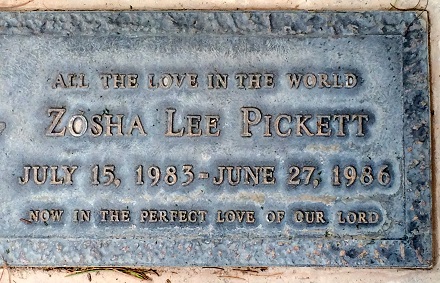
On this date in 1996, 29-year-old Daren Lee Bolton was executed in Arizona for the 1986 kidnapping, rape and murder of a Tucson toddler. Bolton had taken two-year-old Zosha Lee Pickett from her bedroom at night, stabbed her to death and left her body in an abandoned taxi in a storage lot two blocks from her home. It was found a couple of days later.
The medical examiner would testify that the toddler may have suffered “excruciating” pain for up to half an hour before she bled out.
After little Zosha’s death, the police lifted some fingerprints but couldn’t match them to any suspect, so in 1987 they sent them out to other states for them to have a try. Bolton had some convictions in Illinois, and so his prints were in the computerized system there. (Arizona didn’t have such a system in place at the time.) In 1990, during a training exercise, Illinois police officers found a match between Bolton’s fingerprints and a print on Zosha’s window screen. At the time, he was already serving time in Arizona for unrelated charges.
At his trial, Bolton admitted he’d been to Zosha’s home and to the cab where her body was found, but denied any part in her murder. Instead, he said he’d planned to break into the Pickett residence with an accomplice named “Phil” but was scared away. Phil, he said, had come back later and taken and killed the little girl. Bolton had then murdered the man and buried his body in the desert.
The jury saw through this wild story and convicted him of burglary, kidnapping and first-degree murder in 1991.
Bolton had the kind of childhood you might expect: shuttled back and forth between his divorced parents and his grandmother, the victim of physical abuse and possibly also sexual abuse, he was designated “severely emotionally handicapped” and had a long string of assaults to his name by the time he dropped out of school.
He was also charged in the 1982 murder of seven-year-old Cathy Barbara Fritz, also of Tucson, but he was executed before he could be tried in that case. The child had been abducted walking home from a friend’s home, sexually assaulted and then beaten and stabbed to death, all while a “Take Back The Night” demonstration was going on nearby. Bolton was sixteen years old at the time, and he knew the Cathy’s brother. DNA evidence later tied to him to the crime.
He maintained his innocence in both murders, but fired his lawyers and dropped his appeals after less than four years; he said he’d rather die than spend the rest of his life in prison.
His last meal consisted of lasagna, cheesecake and Pepsi.
Zosha Pickett’s parents and Cathy Fritz’s father and brothers were among the thirty witnesses who got to watch him die. He had no last words and, while he glanced at the Picketts once, he refused to acknowledge the Fritz family before he breathed his last, a few minutes past midnight.
A year ago today, Dok Macuei Marer was executed by hanging at Wau Prison in South Sudan.
Dok assassinated tribal chief Chut Dhuol in August 2014, in a possible revenge killing for the previous murder of another chief. There is very little information about this whole affair readily accesible online, a circumstance consistent with the sketchy state of information about the death penalty in the world’s newest state. (Executed Today itself predates South Sudanese independence by four years.)
On this date in 1967, Moustapha Lô was executed for treason in the African nation of Senegal. He had tried to kill the country’s prime minister, Leopold Sedar Senghor, less than three months earlier.
At his trial, Lô freely admitted he’d drawn a gun on Senghor during a ceremony at the Grand Mosque of Dakar on the Muslim holiday of Eid-al-Adha,* but denied that he ever actually intended to kill him.
“I just wanted to give him a warning to change policy,” Lô said. He added, “I wanted to prove … he was not immune to public condemnation.”
His widow, Fatou Sarr, believed him; nearly 45 years after his death, she gave her first interview to the press and said, “He was not able to kill a fly.”
But if he was in fact only acting, Lô’s performance was very convincing: he pointed his pistol at the prime minister and pulled the trigger twice. Fortunately for Senghor, the gun jammed.
The crowd quickly tackled and overpowered Lô and he was hauled away by the police.
Several other people were also accused of being part of the plot. Moustapha Drame was sentenced to life in prison, Doudou Ndiaye to ten years and Momar Mbaye to five years; two other defendants were acquitted of all charges.
Although the country’s religious leaders pleaded for Senghor to pardon his would-be assassin, the prime minister refused. Later on he claimed he had agonized over the decision for days and had nightmares about it, but he concluded, “This is not to judge according to the view of God. Only God can judge in the absolute. However, capital punishment still has a deterrent effect in Senegalese society.”
Lô met his death by firing squad. He said a prayer before his death and claimed he was dying “a martyr.”
Senghor outlived his attacker by 44 years, dying in 2001 at the age of 95.
* The holiday is locally known in Senegal as Tabaski.
Three Greek Cypriots found Guilty of murder were hanged before dawn at Nicosia Central Prison today, the first capital sentences to be carried out in Cyprus since independence in August, 1960. Their fate had been in the balance until 11 o’clock last night, when Mr. Glafcos Clerides, the acting President, announced that after considering all the circumstances, he had decided not to grant a suspension of the executions.
The three men were Hambis Zacharia, Michael Hiletikos, and Lazaris Demetriou. Zacharia was convicted of killing a man with an axe in a Limassol vineyard in September, 1958. The other two were jointly convicted of the murder of a man outside a Limassol cabaret last year.
Last night Mr. Rauf Denktash [the future president of Northern Cyprus -ed.], the Turkish advocate who appeared for Zacharia, had filed a petition in the High Court seeking a declaration that the execution warrant issued by the acting President was illegal and ultra vires, and a declaration that the superintendent of prisons was not legally appointed and could not carry out the executions. The petition was heard in the chamber of Mr. Justice Vassiliades and adjourned for a full court hearing, but this morning was withdrawn.
The English-language Cyprus Mail this morning commends the courage of the acting President and points out that the House of Representatives has power to amend the law if it wishes to abolish capital punishment. It adds that such action is unlikely to be publicly welcomed in view of the number of murders in the republic in recent months.
Despite the correspondent’s confidence in the endurance of the gallows, these first executions for independent Cyprus were also its last executions: no further hangings occurred before Cyprus abolished the death penalty for ordinary crimes in 1983, and for all crimes in 2002.
Corrupt and degrading political associations such as pervade the larger American cities have their natural result in the career of the wretch who expiated his crimes upon the gallows in this city to-day.
He bore the name — Heaven save the mark! — of George Washington Fletcher. Born of a good, respectable family, with a brother an exhorter in the Methodist Church, he has been the black sheep of the flock.
Obstinately repelling all good influences, he has deliberately followed a life of crime from boyhood up, and nothing so well shows the depths to which local politics in this city have sunk as the fact that this man was able defiantly to pursue the life he did merely because he had political friends whose dirty work he did.
Secured immunity from punishment by the small fry ward politicians to whom his aid was valuable, this man was nurtured in the belief that for him the law could have no terrors that “influence” could not remove. The leader of a gang whose services as repeaters at the polls in the interest of a corrupt ring of so-called republicans, Fletcher found that he could defy the law and its officers.
His history is a catalogue of offences against the law, but its sudden ending in the midst of his career, in the very prime of life, proves that justice does not always sleep in Philadelphia, even when a politician is the transgressor.
FLETCHER’S CAREER.
Fletcher was born in a portion of the city called Southwark in 1845. He was only eleven years of age when his innate cruely of disposition showed itself in cutting off pigs’ tails at a pork packer’s yards. He was committed to the House of Refuge for this offence, was soon released and was a couple of years later engaged in a row with a colored boy named Robert Clayton, now living in Atherton street, near Fletcher’s old home, and gave him a serious stab in the side with a knife.
About this time the rebellion broke out, and Fletcher followed the First Pennsylvania Reserves to the Army of the Potomac, deserted and afterward became what was known as a “bounty jumper.”
At the close of the war he shiped in the navy, and was drawn to fill the Swatara‘s quota, one of the vessels which accompanied Admiral Farragut‘s fleet to Europe. On their homeward cruise he deserted from the Swatara at Antwerp. He swam ashore. He then made his way to Liverpool, from which place he worked his passage to Philadelphia on a merchant ship.
Fletcher and James Hanley had both been runners with the Marion Hose, of the old volunteer fire department, and on the formation of the paid department both secured positions. The two had been companions in boyhood, but had grown up very different in character, Fletcher having become a young “rough” and political “striker,” and Hanley a quiet, inoffensive, sober and industrious young man.
Fletcher and his chosen companions planned a series of robberies, but obtained amateur “kids” to perform the dangerous work, while they obtained the “swag” and divided the profits among themselves.
Fletcher’s later career as a fireman was marked with acts of violence, one of which was the shooting of a companion named Stark, which occurred some time previous to the murder of Hanley. This case was settled, like many others in which he was involved, and never reached the courts.
OUT OF EMPLOYMENT.
Fletcher and his early companion Hanley appeared to continue on friendly terms until the spring of 1874, when Fletcherwas arrested, charged with having committed an outrage on a girl about fourteen years of age, named Mary Elizabeth McHugh.
On the 27th of April, 1874, the Grand Jury found a true bill against him on this charge, and he was tried three days after and acquitted, but the accusation cost him his position in the Fire Department. After losing his situation Fletcher was for a long time out of work. He complained greatly of his troubles and placed the entire blame on Hanley. He frequently made threats that he would kill him, and his desire for revenge increased as his repeated efforts to have himself reinstated in the Fire Department were unsuccessful.
On election day, November 2, 1875, the day before Hanley was murdered, Fletcher attempted to vote illegally at a poll in the First war. Frank Wilcox, residing in Redwood street, interposed objections, whereupon the fireman rough levelled his pistol and fired directly at him, but the motion of a friendly hand caused the barrel to point downward, and the ball lodged in Wilcox’s foot. That same day, with pistol in hand, Fletcher was scouring the vicinity of the “Neck” with the intention of killing one Antonio Hale.
HIS LAST CRIME.
Shortly before eight o’clock on the evening of the 3d Fletcher visited the engine house to which Hanley was attached.
At the door he met one of the members named Pinker, of whom he inquired, “is Jimmy Hanley up stairs?”
Pinker replied that he was.
“Then,” returned Fletcher, “tell him to come down; I want to see him.”
Pinker replied, “No, I won’t, George, because if he comes down here there will be trouble between you and him.”
Fletcher replied quickly, “Oh, no there won’t; I saw him up town to-day and we made up.”
“All right, then,” said Pinker, “I will call him,” and he then called up stairs.
Hanley was reading a book, but laid it down and came down stairs immediately. The words, “How are you to-night?” passed between him and Fletcher, and they went toward the the outside together in a friendly way.
Hanley leaned against the jamb of the door, and as a drizzling rain was falling Pinker asked him if he had not better put a coat on. Hanley said yes, and asked Pinker to get him one.
The latter took a coat from the truck and advanced with it to Hanley, telling him where to place it again when he was done with it.
Hanley had just raised his arms to pull the coat on when Fletcher drew a small pistol and fired. The ball entered Hanley’s left breast, cut through the lung and passed into the heart, and, reeling back into the engine house, the wounded man exclaimed that Fletcher had shot him, and fell. Pinker and some of the other firemen lifted him and carried him up stairs to a lounge, on which he expired in about five minutes.
Fletcher was at once arrested. His trial took place a few weeks later, and, a verdict of guilty of murder in the first degree having been agreed upon by the jury and a new trial refused, Fletcher on the 12th of February was sentenced “to be hanged by the neck until dead.” The Governor nixed fixed just one year ago for the execution, but through the legal delays and arguments in the Supreme Court the execution was postponed.
Since Fletcher’s conviction the most strenuous efforts have been made to secure his pardon, mainly by politicians, in whose behalf he has often rendered important services at the polls.
James H. Heverin, the prisoner’s counsel, has also labored most faithfully in behalf of his client, not ceasing his endeavors to procure a pardon or a reprieve until within twenty-four hours of his death.
HIS LAST HOURS ON EARTH.
Recently the conduct of the condemned man has undergone a change under the ministrations of the Rev. Camp, the Methodist preacher, who has been in faithful attendance upon him.
Fletcher leaves a wife and three children, aged respectively five, three and about two years, all of whom have been frequent visitors to him and have had a softening effect upon him.
He has gradually come to be repentant for his crimes and to take comfort in the consolations of religion. Yesterday he was visited for the last time by his family, his counsel Mr. Heverin, Rev. Dr. Westwood, George H. Stuart and others. His last farewells are said to have been very touching.
Fletcher went to sleep about ten o’clock last night and slept soundly for five hours. His spiritual advisers were with him until he retired, and he prayed fervently with them.
When he awoke this morning, at half-past three o’clock, he lit a cigar and sat on a stool in a thoughtful mood. He talked to Keeper Everly of his death, and said he was prepared to die.
“In three or four hours,” said he, “I shall be in heaven.”
Early this morning he was visited by Rev. Messrs. Camp and Pearce, and sang with them in a clear, loud voice, the “Crucified One,” one of Moody and Sankey‘s hymns, commencing, “It is the promise of God full salvation to give,” which seemed, of all sacred pieces, his favorite one.
His voice rang out clear in the corridor, and the prisoners near him must have distinctly heard it, for his door was partly open. His brother-in-law paid his farewell this morning.
THE EXECUTION.
The Sheriff and his party arrived at the prison at eighteen minutes before ten o’clock, and upon being told that his counsel were among the visitors Fletcher sent for them.
An affecting interview was the result, all of the party, including ex-Sheriff Leeds, coming out of the cell with their eyes full of tears.
The scaffold was erected in the convict’s corridor. At ten minutes past ten Fletcher was brought from his cell, and the dismal procession walked to the gallows.
As Fletcher stepped on the fatal trap and faced the spectators below he bore a subdued expression, but displayed no sign of trepidation. A neat black suit* gave him a somewhat clerical appearance, which was heightened by his attitude, his hands being peacefully clasped together, while his head slightly inclined as Mr. Camp prayed fervently that as God had permitted His Son to die for sinners and that whomsoever believeth in Him shall have everlasting life, so might His servant, George Fletcher, have his sins pardoned and be admitted to everlasting life.
Then the doomed man, still betraying no sign of wavering, shook hands with the clergymen, the Sheriff and others, and straightened himself up, while the noose was adjusted, his hands manacled behind his back, and the white cap drawn over his face.
He was then left alone on the scaffold, and all but one of the supports under the trap door on which he stood removed.
Rev. Mr. Camp then lifted his voice in a final prayer, saying, “Now, Lord, we commend the soul of George Fletcher to thine everlasting care. Lord Jesus, receive his spirit, in the name of the Father, Son and —-” He had progressed thus far when he was interrupted by the springing of the trap by the Sheriff, who, by pulling the rope, had pulled away the last upright, and Fletcher’s body fell with a jerk.
STRANGLED TO DEATH.
The trap was sprung at eighteen minutes past ten.
The neck was not broken, and the poor man died slowly by strangulation.
At twenty-five minutes past ten, seven minutes after the fall, the pulse was beating 140 to the minute. It lessened rapidly, but it was not until thirty-five minutes past ten, or seventeen minutes after the fall, that the pulse and the heart ceased their action.
The body was then cut down and taken to the deadhouse, where the physicians formally declared death to have resulted from strangulation.
* The suit was provided courtesy of one of Fletcher’s old political bosses, Jesse Tettermary — a little investment in the future loyalty of his other muscle, perhaps. (Per The North American, June 11, 1877)


 At his trial, Bolton admitted he’d been to Zosha’s home and to the cab where her body was found, but denied any part in her murder. Instead, he said he’d planned to break into the Pickett residence with an accomplice named “Phil” but was scared away. Phil, he said, had come back later and taken and killed the little girl. Bolton had then murdered the man and buried his body in the desert.