1890: Otto Leuth

(Thanks to Meaghan Good of the Charley Project for the guest post. -ed.)

On this date in 1890 at the Columbus Penitentiary in Ohio, a sullen German-American teenager named Otto Leuth (sometimes spelled “Lueth”) paid with his life for the brutal murder of his seven-year-old neighbor, Maggie Thompson.

John Stark Bellamy II, writing of the murder in his book The Corpse in the Cellar: And Further Tales of Cleveland Woe, noted how familiar the case sounds to modern ears:

[T]he sickening murder of an innocent child; yet another child accused for the dreadful deed; a sensational trial, replete with dubiously “expert” testimony, suspicious “confessions,” allegations of police “third-degree” methods, and charges of biased press; not to mention “latchkey” children, systematic child abuse, saccharine sympathy for the guilty, and charges of ethnic favoritism.

Yet it happened over a century ago.

Otto, sixteen at the time he killed little Maggie Thompson, had had a hard life, as Bellamy explains in his book. His mother, Lena, testified at his trial that she

went into veritably demonic fits of rage, during which she was in the habit of physically abusing her children, especially Otto. From an early age, she blandly admitted, she had pulled his hair, kicked him, beaten him, walked on him, and often hit him with any object that came to hand. Once, when Otto was eight, she had beaten him with a chair leg and, when [Otto’s father] Henry tried to intervene, stabbed Henry twice with a convenient butcher knife. Just a few months before Maggie Thompson’s murder, Lena had repeatedly slammed Otto’s head into a wooden door.

It speaks volumes of the difference between that century and this one that nobody who heard Lena’s testimony seemed to think this was in any way excessive, never mind cruel; on the contrary, one person praised her methods as being “good German discipline.”

On May 9, 1889, sixteen-year-old Otto was alone at his family’s home at 47 Merchant Avenue in Tremont, a suburb of Cleveland. He was used to being alone: his mother had been committed to a mental hospital some months before, his father was wrapped up in his cabinet-making business, and his older brother had moved out of the house.
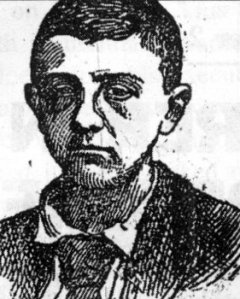

Otto (top) and his victim.

That morning, down the street at 24 Merchant Avenue, Maggie Thompson set off for school. Her mother, Clara, dropped her off at the front gate; it was the last time she would see her daughter alive.

Maggie attended the morning classes and, when school was dismissed for lunch at 11:15 a.m., started on the four-block walk home. En route, she vanished without a trace, as if “the sidewalk might have opened and swallowed the girl.”

Naturally there was a frantic search, lead by her devastated parents and the Cleveland Police Department, who tore the city apart looking for her.

But, although there were numerous false sightings and a few wild stories about Maggie’s disappearance, in spite of everyone’s efforts they couldn’t find her.

Otto participated in the search, along with most of the neighborhood. Nearly every day he would approach Clara Thompson and solicitously ask if she’d heard any news of her child.

In early June, Clarissa Shevel, the woman who lived with her husband in the back of the Lueths’ two-family house, asked Otto to do something about the terrible stench that pervaded the entire building. Otto suggested the odor was caused by a dead animal. He bought some chloride of lime and put it in the ventilation hole, then burned some sulfur, but it didn’t help.

Around that time he was witnessed carrying some badly stained bedding to the smokehouse at the back of the property.

On June 9, Otto’s mother Lena, who had by now been discharged from the mental hospital, became fed up with the smell and sent her husband Henry down to the cellar to investigate. He came back up a few minutes later, deeply shaken, and ran out to find a policeman.

In the Lueths’ cellar was the nude corpse of Maggie Thompson.

She was wrapped in one of Lena’s dresses and her own clothes lay underneath her. She had been beaten to death and her body was so badly decomposed that her parents had to identify her by scars on her hips.

The police promptly arrested everyone who lived at the house: Henry and Lena Lueth, Clarissa Shevel and her husband, and Otto, who was picked up on his way home from the ice cream parlor. All five suspects were separated and subjected to a serious “sweating,” but Otto was the prime suspect. He had a reputation as a bully, and he’d been at home alone for much of the previous month.

Bellamy records:

The climax came at 3:30 a.m., when an agonized female shriek resounded from the floor below the sweating room. “Who is that?” cried Otto to Detective Francis Douglass. “Your mother, I believe,” replied Douglass. “She had nothing to do with it!” blurted out Otto. “Who did?” queried Douglass. Otto: “I did it! I did it!” Douglass: “Did what, Otto?” “I killed her! I killed her! Please give me your revolver so I can kill myself!”

Resisting the temptation, the police instead took his verbal confession, wrote it down, had him sign it and escorted him to a cell.

Otto said he had been standing outside his parents’ home at about 11:30 a.m. on May 9 when he encountered Maggie. She asked him if he could donate any buttons to the “button-string” she was making, and he said he had four and would give them to her if she came inside.

Maggie obediently followed him in, and he led her upstairs to his bedroom, where he attempted to rape her. When she screamed, he hit her with a nearby hammer.

Otto said he thought he’d probably killed her with the first blow, but he kept striking her until her head was a pulp and the bed was covered in blood. After an unsuccessful attempt to have sex with her body, he fled the scene. He did go back to the house that night, but spent the next several days at his brother’s home.

Six days later, just before his mother was supposed to come home, Otto returned home to clean up. He carried Maggie’s corpse to the family cellar and left it lying there; he didn’t even bother to bury it or cover it up.

Given Otto’s confession, the circumstantial evidence and the revulsion his crime invoked in the city of Cleveland, his lawyer didn’t have much to work with. Not even trying for an acquittal, his defense instead claimed Otto was mentally impaired and/or insane.

Otto had a strange depression in his skull and his attorney suggested he was brain-damaged — which might very well have been true, given the abuse he had suffered at Lena’s hands. Several members of his family, including his mother and brother, had epilepsy, and his attorney suggested he might have had a seizure and committed his crime without even knowing what he was doing.

Such a scenario was possible. The problem was, though, that none of the medical experts who testified for the defense could diagnose Otto with epilepsy.

The claims of subnormal intelligence were contradicted by the testimony of Otto’s former teachers. Although his pathetic attempts to conceal Maggie’s body might indicate otherwise, his intellect seems to have been about average. Before he quit school at age 13, he had been an unexceptional student with some talent as a violinist.

Otto’s lawyer also said his client had not, in fact, attempted to sexually assault Maggie Thompson either before or after death, and Otto had invented that part of his confession because the police were pressing him to cough up an explanation for his motiveless crime. But given the fact that Maggie’s body was found naked, this claim didn’t carry much weight either.

It was no surprise that, when the trial concluded on December 27, 1889, the jury came back with a verdict of guilty without a recommendation of mercy. Perhaps the only surprising thing was that they actually bothered to deliberate for a whole four and a half hours.

Otto rapidly exhausted his appeals and was hanged eight months after his trial, alongside another killer, one John “Brocky” Smith of Cincinnati. Two other men had also been scheduled to die that night, but one got reprieved and the other’s execution was postponed.

Otto left behind a statement where he admitted he’d killed Maggie Thompson, but denied his previous claims that he’d tried to rape her. He died calmly and without a fuss, standing on the trap and saying simply “All right, let her go.”

On this day..

1987: Dale Selby Pierre, Hi-Fi Murderer

On this date in 1987, Utah executed Dale Selby Pierre for one of the most notorious crimes in that state’s history — the Hi-Fi Murders.

Pierre, along with two fellow airmen from the Hill Air Force Base, William Andrews and Keith Roberts, began an armed robbery of a hi-fi shop in nearby Ogden near closing time on the evening of April 22, 1974.

The night that unfolded would be a visit to an antechamber of hell not only for the two young clerks on duty at the time, but three other people who wandered into the store while the crooks were still in it — each of whom was added to the growing pen of hostages Pierre et al kept in the basement.

After plundering the shop of $25,000 worth of electronics, Pierre and Andrews went to get rid of their prisoners by making them drink liquid Drano.

This method of homicide, theoretically an elegantly quiet one which would facilitate a clean getaway, had been cribbed from a murder scene in the 1973 Dirty Harry movie Magnum Force.

The struggles of Cortney Naisbitt, one of the surviving victims, forms the subject of Victim: The Other Side of Murder — a classic of the true-crime genre and of the victim’s rights movement.

But human flesh is hardier than celluloid.

Unlike the poor prostitute in Magnum Force, Pierre and Andrews’s victims groaned and gurgled, their blistering mouths suppurating so much fluid that duct tape to quiet them down wouldn’t stick. And the Drano didn’t kill them, or at least it was sure taking its time.

“I remember the noise they were making, the sounds of pain they were making,” Pierre told his clemency hearing. “It was something greater than sad.”

Since they hadn’t got rid of their victims quite so cleanly, Pierre simply set about shooting them — and in the case of Michelle Ansley, a 19-year-old in her first (and last) week on the job at the Hi-Fi shop, raping her first. These execution-style murders had only mixed results, and one of the hostages — 43-year-old Orren Walker — being noticeably not dead, had a ball-point pen kicked into his ear in an attempt to finish him off.

Somehow, Walker still survived, as did 16-year-old Cortney Naisbitt, who suffered severe brain damage. (Both have since died.) Stanley Walker, Carol Naisbitt, and Ansley were not so “lucky.” But neither were the perps: since Andrews had openly talked at the Air Force base about boosting that very hi-fi shop and even killing anyone who “gets in the way,” suspicious fellow airmen soon turned them in.

The 21st century’s more polished and calculating strategic communications consultant probably would have advised keeping well clear of such an incendiary crime, but death penalty opponents actually pushed clemency hard in the Hi-Fi case.* For the NAACP, the sentences underscored racial disparity in the death penalty.

Rubbish, one might say, given the killers’ epically villainous conduct. But one member of the all-white jury was apparently passed a note by parties unknown reading “Hang the niggers.” And the NAACP noted that Utah gave death sentences to these guys, but not to a white supremacist who murdered two black men for jogging with white women.

None of this cut any ice with Utah. Years later, the killers themselves had a hard time fitting that monstrous night into any kind of comprehensible rationale. Pierre:

The crime took a course of its own. It wasn’t planned that way. People kept coming in and I just panicked. The only way to prevent what happened was to have been moved away from the Air Force entirely … Of course the alcohol and the pills I was consuming didn’t help — valiums, reds, black beauties and yellow jackets … I tell myself, “You have to accept responsibility for it — you did it, you were there. You can’t rationalize it.”


Dale Pierre pleads his case to the Utah clemency board.

Dale Pierre was the very first person put to death in Utah after its famously groundbreaking execution of Gary Gilmore in 1977. But in fact, the Hi-Fi killers had preceded the eager volunteer Gilmore on Utah’s death row, and Gilmore as he walked his last mile reportedly wisecracked to Pierre and Andrews, “I’ll be seeing you directly.”

Pierre’s accomplice William Andrews was also finally executed in 1992, after a then-unimaginable (and anything but “direct”) 18 years on death row — nearly half his life. Their fellow accomplice Keith Roberts didn’t personally take part in the cellar hecatomb and therefore avoided the death sentence: he was paroled in 1987.

* The clemency push was much stronger for William Andrews than for Dale Pierre, since Andrews was also making the argument that he hadn’t directly killed anyone and hadn’t intended to. As a matter of fact, the manipulative Andrews was and is widely doubted on that point — but any such claim was wholly unavailable to the acknowledged triggerman Pierre.

On this day..

1628: Milady de Winter, Three Musketeers villainess

Late this night* in 1628 was the fictional execution of The Three Musketeers antagonist Milady de Winter.

Milady de Winter, as the heroine of Agnes Maupre’s revisionist French graphic novel series (Author interview | Another (Both in French)).

This conniving minx bears the fleur-de-lis brand of a teenage crime upon her shoulder — a very naughty beauty-mark indeed — but becomes a secret agent of Cardinal Richelieu. (Richelieu is a point of friction for the Musketeers right from the start.)

This novel — which has long been in the public domain (Text at Gutenberg.org or ClassicReader.com | Free audio book at Librivox.org) — features Milady continually bedeviling the protagonist d’Artagnan. He loves her; she keeps trying to kill him. Pretty typical for these grim annals. (She also used to be Athos’s wife, years ago, until he tried to murder her. Long story.)

To skip to the end of things, Milady is portrayed as having orchestrated at Richelieu’s behest the (actual, historical) assassination of the Musketeers’ buddy the (actual, historical) Duke of Buckingham, which Milady accomplishes by seducing and manipulating his (actual, historical) assassin, John Felton. In reality, Felton was motivated by the stirring Republican sentiment that would soon generate a revolution; in Dumas, he’s a horny dupe who beholds his seductress escaping by sea even as he’s placed under arrest.

Buckingham was (actually, historically) murdered on August 23.

The fictional narrative picks up on August 25, when the escaped Milady writes to Cardinal Richelieu from the safety of Boulogne. Unbeknownst to her, her hours are numbered.

Milady proceeds the next morning to a convent in Bethune where she chances to encounter the mistress of her old foe d’Artagnan … and, by that night, to slay said mistress with poison just ahead of the arrival of the Musketeers.** But the Musketeers are able to track the escaping murderess down by the next evening. There, they subject her to a snap “trial”:

“We wish to judge you according to your crime,” said Athos; “you shall be free to defend yourself. Justify yourself if you can. M. d’Artagnan, it is for you to accuse her first.”

D’Artagnan advanced.

“Before God and before men,” said he, “I accuse this woman of having poisoned Constance Bonacieux, who died yesterday evening.”

He turned towards Porthos and Aramis.

“We bear witness to this,” said the two Musketeers, with one voice.

D’Artagnan continued: “Before God and before men, I accuse this woman of having attempted to poison me, in wine which she sent me from Villeroy, with a forged letter, as if that wine came from my friends. God preserved me, but a man named Brisemont died in my place.”

“We bear witness to this,” said Porthos and Aramis, in the same manner as before.

“Before God and before men, I accuse this woman of having urged me to the murder of the Baron de Wardes; but as no one else can attest the truth of this accusation, I attest it myself. I have done.” And d’Artagnan passed to the other side of the room with Porthos and Aramis.

“Your turn, my Lord,” said Athos.

The baron came forward.

“Before God and before men,” said he, “I accuse this woman of having caused the assassination of the Duke of Buckingham.”

“The Duke of Buckingham assassinated!” cried all present, with one voice.

“Yes,” said the baron, “assassinated. On receiving the warning letter you wrote to me, I had this woman arrested, and gave her in charge to a loyal servant. She corrupted this man; she placed the poniard in his hand; she made him kill the duke. And at this moment, perhaps, Felton is paying with his head for the crime of this fury!”

And so forth.

Then these obviously impartial judges judge her guilty, and have the executioner of Lille — whom they have thoughtfully procured in advance — chop off her head and dump her in a river.

“The executioner may kill, without being on that account an assassin,” said the man in the red cloak [i.e., the executioner himself], rapping upon his immense sword. “This is the last judge; that is all. Nachrichter, as say our neighbors, the Germans.”

Extrajudicial is as extrajudicial does. And in this case, Richelieu is just as happy to be rid of his duplicitous agent and, admiring the protagonist’s moxie, commissions d’Artagnan a lieutenant in the Musketeers. D’Artagnan is the fourth of the titular “three Musketeers”, so this denouement means that he’s finally made it … and he should stand by for duty in sequels continuing to mix-and-match Dumas’s fictional characters with actual, historical events.

Indeed, in the next volume of the series, Twenty Years After, it’s Milady’s vengeful son Mordaunt who acts as Charles I‘s executioner.

This date’s captivating femme fatale has appropriately been portrayed by a ravishing host of silver screen sirens including Lana Turner, Mylene Demongeot, Antonella Lualdi, Faye Dunaway, Rebecca de Mornay, Emmanuelle Beart, and (most recently as of this writing), Milla Jovovich.

* August 27-28, right around midnight. Dumas isn’t specific as to pre- or post-midnight.

** In the novel, it’s Madame de Chevreuse who has arranged this rendezvous of d’Artagnan with his lover — another actual, historical person whom we have met elsewhere in these pages.

On this day..

1825: Stephen Videto, Indian giver

On this date in 1825, Stephen Videto was hanged in Franklin County, New York, for murder.

This History of Clinton and Franklin Counties misstates the execution date but otherwise sums the matter up nicely. Videto found himself yoked to an engagement he’d come to regard as disagreeable.

Rather than just break the thing off,* he arranged — so the jury found, though Videto always denied it — to kill the poor woman. (Literally poor. Her last husband had left her, abandoning her penniless.)

Videto contrived a whole scenario where the colored man was lurking around his house … the red-colored man, in this case. Scary Indians.

Claiming to be spooked by encounters with mysterious native prowlers, Videto armed himself up; sure enough, one night soon, an Indian shot into his bedroom and started a firefight. The perennially discarded Fanny Mosley was killed in the crossfire.

For the apparent calculation that went into this cover story, Videto was awfully careless about the details. As rudimentary as crime scene forensics were in 1825, it was still self-evident that the glass in the window had been shot outward, not inward; and, that the ball causing Mosley’s fatal wound had likewise originated from within the house, not without. And come to think of it, the “Indian footprints” outside that window looked an awful lot like Videto’s own. And nobody else had ever seen these Indian stalkers Videto was on about — not that night, nor in his buildup of the preceding days.

The evidence might be circumstantial, but those were a whole lot of circumstances. The jury took 15 minutes to convict him, although Videto maintained his innocence to the last — even waving a written declaration of such to the onlookers after the trap fell, while he was strangling to death.

We have a letter from a witness to this hanging, a Vermont silversmith named William Ransom Vilas:**

After a large concourse of people had assembled which was estimated at six or eight thousand, [Videto] was then taken from his place of confinement and conducted by the sherif and guard of seven independent companies to the place of his execution. Then, with 2 assistants, he ascended the gallows, where a discourse was delivered by Elder [Nathaniel] Culver from Luke 13th 23, in which he pointed out to him awful situation and then he protested his innocence of the crime alledged against him and likewise stated that he was no way accessory. Then after giveing a parting hand to each one of his attendants and to a Brother, which was all the relation of his present, his hands were then bound; the rope about his neck was then fastened, and the moment was at hand. The fatal stud was then nock-d out, and now, do not you see him in your imagination hung & strangling. O twas a solemn sight, but the laws must be put in execution.

Although he protested his innocence, it (is) generally believed that he was guilty but protested innocence on account of the conexions. Thus it is that we see man snached from the hand of existence by the Executioner, thus we may justly say “the wicked do not live out half their days.” He (had) a long trial and without doubt an impartial one. But we are frail mortals all hastening to our Mother, ____our joys are like the morning dew before the morning sun. They pass we know not where and we are led to reflection:

Mortals behold the hour glass.
And leave your wordly care
It shows how swift our minutes pass
And bids us all for death prepare.

* Possible motivation for preferring homicide to a breakup: his “beloved” was pregnant.

** As a Vermont Vilas, we suppose that this writer was probably related to politician Levi Baker Vilas and to his (future, at this point) son, eventual U.S. Senator and Secretary of the Interior William Freeman Vilas.

On this day..

1889: Auguste Neel, on St. Pierre

On this date in 1889, the only guillotine execution in North America took place on the tiny French remnant colony of Saint Pierre, just off Newfoundland.

August(e) Neel had capped a Dec. 30, 1888 drinking binge with fellow fisherman Louis Ollivier by breaking into a boat captain’s cabin they expected to find empty. Instead, they found the armed captain ready to defend himself … so they overpowered him and stabbed him to death.

And then, for some reason — “because we were sloshed and we wanted to find out how much fat the old seadog had in his body,” Neel told the court — the murderous sots dismembered the body.

While the murder was not particularly premeditated, it occurred during a perceived crime wave, and the post-mortem butcher’s act really grossed out the court. (They probably also didn’t do themselves any favors at the bar by having attempted to sail to Newfoundland.) All in all, a prime case for example-setting: Neel, as the lead culprit in the caper, was sentenced to the worst example possible. His partner got 10 years at hard labor.

Now, St. Pierre hadn’t had an execution and didn’t have the infrastructure for it. But French law didn’t let the locals in far-flung islands just do a practical straightforward thing like hang a bloke or shoot a bloke. And it wouldn’t do to have the colony send Neel somewhere where executions were a done thing. It was there in black and white that executions had to be conducted by guillotine, near the site of the crime. And so an old spare guillotine was disassembled, boxed up, and shipped up to St. Pierre from Martinique, expressly to sever Neel’s head.

Neel seems to have been the calmest man on the island, almost philosophically indifferent to the the head-chopper. The community he had aggrieved could not say the same: St. Pierre had to recruit a local petty criminal to serve as executioner, and the guy was so ostracized that he left for France afterwards. They hadn’t thought through the execution procedure to determine who would give the order to drop the blade, so after an uncomfortable pause, Neel himself shouted at the executioner to do it. By the time it hit bottom, human flesh was left grotesquely clinging to the dull imported blade.

The prosecutor vowed in the face of this dog’s breakfast never to seek another death sentence.

Never used again, this infamous device remains in St. Pierre to this day. It can be seen there behind the stairs at the Musée de l’Arche.


The St. Pierre guillotine. (cc) image from The Tedster, who also thoughtfully provides photos of the museum’s explanatory placards. 1, 2, 3, 4, 5, 6.

The Neel story was “re-imagined” — nigh rewritten — for the heavily fictionalized 2000 Juliette Binoche film La Veuve de St. Pierre.

The primary source for this account — apart from the museum placards linked in the caption above — is the invaluable Bois de Justice, an astonishingly encyclopedic resource on the history of the guillotine.

On this day..

1700: The Rev. Thomas Hunter, M.A.

We doubt that any interposition of ours can improve the story of this execution as provided in the Newgate Calendar:


Executed on 22nd of August, 1700, near Edinburgh, for the diabolical Murder out of Revenge of the Two Children of Mr Gordon

It is with deep regret that we are compelled to bring before the reader a murderer, in a character which ever should be held most sacred. A crime more premeditated, and more fraught with cruelty, never stained the annals of history. Ambition has often impelled tyrants to shed innocent blood; revenge has stimulated men to kill each other; jealousy with ‘jaundiced eye’ destroys the object of its love; but God forbid that we should ever again have to record the fact of a tutor, a minister of the Gospel, premeditatedly murdering his pupils! — the sons of his benefactor. When we add, that this most miserable sinner expiated his offence in avowing himself an atheist, we arrive, at once, at the very depth of human depravity.

This detestable culprit was born in the county of Fife, in Scotland, and was the son of a rich farmer, who sent him to the University of St Andrews for education. When he had acquired a sufficient share of classical learning he was admitted to the degree of Master of Arts, and began to prosecute his studies in divinity with no small degree of success. Several of the younger clergymen act as tutors to wealthy and distinguished families till a proper period arrives for their entering into orders, which they never do till they obtain a benefice. While in this rank of life they bear the name of chaplains; and in this station Hunter lived about two years in the house of Mr Gordon, a very eminent merchant, and one of the bailies of Edinburgh, which is a rank equal to that of alderman of London.

Mr Gordon’s family consisted of himself, his lady, two sons and a daughter, a young woman who attended Mrs Gordon and her daughter, the malefactor in question, some clerks and menial servants. To the care of Hunter was committed the education of the two sons; and for a considerable time he discharged his duty in a manner highly satisfactory to the parents, who considered him as a youth of superior genius and great goodness of heart. Unfortunately a connection took place between Hunter and the young woman, which soon increased to a criminal degree, and was maintained for a considerable time without the knowledge of the family.

One day, however, when Mr and Mrs Gordon were on a visit, Hunter and his girl met in their chamber as usual; but, having been so incautious as not to make their door fast, the children went into the room and found them in such a situation as could not admit of any doubt of the nature of their intercourse. No suspicion was entertained that these children would mention to their parents what had happened, the eldest boy being not quite ten years of age; but when the children were at supper with their parents they disclosed so much as left no room to doubt of what had passed. Hereupon the female servant was directed to quit the house on the following day; but Hunter was continued in the family, after making a proper apology for the crime of which he had been guilty, attributing it to the thoughtlessness of youth, and promising never to offend in the same way again.

From this period he entertained the most inveterate hatred to all the children, on whom he determined in his own mind to wreak the most diabolical vengeance. Nothing less than murder was his intention; but it was a considerable time after he had formed this horrid plan before he had an opportunity of carrying it into execution.

Whenever it was a fine day he was accustomed to walk in the fields with his pupils for an hour before dinner, and in these excursions the young lady generally attended her brothers. At the period immediately preceding the commission of the fatal act Mr Gordon and his family were at their country retreat, very near Edinburgh; and having received an invitation to dine in that city, he and his lady proposed to go thither about the time that Hunter usually took his noontide walk with the children. Mrs Gordon was very anxious for all the children to accompany them on this visit, but this was strenuously opposed by her husband, who would consent that only the little girl should attend them.

By this circumstance Hunter’s intention of murdering all the three children was frustrated; but he held the resolution of destroying the boys while they were yet in his power. With this view he took them into the fields and sat down as if to repose himself on the grass.

This event took place soon after the middle of the month of August, 1700 and Hunter was preparing his knife to put a period to the lives of the children at the very moment they were busied in catching butterflies and gathering wild flowers. Having sharpened his knife, he called the lads to him, and when he had reprimanded them for acquainting their father and mother to the scene to which they had been witnesses, said that he would immediately put them to death.

Terrified by this threat, the children ran from him; but he immediately followed and brought them back. He then placed his knee on the body of the one while he cut the throat of the other with his penknife, and then treated the second in the same inhuman manner that he had done the first. These horrid murders were committed within half-a-mile of the Castle of Edinburgh; and as the deed was perpetrated in the middle of the day, and in the open fields, it would have been very wonderful indeed if the murderer had not been immediately taken into custody.

At the very time a gentleman was walking on the Castle hill of Edinburgh, who had a tolerably perfect view of what passed. Alarmed by the incident, he called some people, who ran with him to the place where the children were lying dead. Hunter now had advanced towards a river, with a view to drown himself. Those who pursued came up with him just as he reached the brink of the river; and his person being immediately known to them, a messenger was instantly dispatched to Mr and Mrs Gordon, who were at that moment going to dinner with their friend, to inform them of the horrid murder of their sons.

Language is too weak to describe the effects resulting from the communication of this dreadful news; the astonishment of the afflicted father, the agony of the frantic mother, may possibly be conceived, though it cannot be painted.

According to an old Scottish law it was decreed that “if a murderer should be taken with the blood of the murdered person on his clothes, he should be prosecuted in the Sheriff’s Court, and executed within three days after the commission of the fact.” It was not common to execute this sentence with rigour; but this offender’s crime was of so aggravated a nature, that it was not thought proper to remit anything of the utmost severity of the law.

The prisoner was therefore committed to jail and chained down to the floor all night, and on the following day the sheriff issued his precept for the jury to meet; and in consequence of their verdict Hunter was brought to his trial, when he pleaded guilty, and added to the offence he had already committed the horrid crime of declaring that he only lamented not having murdered Mr Gordon’s daughter as well as his sons. The sheriff now passed sentence on the convict, which was to the following purpose: that “on the succeeding day he should be executed on a gibbet, erected for that purpose on the spot where he had committed the murders; but that, previous to his execution, his right hand should be cut off with a hatchet, near the wrist; that then he should be drawn up to the gibbet by a rope, and when he was dead, hung in chains between Edinburgh and Leith, the knife with which he committed the murders being stuck through his hand, which should be advanced over his head and fixed therewith to the top of the gibbet.”

Mr Hunter was executed in strict conformity to the above sentence on the 22nd of August, 1700. But Mr Gordon soon afterwards petitioned the sheriff that the body might be removed to a more distant spot, as its hanging on the side of the highway, through which he frequently passed, tended to re-excite his grief for the occasion that had first given rise to it. This requisition was immediately complied with, and in a few days the body was removed to the skirts of a small village near Edinburgh, named Broughton. It is equally true and horrid to relate, that, at the place of execution, Hunter closed his life with the following shocking declaration: “There is no God — I do not believe there is any or if there is, I hold him in defiance.” Yet this infidel had professed himself to be a minister of the Gospel!

On this day..

1887: Israel Lipski

(Thanks to Meaghan Good of the Charley Project for the guest post. -ed.)

On this day in 1887, 22-year-old Israel Lipski was hanged at Newgate Prison for the murder of Miriam Angel.

His trial and execution were well-publicized in their day, and were the subject of a 1984 book, The Trials of Israel Lipski: A True Story of a Victorian Murder in the East End of London by Martin L. Friedland.

But Lipski has been largely forgotten now … except as a footnote in a much more famous unsolved murder.

Lipski was of Polish-Jewish origin. His real name was Israel Lobulsk; he changed it when he moved to the UK.

He lived in a boardinghouse and worked as an umbrella and walking-stick salesman. Miriam, who was also Jewish, lodged at the same address, 16 Batty Street.

Miriam was found dead in her bed June 28 of that year. She’d been killed in an unusual way: she was forced to consume nitric acid, also known as aquafortis, a strong corrosive chemical now used in rocket fuel. She was six months pregnant at the time of her death.

Lipski was found hiding under her bed. He too had consumed nitric acid and the inside of his mouth was burned. Investigators later determined he’d purchased an ounce of the chemical that very morning. They theorized he had killed Miriam during a rape attempt.

Lipski, for this part, insisted he was innocent of any crime and told an extraordinary story: he stumbled across two co-workers in Miriam’s room rifling through her things. Miriam was already dead at this point. The two men attacked and robbed him, poured the nitric acid down his throat and threw him under the bed, where he fainted.

The judge’s summing-up to the jury, described by one news account as “lucid and temperate,” went with the rape theory:

… that the murderer of Miriam Angel entered her room under the influence of unlawful passion; that, balked in this design, his passion turned to homicidal fury; and that in a reaction of shame and terror he had taken a dose of the same poison that he had given to his victim. If that theory was probable, continued the judge, the murder was much more likely to have been the work of one man than two.

The climate of pervasive anti-Semitism in East London during this time sealed Lipski’s fate. London’s Jewish population, largely impoverished Polish and Russian refugees, was ever liable to blame for a wide variety of social problems. On top of everything else, Lipski’s legal defense was abysmal and the judge clearly biased. He might have been guilty, but the fairness of his trial is questionable.

Following Lipski’s conviction and death sentence there was worried speculation that he might, after all, be innocent. Several prominent people, including members of Parliament and investigative journalist William Stead, petitioned the Home Secretary for a reprieve or commutation. (Stead referred to Lipski as “the young martyr” and the “much injured young exile.”) The wind went out of their sails, however, after Lipski’s confession was published:

I, Israel Lipski, before I appear before God in judgment, desire to speak the whole truth concerning the crime of which I am accused. I will not die with a lie on my lips. I will not let others suffer even in suspicion for my sin. I alone was guilty of the murder of Miriam Angel.

I thought the woman had money in her room, so I entered, the door being unlocked and the woman asleep. I had no thought of violating her, and I swear I never approached her with that object, nor did I wrong her in this way. Miriam Angel awoke before I could search about for money, and cried out, but very softly. Thereupon I struck her on the head and seized her by the neck, and closed her mouth with my hand, so that she should not arouse the attention of those who were about the house.

I had long been tired of my life, and had bought a pennyworth of aquafortis that morning for the purpose of putting an end to myself. Suddenly I thought of the bottle I had in my pocket, and drew it out and poured some of the contents down her throat. She fainted and, recognizing my desperate condition, I took the rest. The bottle was an old one which I had formerly used … The quantity of aquafortis I took had no effect on me.

Hearing the voices of people coming upstairs, I crawled under the bed. The woman seemed already dead. There was only a very short time from the moment of my entering the room until I was taken away.

Even before his execution, “Lipski” became a part of Londoners’ vocabulary. It was used as both a slur against Jews and as a verb, the way a certain kind of suffocation murder still known as “burking” was named after William Burke of “Burke and Hare” fame.

A year after Israel Lipski’s execution, the name “Lipski” once again came under scrutiny after a murder suspect yelled it out in front of a witness, leaving scholars and true-crime buffs to speculate about its meaning for the next 120 years and counting.

The victim in that case was a prostitute named Elizabeth Stride. The suspect is known only by his trade name, Jack the Ripper.

But that’s another story.

On this day..

2011: Li Lindong, truck driver

(Thanks to Meaghan Good of the Charley Project for the guest post. -ed.)

A year ago today, coal truck driver Li Lindong was executed for the murder of a 35-year-old man named Mergen.*

The victim was dragged down the street for 160 yards, or 145 meters, before he finally died. His death is symptomatic of the serious ethnic/class tensions in Inner Mongolia, where the crime took place.

Li Lindong was Han Chinese; Mergen was an ethnic Mongol herder. Inner Mongolia covers over 10% of China’s landmass and has 24 million people. Han Chinese make up almost 80% of the population, but the ethnic Mongol minority were there first.


A yurt on the Mongolian steppe.

While the Mongols continue to live a traditional, pastoral existence, the region’s coal industry has been booming of late and many Hans, like Li, have flocked in vast numbers to work in the mines.

Problem: mining and sheep-herding don’t exactly go together.

The Mongols claimed a number of grievances:

  1. The noise from the mines is difficult to live with.
  2. The coal pollution is turning the steppe into desert, making it impossible for them to find pasture for their animals.
  3. The miners are intruding on their land, tearing up the grass and even running over and killing their livestock.
  4. The Chinese government is trying to force them to to give up their nomadic existence and live in permanent houses.

According to The Guardian, these complaints had merit and the damage was obvious, even from a distance:

Many students are from herding families who have been moved into cities as the wide-open pastures are fenced off. The government says such measures are necessary to promote development, prevent overgrazing and protect the fragile grasslands, much of which have turned to desert in recent years. Locals say herders’ rights have been violated and the fencing and mining have created bigger environmental problems, including pollution, noise, traffic and dust storms that blow across much of north-east Asia.

The transformation is evident on the flight to Xilinhot. From the air, the grasslands are blotched with sandy areas near farms and the dark smudges of open-cast pits. From the road, the clouds of dust from mines and trucks is visible miles away.

So outraged were the Mongol herders that they actually began organized protests, which aren’t terribly common in China, particularly among Mongols. (The precedents aren’t good.)

This was what lead to Mergen’s murder.

He and about 20 to 40 other herders had formed a human chain to try to block a convoy of coal trucks. There was a standoff as the truckers tried to persuade the herders to move aside. Finally Li, infuriated, simply hit the gas and ran over some of the herders, killing Mergen.**

Mergen’s murder lead to still more protests. One, attended by some two thousand Mongolian high school students, was the largest protest in Inner Mongolia in twenty years. The protesters claimed the Chinese government hadn’t acted to address the underlying problems that lead to the herder’s death.


A protest over Mergen’s death.

The government claimed otherwise, saying they were going to overhaul the coal mining industry and shut down the worst polluters, as well as try to cut down on other environmental problems like water shortages and soil erosion. (They have, at least, shut down over 200 mines.)

As for Mergen’s murder, their response was swift, as Chinese justice tends to be.

Mergen was killed on May 10. Li Lindong was arrested shortly thereafter and tried on June 8, in a six-hour procedure that resulted in the death sentence. That sentence was carried out two months later.

Nor was he was the only person to face charges. Lu Xiangdong, the passenger in Li’s truck, was also convicted of murder and sentenced to life in prison. Wu Xiaowei and Li Manggang got three years apiece for obstructing justice by blocking the police cars that arrived on the scene and allowing the truckers to escape.

The government also gave a monetary settlement to Mergen’s grieving family, but they would probably rather have him back instead.

As for Inner Mongolia … it’s hanging in there, but it remains to be seen whether the environmental problems will or even can be relieved.

* In his culture, there are no last names.

** According to one widely reported but unconfirmed account, he joked about it, saying he had enough insurance to cover the death of a “smelly Mongolian herder.”

On this day..

1820: Amasa Fuller, the Indiana hero

On this date in 1820, Amasa Fuller was hanged for murdering his rival in love.

“I am a man, and have acted the part of a man!” he declared when taken standing over the still-expiring body of his victim, Palmer Warren. “I glory in the deed!”

It’s one of those problematic constructions of manhood that might do for a graduate thesis.

Our man-actor from the town of Lawrenceburg (and from a star-crossed family with a pattern of violent deaths) had been courting assiduously a “young lady”. Apropos of that graduate thesis, the historical records basically don’t even mention her name; according to a single newspaper article cited in Cecilia Reclaimed: Feminist Perspectives on Gender and Music, it was “Catharine Farrar”. The court records generally just call her the “young lady,” even adding that she was “not handsome,” as in “why are you people committing homicide over this prize?”

But let’s just say Miss Farrar was really great. And Amasa Fuller was really smitten.

Having wooed Farrar into an engagement, Fuller was incensed when he found out that she’d been swooped by a rival while he, Fuller, was away on a business trip. Murder by Gaslight has illuminated the fuller story of Fuller’s revenge; in fine, he returned to Lawrenceburg, and after several unsuccessful attempts to start a scrap with his rival, Fuller forced his way into Palmer’s office, offered him a pistol for a duel, and when the peacable Palmer again refused to fight, Fuller just plain shot him — right through the heart.

Strangely from our retrospective standpoint, the good people of Lawrenceburg viewed Fuller not so much as an unbalanced stalker as, well, the Indiana hero — a man of honor. After Fuller’s conviction,* Lawrenceburg and its surrounding Dearborn County petitioned almost en masse for Fuller’s pardon.

When they didn’t get it, they settled for an execution ballad, “Fuller and Warren”, that lauds “brave Fuller” standing “like an angel” on the scaffold’s trap. (Right before the rope broke.)

This ballad has some bitter words for the near-anonymous object of Fuller’s heart who “robbed him of his honour and his life”: “Cursed be she who has caused this misery; / In his stead she had ought for to die.” And it’s not much kinder to womankind in general:

Of all the ancient history that I can understsnd,
Which we’re bound by the scripture to believe,
Bad women are essentially the downfall of man,
As Adam was beguiled by Eve.

So, young men, beware, be cautious and be wise
Of such women when you’re courting for wives.
Look in Genesis, and Judges, and in Samuel, Kings, and Job,
And the truth of the doctrine you’ll find.

For marriage is a lottery and few gain the prize
That’s both pleasing to the heart and to the eye.
So those who never marry may well be called wise.
So, gentlemen, excuse me; goodbye.

(Some versions of the ballad — there are dozens of variations on record — omit these last and nastiest stanzas.)

* He was prosecuted by future U.S. Congressman Amos Lane, about whom, more in this 1930 JSTOR offering.

On this day..

1926: Richard Whittemore, Mencken subject

On this date in 1926, Richard Whittemore — the chieftain of a notorious armed-robbery syndicate in Prohibition New York and Maryland — was hanged at Baltimore’s Maryland Penitentiary for murdering a prison guard during an escape the year before.

Whittemore, known as the “Candy Kid” — it’s not clear to me whether this throwback nickname alludes to his gang’s prodigious heroin addiction — was national news for a brief twelvemonth during Prohibition.

In 1925, he busted out of prison in Maryland, killing a guard. It was for this crime that he ultimately hanged, but it was for his months on the lam that he made his blackened name.

Whittemore recruited a coterie of cold-blooded toughs and commenced a series of brazenly public violent robberies. (He also wifed up someone called Tiger Girl.)

After heisting a few payrolls — back when such things were delivered in armored cars instead of by digital funds transfer — the Candy Kid’s gang made for New York, where they proceeded to stick up several jewelry stores and eventually (in Buffalo) to hijack a Federal Reserve truck.

For all their momentary success, their candle burned at every possible end. Stickups followed each other with just a few weeks in between to squander the proceeds and, as alluded, the gang indulged a judgment-impairing drug habit.

The end, when it came, was swift.

In March 1926, barely a year after blasting his way out of prison, Whittemore was caught. Within the next five months, he beat charges in New York (pdf), was extradited to Maryland, found himself convicted of murder there, and expeditiously hanged.


Years later, the death of this professional blackguard is probably most noteworthy to posterity for the attendance among the select circle of witnesses of professional crank (and son of Baltimore) H.L. Mencken.

That irascible pundit was no foe of the death penalty (although the nature of his support veered idiosyncratic). He scarcely felt the hanging’s participants to have been degraded or brutalized by the ritual of hanging Whittemore, and held forth on the subject in a subsequent essay later reprinted in A Mencken Chrestomathy:

It is unpleasant, I grant you, to see a man put to death, but the brutality of it is immensely overestimated by those who have never enjoyed that honor. They forget this technical skill that can make even killing painless and humane. And they forget that the victim himself is almost always a brute with little more sensitiveness than an ox. I witnessed recently. He went to his death with a swagger, and obviously full of an imbecile delight in the attention he was attracting. His occupations in his last days were those of a happy half-wit, and his final message, delivered through the tabloid newspaper, the Baltimore Post, was precisely the sort of defiant rubbish that such a moron would be expected to formulate and delight in. The whole thing, to him, was a gaudy show, and it was quite impossible for any rational man, observing him at the end, to have any very active sympathy for him.

A new State law has got rid of the obscene crowds that used to flock to hangings, and of the bungling that once made them revolting. The gallows at the Penitentiary is admirably designed. Whittemore dropped at least ten feet, and he was unconscious instantly. Save for one brief drawing up of the legs as he died he didn’t move an inch. The old-time jail yard gallows was a wooden structure with a high step, and the condemned had to climb up that step. It was a dreadful ordeal. He could see the noose a long way off. But Whittemore, stepping out of a second-story door on to a high platform, was on the trap before he saw the rope at all. If he had not delayed the proceedings to bawl a nonsensical farewell he would have been dead in less than a minute after he emerged. As it was, he dropped in less than two minutes. Was the thing horrible as a spectacle? No more than the most trivial surgery. One does not see a man hanged. One sees a black bag.

I have spoken of Whittemore as a moron. The term is probably flattering. His farewell message in the Post and his philosophical autobiography in the same instructive paper, published a few months ago, showed the mentality of a somrwhat backward boy of ten. Such professional killers, I believe, are nearly all on the same level: a Gerald Chapman is very rare among them, as a man of honor is rare in Congress. The sentimentalists, observing the fact, employ it as an argument against capital punishment. It is immoral, they contend, for the State to take the life of a creature so palpably stupid, and hence so little capable of sound judgment and decent behavior. But all this, it seems to me, is full of bad logic. The State of Maryland did not kill Whittemore because he was a moron: it killed him because he had demonstrated conclusively that his continued existence was incompatible with the reasonable safety of the rest of us. What difference did it make whether his criminality was due to lack of intelligence, or, as in the case of Chapman, to intelligence gone rancid? The only important thing was that he was engaged habitually, and apparently incorrigibly, in gross and intolerable attacks upon the public security. What was to be done about it? He had been sent to prison without effect. He had actually committed a murder in prison. There remained only the device of taking his life, and so getting rid of a dangerous and demoralizing nuisance.

To argue that society, confronted by such a rogue, has no right to take his life is to argue that it has no rights at all — that it cannot even levy a tax or command a service without committing a crime. There are, to be sure, men who so argue, and some of their arguments are very ingenious. But they have not converted any considerable body of reflective men and women. The overwhelming majority of people believe that, when a man adopts murder as his trade, society is justified in putting him to death. They have believed it in all ages and under all forms of government, and I am convinced that they still believe it today. The execution of Whittemore was almost unanimously approved in Maryland. If he had escaped the gallows there would have been an uproar, and it would have been justified.

The opponents of capital punishment have firmer ground under them when they object to the infliction of the death penalty upon criminals other than professional murderers. The public opinion of Christendom long ago revolted against its employment to put down minor crimes: for example, theft. There has been of late a revolt against its use even in certain varieties of murder, and that revolt, I believe, is largely responsible for the increasing difficulty of getting convictions in capital cases, and the increasing tendency of the courts to upset convictions by legal quackery. The truth is that our criminal codes need a thorough overhauling. The old categories of crime are only too often archaic and irrational. It is absurd to hang an aggrieved husband for killing his wife and her lover, and let a professional murderer live because, in a given case, the State is unable to prove premeditation. The test should be, not he instant intention, but the antecedent circumstances. Every one of us, under easily imaginable conditions, may commit a premeditated murder. But that possibility does not make us professional criminals, and it does not necessarily justify the death penalty in case we succumb. Juries obviously have felt that way, for many a murderer has escaped under the so-called unwritten law.

Judge Frederick Bausman, of the State of Washington, a very intelligent jurist, once suggested a way out. All crimes, he said, should be divided into two new categories; those which a reasonable and otherwise reputable man, under the circumstances confronting the accused, might be imagined as committing, and those showing only deliberate and gratuitous criminality. Under the first heading would fall many crimes of passion and many ordinary thefts. Under the second would fall the doings of the Chapmans and Whittemores. The man who commits the former is now often used too harshly; the man who commits the latter is almost always used too softly. What sense is there in the old rule of evidence that the record of an accused, save he go on the stand himself, may not be brought against him on his trial? It is hypocritical and vain, for juries consider it notwithstanding. It is unjust, for the record often contributes to a sound judgment, as it did in the Whittemore case. The important thing is not to play a game according to a set of tight and stupid rules but to punish and put down crime. The way to do that is to proceed swiftly and harshly against professional criminals. I believe that every gunman should be hanged after his first shot, whether it kills or not. To stop short of that is to put the rights that he has deliberately forfeited above the public security. In other words, it is to convert the judicial process into a scheme for protecting and fostering crime.

On this day..