1959: Harvey Glatman, signature killer

On this date in 1959, serial sex killer Harvey Glatman was gassed in San Quentin.

The dweeby, jug-eared TV repairman manifested an early kinky streak when his parents discovered the rope burns he’d given himself practicing autoerotic asphyxiation.

In time, he would do it without that important prefix.

Paroled from Sing Sing for teenage molestation convictions, Glatman moved west — to Denver, and then to Los Angeles, spending several years in monklike isolation from the opposite sex.

“Then,” writes Carlton Smith in a book about the BTK killer, “one sweltering afternoon in July 1957, the dam broke.”*

Glatman began trolling the City of Angels’ famous seedy underbelly for young women to model for “detective magazines” shoots — an understood euphemism for snapping illicit bondage pics. This excellent cover not only enabled him to have his victims willingly put themselves at his mercy in private, it enabled him to take their pictures as trophies.

They were images of Glatman’s detailed methodology of murder, which showed a sequence of terror by re-creating the entire psychological arc of the crime. He first photographed each victim with a look of innocence on her face as if she were truly enjoying a modeling session. The next series represented a sadist’s view of a sexually terrorized victim with the impending horror of a slow and painful death etched across her face. The final frame depicted the victim’s position that Glatman himself had arranged after he strangled her.

-Robert Keppel, Signature Killers


Photos Glatman took of two of his victims, models Judy Ann Dull (top) and Ruth Mercado (bottom). Images via Murderpedia’s collection, at least one of which is very distinctly NSFW. Murderpedia also has, as per usual, a detailed writeup of the Glatman case.

Glatman killed two women this way and a third via a lonely-hearts club meeting,** while losing a few targets along the way who were put off by his aspect or wily enough to demand a male escort for the photography sessions.

He was only stopped in 1958 when a police officer chanced to encounter him while attempting the more daring enterprise of roadside kidnapping. The perp was only 30 years old at the time, a frightening mixture of predatory calculation and homicidal lust: if not for this fortuitous early detection, it’s not too hard to imagine 1957-58 Glatman standing at the outset of a serial rape-murder spree of Bundyesque dimensions.

Unlike that later conniving, spotlight-hogging monster, Glatman post-arrest retreated quickly back to reclusion. He made only a token effort to deny his crimes; as soon as detectives tricked him (by pretending they had it already) into coming clean about a hidden toolbox full of incriminating evidence, the confessions started gushing out of him — another dam burst. He was begging detectives for death well before trial and willingly pled guilty to speed his own steps to San Quentin’s gas chamber. It took less than a year, time Glatman mostly spent in self-imposed isolation from the society of the inmates and guards around him in prison.

“It’s better this way,” he once said near the end, of his imminent date with those noxious fumes. “I knew this is the way it would be.”

Glatman’s LAPD interrogator, legendary detective Pierce Brooks, would later serve as a consultant for the made-for-TV Dragnet 1966 movie. In that film, the serial kidnapper, bondage-photographer, and murderer of young models, “Don Negler”, is conned by police into revealing the location of his incriminating toolbox — just like Glatman was.

The full film is available on YouTube; the interrogation sequence begins about 1:23:56. It clinches with the nebbishy “Negler’s” pathetic self-explanation.

Negler: The reason I killed those girls is they asked me to. (pause) They did; all of ’em.

Joe Friday: They asked you to.

Negler: Sure. They said they’d rather be dead than be with me.

* Glatman is also a suspect in a never-solved Colorado murder from 1954. So maybe that dam had a few leaks.

** The personal-ad gambit led the press to start nicknaming Glatman the “Lonely-Hearts Killer,” which appellation was of course already spoken for.

On this day..

1895: The Vegetarian perpetrators of the Kucheng Massacre

On the morning of September 17, 1895, in the presence of the British and American consuls, seven perpetrators of a Chinese massacre of western Christian missionaries were beheaded at Foochow.

Anticipating the better-known Boxer Rebellion by four years, the Kucheng Massacre (there are many other transliterations of “Kucheng”) was likewise a response to the Celestial Empire’s frustrating second-class status as against European interlopers.

Christian missionaries had been a point of friction in China for decades. Though their rights to proselytize had been guaranteed in a hated treaty dictated to China by force of arms, they often met resentment or worse on the ground.

“You bring incense in one hand, a spear in the other;” one evangelist reported being told: that is, however honorable the immediate intentions of many individual missionaries, their presence looked like a stalking horse for less reputable western interventions like the opium trade. (That’s how it looked to many Chinese. Professional western diplomats themselves found the impolitic preachers a hindrance to their statecraft, according to Ian Welch’s 2006 paper “Missionaries, Murder and Diplomacy in Late 19th Century China: A Case Study” (pdf).*)

On August 1, 1895, these frustrations unleashed a river of blood at the village of Huashan in Gutian County, where a Buddhist secret society — known as “Vegetarians” in the western press for their characteristic dietary vow — fell upon a group of vacationing British Anglican missionaries still abed at dawn and ruthlessly slaughtered eleven of them. (There are some 1890s books paying tribute to the fallen available online: Robert and Louisa Stewart: In Life and in Death, and The sister martyrs of Ku Cheng : Memoir and Letters of Eleanor and Elizabeth Saunders (“Nellie” and “Topsie”) of Melbourne.)

“The attack came,” said a physician from a nearby town who was summoned to the bloody scene, “like a thunderbolt from a clear sky, not one of the victims having received the slightest intimation of the intended assault.”

Word of the carnage struck western powers with similar force.

Incensed newspaper-readers literally demanded** gunboat diplomacy, and literally got it, especially when Chinese authorities drug their feet on the condign punishment the missionaries’ countrymen were clamoring for.

All this put British diplomacy on a sticky wicket, which Welch (pdf) deals with in detail. To satisfy the domestic audience, the government had to be seen to be taking a hard line on avenging the outrages; at the same time, London was wise to the Chinese state’s shakiness and wary that a “barbarous holocaust” perpetrated against the Vegetarians would trigger a mass backlash and bring the whole thing down.

An obdurate Chinese viceroy impeded the quick resolution everyone was after by making inflammatory public proclamations against Christians, and releasing without explanation six of the thirteen men who had initially been condemned to death in the month of August. The seven who were executed on this date were therefore only the vanguard of 26 humans ultimately put to death for their involvement in the atrocity.

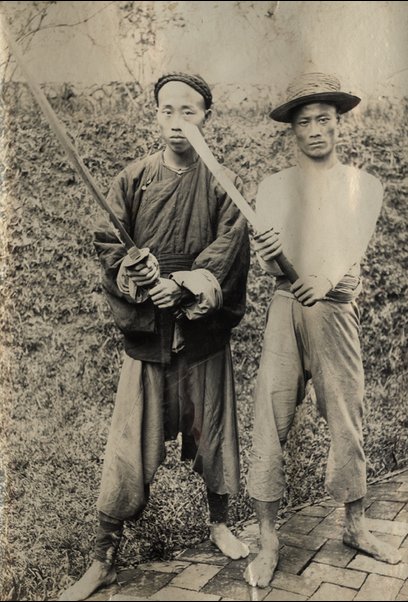
Some of the execution photographs that follow are Mature Content. They’re obtained via Visual Cultures in East Asia; some also available at USC Digital Library.


Raids and investigations to bring the Vegetarian movement to heel continued for several months thereafter, and the whole affair ultimately was quelled without doing any of the wider damage that might have been feared — not even to missionaries who continued pouring into China.

And that, effectively, kicked the can down the road on the anti-foreigner sentiments afoot in the land … sentiments that would find much costlier expression a few years later when another secret society kicked off the Boxer Rebellion.

* I’ve relied heavily on Welch for this post. He’s also collected a massive trove (over 1,200 pages) of primary documents from this incident available in a series of pdfs (some quite large) from the Australian National University website:

** This was not universally so. The wife of missionary Stephen Livingston Baldwin, who knew some of the victims of the attack, urged a “charitable” response and sensitivity that “the Chinese feel that all the world is against them, and they are not far from right.” (New York Times, Aug. 10, 1895) In letters responding to intemperate coverage elsewhere, she acidly compared (pdf) western editorialists’ high dudgeon to their look-forward-not-back dismissal of recent stateside anti-Chinese violence.

It was ten years yesterday since more Chinese were killed, and burned alive and left to die wounded, in one hour, at Rock Springs, Wyoming (the very same Territory in which the recent massacre occurred) than have been Americans and English in China in the thirty-four years I have personally known that land, being a resident there twenty years and closely connected with it ever since. Ten years yesterday since that awful Rock Springs massacre, and up to date no one arrested, much less punished! The anti-Chinese papers of the town and neighbourhood gloating over the awful details and assuring all that there would be “no Congressional investigation,” and no waste of “enterprising newspaper eloquence” over the woes of the Chinese, “though their blood flow like rivers, as they had no votes and no friends.” In less than four weeks after the Ku-Cheng massacre, arrest, investigation and execution have all taken place for the Ku-Cheng massacre. Would that our colored, red and yellow brethren, so helpless in our so-called civilized and Christian land, had some power behind them to bestir Ministers Plenipotentiary, wave flags, and run gunboats to the front, to bully, if necessary, our pusillanimous Government into some sort of civilization — I will not say Christian justice!

On this day..

1866: Dmitry Karakozov

On this date in 1866 (September 3 O.S.; September 15 N.S.), Russian revolutionary Dmitry Karakozov was hanged in Peter and Paul Fortress for attempting to assassinate Tsar Alexander II.

Karakozov was a son of noble stock — the self-hating variety, obviously, and suicidally disturbed into the bargain. He supposedly hailed from a terrorism cell branding itself “Hell”, although this was bandied about by the police afterwards and conveniently supported a hunt for radicals.

Karakozov, at least, considered the state of tsarist Russia positively infernal, and on April 4, 1866, he went to scourge it — firing a shot at the monarch at St. Petersburg’s Summer Garden. He missed.

The tsar’s guards tackled him as he fled, and the unharmed Alexander walked up to the gunman and asked him, “What do you want?” He may have been genuinely bewildered: Alexander was the guy trying to liberalize Russia. Just a few years before, he had freed the serfs.

“Nothing,” Karakazov replied. “Nothing.”

A statement of implacability: no progress would be bargained with even the most progressive despot. The despotism itself must go. A manifesto addressed to “Friends-Workers” was found in his pocket underscoring the point; it read in part (translated from p. 21 of this Russian pdf):

I have decided to destroy the wicked Tsar, and to die for my beloved people…

If I accomplish this deed, I will die with the thought that in death I did something good for my dear friend, the Russian peasant.

If I do not accomplish it, then others will follow my path. Where I fail, they will succeed, and my death will be their example and inspiration.

Others would follow him, and in time successfully murder Alexander II after all.

Karakozov himself, the first Russian revolutionary to attempt regicide, didn’t seem to have revolutionary satisfaction on his mind at the end. He converted to Orthodox Christianity in prison, sought “as a Christian, of a Christian” his prospective victim’s clemency … and multiple newspaper accounts report him kneeling to kiss a cross presented to him on the scaffold by the priest. (All via Odd Man Karakozov, which argues that all this need not imply such a reversal of conscience as it might appear.)

What certainly did happen — more immediately than those copycat assassinations — was a reactionary wave of national chauvinism, whose more wretched manifestations will not be unfamiliar to the present day. The patriotic Glinka opera Ivan Susanin was staged a few days later at the Bolshoi in Moscow. According to an eyewitness account of Tchaikovsky quoted in Romanov Riches: Russian Writers and Artists Under the Tsars, this salute to a Russian peasant’s sacrifice for the Romanov dynasty went a little bit off-script.

I think the Moscow audience went beyond the bounds of sense in their outburst of enthusiasm. The opera was not really performed, for as soon as the Poles appeared onstage, the whole theater shouted, “Down with the Poles!” and so on. In the last scene of Act 4, when the Poles are supposed to kill Susanin …

… the actor playing him started fighting the chorus members who played Poles, and being very strong, knocked down several of them, while the rest of the extras, seeing that the audience approved this mockery of art, truth, and decency, fell down, and the triumphant Susanin left unharmed, brandishing his arms, to the deafening applause of the Muscovites.

If true, that is little short of fantastic.

The apparatus of state went so far as to build up a new Susanin for the occasion at hand, hyping a questionable story that a young peasant named Osip Komissarov — who was from Susanin’s own province of Kostroma — had jostled Karakozov just as he took the shot, causing it to go awry. The good-natured bumpkin was rewarded with summary ennoblement as “Komissarov-Kostromskoy” and eye-rollingly terrible poetic tributes from the likes of Vyazemsky and Nekrasov. However, Komissarov’s embarrassing stupidity and want of manners would eventually necessitate Komissarov-Kostromskoy’s being packed out of polite society to country estates on a generous pension to bankroll his ample appetite for liquor.

So Dmitry Karakozov did do something for the Russian peasant after all.

On this day..

1767: Elizabeth Brownrigg

On this date in 1767, a jeering mob damning her to hell* saw Elizabeth Brownrigg hang at Tyburn.

“The long and excruciating torture in which this inhuman woman kept the innocent object of her remorseless cruelty, before she finished the long-premeditated murder,” says the Newgate Calendar, “more engaged the attention and roused the indignation of all ranks, than any criminal in the whole course of our melancholy narratives.” Hers is a very rich text.

As a middle-class midwife, Brownrigg mined the Foundling Hospital for young girls whom she would take on as apprentice domestic servants.

Brownrigg was far from the only one exploiting this ready pool of virtual slave labor, but it was her home’s marked sexualized sadism that really moved copy (pdf pamphlet). And Chateau Roissy it was not.

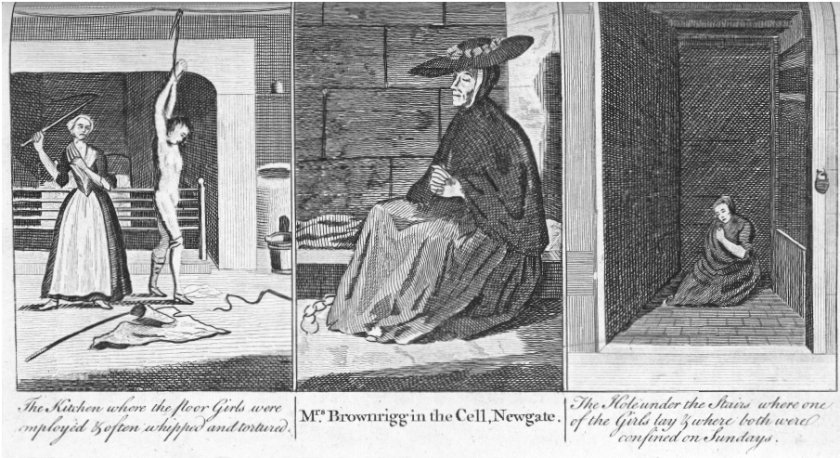
Elizabeth liked to keep the servants locked up, starving, usually naked, and would pinion their hands and inflict merciless corporal punishment for the least transgression against rules like “having any more bread”. The Old Bailey Online preserves one servant’s trial testimony:

Q. In what manner did she use to beat her?

M. Mitchel. She used to tie her up in the kitchen; when first she began to be at her, she used to tie her up to the water-pipe, with her two hands drawed up above her head.

Q. Describe that water-pipe.

M. Mitchel. That goes across the kitchen; the hooks that hold it are fastened into a beam.

Q. Had she used to have her clothes on when your mistress tied her up in this manner to beat her?

M. Mitchel. No, no clothes at all.

Q. How came that?

M. Mitchel. It was my mistress’s pleasure that she should take her clothes off.

Q. What had she used to beat her with?

M. Mitchel. She beat her most commonly with a horse-whip.

Q. How long did she use to beat her in this manner?

M. Mitchel. I cannot justly say, but she seldom left off till she had fetched blood.

This witness Mary Mitchel(l) was the lucky one of the Brownriggs’ last two Foundling Hospital charges: both girls had been stripped and horsewhipped so regularly that ulcerating, infectious sores — never able to heal before the next thrashing — pocked their bodies.

But Mary Mitchell at least survived. Her fellow-sufferer Mary Clifford was flat beaten to death, the body stuffed in the family coal-hole like so much rubbish. (In life, Mary Clifford was sometimes made to sleep there, too.)**


Detail view (click for a larger, three-panel image) of Elizabeth Brownrigg and her crimes illustrated in the Newgate Calendar.

For working-class Londoners struggling to navigate the dislocations of the Industrial Revolution, here was a villainess indeed. London was swelling, urbanizing, bustling with vulnerable orphans and abandoned children like our foundling Marys; all its working classes, for that matter, had reason to feel endangered in the face of fights for their lives against emerging commercial powers working hand in glove with the state — not excluding the ubiquitous threat of the gallows for pitiable property crimes.

And as Peter Linebaugh observes, “apprenticeship” by the 18th century “was less likely to involve the development of highly qualified, skilled labour power than to be the means of organizing the exploitation of young labour power.”† Like it’s not enough working your crappy dead-end unpaid internship; now, it comes with flogging?

Somehow, Brownrigg’s husband and son were convicted only of a misdemeanor and got off with a few months in prison, but Elizabeth bore all the hatred of Londoners more used to seeing apprentices swing than even the vilest master. The Murder Act which had appropriated even the corpses of London’s marginal people was applied to anatomize our former midwife; her skeletal remains were long displayed in a niche at the Royal College of Surgeons.

Oh, and the Foundling Hospital — which had cautioned the Brownriggs before about their excessive abuse of servants but not actually stopped sending them young girls to abuse — started finally instituting some oversight.


There’s a vicious and unsigned satire, “Elizabeth Brownrigge”, published in the September 1832 Fraser’s magazine. Over the years, it has occasioned a great deal of dispute among Thackeray scholars as to whether it might not have been an early creation of that master satirist’s pen. (Thackeray would have just turned 21 when it published.)

We’re not qualified to render judgment on the literary forensics, but the skewering of a murderess through the author’s mock-sympathy has a deliciously Thackerian flavor about it: the world was “incapable of understanding the height of her virtue.” It also underscores the continuing resonance of Elizabeth Brownrigg to Londoners 65 years after her execution.

The magnanimity of her soul, like Mr. Smeaton‘s pharos on the Eddystone, was firmly fixed upon the rock of the soundest principles, and diffused a light around it, for the guidance of those who were beating the waves upon the dark and troubled ocean of adversity, but was itself unshaken by the storm … [in prison] the fair and excellent Elizabeth adopted, as nearly as circumstances would allow, the same admirable disposition of her time to which she had been accustomed when inhabiting her own romantic bower in the village of Islington. She completed a large stock of baby-linen for the poor; she perused new publications of the day; and she composed an elaborate parallel between the characters of Socrates and Lady Jane Grey, after the manner of Plutarch. These are the two distinguished personages, in the whole range of authentic history, who in their strength of mind, purity of life, and extensive accomplishments, bore the strongest resemblance to herself; and to them, perchance, the attention of our heroine was more particularly directed in the quiet and retirement of her cell by the many points of similarity which subsisted between their destiny and her own.

Later, the fictional Elizabeth mounts a defense of such oblivious loathsomeness that it naturally impresses the judge:

“… punishment is a moral medicine. I may, perchance, actuated by too eager a desire for the rapid cure of my little and much-cherished patient, have dispensed my alternatives too liberally, and produced and untoward, an unexpected, and a most deeply-lamented consequence; but am I, therefore, to be condemned as guilty? In the analogous case of the physician, whose too-abundant anodynes may have lulled the sufferer to endless slumbers, or whose too copious phlebotomy may have let out the fever and the life at one and the same moment from the veins, would this most harsh and unmerciful measure be applied? … I demand from the justice of your lordship and a jury of my countrymen — as a matter not of mercy, but of right — the same impunity in my case which would be accorded, freely an unasked, under parallel circumstances, to the medical practitioner.”

Thackeray or whomever lay behind this pasquinade had a wider literary target in mind than simply Elizabeth Brownrigg(e)’s class. The short story is prefaced with a dedication to “the author of Eugene Aram“, meaning the popular novel published earlier in 1832 by Edward Bulwer-Lytton — a lifelong Thackeray bete noir. That novel concerned another renowned 18th century murderer, and it’s safe to say from the dedication that our satirist considered Bulwer-Lytton’s empathetic portrayal of the titular homicide a little, er, soft on crime.

I have been taught by Eugene Aram to mix vice and virtue up together in such an inextricable confusion as to render it impossible that any preference should be given to either, or that the one, indeed, should be at all distinguishable from the other … I had, indeed, in my dramatic piece, been guilty of an egregious and unpardonable error: I had attempted to excite the sympathies of the audience in favour of the murdered apprentices, but your novel has disabused me of so vulgar a prejudice, and, in my present version of her case, all the interest of the reader and all the pathetic powers of the author will be engaged on the side of the murderess.

* The Newgate Calendar: “On her way to the place of execution the people expressed their abhorrence of her crime in terms which, though not proper for the occasion, testified their astonishment that such a wretch could have existed: they even prayed for her damnation instead of her salvation: they doubted not but that ‘the devil would fetch her,’ and hoped that ‘she would go to hell.’ Such were the sentiments of the mob.”

** Elizabeth Brownrigg admitted to the Ordinary of Newgate the truth of Mary Mitchell’s horror testimony.

† Conversely, rogues who took to the highway and became working-class heroes were very often men who had absconded from their apprenticeship — for instance, Jack Sheppard and Dick Turpin.

On this day..

1943: Phillip Coleman, the last man hung in Montana

(Thanks to Meaghan Good of the Charley Project for the guest post. -ed.)

On September 10, 1943, multiple murderer Phillip “Slim” Coleman Jr. was hanged in Missoula, Montana.

The African-American Coleman would be the last man judicially noosed in that state, and Montana didn’t execute anyone else at all for more than fifty years. (Duncan P. McKenzie died by lethal injection in 1995 to end the drought.)

Coleman started his crime spree when he battered to death eighty-year-old Andrew J. Walton on July 3. The octogenarian was still alive when his sister found him the next morning, but he died in the hospital the next day without ever regaining consciousness.

With no witnesses or leads, the case quickly went cold.

On July 24, Coleman another man, Lewis Brown, were hired to work on the Northern Pacific Railroad thirty miles from Missoula. They had arrived at the train stop separately and it’s unclear whether they knew each other before, but on the same day they were chummy enough to start plotting to rob and kill their boss, Carl W. Pearson.

Late that night, Coleman went to Pearson’s home, woke him up and said Brown was ill and he had to come. Pearson grabbed a bottle of aspirin and headed out. There in the yard, Brown struck him on the head behind and left his body in the yard. Coleman went back inside, found Pearson’s wife Roslyn, and stabbed her to death in her bed.

The men spared the couple’s child, seven-year-old Richard; it was he who found the bodies the next day.

The murderers collected their loot, divided it between them and went their separate ways. Brown and Coleman were almost immediately identified as the prime suspects in the murder and picked up: Brown the day after the killings, and Coleman the day after Brown. Coleman was charged with Roslyn’s murder and Brown was charged in Carl’s death. Both were convicted, but Brown got only a life sentence and Coleman got the death penalty.

The condemned Coleman converted to Catholicism after his conviction, then, attempting to cleanse his soul, he summoned the sheriff and confessed to Andrew Walton’s murder. He had been a suspect since his arrest in the Pearson case, since the crimes were so similar, but had previously denied any knowledge of Walton’s death. Coleman got all of twelve cents, he said, from robbing Walton.

Amateur historian R. Michael Wilson, writing of the case, said, “He asked the sheriff to keep his confession secret in case the governor had a last minute change of heart and decided to grant a reprieve or communtation.”

Coleman’s hanging went off without a hitch.

On this day..

1929: Constantine Beaver, Alaskan native

On this date in 1929, Alaskan native Constantine Beaver hanged in Fairbanks, Alaska.

Described as a “woodsman”, Beaver shot his friend Egnatty Necketta during a drunken altercation the previous December.

Neither Beaver himself nor the several witnesses spoke or understood English, so much of the trial was conducted via interpreters. The jury, in finding him guilty, availed an option to remain silent as to the penalty, punting the decision to the judge — who went with hanging. Several jurors then protested, too late, that they hadn’t understood that was a possible outcome of their silent penalty decision.

In pre-statehood Alaska under federal governance, it was U.S. President Herbert Hoover 4,000 miles away in Washington who would have the final say in this affair — riding high, as it happened, at the very moment of the stock market peak right before the economic meltdown that would define his presidency.

Hoover said no.

Hopeful throughout the greater part of the night that a stay of execution would arrive Beaver bore himself with fortitude when informed that he must die. His only wish was that the intervening time might speed by so that his mental agony might be ended.

…

When Beaver reached the death chamber he broke into a tribal chant which continued until the floor opened beneath him.

It was “the saddest affair I’ve had to witness,” said a U.S. deputy who was present at the execution. And it was the last hanging ever conducted in Fairbanks.

Of possible interest: “American Indian Executions in Historical Context” by David V. Baker, a lengthy pdf.

On this day..

1821: Timothy Bennett, duelist

From the Oct. 12, 1927 Republican Herald recapping the Land of Lincoln’s hanging history on the occasion of its trendy switch to the electric chair.

Hanging has been the legal method of execution in the state of Illinois for 106 years, the first execution in the state being held at Belleville on September 3, 1821, when Timothy Bennett paid the penalty for murder resulting in a duel in which Timothy [sic — the rest of the article refers to the victim as “Alphonso”] C. Stewart was killed.

According to the account appearing in an old history of St. Clair county, now in the state historical library, Timothy Bennett and Alphonso C. Stewart became involved in an argument while under the influence of liquor, on February 8, 1819, at Belleville. Friends interfered and sought to effect a reconciliation, but their efforts were unavail[ing]. Finally it was agreed to arrange a sham duel in the belief that the ridiculous issue would bring the two participants to their senses.

“The duel was arranged,” the account reads. “Jacob Short and Nathan Fike acted as seconds. When the word was given and the rifles discharged, it was proven the ‘sham’ duel was fought with powder and lead-at any rate Alphonso C. Stewart fell to the ground mortally wounded.

Special Session in Court

“Timothy Bennett was arrested and so were the seconds, Short and Fike. A special term of the circuit court was held March 8, 1919 [sic], under a special law of the legislature to hold said term. The officers of the court, John Reynolds, judge; John Hay, clerk, and W.A. Beard, sheriff, were all appointed by Governor Shadrack Bond.

“The grand jury found true bills of indictments for murder against Bennett and the two seconds after hearing the testimony of Reuben Anderson, James Parks, James Kincade, James Reed, Daniel Million, Ben Million, Peter Sprinkle and Michael Tannahill.

“When the case was called for trial the sheriff reported that Bennett had broken jail and was at large. Short and Fike had their trial in June 1819, and were acquited [sic].

“Bennett was captured and jailed about July 1, 1821. A special term of court was held July 26, 1821. The grand jury found a new indictment against him for the same offense

Trial Starts Immediately

“Bennett was put on trial July 27, 1821, before Judge Reynolds and a jury. The jury rendered a verdict July 28, and found the presoner [sic] guilty. He had entered a plea of not guilty.

“The court then proceeded to pass sentence upon him in the following words:

“And it being demanded of him if anything for himself he had or knew to say why the court should not proceed to pass sentence upon him, he said he had nothing more than he had before said. Therefore it was considered by the court that he be hanged by the neck until he is dead, and that the sheriff of the county do cause execution of this judgment to be done and performed on him, the said Timothy Bennett, on Monday, the third of September, next, between the hours of ten in the forenoon and four in the afternoon at or near the town of Belleville.”

“Neither Bennett nor his friends believed that this awful sentence would ever be executed. The latter made strenuous efforts to have him pardoned. Failing in this, they tried to have the sentence commuted. But the governor remained firm and against all entreaty.

“On the day appointed for his execution, Bennett was hanged near West Belleville, near the site of the Henry Raab school. The execution was witnessed by a multitude of men, women and children.

On this day..

1987: Moses Jantjies and Wellington Mielies, after the Langa massacre

On this date in 1987, Moses Jantjies and Wellington Mielies — “political prisoners” in the estimation of their supporters — hanged along with five common criminals at Pretoria for the murder of Ben Kinikini and five others.*

The killing of Kinikini occurred in an environment of bitterly escalating hostilities in the eastern cape city of Uitenhage and especially the KwaNobuhle township. Anti-apartheid school boycotts dating back to September 1984 (part of a spreading revolt in the townships at that time) had metastasized into violent confrontations when protesters were denied meeting space by the black KwaNobuhle councillors.

Kinikini was such a councillor, and he and the others had been under popular pressure to resign, and even had their homes stoned, since the last weeks of 1984.

Protesters stoned vehicles. Riot squads roamed the streets. Police shootings became everyday events, and more enraged crowds gathered at the resulting funerals of their victims.**

On March 21, 1985,† police opened fire on one such funeral procession, slaying some 20 people in a single go — the Langa Massacre.


Coffins of the Langa Massacre’s victims. (cc) image from United Nations Photo Library. Also see this, this, this and this.

And then it really hit the fan.

Riots erupted following the Langa massacre, and it was on March 23 that Kinikini was dragged from his house and murdered: black township councillors were liable to be seen as apartheid collaborators. Defense witnesses for Jantjies and Mielies were quite a bit more specific, slating Kinikini with direct links to murderous vigilantes who liked to beat up and rape protesters in the creepy privacy of Kinikini’s apt personal business, a mortuary.

And as one memoir of the period puts it, “the government knew black councillors would not participate in a democratic charade unless their lives and property were protected and avenged. Some two and a half thousand black councillors, policemen and informers, real and rumoured, had been killed in the unrest that had begun in 1984.”

For South African president and white-rule stalwart P.W. Botha, those were far more pressing constituencies than mercy appeals from usual suspects like black activists and the West German government. These were also the first two township-rising convicts to come up for execution, out of some 33 then on death row, so their treatment figured to set the precedent for even higher-profile cases on the horizon like the Sharpeville Six. (In the event, apartheid collapsed before the Six could actually be hanged.)

The message was hardly lost on its internal audience.

“We have come to terms with the fact that the enemy has declared war,” Winnie Mandela told a Johanessburg memorial service for Jantjies and Mielies hanged. “We accept the challenge. The blood of the comrades has not flowed in vain.”

* Ben Kinikini, his four sons and nephews, and one other person were stabbed and burned to death. Some reports term at least Ben Kinikini’s killing a “necklacing” — the brutal method of popular execution that arose in the 1980s in which the “jewelry” was a rubber tire filled with flaming petrol. It sounds from the widow’s secondhand description as if this could indeed characterize it, though the fact that the Truth and Reconcilation Commission called a July 1985 killing the country’s first necklacing might indicate otherwise. News stories suggest that photographs and video exist of, if not the murder, at least the aftermath: perhaps these are dispositive on the point.

** See Thole Majodina, “A Short Background to the Shooting Incident in Langa Township, Uitenhage,” Human Rights Quarterly, August 1986.

† March 21 also happened to be the very anniversary date of one of apartheid South Africa’s most infamous police atrocities, the 1960 Sharpeville Massacre. Thanks to Sharpeville, this first day of spring is the International Day for the Elimination of Racial Discrimination, as well as the date on which South Africa marks Human Rights Day.

On this day..

1887: Henri Pranzini, repentant?

On this date 125 years ago, a notorious French triple murderer was guillotined outside La Roquette Prison.

This condemned murderer, so infamous that anarchist bomber Ravachol planned to invoke his name as an emblem of crime in a suppressed courtroom speech, slaughtered a prostitute, her maid, and the maid’s child so that he could plunder the apartment’s jewelry.

Your basic sensational common butchery, given added legs by comparison to the next year’s apparition across the channel of the Whitechapel murderer.*

That’s just one of several more famous (or infamous) contemporaries for whom Pranzini was a sort of subplot character.

The artist Paul Gauguin — though he couldn’t quite remember the name right — suspected that this particular killer plotted his crime at the cafe that both he and Vincent Van Gogh frequented. (Van Gogh painted the proprietress, who was also possibly his lover.)

According to Van Gogh, the whole Pansini [Pranzini] affair, as well as many others, was hatched in this place … From this Pansini case sprang another case, also, according to Van Gogh, hatched in this famous cafe, the Prado case

We’ve noticed in these pages Gauguin’s disturbing severed-head jug, and its seeming inspiration from that other guillotinee, Prado.

While Gauguin’s meditations on the guillotine veered to the grotesque, a Norman teenager fresh off an apparition of Jesus Christ found spiritual sublimity in this villain. The woman eventually known as St. Therese of Lisieux later recollected

I heard talk of a great criminal just condemned to death for some horrible crimes; everything pointed to the fact that he would die impenitent…. I felt in the depths of my heart certain that our desires would be granted, but to obtain courage to pray for sinners I told God I was sure He would pardon the poor, unfortunate Pranzini; that I’d believe this even if he went to his death without any signs of repentance or without having gone to confession. I was absolutely confident in the mercy of Jesus. But I was begging Him for a “sign” of repentance only for my own simple consolation.

My prayer was answered to the letter! In spite of Papa’s prohibition that we read no papers, I didn’t think I was disobeying when reading passages pertaining to Pranzini. The day after the execution I found the newspaper “La Croix.” I opened it quickly and what did I see? Ah! my tears betrayed my emotion and I was obliged to hide. Pranzini had not gone to confession. He had mounted the scaffold and was preparing to place his head in the formidable opening, when suddenly, seized by an inspiration, he turned, took hold of the crucifix the priest was holding out to him and kissed the sacred wounds three times! Then his soul went to receive the merciful sentence of Him who declares that in heaven there will be more joy over one sinner who does penance than over ninety-nine just who have no need of repentance.

I had obtained the sign I requested.

Nameless citizens on the square when the blade fell settled for less exalted signs, like the ancient superstition of dipping into the spattered blood. (“Such scenes would disgust the black savages of Dahomey and the Gold Coast,” the London Times sniffed (September 1, 1887), and in vain urged the French government to take up legislation for private executions.)

* Pranzini found himself in Madame Tussaud’s for a spell.

On this day..

1481: Michal Olelkowicz and Iwan Holszanski, Lithuanian princes

On this date in 1481, two Lithuanian princes were beheaded in Vilnius for plotting the assassination of the Polish-Lithuanian king.

This late 15th century was a heady time for Poland under the Jagiellon dynasty, and one of this dynasty’s going projects was keeping the adjacent realms of Poland and Lithuania linked together. In time, they would become formally joined, but at this point they were independent entities “united” only by the personal union of the Jagiellon monarch himself.

That monarch in the late 15th century was the redoubtable Casimir IV (Kazimierz IV): Grand Duke of Lithuania since 1440, King of Poland since 1447. Casimir’s family hailed from Lithuania; indeed, as that place had been last European place to Christianize, Casimir’s own father had been born a pagan.

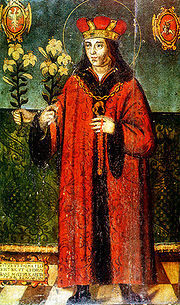
Casimir IV’s eponymous son is St. Casimir, patron saint of both Lithuania and Poland; both actively honor his feast date of March 4.

Lithuania agonistes

Lithuania had a strong independent streak (pdf), and its boyars did not necessarily see eye to eye with the Grand Duke. Casimir was keen on centralizing Lithuania’s administration and checking the potential rivalry of the most powerful Lithuanian families, the classic seeds of crown-vs-nobility conflict the world over.

And both watched with a wary eye the growth of Muscovy under the energetic leadership of Ivan III, aka Ivan the Great.

That expanding state in the 1470s gobbled up the buffer city-state of Novgorod; Ivan III’s newly-minted honorific Tsar of all the Rus(sians) openly announced his designs on Lithuania’s own historically Slavic Ruthenian territory. “The gatherer of the Russian lands,” Ivan is known as … and Lithuania (much larger then than it is now) stood to be the gatheree.

The Great Stand on the River Ugra

Come 1480, Casimir was allied against Moscow with the Mongol Horde, the famous “Tatar yoke” that had been collecting Russian tribute for two-plus centuries. In Russian historiography this is the crucial moment when that yoke is thrown off, and the Muscovites accomplished that in part by crossing up the Lithuanians.

The Horde, having marched through Lithuanian territory, assembled on the banks of the Ugra River, opposite a waiting Muscovite army. Neither army attacked. Instead, they waited … and waited … and waited some more.

The Horde, for its part, was waiting for reinforcements from its Lithuanian ally. But those reinforcements never arrived, thanks in part to Russia’s alliance with Crimean khan Mengli Giray, who seems to have absorbed Casimir’s attention in the fall of 1480 with a vexing combination of raids into southern Lithuania and dilatory ceasefire diplomacy. Distracted by the homeland threat, Lithuania never got around to supporting the Horde … and the Horde, after freezing itself on the banks of the Ugra for a couple of months, simply marched away in frustration.

Moscow never again paid it tribute … and its Crimean ally destroyed the Great Horde utterly in 1502.

Chop

This was the context, back in Lithuania, for the attempt on Casimir’s life that would cost two princes their heads. Notwithstanding his unhelpful alliance with the Great Horde, it seems apparent that Casimir himself espoused a fundamentally western policy: the Jagiellon dynasty had branches in Hungary, Bohemia, Germany, and Casimir had more taste for meddling in these realms than dealing with Russia. One could imagine how a Lithuanian magnate out his lucrative Novgorod trade would feel like the head man didn’t really have his eye on the ball; in 1478, a Lithuanian delegation even requested that Casimir appoint a Lithuanian governor to look after the interests of the Grand Duchy. (Casimir refused.)

And these nobles were getting it at both ends, since Casimir’s state-centralization project meant that they were being cut down to size in terms of their internal political power, too.

Apparently with the support of Moscow itself (whose expansionary interest is self-evident) Iwan Holszanski and Fedor Bielski hatched a plan to murder the Grand Duke and his sons on Palm Sunday, 1481 — which was also the occasion of Fedor Bielski’s wedding. The idea was to replace him with Michal Olelkowicz (Mikhail Olelkevich), who had been Novgorod’s elected prince-ruler in the late 1460s; it’s not clear to me if Olelkowicz himself was actually in on the scheme.

Casimir, at any rate, caught wind of the plot. Legend has it that a servant decorating a room ran across the conspirators’ weapons niches and reported it; it’s alternately alleged that the assassins meant to jump Casimir while out on his favorite pastime, hunting.

However it was supposed to go down, it didn’t work. Bielski was able to flee to Moscow (ditching his newlywed bride), but left Holszanski and the coup’s prospective beneficiary Olelkowicz to suffer beheading this date upon evidence “brighter than the sun” of their treason.

Sources:

This webcache page.

The Polish-Lithuanian State 1386-1795, by Daniel Stone.

Russia’s Steppe Frontier: The Making of a Colonial Empire, 1500-1800, by Michael Khodarkovsky.

On this day..