555: Rusticus and John

On an uncertain date in the autumn of 555, a Byzantine commander and his brother were put to death for the treacherous murder of the vassal king of Lazica.

Rusticus, the commander, probably had good cause to be annoyed with Gubazes II, who ruled a borderlands realm on the eastern edge of the Black Sea, in modern-day Georgia.

Gubazes had gone from calling in Persian aid in 541 against Lazica’s Byzantine masters, to summoning Byzantine help against the Persians a few years later. Now, he was kvetching to Byzantine Emperor Justinian about the Byzantine generals he’d called for.

We’ll let J.B. Bury take it from here:

King Gubazes, who had been engaged in frequent quarrels with the Roman commanders, sent a complaint to Justinian accusing them of negligence in conducting the war. Bessas, Martin, and Rusticus were specially named. The Emperor deposed Bessas from his post, but assigned the chief command to martin and did not recall Rusticus. This Rusticus was the Emperor’s pursebearer who had been sent to bestow rewards on soldiers for special merit. He and Martin determined to remove Gubazes. To secure themselves from blame, they despatched John, brother of Rusticus, to Justinian with the false message that Gubazes was secretly favouring the Persians. Justinian was surprised, and determined to summon the king to Constantinople. “What,” asked John, “is to be done, if he refuses?” “Compel him,” said the Emperor; “he is our subject.” “But if he resist?” urged the conspirator. “Then treat him as a tyrant.” And will he who should slay him have naught to fear?” “Naught, if he act disobediently and be slain as an enemy.” Justinian signed a letter to this effect, and armed with it John returned to Colchis. The conspirators hastened to execute their treacherous design. Gubazes was invited to assist in an attack on the fortress of Onoguris, and with a few attendants he met the Roman army on the banks of the Chobus. An altercation arose between the king and Rusticus, and on the pretext that the gainsayer of a Roman general must necessarily be a friend of the enemy, John drew his dagger and plunged it in the royal breast. The wound was not mortal but it unhorsed the king, and when he attempted to rise from the ground, a blow from the squire of Rusticus killed him outright.

The Lazi silently buried their king according to their customs, and turned away in mute reproach from their Roman protectors. They no longer took part in the military operations, but hid themselves away as men who had lost their hereditary glory. The other commanders, Buzes and Justin the son of Germanus, concealed the indignation which they felt, supposing that the outrage had the Emperor’s authority. Some months later, when winter had begun, the Lazi met in secret council in some remote Caucasian ravine, and debated whether they should throw themselves on the protection of Chosroes. But their attachment to the Christian religion as well as their memory of Persian oppression forbade them to take this step, and they decided to appeal for justice and satisfaction to the Emperor, and at the same time to supplicate him to nominate Tzath, the younger brother of Gubazes, as their new king. Justinian promptly complied with both demands. Athanasius, a senator of high repute, was sent to investigate the circumstances of the assassination, and on his arrival he incarcerated Rusticus and John, pending a trial. In the spring (A.D. 555) Tzath arrived in royal state, and when the Lazi beheld the Roman army saluting him as he rode in royal apparel, a tunic embroidered with gold reaching to his feet, a white mantle with a gold stripe, red shoes, a turban adorned with gold and gems, and a crown, they forgot their sorrow and escorted him in a gay and brilliant procession. It was not till the ensuing autumn that the authors of the death of the late king were brought to justice, and the natives witnessed the solemn procedure of a Roman trial. Rusticus and John were executed. Martin’s complicity was not so clear, and the Emperor, to whom his case was referred, deposed him from his command in favour of his own cousin Justin, the son of Germanus. Martin perhaps would not have been acquitted if he had not been popular with the army and a highly competent general. (link)

“The historical importance of the Lazic War,” Bury says, “lay in the fact that if the Romans had not succeeded in holding the country and thwarting the design of Chosroes, the great Asiatic power would have had access to the Euxine and the Empire would have had a rival on the waters of that sea. The serious menace involved in this possibility was fully realised by the Imperial government and explains the comparative magnitude of the forces which were sent to the defence of the Lazic kingdom.”

On this day..

2008: Greg Wright, still fighting for exoneration

Two years on from his execution in Texas this date in 2008, the website FreeGregWright.com still bears its namesake’s now-hopeless case for exoneration.


Wright’s wife Connie (the woman on the right) and their friend Bente Hjortshøj released this photo of Greg Wright 15 minutes after execution “to show the world the cruel and unusual punishment and its horrible consequences.”

Wright and another homeless man, John Adams, were taken in by a generous 52-year-old widow named Donna Vick. Vick paid for her charity with her life … but who was the killer?

Adams fingered Wright, but Wright always insisted that Adams killed her. Late-arriving DNA evidence appeared to back Wright. So did too-late-to-matter confessions by Adams. (Adams, for his part, was also convicted for capital murder; each man was separately tried on the theory that he was the murderer and the other the bystander.)

The disputed facts of this case are a muddier affair that don’t readily admit a slam-dunk exoneration. An episode of the Dallas DNA television series looked at Wright’s case and disappointed Wright’s supporters with its unfavorable view of the subject’s case.

Wright, nevertheless, maintained his innocence from the execution gurney.

John Adams lied. He went to the police and told them a story. He made deals and sold stuff to keep from going to prison. I left the house, and I left him there. My only act or involvement was not telling on him. John Adams is the one that killed Donna Vick. I took a polygraph and passed. John Adams never volunteered to take one. … I was in the bathroom when [Adams] attacked [Vick]. I am deaf in one ear and I thought the T.V. was up too loud. I ran in to the bedroom. By the time I came in, when I tried to help her, with first aid, it was too late. The veins were cut on her throat. He stabbed her in her heart, and that’s what killed her. I told John Adams, “turn yourself in or hit the high road.” I owed him a favor because he pulled someone off my back. I was in a fight downtown. Two or three days later he turned on me. I have done everything to prove my innocence. Before you is an innocent man.

The victim’s son — for whom little ice was cut by Wright’s admitted failure to summon medical help for the victim, or to turn in the alleged killer Adams — complained that the statement was “the same thing we’ve got since day one, each of them blaming it on the other one.”

Former congresswoman Cynthia McKinney witnessed the execution, taking a break from her Green Party presidential bid.

One of the crime scene investigators in this case, Eric George Rosenstrom, is now himself wanted for murder.

On this day..

1869: Charles Carpentier

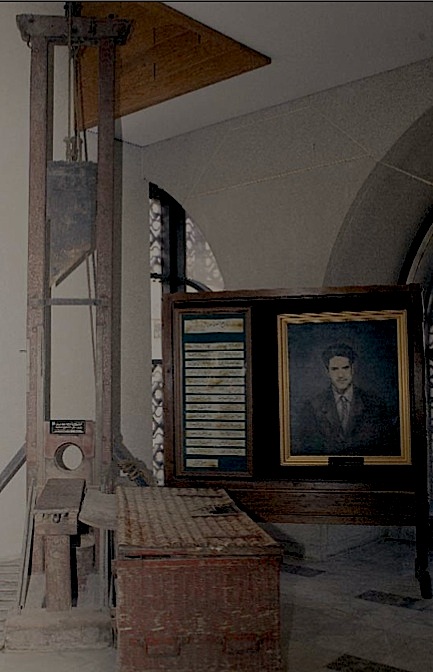
On this date in 1869, an impressive crowd packed Arras’s Grande Place for the beheading of Charles Carpentier.*


Photo believed to have been taken shortly before Carpentier’s execution.

According to Bois de Justice, whose collection of guillotine arcana is second to none, this is one of the rare photographs extant of the guillotine in its more classically inspired public-scaffold setup.

Its construction is lovingly detailed in this New York Times report on the following year’s execution of Jean Baptiste Troppmann:

… a square-shaped scaffold, thirteen feet long by about twelve feet six inches wide, supported on four posts six feet in height, and reached by a flight of ten steps. This scaffold is railed in on all sides, with an open balustrade, and at two-thirds of its length are fixed two upright parallel posts, surmounted by a cross-beam which goes by the name of the “chapeau.” They are thirteen feet high, and have a space of about fifteen inches between them. The knife, which is attached to the chapeau, is composed of a triangular blade of steel, fixed by means of three iron pins into a leaden haft, called the “mouton,” which gives it great weight. This mouton is nearly fourteen inches broad and the blade at its greatest width hardly a foot … The criminal, having mounted the scaffold, finds himself in front of the vertical bascule, which extends from just above his ankles to the middle of his breat, and facing him also is the lunette, with its movable portion raised. The executioner pushes the bascule, which falls into the horizontal position, and then pushes it along the table; the head of the victim seems, as it were, to throw itself into the semi-circular opening of the lunette, and an assistant immediately seizes hold of the hair. Two things now remain to be done — one is to press the button which acts upon the mechanism of the upper portion of the lunette, causing it to fall and secure the head of the criminal — the other is to set loose the knife which is to cut the head off. On decapitation taking place the head is thrown into the basket while the executioner, by a single motion slides the body down the inclined plane. The rapidity of the motion is almost inconceivable …

With the best part of a century under its lunette, the guillotine at this point had been improved from the revolutionary original that Marie Antoinette or Robespierre died upon. But it had the same theatrical concept.

However, an assistant executioner and carpenter by the name of Leon Berger was even then in the process of designing a more compact, less monumental version of the device. This technical advance met evolving French social mores with the 1870 abolition of the scaffold and its towering thirteen-foot chapeau in favor of “the Algerian model.”

From then on, the business was to be conducted by a traveling executioner with a portable guillotine at ground level, meant to reduce the carnival atmosphere and centralize administration of justice.

This concession to an age’s liberalism might well have led to an abolition on public executions full stop, had the French state not simultaneously fallen apart.

The upshot was that the French public beheading — sans scaffold — would persist for seven more decades, long enough not only for photography but for film.

* For murder and robbery on the highway, as reported by the September 16, 1869 Le Figaro. Noting the contrast with some recent acquittals of other criminals, the paper remarked apropos its skeptical stand on the death penalty that “though Carpentier is very unattractive at least from what we know of his case, we confess sincerely that his conviction was not sufficient to convince us [of capital punishment], because it proves once again how juries in different places arrive at different verdicts for the same types of crimes.” Le Figaro anticipated that regional inconsistencies in sentencing would contribute to ending the death penalty.

On this day..

1401: Klaus Stortebeker, Victual Brother pirate

On this date in 1401,* “Victual Brother” Klaus Störtebeker was beheaded in Hamburg.

Statue of Klaus Stortebeker. (cc) image from blariog

This legendary freebooter terrorized the Hanseatic League‘s trading channels from Novgorod to London in the 1390s.

He was the most famous of a company of privateers who’d been hired out in 1392 to place their thumb on the scale of Scandinavian dynastic politics** — notably, supplying Stockholm during a siege, from which service they obtained† the nickname Victual Brothers. It stuck, even when operations had moved far beyond the larder.

In the mid-1390s, the “brothers” turned against Danes and Hanse alike, raiding coasts and plundering sea trade from their base in the shattered port of Visby.

Klaus, the most famous of them, is still remembered today “like Che Guevara, a freedom fighter, but also like Robin Hood, because he fights the rich in the name of the poor”:‡ folk hero-outlaws, men of the pirate utopia.

Whatever debunking that legend might invite, its existence speaks to that timeless romance of the road. And then there’s that kernel of truth, or so one hopes: after Stortebeker’s death, the remnants would persist as the Likedeelers, “those who share equally.”

The buccaneer’s end, after capture by Simon of Utrecht, was equally legendary: he’s supposed to have made a scaffold pact with the headsman to spare any of his mates he could walk past once decapitated.

Rising from the chop like St. Denis, the headless trunk of Stortebeker lurched past 11 of them before the executioner himself tripped it up. (In the most embroidered version of this story, Hamburg not only didn’t honor the promise, it executed the executioner when all was said and done. But we’re pretty comfortable saying that once we reach the headless zombie pirate part of the story, the reader has carte blanche to rewrite anything not to liking.)

Drink up me hearties yo ho! “Stortebeker” itself just means, “quaff the mug.”

Klaus Störtebecker is our master
advised by Godeke Michels!
Shoot through the waves like storm, just faster
The Flying Dutchman’s godfather
Gaffer is the ships goblin
Let’s tackle, crew!
Life is bauble!
We are the hell of Helgoland

Our bloody flag is cracking the mast
Rats scurrying on the floor
A skeleton is our guest
On the sail there are strange shadows
The mermaid is swimming in our wake
Laugh, crew!
Life is bauble!
Still ruling is the hell of Helgoland

And when our ship makes its last run
Laugh while like a coffin she goes down
We die an ancient pirate’s way
Today we fight, tomorrow we drown
In green algae and white sand
Land ho, crew, land!
Life is bauble!
Such dies the hell of Helgoland

-Folk song honoring Klaus Stortebeker
(translated here)

* As often for events at this distance of time, the dates are a little bit shaky; 1400, rather than 1401, has been proposed for the actual year of Stortebeker’s execution; October 21 rather than October 20 is also given on some sites. Folklore more so than almanac blogs has the luxury of indifference to such particulars.

** The Victual Brothers were initially retained to oppose the adroit Danish Queen Margaret. She would face (and brush aside) even weirder challenges to her rule en route to lashing together the Kalmar Union under Danish regional hegemony.

† Alternate explanation: food-based euphemisms for piracy trace to armies’ victual officers, and their unscrupulous methods of filling the mess hall.

‡ In a continuing spirit of democratic larceny — or as a gang symbol for the local Hell’s Angels, whatever — our man’s alleged skull was stolen from a Hamburg museum earlier this year.

On this day..

1920: Frank Campione, “are they really going to hang me?”

(Thanks to Robert Elder of Last Words of the Executed — the blog, and the book — for the guest post. This post originally appeared on the Last Words blog here. Fans of this here site are highly likely to enjoy following Elder’s own pithy, almanac-style collection of last words on the scaffold. -ed.)

“Are—they—really—going—to—hang—me? Don’t— let—them. Save me. Jesus—Mary—Joseph. My little baby! My wife! . . . I’m—going—my—rest. Take— care—me. Where are you, Mr. Meisterheim [his jailer]? Talk to me.”

Meisterheim: “Be brave, Frank. It’ll be over in a minute.”

“Shake hands once more then. Are they—really going—to hang me?”

— Frank Campione, convicted of robbery and murder, hanging, Illinois.
Executed October 14, 1920

Part of the Cardinella Gang, Campione and company were responsible for more than four murders and 250 holdups and burglaries, according to authorities. The gang killed Albert Kubalanzo for $6.30.

During the months he was in jail and on trial, Campione sang lullabies to his pillow night and day. Even when admitting that he had been feigning madness, Campione held the pillow. “I’ll die happy if you let me keep this pillow with me,” he said. “It reminds me of my baby son.”

On this day..

1846: William Westwood, aka Jackey Jackey

On this date in 1846, the Australian outlaw William Westwood — better known as Jackey Jackey — was hanged with 11 others for a prison riot/escape attempt that claimed several guards’ lives.

“To the old hands,” relates George Boxall in this volume of bushranger folklore, “he was always the gentleman bushranger.”

More legends have collected round the name of Jackey Jackey than round that of any other of the bushrangers, and many of them are obviously variants of the stories told of the historical highwaymen of England. For instance, Jackey Jackey is said to have bailed up the carriage of the Commissary. When he discovered that the Commissary’s wife was inside he dismounted, opened the door and, sweeping the ground with his cabbage tree hat, as he bowed low before her, he invited her to favour him with a step on the green.* He rode incredible distances in incredibly short periods of time** … [and] never did anything mean or brutal or unworthy of a gentleman bushranger, until he was almost goaded to madness by the cruel discipline of Norfolk Island.

Transported to Australia at the age of 16, Jackey Jackey made that reputation with only a scant few months in the bush. The Victorian era was already underway in our young outlaw’s mother country; the day of the highwayman had long since given way to the day of romanticizing the highwayman.

Only on the empire’s distant fringes could the profession persist; there, men like our day’s principal self-consciously took their chivalrous forebears as their templates: Jackey Jackey thrashed a confederate who did violence to a woman, and threatened to murder the man if they should meet again.

Jackey Jackey had only a few months out in the bush in 1840-41 to trace the outlines of the gentleman bandit figure he aspired to. Caught in an inn in 1841, he spent the next several years exercising that other great craft of the folklore criminal: escape.

A cycle of jailbreaks, fleeting moments of liberty, recaptures, higher-security lockups, and increasingly desperate jailbreaks eventually landed at Norfolk Island, where “the treatment of the prisoners in the island was rigorous in the extreme, and may aptly be described as savage.” (Boxall, again)

Just a few years before Jackey Jackey’s death, they had been savage enough to provoke inmates desperate for the release of death to draw lots between the privileges of being murdered by a fellow-prisoner and hanging as that murderer.

Norfolk experimented with liberalizing its regimen in the early 1840s, but it was in rollback mode when our bushranger landed there. The steady removal of the minute privileges that make incarceration bearable — the right to grow a few potatoes; access to one’s own cooking tin and utensils — eventually triggered a similar suicidal mental break … but this time, on a riot scale.

Jackey Jackey made the following speech: “Now, men, I’ve made up my mind to bear this oppression no longer ; but, remember, I’m going to the gallows. If any man funks let him stand out. Those who wish to follow me, come on.”

A policeman named Morris was standing in the archway or entrance to the yard, Jackey Jackey rushed forward, struck him a fearful blow with an enormous bludgeon, and knocked him down. A large mob of the prisoners snatched up such weapons as came to their hands and followed him.

…

there were about eighteen hundred prisoners on the island, and of these, sixteen hundred were among the rioters. The soldiers numbered only about three hundred, but their discipline enabled them to overawe the vastly superior force, numerically, opposed to them. Perhaps the habits of obedience and submission, so long enforced on the prisoners, may have had some influence. Perhaps, even among this herd of desperate and reckless men, the sight of the soldiers standing firmly with their guns presented ready to fire may have instilled some fear. However this may have been, there was no fight. The rebels retired slowly and unwillingly to the Lumber Yard, where they permitted the soldiers to arrest them one after the other without making any show of defence until one thousand one hundred and ten of them were placed “on the chain.” Perhaps Jackey Jackey and the more violent of his followers may have thought that they had done sufficient to ensure them that death on the gallows which was the avowed object of their rising, while the majority had been so demoralised by official brutality as to be utterly indifferent as to what might become of them.

Twelve suffered death on the Norfolk Island gallows this date for the murder of the guard, with headline-grabber Jackey Jackey exonerating four of his fellow-sufferers in his dying statement.


The remains of the gallows area at the Norfolk Island gaol, gorgeously captured by Canberra photographer Allyeska. (Image used with permission.)

The bitter letter our despairing bushranger wrote to a gaol chaplain, meanwhile, could have been posted from many a modern penitentiary.

I was, like many others, driven to despair by the oppressive and tyrannical conduct of whose whose duty it was to prevent us from being treated in this way. Yet these men are courted by society; and the British Government, deceived by the interested representations of these men, ontinues to carry on a system that has and still continues to ruin the prospects of the souls and bodies of thousands of British subjects … instead of reforming the wretched man, under the present system, led by example on the one hand, and driven by despair and tyranny on the other, goes on from bad to worse, till at length he is ruined body and soul. Experience, dear bought experience, has taught me this. In all my career, I never was cruel I always felt keenly for the miseries of my fellow-creatures, and was ever ready to do all in my power to assist them to the utmost, yet my name will be handed down to posterity branded with the most opprobrious epithet that man can bestow. … this place is now worse than I can describe. Every species of petty tyranny … is put in force by the authorities. The men are half-starved, hard worked, and cruelly flogged. … Sir, out of the bitter cup of misery I have drunk from my sixteenth year ten long years and the sweetest draught is that which takes away the misery of living death; it is the friend that deceives no man; all will then be quiet no tyrant will there disturb my repose, I hope, William Westwood.†

(Boxall’s History of the Australian Bushrangers is available from archive.org here.)

* This legend is lifted wholesale from the c.v. of English highwayman Claude Duval.

** Warp-speed horsemanship features in many English outlaw legends, including those of Dick Turpin and the lesser-known John Nevison.

† Death as an escape from injustice and misery: another timeless theme.

On this day..

1924: Frank Johnson, the first electrocuted in Florida

On this date in 1924, “colored male” Frank Johnson was electrocuted in Florida.

He was, in fact, the very first to die in the Sunshine State’s electric chair.


The original Florida electric chair.

“Old Sparky” (numerous electric chairs shared this nickname) was brand new here in the Roaring Twenties, a jerry-built contraption outfitted with “homemade accessories” to replace the icky old gallows with a brave new world’s brave new mankiller.


Top: a scantily-detailed penitentiary “personnel card” for Frank Johnson. Middle: details of the execution. Bottom: Florida’s official typed list of its early executions.

All images are from this Florida Department of Corrections page.

This same furniture that killed Johnson would ultimately take the lives of 265 men and one woman — notables from Giuseppe Zangara to Ted Bundy, milestones like John Spenkelink, and scores of strange and forgotten perps among them.

Notoriously error-prone by the end of its run, the device was finally replaced in 1999.

On this day..

1922: C.C. Stassen, white miner

On this date in 1922, white miner Carel Christian Stassen was hanged in South Africa for murdering two blacks during the recent Rand Rising.

Also known as the Rand Rebellion or Rand Revolt, this rising saw a strike by white miners transmuted into outright insurrection … before being ruthlessly suppressed.

This seminal event in 20th century South Africa is also a classic study in the indeterminate solidarity of race and class, and would help set the stage for the apartheid system to come.

In the years preceding the Rand Revolt, an aristocracy of skilled white miners found itself, er, undermined by the sinking price of gold and the vast pool of underpaid black miners who had long been consigned to strictly unskilled jobs.

When white miners went on strike as the calendar turned to 1922, it was — self-consciously — in defense of white privilege: specifically, a color bar protecting white semi-skilled positions from black competition which white mine owners intended to breach.

In a context where the vast majority of mine workers overall were black, the strikers rallied under the banner,

“Workers of the world, unite and fight for a white South Africa!”


Note the sign in the lower left with the racialized twist that old labor slogan.

Inspiring stuff.

The strike’s peculiar dynamics bear all manner of historical inquiry. In its opening months, South Africa’s native black laborers were entirely left out, neither engaged as potential allies (obviously) nor targeted as “scabs” or enemies (more surprisingly).

But this just-among-whites dispute broke out of the family around March 7-9 when — on the very eve of military conflict with Jan Smuts‘ government — rumors swept the white strikers’ communities “that the natives were fighting the Whites … and that the Strikers and Police were working in conjunction to suppress the natives,” that “the kaffirs will kill us all.”

The quotes are actual period citations given in Jeremy Krikler’s 1999 article “The Inner Mechanics of a South African Racial Massacre,” in The History Journal, Dec. 1999. Krikler’s subsequent book, White Rising: The 1922 Insurrection and Racial Killing in South Africa, explores this topic in much greater detail.

In Richard Seymour’s summary,

they took their appeal to be part of the white community seriously, and in their murders dramatised their desire to be in solidarity with the institutions of white supremacy that were about to massacre them: it was as if to re-direct the fire onto the ‘real’ menace, as opposed to the respectable white workers who only wanted their fair share.

C.C. Stassen was one of those conducting dramatic murder — in his case, of two natives in what Stassen insisted was self-defense against an aggressive black mob.

As one can discern from his presence in these pages, however, Stassen’s homicides did not arouse a sentiment of solidarity among the country’s owners. Shortly after crushing the revolt in March (around 200 people died) they gave notice of their preference for class consciousness above race consciousness, hanging Stassen over the objections of labor unions in South Africa and abroad.

The legacy of the Rand Rising and the hangings of Stassen and others was the Pact Government, an alliance of white miners and Afrikaans farmers that ousted Smuts in a 1924 election.

Even though this new state arrangement proceeded to firm up race privilege in the mining sector with the piquantly named “Colour Bar Act”,* it did so on the basis of the victors’ terms established by the Rand Revolt.

The Pact Government … … ensure[d] that skilled work on the mines remained the preserve of whites, [but] it made no attempt to reverse what the mine owners had achieved: the expulsion of whites from a range of semi-skilled occupations … White wages fell markedly and labour militancy was terminated. The Rand — site of enormous battles in the early twentieth century — never again saw a significant white mineworkers’ strike. The curtain came down upon an epoch of white labour. Whatever revolutionary tradition it had had, was rooted out forever.

–White Rising

* The National Party that enacted the Colour Bar Act would, when it next controlled the government in 1948, establish apartheid.

On this day..

1987: Mehdi Hashemi, Iran-Contra whistleblower

On this date in 1987,* Iranian cleric and revolutionary official Mehdi Hashemi was secretly executed … seemingly, for leaking the Iran-Contra scandal.

Hashemi was an O.G. of the Iranian Revolution, imprisoned by the notorious secret police SAVAK** and freed when the Shah’s government collapsed in 1979.

Hashemi had a series of posts in the revolutionary state generally relating to exporting the revolution, and under the aegis of Ayatollah Montazeri, who in the late 1980s was the heir apparent of Ayatollah Khomeini for leadership in the Islamic Republic.

Montazeri was a rival of parliamentarian Akbar Hashemi Rafsanjani,† and further to that rivalry the Montazeri faction leaked embarrassing information about Rafsanjani’s dealings with the United States.

The Great Satan’s disreputable Middle East policy entailed playing both sides of the destructive Iran-Iraq War — arming Saddam Hussein‘s Iraq, while also making secret weapons sales through Israel to Iran despite a supposed arms embargo, thereby obtaining the release of American hostages in Lebanon.

This is the “Iran” half of the Iran-Contra scandal … which became the Iran-Contra scandal when Hashemi publicly exposed the existence of secret Iranian-American contacts to the Lebanese magazine Ash-Shiraa.

The immediate motivations appear murky even to specialists, of whom this writer is not one … but whatever they were, the leak backfired — as so often is the case — on the whistleblower himself.

While the authors of the covert policy in each country emerged stronger, Hashemi was arrested just before the story broke publicly and “persuaded” (with 75 lashes!) into one of those Soviet-style auto-denunciations, which was broadcast on Iranian TV.

Hashemi’s self-flagellation, as characterized here, runs thus:

Deviation is my ultimate sin. This is why I now stand before you. I began my career with minor infractions, gradually strayed from the correct path, continued with larger mistakes, then to major sins, and ultimately to the worst sin possible — that of heresy, apostasy, and treason against the Imam, the Community, Islam, and the Islamic Revolution. I have to ask myself what was the root cause of my downfall? …

(His answer: “carnal instincts”.)

I now realize that despicable sinners like myself had no business inside the heir-designate’s office. I thank God that I have been removed from that office …

I would like to plead with my former colleagues and friends who shared my deviant ideas to return to the correct path, relinquish their false notions, reform themselves, unite against imperialism, and overcome the carnal instincts that can lead them toward having relations with Satan and his representatives.

He was tried on a basket of nasty charges including “corruption on earth,” murder, kidnapping, plotting against the government … and, because state authority is not immune to irony, arms struggling.

Hashemi’s patron Ayatollah Montazeri worked unavailingly behind the scenes to save his man; Hashemi’s judge noted in his memoirs that the execution was carried out before the sentence went public, specifically to prevent Montazeri throwing his weight around to stop it.

But that weight would dwindle near to nothing in the months ahead, as the case opened a schism between Montazeri and the Iranian leadership.

After publicly calling for greater political openness, and criticizing a horrifying 1988 mass execution, Montazeri was officially demoted from the designated successor position in favor of Ayatollah Khamenei — who did indeed succeed to the Supreme Leader job, and holds it to this day.

Montazeri remained a frequent internal critic (and, for a time, political prisoner) of the Iranian government during the 1990s and 2000s; by the time of his December 2009 funeral, he was an emblem for the embattled Iranian reform movement.

* The execution was reported by Iranian radio as having taken place at dawn that same day, but opposition organizations immediately charged that it had actually been carried out some days before. (See New York Times, Sep. 29, 1987) If the matter has been definitively resolved, I have not been able to document it.

** For murdering a pro-regime theologian who dissed the Khomeini-backed book The Immortal Martyr, which recast Shi’a martyr Husayn Ali as a revolutionary inspiration for modern times.

† Rafsanjani also has a son named Mehdi Hashemi Rafsanjani — who is not to be confused with the subject of this post.

On this day..

1998: Cao Haixin, unwelcome meddler

On this date in 1998, the execution grounds settled a local political rivalry in China.

According to an upsetting 1999 Los Angeles Times feature, Cao Haixin had lately governed a small village that was being swallowed up by the sprawling Zhengzhou metropolis.

The previous village chief, Cao Xinbao, had profiteered gleefully from his run at the top with sweetheart deals on rapidly appreciating real estate for himself and his connections.

Cao Haixin, a reformist farmer, beat Cao Xinbao at the polls in 1995 and set about making unwelcome inquiries into the whereabouts of millions of yuan … at which point a goon squad of the ancien regime led by Cao Xinbao’s own brother actually invaded Cao Haixin’s home looking to intimidate or murder him. No subtlety needed.

Instead, the mayor grabbed a hunting rifle and killed his predecessor’s brother in the affray.

Astonishingly, Cao Haixin was the man arrested for this incident, and sentenced to death in a provincial court seemingly stacked with Cao Xinbao allies. A Zhengzhou municipal judge reportedly told one of the condemned man’s many supporters that local village officials had on a full-court press for execution as the case worked its way through the system.

Eventually — after a few cycles of appeals to the Supreme Court, which in turn fruitlessly referred inquiries back to those very village officials who wanted him dead — Cao Haixin was executed in secret. The next day’s news announcement reported nine executions, but listed only eight names.

The problem, analysts say, is that the national and provincial governments are dependent on local strongmen such as Cao Xinbao to implement the state’s basic rural policies concerning land, grain and taxes. Local cadres’ control of these policies affords them ample opportunities to line their own pockets.

These strongmen often wear the multiple hats of local clan leader, village chief and party boss. They often have a corrosive influence on China’s fledgling village election system, leaving peasants with little recourse to justice.

…

Today, the faith of many of the villagers–faith in the law, in China’s future and in themselves–lies shattered.

Cao Haixin’s widow and 14-year-old daughter struggle to survive. Many of the villagers, lawyers and journalists who fought for more than two years to stop Cao’s execution remain depressed and cowed.

“I feel powerless and frustrated,” said one of Cao’s lawyers. “I ask myself, did I help to deceive the masses by even participating in this sham trial?”

–Los Angeles Times, Oct. 17, 1999

On this day..