1792: Nicolas Pelletier, Madame Guillotine’s first kiss

On this date in 1792 — a surprisingly late date, just nine months before the king himself would die under its blade — debuted the iconic symbol of the French Revolution, the guillotine.

Today, it turned a thief and killer named Nicolas Pelletier from thug to trivia. Much more illustrious names would follow, and anon.

Though predecessors of the grim machine had been used centuries before in Scotland, Italy and Switzerland, the guillotine ushered in a distinctly modern era of technological application to capital punishment informed by egalitarianism — prior to the French Revolution, nobles and commoners had different modes of execution — and by legal and medical expertise aimed at minimizing pain.*

In fact, the device’s namesake, physician Joseph-Ignace Guillotin, opposed the death penalty altogether; he approved scientific and “painless” execution as a stopgap measure.**

For his troubles, the humane doctor’s name became synonymous with terror, enough so that his descendants changed their handle. One wonders how the doctor judged his own legacy; certainly better for any condemned person to die on the guillotine than the breaking wheel, but the mechanical efficiency of the “French razor” and the depersonalization of the condemned in relation to the headsman and the witnesses also made possible the mass executions the French Revolution is known for.

Singular Guillotin, respectable practitioner: doomed by a satiric destiny to the strangest immortal glory that ever kept obscure mortal from his resting-place, the bosom of oblivion! … “With my machine, Messieurs, I whisk off your head (vous fais sauter la tete) in a twinkling, and you have no pain;”–whereat they all laugh. (Moniteur Newspaper, of December 1st, 1789 (in Histoire Parlementaire).) Unfortunate Doctor! For two-and-twenty years he, unguillotined, shall near nothing but guillotine, see nothing but guillotine; then dying, shall through long centuries wander, as it were, a disconsolate ghost, on the wrong side of Styx and Lethe; his name like to outlive Caesar’s.

–Carlye

Whither the ethical role of the physician dedicated to life in the protocol of dishing out death? It’s a strikingly current dilemma.

Want to know more about how the guillotine was built? Want to build your own?

* Pain reduction was distinctly not the order of the day under the ancien regime. Often, quite the opposite.

** It was still another physician, Antoine Louis, who actually designed the decapitation machine; for a time, it was known as the Louisette. The working model was built from Louis’ design by a piano maker — and it may be more than coincidence that the science of constructing this mechanically complex musical instrument was also bursting with creativity on the cusp of the Industrial Revolution.

On this day..

1868: John Millian, who martyred a madam

On this date in 1868, Mark Twain witnessed a Frenchman hanged in Virginia City, Nevada for murdering a popular prostitute.

Julia Bulette had turned up murdered in January 1867, her parlor ransacked for valuables. The crime went unsolved for several months until John Millian — or, Millain or Milleain — was caught selling one of her dresses.

The immigrant spoke very little English and was effortlessly convicted, though he maintained his innocence to the gallows.

Some three thousand people turned out for the hanging … among them Mark Twain, who was back to visit the town where he had lived a few years before, writing for a local newspaper.

He wrote about the execution in a letter from Virginia City, published in the Chicago Republican May 31, 1868 and only recently excavated by Nevada archivist Guy Rocha:

NOVEL ENTERTAINMENT.

But I am tired talking about mines. I saw a man hanged the other day. John Melanie, of France. He was the first man ever hanged in this city (or country either), where the first twenty six graves in the cemetery were those of men who died by shots and stabs.

I never had witnessed an execution before, and did not believe I could be present at this one without turning away my head at the last moment. But I did not know what fascination there was about the thing, then. I only went because I thought I ought to have a lesson, and because I believed that if ever it would be possible to see a man hanged, and derive satisfaction from the spectacle, this was the time. For John Melanie was no common murderer — else he would have gone free. He was a heartless assassin. A year ago, he secreted himself under the house of a woman of the town who lived alone, and in the dead watches of the night, he entered her room, knocked her senseless with a billet of wood as she slept, and then strangled her with his fingers. He carried off all her money, her watches, and every article of her wearing apparel, and the next day, with quiet effrontery, put some crepe on his arm and walked in her funeral procession.

Afterward he secreted himself under the bed of another woman of the town, and in the middle of the night was crawling out with a slung-shot in one hand and a butcher knife in the other, when the woman discovered him, alarmed the neighborhood with her screams, and he retreated from the house. Melanie sold dresses and jewelry here and there until some of the articles were identified as belonging to the murdered courtezan. He was arrested and then his later intended victim recognized him.

After he was tried and condemned to death, he used to curse and swear at all who approached him; and he once grossly insulted some young Sisters of Charity who came to minister kindly to his wants. The morning of the execution, he joked with the barber, and told him not to cut his throat — he wanted the distinction of being hanged.

This is the man I wanted to see hung. I joined the appointed physicians, so that I might be admitted within the charmed circle and be close to Melanie. Now I never more shall be surprised at anything. That assassin got out of the closed carriage, and the first thing his eye fell upon was that awful gallows towering above a great sea of human heads, out yonder on the hill side and his cheek never blanched, and never a muscle quivered! He strode firmly away, and skipped gaily up the steps of the gallows like a happy girl. He looked around upon the people, calmly; he examined the gallows with a critical eye, and with the pleased curiosity of a man who sees for the first time a wonder he has often heard of. He swallowed frequently, but there was no evidence of trepidation about him — and not the slightest air of braggadocio whatever. He prayed with the priest, and then drew out an abusive manuscript and read from it in a clear, strong voice, without a quaver in it. It was a broad, thin sheet of paper, and he held it apart in front of him as he stood. If ever his hand trembled in even the slightest degree, it never quivered that paper. I watched him at that sickening moment when the sheriff was fitting the noose about his neck, and pushing the knot this way and that to get it nicely adjusted to the hollow under his ear — and if they had been measuring Melanie for a shirt, he could not have been more perfectly serene. I never saw anything like that before. My own suspense was almost unbearable — my blood was leaping through my veins, and my thoughts were crowding and trampling upon each other. Twenty moments to live — fifteen to live — ten to live — five — three — heaven and earth, how the time galloped! — and yet that man stood there unmoved though he knew that the sheriff was reaching deliberately for the drop while the black cap descended over his quiet face! — then down through the hole in the scaffold the strap-bound figure shot like a dart! — a dreadful shiver started at the shoulders, violently convulsed the whole body all the way down, and died away with a tense drawing of the toes downward, like a doubled fist — and all was over!

I saw it all. I took exact note of every detail, even to Melanie’s considerately helping to fix the leather strap that bound his legs together and his quiet removal of his slippers — and I never wish to see it again. I can see that stiff, straight corpse hanging there yet, with its black pillow-cased head turned rigidly to one side, and the purple streaks creeping through the hands and driving the fleshy hue of life before them. Ugh!

This text, as well as a local paper’s report of the hanging, are also here.

Though Twain’s take on the hanging may attract our attention in posterity, the most famous party in the affair is the victim, Julia Bulette. A public figure in life, she was publicly mourned in death and quickly attained mythic status with the full panoply of secular laurels — dimestore paperbacks, “Bonanza” adaptations, and audio book treatment by the Nevada Library and Archives:

[audio:JuliaBulette.mp3]

On this day..

1995: Richard Snell – did he go out with a bang?

At 9 p.m. this evening on this date, white supremacist Richard Snell was executed for murder in Arkansas.

He went out full of venom and smugness, his last words menacing the state’s governor:

Governor Tucker, look over your shoulder; justice is coming. I wouldn’t trade places with you or any of your cronies. Hell has victories. I am at peace.

(Source — but possibly erroneous; note the comments to this post)

It had been as satisfying* for Snell as last days on earth come: the very morning of his execution, militia fellow-traveler Timothy McVeigh blew up Oklahoma City’s Murrah Federal Building.

It is not for this venue to attempt any definitive judgment on the connections and cul-de-sacs of the much-scribbled-about white supremacist labyrinth. It is enough for our purposes to note several items which may be coincidence and have sometimes been reckoned rather more.

  • April 19 had already become the militia movement’s holy day: April 19, 1775, had sparked the American Revolution; more to the point, it had been the date in 1993 of the slaughterous Waco siege. Snell’s execution was slated for that date intentionally, much to the outrage of his sympathizers: so was McVeigh’s plot.
  • Twelve years before his death, Snell himself had schemed to blow up the very same building.
  • Snell has been reported to have predicted that there would be a bombing on his execution date.

After his execution, Snell was returned to Oklahoma Christian Identity mecca (and possible McVeigh haunt) Elohim City, where he lay three days in an open casket before being interred in the community’s cemetery under a headstone marked “Rev Richard Wayne Snell. Patriot.”

* Snell was “smiling and chuckling and nodding” on his last day as he watched coverage of the bombing.

On this day..

1763: Marie-Josephte Corriveau, Quebec murderess

On this date in 1763, a young woman shuffled off this mortal coil and into Quebecois folklore.

She’d made the mistake of outliving two husbands, and was convicted (with her father) of having been the instrument of their demise. Gibbeted after her death — a punishment not used in France, but Quebec had been captured by the English in the French and Indian War — her corpse became a figure of ghost stories and popular superstition, haunting passersby and playing poltergeist.

But why take it from me? Here’s the unhappy fate of Madame Corriveau, in puppet theater.

Or a stylish graphic novel-style cartoon.

Devotees of the written word can get their fill in two 19th century texts available free from Google Books: a passage in Maple Leaves, and a historical novel in which she figures as a character, The Golden Dog. Her French Wikipedia page is here.

On this day..

2004: Jerry McWee, a former policeman

On this date in 2004, South Carolina executed a man who had once been on the other side of the law.

Jerry Bridwell McWee hardly fit the profile of a future death row inmate when he met one George Scott. McWee was pushing 40, had no criminal record, and had once done a stint as an Augusta, Ga., police officer.

But it wasn’t many months that the two had iced a couple of Aiken County denizens in a hunt for drug money.*

It may have worked to Scott’s advantage that he was a career criminal, and had the instinct to turn state’s evidence before his confederate could send him to the gurney. Even so, it took some wheedling to get a death sentence out of the jury, which was clearly better inclined to give McWee life. A law (since reversed) at that time forbade advising jurors on parole scenarios, so the jury’s repeated pleas to know when the prisoner might be released under a life sentence — actual answer: age 71, at the earliest — were denied.

It was bum luck for Jerry under the circumstances, but also a mess of his own making; there was no question of innocence or some other mitigating point that gave him any likelihood of winning South Carolina’s first executive clemency.

The invaluable archives at the Clark County (Ind.) prosecutor’s web page collect news stories about every modern execution in the United States. On Jerry McWee’s page, an Associated Press report from the death chamber sketches an affecting portrat of two families’ grief.

In his final statement read by his lawyer, McWee asked both his own family and [victim John] Perry’s family to forgive him. “I only wished that things could have been different,” McWee wrote. “I would give anything if only that could have been the case.” A tear formed in his eye as his mother blew a kiss back at him and his final words were read. That tear finally rolled down the side of his head moments after he stopped breathing. More than 10 minutes later, McWee was officially declared dead at 6:18 p.m.

Celia McWee softly sobbed, a well-wadded tissue in her hand, as she waited for prison officials to open the curtain to the death chamber. She gasped “Oh my God” and her cries got louder as the curtain opened and she saw her clean-shaven son strapped to the gurney, his arms extended, and intravenous tubes stretching through a nearby wall. A minister put his hand on her shoulder. After glancing at his mother, Jerry McWee looked back at the ceiling, softly mumbling as the tubes shuddered. He blinked several times and his breathing got shallow, then stopped. Celia McWee’s sobs got softer as it was obvious McWee was no longer breathing. But she never took her eyes off her son.

A member of Perry’s family also witnessed the execution, and his gaze never left McWee’s body either. After the execution, Perry’s wife and family issued a statement thanking the community, law enforcement and prosecutors and saying it was not a time to rejoice. “God has given us free will – we are each responsible for our actions,” part of the statement read. “Please make choices you can live with. Please pray for the soul of Jerry B. McWee.”

The executed man’s mother, Celia McWee, also lost a daughter to murder in 1980; she had been, and remains, a mainstay of the anti-death penalty movement. On this biographical page, she sets the scene through a mother’s eyes.

One day Jerry came to my work. We said hello but I was still angry and didn’t ask if he wanted to talk. I thought, “If you’re going through a hard time, then good, because now you’re being punished for what you did.” To this day I’ll never forgive myself for not reaching out to him.

…

Jerry didn’t want me to witness the execution but I fought tooth and nail to be there. I couldn’t let him die in front of a room full of strangers. … The wife of Jerry’s victim wasn’t there, and I would say she’s the most sympathetic person I’ve ever known. She never publicly denounced what my son did, nor did she ever call for his execution.

Just before the lethal injection, Jerry turned to take a good long look at me and then blew me a kiss. After that he closed his eyes and I watched the blood drain from his face. I don’t know what could be harder than watching your son die like that. A mother does not see a 30, 40, 50-year-old man strapped to that cross-like gurney. She sees the child she gave birth to, the child that in her eyes never grew up.

* In two separate crimes, each had been the triggerman once. Formally, McWee was executed only for the first murder, a clerk McWee had shot in the course of robbing a convenience store of $350. He subsequently pleaded guilty to the second murder, for which he received a life sentence; Scott did likewise.

On this day..

1888: Jochin Henry Timmerman, “don’t let them take you alive”

On this date in 1888, Jochin Henry Timmerman was hanged across from the cemetery in Goldendale, Washington for the murder of a freight driver.

The account of this bit of local color in a territory still a year away from statehood comes from Washington’s HistoryLink website.
The page includes a lengthy account of the crime and capture of the only man ever hanged in Klickitat County. We excerpt here the affair’s climax.

Because Timmerman steadfastly maintained his innocence, the execution was scheduled to take place after the arrival of the April 6 daily overland mail stage. This was in case Territorial Governor Eugene Semple (1840-1908) sent a stay of execution. Early Klickitat Valley Days states “Friends of Timmerman had a skilled long distance rider with a swift saddled horse waiting at a railroad telegraph station (in) Grant, Oregon, 15 miles from Goldendale, across the Columbia River. A steam ferry tug waited on the Oregon shore, so the rider would not be delayed, if a coveted life saving yellow envelope was placed in his hands” (p. 78). Governor Semple sent no telegram, and the mail stage arrived without a letter of reprieve.

Timmerman, meanwhile, was given a quart of whiskey upon awakening and allowed to consume it all in preparation for his ordeal. The execution took place in Goldendale under Sheriff VanVector’s [sic] direction on a gibbet erected directly across from the town cemetery. The event drew a large crowd. Cora E. Van Hoy Ballou, who watched the execution as a young child, later remembered her mother calling to her and her sister on the morning of April 6, “Wake up children, pappy has gone to the barn to get the team. We’re going to town to see the hanging” (Early Klickitat Valley Days, p. 78). The Van Hoy family was not alone: The Washington Standard reported that more than 3,000 people witnessed Timmerman’s execution.

Timmerman rode to his execution in a wagon sitting up in his own coffin, reportedly smoking the cigar. He mounted the scaffold unassisted and tossed the cigar butt into the crowd, who fell upon it and fought for bits as souvenirs. Local tradition later told that just before his hanging Timmerman prophesied that Goldendale would soon be destroyed by fire, and indeed, on May 13, 1888, a little more than a month after Timmerman’s execution, seven blocks of Goldendale’s business district did burn down.

Timmerman went to his death maintaining his innocence. His last words are reported to have been this advice: “All I can say is that if you ever get caught in a scrape like this, don’t let them take you alive”

On this day..

1979: Zulfikar Ali Bhutto, Prime Minister of Pakistan

In the small hours of the morning this date, the Pakistani military junta hanged former Prime Minister Zulfikar Ali Bhutto.

At the end of 1971, Bhutto, a former cabinet official who had broken with Pakistan’s military strongman, rode a wave of discontent into power as the economy crumbled, and East Pakistan broke away from Islamabad to form Bangladesh.

Born to a well-heeled Muslim family in British India, the charismatic and often arrogant Bhutto had feets in the streets and a way with both the domestic audience and the global one:

But he did not necessarily have a power bloc equal to the weight of the Pakistani military as he navigated the storm of controversial domestic challenges; in retrospect, it seems only a matter of time before his hold on power would slip.

In July 1977, Army Chief of Staff Muhammad Zia-ul-Haq, a fellow clan member whom Bhutto had promoted ahead of more senior officers, repaid his sponsor by overthrowing him in a virtually bloodless coup.

A protracted — and vengeful — legal drama with a pre-scripted ending unfolded over the ensuing two years, with Bhutto twice released and twice re-arrested, convicted of an earlier political murder on the testimony of “witnesses” who had obviously been tortured and coached, and his sentence upheld by a divided Supreme Court gamed to avoid the presence of a pro-Bhutto judge.

It was not out of character for this affair that the fallen Prime Minister was hanged secretly and before he expected, his (widely protested) death not announced until the following morning.

Allegories of Bhutto and Zia struggle for power in this early Salman Rushdie novel (more).

Bhutto makes a flawed saint, but his turn at power stands as an island of something like democracy in a sea of Cold War Pakistani dictatorships.

The Pakistan Peoples Party he founded still remains a principle organ of liberalism in Pakistan, and still honors its martyred leader. Reflective of both the vision and the personal autocracy of its progenitor, its leadership has passed dynastically through Bhutto family members, most famously daughter Benazir Bhutto, who succeeded Gen. Zia (he died in a suspicious plane crash) as Prime Minister — the first female elected head of state in the Islamic world.

Benazir Bhutto, of course, was assassinated this past December, just ahead of parliamentary elections that have just now produced a coalition government that will vie with Islamabad’s most recent military ruler for power.

The website bhutto.org preserves a considerable collection of the elder Bhutto’s writings, as well as photography, video and other resources.

On this day..

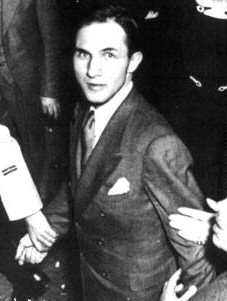
1936: Bruno Richard Hauptmann, The Most Hated Man in the World

On this date in 1936, a German immigrant went to New Jersey’s electric chair for kidnapping and murdering the infant son of famed aviator Charles Lindbergh.

Snatched

The kidnapping of the Lindbergh boy in 1932 had touched off an outpouring of public compassion matched only by the clumsiness of the investigation. The circus that formed around a father desperate to retrieve his boy — and prone to rash decision-making thereto — pulled in underworld figures, military intelligence officers (including the founder of the CIA’s forerunner and the father of Gulf War General Norman Schwartzkopf), a meddlesome schoolteacher, and queer characters like “Cemetery John,” who somehow managed two meetings with Lindbergh’s intermediaries, making off with a box full of ransom cash without anyone so much as tailing him, much less having to fork over the hostage.

The boy, in fact, was dead, and would be discovered weeks later, a few miles from the Lindbergh house, in such a state of decomposition as to suggest that, by accident or intention, he had suffered a fatal head injury almost at the moment of his abduction.

Two years’ fruitless investigation ensued, with leads that frustratingly faded away and at least two suspects who committed suicide. The police job had been a hash from the start, between amateurish cock-ups like failing to measure footprints found on the scene and security breaches in the chaotic weeks following the kidnapping. Most damagingly, a newspaper laid hands on an early ransom note and printed it, making it impossible subsequently to positively discern the kidnapper’s real notes from hoaxes.

But John Law had done one thing right: paid the ransom in soon-to-be-obsolete gold certificate. As they’d hoped, someone was finally caught spending this distinctive currency: Bruno Hauptmann.

Hauptmann actually went by “Richard”, but with its unerring sense of the Zeitgeist, the press played up his menacing alien moniker. After two and a half years, the public was ready to hate someone, and an illegal immigrant with a criminal record* from the late war’s great enemy was pretty much made to order.

Trial of the Century

The one thing Hauptmann didn’t do was confess — and that necessitated the “Trial of the Century,” or in Mencken’s coinage, “the greatest story since the Resurrection.”

It was O.J. before 24-hour cable. Journalists packed the small-town courtroom of Flemington, N.J.; for six weeks early in 1935, an aggressive prosecutor vied with a flamboyant (but cripplingly dissolute) defense attorney hired for the penurious defendant by the Hearst newspaper empire in exchange for inside information.

This newsreel footage of the trial consists mostly of Hauptmann’s own testimony, and even at seventy-plus years’ distance it crackles with drama — and with the persecutorial atmosphere that sealed Hauptmann’s fate, guilty or not. (The defendant often sounds uncertain and evasive in these clips — it cannot have helped his standing with the jury, but it is worth recalling that English was not his native language.)

History’s Verdict

The case was circumstantial, the most powerful circumstance, of course, being Hauptmann’s possession of ransom money — thousands of dollars worth, as it turned out, stashed in his garage. Hauptmann said a friend had left it when returning to Germany; the alibi didn’t convince many, but Hauptmann stuck to it to the end, even refusing to accept a commutation in exchange for a confession. This audio of a convicted Hauptmann still maintaining his innocence comes from the New Jersey Star-Ledger blog.

[audio:Bruno_Hauptmann.mp3]

Much other evidence against him — shaky eyewitness testimony, doubtful courtroom forensics — seems less damning, especially from the perspective of time. Unexplored problems — why would a professional carpenter build such a shoddy ladder? How could he have known the (rare) night the Lindberghs would actually be home? — gesture emptily towards other suspects never pursued, though they are very far from authoritatively exonerating Hauptmann. Ultimately, it’s a case with many unclear data points, whose importance and configuration invite dispute. (Here‘s a site dedicated to Hauptmann’s innocence, including this article (.pdf) outlining the main arguments his partisans make.)

Even the verdict’s defenders, and there are many, concede that portions at trial were exaggerated or outright perjured in an atmosphere hardly conducive to dispassionate review. Whether that makes Hauptmann “guilty but framed” or plausibly innocent (of the kidnapping, if not of opportunistic extortion) has been the subject of far more rumination than this blog can hope to assay.

A few of the many books about the Lindbergh case

An enigmatic criminal tied to an enigmatic icon in a painfully public four-year drama that transfixed the nation and still inspires debate: that “Trial of the Century” marquee holds up pretty well.

* In Germany; Hauptmann’s record was clean stateside — apart, that is, from Charles Lindbergh, Jr.

On this day..

2001: Robert Lee Massie, who spent a lifetime dying

On January 7, 1965, 23-year-old Robert Lee Massie shot and killed Mildred Weiss during a botched robbery near her home. He pleaded guilty and, sentenced to die by the state of California, came within 16 hours of execution in 1967, when then-Governor Ronald Reagan temporarily halted his execution so that he could testify at the trial of his alleged co-conspirator. By this time, Massie had begun complaining to anybody who would listen about the conditions on death row, and greeting the prospect of an execution date as a welcome deliverance, was dubbed “the prisoner who wants to die” by the press.

However, Reagan’s reprieve bought him just enough time to live to see a California Supreme Court decision temporarily halting executions, which was followed by the US Supreme Court Furman v. Georgia decision of 1972 banning the death penalty as then being enforced as unconstitutionally arbitrary and capricious.

With Furman, death rows across the country were summarily cleared, and Massie, a model prisoner, was paroled for good behavior in 1978. By this time, the US Supreme Court had handed down the Gregg v. Georgia decision holding that states had revised their death penalty statutes sufficiently to allow executions to resume.

Only months after his release, Massie killed Boris Naumoff in his liquor store and wounded a clerk in another botched robbery. Again pleading guilty, this time over the objections of his court-appointed lawyer, Massie was again sentenced to die.

As before, Massie welcomed his sentence and, acting on a own novel interpretation of the Sixth Amendment guarantee of self-representation, argued that he had a constitutional right to bypass the appeals process usually automatic in capital cases and that there “is no meaningful difference between forcing an automatic appeal upon a defendant and forcing unwanted counsel upon him.” The appeals court disagreed, ruling that “while a litigant may waive the advantage of a law intended solely for his benefit, he may not waive a law established for a public reason.”

Appeals in capital cases were never intended to allow the prisoner to “choose his own sentence,” the Court wrote, and were in fact in place for just such a reason of ensuring full investigation into the “real issue [of] the propriety of allowing the state to conduct an illegal execution of a citizen.” The state was obliged to proceed with Massie’s appeals against his stated wishes, a charge unique to capital cases, because of the singular obligations imposed by the death sentence on the legal machinery of the state — and in fact imposed by the Furman and Gregg decisions that years earlier had ushered Massie unwillingly off death row.

His appeals continuing against his wishes, Massie’s conviction was ultimately overturned in a 1985 California Supreme Court decision holding that the sentence was invalid because his lawyer had not consented to the guilty plea.

Convicted again in a retrial in 1989, Massie was, once again, sentenced to death. Though he was briefly heartened enough to pursue appeals in earnest, those, too, foundered; increasingly convinced that corrupt judges were violating their oath to uphold the Constitution and greasing the machinery of death, he determined once again to pursue his own death.

As his appeals ran out, lawyers and advocates of all stripes stepped in to try to prevent Massie’s execution. A lifetime of abuse in foster care and juvenile detention centers and evidence of clinical depression and mental disorder were all presented at the last minute in a last-ditch attempt to save a man who didn’t want saving.

All were denied, and Robert Lee Massie was executed at the age of 59 on March 27, 2001. He was just the ninth prisoner executed in California in the post-Furman era and the 703rd nationwide.

Massie is one of a growing trend of death row volunteers, prisoners who voluntarily seek to run through their appeals and bring their lives on death row to an end. His frequent visitor in his last years in prison and “next friend,” Michael Kroll,* writes:

My friend, Bob Massie, maneuvered the state of California into assisting in his suicide. He had his own lawyer doing the dance of death with the attorney general and managed to avoid being declared incompetent.

And in the words of a relative of one of Massie’s victims:

I know he wants to die. It makes me think, if he wants out of the suffering, well, maybe we shouldn’t be killing him. Maybe he should just be left there to suffer.

Tossed hither and yon with the shifting legal tides of death penalty law spanning eight presidential administrations, Massie had to aid his executioners to the very last breath: when finally strapped to a gurney 36 years since that young man had murdered Mildred Weiss, he obligingly flexed his arm to help the technician find a suitable vein.

* Kroll tried to prevent Massie’s execution on the grounds that he was mentally ill, incurring his friend’s wrath.

On this day..

1998: Gerald Eugene Stano, misogynist psychopath

(Thanks to the tireless Lilo of Lost In Lima Ohio and Perverted Primates for the guest post.)

On this date in 1998, the story of a boy named Paul ended in Florida’s electric chair.

Paul was born in 1951, in Schenectady, New York. He was the fifth child born to his mother, and would be the third she put up for adoption. At thirteen months old, Paul was malnourished and neglected both physically and emotionally to the point that county officials found him unfit to be adopted. But out of the slightest bit of luck, the small child caught the attention of Eugene and Norma Stano, who fought for six months to adopt the severely delayed child. And it was out of that luck that Paul became Gerald Eugene Stano.

Gerald Eugene Stano’s problems didn’t end with his new life with his adoptive parents; instead, he continued to develop a series of problems that would follow him, shaping his outlook on the world forever, and likely providing him with the excuses he needed to justify his actions later in life.

Gerald still wet the bed at ten, was the target for bullies and regularly laughed at by girls. Late in his life he would claim that women used to pull his hair, and even threw beer bottles at him, all without any provocation. He lagged behind in school, failing to graduate high school until he was 21 years old, and except for music class never achieved a grade higher than a C or D.

Yes, Gerald had a sad and difficult life, one that most people would find it easy to sympathize with. Despite his claims of being an outcast, Gerald flaunted his high opinion of himself, often going as far as to refer to himself as a “real Italian stallion”.

It seems that few really paid attention to Stano — not until March 25, 1980, when a woman by the name of Donna Hensley stumbled away from him, and walked into a police station.

Hensley would tell police that she was a prostitute, and had been approached by a man requesting her services. Once at her motel room, the two began to argue and the man ended up slicing her with a knife before insulting her and fleeing. Hensley was adamant that the man be found and charged.

An officer investigating the incident went looking for the prospective suspect, but ended the search with only a license plate for a car that matched the description. Following up with the plate number, the officer found the vehicle was registered to Gerald Eugene Stano, a 28-year-old man with a long arrest record but no convictions. Hensley gave a positive identification from Stano’s mug shot, and thus began investigation into a series of grisly murders.

On February 17, 1980 two college students had stumbled onto the decomposing remains of a young woman, and police had begun investigating the gruesome murder. The victim, 20-year-old Mary Carol Maher, was found in a remote area lying on her back, her arms at her side. Police believed she had been there for weeks, and upon moving the body discovered that she’d been repeatedly stabbed in the back, legs and chest.

During questioning for the assault on the prostitute, Stano, who fit the profile of the person sought for Maher’s slaying, was asked about the murder victim. Despite having confessed to the assault, Stano would only provide enough information to confirm that he’d previously seen Maher. But with more questioning, Stano broke and began replaying the scene out with the detective, even accompany the detective to the murder scene, and confirming the position of the body.

After returning to the police station, another detective suggested questioning Stano on a missing persons case, that of Toni Van Haddocks, a 26-year-old prostitute who had not been seen for some time. Stano denied any involvement in that case.

On April 15, 1980 a human skull was found in a garden by a Daytona resident, and a search of the area lead to clothing and more bones. Police would determine that these were the remains of Haddocks. Stano was again questioned and despite his first denials, later confessed to the murder, and would soon begin confessing to many more.

In the end, Stano admitted the gruesome murders of over 40 women, and was sentenced to death. After many failed appeals, his execution took place on March 23, 1998.

The death penalty has always been a very touchy subject. Many of its opponents believe that nothing justifies the taking of another person’s life, even if done by the state as a means of punishment. I agree that every life has value, but am personally compelled to ask whose life had more value — the victims that Stano murdered, or Stano himself?

My answer would favor the victims, and therefore I am resolved to believe that giving him any punishment less than what he received — death — would be an injustice to those who were killed by his hands.

On this day..