1796: Mastro Titta’s first execution of many

A Catholic man with the name Giovanni Battiste (“John the Baptist”) Bugatti could hardly have had a more ironic role in church history than the man who, on this date in 1796, dispatched his first victim as official executioner of the Papal State. Nicholas Gentilucci was hanged for killing a clergyman and his coachman, then robbing two friars while on the lam; Gentilucci’s corpse was subsequently quartered.

Little is known about Gentilucci, but much is known of his then-17-year-old executioner, for Bugatti, who would become known simply as Mastro Titta, turned out to be the most individually prolific taker of life in turn-of-the-19th century Rome.

Bugatti was born in Rome in 1779 and, even while putting criminals of the state to death, lived and worked on the west side of the Tiber River as an umbrella painter. Executions were a side job, and these ghastly deeds were recognized as such by the church, which compensated him a paltry three cents of a Roman lira for each body.

“Minister of Justice”
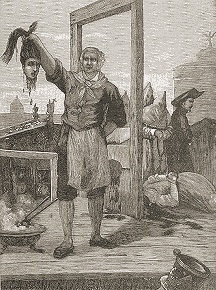
Mastro Titta brandishes an executed woman’s head.

The original Mastro Titta — the titular corruption of the “Minister of Justice” — took responsibility for each of his “patients” (as he called them, and as they were notoriously referred to by others), dutifully noting each of the 516 in his memoir. He stood for 69 years as the primary administrator of the death penalty in papal Rome, killing variously by beheading, hanging, and use of the mallet. Some were charged with murder, others with conspiracy, others with more petty crimes, but all were found guilty by the court of judges chosen by the Church’s bishops and cardinals.

The Minister’s performances were not without an (increasingly practiced) flair, heavy on the religious symbolism. Bugatti’s residence on the west side of the river meant that, when he was to carry out a punishment, he had first to cross the river.

Initially, the executions were carried out in the Piazza del Popolo, but that location was retired in the 1820’s; it’s not clear how consistent the location was after this, but at least one later execution occurred near San Giovanni decollato, home to the group of monks dedicated to comforting the condemned even when the final blow didn’t occur at its doorstep. Regardless of the locale, a spectacle soon arose surrounding that crossing and the parade which followed, as documented by Italian dialect poet G.G. Belli in 1835 (presumably for the execution of Giovanni Orioli di Lugo on July 11 of that year):

The Dilettante at the Bridge

They approach: Attention: the ceremony is brief.
Behold the condemned, neck bare and stretched.
He is the first man of the opera, the Patient,
The Ace of Spades, lord of the fesitval.

And behold the professor that will soon be
The surgeon acting for the people
For three pence, the community,
He will cure the ills of their pained head!

But not the man on the left: the other, to the right.
He in the second place is the Assistant.
The proceedings wait for Mastro Titta.

Do you want the usual from me, who takes the head?
I who never miss it: I am consistent;
And I know him as well as I know the Pope.

The translation is largely mine, with help on some difficult sections from a well-written and complete description of Mastro Titta’s life and work here and here.

Just a Job
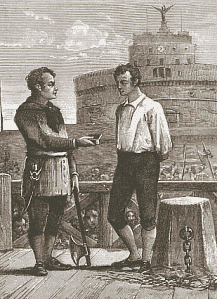
A pinch of snuff before I snuff you?

Bugatti was known for playing the role of executioner in a manner which left no doubt as to his feelings towards the act: it was his job, his service to the Church itself, undisturbed by any personal animus towards the condemned — particularly early in his career.

He often offered snuff to his victims and spoke briefly and quietly with them prior to the execution, likely ploys to ease the victim into his role in the spectacle. Dickens viewed one of Mastro Titta’s beheadings on 8 March 1845*, and, in his Pictures From Italy, he remarked on the callousness of the event.

In keeping with this attitude, most of the entries in Mastro Titta’s memoir are fewer than 20 words. They reflect a man who seeks to distance himself from the crowd’s bloodlust. A selection:

  • “Tommaso Tintori, guilty of homicide, 28 February 1810″ (The first using the “new edifice for beheading from the French government” — that is, the guillotine)
  • “Pecorari Angel, of Poli, aged 29. Peasant guilty of premeditated homicide of one woman, condemned to «death as an example» in Poland on 21 January 1847.” (There were a number of prisoners sentenced in other Catholic parts of Europe sent to Rome for Titta’s ministrations.)
  • “Sabbatino Proietti, aged 25, «decapitated» in Rieti for petty theft and highway robbery and murder on 20 August 1853, died converted, executed through administration of justice at the public square at the Bridge.”
  • “Angelo Lisi di Alatri, found guilty of premeditated highway robbery and murder in Frosinone, «dead» on 30 April 1862.”

An Anomalous Man

Bugatti was born just seven years prior to the Grand Duchy of Tuscany becoming the first of the Italian states to abolish the death penalty. There, Leopold II barred torture and punishment of death, a decision heavily influenced by Cesare Beccaria’s On Crimes and Punishments and a desire to distance his nation from Rome.

In the neighboring Papal State, however, the practice continued, the embodiment of the church’s power over its people in matters earthly and spiritual. Executions of the time performed for various reasons, but with a handful of exceptions, they were almost exclusively performed on persons in the lower class. Many relied on the use of torture or testimony from confessionals. Papal executions were carried out until the 1870s and only declared unnecessary (though not banned by the Church) by Pope John Paul II in the 1990s.

A complete discussion of the role of executions in the Catholic Church is too much for this space,** but a man like Bugatti serves usefully to exemplify the absurdity endowed in these killings by the Catholic Church. Where the half-dozen popes who served over Bugatti thought such executions to be necessary for the control of the masses, they had no such ideas about nobles who committed crimes.

The execution itself consisted of a parade with masked priests, banners, scriptural readings, and sermonizing, culminating in the death of the condemned. John L Allen of the National Catholic Reporter described the treatment of these executions in that day as “a liturgy”, and descriptions from writers such as Lord Byron show a scene which could only be described as a mix of Catholic Mass and town festival.

Such ritualized killing came to contrast starkly with the Italian celebration of an anti-death penalty position, and the two stood at odds for over a century. In 1909, the topic was hot enough that a plaque glorifying two Italians executed by Bugatti in 1825 was erected; a dozen years later, its contents were concealed out of deference to Rome until after the Second Vatican Council. The commemorated, Angiolo Targhini and Leonida Montanari (here’s their Italian Wikipedia page), were convicted essentially of riling the people, and they were summarily beheaded; their story was the inspiration for Luigi Magni’s 1969 classic Nell’anno del Signore:

“So ends the long list of Bugatti.”

Mastro Titta was given an official residence, and at the end of his term, he was handsomely rewarded with a pension for his service — 30 scudi per year. His final executions were carried out on 17 August 1864, wearing his traditional red cloak (now on display at the Criminology Museum of Rome): Antonio Olietti of Rome and Domenico Antonio Demartini were beheaded for homicide.

The Minister of Justice was 85, four and some years from the end of his life, and the final line in his memoir reads, “So ends the long list of Bugatti. May that of his successor be shorter.”

Indeed it was.

The final executions in Rome occurred on 24 November 1868 at the hands of Antonio Balducci, Bugatti’s long-time apprentice; the event was marked by Pope Pius IX famously intoning in response to calls for a stay, “I can’t, and I don’t want to.” The last execution in the Papal State was of Agatino Bellomo on 9 July 1870, in Palestrina, shortly before the nascent unified Italy absorbed Rome.

Mastro Titta is still known in Italy,† but, adrift amid a particularly violent period of revolution, his legacy as papal executioner is largely lost to the rest of the world.

* The day’s guillotinee was Giovanni Vagnarelli, 26, from Augustine; he killed Bavarian Anna Cotten and robbed her, and her wife’s statement at confessional was used to convict Vagnarelli. Such confessional convictions were not uncommon, as Bugatti’s own memoir confirms.

** There’s surprisingly little reading out there about this topic, though it would seem ripe for a book or two. Here’s what I can find:

  • “Fear and Loathing in Bologna and Rome: The Papal Police in Perspective”, Steven Hughes, Journal of Social History, 1987.
  • “Capital Punishment: The Curious History of its Privileged Place in Christendom”, James J. Megivern, Proceedings of the American Philosophical Society, 2003.
  • For a discussion of current discourse in Catholic teachings, this is rather interesting: “To Kill or Not to Kill: The Catholic Church and the Problem of the Death Penalty”, lecture by E. Christian Brugger, Asst. Prof. of Ethics, Dept. of Religious Studies, Loyola University, 2001.

† A half dozen kilometers from the bridge that Mastro Titta crossed on his way to carry out Papal justice now stands the Mastro Titta Pub. It is reportedly “tastefully done” and serves mostly Belgian beers.

On this day..

1933: Giuseppe Zangara, who is not on Sons of Italy posters

On this date in 1933, Giuseppe Zangara went to Florida’s electric chair for the murder of Chicago mayor Anton Cermak — the man he had accidentally shot while attempting to assassinate President-elect Franklin Delano Roosevelt.

Zangara had to stand on a chair to take the shot: he was only five feet tall. This image is from Miami Police of Yesterday, a site by a descendant of one of the officers who arrested Zangara.

A strange and strangely forgotten man, the Italian immigrant came within inches of dramatically altering American history.

On February 15, 1933, at a Roosevelt speech in Miami’s Bayfront Park, Zangara perched himself on a metal folding chair within ten meters of the man who was then President-elect, but somehow managed to miss him. A bystander, Lillian Cross, grabbed his arm, and others in the crowd wrestled him down.

Certainly Zangara would be better remembered if he had shot Roosevelt (and Roosevelt would be very much less remembered), but his head-scratching persona accounts for at least some of his obscurity.

He’s sometimes called an anarchist — the early 20th-century equivalent of calling him a terrorist — and he talked the talk. Here, his last words:

You give me electric chair. I no afraid of that chair! You one of capitalists. You is crook man too. Put me in electric chair. I no care! Get to hell out of here, you son of a bitch [said to the chaplain] … I go sit down all by myself… Viva Italia! Goodbye to all poor peoples everywhere!… Lousy capitalists! No picture! Capitalists! No one here to take my picture. All capitalists lousy bunch of crooks. Go ahead. Pusha da button!

Zangara was a working-class immigrant. But his specific motivation for murdering Roosevelt seems murky at best — there’s no clear subversive organization or cause with which Zangara seemed a dedicated fellow-traveler. The wikipedia page about him describes his lifelong stomach pains as the cause of his act, which seems a queer thing to make a fellow shoot a president.

The major conspiracy proposal, that the anti-mob mayor Cermak was the real target all along of a mafia-engineered hit (here (.doc) is a version) is highly speculative, to put it generously. (Update: More on this here, via Chicagoland) Certainly Zangara might have been, as he claimed and most believe, a lone nut — many have done worse for less cause.

The world didn’t have long to unravel this man’s mysteries; justice moved with a rapidity terrifying even by the standards of the time — as reflected in the title of one of the books about him, The Five Weeks of Giuseppe Zangara.

Zangara had already been sentenced to a long prison term for the several bystanders his errant shots had struck when Anton Cermak finally succumbed — after 19 painful days — to a gut shot. Two weeks after that, his killer was dead, too.

During his first trial, the judge pressed him on his motivation, as reported in a press clipping that became part of Zangara’s FBI file:

Q. Have you ever been in jail before? Ever been in any trouble?

A. No, this is the first time.

Q. Did you ever hurt anyone before?

A. No, me no hurt anyone.

…

Q. Did you plan this shooting?

A. No.

Q. When did you decide to do it?

A. I got it in my mind capitalist hurt people. They are to blame for my stomach hurting. My stomach was hurting bad. It was like I was on fire. It burns my mind, I act like a drunken man. It came in my mind when I was suffering.

At this trial — the one before Cermak died — he pled unsuccessfully for execution: “I am sorry only because I did not kill. I am sorry about nothing. Put me in the electric chair.” It reads like “suicide by cop”.

Zangara might not be a name of Oswaldesque dimensions among the assassinariat, but he comes in for a scene in Stephen Sondheim’s strange musical theater, Assassins.

Officially, Zangara was punished for the man he killed, not the soon-to-be-President he was (presumably) aiming at. But such a close scrape for such a transformative American leader, a man sometimes credited with saving capitalism from itself in an age of crisis, has made Zangara’s one famous act fodder for alternative history that asks the question “what might have been?”

On this day..

1998: Bahram Khan, by his victim’s brother

Ten years ago today, in Taliban-controlled Afghanistan, 30,000 people witnessed an alleged murderer shot to death by the victim’s brother at Kabul’s national stadium.

The Taliban had held Kabul for little more than a year at this point, and this sort of ostentatious shari’a execution was still a novelty. Amnesty International reported that loudspeakers summoned people to the stadium expressly to witness the execution (and the subsequent flogging of an accused rapist), and that the victim’s family refused the pleas of the crowd to spare Khan’s life.

Amnesty also excerpted a translated Taliban Radio report of the event.

The occasion of applying Shari’a law to a murderer in Kabul Stadium today was attended by a number of high ranking officials of the Islamic Emirate of Afghanistan and thousands of Kabul people. First some verses from the Koran were recited .. Deputy Court Martial .. Mawlawi Sayd Abdul Rahman Agha .. in turn spoke about the implementation of Allah’s order on Allah’s earth to criminals in order that other criminals should take an example from it. .. Subsequently Esteemed Abdul Nasir Nastier, an official of radio television introduced the criminal and read out the court martial’s decision. After reading out the court martial’s decision Bahram Khan, son of Mohsin Khan, citizen of Bagrami district of Kabul Province, who had killed Asadullah, son of Neck Mohammad on the night of 28th-29th of Sonbola [19th-20th September] this year .. was executed before thousands of Kabul people.

Here is the original Associated Press story, archived by Rick Halperin‘s death penalty news mailing list:

A convicted murderer was executed in a Kabul football stadium Friday — shot in the head and chest by the victim’s brother — despite a plea for mercy from a crowd of thousands. It was the 3rd public execution under the new Taliban regime, whose harsh brand of justice makes many Afghanis uneasy. That opposition was reflected Friday by the fact that even the judge in the case joined the effort to spare Bahram Khan’s life.

“Let him live!” the crowd shouted as Khan’s hands were bound behind his back and he was removed from the pickup truck that carried him into the arena. But the victim’s father, Nek Mohammed, strode to the microphone. “We won’t forgive him. If we let him live he will kill again. We know this man.”

While executions took place in Afghanistan before the Taliban’s takeover last year, the army of former Islamic seminarians has added several new twists. For example, it has curtailed defendants’ right to appeal rulings and gives the families of murder victims the option of carrying out a court-imposed death sentence or granting mercy.

It wasn’t immediately clear Friday whether the crowd’s intervention on behalf of Khan stemmed from general objections to such forms of punishment or was based on the particulars of the case. At any rate, it was fruitless. Khan’s executioner jumped up onto the truck and quickly dispatched one bullet into Khan’s head and another into the 29-year-old’s chest. Khan crumpled to the ground.

Khan’s body was carried and another man was pushed onto the field and given 100 lashes for raping a woman last year. In addition to the executions, the Taliban has also begun public amputations of hands and feet, an Islamic punishment for theft.

The Taliban religious militia overran the capital of Kabul in 1996 and now controls 85% of the country. Afghanistan’s former president, Burhanuddin Rabbani, heads an anti-Taliban alliance of minority ethnic groups that is fighting the Islamic army on several fronts.

On this day..

1963: Jean-Marie Bastien-Thiry, model for the Jackal

On this date in 1963, clutching a rosary, French officer Jean-Marie Bastien-Thiry was shot by a firing squad in the Paris suburb Ivry-sur-Seine for attempting to assassinate Charles de Gaulle.

Perhaps no anticolonial struggle left a more considerable intellectual and cultural footprint than the Algerian War of Independence against France. It gashed the French polity as well; the right violently rejected the swelling sentiment to end their country’s 132-year occupation. It is often said that the conservative Charles de Gaulle was the only man who could have engineered the departure with the support of a sufficient portion of the populace — but a sufficient portion by no means meant all, and every blunder multiplying the [French] body count was laid on de Gaulle’s head besides.

On August 22, 1962 — just weeks after that war successfully expelled the European power — an assassins’ team led by Bastien-Thiry (collaborating with the far-right Organisation de l’armée secrète) unleashed a machine gun fusillade at de Gaulle’s car. Hundreds of shots were fired; miraculously, the president and all his aides all escaped unharmed.

Although the actual gunmen were reprieved by their intended target, their manager was not. Said de Gaulle,

The French need martyrs … I gave them Bastien-Thiry. They’ll be able to make a martyr of him. He deserves it.

Certainly Bastien-Thiry had that in mind. At his trial (as recorded by a sympathetic French-language website), he addressed his conduct to posterity:

Nous avons exercé le droit de légitime défense contre un homme, au nom de ses victimes, au nom de nos concitoyens et au nom de nos enfants ; cet homme est ruisselant de sang français et il représente la honte actuelle de la France. Il n’est pas bon, il n’est pas moral, il n’est pas légal que cet homme reste longtemps à la tête de la France ; la morale, le droit et la raison humaine s’unissent pour le condamner. La vérité que nous avons dite, et que bien d’autres que nous ont dite avant nous, restera attachée au nom de cet homme, où qu’il aille et quoi qu’il fasse. Un jour cet homme rendra compte de ses crimes : devant Dieu, sinon devant les hommes.

Bastien-Thiry’s sensational plot, and the ongoing efforts of the OAS to murder de Gaulle, inspired Frederick Forsyth’s novel The Day of the Jackal, and a classic 1973 film of the same title:

Part of the Themed Set: The Written Word.

On this day..

1845: An Italian highwayman, as witnessed by Dickens

On this date in 1845, Charles Dickens witnessed a man beheaded in Rome for robbery and murder.

At 33, Dickens was well-established in his field; he already had to his credit The Pickwick Papers, Oliver Twist, Nicholas Nickleby and others.

Dickens spent a good part of the mid-1840’s abroad, with extended stays in North America, Italy and Switzerland, although without much abating his prodigious output. He intended the travelogue Pictures From Italy to help finance his journeys; it met an unenthusiastic reception and rates distinctly among Dickens’ minor works.

This day’s events took place during the latter stages of Dickens’ stay in Italy and — as the distinctly proscriptive last paragraphs of this excerpt indicate — touch a social theme very pressing to the author, one to which he would soon return again. Years later, the utterly unedifying scene of the public guillotine would be fodder for Dickens’ A Tale of Two Cities, whose tragic protagonist has already appeared in these pages.

Of note also is Dickens’ implication — though he doesn’t quite state it outright — that the criminal was uncovered by a secret revealed under the seal of confession, a touchy point for the priesthood as any viewer of television crime dramas will certainly be aware. We have to allow a considerable latitude for a misapprehension on the traveler’s part here, especially given that Pictures as a whole caught considerable heat from the moment of its publication for its relentless anti-Catholicism. (Update: More on the use of confessionals in Papal Rome in this post about the Vatican’s headsman.)

Here’s the scene in its entirety:

On one Saturday morning (the eighth of March), a man was beheaded here. Nine or ten months before, he had waylaid a Bavarian countess, travelling as a pilgrim to Rome – alone and on foot, of course – and performing, it is said, that act of piety for the fourth time. He saw her change a piece of gold at Viterbo, where he lived; followed her; bore her company on her journey for some forty miles or more, on the treacherous pretext of protecting her; attacked her, in the fulfilment of his unrelenting purpose, on the Campagna, within a very short distance of Rome, near to what is called (but what is not) the Tomb of Nero; robbed her; and beat her to death with her own pilgrim’s staff. He was newly married, and gave some of her apparel to his wife: saying that he had bought it at a fair. She, however, who had seen the pilgrim-countess passing through their town, recognised some trifle as having belonged to her. Her husband then told her what he had done. She, in confession, told a priest; and the man was taken, within four days after the commission of the murder.

There are no fixed times for the administration of justice, or its execution, in this unaccountable country; and he had been in prison ever since. On the Friday, as he was dining with the other prisoners, they came and told him he was to be beheaded next morning, and took him away. It is very unusual to execute in Lent; but his crime being a very bad one, it was deemed advisable to make an example of him at that time, when great numbers of pilgrims were coming towards Rome, from all parts, for the Holy Week. I heard of this on the Friday evening, and saw the bills up at the churches, calling on the people to pray for the criminal’s soul. So, I determined to go, and see him executed.

The beheading was appointed for fourteen and a-half o’clock, Roman time: or a quarter before nine in the forenoon. I had two friends with me; and as we did not know but that the crowd might be very great, we were on the spot by half-past seven. The place of execution was near the church of San Giovanni decolláto (a doubtful compliment to Saint John the Baptist) in one of the impassable back streets without any footway, of which a great part of Rome is composed – a street of rotten houses, which do not seem to belong to anybody, and do not seem to have ever been inhabited, and certainly were never built on any plan, or for any particular purpose, and have no window-sashes, and are a little like deserted breweries, and might be warehouses but for having nothing in them. Opposite to one of these, a white house, the scaffold was built. An untidy, unpainted, uncouth, crazy-looking thing of course: some seven feet high, perhaps: with a tall, gallows-shaped frame rising above it, in which was the knife, charged with a ponderous mass of iron, all ready to descend, and glittering brightly in the morning sun, whenever it looked out, now and then, from behind a cloud.

There were not many people lingering about; and these were kept at a considerable distance from the scaffold, by parties of the Pope’s dragoons. Two or three hundred foot-soldiers were under arms, standing at ease in clusters here and there; and the officers were walking up and down in twos and threes, chatting together, and smoking cigars.

At the end of the street, was an open space, where there would be a dust-heap, and piles of broken crockery, and mounds of vegetable refuse, but for such things being thrown anywhere and everywhere in Rome, and favouring no particular sort of locality. We got into a kind of wash-house, belonging to a dwelling-house on this spot; and standing there in an old cart, and on a heap of cartwheels piled against the wall, looked, through a large grated window, at the scaffold, and straight down the street beyond it until, in consequence of its turning off abruptly to the left, our perspective was brought to a sudden termination, and had a corpulent officer, in a cocked hat, for its crowning feature.

Nine o’clock struck, and ten o’clock struck, and nothing happened. All the bells of all the churches rang as usual. A little parliament of dogs assembled in the open space, and chased each other, in and out among the soldiers. Fierce-looking Romans of the lowest class, in blue cloaks, russet cloaks, and rags uncloaked, came and went, and talked together. Women and children fluttered, on the skirts of the scanty crowd. One large muddy spot was left quite bare, like a bald place on a man’s head. A cigar-merchant, with an earthen pot of charcoal ashes in one hand, went up and down, crying his wares. A pastry-merchant divided his attention between the scaffold and his customers. Boys tried to climb up walls, and tumbled down again. Priests and monks elbowed a passage for themselves among the people, and stood on tiptoe for a sight of the knife: then went away. Artists, in inconceivable hats of the middle-ages, and beards (thank Heaven!) of no age at all, flashed picturesque scowls about them from their stations in the throng. One gentleman (connected with the fine arts, I presume) went up and down in a pair of Hessian-boots, with a red beard hanging down on his breast, and his long and bright red hair, plaited into two tails, one on either side of his head, which fell over his shoulders in front of him, very nearly to his waist, and were carefully entwined and braided!

Eleven o’clock struck and still nothing happened. A rumour got about, among the crowd, that the criminal would not confess; in which case, the priests would keep him until the Ave Maria (sunset); for it is their merciful custom never finally to turn the crucifix away from a man at that pass, as one refusing to be shriven, and consequently a sinner abandoned of the Saviour, until then. People began to drop off. The officers shrugged their shoulders and looked doubtful. The dragoons, who came riding up below our window, every now and then, to order an unlucky hackney-coach or cart away, as soon as it had comfortably established itself, and was covered with exulting people (but never before), became imperious, and quick-tempered. The bald place hadn’t a straggling hair upon it; and the corpulent officer, crowning the perspective, took a world of snuff.

Suddenly, there was a noise of trumpets. ‘Attention!’ was among the foot-soldiers instantly. They were marched up to the scaffold and formed round it. The dragoons galloped to their nearer stations too. The guillotine became the centre of a wood of bristling bayonets and shining sabres. The people closed round nearer, on the flank of the soldiery. A long straggling stream of men and boys, who had accompanied the procession from the prison, came pouring into the open space. The bald spot was scarcely distinguishable from the rest. The cigar and pastry-merchants resigned all thoughts of business, for the moment, and abandoning themselves wholly to pleasure, got good situations in the crowd. The perspective ended, now, in a troop of dragoons. And the corpulent officer, sword in hand, looked hard at a church close to him, which he could see, but we, the crowd, could not.

After a short delay, some monks were seen approaching to the scaffold from this church; and above their heads, coming on slowly and gloomily, the effigy of Christ upon the cross, canopied with black. This was carried round the foot of the scaffold, to the front, and turned towards the criminal, that he might see it to the last. It was hardly in its place, when he appeared on the platform, bare-footed; his hands bound; and with the collar and neck of his shirt cut away, almost to the shoulder. A young man — six-and-twenty — vigorously made, and well-shaped. Face pale; small dark moustache; and dark brown hair.

He had refused to confess, it seemed, without first having his wife brought to see him; and they had sent an escort for her, which had occasioned the delay.

He immediately kneeled down, below the knife. His neck fitting into a hole, made for the purpose, in a cross plank, was shut down, by another plank above; exactly like the pillory. Immediately below him was a leathern bag. And into it his head rolled instantly.

The executioner was holding it by the hair, and walking with it round the scaffold, showing it to the people, before one quite knew that the knife had fallen heavily, and with a rattling sound.

When it had travelled round the four sides of the scaffold, it was set upon a pole in front — a little patch of black and white, for the long street to stare at, and the flies to settle on. The eyes were turned upward, as if he had avoided the sight of the leathern bag, and looked to the crucifix. Every tinge and hue of life had left it in that instant. It was dull, cold, livid, wax. The body also.

There was a great deal of blood. When we left the window, and went close up to the scaffold, it was very dirty; one of the two men who were throwing water over it, turning to help the other lift the body into a shell, picked his way as through mire. A strange appearance was the apparent annihilation of the neck. The head was taken off so close, that it seemed as if the knife had narrowly escaped crushing the jaw, or shaving off the ear; and the body looked as if there were nothing left above the shoulder.

Nobody cared, or was at all affected. There was no manifestation of disgust, or pity, or indignation, or sorrow. My empty pockets were tried, several times, in the crowd immediately below the scaffold, as the corpse was being put into its coffin. It was an ugly, filthy, careless, sickening spectacle; meaning nothing but butchery beyond the momentary interest, to the one wretched actor. Yes! Such a sight has one meaning and one warning. Let me not forget it. The speculators in the lottery, station themselves at favourable points for counting the gouts of blood that spirt out, here or there; and buy that number. It is pretty sure to have a run upon it.

The body was carted away in due time, the knife cleansed, the scaffold taken down, and all the hideous apparatus removed. The executioner: an outlaw ex officio (what a satire on the Punishment!) who dare not, for his life, cross the Bridge of St. Angelo but to do his work: retreated to his lair, and the show was over.

Pictures from Italy is available free online from Project Gutenberg.

The date and description would indicate that Dickens witnessed the death of 26-year-old Giovanni Vagnarelli. (See this list of the Holy See’s executions.)

Part of the Themed Set: The Written Word.

On this day..

1999: Walter LaGrand, a German gassed in America

(Thanks to German political scientist Matthias Lehmphul for the guest post -ed.)

The last man — so far — to die in the gas chamber, Walter LaGrand, was executed by the state of Arizona on March 3rd, 1999. He was one of just 11 prisoners gassed among the 1,099 executions to date since the U.S. death penalty was reinstated in 1976.

The United States introduced the gas chamber as an execution method in the beginning of the last century. The first death row inmate ever executed with poisoned air was Chinese migrant Gee Jon, who died at the Nevada State Prison in 1924. Relative to the other methods in use at the time — the electric chair, hanging, and the firing squad — gas was believed the most humane way of taking a person’s life.

It took 70 years for a court to finally recognize it as cruel and unusual punishment. In 1994 a federal judge ruled that the gas chamber violated the eighth amendment of the U.S. Constitution. Shortly before Walter LaGrand’s scheduled execution, the Ninth Circuit Court of Appeals issued a stay whose logic would have banned lethal gas forever. This was overruled by the U.S. Supreme Court, leaving it as it remains today -– a backup or secondary option for putting a delinquent to death in five states: Arizona, California, Maryland, Missouri and Wyoming.

Death penalty for a murder in a bank


Walter LaGrand (top) and his brother Karl.

Walter LaGrand was following his brother Karl LaGrand, who Arizona had executed by lethal injection a week earlier. The brothers were sentenced to death on December 14th, 1984 for stabbing to death an employee of a bank in Marana, Arizona.

On January 7, 1982, 19-year-old Walter and 18-year-old Karl drove from Tucson to Marana to rob the Valley National Bank. Brandishing a toy gun, they ordered the bank manager, Ken Hartstock, to open the vault. Mr. Hartstock, however, did not have the complete combination. The brothers bound Mr. Hartstock’s hand together with electrical tape. When he attempted to shout at Karl, he was stabbed to death with a letter opener.

Another bank employee, Ms. Lopez, was in the room at the time of the murder. Her hands had also been bound, and she too suffered several stab wounds. She later became the state’s key witness.

When they were arrested, Karl LaGrand confessed to the killing and tried to shield his older brother from a capital murder charge by stating that Walter was not in the room when the stabbing occurred.

Ms. Lopez, however, testified that both brothers were surrounding Mr. Hartstock at the time of his death.

Between different worlds: A childhood without a home

At the time Walter and Karl LaGrand were born, their mother, Emma Maria Gebel, lived in Augsburg in what was then West Germany. The boys were cared for either by Emma’s mother or a babysitter. When Emma’s mom became ill and could no longer handle the children, the two kids were put into an orphanage.

During the two years they remained at this place they suffered an egregious lack of care. Deprivation of food and blankets were common punishments at this institution. When Emma took the boys back they already suffered insomnia and post-trauma disturbances. In 1966 Emma married Masie LaGrand, an American soldier stationed in Augsburg. He adopted the two boys and their older sister Patricia. Together they moved to the USA in 1967.

Soon their new dad was send to Vietnam. After returning from this war he never was the same; Emma and Masie divorced in 1973. The boys’ delinquent record can be tracked back to 1978 — when they first ran away from home and shoplifted.

Though Karl and Walter were adopted, they never were naturalized by the national immigration service. They remained German citizens — and that set the stage for another legal controversy in the days before their execution.

Power Politics: How the United States overrules international law

In a personal meeting with President Bill Clinton, German Chancellor Gerhard Schröder expressed his concerns about the fate of both brothers. However, the main argument was not the execution method but the lack of consular assistance by the time of arrest.

The Vienna Convention on Consular Relations (VCCR) is one of the bedrock documents of international law. Under Article 36 of the VCCR any arresting authority is obliged to promptly notify a detained foreign national of his or her right to contact and seek assistance from their consulate.

This article does not exempt foreign citizens from prosecution, nor does it give special rights under the law. It only insures that foreign nationals -– including Americans abroad –- have the means to defend themselves in a uniquely vulnerable situation. The United States and Germany are among the VCCR’s 169 signatories.

On January 22nd, 1998 the Special Rapporteur to the UN High Commissioner of Human Rights Bacre W. Ndiaye criticized the United States for its arbitrary disregard for treaty obligations like consular notification:

There seems to be a serious gap in the relations between federal and state governments, particularly when it comes to international obligations undertaken by the United States Government. The fact that the rights proclaimed in international treaties are already said to be a part of domestic legislation does not exempt the Federal Government from disseminating their provisions. Domestic laws appear de facto to prevail over international law, even if they could contradict the international obligations of the United States. (Extrajudicial summary on arbitrary executions, E/CN.4/1998/68/Add.3:C.108 — full document (.pdf))

Much too late, Germany opened a legal case against the United States on Walter LaGrand’s behalf at the International Court of Justice (ICJ) in The Hague, Netherlands.

Karl LaGrand has been already executed when Berlin filed suit against Washington. Justice Christopher Weeramantry urged the United States to spare the life of Walter LaGrand. The White House argued it was a matter of the State of Arizona, outside the purview of federal authority. Under extreme international pressure, the Arizona Board of Pardons and Paroles took an unprecedented step: for the first time ever, it recommended an 60-day reprieve to await the decision of Germany’s suit against the United States at the ICJ.

Governor Jane D. Hull ignored it.

Past … and Prologue?

Walter and Karl LaGrand always had a close relationship and that did not change during their trial or time on death row. Until the end of 1998 they were celled beside one another and enjoyed the ability to talk freely. They held mirrors through the bars of their cells, so that they could see the other while talking. The chance to go out together on a work crew (when they were allowed to work) always excited them due to the fact that they were then able to see each other. In fact, they were emotionally so close that, if they have to die, they had expressed a preference to be executed on the same day.

Given a choice in their method of execution, both brothers tactically opted for the gas chamber to give the legal challenges to lethal gas a chance to save them. With those challenges foundering, both were offered a late switch to lethal injection in exchange for dropping suit.

Karl took the deal. Walter, as the New York Times put it, “opted for the gas, with its resonance of the Holocaust for Germans.”

Before the executioner switched the lever to initiate a chemical reaction between cyanide pellets (KCN) and sulfuric acid (H2SO4) the inmate was given his last words. Walter LaGrand said:

To all my loved ones, I hope they find peace. To all of you here today, I forgive you and hope I can be forgiven in my next life.

This date’s gassing with hydrogen cyanide (HCN) took 18 minutes until the heart of Walter LaGrand stopped beating. While the execution took place witnesses left the room nauseated.

Will history repeat? There are some 125 foreign nationals on death row in the United States today. Another pair of German brothers, Michael and Rudi Apelt, are as of this writing waiting to be put to death in Arizona — perhaps, if they choose it, in the same gas chamber where Walter LaGrand perished.

Legal and diplomatic fallout

Still smarting from the LaGrands’ execution, German foreign minister Joschka Fischer said at the 55th Session of the Commission on Human Rights in Geneva on March 23rd, 1999:

States whose justice system kill are not meeting their responsibility to set an example to society. Europeans believe that the death penalty cannot be justified either ethically or legally and has not proved to be an effective means of combating crime.

The ICJ ruled in favor of Germany‘s LaGrand suit on June 26th, 2001, more than two years after the brothers had been put to death. It was the first time that a country won a case against the United States on this matter.

In 2005, facing multiplying challenges from death-sentenced foreign nationals similarly denied their rights under the VCCR, the Bush administration formally withdrew the United States from the ICJ’s oversight for such cases.

On this day..

1877: Jack McCall, Wild Bill’s murderer

On this date in 1877, Jack McCall was hanged in Yankton, South Dakota, for the murder of Wild Bill Hickok.

It was the most notorious crime in the old west: the legendary gunfighter and lawman shot from behind playing poker in the gold rush town Deadwood, S.D. on August 2, 1876.

McCall‘s grievance against Wild Bill remains unclear, which seems no less than properly atmospheric. One version has him losing at cards to Hickok the night before the murder, then humiliated to accept Hickok’s charity for his evening meal. Since Deadwood sprang up on Lakota Sioux land in defiance of treaty obligations and thus was an outlaw settlement without legal oversight, McCall might also have been engaged by another party to eliminate the town’s de facto source of law further to some private profit.

That speculation gains some circumstantial support from the surprising proceedings the following day. An impromptu “miner’s court” acquitted McCall — the defendant claimed to have been avenging the murder of a brother who does not seem to have ever existed at all — of a murder they plainly knew he committed. This obliging verdict prompted a newspaper to remark,

Should it ever be our misfortune to kill a man … we would simply ask that our trial may take place in some of the mining camps of these hills.

McCall made for Wyoming, but couldn’t resist boasting of his famous crime, which was known to have graduated into a fair gunfight in his retelling. The times and the lands were unsettled enough that with an ounce of discretion he might have vanished. Instead, his loose lips got him nabbed by a federal marshal and extradited back to South Dakota — where he learned that the miner’s court verdict of an illicit settlement didn’t count as a legal acquittal for purposes of double jeopardy.

His hanging this morning — with the pertinent last words, “draw it tighter, Marshal” — was the first legal execution in South Dakota.

Like the reason for his one memorable act, McCall was an obscure character; his background was uncertain even when he lived. It was only through his victim that he left an imprint: he certainly elevated the legend of Hickok, whose cinematic demise also bequeathed to the arcane poker argot the term “dead man’s hand” — a pair of aces and a pair of eights (or more specifically, the black aces and black eights; the fifth card is uncertain) — after the last hand of cards Wild Bill ever held.

The dead man’s hand. Image used with permission.

On this day..

2002: Monty Allen Delk, in a Three-Pronged Failure

(Thanks to David Elliot at Abolish the Death Penalty for the guest post -ed.)

Six years ago today the state of Texas executed an FBI agent, a state district judge, the president of Kenya and a war hero who commanded a nuclear-powered submarine during the Civil War. More aptly put, Texas executed a seriously mental ill inmate named Monty Allen Delk who, at varying times, believed he was all of these things.

Delk was convicted and sentenced to death for the murder of Gene “Bubba” Allen of Anderson County in East Texas. Although the state of Texas maintained that Delk was “malingering,” i.e., pretending to be mentally ill to stave off execution, the prison system’s former chief mental health officer stated that Delk suffered from a severe mental illness, one that had become progressive in nature since it was first noticed in 1989 –- years after Delk was tried and convicted.

A close examination of the Delk case reveals yet another significant flaw in the capital punishment system:

The U.S. Supreme Court has ruled that executing severely mentally ill inmates violates the U.S. Constitution.

The court also has held that a death row inmate must be mentally competent in order to drop his appeals.

But the court has not directly addressed the issue of whether a death row inmate must be mentally competent in order to pursue his state and federal habeas appeals. In fact, the Texas Court of Criminal Appeals, and the 5th Circuit Court of Appeals, which has jurisdiction over death penalty cases in Texas, have ruled that prisoner competence during state and federal habeas proceedings is not constitutionally required.

The question is fundamental to due process. Habeas is the first, last and often only avenue of appeal for death row inmates whose sentences have been upheld on direct appeal by the Texas Court of Criminal Appeals. But because Delk was unable to assist his attorney through his habeas appeals, he could not answer simple questions that were key to his case -– questions such as, did he commit the crime? Did he think his trial was fair? Did he think his trial lawyers adequately represented him? Were there circumstances about the crime or about his personal history that mitigated against a death sentence?

The fact that Delk’s execution was allowed to proceed represented a three-pronged failure on the part of Texas’ death penalty system. The first failure must be attributed to the courts, which failed to order a psychiatric evaluation of Delk, despite repeated requests by Delk’s very able attorney, John Wright of Huntsville.

The second failure lies with Texas’ executive clemency system. Because of his mental illness, Delk’s sentence should have been commuted to life in prison. Yet the Board of Pardons and Paroles as well as Texas Gov. Rick Perry did nothing. (It is important to note that four days before Delk’s execution, the Georgia Parole Board, acting in a similar case, commuted death row inmate Alexander Williams sentence to life in prison after pleas from human rights activists. Williams is a chronic paranoid schizophrenic who thinks Sigourney Weaver is God and that little green frogs are in his prison cell, staring at him.)

The third failure rested with the Texas media. While Williams’ case attracted comprehensive media coverage in Georgia and beyond, newspapers in Texas largely failed to investigate Delk’s case. Government -– including the criminal justice system –- works best under the glare of public scrutiny. Absent such scrutiny, abuses occur. In this case, no one outside Texas’ fervent anti-death penalty community took much notice of Delk’s execution.

The good news is Texas’ newspapers are beginning to sit up and take notice. If I am not mistaken, every major Texas newspaper has called either for abolition of the death penalty or for a moratorium on executions. The issue of capital punishment has advanced from the margins to the mainstream. In today’s climate, one wonders whether Texas officials could get away with executing a person as severely mentally ill as Delk.

Ultimately, the Supreme Court will have to directly confront the issue of whether a death-sentenced prisoner need be mentally competent during his habeas appeals. Until that happens, we simply will have to ask ourselves a key question:

Is executing someone who is so severely mentally ill he does not know who he is not the very definition of an insane act?

On this day..

1902: Harry “Breaker” Morant and Peter Handcock, “scapegoats for Empire”

On this date in 1902, two Australian officers were shot in virtual secrecy at Pretoria for atrocities they committed in service of the crown during the Second Boer War.

Harry “Breaker” Morant — he got the nickname from his aptitude with horses — was the famous one of the pair and the reason the date is so well-known to posterity as to merit its own cinematic treatment (review):

A colorful son of the Commonwealth’s hardscrabble strata, Breaker Morant led a life that has been improved into mythology, not least by his own efforts. Impoverished but educated, he migrated in 1883 from England to Australia where he carved out a larger-than-life profile as a bush poet, married the (subsequently) famous anthropologist Daisy Bates and eventually — fatefully — volunteered for service in South Africa.

The Second Boer War, Britain’s (ultimately successful) fight to corral the Dutch-descended Boer republics into the empire, started sunnily enough for the English, but as the Boers abandoned a conventional war they could not win and adopted guerrilla tactics, it descended into an exceedingly dirty conflict — notable for Britain’s pioneering use of concentration camps.

It was also notable for savagery between combatants. When Morant’s best friend in the unit was tortured and mutilated by Boer guerrillas, the poet went on a rampage, ordering a number of prisoners’ summary executions over a period of weeks. It was for this that he and his confederate were shot this day. The fact of his confinement was not communicated to the Australian government; Peter Handcock’s wife only learned of his execution weeks later, from press reports.

The defendants maintained that there was a standing order from the top to kill any Boer caught wearing British khaki, a tactic the Boers were known to employ, and that the order was frequently enforced. Though the prosecution strenuously maintained otherwise at trial, the existence of that (unwritten) directive has become accepted to posterity.

What remains murky is the matter of why — why these two, why now? And is Breaker Morant a hero or a villain? Those questions are also prisms for the many currents of Morant’s case so strikingly prescient for the century that lay ahead.*

Asymmetric warfare and the legal status of guerrillas. Human rights and war crimes. Corruption and plausible deniability. The moral culpability of subordinates for the orders of the brass. And certainly all the contradictory forces of empire and resistance entailed by an Australian adventurer shot by a Scottish detachment for killing Dutchmen in Africa at the behest of London.** It was an old-time colonial war in a world becoming, for we of the early 21st century, recognizably modern.

Hard-living to his dying breath, Morant stayed up the night before he was shot scribbling his last poem — piquantly titled “Butchered to Make a Dutchman’s Holiday”.

In prison cell I sadly sit,
A d__d crest-fallen chappie!
And own to you I feel a bit-
A little bit – unhappy!

It really ain’t the place nor time
To reel off rhyming diction –
But yet we’ll write a final rhyme
Whilst waiting cru-ci-fixion!

No matter what “end” they decide –
Quick-lime or “b’iling ile,” sir?
We’ll do our best when crucified
To finish off in style, sir!

But we bequeath a parting tip
For sound advice of such men,
Who come across in transport ship
To polish off the Dutchmen!

If you encounter any Boers
You really must not loot ’em!
And if you wish to leave these shores,
For pity’s sake, DON’T SHOOT ‘EM!!

And if you’d earn a D.S.O.,
Why every British sinner
Should know the proper way to go
Is: “ASK THE BOER TO DINNER!”

Let’s toss a bumper down our throat, –
Before we pass to Heaven,
And toast: “The trim-set petticoat
We leave behind in Devon.”

His last words were hurled at his firing squad: “Shoot straight, you bastards! Don’t make a mess of it!”

* It is no coincidence that the Australian film excerpted in this post was released while the Vietnam War was still a fresh memory.

** Breaker Morant’s memory would develop into a point of Australian suspicion towards the British military, especially after Morant’s persecutor helped author World War I’s infamous hecatomb of Australian (and New Zealand) troops at Gallipoli. Morant and Handcock turned out to be the last Australians executed by the British military.

Update: Via Airminded, an Australian history program took a skeptical look at the Breaker Morant myth a few years ago.

On this day..

1879: Charles Peace, Victorian cat burglar

On this date in 1879 was hanged one of the most colorful — and, subsequently, romanticized — career criminals of 19th century England, for the murder of a onetime friend whose wife he had endeavored to seduce.

Charles Peace told a clergyman who had an interview with him in prison shortly before his execution that he hoped that, after he was gone, he would be entirely forgotten by everybody and his name never mentioned again.

Posterity, in calling over its muster-roll of famous men, has refused to fulfil this pious hope, and Charley Peace stands out as the one great personality among English criminals of the nineteenth century. In Charley Peace alone is revived that good-humoured popularity which in the seventeenth and eighteenth centuries fell to the lot of Claude Duval, Dick Turpin and Jack Sheppard.

So declaims H.B. Irving’s rollickingly readable sketch of Victorian England’s most notorious pre-Ripper outlaw.

Peace was a knave all his 47 years, and lost the best part of two decades to various stints in prison. It is chiefly for his last few years — not surprising, perhaps, in a habitue of these annals of execution — that he so colorfully endows his spot in the firmament of criminal history.

A copious string of home burglaries, audacious in both their nature and extent, disturbed South London in 1877-78, arousing the fear of the communities. Police suspected an entire gang must be at work. Irving, once again:

Perhaps [Peace] hardly realised the extent to which his fame was spreading. During the last three months of Peace’s career, Blackheath was agog at the number of successful burglaries committed in the very midst of its peaceful residents. The vigilance of the local police was aroused, the officers on night duty were only too anxious to effect the capture of the mysterious criminal.

Upon capture the master criminal revealed himself a gnarled character at once grandfatherly and fey — “a half-caste about sixty years of age, of repellent aspect,” the police described their catch. As the onion layers fell away, this strange creature of such otherworldly capacity for theft also revealed himself the vanished fugitive of a two-year-old murder — a personal affair (of much less brilliance than his burglary) whose particulars are thoroughly handled by Irving.

Although Peace was known by both name and distinctive appearance for that crime, he had coolly disregarded the price on his head and concealed himself in the infallible cloak of bourgeois respectability. “A period of true splendour,” Charles Whibley called it in his A Book of Scoundrels:

Like Fielding, like Cervantes, like Sterne, Peace reserved his veritable masterpiece for the certainty of middle-life. His last two years were nothing less than a march of triumph. If you remember his constant danger, you will realise the grandeur of the scheme. From the moment that Peace left Bannercross with Dyson’s blood upon his hands, he was a hunted man. His capture was worth five hundred pounds; his features were familiar to a hundred hungry detectives. Had he been less than a man of genius, he might have taken an unavailing refuge in flight or concealment. But, content with no safety unattended by affluence, he devised a surer plan: he became a householder. Now, a semi-detached villa is an impregnable stronghold. Respectability oozes from the dusky mortar of its bricks, and escapes in clouds of smoke from its soot-grimed chimneys. No policeman ever detects a desperate ruffian in a demure black-coated gentleman who day after day turns an iron gate upon its rusty hinge. And thus, wrapt in a cloak of suburban piety, Peace waged a pitiless and effective war upon his neighbours.

Whibley lovingly chronicles Peace’s superb technique and stupendous windfall. The thief’s overt career was in dealing musical instruments — skillful handling of the fiddle was a lifelong avocation; the simpatico that established with Sherlock Holmes earned the tribute, “My old friend Charlie Peace was a violin virtuoso” from Arthur Conan Doyle’s fictional detective in “The Adventure of the Illustrious Client” — and he was obliged to justify wealth so disproportionate to his station with an allusion to marrying into money.

Nothing like a Holmesian surmise from such retrospectively suggestive clues found him out; the police chanced to nab him on the job and commenced the familiar tedium of turning former friends against him (enlivened by Peace’s attempt to escape by hurling himself from a train). The supposed heiress who had lived with Peace as his supposed wife readily cooperated in his doom, for which services she applied on the day after his sentence for the £100 reward. Contemporaries caught up in the allure of the wondrous criminal branded her “traitress Sue”.

Charley did not so ill-use his confederates; he was obstinate in his refusal to yield up the name of his fence, and remained affectionate after his treacherous lover to the very end. Indeed, Whibley notes, in his departing reconciliation with an injurious world, Peace “surrendered himself to those exercises of piety from which he had never wavered”

The foolish have denounced him for a hypocrite, not knowing that the artist may have a life apart from his art, and that to Peace religion was an essential pursuit. So he died, having released from an unjust sentence the poor wretch who at Whalley Range had suffered for his crime,* and offering up a consolatory prayer for all mankind. In truth, there was no enemy for whom he did not intercede. He prayed for his gaolers, for his executioner, for the Ordinary, for his wife, for Mrs. Thompson, his drunken doxy, and he went to his death with the sure step of one who, having done his duty, is reconciled with the world. The mob testified its affectionate admiration by dubbing him ‘Charley,’ and remembered with effusion his last grim pleasantry. ‘What is the scaffold?’ he asked with sublime earnestness. And the answer came quick and sanctimonious: ‘A short cut to Heaven!’

The incidence of Peace-related “penny dreafuls” — sensationalized popular publications — testify to the public imagination captured by this day’s victim. The wonderful site Yesterday’s Papers has posted a variety of fascinating Victorian Peace accounts (some reportedly by way of like-minded fellow-travelers). Executed Today is pleased to reprint several images here with permission.

* After he was condemned to die, Peace confessed to having also shot a constable in order to evade capture some years earlier. He had actually attended the trial where an innocent man, one John Habron, was sentenced to death for that crime. Habron, luckily, had been reprieved two days before his own hanging; on the strength of Peace’s confession, he was exonerated and released.

On this day..