On June 9, 1944, the 2nd SS Panzer Division hanged 99 habitants of the French town Tulle as revenge upon the French Resistance.
On June 7, the Communist Francs-Tireurs et Partisans (FTP) guerrillas launched a pre-planned attack on German and milice positions in Tulle. By the 8th, the FTP had liberated the town* … temporarily.
Come the evening of the 8th, the 2nd SS Panzer Division — which had been stationed in southern France but was rumbling north to fortify the German position in the wake of the Allied landing at Normandy — arrived at Tulle and re-occupied the city.
On the morning of the 9th, the Germans went door to door and detained nearly all the men in Tulle over the age of 16, an estimated three to five thousand potential hostages. By the afternoon these had been efficiently culled to 120 semi-random targets for exemplary revenge to cow the populace, people who looked too scruffy to the Germans and didn’t have an alert contact with sufficient pull to exclude them from the pool. The count was determined, as a poster announcing the executions explained, as the multiple of 40 German soldiers estimated lost* during the FTP action.
Throughout the afternoon, that threat was enacted with nooses dangled along lampposts and balconies on the Avenue de la Gare — although not to the full 120 but rather to the odd number of 99. It remains unclear why the hangings stopped early; certainly it was no excess of sentiment on the part of the Panzer division, which had been redeployed to France after giving and getting terrible casualties on the far bloodier eastern front.
“In Russia we got used to hanging. We hanged more than 1,000 at Kharkov and Kiev, this is nothing for us here,” a Sturmbannführer Kowatch remarked to a local official.
And so in batches ten by ten, before an audience of other prisoners and frightened townspeople peeping through shuttered windows and mirthful SS men, the hostages were marched to their makeshift gallows, forced up ladders with rifle-butt blows, and swung off to publicly strangle to death. The avenue’s unwilling gibbets were not suffered to discharge their prey until the evening, when the 99 were hurriedly buried in a mass grave. Afterwards, another 149 were deported en masse to Dachau, most of whom would never return.
The never-repentant commander who ordered the mass execution, Heinz Lammerding, was condemned to death in absentia by a French court; however, West Germany refused extradition demands,** and Lammerding died in 1971 without serving a day in prison.
This event remains a vivid civic memory in Tulle, as well as the namesake of the Rue du 9-Juin-1944; travelers might peruse a guide to the numerous memorials in the vicinity available here (pdf).
The 2nd SS Panzer Division proceeded the next day on its northerly route to Oradour-sur-Glane, and there participated in the mass murder of its inhabitants, an atrocity that is much better remembered today than that of Tulle. The journey and operations of this division are the subject of a World War II microhistory titled after the unit’s nickname, Das Reich: The March of the 2nd SS Panzer Division Through France, June 1944.
* The 40-to-50 German dead in Tulle include some summarily executed. For example, nine officers of the SD were shot in a graveyard after capture.
** Lammerding’s comfortable liberty became headline news in the 1960s, which was not long after Israeli commandos had kidnapped the fugitive Nazi Adolf Eichmann. France allegedly mulled such an operation to bring Lammerding to justice.
On this date in 1916, eight convicts were summarily executed by Argentine police after a prison break in an affair known as the Zainuco Massacre.
Almost all the information about this event available online appears in Spanish and this also applies to the links in this post.
Jose Cancino, Nicolas Ayacura, Fructuoso Padin, Jose Lopez, Antonio Stradelli, Transito Alvarez, Francisco Cerda and Desiderio Guzman were among the last escapees among over 100 inmates who had overpowered their guards and fled the overcrowded Nequen prison on May 23.
Most of these men would be trapped and re-arrested in the coming days, but a large body of them forged rapidly westward, hoping to cover the 500 kilometers to the Chilean border. Not until a week later did police catch up with them, at a place called Zanaicuo south of the city of Zapala.
Bivouaced at a ranch there, the fugitives* were awakened from their rest during the dark early hours of May 30 by a fusillade; they had looted where possible during their flight, but their ammunition was not plentiful and quickly exhausted itself, forcing the escapees’ surrender.
At this point, their captors divided their prizes, either 15 or 16 souls, into two halves. The first of these halves, the lucky half, marched away to Zapala, destined to return to their irons. The other eight were brought to a lagoon, putatively to freshen up … and there they were shot dead, to a man. The cops’ story was that a couple of them tried to grab guns, though a resident of the parts who found the bodies reported that all eight had been shot execution-style in the head. They were consigned to a mass grave.
A few months later, nosy Neuquen journalist Abel Chaneton, who evinced an unwanted degree of interest in this incident, was also shot dead by police, permitting the quiet closure of the case.
And there it has rested ever since — mostly in obscurity, although a human rights consortium recently marked the centennial of the killings by placing a sculpture and marker, reading:
100 years after the Zainuco massacre, we rise up against oblivion and the impunity of this and all the crimes of the state authorities.
* A South African named Martin Bresler had separated from the main body of prisoners and did indeed manage to reach Chile — allegedly surviving a freezing night by nesting inside his horse, tauntaun style. He moved to the United States, fought in World War I, and wound up dying in a Buenos Aires mental asylum in 1942.
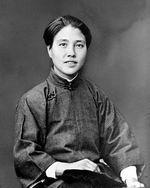
The Chinese Communist Xiang Jingyu was martyred on May Day of 1928.
The preeminent female cadre of her time, Xiang was the 16-year-old daughter of a merchant when imperial China fell in 1911. She came of age, and radicalized, in the tumultuous aftermath, becoming an early advocate for women’s liberation as an essential objective of the revolution. She also became the wife of Mao crony Cai Hesen.
Xiang made her mark with a seminal 1920 essay, published while studying in France, “A discussion of women’s emancipation and remoulding.” In it, “Xiang called upon women who had realized consciousness to form four organizations: a study and propaganda society, a free choice in marriage league, a student loan society, and public nurseries.” (Andrea McElderry, “Woman Revolutionary: Xiang Jingyu,” The China Quarterly, March 1986)
Returning to China the following year, she became one of the Communist Party‘s leading voices in the women’s section, where she dunked on bourgeois feminism (“The result of their efforts will be that the whole bunch of them will enter the pigsties of the capital and the provinces where together with the male pigs, they can preside over the nation’s calamities and the people’s misforturtunes”) and gained only halting traction campaigning for girls’ education and mobilizing female factory workers. Her dour and driven demeanor earned her the nickname “Old Grandma”.
Arrested by French soldiers in Hankou‘s French Concession, Old Grandma had no time for the captors who would betray her to the Kuomintang, and her own death. “I am Xiang Jingyu, a member of the Chinese Communist Party. You can kill me and cut me to pieces. I myself have no hope, but tens of thousands of Xiang Jingyus will rise up in my place.”
The present-day Communist Party esteems her a hero.
On the morning of this date in 1916, British Captain John Bowen-Colthurst ordered the summary execution of three Irish journalists in his custody: part of a still-notorious murderous rampage through Dublin amid the Easter Rising.
Bowen-Colthurst’s subsequent “insanity” skate has been a sore subject in the century since its predictable enactment.
The product of landed Anglo-Irish elites — his childhood manor, Dripsey Castle, still stands — had trotted the globe in service of the empire: the Boer Wars, India, Tibet, and the western front.
It’s the sort of background that should have made Bowen-Colthurst a calm hand in a tight spot.* Instead, the Easter Rising panicked him. Atrocities against Irish nationalists are not exactly surprising in the abstract here, but Bowen-Colthurst’s behavior in these hours was so erratic and violent that his men would remark that he had lost his head … although they strikingly never disobeyed his patently illegal orders.
At Portobello Barracks in Dublin, which in this week swarmed chaotically with off-duty leave soldiers reporting themselves for duty in the face of the armed insurrection, the Third Royal Irish Rifles’ commander was absent on sick leave and evidently took command discipline with him. “Captain Colthurst, although not the equal in rank of Major Rosborough, was the senior office in point of service and, according to all the evidence, considered himself at liberty to ignore his brother-officers,” Francis Sheehy-Skeffington’s widow explained.
Sheehy-Skeffington — a gentle pacifist affectionately known among antiwar socialists and the women’s movement as “Skeffy” — had been arrested on sight on April 25th, while out and about trying to dissuade looters. Bowen-Colthurst marched him out overnight as a human shield for a random patrol, and did not mind murdering before his eyes a passing young man caught out after curfew.
Proceeding along, Bowen-Colthurst grenades a tobacconist’s shop, mistakenly thinking that its owner, named Kelly, was Sinn Fein man Tom Kelly. In fact, the tobacconist Kelly was a loyalist, as were the two publishers that Bowen-Colthurst arrested at his place: Patrick McIntyre and Thomas Dickson.
Ignoring their protests, our unstable captain brought all three men back to the barracks. By morning’s light, he had decided on no authority but his own to have them executed.
“I am taking these prisoners out and I am going to shoot them because I think it is the right thing to do” was all the justification that he submitted. Later, he would say that he feared the prisoners would escape; that, believing that Germans were landing and revolutionaries were gunning down Black and Tans throughout Dublin, “I took the gloomiest view of the situation and felt that only desperate measures would save the situation.” So he shot the one guy who didn’t want to fight and two guys who were on his own team. According to later testimony, he would even order Skeffy to be re-shot upon being informed that the man was still moving several minutes after execution.
Still, the tilting captain had enough self-possession to openly worry to a brother-officer that he might have committed a hanging offense … and to actively conceal the evidence of it. Had events not been exposed by a courageous whistleblower, Sir Francis Vane, everything surely would have been obfuscated into the soupy fog of war. Embarrassingly compelled by Vane’s tattling to court-martial Bowen-Colthurst only to pass him off to an asylum (and later, to Canada), the brass took it out on Vane by terminating his career a few months later: “this officer was relegated to unemployment owing to his action in the Skeffington murder case in the Sinn Fein rebellion.”
Uproar at the Bowen-Colthurst affair had some interesting knock-on effects: for one thing, the naked impunity available to an officer at a time when enlisted men in France were being shot at dawn for minor disciplinary lapses might have contributed to the British command’s decision later in 1916 to permit the execution of a shellshocked lieutenant. And, an associate of the loyalist British commander in Ireland during the Easter Rising claimed that Sheehy-Skeffington blowback subsequently led to the execution reprieve granted to Eamon de Valera: that future president of independent Ireland just so happened to have his name “first on the list” when the matter came to a head.
Today, a visitor center at the former Portobello Barracks (now called Cathal Brugha Barracks) memorializes the three men executed there on April 26, 1916.
* We don’t mean to be cavalier about the psychological strains inflicted by violence. Bowen-Colthurst seemed to exhibit signs of shell shock in the trenches, whether due to the shells themselves or to having lost his younger brother in the war.
The victor, Thordr Kakali Sighvatsson, wisely offered leniency to his vanquished foes inducing many to swear oaths that helped Thoror cement his hold on the north of Iceland. But two chiefs are too many, and when Brandur was overtaken fleeing the battlefield, he was beheaded summarily. A crucifix erected in the 21st century now marks the spot.
On this date in 2004, Italian mercenary Fabrizio Quattrocchi was executed by Iraqi insurgents.
A former Italian army corporal turned baker, Quattrocchi (English Wikipedia entry | the vastly more detailed Italian) hired on with an American contractor in the Iraq fiasco as a private security guard at €8,000 per month, intending to save enough to start a family.
Instead, Quattrocchi was seized as a hostage outside Baghdad with three comrades on April 13, 2004, by the “Green Brigades,” one of that era’s many ephemeral bodies of militants. The other three* were held (and eventually freed unharmed via a June 2004 special forces raid) further to an unsuccessful ultimatum demanding Italian withdrawal. Quattrocchi, by contrast, was executed the very next day after capture — seemingly to prove that the kidnappers meant business after Italian Prime Minister Silvio Berlusconi greeted news of the men’s capture with a vow that he would never give in to “blackmail.”
A video of the murder was delivered to Al Jazeera TV, which has never aired it in its entirety. However, it became known via second-hand reports of those who had viewed it, and eventually from a partial airing of the video, that just prior to being shot Quattrocchi spat defiant last words to his executioners:
From the London Times, April 16, 2004.
Then he was shot dead,** and dumped in the grave he’d been forced to dig for himself.
Thanks to these last words, which Berlusconi and his foreign minister Franco Frattini immediately pinned to a bloody banner, Quattrocchi’s memory has been the subject of partisan rancor in Italy. The left has disdained to celebrate a gun for hire in a disastrous imperial foray; the right has honored his patriotism and conferred a medal of valor upon him in 2006 — arousing some protest since this recognition has not been extended to regular Italian soldiers who fell to terrorist attacks in Iraq, nor to less bellicose murdered hostages like Enzo Baldoni.
* The other captives were Salvatore Stefio, Maurizio Agliana, and Umberto Cupertino, all like Quattrocchi Italians in their mid-thirties. Stefio would later be prosecuted and acquitted for unauthorized recruitment of security contractors.
** About a month after Quattrocchi was slain by gunfire, the grisly beheading of hostage Nick Berg inaugurated a different epoch in Iraq’s stagey hostage murders.
Miraculously, Moguel survived their volley, and even survived the coup de grace shot to the head afterwards delivered by the squad’s commander.
Although badly disfigured, he managed to crawl away from the execution grounds and went on to live a full life with the nickname El Fusilado (“the executed one”). He died around 1975.
March 11, 222 marked the downfall of the Roman emperor Elagabalus (or Heliogabalus, in the Greek rendering).*
Notorious to posterity for lapping the field in outrageous sensuality, he was the 14-year-old cousin of the deposed brute Caracalla and stepped into the purple because his crafty grandma won the civil war that ensued Caracalla’s assassination.
By family heredity he was by that time already the high priest of the Syrian sun-god Elagabalus,** in the city of Emesa (present-day Homs, Syria). History has flattered the youth with the name of his novel god, although in life the former was simply Marcus Aurelius Antoninus. By any name, his eastern affectations would smell as foul to the Romans.
We’re forever constrained by the partiality of our few sources when it comes to antiquity and the possibility cannot be dismissed that the bizarre and alien portrait remaining us is mostly the outlandish caricature of his foes. However, such sources as we have unanimously characterize Elagabalus as — per Gibbon’s summary — “corrupted by his youth, his country, and his fortune” and it is this that has made his name a western metonym for for the sybaritic Oriental despot. (“I quote in elegiacs all the crimes of Heliogabalus,” patters the Modern Major-General of Gilbert & Sullivan canon.)
But in this they are not faithless to their sources. The ancient chroniclers practically compete for outlandish anecdotes of hedonism (the very dubious Historia Augusta) …
He would have perfumes from India burned without any coals in order that the fumes might fill his apartments. Even while a commoner he never made a journey with fewer than sixty wagons, though his grandmother Varia used to protest that he would squander all his substance; but after he became emperor he would take with him, it is said, as many as six hundred, asserting that the king of the Persians travelled with ten thousand camels and Nero with five hundred carriages. The reason for all these vehicles was the vast number of his procurers and bawds, harlots, catamites and lusty partners in depravity. In the public baths he always bathed with the women, and he even treated them himself with a depilatory ointment, which he applied also to his own beard, and shameful though it be to say it, in the same place where the women were treated and at the same hour. He shaved his minions’ groins, using the razor with his own hand — with which he would then shave his beard. He would strew gold and silver dust about a portico and then lament that he could not strew the dust of amber also; and he did this often when he proceeded on foot to his horse or his carriage, as they do today with golden sand.
Silius Messalla and Pomponius Bassus were condemned to death by the senate, on the charge of being displeased at what the emperor was doing. For he did not hesitate to write this charge against them even to the senate, calling them investigators of his life and censors of what went on in the palace. “The proofs of their plots I have not sent you,” he wrote, “because it would be useless to read them, as the men are already dead.”
Detail view (click for the full image) of The Roses of Heliogabalus, by Sir Lawrence Alma-Tadema (1888). The work alludes to one of the boy-emperor’s crimes of decadence recounted in the Historia Augusta: “In a banqueting-room with a reversible ceiling he once overwhelmed his parasites with violets and other flowers, so that some were actually smothered to death, being unable to crawl out to the top.”
Most scandalous to Romans, or at least most expedient for his foes’ vituperations, were the adolescent’s outrageous transgressions of masculinity — again, we must underscore, “alleged”. They’re clearly deployed by his enemies to magnify Elagabalus’s cultural easternness, and we might suspect them to also hint at the emasculating power of the teenager’s mother and grandmother who were the true chiefs of state (and who were outrageously admitted to the Senate). Yet if we are to believe the half of what we read of Elagabalus then this effeminate priest-king constitutes one of history’s most notable transgender or genderfluid figures.
When trying someone in court he really had more or less the appearance of a man, but everywhere else he showed affectations in his actions and in the quality of his voice. For instance, he used to dance, not only in the orchestra, but also, in a way, even while walking, performing sacrifices, receiving salutations, or delivering a speech. And finally, — to go back now to the story which I began, — he was bestowed in marriage and was termed wife, mistress, and queen. He worked with wool, sometimes wore a hair-net, and painted his eyes, daubing them with white lead and alkanet. Once, indeed, he shaved his chin and held a festival to mark the event; but after that he had the hairs plucked out, so as to look more like a woman. And he often reclined while receiving the salutations of the senators. The husband of this “woman” was Hierocles, a Carian slave, once the favourite of Gordius, from whom he had learned to drive a chariot. It was in this connexion that he won the emperor’s favour by a most remarkable chance. It seems that in a certain race Hierocles fell out of his chariot just opposite the seat of Sardanapalus, losing his helmet in his fall, and being still beardless and adorned with a crown of yellow hair, he attracted the attention of the emperor and was immediately rushed to the palace; and there by his nocturnal feats he captivated Sardanapalus more than ever and became exceedingly powerful. Indeed, he even had greater influence than the emperor himself, and it was thought a small thing that his mother, while still a slave, should be brought to Rome by soldiers and be numbered among the wives of ex-consuls. Certain other men, too, were frequently honoured by the emperor and became powerful, some because they had joined in his uprising and others because they committed adultery with him. For he wished to have the reputation of committing adultery, so that in this respect, too, he might imitate the most lewd women; and he would often allow himself to be caught in the very act, in consequence of which he used to be violently upbraided by his “husband” and beaten, so that he had black eyes. His affection for this “husband” was no light inclination, but an ardent and firmly fixed passion, so much so that he not only did not become vexed at any such harsh treatment, but on the contrary loved him the more for it and wished to make him Caesar in very fact; and he even threatened his grandmother when she opposed him in this matter, and he became at odds with the soldiers largely on this man’s account. This was one of the things that was destined to lead to his destruction.
Aurelius Zoticus, a native of Smyrna, whom they also called “Cook,” after his father’s trade, incurred the emperor’s thorough love and thorough hatred, and for the latter reason his life was saved. This Aurelius not only had a body that was beautiful all over, seeing that he was an athlete, but in particular he greatly surpassed all others in the size of his private parts. This fact was reported to the emperor by those who were on the look-out for such things, and the man was suddenly whisked away from the games and brought to Rome, accompanied by an immense escort, larger than Abgarus had had in the reign of Severus or Tiridates in that of Nero. He was appointed cubicularius before he had even been seen by the emperor, was honoured by the name of the latter’s grandfather, Avitus, was adorned with garlands as at a festival, and entered the palace lighted by the glare of many torches. Sardanapalus, on seeing him, sprang up with rhythmic movements, and then, when Aurelius addressed him with the usual salutation, “My Lord Emperor, Hail!” he bent his neck so as to assume a ravishing feminine pose, and turning his eyes upon him with a melting gaze, answered without any hesitation: “Call me not Lord, for I am a Lady.” Then Sardanapalus immediately joined him in the bath, and finding him when stripped to be equal to his reputation, burned with even greater lust, reclined on his breast, and took dinner, like some loved mistress, in his bosom. But Hierocles fearing that Zoticus would captivate the emperor more completely than he himself could, and that he might therefore suffer some terrible fate at his hands, as often happens in the case of rival lovers, caused the cup-bearers, who were well disposed toward him, to administer a drug that abated the other’s manly prowess. And so Zoticus, after a whole night of embarrassment, being unable to secure an erection, was deprived of all the honours that he had received, and was driven out of the palace, out of Rome, and later out of the rest of Italy; and this saved his life.
He carried his lewdness to such a point that he asked the physicians to contrive a woman’s vagina in his body by means of an incision, promising them large sums for doing so.
Some books about Elagabalus
The essential problem for Elagabalus was that regardless the precise reality of the behavior his sure cultural distance from Roman manners was also a cultural distance from Roman soldiers — the men whose power to arbitrate succession had placed him in the purple to begin with. The reader may hypothesize the direction of causality but Elagabalus’s historical reputation proves that he failed to bridge that distance.
The fickle Praetorian Guard soon harbored an accelerating preference for Elagabalus’s cousin and heir Severus Alexander, a moderate and respectable Roman youth. Elagabalus triggered his own downfall, and summary deaths meted out to his associates and hangers-on like the hated charioteer/lover Hierocles, with an ill-considered attempt to disinherit this emerging rival. For this narrative we turn to Herodian, a contemporary of events who has disdain for the emperor’s weird god and his “dancing and prancing” but is not nearly so colorful on the subject of his purported sexual depravity. (For Herodian, Elagabalus’s “mockery of human marriage” consists in taking and discarding several different wives, including a Vestal Virgin.)
the emperor undertook to strip Alexander of the honor of caesar, and the youth was no longer to be seen at public addresses or in public processions.
[11 or 12 March 222] But the soldiers called for Alexander and were angry because he had been removed from his imperial post. Heliogabalus circulated a rumor that Alexander was dying, to see how the praetorians would react to the news. When they did not see the youth, the praetorians were deeply grieved and enraged by the report; they refused to send the regular contingent of guards to the emperor and remained in the camp, demanding to see Alexander in the temple there.
Thoroughly frightened, Heliogabalus placed Alexander in the imperial litter, which was richly decorated with gold and precious gems, and set out with him for the praetorian camp. The guards opened the gates and, receiving them inside, brought the two youths to the temple in the camp.
They welcomed Alexander with enthusiastic cheers, but ignored the emperor. Fuming at this treatment, although he spent the night in the camp, Heliogabalus unleashed the fury of his wrath against the praetorians. He ordered the arrest and punishment of the guards who had cheered Alexander openly and enthusiastically, pretending that these were responsible for the revolt and uproar.
The praetorians were enraged by this order; since they had other reasons, also, for hating Heliogabalus, they wished now to rid themselves of so disgraceful an emperor, and believed, too, that they should rescue the praetorians under arrest. Considering the occasion ideal and the provocation just, they killed Heliogabalus and his mother [Julia] Soaemias (for she was in the camp as Augusta and as his mother), together with all his attendants who were seized in the camp and who seemed to be his associates and companions in evil.
They gave the bodies of Heliogabalus and Soaemias to those who wanted to drag them about and abuse them; when the bodies had been dragged throughout the city, the mutilated corpses were thrown into the public sewer which flows into the Tiber.
More detail on reprisals — not exactly dated — comes from Cassius Dio:
His mother, who embraced him and clung tightly to him, perished with him; their heads were cut off and their bodies, after being stripped naked, were first dragged all over the city, and then the mother’s body was cast aside somewhere or other, while his was thrown into the river.
With him perished, among others, Hierocles and the prefects; also Aurelius Eubulus, who was an Emesene by birth and had gone so far in lewdness and debauchery that his surrender had been demanded even by the populace before this. He had been in charge of the fiscus, and there was nothing that he did not confiscate. So now he was torn to pieces by the populace and the soldiers; and Fulvius, the city prefect, perished at the same time with him.
The History of Rome podcast covers Elagabalus in episode 104.
* As pertains the mandate of this here site Elagabalus’s death is far more a murder than an execution, while the actual and threatened executions surrounding this murder are not necessarily dated, and verge towards lynchings. But between them we have a patina of somewhat orchestrated state violence with a somewhat dependable calendar peg that will suffice for a worthy cheat.
** The deity Elagabalus was among several pagan forerunners of the later sun god Sol Invictus, whose cult in turn became eventually conflated with another strange Asian religion, Christianity. There is a reading (distinctly a minority one) of Elagabalus as Rome’s Akhenaten, an unsuccessful proto-monotheist traduced by the incumbent priests who defeated his before-his-time religious revolution.
† Cassius Dio was a senatorial historian which both positioned him to know the scandalous things he reported and problematically incentivized him to concoct scandalous things to report. In particular we should note that Elagabalus’s successor Severus Alexander was personally and politically tight with Cassius Dio and, the historian boasts, “honoured me in various ways, especially by appointing me to be consul for the second time, as his colleague, and taking upon himself personally the responsibility of meeting the expenditures of my office.” In reading Cassius Dio we read the party line of the post-Elagabalus regime.
Soviet spy Helene (“Leen”) Kullman was shot by the Germans on this date in 1943 … or was she?
Kullman (English Wikipedia entry | the much more detailed Estonian) was just out of teaching school when the Germans occupied Estonia. She joined the Red Army and was eventually trained as an intelligence agent, infiltrated by parachute behind German lines in September 1942, and arrested by the Gestapo in January 1943.
This is where things get interesting.
According to the Soviet hagiography that resulted in her decoration as a Hero of the Soviet Union in 1965, Kullman defied her torturers and was shot by them on March 6, 1943: a standard Great Patriotic War martyr.
However, stories in post-Soviet, and heavily anti-Soviet, Estonia have circulated to the effect that Leen Kullman wasn’t killed in 1943 at all — that she cooperated with her captors and ended up dying peacefully in West Germany in 1978. One family member allegedly received a cryptic message in the 1960s, “Leen lives with the man who saved her life, and has two children. I’m not allowed to say more.”
Almost everything about her available online is in Estonian; readers with that particular proficiency might also enjoy this 1965 radio interview with her sister.
On this date in 1291, Sa’ad al-Dawla, a Jewish physician become grand vizier, was put to summary death as his patron and protector Arghun Khan lay expiring on his deathbed.
The story has it that Sa’ad won the khan’s confidence by a successful medical consult, and then told the big guy all about the corruption of his courtiers.
This descendant of Genghis Khan* knew an able servant when he saw one and Sa’ad soon had charge of the empire’s finances — the latter not failing to exercise the patronage prerogatives of his office on behalf of his own kith and kin. For the khan, a Buddhist heir to steppe conquerors, he was an able man to make the caravans run on time and the treasuries burst with gold. The Muslim populace saw it a bit differently, as one Baghdad poet gibed:
The Jews of this our time a rank attain
To which the heavens might aspire in vain.
Their is dominion, wealth to them does cling,
To them belong both councillor and king.
O people, hear my words of counsel true
Turn Jew, for Heaven itself has turned a Jew!
We have seen many times in these pages that upstart administrators elevated by the caprice of the sovereign — Jews or otherwise — often risk an extremely perilous situation should their master predecease them. Sa’ad had resentment in proportion to his power … and when the khan fell ill, the former redoubled while the latter vanished.
Expediently accused of poisoning the dying Arghun Khan, Sa’ad was seized in the royal camp and given over to summary execution/murder. (Less exalted Jews in Baghdad faced a less exalted riot.)
* Arghun Khan’s grandfather Hulagu Khan was Genghis Khan’s grandson. Hulagu Khan has been seen in these pages, for he conquered Baghdad and executed the last Abbasid caliph in 1258.


 The preeminent female cadre of her time,


 Notorious to posterity for lapping the field in outrageous sensuality, he was the 14-year-old cousin of the deposed brute
 Kullman (