1789: Thomas Phipps the elder and Thomas Phipps the younger

From the Newgate Calendar (with thanks to frequent guest poster Meaghan Good of the Charley Project for the find):


These malefactors were father and son; and their final exit from this life was attended by circumstances of the most heart-rending and melancholy description.

The father was a man of good property, and lived on his own estate at Llwyney Mapsis, in Shropshire; and he and his son were indicted for uttering a note of hand for twenty pounds, purporting to be that of Mr. Richard Coleman of Oswestry, knowing the same to have been forged.

It was proved on their trial that Mr. Coleman never had had any transactions with Mr. Phipps that required the signing of any note whatever; that about the Christmas before, Mr. Coleman was served with a copy of a writ at the suit of Mr. Phipps the elder, which action Mr. Coleman defended, and for want of further proceedings on the part of the plaintiff, a non pros. was signed, with two pounds three shillings costs of suit against Phipps.

Upon this an affidavit was drawn up and sworn by Phipps the elder, Phipps the younger, and William Thomas, their clerk, for the purpose of moving the Court of Exchequer to set aside the judgment of non pros. and therein they swore that the cause of action was a note of the said Coleman’s for twenty pounds, which was given as satisfaction for a trespass by him committed in carrying some hay off the land of one of Mr. Phipps the elder’s tenants.

The Court thereupon granted a rule to show cause why the judgment should not be set aside; but Mr. Coleman insisting that the note was a forgery, the present prosecution was instituted against the father, son, and Thomas.

After a full hearing at the assizes at Shrewsbury, the father and son were pronounced “Guilty of uttering and publishing the note, knowing it to be forged;” and William Thomas was found “Not Guilty.”

Though convicted on the fullest evidence, the unhappy men, until the morning of their execution, persisted in their innocence; but when about to leave the jail, young Phipps made the following confession: “It was I alone who committed the forgery: my father is entirely innocent, and was ignorant of the note being forged when he published it.”

They were taken in a mourning-coach to the place of execution, accompanied by a clergyman and a friend who attended them daily after their condemnation.

On their way to the fatal tree the father said to the son, “Tommy, thou hast brought me to this shameful end, but I freely forgive thee;” to which the son made no reply. It being remarkably wet weather, their devotions were chiefly performed in the coach.

When the awful moment arrived, Mr. Phipps said to his son, “You have brought me hither; do you lead the way!” which the youth immediately did, and in the most composed manner ascended the ladder to a temporary scaffold erected for the purpose of their execution, followed by his father.

When their devotions were finished, and the halters tied to the gallows, this most wretched father and son embraced each other, and in a few moments the scaffold fell, and they were hand-in-hand launched into eternity, September the 5th 1789, amid a vast concourse of pitying spectators.

The father was forty-eight, and the son just twenty years of age.

On this day..

1783: William Wynne Ryland, court engraver

On this date in 1783, British engraver William Wynne Ryland hanged at Tyburn* before a throng of gallows-voyeurs such as “had not been seen on a like occasion since the execution of Dr. Dodd.” (Morning Chronicle and London Advertiser, Aug. 30, 1783)

“[H]is evil genius prompted him, for gold, to debase his talents in engraving,” the Newgate Calendar opined. “By one fatal act, he entirely ruined his reputation as a man: but his name as an artist will ever stand in the highest estimation.”

French- and Italian-trained, Ryland was a premier court artist in his day, noted for importing stipple engraving from the continent to England. He earned a royal pension for his portraits of Hanoverian elites.


Some Ryland portraiture, from the National Portrait Gallery: King George III and his queen, Sophia Charlotte.

Although Ryland’s first attempt to parlay his draftsmanship into a print-selling business had gone bankrupt in 1771, he does not seem to have been entirely neglected by the muse of business acumen, either. Over the subsequent decade he had discharged all his previous debts and stockpiled assets to the amount of £10,000. “I am rich beyond temptation,” he protested to the jurors who tried him for his life. The Crown could produce little in the way of an immediate motive for the forgery. (“It is impossible for us to penetrate so far into the heart of man as to know what his inducements are.”)

But lucre is its own motivation, and the facts of the case weighed heavily against Ryland.

He had come into (legitimate) possession of £200 bill of exchange issued by the East India Company and dated October 5, 1780. Somehow it transpired that Ryland then exchanged two copies of this bill — one on September 19, 1782 with the banker Sir Charles Asgill, and then once again on November 4, 1782 to a banking firm with the Dickensian name of Ransom & Co.

Both bills were identical to every inspection, with the same amount, date, and cheque number, and Ryland the expert engraver could give no convincing account of the second note’s provenance. In the public’s mind, the fact that he had fled the indictment and then dramatically attempted suicide when his capture was imminent surely cinched the case.

Ryland’s attempts to inspire in the jurors a sufficient doubt as to whether the East India Company might not have accidentally circulated two identical bills was fatally undone when it turned out that a difference between the two bills could be found after all — by the paper manufacturer, who proved to the court that the second bill was inscribed on paper whose watermark established that did not exist on its purported date of issue.

this sheet of paper was made at the mill, on that particular mould, it has a defect on it; on the 21st of January, 1782, of the same mould of which this note is now shewn me, I made this sheet of paper; there is a defect of the mould, either by an injury it has received, or in consequence of the quantity of paper made on it, the bill has the same defect; and there is likewise a defect which the bill has not, so that the sheet of paper on which the bill was written, was made from that mould. This could not happen in the same places, and situations in any two moulds.

The jury needed only half an hour to convict him.

By the Morning Chronicle and London Advertiser‘s account, he was London’s star attraction on his hanging day.

At half past nine a man on the steps of newgate called out, “Mr. Ryland’s coach,” upon which a mourning-coach, that was standing opposite the Sessions-house, drew up to the door of the prison, and in about two minutes after the unhappy man walked down the steps at a brisk pace, and entered the vehicle; presently after which [fellow condemned prisoner John] Lloyd went into another mourning coach. The Ordinary of Newgate, another clergyman, a gentleman in mourning, (said to be a relation of he convict’s) and a sheriff’s Officer, went in the coach with Mr. Ryland …

These coaches, which immediately followed the Sheriffs’ carriages, having drawn a few yards from the door of the prison, two carts were drawn up; [James] Brown, [Thomas] Burgess, and [John] Edwards were tied in the first, as was [James] Rivers in the last cart …

The gallows was fixed about 50 yards nearer the park wall than usual. About five minutes before 11 o’clock, Ryland’s coach drew on the right of the gallows, as did Lloyd’s on the left; and between them the cart; soon after which a violent storm of thunder, lightning, and rain came on, when the Sheriffs gave orders for a delay of the execution. When the storm had subsided, and some time had been employed in prayer, Rivers was lifted from one into the other cart, which backing to Lloyd’s coach, he alighted therefrom, and entered the vehicle, and after the ropes had been fixed about the necks of these unfortunate men, Ryland stepped from the coach to join his unhappy fellow sufferers. After a conversation of at least ten minutes between Ryland and Mr. Villette, Ordinary of Newgate, and the same time employed in an earnest discourse between Lloyd and Burgess, all the malefactors joined in singing the hymn, called, “The Sinners Lamentation”


Editor’s note: I’m not certain whether this is the hymn alluded to.

Ryland was the object that attracted the general attention, from Newgate to Tyburn, the sound that reverberated from every quarter, amidst the immense multitude was, “Which is ryland? There, that is Ryland in the first coach!” Exclusive of the usual accommodations, a vast number of temporary stages were erected; and gentlemens and hired carriages were innumerable. Some rooms, for accommodating private companies, were actually let at the enormous rate of from six to ten guineas.

Notwithstanding the vast press of the crowd, amidst the astonishing number of horsemen, carriages, and people on foot, we have not heard that any body was materially hurt, though many were forced down and trod on.

Ryland was in mourning, and wore a tail wig … Through the whole of this trying scene [he] conducted himself with remarkable serenity and fortitude, strongly indicating that he was prepared for, and perfectly reconciled to his fate.

The wheel of fortune turning against the mighty — especially when they should hazard their lives for a needless pittance — being irresistible to other artists, Ryland is the title character of a a comedic play.

* One of the very last hangings at Tyburn.

On this day..

1697: Three duty stamp counterfeiters

On this date in 1697, nine men hanged at Tyburn — all for property crimes.

Three were highway robbers. A fourth was a coiner. A fifth was a pickpocket. A sixth was a husbandman who stole a gelding.

The remaining three men, Thomas Houghton, Francis Cook and Francis Salisbury, operated a ring selling vellum paper bearing counterfeit sixpenny impressed duty stamps.

Their offense was against a 1694 levy titled “An act for granting to Their Majesties several duties on Vellum, Parchment and Paper for 10 years, towards carrying on the war against France”. This statute (full text here) imposed taxes of varying amounts for any number of a huge variety of officially-registered business. Routine commercial transactions now almost universally came with a rake for the taxman: “every skin or piece of vellum or parchment, or sheet of paper, upon which shall be ingrossed or written any indenture, lease, or deed-poll” had to be executed with a sixpenny stamp.

As a practical matter, such skins or pieces of vellum or parchment were sold pre-stamped, the stamp to be canceled by the parties in question when they signed on the line which is dotted. And it was this market that Houghton, Cook, and Salisbury exploited.

While counterfeiting the specie could be held to imperil the kingdom so dangerously to rate as treason, this trio’s “counterfeiting” was just everyday white-collar siphoning. By forging a bogus sixpenny stamp and applying it to sheafs of contract-ready vellum that they could sell at market rates, they got the revenue-agent’s cut — not the crown. (The scam is described in their Newgate Calendar entry, which inexplicably gives short shrift to Francis Cook.)

Though the “war against France” named by the stamp bill — the War of the League of Augsburg or the Nine Years’ War — had ended weeks before even the hangings we mark on this date, the lucrative levy long outlasted it. In the following century, England revived this type of tax often, notably in 1712 expanding it to encompass printed publications like newspapers and pamphlets. Hey, just require anything printed on paper to have a royal stamp on it — easy! This habit would eventually create the 1765 Stamp Act so obnoxious to North American colonists in the run-up to the American Revolution.

On this day..

1720: Edward Hunt, the first counterfeiter executed in colonial Pennsylvania

On November 19, 1720, Edward Hunt was hanged in Philadelphia. He was the only Pennsylvanian executed for treason prior to the American Revolution — that treason being not the betrayal of the state (in the sense we might think of it today), but counterfeiting.

In the bitterness of his scaffold speech, which disdains the customary acknowledge-my-guilt, pray-for-my-soul form of the genre to complain about his case, Hunt made plain that he was not reconciled to the justice men had rendered him.

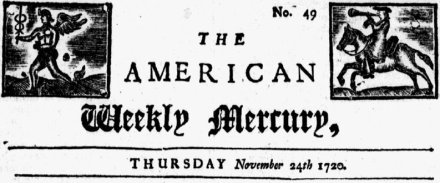
The American Weekly Mercury of Thursday, November 24 published “this extraordinary Piece” only with a preface complaining that “it is evident, that the following Speech was intended to misrepresent the Administration and Justice of this Government, as well as to infuse both ill Principles and Practices into the Minds of the People.”

The Dying Speech of Edward Hunt, formerly taken in Rebellion at Preston, and transported a bound Servant to the Island of Antigua, before his Execution upon the 19th Instant, at Philadelphia, where he had been legally convicted of High Treason, and most justly condemn’d for his Counterfeiting Spanish Silver Coin, made current* by Act of Parliament within all his Majesties Colonies in America.

It may be expected, that I should say some thing now concerning my Life and Conversation, which i must with Sorrow own to God and the Word has not been according to the Precepts and Principles of the Church, in which I was bred and educated: But with a sincere repentance and hearty Sorrow I do lament all the Errors of my past Life, firmly believing in my Saviour Jesus Christ, in whose Merits and ever flowing Mercy I do only trust for Salvation and Pardon, who has promised Eternal Life on no other Terms to the most Righteous upon Earth.

As to the Crime that now I suffer for in particular, I must own it is an Offence against the Laws, which I hope God will pardon me since he knows that I did not do it with any Design to cheat or defraud any one, or to make a Practice of Coining; but being ignorant of the Breach of any Laws of God or Man, I thought I might cut those Impressions as innocently as any other, or the Stamps that the Gentlemen of this place imploy’d me about, to make Farthings.** I am an English Subject, and desired to have the Privilege of the Laws of England, but it was not granted in any Point, except in Condemning me.

I am the first unhappy Instance of this kind that ever suffered in the King’s Dominions, pray God it may be a Warning to all, not to offend wilfully in the same that I did through Ignorance: For if I had known it, I would not have taken all the World to have done it. God give me a patient Resignation to submit to his blessed Will, in whatsoever he please.

I do heartily ask Forgiveness of all that I have offended in any manner of way, and do sincerely forgive all that have injured or offended me; particularly Mr. John Moore and Morris Birchfield, and the Evidence that swore against me in that Tryal. I do solemnly declare, That I know not any thing, or have been guilty of any one thing laid to my Charge in that Matter, or any of the other things laid to my Charge, by John Butler, either in England or Ireland.

I did petition the Honourable Governor for a Reprieve, until the King’s Pleasure was known concerning me, being I could not be tried by the Laws of England in all Points, as a Church of England Man ought to be: But it was a Privilege too great for me to obtain. Pray God to forgive them all, and every one that has a hand in taking away my Life any manner of way, and that my Blood be not required at their Hands, for they know not what they do. I am on Earth judged and condemned to die for the Breach of a Law of Man that was not duly published, which for that Reason I transgress’d it ignorantly, though the first that suffers for the Transgression of unknown Laws, or that was sentenced according to the Laws of England, without the Privilege of a Subject, which I desired of the Judge, which I know was not qualified by the same Laws to try me.

I do not know what Advantage there can be to any in my Death, and that I could not appeal to my King, neither before nor after my Tryal. I do not speak this because I am not in Charity with all the World, I do, from the Bottom of my Heart, forgive all in Obedience to my Saviour’s Command and Example, who suffered more for me, being innocent, and had not only done no Harm, but Good, and pray’d even for is cruel Persecutors and Murderers, and promised, That those that follow his Examples in this World by patiently enduring the Cross, shall reign with him to all Eternity: To Him therefore I commit all, an my poor Wife, beseeching him to help her, and be her Support and Comfort, and preserve her poor Soul free from the Polutions [sic] of the World, that through his precious Merits we may meet where we shall be both happy to all Eternity, in the merciful Arms of our dear Lord and Saviour Jesus, who I do beseech to receive my poor Soul.

According to Kenneth Scott’s Counterfeiting in Colonial America, Edward Hunt’s wife, Martha, got a £500 fine and a lifetime prison sentence for misprision of treason. (If that book is up your alley, Scott has an even more specific Counterfeiting in Colonial Pennsylvania.)

* Early colonial American commerce was severely hampered by a shortage of English/British currency. As a result, coins minted in Spain’s lucrative southern territories served as the colonies’ primary currency in the 17th and 18th centuries, particularly the iconic eight-real silver “pieces of eight”.

This is the reason why the currency of the present-day U.S. isn’t an “American pound sterling” but the almighty dollar: Dutch colonists had brought a coin called the leeuwendaalder to their former New Amsterdam (New York) province, the name deriving from the German thaler. As the pieces of eight corresponded to the thaler/daalder, it inherited the same name. Indeed, the “Spanish Dollar” remained legal tender in the post-colonial United States until 1857.

This is also the reason for reckoning of the eight constituent bits that comprised the dollar, and hence of the American colloquialism “two bits” to denote $0.25 … and, later, the adjective “two-bit” to man something cheap, mean, or small-time.

** They may have been Spain’s coins, but it’s wildly implausible that any Englishman could think he could counterfeit “innocently.”

On this day..

1690: An infanticide, a coiner, and a highwayman

Hanging day — and burning day, and drawing-and-quartering day — at Tyburn this date in 1690 saw a dozen souls condemned to shuffle off this mortal coil.

Nine of these were reprieved, mostly various shoplifters and thieves. (One, Constance Wainwright, was just 16 years old: she stole a silver teapot and a petticoat.)

Mercy Harvey — named only M– H– in her Old Bailey indictment — was a domestic servant and “a very Ignorant Silly Girle” who bore a son out of wedlock. A young woman in such a predicament in 1690 London could be liable to lose her position, and in a city swelling up daily with new arrivals there could be very far to fall indeed.

The Ordinary of Newgate devotes the most space in his account to her, suggesting that she was the most amenable of the condemned to his ministry. Mercy Harvey described to him a timeless predicament.

I discoursed with her, and ask’d, Whether she had any Promise of Marriage with him who begat it? She answered no. Or whether he did promise any Maintenance for herself? She replyed no: but by often soliciting her she yielded to his Desires. She said that when she proved with Child, she dispaired how to provide for it, and so Satan tempted her to expose the Child to Death.

The young woman confessed her crime on hanging-day, but in a state of near collapse, and she was “very sick, and unfit for Discourse.”

What added torture Harvey must have experienced with the rough hemp rope around her neck as the Ordinary with “unwearied industry” dilated to volley “all manner of Godly Exhortations” at her two male counterparts.

Thomas Castle and Thomas Rowland both refused to play their part, clinging by their obdurance to a last remnant of dignity or to fleeting extra moments of life.

Castle had suffered the added indignity of being dragged to the fatal tree on a sledge. Condemned a traitor under England’s bloody code for coining 50 counterfeit shillings (coin-clipping materials were found stashed up his chimney in an iron box), Castle was fortunate enough to have the disemboweling-and-quartering part of his sentence remitted.

The last character of the bunch was one of those stock characters of a passing age, the highwayman. Thomas Rowland had skipped out two decades prior on an apprenticeship in the exciting field of bricklaying and taken to the roads, where according to a colorful Newgate Calendar record he “always robbed in women’s apparel, which disguise was the means of his reigning so long in his villainy.” (But he made his getaways, we are assured, riding astride his mounts — not sidesaddle.)

We don’t know if Rowland caught any flak in Newgate for this abrogation of masculinity, but Rowland “was so abominably wicked that the very morning on which he died, lying in the Press Yard, for he wanted for no money whilst under confinement, a common woman coming to visit him, he had the unparalleled audaciousness to act carnally with her, and gloried in the sin as he was going to execution.”

On this day..

1812: William Booth, forger

On this date in 1812, William Booth was hanged at Stafford for counterfeiting.

Booth might have murdered his brother John, who was found beaten to death in a Warwickshire stable in 1808. He defeated that charge for want of evidence.

But he would not be two times lucky before the bar.

As a “farmer” living on 200 acres, he enjoyed the privacy to build his own mint, complete with forged royal stamps for churning out banknotes — more than enough cause to hang a man should he be caught, which Booth was. He was a difficult fellow to arrest, the Bury and Norwich Post reported (Aug. 19, 1812), because his farmhouse turned out to be “a little fort, full of trap-doors, and barred and bolted like a bastile.”

Booth’s engineering acumen might have come in handy for his executioners. As a broadside notes, the gallows Booth

ascended with a firm and steady step, but turned his back upon the populace almost immediately; after some time spent in prayer, the rope was adjusted, and a signal being given by the malefactor, (throwing his handkerchief from him that he was ready to submit to his fate,) the drop sunk, when, shocking to relate, by the cord slipping from the fatal tree, the unfortunate man fell from the top of the gallows upon the platform, a distance of eight or ten feet, where he remained motionless and insensible for some minutes.

The stunned prisoner was gradually revived, and redoubled his pieties. The fall must have rendered the noose unusable, because for some reason a delay ensued sufficient to stretch out the proceedings to two full hours, all of which Booth spent in the shadow of the gallows. Even when they finally had him trussed up and ready to hang again, they needed a do-over: Booth once more dropped his handkerchief, but the drop embarrassingly failed to dislodge. Booth, who had twice prepared himself to walk to the brink of death only to twice survive, asked for his handkerchief back once the apparatus had been fixed so that he could re-drop it.

Having faced two capital trials, and two executions, Booth couldn’t even get buried right on the first time. Apparently a re-drawing of the county line required his remains to be exhumed and re-interred, giving rise to a ballad, “Twice Tried, Twice Hung, Twice Buried”.

(Although this version proposes twice hanged and once drowned: suffice to say, Booth lived an interesting death.)

On this day..

1327: Adso’s lover in The Name of the Rose

On an unspecified date presumably around early December of 1327 — the timeframe is approximated by action’s story’s commencing on “a beautiful morning at the end of November” — the Inquisition burns the nameless peasant lover of the narrator in Umberto Eco’s novel The Name of the Rose.

Adso of Melk is apprenticed to the scientific-minded William of Baskerville — a deliberate allusion to Sherlock Holmes — when the monk is dispatched to an Italian monastery to sniff about for heresy.

The Name of the Rose unfolds a labyrinthine murder mystery around a literal labyrinth (a maze-like library) as William and Adso fight crime and the superstitious dogmatism of the Church. Well … William fights these things. Young Adso mostly comes along for the ride and keeps the action signposted for the reader with his cluelessness.

As a teenage boy, Adso has his own demons to confront.

During their short stay at the monastery, Adso has a chance, and scorching, sexual encounter with a peasant girl from the lands owned by the monks. This subplot intersects with a relentless Inquisitor — the real-life historical figure Bernard Gui* — in pursuit of refugee Dolcinians and other heretical types who were actually running around northern Italy at this time.

The long and short of it is that the girl is condemned to the stake as a sorceress on ridiculous circumstantial evidence that the reason-favoring duo is in no position to repel, and that Gui is eager to trump up further to politically muscling Dolcinian-friendly monks.

The very watchable 1986 cinematic adaptation of the novel, starring Sean Connery as Brother William and Christian Slater as Adso, takes some liberties with Eco’s text on the matter of the girl.

In the novel, her execution happens “off-camera” but with a numbing certitude; it’s an evil in the world that no protagonist can prevent, and Adso just has to get used to the idea.

I was tempted to follow her … William, grim, restrained me. “Be still, fool,” he said. “The girl is lost; she is burnt flesh.”

Directly after convicting the girl for witchcraft, and nabbing two heretical monks in the process, Gui departs the convent towards the papacy’s then-residence at Avignon for a gratifying show trial. The monks are the real prize; Brother William prophesies that the girl

will be burned beforehand, along the way, to the edification of some Catharist village along the coast. I have heard it said that Bernard is to meet his colleague Jacques Fournier (remember that name: for the present he is burning Albigensians, but he has higher ambitions), and a beautiful witch to throw on the fire will increase the prestige and the fame of both.

The smitten Adso is heartbroken over this cruelty.

“So the cellarer was right: the simple folk always pay for all, even for those who speak in their favor … who with their words of penance have driven the simple to rebel!”

The only sure thing was that the girl would be burned. And I felt responsible, because it was as if she would also expiate on the pyre the sin I had committed with her.

I burst shamefully into sobs and fled to my cell, where all through the night I chewed my pallet and moaned helplessly, for I was not even allowed — as they did in the romances of chivalry I had read with my companions at Melk — to lament and call out the beloved’s name.

This was the only earthly love of my life, and I could not, then or ever after, call that love by name.

The film indulges a happier and very implausible fate for Adso’s hot little number: in this version, the executions take place on-site at the monastery, and other peasants riot, murder the Inquisitor, and free our oblate’s muse. Hey, in a work that’s all about faith, why not a little deus ex machina?

Warning: Spoilers The Name of the Rose is a detective story, and the clips below intercut the execution scene with the mystery’s big reveal. Don’t watch them if you want to approach the film or the book without knowing how it all plays out.

The movie’s softhearted approach has the benefit of allowing a more cinematic and literal presentation of Adso’s choice between the life of the mind/soul and the life of the flesh. The clip below is spoiler-safe, since you already know which one he chooses.

To geek out on this book’s complex tapestry of allusions, you could do worse than this archived study guide.

* Played by F. Murray Abraham in the film. Gui wrote a notable tract on examining heretics; dust off your Latin to read it on Google books here, or get the gist with this English-translated excerpt.

On this day..

1773: David Reynolds, colonial counterfeiter

On Friday the 17th Instant at Morris Town in East New Jersey, was executed, David Reynolds, a Native of Ireland, about 32 years of age, for counterfeiting the money Bills of Credit of that Colony. He arrived there about ten Years ago, and chiefly followed the farming business, till getting acquainted with one Rosecrans (executed some time ago for the like Crime, but without declaring his Accomplices) he was by him led into the Scheme of making and passing counterfeit Money; after the Execution of Rosecrans, Reynolds accidentally met with Capt. Richardson (of Philadelphia, who is fled) and getting acquainted with each other’s Characters, was by him introduced to Ford, Haynes, Cooper, Budd, King, and the rest of the Gang. Ford the Principal, termed by the Rest, the Treasurer of the three Provinces, had counterfeited the Money Bills of New York, New-Jersey, and Pennsylvania, in so Masterly a manner as not to be distinguished from the true Bills without the nicest Inspection, and also several of the Gold and Silver Coins current in the British Colonies: and in passing these, Reynolds and the Rest of the Accomplices continued, till Ford and King were apprehended and imprisoned in Morris County Gaol, from whence they soon made their escape, as mentioned in the Papers.


Paper currency of colonial New Jersey.

One of the Gang being convicted of aiding them in their Escape and other high Misdemeanors, to mitigate the Punishment, made some Confessions tending to the Discovery of the Rest, which alarmed another, who made an ample confession of the whole, in Consequence of which Reynolds, Haynes, Cooper, and Budd, were tried, confessed their Guilt, and were condemned to be hanged. Their Execution was ordered to be on the 17th Instant; before that Time, Budd and Haynes were respited for a Month, but Reynolds and Cooper were ordered to prepare for Execution at the Time appointed. A few Minutes before the Time, Cooper confessed himself privy to the Robbery of the Treasury at Amboy, and that he received Three Hundred Pounds of the Money; on which he was also respited till he should make further Discoveries. Reynolds was therefore ordered for Execution alone, at which he seemed much affected and burst into Tears, but thro’ the Assistance of a Minister who attended him, he grew Calm, and resigned to his Fate. His Behaviour during his Confinement and after his Sentence, was penitent and submissive; he shewed a proper Sensibility of his unhappy Situation, and earnestly exhorted his Companions in Guilt, to a sincere Repentance. On the fatal Day, he took an affecting Leave of them; and they all discovered the most lively Expressions of that Distress to which their Crimes and Follies had reduced them, which drew Tears from the Eyes of the Spectators. At the Place of Execution, Reynolds sung and prayed very earnestly, and in a short but pathetic Speech, warned the People to avoid the Vices that had undone him, and earnestly requested them not to reflect on his innocent Wife and helpless Infants.

The New-York Gazette; and The Weekly Mercury, September 27, 1773

All the other three reprieved ultimately escaped hanging, owing to influential connections.

On this day..

1797: Gracchus Babeuf, for the Conspiracy of Equals

If the “revolutionary extremist” exists at all as an identifiable type, he exists in purest incarnation in Gracchus Babeuf. No revolutionary better fits the description “narrowminded to the point of genius”; few have defined their heaven more clearly or crusaded so fanatically, ascetically, so religiously to bring it to earth.

Gracchus Babeuf: The First Revolutionary Communist

On this date in 1797, Francois-Noel Babeuf lost his head for the Conspiracy of Equals — the last Jacobin upheaval of the French Revolution, or the first Communist upheaval of post-Revolution modernity.

Francois-Noel — he styled himself “Gracchus” after the populist Roman tribunes — was a young man of Desmoulins‘ generation but from a considerably more hardscrabble background. Like the starry-eyed Dantonist scribbler, Babeuf discovered himself a brilliant journalist and pamphleteer with the onset of the Revolution; he did several prison stints during various revolutionary phases of the early 1790s for his too-radical-for-school opinions.

He did another in 1795 under the French Directory for his firebreathing rag Le Tribun du Peuple, which was particularly unfashionable stuff during the post-Robespierre Thermidorian regime.

Nothing daunted, Babeuf emerged from prison the leading apostle of the Parisian proletariat which had by then been decisively separated from power.

The order of the day was class consolidation with the spoils of the aristocracy apportioned among a new oligarchy of wealth. As France rushed headlong towards Bonaparte and Bourbon restoration, Babeuf was the man left to rally “the party which desires the reign of pure equality.”

The French Revolution was nothing but a precursor of another revolution, one that will be bigger, more solemn, and which will be the last.

The people marched over the bodies of kings and priests who were in league against it: it will do the same to the new tyrants, the new political Tartuffes seated in the place of the old.

Manifesto of the Equals, 1796

One can see why later revolutionaries — Marx included; Babeuf makes a cameo in the Communist Manifesto — would adopt this sort of thing as a harbinger of the next century’s revolutions.

And if the Directory had known who Nicholas II would be, it would have had no intention of going the way of his family.

Instead, it shut him down in February, 1796: Napoleon Bonaparte personally carried out the operation, just days before he wed Josephine.


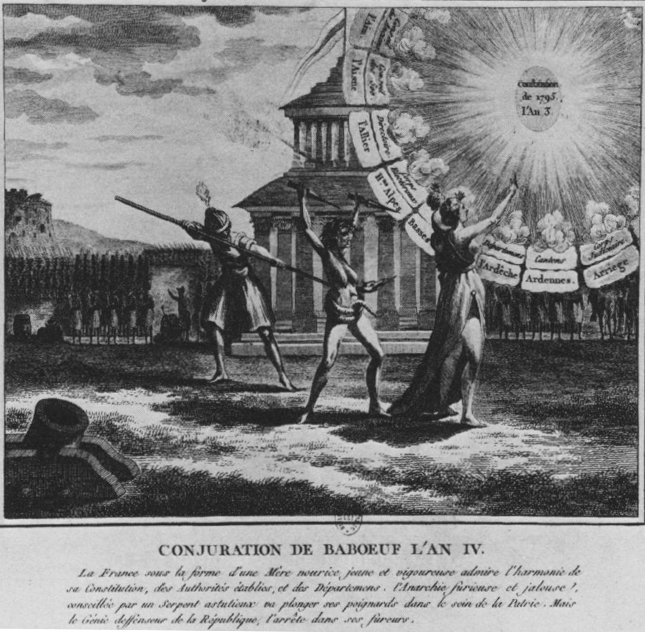
The Babeuf Conspiracy. Anonymous French print.

Babeuf’s party comes down to us as a “conspiracy,” under which word the state would charge him and which his follower Philippe Buonarroti would later rebrand the “Conspiracy of Equals”. It was not so much a grassy-knoll type of conspiracy as it was an underground organization.

When its adherents placarded Paris with the seditious “Analysis of the Doctrine of Babeuf” as the city endured a potentially dangerous economic crisis in April 1796, the government was put to a test of its strength.

It passed.

Having infiltrated Babeuf’s network, it arrested the principals on the eve of the Conspiracy’s intended insurrection. They were hailed out of Paris (a safeguard against sympathetic risings) to the commune of Vendome and there put on trial.* Babeuf and his associate Augustin Alexandre Darthe were condemned to death on May 26th and guillotined the very next day.

The last gasp of the French Revolution dropped with their heads into the basket.

Revolutionary Babeuvism, however, had scarcely just begun.

I don’t know what will become of the republicans, their families, and even the babies still at their mothers’ breasts, in the midst of the royalist fury that the counter-revolution will bring. O my friends! How heart-rending these thoughts are in my final moments! … To die for the fatherland, to leave a family, children, a beloved wife, all would be bearable if at the end of this I didn’t see liberty lost and all that belongs to sincere republicans wrapped in a horrible proscription.

-Babeuf’s last letter to his family

* The trial of Babeuf was itself a jurisprudential milestone: it was the first French trial to be transcribed verbatim.

What might look today like a nifty little advance for efficient judicature was bitterly controversial in 1797. The French Revolution had overturned an ancien regime practice of professional magistrates accepting legal testimony by written deposition and deciding matters behind closed doors. The liberte, egalite, fraternite way would instead demand that testimony be given live in the courtroom where citizen jurors could weigh its credibility.

Babeuf’s lawyer, Pierre-Francois Real, protested against the court stenographers, arguing that “The law insists that the system of written depositions not be restored in any way. That system will undoubtedly return if any means are used to save testimony given orally.”

There’s a fascinating disquisition on the curious and contradictory development of this issue and the way it “violates … common assumptions about the advance of textuality in the West” during the French Revolution in Laura Mason, “The ‘Bosom of Proof’: Criminal Justice and the Renewal of Oral Culture during the French Revolution” The Journal of Modern History, March 2004.

On this day..

1699: William Chaloner, Isaac Newton’s prey

(Thanks to Thomas Levenson of the Inverse Square Blog. Prof. Levenson is head of the Graduate Program in Science Writing at MIT, and author of the forthcoming Newton and the Counterfeiter.)

Early in the morning of March 22, 1699, William Chaloner raged.

Chaloner, a convicted coiner, refused the Newgate Jail Chaplain’s plea to show proper penitence, shouting with “more Passion than Piety,” of his wronged state and unmerited destination (according to his anonymous biographer in the one surviving account of his life). In time, he calmed sufficiently to accept the sacrament, and so proceeded to the execution convoy to be borne from Newgate to the hanging tree at Tyburn (now Marble Arch, just to the west of the old City of London).

There Chaloner’s fury mounted again, and he shouted to the crowd, drawn as always to the spectacle of public hanging days, that “he was murder’d … under pretence of Law.” He mounted the ladder to the top of Tyburn’s gibbet. He prayed, and then pulled the hood over his eyes without aid. When the moment came, the executioner’s men pulled the ladder out of the way and Chaloner dangled, twitching and jumping (the “hangman’s dance”) as long as it took –- minutes, at least — for life to choke out of him. Richer men often paid the hangman to pull on their legs to speed death. Not the destitute Chaloner. He had to choke till he drooped, to the greater amusement of the crowd.

The investigator who had sent Chaloner to the noose was not present; or at least nowhere in his copious notes and letters did he admit to curiosity about the fate of a man whose pursuit occupied him for almost three years. The Warden of His Majesty’s Mint had more pressing duties to perform, and so Isaac Newton allowed the date of Chaloner’s death to pass unmarked.

Isaac Newton? That Newton?
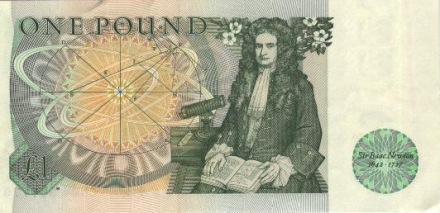

Appropriately, Newton himself wound up on the currency.

The accidents of place and time that brought the man who was recognized in his own day as the greatest mind of the age into conflict with Chaloner, an uncommonly gifted common criminal have fascinated me since I first learned of them through reading Chaloner’s last, piteous letter to the implacable Newton, written days before the hanging. In it Chaloner begged, writing “O dear S[i]r nobody can save me but you O God my God I shall be murderd unless you save me.”

What I wanted to answer was the obvious question: how and why did Isaac Newton come to pass judgment on the life of any other man? I had always thought of him as the nearly cloistered scholar of Trinity College, Cambridge, his home for more than thirty years. It was there he performed the experiments and the calculations that led him, in 1687, to write his masterwork, Philosophiae naturalis principia mathematica the Mathematical Principles of Natural Philosophy — better known simply as the Principia -– as well as pursuing his decades-long program of alchemical research.

So how, I wondered, did he end up in London, wallowing in the muck with the capital’s criminal underground?

Not to put too fine a point on it, finding out has turned into a book Newton and the Counterfeiter, published by Houghton Mifflin Harcourt and scheduled for release on June 4. But, to anticipate that longer story, here is the gist: Newton, after Principia found himself an international celebrity, and, as one of Cambridge University’s representatives to the Convention Parliament of 1689 that legitimized William of Orange‘s seizure of the English throne from the deposed Stuart King James II, he had nearly a year to enjoy the acclaim of London and Europe’s thinking and political elites before returning to the quiet of Cambridge, then a small town of about 5,000 inhabitants. It was an intellectual backwater too, especially compared to the big city in which he encountered figures like Robert Boyle, John Locke, Robert Hooke (whom he despised), Samuel Pepys (whom he did not) and so on. So he started, with Locke’s help, to seek a patronage appointment that would allow him to live comfortably in London. It took six years to find the right one, but ultimately he was offered the Warden’s post at the Mint. That job was supposed to be a sinecure, a nearly no-show position that would pay him a very comfortable wage.

And so it would have turned out were it not for the terribly debased state of England’s silver coinage, which had deteriorated to about half its legal weight for a whole host of reasons. So Newton arrived at a time when (a) the Mint was attempting to recall and recoin the entire stock of silver money for the entire country –- all the smaller units of money essential to everyday transactions –- and (b) coining, counterfeiting, was flourishing as enterprising men and women set out to get rich by filling in the gaps in the money supply with coins that never felt the stamp of an official Mint die. As Warden, it became Newton’s duty to see that legal money was produced fast and fairly, and to pursue all those who set up on their own.

Of those who did none were more technically skilled or ambitious than William Chaloner. His is a fascinating story, told at much greater length in my book, in which you see the currents of rapid economic change, class and ambition all converge within this one, barely remembered life. He was born desperate poor, a weaver’s son in Lincolnshire. He ran from his first apprenticeship to London, where he started out at the very bottom of the criminal ladder, hawking porn on street corners. He rose rapidly, first with his clearly impressive gift of gab, and then, after falling in with someone who knew how to gild surfaces, as the central figure in a series of ever grander schemes to counterfeit gold and silver money. He had sidelines as an informer, betraying conspiracies that he would himself set up, but his central gift and fascination was in the creation of fakes. Ultimately, he was one of the first to recognize the power of paper, and he started to counterfeit a variety of the early experiments with paper money and bank instruments.

In this sense Chaloner’s career –- and Newton’s urgent pursuit of him –- offer a window into the birth of the modern idea of money, of finance. And one of the things that fascinated me about this case is the degree to which this old story tracks some of our immediate problems. England’s and Europe’s economies were in rapid revolution in the late seventeenth century. The old idea of money as a chunk of metal with a pretty picture on it could no longer come close to accommodating the kind of enterprises governments and individuals wanted to undertake, from war to the funding of global webs of trade. And so people came up with all kinds of different ways of trying to represent value and exchange and even the idea of the changing worth of an investment over time. And the people making these experiments did not fully understand the implications of each expedient they tried. The last piece of paper Chaloner counterfeited was called a Malt Lottery Ticket, and it was at once simply paper money, a bond, and a gamble. Traders attempted to value these kinds of things in embryonic financial markets -– which would in a couple of decades blow up in a financial collapse that possess some striking similarities to our current predicament. Newton himself would lose a considerable fortune in that collapse, a sum worth a couple of million pounds, maybe more, in 21st century money.

It was that sense of precariousness that made the pursuit of counterfeiters so urgent in the midst of the late 17th century; England’s money supply was genuinely at risk, and no one had a good grasp of what it would take to make both the daily experience of small transactions and the high finance of war and trade go smoothly. So anyone threatening either or both levels of money was public enemy number one.

Of those who tried their hand at currency crime, Chaloner was the most accomplished, and notorious. By his own admission he counterfeited on the order of 30,000 pounds worth of currency over a seven- or eight-year career, an enormous fortune for the day. His big mistake, though, was to challenge Newton directly, accusing him in public of incompetence or fraud in his management of the recoinage of silver money between 1696 and 1698. He laid that charge both in testimony to Parliament and in a pamphlet he had printed for public distribution, and the scandal could genuinely have wounded Newton, were it not for the influence of his friends in power in Parliament at the moment.

It was enough, certainly, to propel Newton into an extraordinary investigation, an exercise of what may be seen as true non-fiction scientific detection. He set up a net of agents and informers throughout the worst neighborhoods and pubs in London, tracking any instance of coining he could find, interrogating suspects at the Tower or in jail, trying to build a web of connections around Chaloner. That story is contained within a collection of several hundred depositions and summaries of interrogations, all signed by Newton, that have survived, largely unexamined until now. Those records show that it took Newton almost two years in all, but aided in the end by listeners whose lives he held at his disposal inside Chaloner’s cell at Newgate, he managed to collect a sufficient weight of testimony to ensure that he could convict a prisoner clever enough to have escaped several previous attempts at prosecution.

The trial itself was something of a sham. Chaloner had feared being charged on the Malt Lottery Ticket forgery, (as we know from the accounts in Newton’s files of informers in the cells) but Newton actually presented evidence of a coining spree that almost certainly did not take place as described. Among other confounding facts, Chaloner was supposed to have made six different denominations of both silver and gold coins in a single day, which would have involved an enormous confusion of tools and materials that ran counter to basic counterfeiting practice.

No matter: the sheer volume of precise detail that Newton’s witnesses were able (or convinced) to provide produced a conviction within a very short time –- the whole trial took no more than an hour or so on March 3, 1699. There was a truncated appeal process -– really just a request for clemency from the crown, which was denied, and Chaloner’s sentence came down.

Formally, he had been found guilty of high treason, an assault upon the crown in the form of the king’s likeness and authority represented on the face of England’s coins. The punishment for high treason was essentially that suffered by William Wallace of Braveheart fame: to be strangled to the point of death, to be disemboweled whilst still living, to be beheaded and then quartered. By the date of Chaloner’s execution, the punishment had eased this far: convicted coiners were drawn to the place of execution on a rough sledge, subject to all the filth and abuse London’s open-sewered streets possessed; then hung until dead, and then, on rare occasions, to suffer post-mortem dismemberment. Chaloner himself was not, so far as any records revealed, actually cut into pieces. (As a gesture to public decency, women convicted of coining or other capital crimes were not supposed to be hung, lest their twitching at rope’s-end seem lewd. So they were burnt instead – though by the eighteenth century it was common to strangle them to death before lighting the pyre. Mercy, after the fashion of the times.)

Levenson lectures on his book at the MIT Writer’s Series.

One last note in a post gone much too long: Newton was involved in a number of counterfeiting investigations, and by some reckonings at least two dozen people went to their deaths as a result. Some historians, notably Frank Manuel, have speculated that Newton pursued this work with implausible eagerness, out of a kind of frustrated blood lust born of his abandoned and unhappy childhood.

This seems to me to be nonsense. The specific historical context matters here: Newton did not author the bloody code, nor did he send everyone he could to the gallows. Rather, the record of his depositions shows him to be simply a relentless practical man doing his job. He used little fish to catch big fish, and at least some of those low on the ladder received their escape from the gibbet. What you can see here, surprisingly, is the birth of a modern idea of a civil service. The Warden -– even Isaac Newton — was simply a man in a job doing the functions of that job, which included organizing the investigation and prosecution of counterfeiters.

What’s striking, of course, is that this civil servant, this bureaucrat, happened to possess the greatest scientific mind in history. And that’s the real sting in this tale. There is a connection between Newton’s pursuit of counterfeiters and his attempts to understand nature. He did employ the same resources of concentration and logical organization in his criminal investigations that he did when he tackled any problem. But more than the commonality of work habits, there is, I think this link: Newton can be seen as many people: the mathematician, the theoretical physicist, the empirical experimentalist, the alchemical mystic, the heretically devout religious thinker –- and the government functionary too.

And yet he was, of course, a single man, one with many interests, but ultimately with a consistent ambition, to reduce to order the complexity of any problem which was posed to him. Newton did not expect as Warden to have to chase crooks; when he found out that was part of the job he wrote a rather whiny letter to the Treasury to see if he could wriggle out of the duty. When he found he could not, he responded as he always had to the job at hand.

As one consequence, on this day three hundred and ten years ago, William Chaloner died.

On this day..