1849: Anna Koch of Appenzell

This date’s pastoral story of adolescent avarice — and impressive disobedience at the scaffold — comes to us from the tiniest of Swiss cantons,* as related in this public-domain text


Anna Maria Koch and Magdalene Fessler were girls — each about seventeen years of age — living in Gonten in the year 1849. On June 12 of that year the dead body of the latter was found lying in a ditch in one of the village pastures. There were upon it no marks of violence, and a coroner’s jury was led to conclude that the girl had come to her death by falling into the ditch in the dark. A little later, the discovery was made that on June 10 Anna Koch had sold to a silversmith in Gonten a chain, a locket, and a rosary. These articles on examination were proved to have belonged to Magdalene Fessler. Anna Koch was placed under arrest and asked to make explanation. The story related by her is as follows: –On the Sunday following Frohnleichnamsfest she met Jean-Baptiste Matezenauer, a young man of the village, and he gave her the articles of jewellery, saying that he had found them. He told her that she must sell the things and put the money in a bag which she was to hide in a field. She must then take with her a friend, stroll through the field and, as though by chance, spy the bag, pick it up and say, “Oh! I have found something!” With the money she was to buy a wedding dress, Matzenauer promising in a short time to marry her. Matzenauer was arrested and confronted with his accuser. He protested innocence, but the girl adhered to her story. She did even more, she enlarged upon it. She said that on the morning of Frohnleichnamsfest she had been in Matzenauer’s company; that he had then told her he meant to kill Magdalene Fessler in the afternoon, and had asked her to station herself in the field where the ditch was. This, she said, she had done, and that while there she saw Matzenauer drag thither the body of his victim. Despite the inherent improbability of her whole account, the girl vehemently reiterated it, each time challenging Matzenauer to a denial. At last the bewildered inquisitorial fathers before whom the examination was being conducted — perhaps with some recollection of the efficacy of torture in eliciting actionable testimony in the case of Landamman Suter — ordered Matzenauer to be brought under the lash. This was done, but without the hoped-for result. Matzenauer remained obdurate.

The case dragged on till November 13. It was then suddenly terminated by the confession of Anna Koch that she alone had planned and committed the murder. The details of the confession were substantially these: –She, a poor girl, had for a long time felt hurt in pride that she had not the money with which to provide herself the chains and trinkets commonly worn by the girls of her acquaintance. So keen was this feeling that finally she resolved to purchase a chain from one of the silversmiths of Gonten and trust to fortune to enable her to pay for it. She obtained the chain, but failing to pay for it by the time agreed on with the silversmith, was asked to return it. The necessity of doing so was fully impending when, on Frohnleichnamsfest, she met Magdalena Fessler in the churchyard, at the beginning of afternoon service. The latter had about her neck a beautiful chain, and Anna Koch, seeing it, was prompted to kill her, take the ornament, sell it, and with the money realised meet her own debt to the silversmith. She told her friend that she had lost her rosary, and asked her to go with her to find it. The two girls walked on together, soon passing into the field containing the ditch. As they were crossing the latter on a plank Anna Koch pushed Magdalene Fessler, causing her to lose her footing and fall into the water. She then jumped into the ditch herself, seized the head of her victim and, holding the mouth open with her fingers, kept the head under water until death ensued from strangulation. Having made her confession, Anna Koch asked that she might suffer the extreme penalty for her crime. Young people of her acquaintance petitioned the Great Council for a pardon. This was refused, the vote standing only six for pardon and ninety-six for punishment. Decree was then entered that the guilty one be beheaded on the block.

The day before that fixed for the execution (the latter being December 3) the condemned girl spent quietly in prayer and in communion with her confessor. She expressed herself as being entirely reconciled to her fate and, in fact, as anxious to meet it. But when led forth on the day of execution, her manner changed. The wild instincts of her Appenzell nature reasserted themselves. She declared that she could not and would not die, and with fierce cries drowned the voice of the officer who read her death-warrant before the people. The reading finished, four strong men seized the girl and bound her on a sled. Thus secured she was dragged to the headsman’s block in the market-place. But here a fresh difficulty was encountered. On being released from the sled her struggles were so frantic and determined that the executioner could not perform his task. After several vain attempts he sent the Reichsvogt (the same mediaeval official personage that had figured at the execution of Dr. Anton Leu and Landamman Suter) to report the situation of affairs to the Great Council and ask advice. The reply returned was that the headsman must do his duty. After an hour and a half of cries and resistance on the part of the condemned, her head was firmly secured to the block by the braids of her hair, and the fatal stroke given.
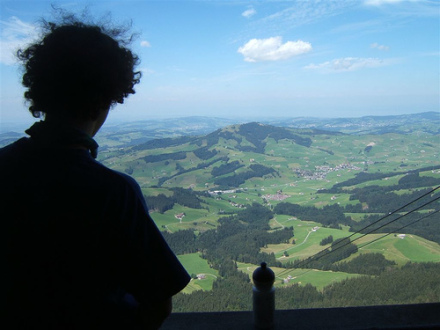

Gonten (it’s the long collection of buildings along the valley road, at the base of the slope) and environs. (cc) image from Michael Beat.

* Appenzell Innerrhoden is the smallest canton by population, and is larger by area only than the urban canton of Basel-City.

On this day..

1327: Adso’s lover in The Name of the Rose

On an unspecified date presumably around early December of 1327 — the timeframe is approximated by action’s story’s commencing on “a beautiful morning at the end of November” — the Inquisition burns the nameless peasant lover of the narrator in Umberto Eco’s novel The Name of the Rose.

Adso of Melk is apprenticed to the scientific-minded William of Baskerville — a deliberate allusion to Sherlock Holmes — when the monk is dispatched to an Italian monastery to sniff about for heresy.

The Name of the Rose unfolds a labyrinthine murder mystery around a literal labyrinth (a maze-like library) as William and Adso fight crime and the superstitious dogmatism of the Church. Well … William fights these things. Young Adso mostly comes along for the ride and keeps the action signposted for the reader with his cluelessness.

As a teenage boy, Adso has his own demons to confront.

During their short stay at the monastery, Adso has a chance, and scorching, sexual encounter with a peasant girl from the lands owned by the monks. This subplot intersects with a relentless Inquisitor — the real-life historical figure Bernard Gui* — in pursuit of refugee Dolcinians and other heretical types who were actually running around northern Italy at this time.

The long and short of it is that the girl is condemned to the stake as a sorceress on ridiculous circumstantial evidence that the reason-favoring duo is in no position to repel, and that Gui is eager to trump up further to politically muscling Dolcinian-friendly monks.

The very watchable 1986 cinematic adaptation of the novel, starring Sean Connery as Brother William and Christian Slater as Adso, takes some liberties with Eco’s text on the matter of the girl.

In the novel, her execution happens “off-camera” but with a numbing certitude; it’s an evil in the world that no protagonist can prevent, and Adso just has to get used to the idea.

I was tempted to follow her … William, grim, restrained me. “Be still, fool,” he said. “The girl is lost; she is burnt flesh.”

Directly after convicting the girl for witchcraft, and nabbing two heretical monks in the process, Gui departs the convent towards the papacy’s then-residence at Avignon for a gratifying show trial. The monks are the real prize; Brother William prophesies that the girl

will be burned beforehand, along the way, to the edification of some Catharist village along the coast. I have heard it said that Bernard is to meet his colleague Jacques Fournier (remember that name: for the present he is burning Albigensians, but he has higher ambitions), and a beautiful witch to throw on the fire will increase the prestige and the fame of both.

The smitten Adso is heartbroken over this cruelty.

“So the cellarer was right: the simple folk always pay for all, even for those who speak in their favor … who with their words of penance have driven the simple to rebel!”

The only sure thing was that the girl would be burned. And I felt responsible, because it was as if she would also expiate on the pyre the sin I had committed with her.

I burst shamefully into sobs and fled to my cell, where all through the night I chewed my pallet and moaned helplessly, for I was not even allowed — as they did in the romances of chivalry I had read with my companions at Melk — to lament and call out the beloved’s name.

This was the only earthly love of my life, and I could not, then or ever after, call that love by name.

The film indulges a happier and very implausible fate for Adso’s hot little number: in this version, the executions take place on-site at the monastery, and other peasants riot, murder the Inquisitor, and free our oblate’s muse. Hey, in a work that’s all about faith, why not a little deus ex machina?

Warning: Spoilers The Name of the Rose is a detective story, and the clips below intercut the execution scene with the mystery’s big reveal. Don’t watch them if you want to approach the film or the book without knowing how it all plays out.

The movie’s softhearted approach has the benefit of allowing a more cinematic and literal presentation of Adso’s choice between the life of the mind/soul and the life of the flesh. The clip below is spoiler-safe, since you already know which one he chooses.

To geek out on this book’s complex tapestry of allusions, you could do worse than this archived study guide.

* Played by F. Murray Abraham in the film. Gui wrote a notable tract on examining heretics; dust off your Latin to read it on Google books here, or get the gist with this English-translated excerpt.

On this day..

2009: Zhang Yujun and Geng Jinping, for tainted milk

(Thanks to Meaghan Good of the Charley Project for the guest post. -ed.)

On this day in 2009, Chinese citizens Zhang Yujun and Geng Jinping were shot to death in connection with China’s tainted milk scandal.

The affair caused some 300,000 infants to became sick, six of them fatally. They were killed by powdered milk tainted with melamine, an industrial chemical used in plastics and fertilizer. Zhang, a dairy farmer from the province of Hebei, sold hundreds of tons of tainted milk powder in 2007 and 2008; he was the largest supplier. Geng supplied toxic milk to dairy companies.

The scandal was stupendous and made headlines all over the world. According to Time magazine, the tainted milk found its way to Taiwan, Singapore and Japan. China’s $232 million dairy export industry cratered as the European Union and a dozen nations in Asia and Africa banned Chinese milk and milk products. The farmers who depended on milk sales for their livelihood were reduced to simply pouring their surplus stock down the drain, and since nobody wanted to buy dairy cows under these conditions, some farmers just slaughtered their animals.

Top: Chinese farmers destroy tainted milk. Bottom: Zhang Yujun (left) and a supplicating Geng Jinping (right).

Nor was milk wasn’t the only export product with this problem; Wikipedia’s timeline of the scandal states melamine was subsequently discovered in Chinese eggs, egg powder, baking ammonia, chicken, crackers and animal food.

Melamine was added to the milk to fool government protein tests, which would show whether the milk had been diluted or not. (Watered-down milk had been a problem in the past; in 2004 thirteen Chinese babies died of malnutrition after being fed milk that was so watery it had almost zero nutritional value.) Melamine, like protein, is high in nitrogen, so the presence of melamine in food would cause the protein content to appear higher than it really was.

It isn’t clear whether the people who altered the milk knew — or cared — that it was poisonous. Very poisonous. Melamine is never supposed to be used in food; it causes kidney stones and in some cases complete renal failure, especially in young children. A child can take over six months to recover from exposure.

Some blame must be attached to the (suspect) Chinese food safety administration, which in May 2008 reported that over 99% of baby milk powders had been deemed safe. (In fact, one major dairy company had begun hearing complaints about its baby milk as far back as the previous December.) The Ministry of Health was informed about the sick infants in July. There are strong suspicions that the government tried to suppress the reports to avoid embarrassment; the Olympics were in Beijing that summer and the world’s eye was on China. The scandal was only made public in September, after the Games.

Twenty-one people involved in the scandal were brought to trial on various charges in December 2008, and convicted in January.

Tian Wenhua, the general manager of the Chinese dairy giant Sanlu, pleaded guilty to producing substandard goods and was sentenced to life in prison. She admitted she’d known the milk was bad for four months before she reported this fact to the authorities. Sanlu tried to keep complaining parents quiet by giving them free milk, which was also tainted. Tien was widely perceived as being the person most responsible for the scandal, and many were disappointed that she didn’t get the death sentence.

Other defendants received various prison terms. One of them was given a suspended death sentence, but only Zhang (guilty of endangering public safety) and Geng (guilty of producing and selling toxic food) were actually executed.

On this day..

1761: John Perrott, bankrupt debtor

On this date in 1761, John Perrott was hanged at Smithfield for fraudulent bankruptcy.

Perrott was one of the bare handful of British subjects executed during the last century that bankruptcy legislation officially came with hemp teeth; he’s sometimes noted as the last bankrupt put to death, although in reality, he was simply the most famous of the last few.


John Perrott hanged at Smithfield (detail view; click for full image). From here.

He got famous in the usual way.

A once-reputable merchant who blew his fortune in the late 1750s? That backstory does not get you into the Newgate Calendar.

Fortune blown by siphoning creditors’ money to shady mistress, then refusing to divulge the particulars? Now you’re talking. It’s a wonderful vignette in the annals of moralism to find Perrott on the eve of his execution keeping mum on the subject because he had already received his last Sacrament — the inference being that in speaking, he would only sully his soul with a lie.

It was an aggravating position for his creditors, who had reason to believe that there remained recoverable cash, in the hands of his “Mrs. Ferne” or elsewhere.

Creditors always get stuck in a bind when debt goes bad.

The death penalty for bankruptcy has a long and illustrious history, back to the Roman Twelve Tables with its Shylock-like right for the aggrieved lenders to cut the debtor apart into parts proportional to their lost investments, de debitore in partes secando.*

Still, that stern corporal stricture has tended to run up against the simple fact that creditors are financially interested parties whose benefit is almost always better served by keeping their debtor among the living where he might be capable of repairing some part of his bond. Slavery, therefore, was often preferred by the ancients and retains a symbiotic relationship to debt to this day: to force the service of a debt, make a man your slave; likewise, to force someone into slavery, make him your debtor. Human traffickers love this tactic.

At any rate, English bankruptcy law as it evolved was a strange hybrid of public (criminal prosecutions) and private (creditors initiated and paid for the prosecutions). Bluffing a charge at the Old Bailey was just one potential strategem in the contentious relationship between borrower and lender, and not the most effective one, as this Duke law journal article (pdf) by Emily Kadens notes:

“[I]f this Bill Pass,” [critics of a 1706 bankruptcy measure] warned, “it will never be executed.” The latter prognostication turned out to be virtually correct. Creditors prosecuted infrequently because of the severity of the punishment and the cost and difficulty involved. Even when creditors did bring lawsuits, juries may have been reluctant to convict not only because of the penalty but also because they understood the potential for fraud in the bankruptcy system itself … A man was made a bankrupt by the ex parte declaration of a person claiming to be a creditor … The alleged bankrupt had no right to object … In the meantime, his alleged creditors had taken possession of his assets, leaving him nothing with which he could fight his case, unless he committed a felony by concealing his assets or had friends or family support him.

That fraud aspect was essential to making it, as Perrott did, so far as the gallows; plain-vanilla bankruptcy was not in itself a capital offense, but a debtor hiding his assets in the process changed matters. The law distinguished the accidental bankruptcy (e.g., the ship with your imports sunk) from the larcenous: “To the misfortunes … of debtors, the law has given a compassionate remedy,” Blackstone notes. “But denied it to their faults.” Which is not to say that many, many debtors did not indulge these “faults.”

It was nearly two full years from the time Perrott sat his lenders down in a tavern in — naturally — Cheapside to give them the bad news that he was a little bit short, until the time he met the hangman. In that span, auditors picking through the wreck of his estate gradually became aware that the numbers didn’t add up, and his bum business practices (selling 20% below cost to obtain ready cash) still left up to 17,000 missing pounds unexplained.

By the by, the emergence into the investigation of a paramour, who then turned out to be hiding Perrott-issued banknotes, transformed an ordinary bankruptcy into one of those felonious asset-concealment situations. (And, into fine tabloid fodder for the broadsheets.) When Perrott wouldn’t come clean with the whereabouts of his purloined boodle, his creditors had him up on hanging charges. And when Perrott still wouldn’t come clean — Sacrament and all — he stiffed his lenders at the last by leaving them no way to recover their swag.

Hopefully, Mrs. Ferne was worth the trouble.

* More discussion of the Roman jurisprudence here.

On this day..

1401: Klaus Stortebeker, Victual Brother pirate

On this date in 1401,* “Victual Brother” Klaus Störtebeker was beheaded in Hamburg.

Statue of Klaus Stortebeker. (cc) image from blariog

This legendary freebooter terrorized the Hanseatic League‘s trading channels from Novgorod to London in the 1390s.

He was the most famous of a company of privateers who’d been hired out in 1392 to place their thumb on the scale of Scandinavian dynastic politics** — notably, supplying Stockholm during a siege, from which service they obtained† the nickname Victual Brothers. It stuck, even when operations had moved far beyond the larder.

In the mid-1390s, the “brothers” turned against Danes and Hanse alike, raiding coasts and plundering sea trade from their base in the shattered port of Visby.

Klaus, the most famous of them, is still remembered today “like Che Guevara, a freedom fighter, but also like Robin Hood, because he fights the rich in the name of the poor”:‡ folk hero-outlaws, men of the pirate utopia.

Whatever debunking that legend might invite, its existence speaks to that timeless romance of the road. And then there’s that kernel of truth, or so one hopes: after Stortebeker’s death, the remnants would persist as the Likedeelers, “those who share equally.”

The buccaneer’s end, after capture by Simon of Utrecht, was equally legendary: he’s supposed to have made a scaffold pact with the headsman to spare any of his mates he could walk past once decapitated.

Rising from the chop like St. Denis, the headless trunk of Stortebeker lurched past 11 of them before the executioner himself tripped it up. (In the most embroidered version of this story, Hamburg not only didn’t honor the promise, it executed the executioner when all was said and done. But we’re pretty comfortable saying that once we reach the headless zombie pirate part of the story, the reader has carte blanche to rewrite anything not to liking.)

Drink up me hearties yo ho! “Stortebeker” itself just means, “quaff the mug.”

Klaus Störtebecker is our master
advised by Godeke Michels!
Shoot through the waves like storm, just faster
The Flying Dutchman’s godfather
Gaffer is the ships goblin
Let’s tackle, crew!
Life is bauble!
We are the hell of Helgoland

Our bloody flag is cracking the mast
Rats scurrying on the floor
A skeleton is our guest
On the sail there are strange shadows
The mermaid is swimming in our wake
Laugh, crew!
Life is bauble!
Still ruling is the hell of Helgoland

And when our ship makes its last run
Laugh while like a coffin she goes down
We die an ancient pirate’s way
Today we fight, tomorrow we drown
In green algae and white sand
Land ho, crew, land!
Life is bauble!
Such dies the hell of Helgoland

-Folk song honoring Klaus Stortebeker
(translated here)

* As often for events at this distance of time, the dates are a little bit shaky; 1400, rather than 1401, has been proposed for the actual year of Stortebeker’s execution; October 21 rather than October 20 is also given on some sites. Folklore more so than almanac blogs has the luxury of indifference to such particulars.

** The Victual Brothers were initially retained to oppose the adroit Danish Queen Margaret. She would face (and brush aside) even weirder challenges to her rule en route to lashing together the Kalmar Union under Danish regional hegemony.

Alternate explanation: food-based euphemisms for piracy trace to armies’ victual officers, and their unscrupulous methods of filling the mess hall.

‡ In a continuing spirit of democratic larceny — or as a gang symbol for the local Hell’s Angels, whatever — our man’s alleged skull was stolen from a Hamburg museum earlier this year.

On this day..

1860: Juan Rafael Mora Porras, President of Costa Rica

This date is the sesquicentennial of former Costa Rican president Juan Rafael Mora Porras’s death by firing squad, for attempting to retake that office from his brother-in-law after being ousted in a coup.

In the mid-19th century, coffee was king in Costa Rica — say, wouldn’t you enjoy a refreshing cup right now? — and Juan Rafael Mora was the young country’s wealthy leading exporter of the ground black gold.

Little wonder he held the presidency for most of the 1850s.

(Signal achievement: allied with American tycoon Cornelius Vanderbilt to help drive filibuster William Walker out of neighboring Nicaragua. Unfortunately, Mora’s army returned home bearing something besides the enemy standards: a cholera epidemic that decimated — literally, killed 10% of — the Costa Rican populace.)

In 1859, while making unwelcome sounds about a national bank not controlled by the coffee barons, Mora was overthrown by another coffee baron — Jose Maria Montealegre.

Rather than leave well enough alone, Mora regrouped in exile and launched an 1860 bid to regain power.

While Juan Rafael Mora was introduced to a firing squad for his trouble, one of his party who was spared that indignity was Mora’s nephew Manuel Arguello Mora, a future novelist and Costa Rican Supreme Court justice.

On this day..

1858: Qualchan

“Qualchan came to see me at 9 o’clock, and at 9:15 he was hung.”

George Wright

It was this morning in 1858 that the gaily dressed Yakama Indian guerrilla Qualchan turned himself in to his Anglo hunter, and was promptly put to death.

Wright was prosecuting the Yakima War in the Pacific Northwest — another characteristic Indian conflict featuring a formerly remote tribe suddenly cursed with valuable land by the discovery of gold.

Qualchan (sometimes “Qualchen”, “Qual-Chen”, or “Qualchien”) was among the Yakima chieftains resisting “encouragement” to give up that part of their territory most desirable to white settlers, and eventually, Qualchan killed encroaching white miners and made himself an outlaw.

For more than two years, the army hunted Qualchan in vain as he harried white settlers around Washington — or, as Wright put it,

Qual-Chen … has been actively engaged in all the murders, robberies, and attacks upon the white people since 1855, both east and west of the Cascade Mountains … committing assaults on our people whenever the opportunity offered.

Late in the game, the American military had been reduced to a Bushian with-us-or-against-us posture:

Kamiakin and Qualchan, cannot longer be permitted to remain at large or in the country, they must be surrendered or driven away, and no accommodation should be made with any who will harbor them; let all know that asylum given to either of these troublesome Indians, will be considered in future as evidence of a hostile intention on the part of the tribe.

The expedient that induced this potent commando to throw his own life away was the capture of Qualchan’s father, Owhi, rather dishonorably effected on an invitation to parley, then parlayed into a threat to execute the hostage lest the wanted Yakima produce himself.

“I thought then the worst that could happen would be a few months’ imprisonment,” remembered Qualchan’s wife (who was also present). “You may imagine my terror and consternation when I saw that they were making preparations to hang my husband. I first thought it was a huge joke, but when I saw the deliberateness of their preparations, the fullness of their treachery and cowardice became apparent.”

And since the U.S. was maintaining that draconian view of Qualchan’s collaborators, Wright followed up his triumph with summary hangings over the next several days of several more Palouse. By the month’s end, he was prepared to declare the Indians “entirely subdued.”

Wright’s rough peace caused the nearby creek in eastern Washington to be christened “Hangman’s Creek”, though there’s been a tendency to steer away from that frightful name in recent times. But what better way to honor an indigenous foe of colonial land conquest than by naming a golf course for him?

The unfolding fate of the Yakimas is further explored in the public-domain book Ka-mi-akin, the last hero of the Yakimas, whose title character was Qualchan’s uncle.

On this day..

1773: David Reynolds, colonial counterfeiter

On Friday the 17th Instant at Morris Town in East New Jersey, was executed, David Reynolds, a Native of Ireland, about 32 years of age, for counterfeiting the money Bills of Credit of that Colony. He arrived there about ten Years ago, and chiefly followed the farming business, till getting acquainted with one Rosecrans (executed some time ago for the like Crime, but without declaring his Accomplices) he was by him led into the Scheme of making and passing counterfeit Money; after the Execution of Rosecrans, Reynolds accidentally met with Capt. Richardson (of Philadelphia, who is fled) and getting acquainted with each other’s Characters, was by him introduced to Ford, Haynes, Cooper, Budd, King, and the rest of the Gang. Ford the Principal, termed by the Rest, the Treasurer of the three Provinces, had counterfeited the Money Bills of New York, New-Jersey, and Pennsylvania, in so Masterly a manner as not to be distinguished from the true Bills without the nicest Inspection, and also several of the Gold and Silver Coins current in the British Colonies: and in passing these, Reynolds and the Rest of the Accomplices continued, till Ford and King were apprehended and imprisoned in Morris County Gaol, from whence they soon made their escape, as mentioned in the Papers.


Paper currency of colonial New Jersey.

One of the Gang being convicted of aiding them in their Escape and other high Misdemeanors, to mitigate the Punishment, made some Confessions tending to the Discovery of the Rest, which alarmed another, who made an ample confession of the whole, in Consequence of which Reynolds, Haynes, Cooper, and Budd, were tried, confessed their Guilt, and were condemned to be hanged. Their Execution was ordered to be on the 17th Instant; before that Time, Budd and Haynes were respited for a Month, but Reynolds and Cooper were ordered to prepare for Execution at the Time appointed. A few Minutes before the Time, Cooper confessed himself privy to the Robbery of the Treasury at Amboy, and that he received Three Hundred Pounds of the Money; on which he was also respited till he should make further Discoveries. Reynolds was therefore ordered for Execution alone, at which he seemed much affected and burst into Tears, but thro’ the Assistance of a Minister who attended him, he grew Calm, and resigned to his Fate. His Behaviour during his Confinement and after his Sentence, was penitent and submissive; he shewed a proper Sensibility of his unhappy Situation, and earnestly exhorted his Companions in Guilt, to a sincere Repentance. On the fatal Day, he took an affecting Leave of them; and they all discovered the most lively Expressions of that Distress to which their Crimes and Follies had reduced them, which drew Tears from the Eyes of the Spectators. At the Place of Execution, Reynolds sung and prayed very earnestly, and in a short but pathetic Speech, warned the People to avoid the Vices that had undone him, and earnestly requested them not to reflect on his innocent Wife and helpless Infants.

The New-York Gazette; and The Weekly Mercury, September 27, 1773

All the other three reprieved ultimately escaped hanging, owing to influential connections.

On this day..

2000: Cheng Kejie of the National People’s Congress

Ten years ago today, former Chinese politburo member Cheng Kejie was executed for gobbling up an impressive $5 million in bribes.

The onetime chairman of the Guangxi Zhuang Autonomous Region was (and, as best I can determine, remains) the highest-ranking official judicially executed since the Communists took power in China in 1949. He’d spent the best part of the 1990s soaking up kickbacks from his powerful post, much of it secreted in out-of-country accounts.

The execution was part of a massive campaign against official corruption which has long bedeviled China’s economic surge. Cheng’s own former boss around this time warned that “graft could destroy China”.

Cheng’s execution was announced after the fact, at the same time that China belatedly publicized the arrest of former Vice-Minister of Public Security Li Jizhou in a billion-dollar smuggling scandal. Li somehow managed to duck execution for similarly show-stopping corruption allegations (including scandalous details supplied by his mistress*), a fact which raised eyebrows in the People’s Republic about improper influence.** He “deserves to die ten thousand times over,” opined the Beijing Youth Daily.

Here in 2010, China (whose wholesale execution pace is quietly on the decline) has moved — not without opposition — to drop the death penalty for a number of non-violent economic crimes. That rollback apparently would not apply to bribery, however.

* Cheng’s case also featured the salacious “other woman” hook, which often rounds out modern-day tales of official malfeasance. Cheng and his bit on the side “conspired to amass wealth for their planned marriage after divorcing their spouses”; Cheng’s lover, however, turned state’s evidence on him. She wound up with a life sentence.

** Li had some serious political weight to throw around; his father had helped prosecute the Gang of Four after the Cultural Revolution.

On this day..

1942: Lodz ghetto “Children’s Action” begins

(Thanks to Meaghan Good of the Charley Project for the guest post. -ed.)

Between September 5 and September 13 was the great deportation of vulnerable individuals from the Lodz Ghetto, one of the largest Nazi ghettos in Europe.

The 150,000-odd Jews within had starved, slaved and suffered for nearly two years, but what came next was almost too much to bear. The Nazis demanded that Mordechai Chaim Rumkowski,* the ghetto’s controversial chairman, turn over 20,000 non-working people for deportation, including the elderly and all children under the age of ten.

Those two groups constituted only 13,000 people altogether, so the gap had to be filled with the sick. The police and other Jewish authorities in the ghetto would have a chance to round up the deportees themselves. If they didn’t accomplish this, the Germans would do it themselves.

Rumkowski’s policy had always been one of accomodating to the Nazis’ demands and appeasing them with the goal of saving as many Jews as possible. He didn’t deviate from his plan even in this instance, and tried to explain himself to the ghetto population in an electrifying speech on September 4:

A grievous blow has struck the ghetto. They are asking us to give up the best we possess — the children and the elderly. I was unworthy of having a child of my own, so I gave the best years of my life to children. I’ve lived and breathed with children, I never imagined I would be forced to deliver this sacrifice to the altar with my own hands. In my old age, I must stretch out my hands and beg: Brothers and sisters! Hand them over to me! Fathers and mothers: Give me your children! […] I must perform this difficult and bloody operation — I must cut off limbs in order to save the body itself. I must take children because, if not, others may be taken as well — God forbid.

I have no thought of consoling you today. Nor do I wish to calm you. I must lay bare your full anguish and pain. I come to you like a bandit, to take from you what you treasure most in your hearts! I have tried, using every possible means, to get the order revoked. I tried — when that proved to be impossible — to soften the order. Just yesterday, I ordered a list of children aged 9 — I wanted at least to save this one aged-group: the nine to 10-year-olds. But I was not granted this concession. On only one point did I succeed: in saving the 10-year-olds and up. Let this be a consolation to our profound grief.

There are, in the ghetto, many patients who can expect to live only a few days more, maybe a few weeks. I don’t know if the idea is diabolical or not, but I must say it: “Give me the sick. In their place we can save the healthy.” I know how dear the sick are to any family, and particularly to Jews. However, when cruel demands are made, one has to weigh and measure: who shall, can and may be saved? And common sense dictates that the saved must be those who can be saved and those who have a chance of being rescued, not those who cannot be saved in any case. […]

Although it was never explicitly stated, the beaten-down, demoralized Lodz Jews harbored few illusions about the fate of deportees; most of them knew by now that deportation meant death.

Naturally there were cries of protest. People in the crowd suggested alternatives. They should all go together. Parents’ only children should not be taken; children should only be taken from families who had several. Rumkowski would have none if it:

These are empty phrases! I don’t have the strength to argue with you! If the authorities were to arrive, none of you would be shouting! I understand what it means to tear off a part of the body. Yesterday, I begged on my knees, but it did not work. From small villages with Jewish populations of 7000 to 8000, barely 1000 arrived here. So which is better? What do you want? That 80,000 to 90,000 Jews remain, or God forbid, that the whole population be annihilated? I have done and will continue doing everything possible to keep arms from appearing in the streets and blood from being shed. The order could not be undone; it could only be reduced.

One needs the heart of a bandit to ask from you what I am asking. But put yourself in my place, think logically, and you’ll reach the conclusion that I cannot proceed any other way. The part that can be saved is much larger than the part that must be given away!

In short, Rumkowski believed that only by cooperating with the German orders could he prevent even more lives from being lost.

He did have a point: The chairman of the Warsaw Ghetto, when faced with a similar deportation order, had committed suicide, and, as the Jewish authorities dragged their feet, the Nazis stepped in and, with much terror and bloodshed, forcibly deported close to 300,000 people over the course of six weeks. Resistance in Warsaw had made no appreciable difference in the death toll.

During the days that followed Rumkowski’s announcement, a general curfew was implemented and everyone was ordered to remain in their homes while the German SS and authorities, assisted by the Ghetto police and fire department (whose own families were exempted from the deportation) went from house to house to select their victims. The orphanages and old age homes were emptied, and Rumkowski himself supervised this to make sure no one was left behind.

People worked desperately to try to save themselves and the families. They knew the Germans would not be picky, would not be closely checking birth records or doctors’ certificates; it was enough for someone to simply look old or sick or very young.

Older men and women darkened their gray hair with coffee. Sick people dragged themselves out of bed and used makeup to brighten their faces. Children tried to hide, with their parents’ help, as Gordon J. Horwitz described in his book
Ghettostadt: Lodz and the Making of a Nazi City:

Some children hid in furniture and bedding, others in basement, in heaps of garbage and laundry, or in woodpiles. Parents did whatever they could, concealing children “in barrels in the attics, in ditches in the field, covered with leaves and branches.” One child sought refuge in a tree but was shot dead when discovered. Another, thanks to his father’s efforts to fashion an unusual hideout, rode out the danger concealed in a chimney on the roof. Though isolated and abandoned by the time they had been assembled in the collection area, child captives fought and scratched at the walls in a last-ditch effort to resist removal.

One teenage girl, after many attempts, managed to escape the assembly point and hid inside a mattress until it was safe to come out. Six-year-old Sylvia Perlmutter, whose experiences were fictionalized in her niece’s verse novel Yellow Star, hid in the cemetery.

Most of these efforts were in vain, however.

The search was thorough and the hunters ruthless. On September 13, the Nazis announced that the deportation was over. The survivors could resume their daily lives. It was not as bad as it could have been; 20,000 were not taken, after all. 15,859 people had been packed into trains, taken to the Chelmno Extermination Camp and killed. A further 600 had been shot within the ghetto itself.

For a long time after this, there were no more deportations. The ghetto inhabitants, although many of them continued to perish from starvation, overwork and disease, dared to hope that perhaps the Nazis would let them survive as long as they worked. But in the end, they didn’t escape: in August 1944, with the approaching Russian Army just 60 miles away, the entire ghetto population was deported to Chelmno and Auschwitz. An overwhelming number, including Chairman Rumkowski, perished.

* It was an open secret that Rumkowski was a pedophile who sexually abused the children in his charge both before and during the war. See Lucille Eichengreen’s Rumkowski and the Orphans of Lodz, and Edward Reichter’s Country of Ash.

On this day..