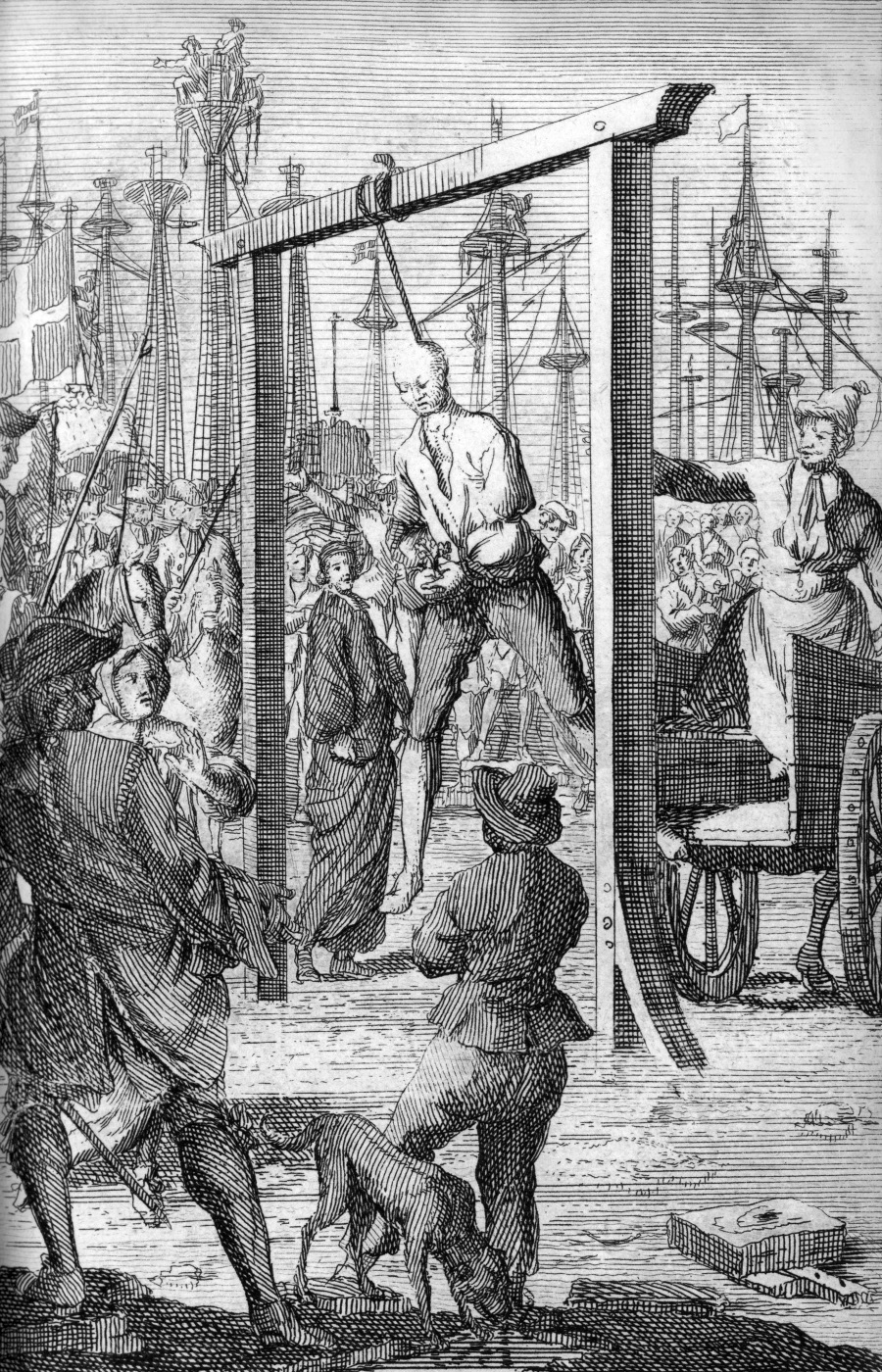
1799: Heshen forced to commit suicide

It was on this date that notoriously corrupt Chinese minister of state Heshen or Ho-Shen was forced to commit suicide in lieu of execution.

The able child of a Manchu military officer, Heshen came of age in the long reign of the emperor Qianlong.

That Heshen rose above his modest station with this monarch’s favor was the source of no small resentment. Rumors circulated that the attractive young former bodyguard reminded the emperor of a lost, beloved concubine — with all that implies.

“Elegant in looks, sprucely handsome in a dandified way that suggested a lack of virtue,” a Korean diplomat described Heshen.

Whatever there might have been to the homosexuality angle, Heshen exploited the imperial protection to gorge himself on the state’s revenues; he’s reported to have filled the bureaucracy with clients who saw to it that Heshen got a yuan out of every tael that passed through state business in the last quarter of the 18th century. He even dynastically married his own son to one of Qianlong’s daughters.

It was the peak of the Qing dynasty’s glory, and the dawn of its imperial stagnation. Heshen — resplendent, omnipotent, and sunk in vice* — remains to this day its persona par excellence.

As long as the emperor lived, Heshen had a virtual free hand.

But as soon as the emperor died — on February 7, 1799, at the age of 87 — the successor** Jiaqing destroyed him.

Citing Heshen’s inability to suppress the nettlesome White Lotus and Miao rebellions, Jiaqing arrested and tortured the former retainer into copping to all manner of offenses both mortal and venial.

My thoughts dwell ever on the Confucian precept: ‘For three years after a parent’s death none of his former surroundings should be changed.’ …

But as regards Ho Shen, his crimes are too grave to admit of possible pardon … Ho Shen is a deep-dyed traitor, lost to all moral sense, who has betrayed his Sovereign and jeopardised the State. As self-constituted dictator he has usurped supreme authority.

Seeing the man’s abrupt change of fortunes, Heshen’s people in the bureaucracy fell over each other to denounce him.

He was condemned to the horrific expiation of “slow slicing”; however, given “the undesirability of executing the chief Minister of State like a common felon in the public square,” Jiaqing “allowed him the privilege of committing suicide, as a mark of high favour and out of regard to the dignity of the nation.”

A principal accomplice was made to witness Heshen ceremonially hanging himself; then the accomplice was reprieved of his own death sentence and sent into exile.

The new sovereign found his nation’s dignity sufficiently upheld by the doomed man’s melancholy inventory of loot destined (of course) for the re-appropriation of the Qing … and sufficiently outraged that, upon discovering weeks after the some artifact Heshen had failed to enumerate,

Had these facts come to Our knowledge before the 18th day of the 1st Moon [i.e., February 22], we should assuredly have decreed Ho Shen’s decapitation, even if We had spared him the lingering death and dismemberment.

However, he has already been permitted to commit suicide, and thus luckily escaped the extreme penalty of public execution. We do not, therefore, insist on his corpse being hacked to pieces.

Jiaqing had better to worry about his own now-declining state, which was about to be hacked to pieces by encroaching European powers.

Having made an example of Heshen and a handful of his most visible allies, he was still saddled with the endemic structural corruption Heshen had fostered in the institutions of Qing governance.

“Historians have tended to see Jiaqing’s failure of nerve in purging the bureaucracy of all tainted officials as something of an original sin whose commission predetermined the dynasty’s steady decline,” writes William T. Rowe of this turning point. “But given the need for at least some continuity in routine administration, it is not at all clear that he could have acted otherwise.”

(Hey, at least he did make the few examples. Not everyone even does that much.)

And so Jiaqing struggled in vain to maintain China’s fading prestige; his reign would witness economic erosion and a burgeoning opium trade that eventually led it to war with the British and humiliating western domination.

Since a sclerotic bureaucracy at once crushing in its expanse, helpless in its effect, and riven with self-dealers, is a timeless theme (especially in China), Heshen persists as a lively emblem of corruption.

Heshen’s luxurious mansion — which was also among Jiaqing’s indictments — still stands; today, it’s a museum.

* It bears remembering that it is principally by the testimony of Heshen’s enemies that we know him.

** Technically, Jiaqing had been ruling since Qianlong symbolically “abdicated” in 1796; in reality, Qianlong continued to run the realm until his death.

On this day..

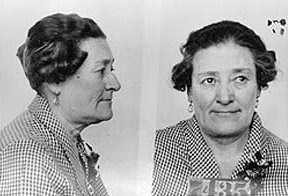
1930: Eva Dugan, her head jerked clean off

On this date in 1930, Eva Dugan was badly hanged.

A former Alaskan cabaret performer, Dugan relocated to warmer climes, took a job keeping house for a to New York.

A mysterious teenage accessory, “Jack”, was never found. Eva was picked up and extradited after the missing rancher’s remains turned up in a shallow grave.

The grizzled former frontierswoman — she followed the Klondike gold rush in her youth — took her fate nonchalantly.

“Wal, I’ll die with my boots on, an’ in full health,” she scolded her jurors. “An’ that’s more’n most of you old coots’ll be able to boast on.”

Eva Dugan’s health may have been full — though she bid unsuccessfully for clemency claiming mental illness — but her body was halved.

At 5 a.m. this date, wearing a homemade silk shroud, a composed Dugan mounted the gallows at the state prison in Florence.

Her death was instantaneous, for the rope, when it snapped at the end of the drop, severed her head from her body.

Five witnesses, two women, fainted. Altogether there were five women in the chamber at the time of the execution. It was the first time in the history of Arizona that an execution was witnessed by women.

Thanks in part to this ghastly scene, Arizona in 1934 replaced the gallows with the western states’ hot new killing technology, the gas chamber … leaving Dugan the last female client of that state’s hangman.

(Another woman, Ruth Judd, narrowly missed swiping Dugan’s distinction; Judd’s hanging sentence was commuted for insanity just days short of her scheduled 1933 hanging.)

On this day..

1939: The only triple execution in Manitoba

On this date in 1939, the Canadian province of Manitoba carried out at Headingley Gaol the only triple execution in its history.

Peter Korzenowski and William Kanuka hanged side by side just after midnight that February 16, while their accomplice Dan Prytula waited 14 minutes for his turn on the gallows.

Less than a year before, drunk on moonshine, the trio beat and kicked 81-year-old Anna Cottick to death on her Dauphin-area farm in an attempt to plunder the place of a rumored $1,000. In fact, they only found twenty-three bucks.

According to an article that appeared on the regrettably extinct Manitoba’s Buried History site,

The process of finding enough corroborating evidence to obtain murder convictions was the stuff of modern crime dramas.

As soon as the Royal Canadian Mounted Police arrived at the Cottick farm, members noticed fresh tire tracks entering and leaving the yard. They were tracked three miles west to within 150 yards of Kanuka’s residence, and from there to the Gilbert Plains home of Prytula’s sister. The tire marks were a perfect match to the treads on Prytula’s 1929 Ford. It was confiscated and, while casts were taken of its treads, Prytula was arrested and his blood-stained clothes, boots and three .32 calibre bullets were seized and sent to the RCMP crime lab for testing.

As one group of police officers were arresting Prytula and Korzenowski, another searched the Cottick residence for additional evidence. Almost immediately they noticed what appeared to be fingerprints on the glass smashed by the assailants. Fragments were sent to experts in Winnipeg, along with a window frame and piece of wall where the bullets fired by Korzenowski and Prytula lodged.

The RCMP also searched the residence and yard of Korzenowski, located a few hundred yards from where Kanuka had been staying. There they found the revolvers used in the break-ins, hidden in a pile of stones. Korzenowski was promptly arrested, and three days later he and his two friends were part of an identification line-up paraded in front of the hospital beds of the Cotticks.*

To top all that off, they bugged the men’s jail cell with a dictograph and snared them in several incriminating conversations. Representative remark: the lawyers are so expensive, “No wonder one has to go robbing.”

* Anna’s 91-year-old husband survived the home invasion.

On this day..

2004: Former vice-governor Wang Huaizhong

On this date in 2004, the former deputy governor of China’s Anhui province was executed for official corruption.

It was just weeks after Wang’s conviction for grifting some 100 million yuan in real estate transactions dating back to the mid 1990’s.

We suppose Wang did his appeals no favors by steadfastly denying guilt — although he might have reckoned that the national “determination … to fight corruption” thwarted any such plan.

Instead of confessing to his crimes, Wang had stood against the public prosecutors and even continued to seek bribes during the investigation from some private business owners, said Wang Huanhai, head of the investigation team.

According to the prosecutor, Wang attempted to use the bribe to buy over more relations, hoping the Central Commission for Discipline Inspection of the Chinese Communist Party would spare him from being inquisited.

During the first trial on Dec. 29, 2003, Wang denied all the allegations, but in the latest trial confessed to most of the crimes and argued for a light penalty on the grounds that the bribes he had taken were not big enough to justify a death penalty.

His request was turned down, given the amount involved in the case as well as his resistance to investigation.

Wang’s prosecutors said he was an orphan and had climbed up the social ladder with an inferiority complex. “That’s why he was dictatorial and could not stand anyone questioning him,” said Wang Huanhai, “Nor did he ever confess to his wrongdoing in public.”

On this day..

1869: Chauncey W. Millard, candy man

On this date in 1869, Chauncey W. Millard was shot in Provo, Utah, for a stagecoach murder and robbery.

Despite the trust fund moniker, Chauncey Millard was an underbelly character, a youth of uncertain age (18 or 19, went the estimate) who had drifted west from an abusive apprenticeship. His complete backstory — not even his name* — was never fully assayed, and the Utah authorities did not keep his acquaintance more than a few weeks before they shot him. “It was snowing like this when I done it,” he remarked on his execution day: frontier justice had not allowed even a single season to elapse.

Though slightly different configurations of his backstory are to be found, all recognize him as a youth barely grown from out of that vast and indistinct vagabondage of lumpen marginalia consigned to the shadowlands to scrap for their bread. He wanted any education save a self-made career of small-time savagery. His life was nasty, brutish, and short.

The San Francisco Daily Evening Bulletin of Jan. 5, 1869, presents a representative summation, channeling a wire story from the scene:

DREADFUL DEPRAVITY — The Salt Lake Reporter of December 24th has the following:

The young man now in the county jail, for the murder of Swett, certainly comes as near being a complete reprobate as any we have met. He tells the story of the murder, and the unsuccessful attempt on Mayfield, with great circumstantiality of detail, adding in conclusion: “Well, Mayfield needn’t be afraid of ever being killed by a pistol, for it can’t be done. His life is insured. I shot at him four times, fair as ever a man did, and with good aim too, and never hurt him.” After the killing, he fled across a ridge, and the next day hired to a Bishop there to herd sheep. As he relates the story, the Bishop spoke of his intention to buy a beef, upon which the young man asked: “Have you got money enough to buy a beef?” “No,” said the Bishop, “but I think I can trade for it.” The prisoner adds very complacently: “I think he was a little scared, but if he had money enough to buy a beef, I thought I would pop him over, take what he had, and light out!” When arrested he merely said: “I suppose you’ll string me up to the first good limb you come to, but I’ll take a nap first.” Upon which he lay down in the wagon and snored quite lustily for four hours.

On awaking he expressed some surprise at not being hanged at once, and was told in this country every man could have a trial and a choice between being hanged or shot. To which he made reply: “By —, that’s bully, I’ll take shooting all the time.” He first gave his name as Chauncey Millard, stating that he had no recollection of his father; but soon after spoke of his mother’s maiden name being Millard, to his paternity is rather doubtful. He was born in the South;** early neglected and abused, and taught nothing worth knowing, his hand was against every man and a good many hands against him. The man to whom he was apprenticed mistreated him, and his first crime was destroying his master’s property for revenge. This was at the age of 13; not long after that he became a bushwhacker, and with a few companions robbed or murdered rebel or Union soldiers indifferently. With the return of peace he came West, and relates several crimes and attempts committed in this Territory.

He expresses a willingness to die, saying he has tried to make money by crime and made a failure. Strangely enough the young man has what phrenologists would call “rather a good head,” and presents an interesting but terrible case of “perverted moral instinct.” He is 18 or 19 years of age, not above the latter, though he is not certain of his age. He presents a curious case of the youthful criminal, made so by the utter neglect of moral cultivation.

Calling him, as one source does, “Utah’s version of Billy the Kid” would probably be more corrective of William Bonney’s inflated legend than of Millard’s utter obscurity.

The tawdry particular of his death: having no kin, and no care, he heedlessly made the Faustian bargain to salvage some last juvenile diversion in this world in exchange for the mortified flesh he was about to take leave of.

The execution proved what a human fiend Millard was. Selling his body to Doctor Roberts of Provo for a pound of candy, he calmly ate the sweets while sitting in the executioner’s chair awaiting the fatal shot.

It’s as pronounced an example as one might ask of the disreputable anatomy trade preying on poverty.

* Chauncey Millard was the name he gave the lawmen, at least; his real identity was never clearly established, though the Salt Lake City News reported shortly before “Millard’s” hanging that guards found a tattoo reading “C.E. Otoway” on his arm and hypothesized that to be his real name. Did 19th century drifters usually tattoo their own names on their bodies?

** Other versions have him a New York delinquent.

On this day..

2010: Liu Lieyong and Chen Xiaohui, Hubei gangsters

Two “prime members” — in the words of the Xinhua report — of a central China gang were executed on this date last year in Hubei province.

Liu Lieyong* was sentenced to death for the crimes of organizing and leading an organized criminal gang, murder, blackmail, illegal possession of arms and gambling, said a statement from the SPC.

Chen Xiaohui was convicted of participating in an organized criminal gang, murder, intentional injury, inciting disorder and illegal possession of arms.

Another 19 people convicted in the case received jail terms from one year with two-year reprieve to suspended death sentences, said the statement.

The crime gang, founded by Liu in the city of Xiantao in Hubei in 2001, had opened casinos, which were illegal in China, illegally forced the transfer of shares in local bus companies and manipulated local cement and food markets.

Liu instructed gang members, including Chen, to murder one person. Chen was also held responsible for another death and nine injuries, the statement said.

The statement did not give details about their victims. According to a report in the Wuhan Morning Post in February 2008, one of the victims was Hu Dongfeng, head of a rival gang in Xiantao. Six of Liu’s gang members ambushed him and shot him dead.

* Not to be confused with the singer and actress Liu Liyang.

Part of the Themed Set: 2010.

On this day..

1888: Prado, before Gauguin

On this date in 1888, “Prado” — also known as “Count Linska de Castillon”; he never copped to his real identity — was beheaded as a thief and murderer at Paris.

The trial of this intrepid criminal promised, in the London Times‘ Nov. 6, 1888 preview, to be “one of the most extraordinary of our times”

He [Prado] is a Spaniard, and was brought up at Gijon, but he refused to say who he was. When 14 years of age he visited Mozambique, India, China, California, the West Indies, and North America. In 1872 he was a sub-lieutenant in the Carlist bands. He then lived by his wits. He once crossed the French frontier and stole 8,000f. At the battle of Somorrostro he was wounded by a shell, and removed to a hospital, from which he enticed the sister of the Order of Saint Vincent de Paul who nursed him. She belonged to one of the first families in England. He married her, and with her visited the Holy Land, but her health failed, and she died on their return to Italy. Prado says he married a second wife at Lima, with a dowry of 1,200,000f., and that after her death he committed many daring robberies.

He’s the most interesting man in the world.

This vagabond upon the overgrown lost highways of fortune eventually ditched wife #2 in penury in Spain and proceeded to France where he mooched off a local girl and her absentee American sugar daddy, until one night he slashed the throat a dame named Marie Aguetant, the lover of a late-working croupier, and plundered their domicile of chattels.

Prado eluded capture for some time, keeping his lover, taking another — both of whom ended up in the dock with their insolent Don Juan, along with various male intimates in various aspects of accesorizing. None of those others drew a death sentence, but as the interest of the London Times suggests — it fronted near-daily trial dispatches from Paris — all this stuff about cabals of swarthy men ravishing women of their virtue and their valuables made global news.

It also moved Third Republic bodice-ripping true crime like this zippy little volume, “Prado ou Le Tueur de Filles,” with a copyright notice as late as 1931.

A savage crime by a strange character, but now that it’s long departed all living memory, it scarcely stands out. Legion are the lotharios who have slain for the pedestrian motivation of gold.

In a post-bourgeois order, “we will no longer see men like Pranzini, Prado, Berland, Anastay and others who kill in order to have this metal,” the French terrorist Ravachol‘s suppressed address to the courtroom declared in 1892. “The cause of all crimes is always the same, and you have to be foolish not to see this.”

Yes, I repeat it: it is society that makes criminals and you, jury members, instead of striking you should use your intelligence and your strength to transform society. In one fell swoop you’ll suppress all crime. And your work, in attacking causes, will be greater and more fruitful than your justice, which belittles itself in punishing its effects.

-Ravachol


Just a few days before this headline-grabbing execution, impressionist painter Vincent van Gogh undertook the most famous thing he ever did off-canvas: after his latest dispute with roommate and fellow-artist Paul Gauguin, van Gogh sliced off his own left earlobe.*

It was in this abnormal circumstance that Gauguin, fresh to Paris fleeing from the scene of the self-mutilation in Arles, attended Prado’s beheading, even forcing his way through a line of gendarmes to obtain a closer view.

“[H]e may have had the counterphobic desire to reassure himself of his courage by taking an unflinching look at Prado’s execution,” writes Bradley Collins. “Gauguin may have identified with both the executioner and his victim. On the one hand, by watching the state kill a man, he could vicariously release some of his pent-up aggression toward Vincent. On the other, by identifying with Prado he could vicariously atone for the guilt he felt about precipitating Vincent’s breakdown and abandoning [Arles].”

Aptly for Gauguin’s personal demons, the guillotine managed to botch this job, too — giving Prado a non-fatal facial injury and requiring the now-wounded condemned to be repositioned for another chop.

All this pate-slashing sure seems to have found its way into Gauguin’s next creation:


Gauguin’s grotesque “Jug in the form of a Head, Self-Portrait”. “Within one work, he has become both the bloody, earless Vincent [Van Gogh] and the guillotined Prado.” –Collins

* Latter-day revisionist hypothesis: Gauguin actually cut off van Gogh’s ear in a fight, but both painters kept to a cover story to keep everyone out of trouble. That version would only thicken the psychological stew for Gauguin’s pilgrimage to the guillotine and subsequent “self-portrait”.

On this day..

Unspecified Year: The Robbers of Nordenshaw

This Yule, we present an ancient Danish ballad which “is probably too true a picture of the lawless conduct of men of the highest rank, and of a state of things not confined at that period to the islands of Denmark.”

The Robbers at Nordenshaw

The Robbers lurking at Nordenshaw*
From out the green-wood creep,
And march by night to the farmer’s house,
Their Yule with him to keep.**

They’ve march’d away to the farmer’s house
With each in hand a spear;
“Come, cousin, see, we are kith and kin,
“Tap us thy Christmas beer.

“And, farmer, lodge us all tonight,
“And well with liquor ply,
“And with us leave thy pretty wife,
“Or, farmer, thou shalt die.”

“I’ll freely pour my mead and ale,
“And well I’ll serve you too;
“But, Sirs, by all that’s good above,
“No outrage on us do.

“Now if upon my house ye seize,
“And lord it at your will,
“And if ye put my wife to shame,
“That were outrageous ill.”

Some on the table threw their swords,
Some cloaks of fur so fine,
Some bade the honest farmer’s wife
Bring in the beer and wine.

A cloth of woven silk she took,
And over the table spread;
And there her ale and wine they drank,
And ate her meat and bread.

A cautious wife was Oaselille,
And used her words with care;
She rose and told the robber guests
She would their beds prepare.

No thought had she, good Oaselille,
With them to share her bed;
But left them feasting, and for help
Through the dark forest sped.

With hurried step through bush and field
Ran on the lusty dame,
And after four long weary miles
To Drost Sir Peter’s† came.

She reach’d Sir Peter’s courtyard gate,
Drew on her mantle blue,
And boldly up to the upper room,
Sir Peter’s chamber, flew.

“Wake up, Drost Peter Hoseale, wake,
“No moment longer sleep;
“The thieves, that lurk’d at Nordenshaw,
“With us their Christmas keep.

“What! still, Sir Peter, slumbering on
“Nor yet but half awake?
“Those robbers twelve are at the Grange,
“All twelve are now to take.”

Then rose the Drost and call’d his men,
And bade them all to arm;
“Wake up, my men, there’s come tonight
“Good news from yonder farm.

“Wake up, no moment more delay,
“And d’on your trusty mail;
“For Nilus Ufridson is there,
And not the man to quail.”

“Where,” ask’d those sturdy robbers twelve,
They’d drunk of ale so deep,
“Where’s now the farmer’s pretty wife?
“We’ll have her here to sleep.”

“Chide not, good Sirs, a short delay”
The grey-coat farmer said;
“She is even now to the chamber gone
“To make her guests their bed.”

The farmer out of his window look’d,
And saw the Drost’s array;
“There stop here thirty men at arms,
“Are dress’d like cushats gray.”

Then answer’d Nilus Ufridson,
“Of such I’m not afraid,
“If but my comrades stand as firm,
“And faithful prove my blade.”

“No,” answer’d Lave Rimordson,
“And scann’d the troop afield,
“For such men care we not a bean,
“To them we’ll never yield.”

They beat the door with sword and spear
And rais’d a fearful shout;
“Up up, Sir Nilus Ufridson!
“Thy gang and thou come out.”

“Seven tons of gold I’ll give thee, Drost,
“And silver other five,
“To let us hence in peace depart
“My men and me alive.”

“Thy silver, Nilus, heed I not,
“As little heed thy gold;
“Through thee weeps many an orphan child
“For friends beneath the mould.”

Hard fought Sir Nilus Ufridson,
And well he kept his ground,
And heavy were from bar and beam
The blows he dealt around.

Nor less did Lave Rimordson,
But fought with might and main
Till at the hilt by dint of blows
He broke his sword in twain.

He dash’d the hilt against a stone,
The blade stuck in the mould;
“And now, my only chance of life,
“I’ll try good words and gold.

“Drost Peter Hoseale, spare my life,
“And do me no disgrace;
“I’m near of kin to the Danish Queen
“And of an Emperor’s race.”

“If near of kin to the Queen thou art,
“And all so nobly born,
“Why to the Farmer’s didst thou go,
“And treat his rights with scorn?”

So seized Sir Peter all the twelve,
And townward march’d them off;
And set them side by side on poles,
The people’s jest and scoff.

And there they lie on rack and wheel
To bear the heat and cold;
But to the King the Drost has brought
Twelve heavy chests of gold.

* Located on the Danish island of Fyen, Fyn, or Funen.

** The Danish Jul runs all through December up to Christmas Eve, Dec. 24; that date, Christmas Eve, is the big Yule celebration in Denmark.

† I situate this execution in the 13th century based on Drost Peter’s appearance in this historical romance of Danish King Erik VI Menved‘s youth.

On this day..

1718: Stede Bonnet, gentleman pirate

On this date in 1718, the Barbados buccaneer Stede Bonnet was hanged for piracy in Charleston, S.C.

Bonnet had few of the typical swashbuckler’s resume-builders during this Golden Age of Piracy: he was neither a mariner by trade nor a desperate outlaw by circumstance, but a wealthy English landowner in Bermuda.

“He had the least Temptation of any Man to follow such a Course of Life, from the Condition of his Circumstances,” wrote the pseudonymous author (alleged to be Daniel Defoe) of A General History of the Pyrates. But as age thirty hove into view and the seven-year itch demanded scratching, Bonnet undertook an abrupt career change “said to have been occasioned by some Discomforts he found in a married State.”

Bonnet’s version of a cherry-red convertible was a six-gun sloop named Revenge,* which he tricked out from his ample inherited fortune and took cruising for action on the North American coast.

Or, just get this Victorian satire free from Google books.

He raided from New England to the Carolinas, fell in with Blackbeard (which more credible cutthroat charismatic promptly appropriated Bonnet’s hireling** crew), lost his ship, got it back, turned himself in, got a pardon … the rich guy packed plenty of adventure into little more than a year of raiding, but he never seems to have advanced his freebooting skills past the “gentleman hobbyist” level.

South Carolina ships captured Bonnet near Cape Fear, which is actually North Carolina, but never mind: South Carolinians well remembered this character from his involvement with Blackbeard’s recent blockade of Charleston.

Bonnet got gentleman’s quarters upon detention, and his elite education enabled him to favor the colony’s governor with a simpering plea for clemency.

Honoured Sir,

I have presumed, on the Confidence of your eminent Goodness, to throw my self, after this manner, at your Feet, to implore you’ll graciously be pleased to look upon me with tender Bowels of Pity and Compassion; and believe me to be the most miserable Man this Day breathing: That the Tears proceeding from my most sorrowful Soul may soften your Heart, and encline you to consider my dismal State …

if I had the Happiness of a longer life in this World … I’ll voluntarily put [wickedness] ever out of my Power, by separating all my Limbs from my Body, only reserving the Use of my Tongue, to call continually on, and pray to the Lord, my God, and mourn all my Days in Sackcloth and Ashes to work out confident Hopes of my Salvation …

Good grief.

All of which pathos was unwisely belied by an escape attempt which made pardon completely untenable.

Most of Bonnet’s captured crew was hanged en masse on Nov. 8; Bonnet managed to drag on several stays of execution before he followed them from his comfortable digs to the common gallows. A stone monument marks the spot.

* There were many pirate ships Revenge, including that of famous women pirates Anne Bonny and Mary Read and that of the Dread Pirate Roberts. There’s also a band “The Pirateship Revenge”.

** Bonnet paid his crew out of his own pocket, a practice at odds with the more egalitarian pirate norm of crews taking like shares and choosing (or demoting) their own captains.

On this day..

1828: Joseph Hunton, forger

On this date in 1828, Quaker forger Joseph Hunton was hanged at Newgate Prison.

The very model of petit bourgeois hustle, Hunton was a versatile businessman who variously engaged in slop-selling, linen-draping, sugar-baking, and warehousing, before turning his craft to that most lucrative of all trades, money-minting.

Hunton circulated bills of exchange fraudulently drawn on dead people, and easily traced back to his hand. Ever the assiduous merchant, Hunton was arrested trying to flee England — with a letter in his pocket to post for the Times correcting that paper’s inflated account of his graft to a more modest figure.

Since the reputation that preceded him was otherwise a good one, and since executions for white-collar crime suffered declining popularity, Hunton had “every reason to expect that the mercy of the Crown will be extended to the unhappy object of public commiseration.” (The London Times, Nov. 21, 1828, evidently an error-prone source on the subject of J. Hunton.) Even Nathan Mayer Rothschild, one of the founders of that family’s banking empire, signed a petition for Hunton along with other eminences of the London financial district. This sentiment, the Times observed (Dec. 6, 1828)

proves sufficiently that in the opinion of the commercial public, fraud is not an appropriate subject for capital punishment … The human heart, we say, in the 19th century, revolts at such a retribution for such a transgression … [which] flies in the face of those feelings which attest, because they go far to constitute, the advancement of mankind in civilization and humanity. The penalty of death was enacted for the sake of the monied interest,–the monied interest, by this petition, loudly proclaim that they deem the penalty unnecessary!

Little wonder the Newgate Calendar noticed “a very general belief … that a respite would most certainly arrive for him even so late as on the morning fixed for his death. His safety was considered almost certain, and many were scarcely persuaded that he would really suffer even at the moment when the fatal cord encompassed his neck.”

But it was not so.


Some things never change.

Though 1828 is many decades before England developed its exacting “drop tables” calculating the precise length of rope meant to hang a fellow of a given stature, the accounts of Hunton’s hanging are at pains to note that, because Hunton himself was so short, his rope was made longer than that of the three unconnected fellow-convicts who hanged with him. Table or no, the executioner knew his craft: Hunton died instantly, or appeared to.

(Another Quaker once an intimate of Hunton later became notable gallows fodder himself, John Tawell. Tawell was the first criminal captured with use of the telegraph.)

On this day..