On this day in 2010, at 10:38 a.m., at the Southern Ohio Correctional Facility in Lucasville, convicted arsonist and quintuple murderer William L. Garner got the needle for the crimes he had committed eighteen years earlier.
Garner had burglarized the Cincinnati, Ohio apartment of Addie F. Mack on January 26, 1992, after he stole her purse and keys while she was being treated in a hospital emergency room.
After taking some electronics, Garner set three fires within the residence, although he knew there were children asleep inside it. Markeca Mason and Richard Gaines, both 11, Denitra Satterwhite, 12, Deondra Freeman, 10, and Mykkila Mason, 8, all died of smoke inhalation. Addie Mack’s oldest child, 13-year-old Rodriczus Mack, escaped through a window; he was the only survivor.
Rodriczus, Denitra, Deondra and Mykkila were siblings, and Markeca was their cousin. Richard was a friend of Rodriczus who happened to be spending the night.
Thanks to a tip from an observant taxi driver, Garner was arrested the next day and quickly confessed. He considered the children’s deaths to be “accidental” because he only set the fires to obliterate his fingerprints and he believed the children would smell the smoke and be able to get out in time.
Unfortunately, the apartment’s smoke detector was inoperable.
Garner was nineteen years old at the time of the murders. He had a criminal record dating back to age eleven, and following his January 1992 arrest he racked up thirteen behavior infractions in prison … including a fire-setting incident.
A psychologist who interviewed him said he functioned at the level of a 14-year-old, and his IQ tested at 76, barely above the juridical cutoff mark for mental retardation. When asking for clemency, Garner’s attorneys cited these factors as well as his “extremely violent and dysfunctional” upbringing, and also argued that he was brain-damaged due to lead poisoning.
In June 2010, the parole board voted unanimously to reject Garner’s clemency request, stating in its report, (pdf)
Considerable weight was afforded the considerable mitigation presented. It is clear that Mr. Garner suffered developmentally and was raised in an exceptionally and horrendously abusive environment. However, we cannot conclude that the mitigating factors are significant enough to outweigh the aggravating circumstances of an offense resulting in the death of five innocent children.
Garner was executed a month later, using Ohio’s recently-adopted “one-drug” lethal injection protocol (most states use, as Ohio had previously, a cocktail of three). It didn’t go smoothly.
A Toledo Blade article provides a detailed account of his last moments. The prison had to open a second viewing room to fit all the people who came to watch him die.
This post was contributed by Andrew Gustafson, a writer and cartographer based in Brooklyn, NY. Andrew’s work can be found on his website, and he regularly blogs about New York City history and culture for Urban Oyster Tours.
On this date in 1938, Anthony Chebatoris was hanged at the federal prison in Milan, Michigan, becoming the only person executed in Michigan since it gained statehood in 1837.
Chebatoris and an accomplice, Jack Gracy, rolled into Midland, Michigan on September 29, 1937, with the intention to rob the Chemical State Bank. They never did get their hands on the cash, and only one of them would leave the town alive, though with a proverbial noose dangling from his neck. The two men, armed with a pistol and a sawed-off shotgun, entered the bank and approached the bank manager, Clarence Macomber, with guns drawn. In the ensuing scuffle, Chebatoris shot Macomber and another bank employee, Paul Bywater. Upon hearing the shots, Frank Hardy, a dentist whose office was next to the bank, grabbed the loaded deer rifle he kept handy and went to the window to see what the commotion was about. As Chebatoris and Gacy abandoned the botched robbery empty-handed, Hardy began firing at the fleeing robbers, hitting Chebatoris in the arm and causing him to crash the getaway car he was driving. As the wounded men looked for another escape route, Chebatoris spotted a uniformed truck driver named Henry Porter, whom he mistook for a police officer, and shot him. The men then tried to hijack a truck to make their escape, but as Gacy attempted to climb into the cab, the sharpshooter Hardy shot him in the head from 150 yards away, killing him instantly.* Chebatoris took off on foot and was apprehended a short distance away, exhausted and bleeding.
Chebatoris would survive his injuries, as would the bank employees Macomber and Bywater. But the innocent bystander Henry Porter put our convict on the road to the gallows: after two weeks in the hospital, Porter would succumb to his injuries, and murder would be added to the charges against the surviving bank robber. Michigan had outlawed the death penalty for murder in 1846, becoming the first U.S. state to do so. But Chebatoris found himself subject to a legal system that had been changed by New Deal politics and the public’s panic over escalating violence and criminality. Federal prosecutors took on the case, under the authority of the National Bank Robbery Act of 1934, which was passed in response to the rash of bank holdups across the country. The law gave the federal government the authority to prosecute anyone involved in the robbery of a bank that was a member of the Federal Reserve System or the newly created Federal Deposit Insurance Corporation. Unluckily for Chebatoris, Chemical State Bank was a member of both.
With a mountain of evidence against him, Chebatoris was easily convicted, and on November 30, 1937, he was sentenced to death by federal judge Arthur Tuttle. The case set off a political controversy in Michigan, one that would pit an anti-death-penalty governor against federal judges and prosecutors who wanted the sentence passed down and carried out in the state. Under the federal statute, federal death sentences could only be carried out in states that had their own death penalty. While Michigan had long abolished capital punishment for murder and other crimes, it still kept an obscure law on the books allowing execution for treason (which has never been exercised, as it is unclear how one would commit treason against the state of Michigan). This loophole allowed the federal capital prosecution and execution to proceed within the confines of the staunchly abolitionist state.
In response to the decision, Michigan Governor Frank Murphy said, “There hasn’t been a hanging in Michigan for 108 years. If this one is carried out in Michigan, it will be like turning back the clock on civilization.” Illinois, which had its own electric chair, offered to finish off Chebatoris, but Judge Tuttle ordered that the execution should proceed in Michigan, noting, “The just verdict having been returned, the law was mandatory in the three respects, namely that the penalty should be death, that it should be hanging, and that it should be within the state of Michigan. These last two requirements resulted from the fact that Michigan has one statute providing for the death penalty by hanging. If the sentence had been different in any one of these respects, it would have been unlawful. I have neither the power nor the inclination to change the sentence.”
Chebatoris was transferred from the Saginaw County Jail, where he had been held throughout his trial, to the federal prison in Milan. At 5 a.m. on July 8, 1938, he was brought to the gallows, and before 23 witnesses, including an inebriated hangman named Phil Hanna, he was hanged. In the middle of the night before the execution, Hanna had arrived at the prison demanding that his three drunken friends be admitted to the hanging. After an argument with the warden and a call to the director of the Federal Bureau of Prisons, Hanna was allowed to proceed with execution, and the warden acceded to his demands (though at the time of the execution, the warden barred the three friends from the proceedings, knowing that the room was too dark, and Hanna too drunk, for him to notice their absence).**
Chebatoris’ execution was both a unique event and a bellwether for things to come in the federal death penalty system. Since 1927, he is the only person to be executed for a murder committed in a state that does not have its own death penalty statute. After World War II, executions, both federal and state, went into a steep decline across the United States, culminating in the 1972 Supreme Court decision Furman v. Georgia, which struck down every capital punishment statute in the land. Four years later, the death penalty was revived in Gregg v. Georgia, and it took barely six months for states to resume executions. The federal government was slower, however, and the first post-Furman federal death penalty statute did not appear until 1988. Since that date, however, we have seen the steady expansion of the federal death penalty, building on the precedents set by the National Bank Robbery Act. Rather than targeting bank robberies, the federal government has used the death penalty to take aim at other perceived scourges, employing it is a weapon in the various domestic “wars” on crime, drugs, and terrorism.
In the past twenty years, the federal death penalty has been transformed from a seldom-used punishment for pirates and crimes committed in the territories to an expansive weapon that can be imposed in a wide range of jurisdictions, leading the Criminal Defense Network to conclude that “virtually every homicide occurring within federal jurisdiction is now death-eligible.”† The greatest expansion of the federal death penalty came with the 1994 Violent Crime Control and Law Enforcement Act, which greatly expanded federal jurisdiction and authorized the death penalty for nearly 60 different crimes. And the reach of the federal death penalty has continued to expand, even into states like Michigan that have rejected capital punishment.
There are currently 58 people sitting on the federal death row, nine of whom committed their crimes in states that either do not have a constitutionally valid state death penalty statute or have active moratoriums on the death penalty.‡ Interestingly, all of those nine were sentenced to death during the tenures of Attorneys General John Ashcroft and Alberto Gonzalez, and their decisions to pursue capital prosecutions marked a departure from the actions of their predecessors. Early in his term, John Ashcroft revised the U.S. Attorneys Manual and removed language about the Department of Justice’s policy towards seeking the death penalty in states that did not have their own capital punishment statutes. Previously the manual stated that in these states, “penalty-driven decisions to file federal charges are inappropriate.” That language was removed, and presumably this opened the door for the increase in prosecutions, convictions, and death sentences handed out in federal districts located within abolitionist states. Since Chebatoris’ execution, no one who falls into this category has been executed, and current Attorney General Eric Holder has signaled a return to the earlier practices, meaning the federal government will be less inclined to pursue these kinds of cases. Nevertheless, it is likely that at least one of these nine will eventually be executed.
When that happens, Anthony Chebatoris will no longer be a solitary historical footnote.
* Hardy was a hero, but he is not nearly as celebrated as another bank robbery foiler, Northfield, Minnesota’s Joseph Lee Hayward, who is remembered annually at the town’s “Defeat of Jesse James Days.” Perhaps Midland could build its own tourist attraction around Hardy?
** For a detailed account of the case of Anthony Chebatoris, read Aaron Veselenak’s article in the May/June 1998 issue of Michigan History Magazine, “The Execution of Anthony Chebatoris.”
† From Burr, Dick, David Bruck and Kevin McNally (2009). “An Overview of the Federal Death Penalty Process.” Capital Defense Network.
‡ These death row inmates are: Carlos Caro (WV), Donald Fell (VT), Marvin Gabrion (MI), Dustin Honken and Angela Johnson (IA), Ronald Mikos (IL), Alfonso Rodriguez (ND), Gary Sampson (MA), and Kenneth Lighty (MD). For a description of their cases, visit the Death Penalty Information Center. All are held in the Federal Correctional Complex in Terre Haute, IN, with the exception of Gary Sampson, who is being held in New Hampshire. For more information on these cases, visit the Death Penalty Information Center.
This date marks the centennial of perhaps the most famous execution in the history of Reunion Island: the June 20, 1911 guillotining of Sitarane and Fontaine.
Sitarane (French link) — his actual name was Simicoudza Simicourba — hailed from Portuguese Mozambique, supposedly from a long line of sorcerors.
A contract job brought him to Reunion, but he soon abandoned it for the black [magic] economy. A fellow purported necromancer named Pierre-Elie Calendrin pulled Sitarane and run-of-the-mill hoodlum Emmanuel Fontaine into a prolific little crime ring that terrorized Reunion around 1907 to 1909, amassing about a dozen murders.
And what murders!
Most of the sources on this circle are French, and they narrate weird occult criminality: reading tarot and sacrificing a black cock before a proposed adventure, drinking the blood of their victims to gain their strength.
Still, this was practical magic: Calendrin, Sitarane and Fontaine killed people so that they could rob them.
So it was with their dark arts, too: the sacrificed chickens were drugged and tossed to watchdogs; a mysterious powder blown through keyholes narcotized targets before the gang burst in to do its dirty work. It’s Sherlock Holmes in the Indian Ocean.
The three were finally surprised in the midst of one of their mercantile and monstrous sorties, and tried in 1910.
Although all three received death sentences, Calendrin — who as the trio’s leader would figure to have been the most culpable among them — had his execution mysteriously commuted to penal transportation to Guyana instead. Maybe he foretold the lottery numbers for a judge, or just cooked him a mean chicken dinner.
Sitarane died wailing a Comorian death-chant. Fontaine, more panicky, resisted the executioners and got his neck in a twist, resulting in a bad strike from the blade that lodged in his jaw.
But bad luck on the appellate circuit would mean a bit of immortality that the spared Calendrin could never obtain: today’s doomed — most particularly Sitarane — live on yet as popular saints with a special appeal to the underworld.
Sitarane’s jaunty red grave in Saint-Pierre attracts a lively flow of cult offerings from supplicants hoping to avail the powers of its resident thaumaturge … and of gawkers who do not fear to tempt the evil eye by photographing same. Allegedly, it’s the place to pray for fortune in the sort of nefarious scheme Sitarane used to get up to: folk contemplating a robbery or homicide are among those particularly likely to invoke their criminal forebear, as are those who fear such plots against them.
Image: Par Thierry Caro (Travail personnel) [GFDL (www.gnu.org/copyleft/fdl.html) ou CC-BY-SA-3.0-2.5-2.0-1.0 (www.creativecommons.org/licenses/by-sa/3.0)], via Wikimedia Commons
The toxic hallucinogen Datura, a “witches’ weed” of long standing deployed over the centuries in all manner of potions and poultices, is knownlocally as Herbe à Sitarane.
On this date in 1955, Barbara Graham was gassed at California’s San Quentin Prison, along with two confederates in the brutal murder of an elderly widow.
Following the classic sob-story vector from orphan to juvenile delinquent to petty criminal, Graham found her calling as femme fatale.
She entered adulthood with World War II, and spent the war years alternating between failed marriages and the working-girl beat for Pacific military bases.
“Sure, I was a prostitute — and a damn good one,” she later confided to a reporter. “Why do people make so much of sex anyway? It’s part of our natural make-up, like getting hungry for food. If you want to eat, you go to a grocery store or a restaurant. If you need sleep, you sleep. If you want sex, why not get it?” (Source, a thorough .doc file)
Police made a bigger deal of perjury when she unwisely tried to help out some underworld friends by swearing to a demonstrably bogus alibi for them. She did some real time, tried to go straight in a boring Nevada town, and inevitably — for the likes of this site — returned to the siren lures of California.
It was back to the familiar job servicing the familiar hunger … but now with a new hunger of her own: heroin.
And heroin meant a now-ravenous appetite for cash.
Barbara Graham’s trip to the gas chamber and to California crime history began when she and some fellow-addicts tried to satiate that latter craving by burgling the Burbank home of Mabel Monohan, who was rumored to live alone with a lot of portable valuables.
The job was a botch from beginning to end: someone bludgeoned the crippled woman to death, but nobody found the supposed boodle. And as the police investigation led back towards the culprits, two of them flipped on their confederates.
(The first of them was kidnapped and murdered to prevent his testimony while everyone was still on the lam. The second happily took his place as the stool pigeon once everyone was in custody. Graham, proving that those who do not learn from history are doomed to repeat it, got caught on a wire trying to suborn perjury on her own behalf, dramatically destroying her alibi defense mid-trial.)
Shock murder authored by vamp courtesan? (The informant would testify that Graham personally pistol-whipped the victim into a bloody heap.) Hellooooo, California noir.
In its day, Graham’s case prompted all the moralistic hand-wringing familiar to the condemned-hottie tableau down to our present age. And at least that much unconcealed voyeurism. On the eve of her death, the Los Angeles Times palpitated:
“Nothing can be done now — I’m lost,” Mrs. Graham sobbed yesterday when told that Federal judges here and in San Francisco had turned down the latest bids for a stay of execution …
Two years in prison waiting for death have taken their toll of the once attractive convicted murderess.
Her reddish-blond hair has reverted to its natural black color. She has lost about 30 pounds. She is gaunt, tense and near hysteria.
The two men who shared her crime, her sentence, and her fate, did not endure a similar public microscope. Why would they? Jack Santo and Emmett Perkins — and this is the first we’ve even bothered to name them in this post — were just two dude hoods from central casting. Three hours after “Bloody Babs” succumbed to the fumes,* Santo and Perkins were gassed together as the forgettable postscript, “chatt[ing] amiably” with one another in the little metal shed while San Quentin’s personnel did all the preparatory business. (Los Angeles Times, June 4, 1955)
Graham’s persistence with a decreasingly plausible innocence story similarly amplified the pathos of her situation.
A 1983 television remake starred former Bionic Woman Lindsay Wagner.
* Given the standard advice for gas chamber clientele that breathing deeply makes it all go down easy, Graham aptly retorted, “How in the hell would you know?”
On this date in 1307, radical preacher Fra Dolcino was gruesomely put to death in a daylong public torture at the Piedmontese town of Vercelli.
Dolcino was the millenarian successor of Gerard Segarelli, whose itinerant commune of impoverished penitents — Apostles, they called themselves, to the chagrin of the Church hierarchy — had attracted followers for near half a century before the powers that be smashed it.
The shade of the burned firebrand (and the corporeality of his refugee onetime followers) haunt the murderous monastery of Umberto Eco’s The Name of the Rose. Here, the paternal Franciscan unraveling the novel’s mystery explains Fra Dolcino’s illicit movement to his naive protege.
We were talking about those excluded from the flock of sheep. For centuries, as pope and emperor tore each other apart in their quarrels over power, the excluded went on living on the fringe, like lepers … all of them were ready to hear, or to produce, every sermon that, harking back to the word of Christ, would condemn the behavior of the dogs and shepherds and would promise their punishment one day. The powerful always realized this. The recovery of the outcasts demanded reduction of the privileges of the powerful, so the excluded who became aware of their exclusion had to be branded as heretics, whatever their doctrine …
the movements of spiritual renewal were blocked; they were channeled within the bounds of an order recognized by the Pope. But what circulated underneath was not channeled. It flowed, on the one hand, into the movements of the flagellants, who endanger no one, or into the armed bands like Fra Dolcino’s …
From the cinematic adaptation of The Name of the Rose. The monk’s semi-coherent summons to “penitenziagite” is significant because it marks him as a former adherent of the penance-focused movement. An Italian metal band called Dolcinian had a song (and album) of that exact title.
But were they really an “armed band”?
Executed Today is pleased to mark this portentous anniversary in conversation with historian Dr. Jerry Pierce, currently working on a book about the outlaw movement.
JP: A lot of people get kind of caught up in the Dolcino part. It’s not about him until the very end.
The group itself originated in 1260, and it lasted 40-some years before it ran into any trouble. Their whole goal when they start is essentially, live a life of poverty like the original Apostles. And apparently that’s a problem for people later.
That’s really all it was about. It’s communal living, it’s not owning things at all, including houses. By 1260, they were better Franciscans than the Franciscans were.
And the Franciscans had a big presence in the city of Parma, where this thing got started, so they were slightly peeved.
So it’s a challenge to the Franciscans?
It’s not trying to show up the Franciscans, but it becomes a challenge.
The “Apostles” wander around, they beg for their food, they tell people to do penance.
The early Franciscans started off the same way, all about poverty, but once they became established, the order became all about money.
And the Apostles are not the only ones mounting this challenge.
Right. Waldensians in France predate the Franciscans by about 30 years or so.* You just have a guy in France who’s a businessman who hears a reading of the gospel saying to give up your possessions and follow Christ. And that’s what he does. He even pays someone to translate the Bible into vernacular French, which is a big no-no.
His group and Segarelli’s group are not an issue as long as they don’t say anything about the doctrine. So long as they don’t say anything about the Trinity or the Eucharist, they’re just calling people to penance — they’re okay.
But the reason these groups come along is that in that period, around 1150 — Europe is experiencing a big economic change. The haves are on the side of the church. This is the core of all of them, and it’s the core of the Dolcino philosophy as well — the church is preaching poverty, but it’s living wealthy.
So they were doing something within the practice of the Church’s community for decades. How did they get so dangerously on the outs?
The bishop of Parma actually patronizes the Apostles and grants indulgences to people who give money to them. They’re not just some kooky group that’s out there even though the main writings about them are by their opponents.**
But what happens is they become really, really popular, and people start following them, and the Franciscans get the hierarchy involved.
There’s nothing doctrinal about them until Dolcino that becomes heresy.
And what specifically is that?
You take Segarelli’s stuff about poverty and radical egalitarianism, and you have Dolcino either witness or know about the execution of Segarelli, and that sort of crystallizes for him that members of the Church are forces of evil.
Basically, Dolcino says that if they would kill this guy for preaching nothing other than poverty, which is their own message, then there’s something wrong.
Because of the persecution — Segarelli’s execution, the Inquisition moving in and questioning people — that kind of pressure is what spurs Dolcino to take off to the northern mountains. That’s sort of the catalyst for him to become apocalyptic.
But even suppressing that takes the Church years.
The chronology is muddy because we only have about three sources, but we think he joined the order before Segarelli was executed. And between 1300 and 1302 or 1303, he’s off in the northeast of Italy near Trento.
He’s from Valsesia, a river valley in the Piedmont, and he eventually returns with a bunch of followers across the mountains — between Novara and Vercelli. It’s an important area because the bishops of the two cities have been fighting each other for access to the valleys, and fighting the local feudal lords, the Biandrate.
This family that’s been controlling the region, they’ve been extending their influence far up the river valley and the farther you go up the valley, the more independent the people are up there; they hate people who encroach on their autonomy and they’ve recently rebelled and kicked them out.
Essentially, Dolcino enters this sovereign territory, and he’s saying to the inhabitants, the wealthy church and the people who live down on the plain are wicked and they’re going to assault you, and sure enough …
And that’s the rebellion that takes place, it’s these farmers and families who live up there against the Crusader army.
A Crusade?
The Pope† allowed a papal indulgence for people going on Crusade up there. They essentially recruit a mercenary army.
The irony of it is that the things that Dolcino and his followers are accused of is raiding people’s houses and stealing all their stuff, and raiding churches and stealing all the gold. Well, guess who actually did that? And all the mercenaries needed to say when they plundered was, “uh, yeah, Dolcino did that.”
You have these non-Valsesian Crusaders and mercenaries who sort of move into these territories and basically get beat by the locals several times.
We know there was this final pitched battle. The Dolcinians flee to a mountaintop awaiting the End Times. Essentially what the Crusader army did was they starved them into submission, basically just blockaded the whole area, and then overran a bunch of starving women and children.
“On that day more than a thousand of the heretics perished in the flames, or in the river, or by the sword, in the cruellest of deaths. Thus they who made sport of God the Eternal Father and of the Catholic faith came, on the day of the Last Supper, through hunger, steel, fire, pestilence, and all wretchedness, to shame and disgraceful death, as they deserved.” (Source)
Dolcino also had a female opposite number, and the sect preached egalitarianism. Did they have an egalitarian gender politics as well?
The woman, Margaret or Margherita, it’s hard to tell exactly who she is — there’s all this embellishment. She’s sometimes called the “wife” of Dolcino, or sources call her the “mistress”, which makes it sound seedier. But we don’t actually know if they were involved or not involved. She was a former nun, and we know a little bit about her family, but there’s just not much about her.†
As to gender generally, the sources will say, these Apostles believed that nobody should own any property so they shared all their things and even their women.
So you’re meant to think that they just pass them around, but that wasn’t the case at all; there weren’t orgies and such. In this case, they did stress radical egalitarianism.
This is actually the ideology of the Christians in the first century: they also say, the world we live in is wrong, and it’s about to end — one of the things about the world they live in is, it’s patriarchal, and they come up with radical egalitarianism because there’s not supposed to be any distinctions in heaven and they’re looking forward to that.
We don’t exactly know if, in the end, it was the Dolcinians themselves fighting or the inhabitants of the area who protected them. But whoever it was, the [anti-Dolcino] sources on the battles also say, basically, “oh my God, the women are wearing pants and fighting next to the men.”
What’s the legacy of this whole movement?
In its own time, there were remnants of the Order of the Apostles still in Parma and the area for the next 20 or 30 years. It’s not heresy to be part of the group per se. There are references to sort of straggler parts of the group in France, in Spain, for the next 100 to 200 years, but it’s really hard to tell.
We do know they spread out pretty far. At one point under Segarelli they sent people to Jerusalem.
The people who live in Valsesia still today totally revere Dolcino. You can go on Dolcino hiking tours!
And there’s been this long history of appropriating his meaning.
“Thou, who perchance
Shalt shortly view the sun, this warning thou
Bear to Dolcino: bid him, if he wish not
Here soon to follow me, that with good store
Of food he arm him, lest impris’ning snows
Yield him a victim to Novara’s power,
No easy conquest else.”
-Mohammed, in Dante’s Inferno (He sounds prophetic, but Dante wrote after Dolcino’s death, with the action set while the heresiarch was still alive.)
In 1407, members of the Church went out and built a church consecrated to the fight aganist the heretics near the site where the Dolcinians were wiped out, and the local populace was outraged.
In 1907, Dolcino was appropriated by the Italian socialists. There was a workers’ group that planted a big red flag, and then they built a monument to him, with a plaque on it with the lines from Dante‘s Inferno.
There’s pictures of this monument, with tons of people up on the mountainside and they’re all dressed in their best.
And the monument lasted until the mid-1920s when the fascists blew it up with pro-fascist clerics. It was rebuilt in 1974, and you can see the old Catholic church from it — two opposing claims on Fra Dolcino.
Obviously you’re pretty sympathetic to this movement. What do you think we ought to make of them?
I think for me the key to understanding the whole order is not just to say, “well, everyone understands it wrong.” There’s a sort of willful wrongness to it, that whenever you put apocalypticism in it, it immediately puts people in the crazy category.
But in this period, when people talked about the end of the world, it didn’t necessarily mean they were nuts.
And then the other thing is, they’re not as violent and threatening as they appear on first read. I’m not even sure that they ever lifted a finger against the Crusaders, they may have just fled. Which in a sense means that they hold true to their values to the end.
‡ Margaret was also executed — allegedly turning down several smitten suitors’ offers to marry her if she would abjure. (Margaret was rich.) Although she’s most picturesquely shown burnt to death in front of Fra Dolcino during or before the latter’s torture, the sources seem to be unreliable as to whether she was in fact also executed on June 1, or on some other date.
On this date in 1730, career criminal James Dalton was executed at Tyburn.
Detail view (click for full image) of James Dalton’s wig box depicted in the boudoir of prostitute Moll Hackabout in Hogarth’s A Harlot’s Progress.
Crime ran in the family for young master Dalton; his father hanged upon the information of notorious (and himself eventual gallows-bird) Jonathan Wild. According to the Ordinary of Newgate’s report, our day’s principal “went between his Father’s Legs in the Cart, to his fatal Exit at Tyburn.”*
Who knows but what naughty urchins (or parents) in the throng were deterred by that affecting spectacle. For the Daltons, it was more like Take Your Child to Work Day.
While the elder Dalton’s skills ran towards card-sharping, young master James went in for the more conventional varieties of larceny — both those practiced by stealth, and those practiced by force.
These pursuits saw him twice transported to America, for which we have to thank the English judiciary on account of Dalton’s resultant biography at Early American Crime.
(In)famous for his many dalliances, Dalton’s exploits could move copy in their day — and their author transgress the lines between the underworld and “legitimate” celebrity.
“In the height of all our Robberies” [Dalton] and his companions “used to go to the Playhouse, dressed like Gentlemen,” and that once, while watching The Beggar’s Opera, “Captain Macheath’s Fetters happening to be loose,” one of them “call’d out, Captain, Captain, your Bazzel is undone.” The real thieves, having shown up the actors with their superior knowledge of both irons and cant, then retired in style to an alehouse, “in four Chairs, with six Lights before each Chair.”**
Just another hanged thief.
Except, also not — because while his career in malefaction would undoubtedly have added up to a death sentence, his condemnation was secured upon the word of a perjurer upon a very doubtful charge.
A character named John Waller, an “affidavit man” whose profession was supplying bogus testimony to hang whomever could be hanged where a reward was available, insisted that Dalton had robbed him upon the roads. Dalton vigorously denied (and even rebutted with evidence) this charge even while admitting his general life of crime, but it was upon this dubious offense against Waller that he stretched his neck. Dalton died at Tyburn with three others, though a fifth member of their party, one Hugh Norton or Haughton, managed to cheat the executioner by hanging himself in his cell.†
It was the rough justice of the 18th century, a time frequently admitting opportunity to repay tit for tat.
In this case, the professional perjurer who hanged Dalton was two years later convicted himself after making a bogus accusation of highway robbery. Waller was condemned by the court to stand in the pillory at the Seven Dials — a dangerous punishment cousin to the era’s death penalty, inasmuch as the mob violence thereby invited not infrequently proved fatal.
John Waller bombarded with refuse in the pillory.
Waller had quite a reputation, but the fury of the crowd was nothing next to that of James Dalton’s brother, Edward — who, with a confederate, brazenly climbed onto the platform, wrenched the “assize man” out of his pillory, and savagely beat him to death.
** Andrea McKenzie, “The Real Macheath: Social Satire, Appropriation, and Eighteenth-Century Criminal Biography,” Huntington Library Quarterly, Vol. 69, No. 4 (December 2006), with the quotes supplied by a 1730 publication called “The Life and Actions of James Dalton (the Noted Street-Robber)”
† Norton/Haughton was posthumously hanged in chains the next day.
On this date in 1882, George Henry Lamson was hanged at England’s Wandsworth Prison for poisoning his brother-in-law in pursuit of an inheritance.
Once decorated for his volunteer medical practicioning in the benighted lands of eastern Europe, Dr. Lamson fell prey upon his return to England to morphine addiction which cleaned out his assets.
Desperate to resolve his debts, he administered a lethal aconitine dose to the paraplegic 18-year-old Percy John.
Apparently, the good doctor had learned all about this efficacious chemical at the knee of Queen Victoria’s own physician, Robert Christison.
Unfortunately, Lamson hadn’t been keeping up with his technical journals in the meantime: Christison had taught him that aconitine poisoning was undetectable, but a forensic technique to identify it had subsequently been developed.
(Minor-league milestone: Lamson’s was the first recorded criminal defense that attempted to blame ptomaine poisoning, a now-discredited theory that death can be induced by alkaloid toxins from decomposing food. But the lawyer making that defense would later write that he not only believed his client guilty, he also thought Lamson had iced his wife’s older brother, Herbert.)
The particulars of Lamson’s trial are recounted at length in this free book, from which we excerpt the interesting description of executioner William Marwood’s craft in arranging the scene.
Lamson was a more powerfully built man than he appeared, weighing upwards of 11 stone 12 Ibs., and the executioner, evidently fearing that hie strength would operate somewhat against a sharp and quick fall, fastened back his shoulders in a manner which precluded all possibility of the culprit resisting the action of the drop …
When the convict was pinioned the procession moved on, the clergyman the meanwhile reading the service of the Church appointed for the burial of the dead, the doomed man respondnig almost inaudibly to the words as they were uttered by the chaplain. It was with great difficulty now that he could walk at all; indeed, it is certain that had he not been supported by the two warders who stood on either side of him, he would have fallen to the earth. Suddenly he came in sight of the gallows, a black structure, about 30 yards distant. The grave, newly dug, was close at hand. The new and terrible spectacle here acted once more with painful effect upon the condemned man, for again he almost halted and fell. But the warders, never leaving hold of him, moved on, while Marwood came behind. At last the gallows was reached, and here the clergyman bade farewell to the prisoner, while Marwood began his preparations with the rope and the beam overhead. With a view to meet any accretion of fear which might now befall the culprit, a wise provision had been made. The drop was so arranged as to part in the middle, after the fashion of two folding doors ; but, lest the doomed man might not be able to stand upon the scaffold without assistance, two planks of deal had been placed over the drop, one on either side of the rope, so that up to the latest moment the two warders supporting the convict might stand securely and hold him up, without danger to themselves or inconvenience to the machinery of the gallows. In this way Lamson was now kept erect while Marwood fastened his legs and put the cap over his eyes. He must have fallen had the arrangement been otherwise, for his effort to appear composed had by this time failed. Indeed, from what now occurred it is evident that the convict yet hoped for a few moments more of life, for, as Marwood proceeded to pull the cap down over his face he pitifully begged that one more prayer might be recited by the chaplain. Willing as the executioner possibly might have been to listen to this request, he had, of course, no power to alter the progress of the service, and was obliged to disregard this last demand of the dying man. Signalling to the warders to withdraw their arms, he drew the lever, which released the bolt under the drop, and so launched the prisoner into eternity, [the] clergyman finished the Lord’s Prayer, in the midst of which he found himself when the lever had been pulled, and then, pronouncing the benediction, moved slowly back to the prison.
Though aconitine poisoning dates back to antiquity (the Greeks figured that the original dog from hell, Cerberus, drooled aconitine) and has been used as a literary device by Oscar Wilde, James Joyce, and J.K. Rowling, Dr. Lamson’s was long the last known case of criminal homicide by aconitine — until the 2009 conviction of a west London woman for slipping this illustrious mickey to her paramour in his chicken curry.
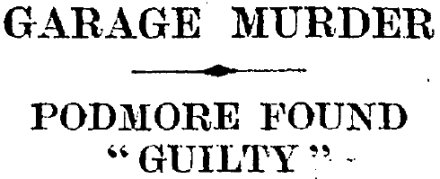
On this date in 1930, criminal forensics claimed an apparent — albeit controversial — victory with the hanging of William Henry Podmore.
Podmore was noosed by a chain of circumstantial evidence investigators used to connect him to a murder scene — that, specifically, of his former employer Vivian Messiter, whose badly decomposed corpse was found tucked in a garage nine months after it went missing.
The ensuing investigation went like a Roaring Twenties version of CSI.
First, famed pathologist Bernard Spilsbury established a cause of death: blunt force to the skull, apparently delivered by a bloodied hammer found nearby.
After that, it was a matter of connecting some malefactor to the handle of the hammer.
[A] scrap of paper, about two inches square, which was found behind a barrel in [the] garage … led ultimately to the conviction of the murderer. This fragment was caked with dirt and soaked in oil, and had been repeatedly trodden under foot, and the problem was to remove the dirt and oil, without also removing the pigment of the copying ink pencil.
After numerous experiments with various makes of copying ink pencil, petroleum spirit was found to be suitable for the purpose, and a message from a man calling himself “W. F. Thomas” was left upon the paper. Until then, it was not known that anyone of the name of “Thomas” (an alias of Podmore) had been in any way connected with the victim.*
This was still very far from placing a fellow on the gallows until a further bit of investigative prestidigitation produced an apparent motive:
a leaf from a note-book showing indentations which had, presumably, been made by the pressure of a pencil on another leaf of the book subsequently torn out. By means of photography with the use of oblique lighting to illuminate the edges of the indentations, words relating to bogus orders, with the initials of “Thomas,” were rendered visible.*
From such paper was the crown able to craft a case which the reader will readily discern: Podmore, a mechanic only temporarily in Mr. Messiter’s employ, had entered some fraudulent transactions upon which he claimed a commission, and a fatal altercation presumably ensued upon Messiter’s discovering the con. The fact that Podmore was already wanted for fraud and robbery elsewhere did not help the defendant’s situation.
The “Garage Murder” investigation played out for months throughout 1929, much of which Podmore spent in jail on the other larceny charges while the cloud of suspicion gathered over him. In early March 1930, trial bulletins on counsels’ disputes over this novel evidence — its admissibility, its weight and application to the theory of the crime, and the sleuthing techniques employed to gather it — filled the papers almost daily.
Evidence that fit “like a crossword puzzle” (in the summing-up of the state’s attorney) nevertheless did not amount to anything so ironclad that Podmore wanted for public support: in the couple of weeks between a rejected appeal and Podmore’s execution, 12,000 people signed a petition for his reprieve, including 79 Members of Parliament.**
(Those crossword forensic clues had been buttressed by that classic recourse of the prosecutor, dubious jailhouse-snitch testimony as to the convenient spontaneous confession of the accused allegedly delivered to perfect strangers in the most injurious possible situation: that such specious evidence might have proved decisive in a matter of life and death seems to have moved a lot of signatures to the clemency petition.)
Given the circumstances, the Home Secretary took the unusual step of issuing a statement on its denial of this measure to calm the “disquiet in the public mind” — and expressing his confidence beyond any “scintilla of doubt as to the prisoner’s guilt.”†
* C. Ainsworth Mitchell, “Scientific Documentary Evidence in Criminal Trials,” Journal of Criminal Law and Criminology Vol. 23, No. 2 (July-August, 1932)
** London Times, April 16, 1930
† London Times, April 21, 1930. “I searched for many days,” Secretary Clynes said after the hanging (Times, April 23, 1930), “in the hope that I would find a reason for recommending a reprieve. I searched in vain.”
Although O’Bryan was after his own kids, he might have given some out to the neighbors as well.
Nobody else died, or even got sick, but this was the era of the after-school special and satanic hysteria, so this pedestrian malefactor’s incidental connection to Halloween — after all, he could have just poisoned the kids’ Cheerios instead — metastasized into baseless urban legends of Stephen King villains spiking candy corn with rat poison and candy apples with razor blades.**
“The crime changed the way Texas youngsters, particularly those in the Houston area, celebrate Halloween,” the A.P. reported. “Some neighborhoods informally banned distribution of candy.”
Some nutbar kills his offspring for the insurance money back in the Ford administration, and that’s why you’re still getting crayons in your pillowcase sack. Crayons.
Siouxsie and the Banshees turned this creeper scenario to good effect in the 1986 song “Candyman”.
Beware the masked pretender
He always lies, this candyman
Those lips conspire in treachery
To strike in cloak and dagger, see!
* There are some reports out there of a March 30 execution, but newspaper accounts do appear to confirm that O’Bryan was put to death in the early moments of March 31, a Saturday.
(Thanks to author Dick Haws for graciously allowing us to reprint this chapter from Iowa and the Death Penalty: A Troubled Relationship, 1834-1965. Check out the book for more on the other 44 men (no women) hanged in the Hawkeye State. -ed.)
Phillip and William Heincy established several firsts when they were hanged on the same scaffold at the Iowa State Penitentiary in Fort Madison. They were the first — and only — father and son team to be executed by the State of Iowa. And Phillip, at 72, was the oldest. But it was the two men’s ignorance, their dim-wittedness, that also must have set some kind of record. Together, they had lived well over 100 years on the planet yet they had remained sublimely ignorant of the world around them. Phillip, or “Dad” to William, testified that he had gone to school off and on through the second grade, that he couldn’t write, couldn’t read, had never placed a long-distance telephone call, didn’t know the significance of Easter nor the number of months in a year, nor the number of days in a week, nor anything special about the Fourth of July, except that “I have to work every Fourth of July.” For his part, William, or “Bill” to “Dad,” testified he was born on Christmas Day 1900 but never knew the significance of that day nor Easter nor the Fourth of July. He said he had attended school for “parts of four years.” Their defense attorney, K. B. Welty, summed up his clients’ plight. “These men came into this world with very limited capacities, never attending Sunday School or church except for a few times, and school was limited, and society in which they traveled was limited and opportunities were limited because their intelligence did not permit them to get into proper society.”?
But that isolation didn’t prevent them from becoming ruthless criminals, and, in the end, murderers. Dad didn’t enter prison until he was 51, which suggests, as their Catholic priest on death row observed, that son Bill “apparently is the dominant personality and the father seems to follow his lead.” The two were Missourians and, in 1924, were arrested for the first time for stealing a Ford touring car and escaping from jail. Dad got seven years in a Missouri prison, Bill, four years. After their release, they headed north in to Iowa, and in 1931, near Iowa Falls, they held up a couple at gunpoint, kidnapped them and stole their car. About two weeks later, they shot it out with Mason City police and were apprehended. They were convicted under the false names they gave — P. H. Smith for Dad, W. H. Baker for Bill — and sentenced to a maximum of 25 years at the Iowa State Penitentiary. Dad was paroled after nine years, Bill got out after about 10 years.
In 1944, they were back together and ready to attack again. On the evening of Dec. 14, 1944, Bill and Dad boarded a train out of Quincy, Ill., bound for Spirit Lake in northern Iowa. During an earlier spring Dad had worked for a short time on a farm near Spirit Lake while Bill had helped out at a nearby resort on West Lake Okoboji, run by Robert and Esther Raebel, a prominent, deeply religious, childless couple who were known for the hours they spent with the children of the Spirit Lake Methodist Church. The Heincys would later claim they had headed to northern Iowa to retrieve a car they had stored there and to make some money hiring out to pick corn. Dickinson County Attorney W. B. Bedell never believed them; he maintained their only reason for coming to Spirit Lake was to steal and murder. Bedell cross-examined Dad, getting him to admit that he didn’t know where the car was, that he and his son carried no luggage with them, no extra clothes, no work gloves, but that they did bring along a gun and a billy club. “You didn’t expect to pick corn with a billy and a gun, did you?” Bedell asked. After arriving in Spirit Lake, Bill said in his confession, they loitered around the railroad depot for a few hours, undecided about what to do next. They went to a tavern and had a beer, then ate a sack of donuts. Then, almost by chance and with apparently little forethought, the two said in their confessions they decided to walk the four and one half miles to the Raebel resort, planning to rob the couple of the large amounts of money they believed they had on hand. Bill and Dad said they watched through a resort window as the Raebels ate supper, washed the dishes, and moved into the living room, where Esther addressed Christmas cards at a card table. When Robert got up to go down the basement to check the furnace, the Heincys struck, breaking into the resort. Bill, who was carrying both the .22-caliber revolver and the billy club, shot Robert just as he was coming back up the stairs. He staggered into the living room and fell on the floor, almost at his wife’s feet. The bullet entered his neck below the right ear and severed his aorta, causing him to bleed to death. From Esther, the Heincys demanded money and the car. She gave them all the money she had — about $28 — and the car keys. Before fleeing, Bill slugged the woman several times over the head with the billy club, knocking her unconscious to the floor. In their confessions, the Heincys said they believed they had killed both the Raebels, but, within about two hours, Mrs. Raebel had recovered enough to call the Okoboji telephone operator, who spread the alarm. Mrs. Raebel was also able to identify her assailants.
“Have you ever seen the men before?” she was asked at the coroner’s inquest.
“Oh, yes, absolutely,” she responded. “I just know it is those men, see, that worked at our place.”
“Both men worked at your place?”
“No, no, just the one. The old man stayed with Jens.”
“Jens Anderson?”
“Yes. He worked on the farm there. That is right.”
“Would you know the man’s name?”
“Well, his name, Heinke, something like that.”?
“Was it Heincy?”
“Yes, that is right. Yes,” she repeated and identified photographs of the two.
The Raebels’ car was found the next day abandoned in downtown Storm Lake. Nineteen days later, the Heincys were arrested without incident in Quincy, Ill. They were returned to Iowa, quickly confessed, pleaded guilty and awaited sentencing from Judge Fred M. Hudson. The Heincys hoped to escape the death penalty by arguing that they intended only to rob the Raebels, not kill them, that Robert’s death was unintentional. But Judge Hudson was unpersuaded. “If robbery was all they intended,” he asked rhetorically at their sentencing hearing, “why did they not stop there? The facts of these cases warrant the finding that these defendants completed their robbery and then in order to make good their escape and avoid detection and identification, purposely inflicted what they thought were fatal injuries upon both the victims of their robbery, and killed one victim and thought they had killed the other. In so doing they thought they had eliminated the only two persons who knew them and who could identify them as the robbers.” The judge said he also tried to determine whether one of the Heincys was more guilty than the other. “The younger man apparently did the shooting and most if not all of the beating,” Judge Hudson said. “However, the older man planned the robbery with him, entered upon the perpetration of it armed and knowing the younger man was armed and in what manner, demanded and received the money of at least part of it, handed the billy to the young man to use. How can it be said under our law that both are not equally guilty and responsible?” Bill and Dad were sentenced to be hanged on March 29, 1946.
The effort to spare the lives of the Heincys focused on Gov. Robert Blue, not the Iowa Supreme Court, because the Heincys’ attorney, K. B. Welty, did not believe his clients had been treated unfairly in the court process. “They (Dickinson County authorities) did a grand job,” he told the governor. The appeal to Gov. Blue didn’t come to a head until March 4, 1946 — only 25 days before the scheduled executions — and it raised arguments about the mental acuity of the Heincys. “Actually,” Welty told the governor, “these men are poor, wretched, depraved souls and, although you may feel there is no value of them to society, I say to your honor, we should not hang them. As you well know, we have institutions all over this country where we keep our mentally defective and crippled people.” Welty suggested that if the Heincy defense had had the money to hire psychiatrists, “possibly and probably a different result could have been obtained.” Welty also blamed society for allowing the Heincys freedom in the first place. “Perhaps they should have been kept in the penitentiary long ago and I presume that society has laxed in not seeing to it.” But the governor bored in on the question of the Heincys’ insanity, asking Welty whether the Dickinson County judge had heard any testimony about it. “No, your honor,” Welty responded. “You didn’t call any local doctors that would have any knowledge of psychiatry?” the governor asked. “No, sir,” Welty responded. “Did you raise that question with the court?” the governor continued. “No, sir,” Welty answered. “Do you feel they know the difference between right and wrong?” the governor asked. “Yes, sir, at times, but I think there are times in their lives that they were so crazed that they lost control of themselves,” Welty responded. “Any feeling on your part that they are insane, or are they uneducated persons who lack self-control?” the governor asked. “In respect to the elder Heincy, I have sensed that he is rather unbalanced,” Welty responded. “I think the younger fellow is not that bad.” The governor didn’t delay in announcing his decision. “Their whole history has disclosed that they were at war with society,” Gov. Blue said. “I can find in statements made to me no reason for granting executive clemency.”
But Welty battled on. Only days before the scheduled execution, he asked for a sanity hearing. Arguing that Dad Heincy had “the mentality of an 8-year-old boy,” Welty said, “we certainly would not hang an 8-year-old boy in this state. I can’t believe that the great State of Iowa, on the eve of its one hundredth birthday, will bloody its hands by taking lives in this manner. The time will come when this state will follow other intelligent states and do away with executions.” Welty was partially successful. The Iowa Board of Control ordered an immediate sanity examination of the Heincys. Two psychiatrists and a psychologist questioned the two men for more than two hours on the Wednesday before they were scheduled to be hanged. Their conclusion? Neither of the Heincys was insane nor feebleminded.
The hangings went off as scheduled. Dad and Bill, on the night before their executions, got baths, shaves and haircuts, and the prison-made suits, hats, shoes and ties. The traps were sprung by Dickinson County Sheriff Joe McQuirk at 6:01 a.m. Bill dropped a split second before Dad. Dad was pronounced dead after 11 minutes, Bill after 12.
NOTES
Sources include Governor’s Correspondence on Criminal Matters, Phillip Heincy file, State Historical Society of Iowa, Des Moines; Governor’s Correspondence on Criminal Matters, William Heincy file, State Historical Society of Iowa, Des Moines; the Spirit Lake Beacon; the Des Moines Tribune; the Des Moines Register.

 Garner had burglarized the Cincinnati, Ohio apartment of Addie F. Mack on January 26, 1992, after he stole her purse and keys while she was being treated in a hospital emergency room.


 Following the classic sob-story vector from orphan to juvenile delinquent to petty criminal,


 Once decorated for his volunteer medical practicioning in the benighted lands of eastern Europe,