1881: Percy Lefroy Mapleton, police sketch milestone

When Percy Lefroy Mapleton plunged through the gallows-trap at Lewes Prison on this date in 1881 for robbing and murdering a train passenger, he had the consolation of a minor milestone in policing history: he was the bobble-headed subject of the first published police sketch.
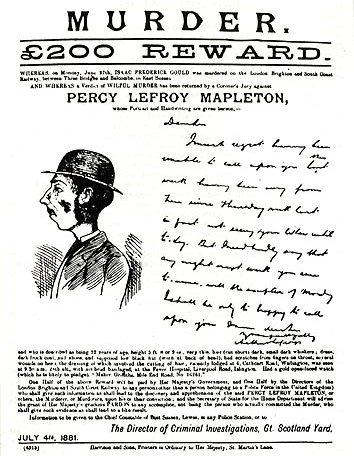
Mapleton (he gave his name initially as Percy Mapleton Lefroy) entered the annals of crime lore at Brighton‘s Preston Park railway station on the 27th of June, a mere five months before his execution. On that occasion, he presented himself, bloodied and bedraggled, to a ticket agent with a complaint that he’d been assaulted on the train by two unknown men.

Maybe it was the gold watch chain dangling out of his boot (the man said he’d stashed it there for safekeeping) or an unexplained couple of Hanoverian medals he possessed (the man didn’t know anything about those!), or his keen desire to ditch the investigators and return immediately to London for some business (so why take the train to Brighton in the first place?). There wasn’t quite sufficient reason to hold him, but there was ample cause to give him a minder for his ride back to London.

Apparently Sgt. George Holmes hadn’t been fully briefed on suspect escort protocol.

During their ride, police searching the rail line by which the strange bloodied man had arrived turned up the body of an elderly coin dealer named Isaac Gold, the sort of character who would have pocket watches and Hanoverian medals to steal. A telegraph sent from the nearest station arrived ahead of Mapleton’s train, reading

Man found dead this afternoon in tunnel here. Name on papers “I Gold”. He is now lying here. Reply quick.

At this point, explicit instructions to keep eagle eyes on Percy Mapleton would hardly seem to be required — yet they were indeed forthcoming. Despite what headquarters and common sense were telling him, however, Sgt. Holmes allowed the murder suspect to talk him into letting him “change clothes” unsupervised in a house. And so began a nationwide manhunt.

This manhunt would be distinguished by a police sketch of the fugitive created with the help of Mapleton’s acquaintances. London Metropolitan Police’s (then-newborn) Criminal Investigation Department appealed to the press for help and the Telegraph made history by printing the man’s profile, first time such a drawing had hit newsprint for this purpose.

Age 22, middle height, very thin, sickly appearance, scratches on throat, wounds on head, probably clean shaved, low felt hat, black coat, teeth much discoloured … He is very round shouldered, and his thin overcoat hangs in awkward folds about his spare figure. His forehead and chin are both receding. He has a slight moustache, and very small dark whiskers. His jawbones are prominent, his cheeks sunken and sallow, and his teeth fully exposed when laughing. His upper lip is thin and drawn inwards. His eyes are grey and large. His gait is singular; he is inclined to slouch and when not carrying a bag, his left hand is usually in his pocket. He generally carries a crutch stick.

The publicity blitz generated dozens of erroneous reported sightings throughout the country, but successfully put the screws to the wanted man who was hemmed into an untenable boarding house bolt-hole with an increasingly suspicious landlady and a dwindling pool of money. At last he was

apprehended on Friday evening, July 8, at 32, Smith-street, Stepney, where he took lodgings two days after his disappearance from Wallington … He went out very little, and chiefly at night … He described himself as an engraver, and as one who needed quietness. A telegram sent by Lefroy from 32, Smith-street, to his friend Seele was the cause of his arrest. It appears that the suspicions of his landlady, Mrs. Bickers, being aroused by his peculiar mode of living, she sent her daughter to the address indicated on the telegram, which ran as follows: —

From G. Clark, 32, Smith-street, Stepney, to S. Seele, at J.T. Hutchinson’s, 56, Gresham-street, London, E.C. — Please bring me my wages this evening, about eight, without fail. Flour to-morrow. Not 33.

This telegram led some unknown person, it is said, to call at Scotland-yard, and give information.

On this day..

1789: Ann Davis, the first woman hanged at Sydney Cove

The first woman hanged in colonial Australia was Ann(e) Davis, on this date in 1789.

Convicted in London “for feloniously stealing, on the 27th day of April, eight pair of silk stockings, value 8s. the property of James Atkinson,” Davis was one of 101 female convicts transported to Sydney Cove with the First Fleet aboard the Lady Penrhyn.* Davis would have been in the crowd of onlookers the year before when the fledgling colony conducted its very first execution.

This spectacle did not un-sticky Davis’s fingers, for she was sentenced in Sydney Cove for again plundering wardrobes to the tune of

four linen shirts of the value of twenty nine shillings and six pence; one cheque shirt of the value of four pence; one linen waistcoat of the value of two shillings; two cambrick handkerchiefs of the value of three shillings; one silk waistcoat of the value of two shillings; one dimety waistcoat of the value of eighteen pence of the goods and chattels of the said Robert Sidaway; and one linen bed gown of the value of two shillings; one linen apron of the value of eighteen pence; two linen caps of the value of sixpence; one piece of a cap of the value of one penny; one muslin handkerchief of the value of six pence; and one pair of linen pockets of the value of one penny of the goods and chattels of Mary Marshall in the same dwelling house.

Davis attempted to plead her belly, failing to impress a jury of matrons impaneled to scrutinize her for pregnancy.

Seaman Jacob Nagle piteously recorded her end:

Some time after this, one of the wimen [Ann Davis] stole some wet clothes and was condemned and hung. She strove to bring a free man in guilty that belonged to our ship that was on duty on shore, it being proved by a number of witnesses that he was innocent and new nothing of it. Otherwise, she might have been saved, as the Governor left it to Captain Hunter, but he would not for give her, and when brought to gallos, leading her by two wimen, she was so much intocsicated in liquor that she could not stand without holding her up. It was dreadful to see heir going to aternity out of this world in such a senceless, shocking manne.

As noted by Australia’s Dark Heart the experience of dispatching this creature might have been especially traumatizing to the colony’s unwilling executioner James Freeman — for he was found roaring drunk a few days later and punished with 100 lashes.

* After discharging its human cargo, the Lady Penrhyn proceeded upon further circulating in the Pacific and the Far East; in 1788, she sighted and named the Cook Islands atoll of Penrhyn.

On this day..

2010: Li Haito, reliquarian

From IANS on Friday, Nov. 19 of 2010. (via)

China executes official for plundering cultural relics

Beijing, Nov 19 (IANS) China Friday executed an official for stealing and selling cultural relics protected by the state, reports Xinhua.

Li Haitao was the chief of the cultural relics protection authority of the imperial garden in the Hebei provincial capital of Chengde.

He was executed after China’s Supreme People’s Court approved the death penalty on a conviction of embezzlement, the Intermediate People’s Court of Chengde said.

By taking advantage of his post between 1993 and 2002, Li had stolen 259 cultural relics stored in the depository of the Eight Outer Temples, an imperial compound built on the three-century old Summer Mountain Resort.


Putuo Zongcheng, one of the Eight Outer Temples. (cc) image from Ana Paula Hirama.

Li, 50, replaced the relics with copies, inferior or incomplete objects, and asked his subordinates to alter the records.

The stolen items included gold gilded Buddha statues, five of which were listed as state relics under first class protection, 56 were in the second grade and 58 in the third.

Li pocketed more than 3.2 million yuan ($482,240) after selling 152 stolen pieces.

Police have seized 202 relics and are still hunting for 57 other items.

Li’s four accomplices — Wang Xiaoguang, Yan Feng, Zhang Huazhang and Chen Fengwei — were given jail terms of up to seven years with fines.

His crimes went unnoticed until a Chinese expert found two royal cultural relics belonging to Beijing’s Palace Museum at an auction in Hong Kong in 2002.

The expert reported his discovery to the state cultural heritage authorities, which prompted a probe that found Chengde was the source of the relics.

Covering an area of 5.6 million sq metres, the Summer Mountain Resort was the temporary imperial palace of the Qing Dynasty (1644-1911) emperors Kangxi and Qianlong.

The mountain villa, the largest remaining classical imperial garden architecture in China, and the outlying temples were placed on the World Heritage list in 1994.

On this day..

1849: Pierre Dudragne, avarice

On this date in 1849, Pierre Dudragne was guillotined at Chalon-sur-Saone.

He’d done a doubly dirty deed, choking out the 85-year-old widow Marechal in the course of burgling her Montmort home … and then also murdering the old lady’s servant, Claudine Bray. No honor among thieves: Bray was Dudragne’s own lover and accomplice in the heist, and his motive was the firm preference not to split the boodle with her.

On this day..

1740: Ned Darcy, of the Kellymount Gang

On this date in 1740,* Ned “Darcy, one of the Kellymount gang, was tried at Carlow, on the Proclamation; and, being proved to be the man, in ten minutes he was taken from the dock and hanged, and his head fixed on the Court House.”

The Kellymount gang — named for a County Kilkenny town it frequented — was a band of outlaws who were the terror of Leinster in 1740, a famine year due to a brutal frost.

Numbering as many as 30 strong, this troop had the boldness even to lay siege to manors and the ferocity to put gentlemen in mortal terror; we find our same principal just weeks before his execution going the full monster:

August 30 — Yesterday morning, one Ned Darcy went to the house of one Doran, in the County of Carlow, took him out of his bed and, naked as he was, put him on horseback, and in that manner carried him through part of the Counties of Carlow and Kilkenny; and being met by several, were asked where they intended to take him, to which they replied they were going to hang him, he having been the occasion of hanging a brother and a father of Darcy’s; and we have been since informed that, having taken him into Kellymount Wood, they cut out his tongue, cut off his ears, and pulled out one of his eyes, then desired him to go to Sir John, in Capel Street, give in his examination to him of their proceedings, and tell him they would serve him in the same manner were he in their power, as also Mr. Bush.

Mr. Bush, who came from Carlow three days ago, had one hundred men armed to guard him, and Mr. Gore, the same from Waterford; so by this you may see in what fear we travel in this country.

The Kellymount Gang was mostly busted up in these months with no small number of executions, but its remnants survived to launch the career of one of Ireland’s most celebrated bandits, James Freney — for a few years later, Freney, a failed tavernkeeper mired in debt, chanced to find himself neighbor to “one John Reedy, who had formerly been one of the robbers, commonly known by the name of the Kellymount Gang, but who had been pardoned for making some discoveries.” Reedy advised Freney in a moment of financial desperation that “there was a fair at hand, and that there was a number of drovers to be there; who, he said would have a great deal of cash; and told me, that my only remedy to extricate myself from my creditors, was to make to the highway, and that he would get three or four men to assist me.”

The former publican took up the offer to good effect, and proceeded to make his name and fortune on the roads.

We hope our readers will recognize this famous criminal from the stickup he perpetrates upon the title character in Thackeray‘s 1844 serial The Luck of Barry Lyndon, and likewise in Stanley Kubrick‘s masterpiece 1975 adaptation, Barry Lyndon. (He’s called “Feeney” in the film.)

* Julian date: the quoted blurb comes from Reilly’s Dublin News-Letter of November 8th, 1740.

** Much to the disadvantage of Executed Today, Freney/Feeney was the rare outlaw who was able to retire with his earnings, emigrating abroad and eventually returning to work as a customs official in Inistioge. The account of his criminal origins we have from Freney’s own memoirs.

On this day..

1773: Levi Ames, Boston burglar

Must Thieves who take men’s goods away
Be put to death? While fierce blood hounds,
Who do their fellow creatures slay,
Are sav’d from death? This cruel sounds.

But, ah! Alas it seems to me,
That Murder now is passed by
While Priests and Rulers all agree
That this poor Criminal must die.

What can they no compassion have?
Upon the poor distressed Thief,
Will none appear his life to save
Or pray that he may have relief?

Oh no! The Ministers they say,
For him there can be no reprieve;
He must be hang’d upon the day,
And his just punishment receive.

-“Theft and Murder! A Poem on the Execution of Levi Ames” (1773 broadside)

On this date in 1773, burglar Levi Ames was hanged in colonial Boston for burglary.


Illustration from a 1773 broadside announcing Levi Ames’s controversial execution (click for an image of the entire document).

This young thief’s death — and his surprising purchase on public sympathy in view of the recent politically charged gallows escape by crown loyalist Ebenezer Richardson for killing patriot protester Christopher Seider — are extensively excavated by Anthony Vaver (author of the books Bound with an Iron Chain and Early American Criminals) at his site Early American Crime. I can’t begin to improve upon this series.

On this day..

1769: Six at Tyburn, “most of them, sir, have never thought at all”

The sixfold Tyburn hanging on this date in 1769 — all six men condemned for non-homicide property crimes.*

The acquitted Giuseppe Baretti.

We notice them best for their proximity to an altogether more prominent trial: that of the Italian emigre and scholar Giuseppe (Joseph) Baretti, which would take place two days later, on Friday, October 20.** A society fixture whose gift to posterity was setting down (or inventing) that legendary murmur of the beaten-but-unbowed Galileo, “eppur si muove”, Baretti had lived in London for many years and was well-known to the local elites … but in these days he would fear for his stately neck on account of stabbing a man to death during an October 6 brawl in the Haymarket.

This street and the district to which it gave its name lay a quarter-mile to the west of Coventry Garden (op. cit.) and was part of the same vast zone of street prostitution and other underbelly delights. What the great linguist meant to get up to ’round “Hell Corner” will have to be guessed at but in the course of his business he smacked a woman — after, so Baretti said, “she clapped her hands with such violence about my private parts, that it gave me great pain.” Upon this outrage, several young toughs accosted him, and where the innocent reader might perceive chivalry, Baretti’s defenders asserted a common setup for calculated mayhem. “It is a common case there, I am sorry to say it,” a judge testified. “There is seldom a woman that attacks a man, but they have two or three men behind them, ready to pick your pocket, or to knock you down.” Baretti knifed one of this gaggle, mortally.

Joining the local magistracy in Baretti’s corner was fellow dictioneer Samuel Johnson, who presented himself at the Old Bailey to offer evidence on behalf of his colleague.

Doctor Johnson. I believe I began to be acquainted with Mr. Baretti about the year 53 or 54. I have been intimate with him. He is a man of literature, a very studious man, a man of great diligence. He gets his living by study. I have no reason to think he was ever disordered with liquor in his life. A man that I never knew to be otherwise than peaceable, and a man that I take to be rather timorous.

Q. Was he addicted to pick up women in the street?

Dr. Johnson. I never knew that he was.

Q. How is he as to his eye-sight?

Dr. Johnson, He does not see me now, nor I do not see him. [both men were nearsighted -ed.] I do not believe he could be capable of assaulting any body in the street, without great provocation.

Johnson, however, was sanguine about his timorous pal’s potential execution. The very eve the big trial — and the day after the hanging that provides the excuse for this post — Johnson plied his gallowsshadowing familiar James Boswell with this unsentimental appraisal of human fellow-feeling:

l mentioned to him that I had seen the execution of several convicts at Tyburn, two days before, and that none of them seemed to be under any concern. JOHNSON. “Most of them, sir, have never thought at all.” BOSWELL. “But is not the fear of death natural to man?” JOHNSON. “So much so, sir, that the whole of life is but keeping away the thoughts of it.” He then, in a low and earnest tone, talked of his meditating upon the awful hour of his own dissolution, and in what manner he should conduct himself upon that occasion: “I know not (said he), whether I should wish to have a friend by me, or have it all between GOD and myself.”

Talking of our feeling for the distresses of others; — JOHNSON. “Why, sir, there is much noise made about it, but it is greatly exaggerated. No, sir, we have a certain degree of feeling to prompt us to do good: more than that, Providence does not intend. It would be misery to no purpose.” BOSWELL. “But suppose now, sir, that one of your intimate friends was apprehended for an offence for which he might be hanged.” JOHNSON. “I should do what I could to bail him, and give him any other assistance; but if he were once fairly hanged, I should not suffer.” BOSWELL. “Would you eat your dinner that day, sir?” JOHNSON. “Yes, sir; and eat it as if he were eating with me. Why, there’s Baretti, who is to be tried for his life to-morrow, friends have risen up for him on every side; yet if he should be hanged none of them will eat a slice of plum-pudding the less. Sir, that sympathetick feeling goes a very little way in depressing the mind.”

I told him that I had dined lately at Foote’s, who showed me a letter which he had received from Tom Davies,† telling him that he had not been able to sleep from the concern he felt on account of “This sad afair of Baretti,” begging of him to try if he could suggest any thing that might be of service; and, at the same time, recommending to him an industrious young man who kept a pickle shop. JOHNSON. “Ay, sir, here you have a specimen of human sympathy; a friend hanged and a cucumber pickled. We know not whether Baretti or the pickle man has kept Davies from sleep: nor does he know himself. And as to his not sleeping, sir; Tom Davies is a very great man; Tom has been upon the stage, and knows how to do those things: I have not been upon the stage, and cannot do those things.” BOSWELL. “I have often blamed myself, sir, for not feeling for others as sensibly as many say they do.” JOHNSON. “Sir, don’t be duped by them any more. You will find these very feeling people are not very ready to do you good. They pay you by feeling.”

* One burglar, one forger, and four highway robbers.

** The Old Bailey Online web page puts the trial date on October 18, which is flatly erroneous; it appears to be an algorithm’s conflation for a package of various proceedings spanning “Wednesday the 18th, Thursday the 19th, Friday the 20th, Saturday the 21st, and Monday the 23d of October.”

† A Scottish bookseller, writer and actor, Tom Davies introduced Boswell and Johnson.

On this day..

1902: Jim Buchanan, escaping lynching

On this date in 1902, Jim Buchanan was tried, convicted, sentence, and immediately executed in Nagocdoches, Texas … with his full assent.

Barely a week earlier, a word had been received of a “prosperous farmer”, Duncan Hicks, found murdered with his wife and his daughter near the village of Attoyac.

Although Buchanan was swiftly arrested by a Sheriff Spradley, the fury of multiple mobs hunting him made the lawman and the murderer temporary collaborators on the run, trying to reach the safe haven of a secure jail cell to frustrate the vigilantes.


Daily People (N.Y.), Oct. 15, 1902.

Law and lynch law for years collaborated as good cop and bad cop. In this case, the work of their respective pressures on a desperate prisoner becomes unusually visible.

Buchanan was tried on the morning of October 17 in Nacogdoches. Reportedly the town teemed with vengeful white men readying for any opportunity to seize their prey from the legitimate authorities and have their own way. It was expected that if taken by the frighteningly determined mob, Buchanan would be horrifically burned to death.

Buchanan did what he could do to avoid that fate.

After he was sentenced to hang on November 17, the prisoner aggressively insisted on waiving the month-long wait and signed away all his appeals in the interest of dying on the gallows right now. And so before noon, that’s exactly what happened. His whole legal journey from the first gavel to the drop of the trap took a mere two hours, but at least it didn’t end at the stake.


Dallas Morning News, Oct. 18, 1902.

On this day..

1866: The Richard Burgess gang, for the Maungatapu Murders

On this date in 1866, Nelson, New Zealand was marred for the first time by a gallows — which revenged in triplicate one of the most notorious crimes in New Zealand’s European settlement era.

The gang of toughs led by London-born transport convict Richard Burgess formed itself at the fringes of the early 1860s *gold rush in the South Island’s Central Orago wilderness. The gold strike was nicely timed to attract veterans of the California (USA) gold rush and the Victoria (Australia) gold rush, both of which were ten-plus years old and into their petering-out stages; in those places and many others where gold stirred men’s feet sticking up lucky prospectors was just a lucrative tertiary sector supported by all those the pickaxes, like boom town saloons and cathouses.

And Burgess was an old pro at rendering his peculiar “service”. He’d made his own way for some time robbing miners in Victoria, before he followed his market to Otago and attracted to his train fellow-desperadoes Thomas Kelly (aka Thomas Noon), Joseph Sullivan, and (an old associate from Aussie days) Philip Levy.

Along a stretch known as the Maungatapu track — at a spot now remembered as Murderers’ Rock — the quartet set up an ambush for a group of businessmen whom they learned were moving their money to a bank in Nelson. On June 12, a luckless passing laborer named James Battle passed their way and wound up strangled to death for his mischance. The next day, four businessmen appeared as expected and were all shot and strangled to death, yielding a total haul north of £300.

To their grief, the previously impecunious men were quite indiscreet about throwing their earnings around back in Nelson, and when a friend reported the victims’ party missing the Burgess group became suspect almost immediately. All were in custody within a week of the crime, even before the bodies were located — which only occurred on the 29th when Joseph Sullivan, seeing where the wind was blowing, made a full confession in exchange for clemency.* His statement was the death warrant for his former confederates.

In the account of the next day’s Nelson Examiner, Burgess died boldly and Levy, after favoring the audience in Nelson Gaol with an extended vindication of his innocence, did likewise. But Kelly was entirely unmanned by mounting the scaffold where

ensued a scene of the most painful nature, one which almost baffles description, but which, nevertheless, it is hardly possible to regard otherwise than as a consistent and appropriate finale to this most extraordinary tragedy … [Kelly] for some time resolutely refused to obey the directions of the officials, literally screaming and ejaculating in the most piteous tones, “Don’t do it yet, let me speak. I am forced, I am not hanged, but murdered.” And then, with an almost idiotic expression on his features, “God bless me, where am I? I ought to be allowed to speak.” … During this time the various ministers were engaged in whispering consolation to their respective charges, and the scene of confusion which Kelly’s violent conduct produced may be more easily imagined than described. The ropes were then placed round their necks and the white caps drawn over their faces, but during the whole time Kelly never ceased talking, or rather whining out, in a half broken voice, saying, “I did not write that name on the gun, Burgess did it. I hope I may go to God, and every one here.” …

Our readers may picture to themselves the distressing nature of this scene, which visibly affected every spectator present, and which seemed to increase in intensity every moment it was prolonged. Kelly’s shrill and discordant voice was still heard continually shrieking forth, in the most heartrending accents … Once Kelly attempted to move himself aside from the drop, but was immediately replaced by the officials in attendance.

Kelly kept on babbling as a minister began reading the Anglican Burial Service, and he was still at it when the trap was dropped. Perhaps due to his agitation on the scaffold, Kelly died hard the hard, requiring the help of the executioner’s rough grab on his legs to enhance the pressure of the noose. “The dead silence which followed on the consummation of the tragedy seemed almost a welcome relief,” the Examiner remarked.

After hanging, science and pseudoscience had their way with the bodies: doctors dissected the necks, it being “a matter of dispute amongst medical authorities whether death in such cases is caused by strangulation or by dislocation of the spinal column … it was satisfactorily proved that death has resulted in each case from strangulation, the spinal column being found to be perfect in each instance; thus setting this much vexed question at rest.” Meanwhile, the heads were removed altogether so that phrenologists could cast them.

Those casts are still in the possession of the Nelson Provincial Museum. An obelisk in memory of the five men they slew stands at Nelson’s Wakapuaka Cemetery.

* Sullivan served seven years in prison, then was pardoned on condition that he remove himself permanently from both New Zealand and Australia, although he later violated that condition. His ultimate fate is uncertain but he’s known to have outlived the rest of his party by many decades.

On this day..

1915: Cerkez Ahmed, disposable fanatic

On this date in 1915, Ottoman major Cerkez Ahmed (often Ahmet) hanged in Damascus.

The officer had been an important figure months earlier in the opening campaigns of Armenian genocide in the eastern province of Van where he operated as a paramilitary chief that verged so close to a brigand that he was eventually treated as one. Most egregiously, when two reformist Armenian parliamentarians named Vartkes Seringulian and Krikor Zohrab were arrested and deported to Syria, it was Ahmed who ambushed and murdered them.* (He was also the assassin in the prewar years of opposition journalist Ahmed Samim, but he’d long since been amnestied for that horror.)

Although in this he was enacting the state’s own policy, his proclivity for gorging himself on the valuables of his victims provided an impetus — a pretext, really — to eliminate him. The official communiques between officials determining his fate (and that of an associate) paint a grim and cynical picture. The following quotes can be found piecemeal in a number of sources, but they’re marshaled comprehensively in the open source volume Documentation of the Armenian Genocide in Turkish Sources under the heading “The Case of a Special Organization Major”.

The brigands Halil and Ahmed visited me today. They stated that having completed the massacres in the Diyarbekir area, they came to Syria to do the same for which purpose they said they are ready to receive the orders. I have them arrested. Awaiting your excellency’s orders.

-Telegram from the governor of Aleppo to Cemal Pasha, one of the “Three Pashas” who ran Turkey as a triumvirate


I feel dishonored. I served my country. I desolated Van and environs. Today, you car’t find a single Armenian there … I killed off the Armenian Deputies Zohrab and Vartkes. I grabbed Zohrab, threw him down, took him under my feet and with a big rock crushed his head — crushed and crushed until I killed him off.

-Ahmed, complaining to the intelligence officer Ahmed Refik (according to the latter’s postwar account)


In as much as I am convinced that Cerkez Ahmed committed these crimes by the order of Diyarbekir governor Reshid,** do you still find the liquidation of Ahmed absolutely necessary? Or, should I be merely content with Halil? Kindly respond by tomorrow evening.

-Cemal to fellow triumvir Talaat Pasha


His liquidation in any case is necessary. Otherwise he will prove very harmful at a later date. Talat.

-Talat’s reply to Cemal (on September 15/28, 1915)


The verdict against Cerkez Ahmed is execution. The requisite step will be taken in Damascus tomorrow morning.

-Cemal’s order (on September 16/29)

And he was.

“Undoubtedly Cerkez Ahmed was a scoundrel who deserved to be hanged not once but nine times,” mused the historian Ziya Sakir — who published these ciphered messages in 1943. “With three words uttered by administrative chief Talaat, the life of this creature, who was exploited for the sake of fanatic partisanship, was snuffed out.”

Many years later, Cemal Pasha’s chief of staff Gen. Ali Fuad Erden would reflect on this affair in his memoirs,

Indebtedness to given executioners and murderers is bound to be heavy … those who are used for dirty jobs are needed in times of necessity [in order to shift] responsibility. It is likewise necessary, however, not to exalt but to dispose of them like toilet paper, once they have done their job.

* Reshid Akif Reshid, an Ottoman senator and briefly a state councilor during World War I, provided noteworthy testimony to the postwar Ottoman parliament about the Armenian genocide, detailing the systematic use of extralegal “brigand” paramilitaries in conducting the slaughter: official orders from Istanbul to a provincial official ordered various Armenian communities “deported”; simultaneously, the ruling Committee of Union and Progress “undertook to send an ominous circular order to all points [in the provinces], urging the expediting of the execution of the accursed mission of the brigands. Thereupon, the brigands proceeded to act and the atrocious massacres were the result.”

** The governor referred to here is Mehmed Reshid, one of the genocide’s most enthusiastic agents and “the butcher of Diyarbakir” in Armenian memory. He was arrested after the war and might have been a candidate for this very blog but escaped the prospect of hanging by breaking out of prison and committing suicide when on the verge of recapture.

On this day..