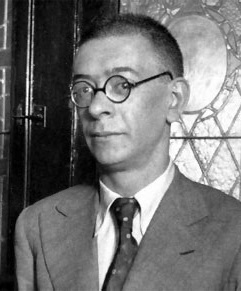
1940: Julian Zugazagoitia, Minister of the Interior to republican Spain

On this date in 1940, the late Spanish Republic’s former Interior Minister was shot by Franco’s dictatorship, having received him from the hands of the Gestapo who arrested the man in exile.

A socialist journalist, Julian Zugazagoitia (English Wikipedia entry | the more detailed Spanish) was tapped for the ministry gig by Prime Minister Juan Negrin — a man to whom history appointed the distasteful destiny of trying to turn the Republic away from the abyss that gaped for it.

Negrin’s major resource in this doomed project was Russian aid* — aid conditioned on Kremlin internal control within Spain, against the other factional groups (anarchists, social democrats, and so forth) that comprised the Republic’s “popular front”. Indeed, Negrin himself came to power thanks to a bloody internal coup against anarchists and anti-Soviet communists. Zugazagoitia found this distasteful but for his year in the government he had to toe the line on it: pressed by a British delegation over the political arrests — and sometimes murders — of pro-Republic dissidents like Andres Nin, Zugazagoitia allowed that “We have received aid from Russia and have had to permit certain actions which we did not like.” (quoted (p. 86) in Orwell’s Homage to Catalonia)

Though he managed to escape abroad as the Republic fell to Franco’s armies, Zugazagoitia was caught by the Gestapo in France; as they had done with his fellow politician Lluis Companys in a similar spot, the Germans deported the former Minister of the Interior to certain execution in Spain.

Zugazagoitia’s grandson, also named Julian Zugazagoitia, directs the Nelson-Atkins Museum of Art in Kansas City, USA.

* An embargo on arms shipments by most western countries all but forced Spain to buy Russian arms, on Russian terms.

On this day..

1941: Francisc Panet

On this date in 1941, “the Romanian Einstein” Francisc Panet was shot with his wife Lili and three other Communists at a forest near Jilava.

A chemical engineer by training, Panet or Paneth (English Wikipedia entry | Romanian) was fascinated by the theoretical research then revolutionizing physics.

While studying in Czechoslovakia, his work on elementary particles brought him to Einstein’s attention, and the two met in 1932 and corresponded thereafter. Panet’s advocates claim that Einstein foresaw for him a brilliant future.

But back in a Romania dominated by fascism, his scientific gifts would be required for more urgent and less exalted purposes: cooking homemade explosives in his bathroom for Communist saboteurs.

Eventually the secret police traced the munitions back to Panet, and he and his wife were arrested in a Halloween raid. Condemned to death in a two-hour court martial on November 5, they allegedly went before the fascists’ guns with the Internationale on their lips.

On this day..

1591: Brian O’Rourke, Irish lord

On this date in 1591, Brian na Múrtha Ó Ruairc — Brian O’Rourke to the English who killed him — was drawn and quartered as a rebel at Tyburn.

O’Rourke was a chieftain in a disappearing world, the Gaelic Ireland that the English had been engaged in reducing ever since King Henry VIII realized that he was King of Ireland back in 1542.

O’Rourke’s patrimony in this Tudor conquest was the kingdom of West Breifne, with a lineage going right back to its 12th century founder. As far as the Tudors were concerned he was just one more truculent local lord to subdue — even if the very “proudest man this day living on the earth.” (per Nicholas Maltby)

O’Rourke’s pride put him into opposition against the English satrap and even led him to succor sailors taking refuge from the shattered Spanish Armada in 1588. But the scope of his autonomy was narrowed and narrowed as expanding English occupation crept upon his environs.

In the end it was his brother-Celts in Scotland who finished him: when O’Rourke turned up there in 1591 seeking license to recruit sword-arms from King James VI (James was not yet James I of England at this point), Queen Elizabeth successfully prevailed upon her Scottish counterpart to arrest and extradite the man — an incident that triggered a riot in Glasgow.

Tried on the highly dubious grounds of treason against England committed in Ireland — plus a lese-majeste incident of having the queen’s image dragged in the mud tossed into the indictment for good measure* — O’Rourke scornfully refused to plead, or to defend himself unless Elizabeth herself would deign to sit in judgment — sovereign to sovereign. The court required only O’Rourke’s body, not his assent, to proceed.

O’Rourke had a sharp enough tongue when minded to deploy it, however. On the scaffold, he witheringly abused the notoriously avaricious bishop Miler Magrath who had been sent to minister to him. Then …

Upon Wednesdaie the 3 of November, Bren O’Royrke was drawne to Tyborne, and there hanged, his members and bowels burned in the fire, his heart taken out, and holden up by the hangman, naming it to be the archtraytors heart, and then did he cast the same into the fire, then was the head stricken off, and his bodie quartered

-John Stowe, The Annales of England (1605) (via)

O’Rourke’s son Brian oge O’Rourke inherited his position, and his struggle, until younger brother Tadgh O’Rourke deposed him with English support. Tadgh died young in 1605 — and with him, West Breifne expired too.

* Enjoy an itemized list of the naughty O’Rourke’s many offenses against English sensibilities from page 144 of this public domain volume.

On this day..

1929: Habibullah Kalakani, Tajik bandit-king

Warlord Habibullah Kalakani, deposed after ten months styling himself King of Afghanistan, was publicly shot on this date in 1929.

An ethnic Tajik whose surname alludes to his native village north of Kabul, Kalakani served in the army of Emir Amanullah Khan.*

This Khan aspired to far-reaching reforms that would modernize his marchlands kingdom and not for the last time an Afghan ruler found this programme stoked a furious resistance among tribal grandees. Kalakani, though derisively nicknamed Bacha Seqao (son of a water-carrier) was just such a grandee, having pivoted profitably from regular military orders to highway robbery.

When Khan’s forces had vacated Kabul to manage a Pashtun rebellion in the south — only the latest of numerous tribal risings that plagued the Khan years — Kalakani in late 1928 sprang a surprise Tajik rebellion from the north and marched on the unprotected capital.

Amanullah evacuated Kabul with a quickness, personally behind the wheel as he blazed his Rolls Royce ahead of Kalakani’s cavalry all the way to India and eventual exile in Europe.


Kalakani

But the “bandit king” soon found his own government strained by the same tensions that had elevated him. Pashtun rebels who used to chafe under a western-oriented king now chafed under a Tajik one — in fact, the only Tajik to rule Afghanistan in its modern history — and their fresh rebellion soon toppled Kalakani in his own turn. He was shot with his brother and their aides, contentedly telling his firing squad, “I have nothing to ask God, he has given me everything I desired. God has made me King.”

Kalakani is still the third-last king of Afghanistan and is still bitterly — violently — controversial on his native soil, where whether you reckon him a hero or a thug depends upon your kinship. Just weeks ago as we write this, a reburial of Kalakani’s remains in Afghanistan provoked bloody ethnic melees on the streets.

* Although there is no specific connection here to Habibullah Kalakani, an execution blog would be remiss not to include a reference to this sadly undateable National Geographic photo tracing to Khan’s reign of one of those real-life dangling man-cages so beloved of the sword-and-sandals fantasy genre. Per NatGeo’s caption, an actual thief was “put in this iron cage, raised to the top of the pole, so that his friends could not pass food or poison to him, and here he was left to die.”

On this day..

1543: Pietro Fatinelli, betrayed by Lando

On this date in 1543, a young nobleman named Pietro Fatinelli was executed for plotting to overthrow the mercantile oligarchy of the Tuscan city-state Lucca.

The Fatinelli family “was of ancient lineage, but had recently played little part in the running of the government,” according to Mary Hewlett in The Renaissance in the Streets, Schools, and Studies. Lucca itself was beginning to wane in importance in the 16th century in the shadow of her Italian rivals and the Holy Roman Emperor Charles V

The young Pietro was able enough to establish himself as an envoy to the imperial court, and ambitious enough to conceive it the platform from which he would redeem the fortunes of Lucca and Fatinelli alike.

Complicit with his friend Captain Giambattista Bazzicalupo di Chiavari, Fatinelli pltted to do away with some of the principal families whom Fatinelli detested, as they represented the merchant oligarchy that spurned his more ancient and noble family.

News of the plot came to the ears of the Lucchese government when Fatinelli unadvisedly mentioned his intentions to Count Agostino Lando, an opprtunistic nobleman from Piacenza, while the two were residing in Venice.


You can’t trust Lando.

Thinking to make some profit at no risk to himself, Lando secretly informed the Lucchese of Fatinelli’s intentions. The signoria acted with utmost secrecy and was able to seize the unsuspecting Bazzicalup di Chiavari while he was reconnoitring in Lucca. They put him to the torture and he cnfessed and revealed the details of the plot, after which he was summarily executed. [August 25, 1542 -ed.]

As Fatinelli resided at the imperial court and had powerful prtoectors, the Lucchesi had a difficult time extraditing him. It took all their powers of persuasion to prove to the emperor that Fatinelli was a traitr. Eventually convinced, Charles V handed Fatinelli over to the Lucchesi, who tried him and publicly executed him after he apologized to the citizens of Lucca. The emperor insisted that, as a last favour, the young man be given the name of his denouncer, as a reward for having repented and admitted his guilt.

Though Fatinelli was defeated, the disaffection with his native city-state proved far deeper-seated than his own person. Just four years after Fatinelli’s hot head fell on the scaffold, another Lucchese nobleman attempted an even more daring revolution.

On this day..

1573: Hugh Cahun, unjustly

On this date in 1573, miscarried justice took the head of Scottish cavalryman Hugh Cahun in Stockholm.

Modernizing in the 16th century, Sweden flattered Scotland with deepening ties not excluding marriage feelers for Mary, Queen of Scots. When a rising Sweden’s ambitions brought her into conflict with Russia, Sweden summoned thousands of Scots soldiers to her banner.


1555 illustration of a Scottish sword dance in the chronicle of Swedish monk Olaus Magnus. (Source).

Hugh Cahun had been in Sweden since probably 1565, in the service of a unit commanded by his older brother William. It was one of three Scottish cavalry commands in Sweden at this time; French and German troops too joined the polyglot coalition.*

In the summer of 1573, Cahun caught wind of recruitment among these foreign auxiliaries for a plot to depose the Swedish King John III in favor of his imprisoned predecessor Erik XIV. Cahun reported the plot, but he didn’t know enough about it to make it stick to someone else — so perversely, he himself became the one suspected of seditious design.

King John appears by his vacillation not to have been all that convinced of the turn justice had taken in this case, twice reprieving Cahun and ultimately sparing him the horrors of the breaking-wheel for a simple beheading — sort of the early modern equivalent of the calculating modern governor who, faced with compelling evidence of innocence, consents to send a condemned man to a dungeon for the rest of his life instead of letting the law take its course. (There’s an account of the back-and-forth run-up to Cahun’s execution in this public domain book, provided you’re packing your Swedish proficiency.)

He would have cause to regret his severity soon enough: in the months to come, it would emerge that the plot was actually being spearheaded by a French loyalist of Erik named Charles de Mornay, who would himself be executed the following September.

* The Scottish were suffered their Calvinist religious devotions because of their foreign tongue — “otherwise their heresy could have infected others.”

On this day..

1989: Francis Minah, Vice President of Sierra Leone

On this date in 1989, Sierra Leone politician Francis Minah was hanged at Freetown’s Pademba Road Prison as a traitor.

He was a veteran minister of state under the country’s dictatorial first president Siaka Stevens — a reign recalled in Sierra Leone historiography as the “17-year plague of locusts” that looted the country and opened the path to its horrific civil war.

Nearing 80 years old in 1985, Stevens stepped down and handed power off to another officer as self-dealing and authoritarian as he, Joseph Saidu Momoh.

In early 1987, Momoh dramatically announced the discovery and defeat of an alleged coup attempt against him* and arrested his own Vice President Minah as its instigator. In a farcical trial — Minah denied his guilt to the last — Minah was convicted and death-sentenced with 15 other alleged participants. Most had their sentences commuted to prison terms, but Minah and five others all hanged on October 7, 1989.

* It was indeed Momoh’s fate to be deposed by his army: that happened in 1992.

On this day..

1802: Sanite Belair, tigress

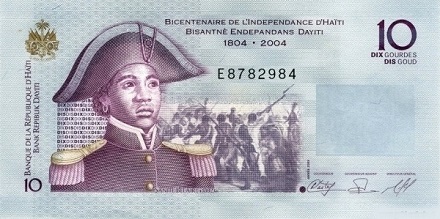
On October 5, 1802, Haitian soldier Suzanne Bélair, called Sanité Bélair, was shot with her husband by the French.

This “tigress” is the most famous of the Haitian Revolution’s numerous female protagonists. A free black woman, she married Charles Belair, the nephew and aide of the man who in the 1790s established pre-eminence on Saint-Domingue — Toussaint L’Ouverture.

L’Ouverture tragically vacillated when the French made their move in 1802 to reverse the revolution’s gains and re-establish slavery, but the tigress rallied General Belair to take the field in resistance — and not only rallied him, but fought alongside him as a regular in his army, attaining the rank of Lieutenant.

It’s said that at her capture, when threatened with beheading, she successfuly asserted the right to an honorable soldier’s death by musketry, and standing before their muzzles cried “Viv libète! Anba esclavaj!” (“Long live freedom! Down with slavery!”)

On this day..

1822: Augustin Joseph Caron, entrapped

On this date in 1822, French Lt. Col. Augustin Joseph Caron was shot at Strasbourg as a rebel.

Little is known of his background, but Caron (English Wikipedia entry | French) enlisted in his army during the revolutionary year of 1791 and advanced into command positions under Napoleon. From his later conduct it’s apparent that these years shaped a political passion that would be starkly at odds with the post-Napoleon Bourbon restoration.

As we have noted elsewhere on this site France’s Liberal (often Bonapartist) opposition during these years was urged by the persecution of the monarchist party into conspiracy as the common coin of its politics.

Out of this mire grew both charbonnerie (France’s analogue to the carbonari terrorists who proliferated in Italy) and an overvigilant secret police whose campaigns of entrapment and threat exaggeration did nothing so well as to further obscure the line between mundane opposition and treason.

The strange interplay between these midnight foes would shape the fate of Col. Caron.

Caron’s path to execution begins with the thwarted rising of the Belfort garrison for New Year’s 1822 — a real plot that the government spies were able to squelch. This resulted in a number of executions, by dint of which it has featured in these very pages.

Caron enters this story in its second chapter: a pensioned former officer of known Bonapartist sympathies, Caron was (with another man named Roger) baited by police spies into mounting an attempted raid on Colmar prison where the arrested Belfort conspirators were being held. Officers chosen to play the part were detailed to meet him as “conspirators” and march with him to Colmar, allowing Caron to make compromising “Vive l’Empereur” exhortations along the way, before finally arresting him.

Though Caron himself had been a willing participant who most certainly did intend to raise a mutiny, the ridiculous spectacle of His Majesty’s warriors congratulating themselves for crushing a plot that they themselves controlled from the get-go came to crystallize the Liberal fulminations against abusive use of agents provocateur. As Alan Barrie Spitzer puts it in Old Hatreds and Young Hopes: The French Carbonari against the Bourbon Restoration,

the means employed to net such a minor, and such a vulnerable, agitator gave the critics of the regime and the defenders of other conspirators the opportunity to assimilate all the operations of the political police to this contemptible one. The government was placed on the defensive from the first. It proved difficult to demonstrate the Caron and Roger had initiated the seditious proposals … Two entire squadrons of chasseurs had conducted their brilliant operation to net only the two original suspects. And then there was the abrasive question of who, under what circumstances, shouted out “Vive l’Empereur!” — that is, tempted innocent passersby-into political crime. The original story … described the squadrons as riding through the countryside crying “Vive l’Empereur,” and innocently wondered whether these purveyors of seditious slogans would be arrested along with Caron, their alleged “leader.”

One Liberal deputy sneeringly pictured future French veterans boasting of their service, “I was in those squadrons that rode through the countryside of the Haut-Rhin shouting ‘Vive l’Empereur!’ in order to test the disposition of the inhabitants.” Indeed, what if the dispositions had been otherwise? It had been only a few years since the emperor really had returned from exile and raised a brief civil war; the idea that the military had risked triggering “the insurrection of a town and the massacre of its inhabitants” for no better reason than to compromise an utter nobody blossomed into a gigantic scandal. Caron became France’s metonym for a patsy;* demands to grant Caron leniency and turn the investigation against his persecutors multiplied discomfitingly.

But this was only one of several high-profile trials against anti-Bourbon plotters unfolding in 1822, and the Liberal denunciations against them practically staked the government’s credibility upon their outcome. So the government saw to the outcome it required — by invoking Caron’s military rank to have him transferred out of the civilian justice system and tried by a military tribunal that would be sure to convict him. Just to complete the shambles, the execution was then hurriedly conducted before Caron’s appeal could be brought before the Court of Cassation.

The Journal of the Lower Rhine gives the following details concerning the execution of Colonel Caron: —

Colonel Caron, who was unanimously condemned to death for the crime of embauchage [“hiring” -ed], by the first permanent council of war of this division, the judgment of which was likewise unanimously confirmed by the council of revision, was executed at two o’clock in the afternoon, in the presence of a small detachment of the garrison, and a numerous concourse of people who were attracted by curiosity. The Abbe Schittig zealously administered to him the consolations of religion, which he received with humility, and he died with the courage of a Christian and an old soldier. Caron was alone in a carriage, amidst the retinue which conducted him to the place of execution. At the entrance of the horn-work, called Finkmatt, where the execution took place, he alighted from the carriage without the assistance of the driver. On arriving in front of the 12 men who were to be his executioners, he refused to have his eyes bandaged. With his hat on, he himself gave the signal. Immediately the muskets were fired, and Caron was no more.

–London Times, Oct. 10, 1822

He’s buried in Strasbourg, under a slab that reads MORT POUR LA LIBERTE.

* In The Red and The Black, the main character Julien Sorel at one point muses that, should a provocative letter be attributed to his hand, it could make him “the next Colonel Caron at Colmar.”

On this day..

1937: Lev Karakhan, Marina Semyonova’s husband

On this date in 1937, the dancer Marina Semyonova lost her husband to the Great Purge.

Semyonova was perhaps the premier Soviet ballerina in the interwar era before the ascent of Maya Plitsetskaya* but artistic genius conferred no safety from the purges.

Least of all was that so for family members who happened to be that choicest of Stalin’s prey, an Old Bolshevik.

Semyonova’s husband Lev Karakhan (English Wikipedia entry | Russian) was an Armenian revolutionary and former Menshevik who joined the Bolsheviks before the October Revolution. He spent the 1920s and 1930s in various foreign policy roles, right up until the end: just a few months before his death, he had been the USSR’s ambassador to Turkey, when he received that ominous recall.

He even gave his name to a 1919 “Karakhan Manifesto”, which was Moscow’s attempt to get friendly with China.

Its author was more successful getting friendly with the Bolshoi’s prima ballerina around 1930, when both were married to other people. Their affair turned civil marriage without hampering the career of either partner; indeed, Semyonova had the honor and terror of accepting the Order of the Red Banner from Stalin’s own hands in June 1937, just a month after her husband had been arrested.

Semyonova just continued performing, because what choice did one have? She only recently died, in 2010, just shy of her 102nd birthday — as one of the legends of her craft.

* Maya Plisetskaya was also touched by Stalin’s terror: in 1937, when Maya was only 11, her father was disappeared into the gulag and killed; her mother was arrested shortly after and survived a forced labor camp in Kazakhstan.

On this day..