1681: Isabel Alison and Marian Harvey, Covenanters

We turn today to William Crookshank’s (certainly partisan) narrative of the hanging of two Scottish Covenanters on this date in Edinburgh, as told in his The history of the state and sufferings of the Church of Scotland.


On the 25th of December some of the students in the College of Edinburgh brought to the head of the Cowgate the effigy of the pope in his robes, with his keys, mitre, and triple crown; and, when they had excommunicated him, they carried him about in a chair, like that wherein he is elected at Rome, to the foot of the Blackfriars’ Wynd. The students, knowing the thing had taken air, gave out that they were to carry his holiness in procession to the Grassmarket, the place of the execution of criminals; whereupon the guards marched thither. Meanwhile the boys marched in procession by the Black-friars’ Wynd to the High-street, three of them going before with lighted torches. Being come thither they condemned his holiness to be burnt: accordingly the torchmen blew up the effigy with gun-powder, notwithstanding their being attacked by some soldiers commanded by Linlithgow and his son; whom they warned to beware whom he struck, since he had relations among them.

The Duke of York’s [the future James II -ed.] being now in Scotland sharpened the edge of the persecution; so that no less than twenty were executed in the course of this year 1681.

The sufferers had, it is true, declared against the king’s authority, for which many of them were hanged, and otherwise persecuted by their enemies, and’censured by their friends. They branded them as madmen, enemies to government and civil society; but it is very plain that they never opposed government or monarchy as such, but only wicked, perjured, and persecuting governors. These they did oppose, and that for the very same reasons that brought about the Revolution and the protestant succession.

I cannot express this better than in the words of the author of the Memoirs of the Church of Scotland, when speaking of the Torwood excommunication. Says he,

I desire the impartial reader to compare it with the memorials above-mentioned, [to wit, the memorial to the Prince of Orange from the people of Great Britain, to invite him to come to their assistance] and see if it be posible for any British protestant, who owns the justice of the Revolution, to reflect upon the zeal of these people, without blushing for himself and the whole nation, that they did not see and abhor the tyranny of those reigns sooner; then they had joined with those people instead of censuring their zeal; the Revolution had then been brought about without sovereign help at all; the Prince of Orange had then been called over, as peaceably as King George, to take possession of the crown; and the blood of near 20,000 people, who were one way or other murdered and destroyed by that now abdicated race of tyrants, had been saved. What a shame is it, says he, to us, and how much to the honour of these persecuted people, that they could thus see the treachery and tyranny of those reigns, when we saw it not; or rather, that they had so much honesty of principle, and obeyed so strictly the dictates of conscience, as to bear their testimony early, nobly, and gloriously to the truth of God and the rights of their country, both civil and religious; while we all, though seeing the same things, yet betrayed the cause of liberty and religion, by a sinful silence and a dreadful cowardice.

But suppose, through the treatment, the unacountable treatment they met with, they had gone a little beyond due bounds, and though sometimes their expressions were not so well chosen, can that either condemn the principles of religion and liberty upon which they acted; nay, or their actual disowning those tyrants, who, for nothing but the matters of their God and Saviour, had declared them outlaws, rebels and traitors? Besides, the blood of many was shed, against whom they could prove nothing, but what they extorted from them by their ensnaring questions. Nay, even some of the weaker sex were hanged or drowned on this score. But I shall relate the matters of fact as they happened in the order of time.

It was a dreadful affront to the Duke of York to find his holiness treated in such a manner, on that grand festival the 25th of December; and therefore the sycophant managers must not overlook such an indignity.

Accordingly, on the 4th of January, the masters of the college declared their abhorrence of what their scholars had done; and on the 6th, the council commanded the magistrates to order the college gates to be shut, and the classes to be dissolved. About this time several of the students were imprisoned, besides Mr Ridpath, which so exasperated the rest, that it is said, they threatened to burn the provost’s house at Priestfield, because the magistrates, who were patrons of the college, instead of protecting them, had acted violently against them; and in a few days the house of Priestfield was burnt.

Whereupon the council, on the 17th, issued a proclamation, offering 2000 merks and a remission, to any who should discover the actors: but it does not appear that any discovery was made …

The order of time leads me to the case of Isobel Alison and Marion Harvey, two young women, who were executed this month, to the perpetual disgrace of the bloody managers, who could have no acts of what they called rebellion, in the least, to lay to their charge.

When they were taken, I know not. Isobel Alison was apprehended at Perth, where she lived, only for speaking against the severity used to sundry good people there; for they could accuse her of nothing else. Marion Harvey was seized while going one day from Edinburgh to hear sermon in the fields, and was last year before the council. But though they had nothing against these two young women, they were resolved to shed their blood: and therefore upon what they owned at their examination they founded their indictment, and took away their lives. That the reader may have a specimen of the injustice of this period, that afterwards became common, I shall here insert the substance of their examination first before the council, and next before the lords of justiciary.

When Isobel Alison was before the council, she was interrogated as follows:

Q. Can you read the Bible?

A. Yes.

Q. Do you know the duty we owe to the civil magistrate?

A. When the magistrate carrieth the sword for God, according to what the scripture calls for, we owe him all due reverence; but when they overturn the work of God, and set themselves in opposition to him, it is the duty of his servants to execute his laws and ordinances on them.

Q. Do you own the Sanquhar declaration? [a speech disavowing Presbyterian allegiance to the government]

A. I do own it.

Marion Harvey’s examination before the council was upon the same points with that of her fellow-sufferer … Only, among other tilings, they said, Will you cast away yourself so? To which shy replied, I love my life as well as any of you, but would not redeem it upon sinful terms. They said, the rock, the cod and bobbins, were as fit for her to meddle with as those things. They offered her the assistance of ministers, but she would have none of their pro. vidiug

On the 17th of January they were brought before the Lords of Justiciary; for it was the constant practice at this time, the one day to bring such as fell into their hands before the council, and there by ensnaring questions, to bring them into a confession of such things as they accounted treason, and next day to prosecute them before the criminal court. These two women were accused for hearing at field-conventicles, harbouring Messrs Cargill, Cameron, &c. owning the Rutherglen and Sanquhar declarations, &c.

When Isobel Alison was before them, she was examined as follows:

Q. Do you abide by what you said the last day?

A. I am not to deny any thing of it. She owned she had converged with David Hackstoun, and disowned their authority.

Q. Do you disown us and the king’s authority in us?

A. I disown you all because you carry the sword against God, and not for him, and have, these nineteen or twenty years, made it your work to dethrone him, by swearing, year after year, against him and his work, and assuming that power to a human creature which is due to him alone, and have rent the members from their Head, Christ.

… Then they said, Your blood be on your own head, we shall be free of it. She answered, So said Pilate, but it is a question if it was so; and ye have nothing to say against me, but for owning of Christ’s truths and his persecuted members. They made no reply, but desired her to subscribe what she had owned, and, upon her refusing, did it for her.

Marion Harvey, before the justiciary, owned the Sanquhar declaration, &c. and then protested that they had nothing to say against her as to matter of fact; but only that she owned Christ and his truth, his persecuted gospel and members; of which she said, Ye have hanged some, others you have beheaded and quartered quick. To this they said nothing; but called those who were to sit on the jury, who appeared with reluctance. One of them said, He did not desire to be engaged in this matter; but he was obliged: then he desired that the confessions of the two prisoners might be read, because he knew not what they had to say against them. When he was ordered to hold up his hand and swear, he fell a-trembling. The jury being fixed, the confessions were read, and the advocate in a speech, aggravated every particular, in order to prove them guilty of treason. Some of the jury urged that there was no fact proved against them. The advocate said, But treason is fact; and taking himself again, he said, It is true, it is only treason in their judgment, but go on according to our law; and if you will not do it, I will proceed. The jury brought them in guilty on their own confession; however, the passing of the sentence was deferred till the 21st, when they were both condemned to be hanged at the Grassmarket on the 26th.

Meanwhile, on the 20th, the council enlarged the powers of the laird of Meldrum for apprehending those who were in the rebellion. The many searches which were made in consequence of this were most oppresive. The same day the magistrates of Edinburgh were ordered to call all the masters of coffee-houses before them, and obliged them to come under a bond of 5000 merks, to suffer no news-paper to be read in their houses, but such as are approved of by the officers of state.

Next day all the students in the college of Edinburgh were ordered to retire fifteen miles from that place, within twenty four hours, and not to come within these bounds without leave from the council, under the pain of being treated as seditious persons. A fine protestant government, to make such a splutter about burning the pope! But it was decent to compliment his Royal Highness the Duke!

On the 26th, Isobel Alison and Marion Harvey were executed according to their sentence. The reader will find what passed between them and Mr Riddel in the Cloud of Witnesses, together with their respective testimonies. When they were brought from the prison to the council-house, in order to be carried from thence to the place of execution, Marion Harvey said, with a surprising chearfulness and heavenenly transport, Behold, I hear my Moved saying unto me, Arise, my love, my fair one, and come away. When in the council-house, Paterson bishop of Edinburgh (such was the spirit of the man!) said, Marion, you said you never would hear a curate, now you shall be forced to hear one; and immediately ordered one of his suffragans, whom he had prepared for the purpose, to pray. When he began, she said to her fellow-prisoner, Come, Isobel, let us sing the 23d Psalm; which they did, and thereby drowned the curate’s voice, and confounded their persecutors.

Their behaviour on the scaffold is not to be omitted. Isobel having sung the lxxxiv Psalm, and read Mark xvi, cried over the scaffold, and said, Rejoice in the Lord ye righteous; and again, I say, rejoice. She was not suffered to pray till she came to the foot of the ladder. As she went up, she cried out, ‘O be zealous, sirs, be zealous, be zealous! O love the Lord, all ye his servants! O love him; for in his favour is life!’ And added, ‘O ye his enemies, what will ye do? Whither will ye fly in that day? for now there is a dreadful day coming on all the enemies of Jesus Christ. Come out from among them, all ye that are the Lord’s people.’ Then she concluded, ‘Farewell all created comforts; farewell sweet Bible in which I delighted most, and which has been sweet to me since I came to prison; farewell Christian acquaintances. Now into thy hands I commit my spirit, Father, Son, and Holy Ghost.’ Then the executioner threw her over.

Marion Harvey likewise sung Psal. lxxxiv. and having read Mal. iii, she said, ‘I am come here to-day for avowing Christ to be Head of his church and King in Zion. O seek him, sirs, seek him and ye shall find him: I sought him and I found him; I held him, and would not let him go.’ Then she rehearsed briefly the heads of her written testimony. Going up the ladder she said, 0 my fair one, my lovely one, come away. And, sitting down on the ladder, she said, ‘I am not come here for murder; for they have no matter of fact to charge me with ; but only by judgment. I am about twenty years of age: at fourteen or fifteen I was a hearer of the curates and indulged; and while I was a hearer of these I was a blasphemer and Sabbath-breaker, and a chapter of the Bible was a burden to me; but since I heard this persecuted gospel, I durst not blaspheme nor break the Sabbath, and the Bible became my delight.’ Upon this the commanding officer called to the executioner to throw her over, which he did accordingly.

On this day..

Feast Day of Saint Agnes

January 21 is the feast date and traditional martyrdom date (in the year 304) of Agnes of Rome, a 13-year-old put to death in the Diocletian persecutions who has the distinction of being among the seven women mentioned by name in the Catholic Canon of the Mass.

Agnes means “chaste” in Greek,* and this was precisely the problem.

As prosperous as she was pulchritudinous, she was pious even moreso and spurned the many suitors for her hand and bed. Eventually one or the other of them peevishly reported her as a Christian.

Upon arrest, the abstinent youth was allegedly subjected to an official program of sexual assault, including displaying her naked in public and forcing her into a brothel. It’s said that divine intervention prevented her violation in these ordeals. (The flowing locks in the Ribera portrait of her at right are part of that myth, supposed to have sprouted long enough to save her from her public shaming.)

Considering that her defining characteristic is her virginity, Agnes has quite the lurid legend — and that does not exclude her very martyrdom. Per the erotically-charged poetic account of the 4th-5th century Christian poet Prudentius,** Agnes rejoiced sensually in the executioner sent to to render her to her heavenly bridal-bed:

I rejoice that there comes a man like this,
A savage, cruel, and wild warrior,
Rather than a languid, soft,
Womanish youth fragrant with perfume,
Come to destroy my life with the death of my honor.

This lover, this one at last, I confess, pleases me.
I shall rush to his eager steps
And not demur from his hot ardor.
I shall welcome the entire length of
His blade into my bosom, drawing the sword-blow
To the depths of my breast.

Original Latin here from Prudentius’s Liber Peristephanon (Crowns of Martyrdom)†

Agnes, whose purported relics are interred in the Roman church Sant’Agnese in Agone, is the patron saint of an entire pantheon of feminine sexual incipience: chastity, virgins, young women, and betrothed couples.‡

Little surprise, then, that the legend arose in Christendom that a maid could invoke the vision of her future husband by performing certain suggestive rituals — like lying supine and naked on her bed — on the eve of St. Agnes (that is, the night of January 20).

It’s upon this occasion that Keats pins his narrative poem The Eve of St. Agnes§ (full text here or here), in which a young woman performing these rites is in her dreamlike state deflowered by the desired suitor her family forbids — and then the two slip away by night “o’er the southern moors.”

Beyond a mortal man impassion’d far
At these voluptuous accents, he arose,
Ethereal, flush’d, and like a throbbing star
Seen mid the sapphire heaven’s deep repose;
Into her dream he melted, as the rose
Blendeth its odour with the violet,–
Solution sweet: meantime the frost-wind blows
Like Love’s alarum pattering the sharp sleet
Against the window-panes; St. Agnes’ moon hath set.


The Eve of St. Agnes, by John Everett Millais (1863) shows Keats’s Madeleine about to disrobe before taking to bed on that occasion. The Keats poem was very popular with Millais’s pre-Raphaelite crowd.

* It’s also similar to the Latin word for lamb, agnus; consequently, the lamb is Agnes’s usual iconographic symbol.

** Prudentius, best-known for his seminal allegorical verse Psychomachia, composed a number of hymnal poems. Some are still in use today — such as “Of the Father’s Love Begotten”.

† Translation has a few tweaks of my own but is primarily that of Colbert I. Nepaulsingh in “The Afrenta de Corpes and the Martyrological Tradition,” Hispanic Review, Spring, 1983.

‡ She’s also the patron saint of rape victims.

§ Tennyson later wrote a short poem of his own touching the same theme, “St. Agnes’ Eve”.

On this day..

2013: Rizana Nafeek, Sri Lankan maid

A year ago today, a blindfolded, white-clad Rizana Nafeek had her head chopped off in public in Dawadmy, near the Saudi capital of Riyadh.

Rizana Nafeek, a Sri Lankan, was among the numerous foreign laborers routinely imported to Saudi Arabia for domestic work. There are an estimated 1.5 million migrant domestic workers in Saudi Arabia from South Asia (especially Sri Lanka), Nepal, Indonesia, East Africa, and the Philippines. Most are employed via the kafala (“sponsorship”) system that places their host in an almost lord-like position of authority.

Such workers are excluded from Saudi Arabia’s labor protections, and as a result stand vulnerable to horrifying abuse.* Household heads often confiscate these workers’ passports, and in some cases have subjected their domestic employees to rape, beatings, wage confiscation, and work weeks of 100-plus hours. One Sri Lankan woman had nails driven into her hands when she complained about overwork.

Rizana Nafeek hardly had time to find out whether any of these perquisites were in store for her. Not long after she arrived in Saudi Arabia in 2005 hoping to make enough money as a domestic drudge to move her impoverished family into a house, she had bottle-feeding duties for her host family’s infant foisted upon her. Nafeek had no training in caring for infants.

In May 2005, that child began choking while in Rizana’s care, and her panicked shouts summoned the mother. By the time the mother arrived, the infant had fallen unconscious, and the upset family immediately handed over their maid to the police, accusing her of strangling the baby.

This was the victim for whom Nafeek was decapitated, and also perhaps an illustration of tunnel vision in law enforcement. It’s quite doubtful whether there was ever any objective basis for supposing a homicide, but the fact that this was the color the family gave to events in the horror of the moment set in motion all the ensuing events.

During the investigation leading up to her 2007 trial and condemnation, Nafeek confessed to smothering the child — but she would later claim this confession was tortured out of her, and that the baby simply started choking on its bottle. (There was never a post-mortem on the dead baby.)

Opaque as the Saudi Arabian criminal justice system is, it’s got ample reputation for obtaining confessions by violence, and for mistreating migrant workers. And the accused had scant legal representation and no translator when she was tried for her life in a Saudi court.

After her conviction, it would also emerge that, order to land her the gig, Nafeek’s Sri Lankan recruiting agency falsified her papers to bump her age up past the legal minimum of 21. Rizana Nafeek arrived in Saudi Arabia carrying a passport that said she was born in 1982, making her 23 years old when she committed the supposed murder … but her birth certificate said that she was born in 1988, and was still a minor when the “murder” took place.

As an international clemency push developed for the potentially-innocent underaged migrant worker, the Saudi government strongly rejected its critics’ charges.

Noting that the dead infant’s family refused repeated blandishments of “blood money” to exercise its right to grant clemency, Riyadh officially “deplore[d] the statements made” by Rizana’s supporters “over the execution of a Sri Lankan maid who had plotted and killed an infant by suffocating him to death, one week after she arrived in the kingdom.”

More sympathetic Saudis, undoubtedly meaning well, offered Rizana Nafeek’s family cash compensation after the young woman was beheaded. That money, too, was angrily refused.

“I will not accept any gifts from the Saudis or the Saudi government which murdered my daughter,” mother Saiyadu Farina told a Sri Lankan newspaper. That anger was widely shared in Sri Lanka; Colombo even recalled its Saudi ambassador in protest.

That’s as may be, but money is sure to carry the argument at the end of the day. Wage remittances by overseas laborers are a massive boon to the island nation, amounting to $6.3 billion in 2012 — 8.8% of the Sri Lankan economy. And Saudi Arabia remains the single largest employer (pdf) of Sri Lankans abroad.

As of the time of Rizana Nafeek’s execution, at least 45 other foreign domestics, most of them Indonesians, were also awaiting execution on Saudi Arabia’s death row.

* Ill treatment of migrant domestic workers is a phenomenon elsewhere in the Middle East, and elsewhere around the world.

On this day..

1690: Andrei Ilyich Bezobrazov, stolnik

On this date in 1690, the Russian stolnik (an administrative office in the Russian court) Andrei Ilyich Bezobrazov was put to death with the magicians he allegedly contracted to bewitch Tsar Peter the Great.

Whatever its other sins, Russia enjoys a reputation for having largely steered clear of the frightful witch-hunts that broke out elsewhere in Europe. Certainly tsars issued many decrees against witchcraft and even prescribed the death penalty in law. But unlike courts in western Europe, Russia does not seem ever to have folded the entire swath of extra-Christian folk beliefs and everyday peasant “magic” together into a juridical theory of omnipresent diabolical terrorism stretching from the neighborhood midwife to the Prince of Darkness himself. Perhaps for that reason, its historical record of witch persecutions presents fewer and more scattered data points.

Elites, write Valerie Kivelson and Jonathan Shaheen,* “demonstrated no interest in formulating a systematized or theorized framework for explaining the uncanny power of magic [and] they also made no effort in their courtrooms to unearth evidence of such a framework … Instead of pursuing connections to the devil, Muscovite judges exerted themselves to track the lineages and results of magic: Who taught you? Whom have you taught? Whom have you bewitched? The judges’ concerns were concrete and this-worldly: who were the victims and who were the victimizers?”

Unfortunately for Bezobrazov, his victim was the tsar himself.

Bezobrazov allegedly obtained the service of “sorcerers and witches” who worked magic “on bones, on money and on water” to enspell the new 17-year-old sovereign during the uncertain period after Peter threw off the regency of his older sister Sophia. Despite Peter’s ultimate reputation as Russia’s great westernizer, the immediate effect of this transition was an oppressive interregnum wherein conservative religious interests took advantage of the new sovereign’s distraction from internal Russian politics to reassert themselves violently.

For Bezobrazov, political turnover augured personal uncertainty. The innocent explanation for his “witchcraft” was invoking a little ritual in hopes of catching a favorable assignment in Peter the Great’s new Russia. It didn’t work.

Bezobrazov was beheaded on Red Square on this date at the same time two folk healers went to the stake with their magic talismans and healing herbs at a swamp across the Moskva from the Kremlin. An essay in this Festschrift describes what it’s like to be a peasant folk healer suddenly under investigation for regicide.

Dorofei Prokofiev … had treated animals belonging to the Bezobrazov household. But when arrested and interrogated, Dorofei did not identify himself as a “sorcerer,” but rather as a posadskii chelovek (artisan), specifically a horse-trainer (konoval) and a blood-letter (rudomet’). He admitted to practicing bean divination and palm reading in addition to treating the illnesses of children and adults with herbs and incantations. His bag contained beans, incense (for protecting brides and grooms from sorcerers, Dorofei said), and a variety of herbs. The herb bogoroditskaia (= royal fern) he gathered himself on St. John’s Day, while reciting the charm “whatever you, herb, are good for, be good for that.” But he denied ever casting a spell to harm the sovereign, and he claimed not to be acquainted with Andrei Bezobrazov — a lie that was quickly uncovered when Dorofei was subjected to torture. At that point Dorofei changed his story: Bezobrazov had asked him to cast a spell on the tsar, but only to make him feel favorably towards Bezobrazov, not to damage the sovereign’s health. Dorofei gave his interrogators examples of the incantations that he used in fortune-telling, all intertwined invocations of Christian figures with sympathetic magic. In short, Dorofei tried to rescue himself by claiming that his healing and fortune-telling activities were all well-intentioned. But the investigators, and Peter himself, were convinced of Bezobrazov’s guilt, which meant Dorofei was guilty as well. Bezobrazov was beheaded, and Dorofei was burned at the stake as a witch.

For everyday folks like Dorofei Prokovie, the author notes, “well-positioned patrons could be either a source of protection or of danger.”

According to Crime and Punishment in Early Modern Russia, which is also the source of the January 8 date, Bezobrazov’s wife was punitively tonsured for not reporting the “plot” and several other of Bezobrazov’s peasants were knouted and sent to Siberia.

* “Prosaic Witchcraft and Semiotic Totalitarianism: Muscovite Magic Reconsidered” in Slavic Review, vol. 70, no. 1 (Spring 2011)

On this day..

1355: Ines de Castro, posthumous queen

On this date in 1355, the 29-year-old lover of the Portuguese crown prince was put to summary death by the reigning king’s minions.

Ines de Castro (English Wikipedia entry | Portuguese) would be posthumously acknowledged as queen on the say-so of her ex, whom everyone obeyed because he was called Peter (Pedro) the Cruel.

But in the years before Ines’s death you could just call him loverboy.

As a young man, Peter got plugged into a typical dynastic marriage with Constance of Panafiel, a descendant of kings of Castille and Aragon.*

In Constance’s entourage came the enchanting Ines, the daughter, albeit illegitimate, of a Galician nobleman.

Peter was entirely smitten by entirely the wrong woman. Vainly did the Portuguese sovereign Afonso IV strive to conform his indiscreet son to the demands of conjugal propriety. At last, the put-upon Constance died after bearing Peter his heir in 1345 and left the field to her rival.

Afonso steadfastly refused to let his lovestruck son marry Ines, and even tried banishing her to Castile, but the two carried on their forbidden passion secretly like they were in poetry, which would soon be the case.


One of 20-plus operas and ballets about Ines de Castro. She also turns up in the Portuguese national epic The Lusíadas, the French play La Reine Morte, and Ezra Pound’s Cantos (“Ignez da Castro murdered, and a wall / Here stripped, here made to stand”) … among many other literary appearances.

But beyond any qualms of prudery, Peter’s obsession made dad sweat the politics.

Peter refused to marry anyone else, and got tight with Ines’s brothers. These guys were Castilian exiles with their own axes to grind. Was the whole fortune of his house and his realm to fall under the sway of this unpredictable faction just because Peter couldn’t keep it in his codpiece? The affair had already made a dog’s breakfast of the alliance Peter was supposed to contract with his scorned wife’s family; now that Peter was having kids** with his mistress, there was the potential for a contested succession, and the brothers were goading Peter to pretend to the throne of their native Castile.

Afonso figured that this was about where his son’s right to romantic love ended. Peter had proven many times that only the most drastic of steps could separate him from Ines.

On the 7th of January 1355, Afonso and his own advisors met in secret and declared Ines’s death. Then three of the king’s emissaries, Pêro Coelho, Álvaro Gonçalves and Diogo Lopes Pacheco, rode out to find the irksome mistress at Coimbra, and chopped off her head right in front of her children.†


Assassínio de Dona Inês de Castro (date unknown), by Columbano Bordalo Pinheiro.

It was only with difficulty that a sufficient reconciliation between father and son was effected to manage a stable transition once Afonso kicked off in 1357. Finally in charge, Peter set about earning that “the Cruel” sobriquet by hunting down the retainers who had slain his wife and having them all put to terrible deaths in their turn, like their hearts ripped out of their chests. Just like had happened to Peter, see.

Peter also announced that he had been secretly married to Ines, posthumously legitimizing her. Legend, probably apocryphal, has it that he even exhumed her body and set her up on the throne in regal finery like the cadaver synod, so that his courtiers could pay their respects to the putrefying flesh of “the queen who was crowned after death”. But she wasn’t coming back for real: in the still-extant Portuguese idiom, “Agora é tarde; Inês é morta” — “It’s too late, Ines is dead.”


Couronnement d’Inés de Castro en 1361 (c. 1849), by Pierre-Charles Comte.

In death at this hour, Ines de Castro reigns in a gorgeous carved tomb in the Alcobaca Monastery … right next to her lover, King Peter I.

* The Peter-Constance marriage was itself an alliance of marital castaways. Constance had been the child bride of Castilian King Alfonso XI, but was put aside by Alfonso so that he could realign his bedroom politics by instead marrying Peter’s own elder sister. But Alfonso neglected her, too — causing a love triangle that would in time end with an execution.

When Peter’s humiliated sister fled the Castilian court, the Portuguese royal family allied with Constance’s family against Alfonso, by marrying the spurned Constance to the spurned-in-law Peter.

** High noble titles were bestowed on the three children of Peter and Ines who survived into adulthood. Two of them, John and Denis, unsuccessfully attempted to claim the throne during the chaotic interregnum of Portugal’s 1383-1385 Crisis.

† Ines’s execution/murder is associated with Quinta das Lagrimas, the Estate of Tears, even though that’s not where it actually occurred. A fountain there is said to have sprung from the tears she said as she was slain, and its red stones stained by her blood.

On this day..

1663: Tempel Anneke, witch

Three hundred fifty years ago today Anna Roleffes — nicknamed “Tempel Anneke” — became one of the last* witches executed in Braunschweig, Germany.

Roleffes (English Wikipedia page | German) is particularly interesting due to the lengthy and detailed records of her case that remain preserved. Consequently she’s become the subject of one of the most compelling microhistories of the witch-hunt era, The Trial of Tempel Anneke: Records of a Witchcraft Trial in Brunswick, Germany, 1663.

The accused was a widow about 63 years of age, putting her right in the demographic sweet spot for a witchcraft accusation. She lived with her son, and kept up a side business in folk medicine and fortune telling, putting her right in the professional sweet spot for a witchcraft accusation.

But again, this was the decline phase of the burning time. The Thirty Years’ War was over,** and with it the time of panicky bloodbaths was receding (ever so gradually) relative to more measured legal procedures. In this meticulously documented instance, procedural rules are rigorously followed by rational, educated investigators looking to convict a duly accused citizen of being the bogeyman.† Some records of the investigation stretch from a full year before her June 1663 arrest.

It’s not completely clear exactly how she first entered the judicial process,‡ but her reputed felicity in the augury business stacked up the evidence against her. (Even though some of the witnesses providing it were themselves fined by the court for engaging it in the first place.) One of the first witnesses in the record was a fellow who came to Tempel Anneke for some palmistry. She told him that he’d soon retrieve some pewter silverware that had been stolen from him, and indeed he did. After such an event, you and I might be tempted to leave Tempel Anneke a favorable review on Yelp; Hans Tiehmann, by contrast, reported her for maleficium.

A person in such proximity to the many private woes of her neighbors could find such accusations quickly became self-confirming in the juridical eye. One shepherd came to her after losing several sheep. She prescribed a burnt curative and this proved effective in protecting the remainder of his flock. Then he returned complaining of an illness of his own, and this she could not cure. Both transactions inculpate her in the record. Just another satisfied customer!

The demonology theory of the day held that any magic at all flowed by definition from Hell. In the hands of judges steeped in such ideas, everyday hexes and cantrips — which, again, many of the witnesses themselves voluntarily sought out — could become, officially, infernal manifestations. From turning up lost cutlery, the proceeding segued all the way demonic contracts.

Tempel Anneke was literate and sharp, cannily refusing to confess anything voluntarily. But the terms of the Carolina — the 16th century Germanic criminal code governing proceedings — authorized torture to obtain such a confession upon a “credibly established legally sufficient and consequently suitable indication” of criminal behavior. (Source) The judges submitted their investigation records to legal experts at the University of Jena, who ruled that they had indeed met the legal threshold to enhance interrogation. This she could not withstand, and so eventually confessed that she had made a pact with Satan sealed with fornication

on her son’s farm in the granary … by the light of the moon, she had to step into a circle on the ground which was black, and on [the Devil’s] urging, she let three small drops of blood into a small piece of linen, from her smallest finger on her right hand, which she had pricked with a needle, and she had to give it to him. Thereupon he had started and said, “I now have your blood, now you are mine, with body and blood, now you shall do what I want from you.”

* She was for a time thought to be the last witch executed in Braunschweig. That distinction appears to belong instead to Katharina Sommermeyer (1698).

** Gone, but certainly not forgotten. Tempel Anneke was a widow because her husband died in the Thirty Years’ War.

† Modernity can’t cast too many stones here.

‡ The Carolina licensed investigation of someone who was simply “suspected of a crime through common repute.” Many accused witches of course were prior to their formal accusations suspected or reputed witches.

On this day..

1941: The massacre at Skede in Liepaja

The World War II occupation of the Latvian town of Liepaja (Libau, to the Germans) produced mass executions throughout 1941.

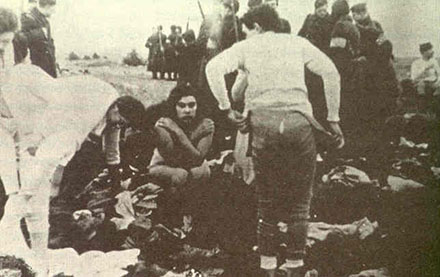
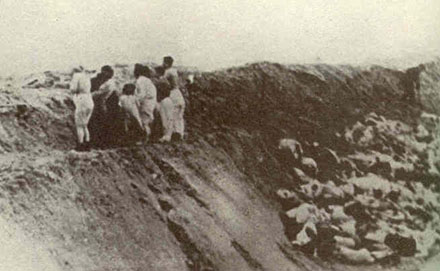
This date in 1941 commenced one of the largest such actions: over 2,700 Jews as well as 23 Communists forced over the course of two-plus days to strip on the freezing Skede dunes overlooking the Baltic and there shot by German and Latvian teams into a vast pit. It’s one of the most recognizable Holocaust atrocities because it was extensively photographed.*

As one can see from the pictures, the victims here were mostly women.


Some of the women in this photographs can be identified by name (pdf). Left to right: (1) Sorella Epstein; (2) presumably Rosa Epstein, her mother; (3) unknown; (4) Mia Epstein; (5) unknown. Alternate identification makes Mia Epstein (5) instead of (4), and (2) Pauline Goldman.

Almost all of Liepaja’s Jews perished during the war.

* Germany’s Bundesarchiv (search on Libau 1941) confirms the precise December 15 dating for these images; it also has some other photographs of atrocities in Liepaja/Libau on other occasions.

On this day..

1934: John and Betty Stam, China missionaries

On this date in 1934, Chinese Communists beheaded John and Betty Stam in the Anhui province town of Miaoshu.

The Stams had settled as China Inland Mission proselytizers in the town of Jingde (at their time generally rendered as “Tsingteh”). Betty Stam (nee Scott) had grown up in China, the daughter of a Presbyterian missionary. John was a New Jersey native who had graduated Moody Bible Institute in 1932. They had a three-month-old daughter named Helen Priscilla.

On December 6, 1934, Communist rebels in China’s long-running civil war entered Jingde and seized the foreign family. According to a tribute page kept by a great-nephew of the, John wrote a short note that evening.

Tsingteh, An.
Dec. 6, 1934

China Inland Mission, Shanghai

Dear Brethren,

My wife, baby and myself are today in the hands of the Communists in the city of Tsingteh. Their demand is twenty thousand dollars for our release.

All our possessions and stores are in their hands, but we praise God for peace in our hearts and a meal tonight. God grant you wisdom in what you do, and us fortitude, courage and peace of heart. He is able-and a wonderful Friend in such a time.

Things happened so quickly this a.m. They were in the city just a few hours after the ever-persistent rumors really became alarming, so that we could not prepare to leave in time. We were just too late.

The Lord bless and guide you, and as for us, may God be glorified whether by life or by death.

In Him,
John C. Stam

The author of John and Betty Stam: Missonary Martyr summarizes his subjects’ “inspiring and instructive story” in a blog post here.

A foreboding message, but Christian evangelizing in China had often proved dangerous to its practitioners.

The next day they were marched 12 miles to Miaoshu where they stopped for the night. Facing martyrdom, the couple stowed their daughter away like Moses, hidden in a sleeping bag with John’s last missive and ten dollars that might serve to care for her.

Miraculously, Helen Priscilla would be overlooked when the Stams’ captors came for them on December 8 and marched them through Miaoshu. It’s said that one Chinese vendor made bold to object, and was added to the doomed party for his trouble. At the end of the march, John was forced to his knees and beheaded before his companions’ eyes; Betty and the shopkeep followed him.

Little Helen survived her parents’ ordeal. A Chinese evangelist named Lo found the girl and carried her 100 miles to a mission hospital. She was taken in from there by Betty’s parents and eventually adopted by Betty’s sister and raised in the Philippines before returning to the United States.

Back in China, another missionary, Frank Houghton, was moved by the sacrifice of the Stams to compose a hymn, “Thou Who Wast Rich Beyond All Splendour” (set to an old French canticle, Quelle est cette odeur agréable?).

On this day..

1982: Dos Erres massacre

On December 7, 1982, a unit of army commandos entered the Guatemalan hamlet of Dos Erres.* There it authored one of the signature atrocities of the bloody Guatemalan Civil War.

This was the Guatemala of Efrain Rios Montt, once a junior officer during the CIA-backed 1954 coup that set in motion decades of civil strife.

Relative brutality in that conflict waxed and waned over the years. In 1982, the now-General Efrain Rios Montt overthrew another general and went full werewolf. “A Christian has to walk around with his Bible and his machine gun,” Rios Montt infamously remarked. And more than walk them: the general’s policy was a you’re-either-with-us-or-with-the-terrorists hard line called Frijoles y Fusiles, “beans and shooting.” Campesinos who were with Rios Montt got the beans.

Shortly before this date’s atrocity, a column of Guatemalan soldiers were ambushed by leftist guerrillas, killing 21. Those guys were going to get the fusiles — them, or any convenient peasants who might hypothetically be on friendly terms with them.

Dos Erres, a remote jungle village of 60 families, was the settlement nearest where the rebels were thought to be operating. The little town had already drawn the ire of the army by resisting recruitment to civil defense patrols.

Late on the night of December 6, 1982, 20 members of Guatemala’s Kaibiles commandos set aside their special forces uniforms and disguised themselves as guerrillas, in green t-shirts and civilian trousers and red armbands. Ostensibly their mission was to recapture the rifles the rebels had seized from the ambushed convoy, which were supposed to be stashed in Dos Erres.

Hiking two hours into the jungle to reach their target, the commandos crept into the still-sleeping settlement at 2 in the morning. With the support of a 40-man regular army detachment to seal Dos Erres’s perimeter, the commandos stormed into residences and drug bewildered townspeople out, herding the men into a school and the women and children into a church.

That commenced an all-day litany of horrors for the residents of what was about to become the former village. Dos Erres was wiped off the map by the end of it.

One of the senior lieutenants on the mission raped a woman, and other commandos immediately availed themselves of the implied license to abuse women and girls. By the end of it, the last sobbing women and children were led out to the forest and machine-gunned en masse.

They were by then the last survivors, save for a little boy who managed to escape into the jungle. Throughout the course of the 7th of December, the Kaibiles brought villagers old and young to the edge of the town well. “As they were brought to the well, they were asked, ‘where are the rifles?’,” one of the participants later described. “They said nothing about rifles, and they were hit on the back of the head with a sledgehammer, and thrown in the well.” Every commando had to participate, so that all were implicated.

Commando Gilberto Jordán drew first blood. He carried a baby to the well and hurled it to its death. Jordán wept as he killed the infant. Yet he and another soldier, Manuel Pop Sun, kept throwing children down the well.

The commandos blindfolded the adults and made them kneel, one at a time. They interrogated them about the rifles, aliases, guerrilla leaders. When the villagers protested that they knew nothing, soldiers hit them on the head with a metal sledgehammer. Then they threw them into the well.

“Malditos!” the villagers screamed at their executioners. “Accursed ones.”

“Hijos de la gran puta, van a morir!” the soldiers yelled back. “Sons of the great whore, you are going to die!”

[Commando Cesar] Ibañez dumped a woman in the well. [Favio] Pinzón, the cook, dragged victims there alongside a sub-lieutenant named Jorge Vinicio Sosa Orantes. When the well was half-filled, a man who was still alive atop the pile of bodies managed to get his blindfold off. He shouted curses up at the commandos.

“Kill me!” the man said.

“Your mother,” Sosa retorted.

“Your mother, you son of the great whore!”

Pinzón watched as the infuriated Sosa shot the man with his rifle and, for good measure, threw a grenade into the pile. By the end of the afternoon, the well overflowed with corpses.

The commandos left town the next morning with six captives: the rebel who had been forced at gunpoint to guide the Kaibiles to Dos Erres in the first place (he would be executed in the field); three teenage girls (the soldiers that night would take turns raping them, then strangled them the next day); and two very small boys (these were returned to the Kaibiles base). A few days later, the army returned and razed the remains of the devastated town to the ground. Only recently has the site been excavated and its many victims’ remains cataloged for proper burial.

The tragedy of Dos Erres became public in the 1990s. Five soldiers who participated in the butchery have each been sentenced to 6,060 years in prison just for this one incident, but there were many more like it in Guatemala in those years — many more people who were put to Frijoles y Fusiles.

A 1990s truth commission after the war pegged the total number of civilians killed during the war above 200,000, mostly indigenous Mayans and (as was the case for most at Dos Erres) mestizos. “State forces and related paramilitary groups were responsible for 93% of the violations documented.”

The truth commission also found that the “government of the United States, through various agencies including the CIA, provided direct and indirect support for some state operations.” Indeed, supporting death squads against leftists in Central American dirty wars was overt U.S. policy during the 1980s; just days before Dos Erres, U.S. President Ronald Reagan returned from a Latin American tour and told reporters that Rios Montt, whom he had just met, was “totally dedicated to democracy in Guatemala.”

“They’ve been getting a bum rap” from human rights nabobs, Reagan averred.

In the fullness of time that rap would eventually encompass Rios Montt’s own remarkable conviction for crimes against humanity and (since the Mayan population was targeted en masse) genocide in a landmark case that’s still being appealed as of this writing. (The May 2013 verdict against Rios Montt was immediately overturned; the case is obviously extremely politically sensitive.) In a separate case, he’s been charged specifically with responsibility for the Dos Erres massacre.

U.S. President Bill Clinton formally apologized for Washington’s role in Guatemala after the truth commission’s findings were issued in 1999.

The PBS radio program This American Life has an hour-long documentary about Dos Erres here; a companion ProPublica series has even richer (and more horrifying) detail.

* Named for its founders, two men named Ruano and Reyes, the name literally meant “two Rs”.

On this day..

1938: Martha Marek, Zeliopaster

On this date in 1938, Austrian Martha Marek was guillotined in Vienna for several murders by poison.

She first came to the attention of the discerning interwar crime audience in 1925 when she and her husband Emil were convicted of insurance fraud: Emil claimed to have “lost his leg while chopping wood” just after having taken out a policy, but examination showed that the lost leg had actually been chopped off methodically — and clumsily. They both served a short stint in prison but at least Martha still had four good limbs to go with her wits.

Martha before her marriage had been the lover of a department store magnate five decades her senior who lavished money on her and left her a tidy inheritance to the chagrin of his family. She made her way in the world hitting mother lodes and living comfortably on them, and the time would come that poison would suit her ends better than seduction.

In July 1932, Emil died of apparent tuberculosis. The next month, the couple’s infant daughter Ingeborg died too. Martha, who had lately been reduced to peddling vegetables in the street, pocketed insurance payments on both.

Shortly after, she moved in with an elderly aunt, and the aunt soon died too — leaving her home and assets to her “caregiver”.

As this nest egg dwindled, Martha opened the place to boarders, and one of these poor souls also died — not before mentioning to some people that he always seemed to get sick when he ate Martha’s food. Turned out, Martha had insured his life too.

Martha actually got away with all of this at first, despite the agitation of the dead boarder’s relative. But she pushed her luck a little bit too far when she tried to fraudulently report some insured paintings as stolen in 1937. Persnickety insurance adjusters investigated, and the whole murder spree came out in the process. She was convicted for killing husband, daughter, aunt, and lodger with the rat poison Zeliopaste (thallium).

Austria’s traditional execution method had been hanging, and its traditional executive behavior had been to commute women’s death sentences.

However, the March 1938 Anschluss annexing Austria to Hitler’s Germany brought an update to Germany’s capital punishment policies. Hitler rejected the mercy application (it didn’t help that Martha was half-Jewish) … and prolific Third Reich executioner Johann Reichhart overpowered a violently struggling Martha Marek to behead her on the fallbeil.

On this day..