1943: The Zalkind family

(Thanks to Meaghan Good of the Charley Project for the guest post. -ed.)

Sometime in the autumn of 1943, a refined actor had a family of Vilna/Vilnius Jews summarily hanged on a public gallows.

Vilna* was one of the major Jewish ghettos in Nazi-occupied Eastern Europe.

Noted for its rich cultural life, the Vilna Ghetto, which at its peak contained approximately 40,000 people, lasted from September 6, 1941 to September 24, 1943. By the end of its existence, however, through starvation, overwork, disease, and bullets, the ghetto’s population had been reduced by three-quarters.

In late September 1943, the ghetto was liquidated. Most of the inhabitants were taken to the nearby forest in Ponar and shot, or sent to extermination camps in Poland or work camps in Estonia, where almost all of them died.

The convivial Bruno Kittel

The liquidation was supervised by German Oberscharführer Bruno Kittel. (He is not to be confused with Otto “Bruno” Kittel, the Luftwaffe flying ace.)

Kittel was an actor. He graduated from the theater school in Berlin and from the plundering school in Frankfurt. On Sundays he played songs on his saxophone at the Vilna radio station. Kittel was not only the youngest of his colleagues; he was the most zealous … [His] reputation extended from Riga to Lodz to Warsaw.

At first glance, you would never guess that Kittel was an executioner. Constantly smiling with his dazzling white teeth, he was perfumed, elegant, polite, and refined.

After the ghetto was no more, a few skilled craftsmen and artisans whose work was essential to the war effort remained within the city at one of three labor camps.

Karl Plagge, a German major in charge of the HKP 562 camp, was sympathetic to the plight of his workers and worked to save their lives, albeit without much success. For this, he would later be honored as a Righteous Gentile by Yad Vashem.

During the liquidation, in an attempt to avoid capture, many of the Vilna Jews concealed themselves in hiding places and bunkers, called “malines” or “malinas”. Sadly, the Nazis caught almost all of them, but a few were able to wait out the carnage and then escape.

The Zalkind family were among the fortunate people who were able to remain in hiding throughout the liquidation.

But they did not survive for very long afterwards.

Their final days are described in The Complete Black Book of Russian Jewry, a collection of accounts of atrocities in the Soviet Union from which the observation about Kittel above is also drawn.

Journalists and historians began gathering eyewitness statements before the war was even over, and Ilya Ehrenburg and Vasily Grossman assembled and edited the accounts and finished the Black Book in 1946. It was the first major documentary work on the Holocaust. However, Stalin refused to allow its publication and had the type-plates and galley proofs destroyed in 1948.

A few copies survived, and the book was finally published in Russian in 1993. The English translation came out in 2002.

The full names of the Mr. and Mrs. Zalkind and their son are not recorded. Yad Vashem’s Central Database of Shoah Victims’ Names lists a Masha Zalkind, age 34, a store manager who was married to Moshe, and Hone Khona Zalkind, 2, whose parents were Masha and Moshe. Both lived in Vilna during the war and were killed in 1943; they might well be the mother and son from this story.

There are several Moshe Zalkinds listed. One, a tailor who was born in 1907, lived in Vilna and was married to Masha. He’s the closest match, but it says he was in Estonia during the war and was killed in 1944.

In any case, the Zalkinds were on the Aryan side of Vilna, probably posing as Christians with forged identity papers, when they were spotted in the street by Bruno Kittel. The Black Book records::

Suspecting they were Jews, Kittel stopped them and had them sent to the concentration camp [at 37 Suboch Street], where he determined that their name was Zalkind and that up until now they had been hiding in a malina. He ordered a gallows to be erected in the middle of the yard and summoned sixty SS men from the Gestapo. When everything was ready and the yard was full of SS surrounding the doomed Zalkinds — husband, wife and child — Kittel said:

“For having violated my order and hiding in the city, you will now be hanged in front of everyone.”

Kittel went over to the gallows to be sure that the rope was strong; then he began the execution process. The child was the first to be hanged. Then the mother. When the noose was tightened around the father’s neck, the rope broke.

Kittel ordered a new noose to be made. But as soon as Zalkind was hanging from it, the rope broke again.

Kittel was simply amused by it all.

“If the rope should break a hundred times, I’ll hang you a hundred times,” he said. And he ordered the hangman to prepare another rope.

Following the rule of collective responsibility, after Mr. Zalkind finally died, Kittel randomly selected fifty inmates of the camp, loaded them into a van and hauled them off to their deaths at Ponar.

Only a few hundred of the Vilna Ghetto’s Jews, mostly those assisted by Major Plagge, survived the Nazi era. Some of the Germans who helped wipe out this city’s once-vibrant Jewish community were apprehended after the war and prosecuted.

Bruno Kittel, however, disappeared without a trace and was never found at all.

* At the time, Vilna was part of Poland. Vilna was its Yiddish name; the Polish name was Wilnow. The city is now the capital of Lithuania and called Vilnius.

On this day..

1858: James Rodgers, lamented

On this date in 1858, youthful delinquent James Rodgers was hanged in New York City.

The 19-year-old Irish immigrant Rodgers, according to the New York Herald‘s Nov. 13 post-hanging review, was one of a gaggle of ne’er-do-wells “well known to the police of the Sixteenth precinct as loungers about the corners.”

Corner-loungers evidently share behavioral DNA with the common high school meathead, for Rodgers (drunk on rum) precipitated his trouble by carrying “his arms a-kimbo, so that one elbow hit [John] Swanston violently as he went by him.” Swanston, a respectable burgher returning from market with his wife, didn’t take kindly to this territory-marking, and exchanged words with Rodgers until the punk terminated the conversation by planting a knife between Swanston’s ribs. The unfortunate gentleman, perhaps second-guessing his decision to make such a big deal over the elbow, expired painfully in the street as witnesses rushed to the scene.

If the Herald is to be believed, a concerted clemency push (including author Caroline Kirkland, who called personally on Gov. John King) went begging owing to a general public outcry against corner-lounging Irish hoodlums and their a-kimbo elbows.

Even though Rodgers was hanged in private in the Tombs, New Yorkers strained the roofs of nearby buildings (at ten to fifty cents per head) just to get a glimpse of him being walked to the gallows with the rope picturesquely around his neck and whatever else they could peep over the walls.

Reportedly contrite (he slept on the stone floor of his cell and ate bread and water by way of self-mortification), prayerful, handsome, and at the gallows unflinching, the youthful Rodgers died game … and also harrowingly.

The Tombs was already by this point employing a gallows that jerked the condemned upward rather than dropping him through a trap: the idea was that this method would humanely kill the wretch on the first strike of the knot.

That was not the case for James Rodgers.

By the time the executioners axed through the rope restraining the counterbalance and the fall of a 250-pound lead weight yanked Rodgers into the air, the noose’s knot had slipped to the nape of the culprit’s neck where it would fail to deliver a lethal fracture. The killer twisted and fought horribly for some eight minutes as he strangled to death, even freeing his right hand from its restraint and with it tearing at his heart. “Sickening to behold,” reported the New York Times.

So, that was James Rodgers. Like many murderers of the time, and especially those who could be constructed as sympathetic people led astray by drink, the man got himself a hanging ballad, “The Lamentation of James Rodgers.”

This ditty appears to have been appropriated, meter and lyrics alike, a generation later for the ballad “Charles Guiteau” — whose subject is the nutter assassin of President James Garfield. Guiteau hanged in 1882.

It’s pretty striking, really, even if not unusual for the genre; the lyrics show a line-for-line lift.

Lamentation of James Rodgers

Come all you tender Christians,
I hope you will draw near,
And likewise pay attention
To those few lines I have here:
For the murder of Mr. Swanston
I am condemned to die,
On the twelfth day of November
Upon the gallows high.

My name is James Rodgers
The same I ne’er denied,
Which leaves my aged parents
In sorrow for to cry,
It’s little ever they thought
All in my youth and bloom,
I came into New York
For to meet my fatal doom.

Charles Guiteau

Come all you tender Christians
Wherever you may be
And likewise pay attention
To these few lines from me.
For the murder of James A. Garfield
I am condemned to die
On the thirtieth day of June
Upon the scaffold high.

My name is Charles Guiteau
My name I’ll never deny,
To leave my aged parents
To sorrow and to die.
But little did I think
While in my youthful bloom
I’d be carried to the scaffold
To meet my fatal doom.

Here’s the Garfield version … as the guilt-ridden young tough James Rodgers is not much remembered on YouTube.

On this day..

1328: Na Prous Boneta, Beguine heresiarch

“Her heart began to marvel that so great a light as the great light that they revealed could be changed so quickly to so great a smoke …”

-Female Beguine quoted by ‘So Great a Light, So Great a Smoke’: The Beguin Heretics of Languedoc

On this date in 1328, the Inquisition relaxed the heretic Na Prous Boneta (or Bonnet) to the secular authorities at Carcassonne for execution.

Na Prous Boneta was part of the great religious movements towards poverty and spiritual rebirth then shaking Europe — the same impulse that drove men like Segarelli and Dolcino to the stake.

In southern France, the first name in this movement so suspect to Catholic orthodoxy was Peter Olivi, a charismatic prophet of egalitarian poverty from the Franciscan order. The Franciscans were the institutional expression of that same renewal movement, but their incorporation into the church had co-opted their once-radical energy. They were divided internally between the ascetic “Spiritual Franciscans” (or Fraticelli) and their brethren grown comfortable with worldly emoluments.*

After Olivi’s (natural) death in Narbonne, France, in 1298, he became an object of popular veneration for the Fraticelli’s lay admirers, among whom the communities of lay Beguin(e) women were especially prominent.**

As we have seen, the Church would soon resolve upon a fearful suppression of the Fraticelli and the Beguines, who came to be closely identified with one another. Scores went to the flames; the Inquisitor Bernard Gui complained that fugitive Beguines (and their Beghard brethren) had the gall to keep up their own calendar of martyrology. (Executed Today fully endorses this practice.)

According to the confession her adversaries would later extract, a mystical vision on Good Friday 1321 in her home town of Montpellier would transport Na Prous Boneta into Beguine leadership — fully aware of the dangers to life and limb.

“Put your heart and mind into the work of the Holy Spirit,” she preached. And “keep your body prepared for martyrdom if it should be necessary.”

And boy, did she have to be prepared.

Prous was all-in on her heretical denunciation of a church that had committed itself to bloody suppression of her sect. She denied the efficacy of the sacraments, said that salvation followed from good deeds even for “Jews and Saracens” and as for the guy in charge just down the way at Avignon …

this present pope, John XXII, is like Caiaphas, who crucified Christ. Moreover, the poor beguins who were burned, and also the burned lepers, were like the innocents beheaded by Herod’s command. Again, just as Herod procured the death of innocent children, thus this Herod, the devil, procured the death of those burned beguins and lepers. Again, she claims that Christ told her the sin of this pope is as great as the sin of Cain.

Though all these confessions were given in 1325, Na Prous Boneta appears to have been kept in prison for three years in an effort to persuade her to change her tune. That Caiaphas-like pope himself took an interest in the case, even ordering (perhaps suggestive of the woman’s following) that her eventual execution take place not in her own city but in Carcassonne.

That execution took place on this date when the visionary, having refused every blandishment to save her soul, caused the inquisitors to declare that

knowing from experience that those who are evil simply get worse by the day when they think they will go unpunished, we, compelled by our office which we are obliged by holy obedience to fulfill diligently, since we neither should nor indeed wish to tolerate any longer such abominations and such dangerous opposition to the entire church and the catholic faith, having obtained counsel concerning the above matters from many religious and secular persons learned in both laws, having God before our eyes and the holy gospels of Jesus Christ placed before us so that our judgment should proceed from God and appear right before God and our eyes should see what is just, on this day, in this place and time assigned by us to hear definitive sentence, sitting as a tribunal, invoking the name of Christ, we pronounce, judge and declare you, Na Prous, to be an impenitent heretic and heresiarch and pertinacious in your obduracy. Since the church can do nothing more with such people, we release you to the secular authorities.

* This conflict is the subject of The Name of the Rose; Olivi’s heir as the Spirituals’ leader, Ubertino of Casale, is a character in that novel.

** One need not stretch too far to see a bit of comeuppance in the emergence of a feminine anti-papal voice at this period; the original movement into all-women beguinages is thought to have been facilitated by the surplus population of unmarried or widowed women created by Europe’s recent enthusiasm for sending young men to die on Crusade.

On this day..

2009: John Muhammad, D.C. sniper

On this date in 2009, D.C. sniper John Muhammad was executed by lethal injection in Virginia.

Muhammad — born John Allen Williams; he renamed himself after joining the Nation of Islam — authored with Lee Boyd Malvo, a juvenile collaborator under his sway, a spree of random sniper attacks around the Washington D.C. suburbs that terrified the nation’s capital in October 2002.

The two were captured together sleeping out in their sniper-mobile — a Chevy Caprice with a hole drilled in the trunk for taking concealed potshots at gas stations and mall parking lots and the like. Although arrested initially in Maryland, the U.S. Attorney General forced their case to the more aggressive death penalty jurisdiction of Virginia. (The two killed people in both states, tallying 10 dead and three wounded all told.)

From the time of his Oct. 24, 2002 arrest until the very end, Muhammad was frustratingly tight-lipped about how and why the carnage took place. Was it personal pique? Religious terrorism? Just a regular criminal racket?

In 2006 testimony, a now-contrite Lee Malvo — at one point he addressed Muhammad directly, saying “You took me into your house and you made me a monster” — outlined a plan that constituted a fearsomely nutty combination of motives: use the mayhem to extort millions of dollars, then take the money and set up a Canadian camp for 140 homeless black youth and rear them as terrorists. It’s just possible that this proposed enterprise pushed every single button in the collective American id.

(Malvo himself pled out to the murders, accepting six life sentences.)

On this day..

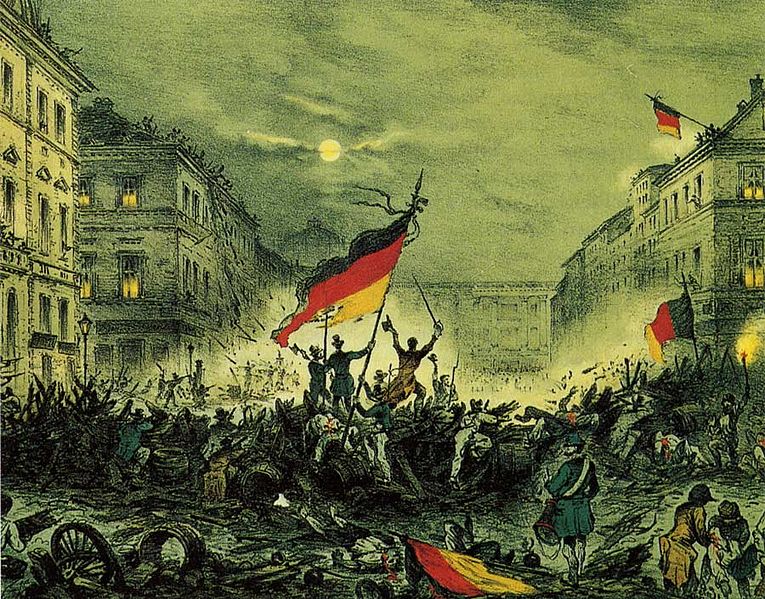
1848: Robert Blum, German democrat

On this date in 1848, a day short of his forty-second birthday, the German revolutionist Robert Blum was summarily shot in Vienna — a tragic victim of Germany’s Revolutions of 1848.

Marker at Robert Blum’s birthplace in Cologne reads “I die for the German liberty that I fought for. May the fatherland remember me.” (cc) image from Elke Wetzig.

Blum grew up in a penniless proletarian family but drifted into the literary set. He spent the 1830s penning liberal-minded plays, poetry, newspaper correspondence. He uncovered a magnetic personality and a gift for organization.

By the 1840s he was a — maybe the — preeminent left-liberal in the Kingdom of Saxony: pro-parliamentary democracy, anti-violence, for a wide grant of civil liberties and mass education.

The pressures, both liberal and radical, pushed to the brink the small realms in the German Confederation, as well as the neighboring Austrian Empire. Both struggled to handle even the liberals’ demands like expanding the franchise and freedom of the press, with old hereditary polities that might not be up to changing times. Germany, Marx and Engels wrote in the Communist Manifesto (1847), “is on the eve of a bourgeois revolution.”

Right on cue…

That pregnant year of 1848 found Blum in the Frankfurt parliament, and his neither-fish-nor-fowl leftism — a little too out there for mainstream liberals; a little too bourgeois for real radicals — made Blum the perfect pick for a solidarity mission.

When in September 1848 the Austrian army was defeated trying to crush a Hungarian rebellion, the Habsburg capital of Vienna took the example and mounted a revolution of its own, putting the government to flight.

Blum was sent as sympathetic delegate to this abortive Viennese commune, but found himself trapped in the city when the Austrian army encircled it in late October.

The Austrians, when they caught him, sent their own message back by denying him any form of deference for his parliamentary rank. Blum’s direct condemnation was a stark warning by the Habsburg state to agitators, but also to their putative brethren dreaming of a Greater Germany. Austria wasn’t buying what the Großdeutsche people were selling.


Detail view (click for the full image) of Carl Steffeck’s painting of Robert Blum’s execution. Here’s a YouTube recreation (in German).

Blum went on to a posthumous career as a star liberal martyr among the German circles who had use for such a character.

Blum’s seven-year-old son Hans grew up to follow his father’s literary footsteps … but from quite the other side of the aisle. He was a pro-Bismarck nationalist.

On this day..

1676: Anna Schmieg and Barbara Schleicher, Langenburg witches

On this date in 1676, the tiny German principality of Hohenlohe strangled and burned to death its last convicted “witches”.

This story is the subject of the recent book The Last Witch of Langenburg: Murder in a German Village by Thomas Robisheaux. (Interview with the author.)

Almost a full year had elapsed since Anna Fessler had received a few shrovetide cakes from the daughter of the neighboring millers.* Hours later, Fessler (who had delivered a child just a week before) took painfully ill and died in her bed.

The cakes led back to the miller’s wife Anna Schmieg, of course. But decades after the Thirty Years’ War, the whole witchcraft construct was on its way out. Robisheaux builds a powerful micro-history of the local magistrate’s painstaking effort to satisfy the era’s rigorous legal standards for witch-persecution.

These standards would soon break down entirely, but in the here and now (or there and then), the authorities had to establish Schmieg’s malevolent reputation, and figure out if there was sufficient evidence to license torture. There wasn’t, the legal doctors whom Hohenlohe consulted advised; Hohenlohe made up a justification to do it anyway.

Hey, times hadn’t changed that much. Maybe still haven’t.

Anyway, the torture did to a co-accused what torture usually does. That luckless itinerant local woman was named Barbara Schleicher: she’d been under a pall from the accusation of a previously-tortured “witch” in a nearby village a few years before, and with the requisite pressure she soon copped to everything. Schmieg denied and fought and repelled, but eventually she too broke down and made the fatal confession. So, on November 8, 1676, before a court constituted of local grandees,

Anna Elisabeth Schmieg and Barbara Schleicher had to confess one more time, openly and publicly.

This was the moment of danger. Were Anna now to curse the judges as she had cursed the executioner before she was tortured, “asking them to join her for God’s Judgment in the Valley of Jehosaphat,” the proceedings might break up. She could be tortured again, but the curse would have had a shocking effect and raised the question about whether an injustice was about to be committed.

Because of these dangers, instead of asking the women to speak for themselves, the county’s officer spoke for them, saying that the two poor sinners had freely confessed their crimes and were ready to be given over to justice. The scribe read of Anna’s use of witchcraft and murder, as well as her seduction by Satan. He pronounced that she had done so many evil things that she could not even remember them all. He then read out a list of Schleicher’s crimes, which included witchcraft, murdering two husbands, turning herself into a wolf, and attempting to commit suicide. Whoever these two poor sinners had been before that day, they were now publicly branded as witches, poisoners, and murderers.

Talk about speak now or forever hold your peace. For not raising a ruckus, the court threw a bone to the wicked and now-confessed hags and mitigated the sentence of tearing at their flesh with iron tongs followed by burning at the stake to tearing at their flesh with iron tongs followed by strangulation followed by burning at the stake.

Chief Justice Assum turned to the court assessors and asked them whether the sentence had been decided as the court scribe had read it. Together they replied yes. Assum then rose, broke the ceremonial staff in two, and threw the pieces to the floor. With this old legal gesture, the blood court was symbolically breaking its staff over the lives of the prisoners. Then he said, “God help their poor souls.” [Local Count] Heinrich Friedrich’s representative then asked that the executioner carry out the sentence. According to prescription, the command to the executioner was repeated three times. At the close the chief justice forbade everyone present, on penalty of bodily punishment, from seeking revenge for this act of justice. No one was to take up violence against the law or question what was being done. The court scribe repeated his admonition.

The executioner then led the women out of the court, across the drawbridge, and over into the market square, where they joined the procession that had assembled. Drummers beat out a cadence, schoolboys sang hymns, and the sober procession marched down Langenburg’s long main street and out the gate at the east end of the town.

Once past the town gate, Anna’s and Barbara’s expulsion from the community was complete. From many perspectives, as we have seen, Anna’s emotional world was not like our own. It would be wrong to assume that Anna and Barbara felt the same anxiety and fear that we would today as they climbed the “Path of Straw” to Gallows Hill. The belief that someone who received absolution before an execution, and who did not sin again by resisting, would go right to heaven may help explain why prisoners rarely resisted at this point. Most tried to meet their fate as best as they could. Considering the suffering of the last ten months, Anna may have welcomed her end. She and Schleicher may also have been fortified for the ordeal by wine. Prayer may have brought them solace. However she felt about her fate, no record mentions her resisting or cursing the executioner or members of the court.

The scene at the gallows must have been crowded. The execution was seen as an example, and it was considered essential that the Langenburg schoolchildren be let out of school to join the procession. There, with the rest of their neighbors, they would have watched Anna and Barbara torn with hot irons and then strangled with a rope. After the bodies were burned to ashes, the last ritual gesture was made. “Lord Chief Justice,” Master Endris asked, “Have I carried out the law?” To which Assum would have replied, “If you have executed what the law and the sentence require, then the law has been fulfilled.”

This verbal exchange was critical for the execution to have fulfilled its purpose. At this moment the law, formally in suspense since Anna’s arrest, had been restored. The breach in public order that had opened on Shrove Tuesday was now mended. Count Heinrich Friedrich had seen to it. The chief justice and the assessors filed back into town and into the courtroom. Once they took their seats, it was announced that justice had been done. A lavish feast awaited them.

Just stay away from the cakes.

* A delicious tradition. Here’s a recipe for vanilla-frosted custard-filled shrovetide buns, from Denmark. Deadly deadly Satanpoison is optional.

On this day..

1864: Retaliatory executions by John Mosby

Though executioners don’t quite bat 1.000 — who does, at any human endeavor? — the field on the whole succeeds more often than not.

On this date in 1864, the Confederate guerrilla John S. Mosby had seven Union prisoners executed, but he only managed to kill three of them — an efficiency very well below the Mendoza Line for the executioner’s trade.

It was a rare competence gap for the brilliant cavalryman.

The irregulars Mosby commanded in the Shenandoah Valley had frustrated for six months the consolidation of rampant northern armies, thereby preserving the Confederate capital of Richmond and extending the Civil War.

The situation had quick become intolerable for the Union, and Gen. Ulysses Grant emphasized (pdf) to Gen. Phil Sheridan the cruel anti-insurgent tactics he would countenance for “the necessity of clearing out the country so that it would not support Mosby’s gang. So long as the war lasts they must be prevented from raising another crop.”

By way of example-setting, the Union army had summarily executed six of Mosby’s rangers at Front Royal in September — followed by a seventh who was captured in early October in Rappahanock County.

Incensed, the Confederate “gray ghost” began stockpiling blue bodies from the offending command of George Armstrong Custer — yes, the Little Bighorn guy; he was perceived by Mosby to be responsible for the atrocity, although the actual paper trail on the execution order seems to be a little sketchy.

Mosby, who fancied himself the genteel sort who would closely abide the laws of war when fighting for the right to maintain human chattel, sent a lawlerly appeal up the chain of command seeking permission “to hang an equal number of Custer’s men.” General Robert E. Lee and Confederate Secretary of War James Sedden granted it.

Twenty-seven captives were therefore assembled and subjected to a lethal lottery. Jay Simson’s Custer and the Front Royal Executions of 1864 recounts this horrible affair in an excrutiatingly page-turning narration.

The preparations began innocently enough on a quiet Sunday morning (November 6, 1864) when 27 Union prisoners of war were ushered with no explanation about what was happening out of a brick storehouse located in Rectortown, Virginia …

[They] were then marched to the banks of Goose Creek, about half a mile away. some, but definitely not all, of this specially selected pool of 27 prisoners belonged to Custer’s commands both past and present … [but] of the seven men eventually selected to die on Mosby’s orders only two were actually members of the Michigan Cavalry Brigade.

All 27 of the prisoners were lined up along Goose Creek and then made to draw slips of paper from a hat. Twenty of those slips of paper which were part of the macabre lottery were simply that, blank pieces of paper. The other seven — one for each of Mosby’s men executed at Front Royal and in Rappahanock County — were marked with a number …

Of the men who were forced to draw those slips of paper, some of them simply stared into space. Others, once they understood what was happening, prayed. There were a few of them who simply broke down.

Among the prisoners was a young drummer boy … who broke down completely, sobbing … He drew a blank slip and immediately proclaimed: “Damn it, ain’t I lucky!” When a second drummer boy was found to be unlucky enough to have drawn one of the marked slips of paper, upon the request of the men who had been spared, Mosby personally ordered the boy to be released from the seven condemned prisoners and the 18 remaining prisoners (excluding the first drummer boy) drew from the slips of paper for a second time.

Then one of the seven adults also got himself swapped out of the scrap by flashing a Masonic sign at a Confederate lodge member. The things that stand between life and death.

Out of the nine to come under death’s pall and the seven who were actually marched overnight to the place of execution (as close to Custer’s camp as Mosby dared) only three were there successfully ushered past death’s threshold.

At 4 a.m. on Monday, November 7, 1864 (the day before the election which would give Abraham Lincoln his second term in the White House and would therefore become the signature on the death warrant of the Confederacy), the Rangers and their prisoners reached the execution site in Beemer’s Woods, a mile west of Berryville, and the executions were carried forward. However, everything did not go exactly according to plan.

In the pre-dawn darkness and confusion (either through carelessness or lack of caring for their orders, since none of the prisoners had actually been involved in depredations against Confederate civilians) the Rangers allowed two of the seven prisoners (one of whom, G.H. Soule, 5th Michigan Cavalry Regiment, punched out a guard) to escape outright. Two other prisoners were apparently shot in the head, but surviving, having only been grazed, also escaped since they pretended, and were apparently believed, to be dead. The remaining three prisoners were hanged. The identities and whether or not these three prisoners were members of either Custer or Powell’s commands are unknown. Lt. Thompson, in accordance with his orders attached a placard to one of the hanged men (just as similar placards had been attached to the bodies of all three of Mosby’s hanged men). Mosby’s placard read: “These men have been hung in retaliation for an equal number of Colonel Mosby’s men hung by order of General Custer at Front Royal. Measure for Measure.”

Believing his purpose accomplished, or at any rate close enough for rebel government work, Mosby then wrote to Union General Sheridan justifying the action and assuring him that future “prisoners falling into my hands will be treated with the kindness due to their condition, unless some new act of barbarity shall compel me, reluctantly, to adopt a line of policy repugnant to humanity.”

The letter, and the 3-out-of-7 reprisal, actually worked — with no further measures exacted for measure or tits given for tat. For the waning months of the war the rival forces confined themselves to killing one another on the battlefield, and not in the stockade.

Well, mostly: one of the conspirators in the plot to assassinate Abraham Lincoln in April 1865 — which did assassinate Lincoln, but was really a wider attempt to decapitate the entire northern government — was a former Mosby’s ranger named Lewis Powell aka Payne. Lincoln killer John Wilkes Booth also seemed to flee in Mosby’s direction (Mosby’s units were still in the field, not covered by the April 9 Appomattox surrender.) There exists an unproven but delicious speculative hypothesis that the hand of John Mosby was among those behind an exponentially more ambitious “line of policy repugnant to humanity.”

Be that as it may, Mosby actually became a Republican after the war — for which he received some Southern death threats — and lived fifty eventful years. Among other things, the aged Mosby regaled the young George Patton (whose father Mosby knew) with Civil War stories.

On this day..

1944: Boy Ecury, Aruban Dutch Resistance hero

On this date in 1944, Dutch Resistance hero Boy Ecury was shot by the occupying Germans.

Ecury (English Wikipedia entry | Dutch) grew up in Oranjestad, capital of the Dutch-controlled Caribbean island of Aruba, but had packed off to the Netherlands to finish school by the time World War II broke out. He spent the early Forties with a Resistance group sabotaging German assets and the like.

This insurgent clique eventually got rolled up, and Boy Ecury was arrested on November 5, 1944. He had only that one night to enjoy the legendary hospitality of the occupiers before he and several others of his group were shot the next day.

The young martyr’s body was repatriated to Aruba after the war and buried with honors; a public memorial still stands to him in Oranjestad.

Boy’s sister, the venerable poet Nydia Ecury, just passed away earlier this year.

On this day..

1927: Alfredo Jauregui, Bolivian lottery winner

La Paz, Bolivia, Nov. 5 (AP). — Selected by lot to die for the murder ten years ago of former President Jose Manuel Pando, Alfredo Jauregui, 28, was executed this morning. The young man died instantly from eight bullets from the rifles of a firing squad.

New York Times, Nov. 6, 1927

Jose Manuel Pando (English Wikipedia entry | Spanish), wealthy landowner, military leader, former president, had seen Bolivia’s Liberal Party to power by prevailing in civil war in 1899, then peaceably handed off power to a Liberal successor in 1904.

The Liberals controlled Bolivia until 1920, but Pando grew overtly critical of his increasingly authoritarian successors. Though the circumstances of his murder in 1917 remain murky, his disgruntled affinity for the upstart Republican party is a likely contributing factor.

Jauregui faced the fusillade proclaiming his innocence; his supposed confederates were the beneficiaries of a Bolivian law permitting only one execution for a single murder … even of the former President’s murder. The four drew lots to determine which would be the “one”.

On this day..

2005: Brian Steckel, the Driftwood Killer

On this date in 2005, Brian Steckel was executed by lethal injection for a Delaware rape-murder.

Steckel got 29-year-old Sandra Lee Long to let him into her apartment on the pretext of making a phone call. (This was 1994, pre-cell phones.) Then he throttled her, sodomized her, raped her with a screwdriver, and set her bedroom on fire. Then he fled. (Long survived the immediate attack; she would die of smoke inhalation from the arson.)

Hours later, he called The News Journal identifying himself as the “Driftwood Killer” and threatening his next prospective victim by name. Police took that woman into protective custody and traced harassing calls she’d been receiving to Steckel, who obligingly confessed when arrested.

And investigators took Steckel’s threats at their word — as well they might with Long’s ghastly murder already under his belt — and counted themselves lucky to have nipped a potential spree killer in the bud. Steckel “thought about committing a murder for a long time,” New Castle County detective John Downs said. “We got him relatively early in his career. This was something he’d worked at.”

Fond of the drink and none too stable, Steckel menaced his own attorneys, spat at prosecutors, soaked up the media attention, and sent dozens of letters from prison, including Long’s autopsy sent to Long’s mother with a scribbled taunt reading “Happy, Happy. Joy Joy. Read it and weep. She’s gone forever. Don’t cry over burnt flesh.” He also made and retracted various dubious confessions to various murders in various states, and alternated between slandering his (known) victim and calling himself an “animal” for killing her.

If the evil was unfeigned, so was the remorse. At the end of his trial, he surprisingly addressed the the jury with an assent to his own execution.

I didn’t know how to say I’m sorry. How do you tell someone’s family you’re sorry for strangling them? … How do you do such a thing? I don’t know. I ask you people to hold me accountable for what I did. I’ve gotten away with so much in my life that I stand here today … I know I deserve to die for what I did to Sandy. … I’m prepared to give up my life because I deserve to.

He carried a like sentiment to the gurney, where he was apologetic to the victim’s mother he had once mocked.

I want to say I’m sorry for the cruel things I did. I’m not the same man I was when I came to jail. I changed. I’m a better man … I walked in here without a fight, and I accept my punishment. It is time to go. I love you people … I’m at peace.

At this point where the repentant felon ought to close his eyes and exit, an awkward 12-minute delay followed while the lethal injection machine clicked several times and Steckel remained lucid, appending his last statement with observations like, “I didn’t think it would take this long.”

While state officials denied there was any problem with the exceedingly slow lethal injection, Steckel did not appear to have been rendered unconscious, and was awake when he finally snorted and convulsed into death.

Attorney Michael Wiseman, pursuing a later lawsuit against the state’s death penalty procedure, claimed that the main IV line was blocked and when executioners switched to the backup line, they didn’t bother (pdf) re-administering the anesthetic sodium thiopental that forms the first drug of the basic three-drug lethal injection cocktail. That omission meant that Steckel would have been conscious when he was hit with a paralytic dose of pancuronium bromide, and still conscious when that was followed with an excrutiating heart-stopping shot of potassium chloride. (More on the process.)

Wiseman even got a member of the execution team to testify that he was “okay with” causing Steckel suffering owing to the bestial nature of Steckel’s crimes. (The source for this is the January 29, 2009 News Journal; the article is no longer available online.)

A federal circuit court rapped Delaware for “occasional blitheness” and “isolated examples of maladministration,” but rejected the lawsuit.

After a five-plus year hiatus following Steckel’s execution, the Blue Hen State resumed executions in 2011, switching for the occasion to the trendy new anesthetic drug pentobarbital since execution chambers can no longer get hold of sodium thiopental. Just like Brian Steckel.

On this day..