2012: Eric Robert, determined volunteer

Tonight at 10 p.m. local (U.S. Central) time* in Sioux Falls, South Dakota will administer a toxic lethal injection to Eric Robert … with Robert’s complete consent. (Update: Robert has indeed been executed as scheduled.)

Robert will reach the gurney on the greased-lightning legal path, thanks to his own willingness to die.

It’s a mere 18 months since Robert (then serving a prison term for kidnapping) and another convict murdered guard Ronald “RJ” Johnson for his uniform during an unsuccessful escape attempt.

Robert pled guilty, requested the death penalty, and waived his appeals. This phenomenon is surprisingly common; the Death Penalty Information Center’s invaluable executions database classifies over 10% of modern U.S. executions as voluntary. (138 volunteers out of 1,308 total executions as of this writing: Robert will be the 139th and 1,309th)

While many of those abandoned their appeals in despair once they’d been on death row for a while, Robert has shown uncommon clarity of purpose from the very first, and his firm and intelligent resistance to any attempt to intervene against his death sentence has undermined any possible argument that the guy isn’t in his right mind. So far as anyone can tell, he sincerely believes in a retributive criminal justice ethos.

It might help that the man has followed an atypical criminal arc. He has a biology degree and was a law-abiding wastewater treatment supervisor and Little League coach until he weirdly posed as a police officer and kidnapped a teenager in 2005.** (He says he was drunk.)

Robert even complained publicly when South Dakota nixed a spring 2012 execution date to conduct the mandatory appellate review all capital cases receive; he wrote a letter to the Associated Press saying that he would kill again.

“Victims of non-capital offenses receive their justice when the perpetrator is placed in custody,” Robert wrote. “Victims in capital cases receive their justice when the perpetrator is executed.” That might indeed constitute a persuasive reason to execute Eric Robert, though the same logic would just as readily dispute the suitability of the death penalty as public policy. It’s invariably justice delayed, after all.

I am free to admit my guilt, as well as acknowledge and accept society’s punishment just as I am free to proclaim innocence in defiance of a verdict. I believe that the sentence of death is justly deserved in any murder and should be carried out … Give the Ron Johnson family their justice, they have been forced to wait too long. I finish where I started — I deserve to die.

The court soon obliged him. With legal interventions seemingly at an end and no reason to expect a change of heart from Robert (who could stop the proceeding at any time by announcing his intent to file additional appeals) his execution tonight appears to be inevitable.

And if legal maneuvering has been light, South Dakota — whose 2007 execution of Elijah Page, another volunteer, was the first in that state since the Truman administration — has not been spared the lethal injection misadventures that have bedeviled American death chambers the country over.

Sodium thiopental, one of the drugs used in the classic three-drug lethal injection cocktail, has become very hard to come by for executions. In 2011, South Dakota was exposed for having purchased a supply of unlicensed thiopental from the India company Kayem Pharamaceuticals.

That led South Dakota to switch its lethal injection process to instead use pentobarbital, again following a nationwide trend. Pentobarbital executions have been subject to their own legal challenges, and in South Dakota such suits have been pushed by advocates for Donald Moeller.

Moeller is the next man scheduled to die at Sioux Falls; like Robert, he’s a volunteer, and he’s successfully rejected the “assistance” of the pentobarbital appeal. If all goes to plan Moeller will die during the week of Halloween: two executions in three weeks for a state where the death chamber went unused for a lifetime.

* See this handy list of the times of day each U.S. jurisdiction conducts its executions. The time is rather unusual; many states have moved away from the stereotypical “midnight assassination” late-night execution in favor of something more proximate to business hours.

** The available public evidence suggests Robert perhaps (and understandably) loathes incarceration; rather than shibboleths about society’s punishment, Robert fought to reduce his kidnapping sentence to bring a potential parole opportunity within his grasp. The escape attempt and bluster about killing people happened after those kidnapping appeals foundered.

On this day..

1772: John Jones, John Sunderland, John Chapman, and John Creamer

The Old Bailey Online site — “A fully searchable edition of the largest body of texts detailing the lives of non-elite people ever published, containing 197,745 criminal trials held at London’s central criminal court” — is one of the scaffold-chaser’s most outstanding resources and well worth perusing by anyone whose interests even remotely touch English crime and law from the Bloody Code to the eve of World War I.

Today’s post touches four such men, very distinctly non-elite fellows all sharing the same common Christian name, all hanged together at Tyburn for burglary. (Technically, John Creamer was hanged for returning from transportation, but he was transported in the first place for burglary.)

We begin as is our wont at the unhappy end. Here the Ordinary of Newgate — that “great Bishop of the Cells”, whose business was salvaging the souls of men whose flesh was forfeit — details the last hours of the doomed. Theirs is typical, even forgettable among scores of such accounts.

The condemned array themselves in various cuts of pathos, contrition, resignation. (Only Creamer somewhat objects to his sentence; this is almost beside the point.)

The clock ticks inexorably.

They’re turned off in the passive voice — who turned them? — crying out to God.

The prisoners were brought down from their cells about a quarter before seven. Their behaviour was every way becoming their unhappy situation.

The appearance of Sunderland and Jones was really moving and affecting by reason of their late illness of a bad fever, of which Sunderland was never expected to have recovered: He was so weak and low that he could scarcely support himself.

Chapman, while his irons were unloosing, said, ‘Ah! these will soon fall to the lot of some poor unhappy fellow!’ Sunderland and Jones were not fettered, the low and sickly condition they were in not requiring it.

Being now ready they went up to chapel, except Creamer, who was of the Catholic persuasion: Sunderland went up first: it was a few minutes before Jones and Chapman followed. In this short interval of time Sunderland said, ‘O how cold am I! I am now as cold as I have been lately hot and distracted with a fever, when I was so light-headed, that nothing run in my mind but a respite was come down, and wondered at their keeping me in my cells. Once upon a time little did I think of coming to this untimely end!’

When Jones came up (who had occasion to wait a little behind) he, with a very decent and christian-like behaviour, fell on his knees to ask God’s blessing.

After being severalty spoken to and prayed with, they were admitted to the Lord’s table, of which they partook, ’tis hoped, to their everlasting comfort.

They were then again recommended in prayer to the mercy of Christ; desiring them stedfastly to look to him as crucified for them, and to be sensible that their sentence was just, but that he, the innocent and immaculate Lamb of God, suffered, the Just for the unjust, and was treated with the greatest shame and ignominy, to take away their curse. They were once more reminded to look unto him, and to let nothing, that might pass on their way, divert their attention from him.

The clock striking eight, Sunderland listed up his hands and said, “We have not three hours more to live in this world.”

Service being ended, they went down from chapel to be made ready. Creamer, while the halter was fixing about him, wrung his hands and wept bitterly, and said, at going out, “God forgive them that have taken away my life for returning back to my own country!”

They arrived at the place of execution at half past ten; and when tied up, I went to perform the last office to them. They behaved with decency. And having again acknowledged that their sentence was just, except Creamer, who thought it rather hard, as he had committed no robbery since his return; but he was told to remember, that he had deserved to die before, and had received mercy: “True, says he, it is so; well, God forgive every one.”

They were once more recommended in prayer to the mercy of God, and then soon were turned off, crying out, Lord, receive our spirits.

Four burglars gone to the Tyburn tree.

In the period after the Seven Years’ War, housebreaking was a boom industry — there was a jaw-dropping eightfold increase in documented burglaries in London from 1766 to 1770. “The material civilization of the urban bourgeoisie became more refined, its belongings — ever increasing in variety and number — became arranged with a view to display and security.” (Linebaugh) Said period also corresponded to the demobilization of some 100,000 soldiers, blithely dumped from the late global war into an economy destitute of social welfare buttressing.

Each veteran “must return to some vocation which he has forgot, or which is engrossed by others in his absence,” lamented The Gentleman’s Magazine. “He must sue for hard labour, or he may starve. If human nature cannot submit to that, cannot he lie down in a ditch and die. If this disbanded brave man should vainly think he has some right to share in the wealth of his country which he defended, secured, or increased, he may seize a small portion of it by force — and to be hanged.”

For the enterprising criminal, the growing quantities of plunder available from a domestic raid exceeded by orders of magnitude the coppers one might riskily expropriate in the streets by main force or dextrous digits.

Entrepreneurial thieves accordingly developed an astonishing felicity for breaking and entering, often (as was the case with all this day’s hanged Johns) penetrating occupied domiciles where the soon-to-be-dispossessed owners dozed.

The blind magistrate and police reformer Sir John Fielding was at this time leading the uphill struggle to control the breaking-and-entering epidemic. (His testimony to Parliament is the source of those “octupling burglary rate” figures.)

Fielding’s anti-burglary agenda included strengthening the city’s embryonic policing, as well as killjoy social measures like shuttering taverns and suppressing the Beggar’s Opera; that very year of 1772, he debuted a (still-extant) magazine to circulate the descriptions of wanted fugitives. And trying to force pawnbrokers and other potential fences into monitoring their inventory sources, Fielding successfully prevailed on Parliament to expose the receivers of stolen goods to the same criminal sanctions as the thieves themselves. (See The First English Detectives: The Bow Street Runners and the Policing of London, 1750-1840)

All these would have limited effect against London’s ingenious burglars. But our four Johns were the kind of men Fielding meant to put out of business.

John Jones and John Sunderland were a team. Six weeks before their hanging, they broke into a home and bent their backs under an entire wardrobe’s worth of booty: “one silver saucepan, value 10 s. one pair of silver knee buckles, value 4 s. and one pair of silver-garter buckles, value 2 s. the property of the said Aaron Franks, Esq; one gold watch-chain, value 20 s. two seals set in gold, value 10 s. six linen stocks, value 3 s. eight pair of silk stockings, value 30 s. two silk pocket handkerchiefs, value 4 s. five other pocket handkerchiefs, value 5 s. five linen-shirts, value 40 s. one pair of pocket pistols, value 40 s. one flannel waistcoat, value 5 s. and one pair of laced ruffles, value 40 s. the property of Jacob Franks, Esq; one cloth coat, value 20 s. one cloth waistcoat, value 5 s. two other linen shirts, value 4 s. one cornelian seal set in silver, value 2 s. one pair of silk stockings, value 1 s. and one pair of thread stockings, value 6 d. the property of Joseph Grover; four other shirts, value 16 s. two pair of worsted stockings, value 3 s. the property of Phineas Ghent, and one thickset frock, value 15 s. the property of Richard Varley , in the dwelling house of the said Aaron Franks, Esq.” (Grover and Ghent were servants. Everyone got cleaned out … and nobody woke up.)

The tricky and essential part of the burglary business, as Sir John Fielding recognized, was getting rid of the loot. Jones and Sunderland were shopped by a suspicious man to whom they attempted to sell some of the clothes.

John Chapman jimmied open the shuttered and barred window of a St. George in the East residence while its owner slept upstairs and emptying the place of “a silk handkerchief, and two linen handkerchiefs, value 2 s. four China bowls, value 20 s. one earthen bowl, value 6 d. one pair of gold weights and scales, value 1 s. one leather box, value 1 s. and thirty-six half-pence.” The theft was only discovered in the morning when a neighbor noticed the broken window and raised the alarm; Chapman was traced when one of the China bowls later turned up, but by that time he’d already notched another successful midnight home invasion. He drew death sentences in both cases.

His 17-year-old accomplice turned crown’s evidence, and described the method in that latter instance:

John Chapman had a chissel in his pocket, a long chissel, a rusly one; he bid me look out that no-body came by; I stood within a yard or two of him; he put his shoulder to the bolt, and pulled very hard, and broke it open; after we had broke it open, the watchman came by to call the hour, past one; we put the shutters to and went a little further down a turning, till he went to his box again. When the watchman went to his box we got in; John Chapman struck a light; we both went in, and shoved the window up; we pulled the window shutter to again, and he had a key that he pulled out of his pocket, or was in the bureau; he pulled the door open; he had a candle in his pocket, wrapped up in a bit of paper, and a tinder box and matches, and pulled the drawers open, one at a time, and took out what was in them; there was a blackish gown, and some cotton to make shirts of, some striped cotton, and a great large table cloth flowered; there were a great many more things I cannot justly mention.

Bonanza.

we went on three or four steps the same side of the room, where there was a good deal of china; we saw the pepper castor with some pepper in it, and a silver spoon; one spoon bigger than a tea spoon; there were two bottles with liquor, one wine I believe; Chapman drank, and then said to me drink; I did; we laid the things upon the ground. I went backwards and searched where the coppers were, there I found half a dozen of tea spoons, in a cupboard where was victuals; the handles of the spoons did not turn up, they went downwards.

We looked down upon the ground, there was a great deal of copper saucepans and some shoes; I took some of the buckles of …

We tied them up in bundles, and brought them over the fields; he carried me down Old Gravel-lane, to (I believe the place is) Broad-street where Mrs. Nimmy lives; he carried them up stairs, and I lay with him all night … Chapman carried the things away in the morning; I got the cotton to make some shirts of; I brought it to Mrs. Nimmy; I knew her very well; she asked me whose they were; I said my brother bought them for me; I said I was going apprentice, and my mother would pay her, when they were made; I cannot tell where any of the other things were carried; Chapman gave me 12 s. for my share; he sold the things.

John Creamer‘s hanging crime was returning from transportation, but that transportation had been imposed in 1769 for yet another burglary.

Creamer’s was the least impressive heist of the bunch, perhaps little more than a crime of opportunity. Short on cash to pay for a pot of beer late one night at his lodging-house, he went upstairs, broke into a fellow-lodger’s room while the fellow-lodger slept, and absconded with 8 3/4 guineas. He not only paid for the beer, he went right out that night carousing and spending freely in the sight of many witnesses. He was traced because one of the coins he parted with had a distinctive “white spot like silver”; the victim, who suspected Creamer to begin with, was able the next day to track down that coin where it had been spent and tie it back to the miscreant.

On this day..

1933: Morris Cohen, medicine-taker

(Thanks to Robert Elder of Last Words of the Executed — the blog, and the book — for the guest post. This post originally appeared on the Last Words blog. Fans of this here site are highly likely to enjoy following Elder’s own pithy, almanac-style collection of last words on the scaffold. -ed.)

“It looks pretty dark, but if I have to, I guess I can take my medicine.”

-Morris Cohen, convicted of murder, Illinois. Executed October 13, 1933

A thirty-eight-year-old barber, Cohen got the electric chair for the murder of Officer Joseph Hastings during a robbery attempt at Chicago’s Navy Pier. A secondary headline in the Chicago Daily Tribune read “Record for Speedy Justice Is Set.” He had been executed less than two months after the crime.

On this day..

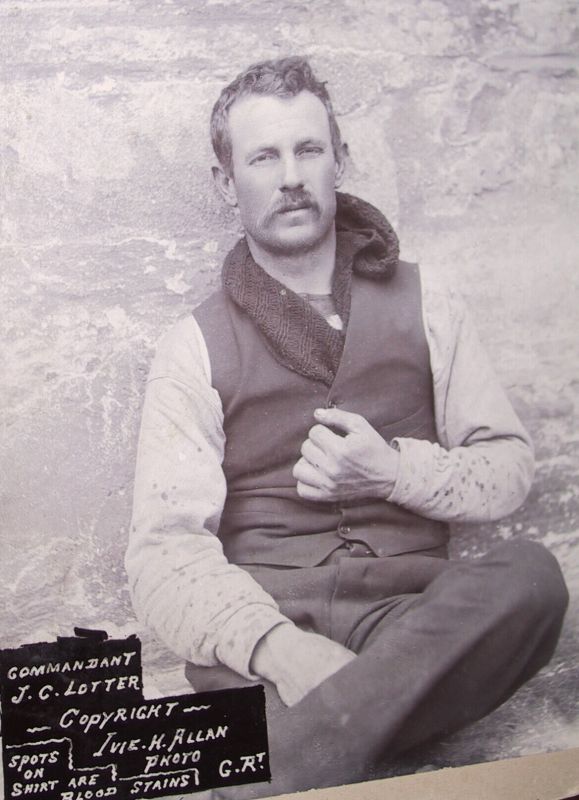
1901: Johannes Lotter, Boer War “rebel”

On this date in 1901, Commandant Johannes Lotter was shot at Middelburg.

Along with Gideon Scheepers, Lotter is one of the most famed Boer guerrillas from the Second Boer War.

Regarded by the British as one of their most nettlesome adversaries in that dirty guerrilla war, Lotter was captured in a bloody early September ambush when matters were well into an unpleasant scorched-earth endgame.

This was cause for much slapping of backs among the Union Jack set, and earned for his captor an immediate promotion.


Lotter’s captured men being jubilantly escorted into Graaff-Reinet.

Lotter almost immediately found himself in the dock for — well, all the things one does in a dirty guerrilla war.*

And one other thing: sedition.

The British charged Lotter as a rebellious subject of the British Cape Colony — rather than a resident of one of the independent neighboring Boer states — who owed allegiance to the British crown; upon this premise things like “killing troopers in war” became “murdering troopers”.

Lotter’s trial hung on his papers.** The defendant “pleaded that he was a Free State burgher, and, as such, entitled to the usage of civilised warfare and a legal combatant’s privileges.”

But he was in a bit of a pickle when it came to proving that the “Commandant Lotter” the British discovered on voting rolls for the Cape Colony city of Colesburg was a different guy. Innocent Blood: Executions During the Anglo-Boer War (its title telegraphs its Boer sympathies) summarizes:

his Free State citizen document was in a small case, which was lost or destroyed theday of surrender. Witnesses for the defence gave evidence that they had seen these papers. British intelligence stated that it could find no proof of his Free State citizenship in Bloemfontein. Lotter responded by asking how he could prove his citizenship when all his witnesses were still on commando and that he had been granted no time to call upon them.

Hey, the guy had six whole weeks from capture to execution to sort it all out.

A “Chair Monument” — there’s a picture of it on this page — commemorates Lotter and his fellow commando Pieter Wolfaardt at the place outside Middelburg where they were shot together on Oct. 12, 1901.

A number of additional prisoners from Lotter’s command taken with him in that same ambush were also eventually executed.

* Specifically: murdering two native spies; killing three British soldiers; blowing up railway lines; and sjamboking loyalist civilians.

** When the British later captured Scheepers, who was unquestionably not a Cape rebel, they simply charged his similar conduct as war crimes to the same capital effect.

On this day..

1817: Gertrudis Bocanegra, Mexican independence heroine

On this date in 1817, Mexican War of Independence heroine Gertrudis Bocanegra was publicly shot in her native town of Pátzcuaro for treason.

Bocanegra (English Wikipedia entry | Spanish), a literate Enlightenment woman was already 45 years old when the rebellion against the Spanish empire broke out.

Her husband and son joined Hidalgo‘s forces, in which service they would lay down their own lives.

Gertrudis Bocanegra kept a safe house, gathered supplies and money, shuttled messages … until Spanish authorities arrested her in 1817 and tortured her for information. (Need one even ask if the noble Bocanegra informed on her compatriots?)

She’s known as La Heroína de Pátzcuaro and is the namesake for, among other things, a plaza in that city and the striking Biblioteca Gertrudis Bocanegra, where one can find this:


(cc) image from eperales depicts Juan O’Gorman‘s monumental Historia de Michoacan. We’ve seen this monument before, as it depicts the Spanish burning to death the last native Tarasco ruler.

Bocanegra’s own execution is also shown in the mural — in the lower right, obscured by the bookshelves in the photograph above, but captured in detail in this Spanish blog post.

On this day..

1987: Eshan Nayeck, the last executed in Mauritius

On this date in 1987, Eshan Nayeck was hanged in Port Louis — capital of the Indian Ocean island nation Mauritius, a former Dutch, French, and British colony near Reunion Island.

It was just the second execution (French link) since Mauritius attained its independence in 1968, and it remains to this day the last.*

Nayeck sensationally stabbed to death a man named Abdool Rashid Atchia in Port Louis’s Central Market in 1983.


Scene of the crime: Central Market in Port Louis, circa 2006. (cc) image from erwinkarim.

* Mauritius abolished the death penalty in 1995, but its current Prime Minister Navin Ramgoolam has publicly mooted (pdf) restoring capital punishment “for crimes such as drug trafficking.”

On this day..

1569: Vladimir of Staritsa, royal cousin

On this date in 1569, Vladimir of Staritsa was forced by Ivan the Terrible’s goons to drink poison.

Vladimir was Ivan’s (barely) younger cousin, both of them grandsons of Russia’s state-building Ivan the Great.

Ivan the Terrible, of course, was the heir to the throne, an inheritance he received at the tender age of three when his father died unexpectedly — leading to Ivan’s famously miserable childhood of being kicked around by the boyars.

The dreadful relationship thereby fostered between throne and nobles came to a crossroads in 1553, when Ivan the Terrible appeared to be on his deathbed. The fading tsar tried to get those boyars to swear loyalty to Ivan’s infant son. Most of the boyars openly preferred the adult Vladimir of Staritsa.

This dramatic encounter is a pivotal episode in Sergei Eisenstein’s classic film Ivan the Terrible.

Instead of dying, Ivan surprisingly recovered. Awkward!

Vladimir actually survived this episode, and he himself may not even have been actively trying to claim the throne: the boyars hated Ivan plenty without his seditious assistance.

And for a while it looked as if any ill feelings were water under the bridge. Vladimir swore loyalty to Ivan upon the latter’s recovery, fought military campaigns alongside Ivan, and was even depended upon by Ivan as a guarantor of peace among Ivan’s own several potentially rivalrous sons.*

But that was the 1550s.

As the 1560s unfolded, Ivan grew increasingly mistrustful of his boyars’ loyalty.** According to this volume, an elevation of Vladimir to the throne was the object of at least one plot during those years. As Ivan’s only male cousin, he was a natural successor should Ivan be deposed, and therefore a natural focal point for Ivan’s enemies.

When Ivan eventually gave rein to his paranoia and unleashed the bloody purges of the oprichnina, Vladimir inevitably succumbed. Ivan decreed his death and forced him to administer the sentence by his own hand with a draught of poison, even going so far as to extirpate Vladimir’s wife and children, too.†

In a twist of the cruel irony Russian history is so susceptible to, Ivan the Terrible’s homicidal suspicion of his relations helped to doom Ivan’s own Rurik dynasty: after Ivan accidentally killed his own son and heir in a fit of pique, the succession which might have found a backup option in Vladimir and his offspring instead utterly collapsed — plunging Russia into the “Time of Troubles” out of which one of those former boyar families, the Romanovs, emerged with the throne after all.

* See Sergei Bogatyrev, “Reinventing the Russian Monarchy in the 1550s: Ivan the Terrible, the Dynasty, and the Church”, The Slavonic and East European Review, Apr. 2007. (pdf here)

** Ivan’s nasty turn after 1560 might trace to the untimely death of his wife Anastasia Romanovna, whom Ivan suspected might have been poisoned by those hated boyars.

† One daughter Maria Vladimirovna of Staritsa, survived.

On this day..

1982: Khosrow Khan Qashqai

On this date in 1982, Khosrow Khan Qashqai was publicly hanged in Shiraz.

A member of the pastoral Turkic Qashqai people of southern Iran, Khosrow returned from exile* with the Iranian revolution. These were the revolution’s hopeful first days, when SAVAK was gone and a new world was possible.

Before it went all pear-shaped.

Not long after Khosrow’s constituents sent him to the new Iran’s new Parliament, relations with the emerging theocratic dictatorship soured, sending the Qashqai leader fleeing to the hills one step ahead of the new secret police in 1980.

Khosrow et al held out for two years before succumbing to Iran’s Revolutionary Guards — a grim period throughout Iran, marked by growing suppression of political dissidence and the ruinous war with neighboring Iraq.

Thirty years on, Qashqai still labor under discriminatory cultural restrictions and even property expropriation that the U.N. has charged constitutes a campaign of “ethnic restructuring”.

* The Shah kicked him out for having backed Mossadegh.

On this day..

1898: Alfred C. Williams

(Thanks for the guest post to Robert Wilhelm, author of the Murder By Gaslight historic crime blog, and author of the book Murder And Mayhem in Essex County. Executed Today readers are sure to enjoy Wilhelm’s detailed investigations into long-lost historic crime. -ed.)

When Alfred C. Williams was arrested for the murder of John Gallo, his conviction seemed highly unlikely. There appeared to be no direct link between Williams and Gallo. There was no absolute proof that Gallo had been murdered, or even that he was dead. But in this case, circumstantial evidence, rather than increasing doubt, actually succeeded in dispelling doubt, bringing investigators closer to the truth and drawing the noose ever tighter around Alfred Williams’s neck.

John Gallo was a young Italian immigrant who worked on a farm in Lynnfield, Massachusetts. He was industrious and popular with the other workers, but kept to himself and very seldom left the farm. Gallo lived alone in a small shack in the rear of the farm. In the early hours of July 28, 1897, the shack caught fire and burned with flames so high they could be seen in neighboring towns. The shack was leveled, leaving nothing but ashes and the charred remains of a body, so badly burned that it could not be identified.

The body was so charred that it took two examinations to verify that it was, in fact, the body of a human. The head and neck were gone, both arms and both legs had been completely consumed, bone and all, by the fire. The spinal column remained with some back muscle attached; the heart, liver, kidneys, and bladders remained, but were badly burned. Everything else was completely gone. The medical examiner could state that the body was that of an adult human being, but nothing more.

With the destruction so complete, it appeared to investigators that nothing could be learned to explain what had happened that night. But as the investigation progressed, details began to emerge, like an image developing on a photographic plate. The fact that there was too little information became a clue in itself, and soon investigators were able to compile a list of facts that pointed to foul play:

  1. The body had been destroyed to a greater extent than would be expected from a fire in such a small building.
  2. The deceased had not been burned in bed. The bedsprings had survived the blaze but the body was found several feet away.
  3. The victim had not been dressed. Some buckles, metal buttons, a few coins and the clasp of a pocketbook were found by the side of the bedsprings, none were found near the body.
  4. The body lay in the doorway between rooms with the head back in the room toward the bed, not falling forward as a person naturally would if trying to escape from a burning room.
  5. A kerosene-oil can, which was usually kept near the stove, was found in the middle of the floor
    next to the body.

It was believed that the victim had been murdered before the fire started. His body was doused with kerosene and ignited, which would account for the severe damage to the body. The flame then quickly spread to the rest of the house.

John Gallo had earned $1.50 a day at Phillips’s farm and was paid monthly, always in five dollar bills. He spent very little and at the time of his death, it was suspected that he had around one hundred dollars earned on the farm. It was also well known that Gallo always carried three twenty dollar gold pieces that he had earned on a construction job prior to coming to the farm. No trace of the gold pieces or any melted gold were found.

Another crime had allegedly been committed near Lynnfield in the early morning of July 28. That afternoon, Alfred C. Williams reported that he had been held up near his rooming house in Wakefield. He had been unable to sleep and went outside to smoke a cigar. As he stood with one foot on the rail fence by the road, someone struck him on the head from behind. He turned to fight back, striking his assailant on the nose causing it to bleed. He was knocked unconscious, robbed of his watch and a small amount of money, and then thrown down the banks of Wakefield Pond.

He told his story to the police, showing them bruises on his neck and face from the fight, and bloodstains on his clothing from the assailant’s nose. The officers were skeptical of his story and held Williams for questioning. Unlike most holdups, Williams apparently had more money in his possession after the crime than he did before. On July 27, Williams had not had enough money to buy a meal or even pay a five-cent streetcar fare. The morning of July 28, he paid his back board bill and made some purchases. The police found seventy-five dollars, in five dollar bills, on his person.

The police learned that Williams had previously worked as a laborer on Phillips farm and knew the habits of the deceased. They searched Williams’s room and under the carpet, they found two twenty dollar gold pieces. When Williams was told where they found the coins he responded, “I know, I put them there.” They also found a bloodstained coat and vest in his room. Alfred C. Williams was arrested for the murder of John Gallo.

At the trial, the prosecution presented a case against Williams that was based entirely on circumstantial evidence. While there was nothing to directly link Williams to the fire, his familiarity with Gallo’s habits, his possession of money — including gold pieces — the day after the fire, the bloody clothing, and Williams’s inconsistent stories, taken all together were incriminating.

The defense challenged the very core of the evidence. There was no proof that the body found in the ashes was John Gallo’s; it could not be proven that a murder was committed or that the fire was not started accidentally; there was no proof that Alfred Williams was anywhere near the fire that night. But Williams was sticking to the story that he was held up on the night of July 28, so his alibi was also a matter of circumstantial evidence, and no one seemed willing to believe it. The jury deliberated for six hours before returning a verdict of guilty, first degree murder.

Alfred C. Williams was hanged in the yard of Salem jail on October 7, 1898. It was not a public hanging; the sheriff issued a few invitations, but only for the purpose of providing legal witnesses. Williams’s arms and legs were bound and his head was covered as he stood on the gallows. At 10:01 a.m. the trap was sprung and Williams dropped six feet, one inch. His neck was broken and he died within seconds. Williams professed innocence to the end.

Get Murder and Mayhem in Essex County here.

On this day..

1646: Zhu Yujian, the Prince of Tang

On this date in 1646, Zhu Yujian was captured and summarily executed at Tingzhou.

This gentleman went under the title Prince of Tang, making him Beavis and Butthead’s favorite Ming despot. Indeed, he was a direct descendant of the founder of that illustrious dynasty. Unfortunately for the Prince of Tang, that descent was of the ninth generation, which meant that the Ming were well into their decadence and decline.

The Prince of Tang had spent essentially the whole of his adult life seeing the state eaten away by sclerotic bureaucracy, internal revolts, economic breakdown … and, as a consequence of all that erosion, by the incursions of the Manchus.

The first ruler of those people’s successor Qing dynasty was already on the Chinese throne at this point, having seized the capital Beijing in 1644. The splintering thereafter of Ming officials and loyalists led to, among other transitional formations, a “Southern Ming dynasty” — far southern, almost to Burma. The Prince of Tang would accede to this contingent remnant of a once-glorious dominion, and enjoy the conceit of the purple and its prospect of imminent violent death for the last 14 months of his life.

When his able military commander Zheng Zhilong saw the writing on the wall and defected, Qing soldiers pouring through defenseless passes and over the Qiantang River swiftly routed the demoralized southern Ming in the summer of 1646.

The Longwu Emperor — that’s what the Prince of Tang was styling himself, the name inaptly meaning “plentiful and martial” — spent his last days being driven from pillar to post ahead of the Qing before he was finally overtaken and put to summary death with his wife.

The Southern Ming would fight on another fifteen years, but the particular familial branch embodied by the Prince of Tang met an unceremonious end long before the Ming as a whole succumbed. Zhu Yujian’s younger brother succeeded him as “the Shaowu emperor” that December and squandered the scant resources of his statelet — “lacking court dress, the thousands of officials who were appointed to the Shaowu government … had to buy theatrical robes from local actors” — on a few weeks’ counterproductive civil strife with a rival Ming claimant until the Qing utterly overran them.

On this day..