1948: The condemned from the Doctors’ Trial

On this date in 1948, seven SS men were hanged at Germany’s Landsberg Prison, condemned for war crimes and crimes against humanity in the so-called Doctors Trial.

Four of the hanged were doctors; three were non-physicians who assisted them. Their trial (which included 16 others, variously acquitted or sentenced to prison terms) by an American military tribunal was a conscious attempt to establish criminal responsibility among the medical profession.

As prosecutor Telford Taylor* said in his opening statement.

To kill, to maim, and to torture is criminal under all modern systems of law. These defendants did not kill in hot blood, nor for personal enrichment. Some of them may be sadists who killed and tortured for sport, but they are not all perverts. They are not ignorant men. Most of them are trained physicians and some of them are distinguished scientists. Yet these defendants, all of whom were fully able to comprehend the nature of their acts, and most of whom were exceptionally qualified to form a moral and professional judgment in this respect, are responsible for wholesale murder and unspeakably cruel tortures.

It is our deep obligation to all peoples of the world to show why and how these things happened. It is incumbent upon us to set forth with conspicuous clarity the ideas and motives which moved these defendants to treat their fellow men as less than beasts.

One of several war crimes trials after the big Nuremberg Tribunal (and held in the same courtroom), the Doctors Trial dealt with the Third Reich’s Frankenstein lab of medical experimentation.

Some of this was combat-related. How long can a downed pilot survive in the North Sea? Throw a POW into freezing water and find out.

Some was more conventional medical advancement, shorn of any ethical sense. How can we treat malaria? Inject some untermenschen and start testing.

And some of it was straight from the Nazis’ racial purification theology: euthanizing the disabled, castrating and murdering Jews and Gypsies, that sort of thing. It’s all a rich tapestry.

The doctors hanged this date included

  • Karl Brandt, Hitler’s personal physician and the co-director of the Aktion T4 euthanasia program**
  • SS hygienist Joachim Mrugowsky, for experiments with concentration camp prisoners
  • SS surgeon and German Red Cross head Karl Gebhart, who enjoyed experimenting with operations on unanaesthetized prisoners
  • Waldemar Hoven, chief doctor at Buchenwald

They kept company with three others who didn’t see the “patients” but pushed around the paper for those who did.

Many of this day’s scaffold clientele died unrepentant; Karl Brandt harangued at such length that the hood was put over his head mid-sentence to move proceedings along.

Landsberg Prison was a fitting site for their expiation. As the New York Times reported (June 3, 1948)

The men died on two black gallows erected in the courtyard of the prison where Hitler wrote “Mein Kampf” while confined after his 1923 Munich putsch.

* In 1970, Telford wrote Nuremberg and Vietnam: An American Tragedy, arguing that American officials had committed war crimes in Vietnam because “we failed ourselves to learn the lessons we undertook to teach at Nuremberg.”

Telford died in 1998, so his commentary on the accountability-free torture of the modern war machine is unavailable.

** Karl Brandt was actually condemned to death by a Nazi court in the closing days of the war and only narrowly avoided execution. His crime? Moving his family out of Berlin so that they could surrender to the Americans instead of the Russians.

On this day..

193: Didius Julianus, who bought the purple from the Praetorians

On this date in 193, Didius Julianus lost the rulership of Rome for which he had paid so dearly.

And his life.

Julianus‘s path to these doleful pages begins with the assassination of the notorious Emperor Commodus at the end of 192.

That man’s successor, Pertinax, was a notable bust with the Praetorian Guard, the elite imperial bodyguard whose status as the only military unit in Rome made it potential — and here, actual — kingmakers.

The Praetorians expected the payoff that had become customary for new executives, and when Pertinax proved less than liberal on that particular budget item, they turned right around and overthrew him.

To see that there would be no mistake the next time around, the Praetorians dispensed with the pretense and brazenly auctioned the purple.

Roman aristocrat and historian Cassius Dio was a witness to this hot mess.

Didius Julianus, at once an insatiate money-getter and a wanton spendthrift, who was always eager for revolution and hence had been exiled by Commodus to his native city of Mediolanum, now, when he heard of the death of Pertinax, hastily made his way to the camp, and, standing at the gates of the enclosure, made bids to the soldiers for the rule over the Romans. Then ensued a most disgraceful business and one unworthy of Rome. For, just as if it had been in some market or auction-room, both the City and its entire empire were auctioned off. The sellers were the ones who had slain their emperor, and the would-be buyers were Sulpicianus and Julianus, who vied to outbid each other, one from the inside, the other from the outside. They gradually raised their bids up to twenty thousand sesterces per soldier. Some of the soldiers would carry word to Julianus, “Sulpicianus offers so much; how much more do you make it?” And to Sulpicianus in turn, “Julianus promises so much; how much do you raise him?” Sulpicianus would have won the day, being inside and being prefect of the city and also the first to name the figure twenty thousand, had not Julianus raised his bid no longer by a small amount but by five thousand at one time, both shouting it in a loud voice and also indicating the amount with his fingers. So the soldiers, captivated by this excessive bid and at the same time fearing that Sulpicianus might avenge Pertinax (an idea that Julianus put into their heads), received Julianus inside and declared him emperor.

Cassius Dio, Book 74

The ignoble achievement is the only thing Didius Julianus is now remembered for.

While Julianus and the Praetorian guard were conducting their damnable business in the capital, three Roman generals in the provinces claimed the throne for themselves.

For centuries the Roman legions had been scattered beyond the Italian peninsula as a hedge against military coups. But after decades of relative stability at the top,* Rome was about to get a bracing reminder of what civil war looked like.

Praetorians — a few cohorts worth of men not in fighting trim — were fine for bullying Senators, but in an outright civil war, they were no match for the legions. The Praetorian Guard’s power to arbitrate the succession was contingent upon the beneficiary’s capacity to cement his own legitimacy by commanding the loyalty of (most of) the state apparatus.

And it turned out that buying the sceptre on spqrBay was not the way to get folks to bend their knees to it.

Septimius Severus, the imperial claimant nearest to the capital, commenced a relentless and virtually unresisted march on Rome, co-opting the troop garrisons and towns as he swept down the peninsula and spurning Julianus’s desperate diplomatic entreaties.

Cassius Dio’s record of Julianus scrambling to defend Rome against Severus is full of black humor.

Julianus … caused the senate to declare Severus a public enemy, and proceeded to prepare against him. In the suburbs he constructed a rampart, provided with gates, so that he might take up a position out there and fight from that base. The city during these days became nothing more nor less than a camp, in the enemy’s country, as it were. Great was the turmoil on the part of the various forces that were encamped and drilling, — men, horses, and elephants, — and great, also, was the fear inspired in the rest of the population by the armed troops, because the latter hated them. Yet at times we would be overcome by laughter; for the Praetorians did nothing worthy of their name and of their promise, for they had learned to live delicately;** the sailors summoned from the fleet stationed at Misenum did not even know how to drill; and the elephants found their towers burdensome and would not even carry their drivers any longer, but threw them off, too. But what caused us the greatest amusement was his fortifying of the palace with latticed gates and strong doors. For, inasmuch as it seemed probable that the soldiers would never have slain Pertinax so easily if the doors had been securely locked, Julianus believed that in case of defeat he would be able to shut himself up there and survive.

In the end, Severus took Rome without striking a blow: the Praetorians switched sides again, and the Eternal City delivered itself from the one usurper to the other. Cassius Dio, again, in media res

the soldiers, convinced by letters of Severus that if they surrendered the slayers of Pertinax and themselves kept the peace they would suffer no harm, arrested the men who had killed Pertinax … We [the Senate] thereupon sentenced Julianus to death, named Severus emperor, and bestowed divine honours on Pertinax. And so it came about that Julianus was slain as he was reclining in the palace itself; his only words were, “But what evil have I done? Whom have I killed?” He had lived sixty years, four months, and the same number of days, out of which he had reigned sixty-six days.

(Actually, Julianus had killed someone: foreseeing that the Praetorians were liable to turn coat yet again, Julianus had the Praetorian prefect who sold him this lemon of an empire put to death for trying to cut a deal with Severus. Despite this negative feedback, the transaction took place on a strict no-refunds, no-exchanges basis.)

A harsh deal for Didius Julianus was a pretty good one for the Roman Empire. Septimius Severus cleaned up his other rival claimants, and ran the empire capably for the next generation.

Kick back with this review of the the dreadful interlude of Didius Julianus with episodes 98 and 99 of the enjoyable History of Rome podcast.

* “The period in the history of the world during which the condition of the human race was most happy and prosperous,” in the judgment of Edward Gibbon.

** The Praetorians were also de-motivated because their promised donative had not been forthcoming.

On this day..

1622: Not quite Squanto (Tisquantum), Pilgrim befriender

On this date in 1622, or very close to it, the Patuxet Native American Tisquantum (better known as Squanto) was about to be yielded by Plymouth Colony Governor William Bradford to Wampanoag chief Massasoit for immediate execution … when the unannounced appearance of a strange ship fortuitously saved him.

Squanto is most famous as the Indian godsend who saved the Mayflower Pilgrims at the Plymouth Bay colony from starvation by teaching those pious wayfarers how to live off the land in the New World.

In that capacity, he made possible (and participated in) the “First Thanksgiving” harvest gorger in 1621 that figures as the antecedent of the modern American holiday. Our day’s principal has therefore been portrayed on the stage by generations of schoolchildren from Cape Cod Bay to California.

But this was only the tail end of one of the most remarkable lives in history.


Photo of Tisquantum bust by N. Ayad of Cupids Cove Chatter. Photo was taken courtesy of the Pilgrim Hall Museum, Plymouth, MA, United States.

As a youth, Squanto was kidnapped from his native soil by English explorer George Weymouth, who sold him into slavery in Europe. Squanto wound up in London in some sort of forced-labor capacity, before hitching a ride back to the Americas with Captain John Smith — the Pocahontas guy.

It was thanks to this improbable abduction and return trip that Squanto was available to materialize out of the woods, speaking the Queen’s English on this alien continent, in the nick of time to save the Plymouth immigrants from disaster.**

However, because Squanto was a real person and not a Disney character, he began exploiting his privileged intermediary position for his own advantage.

According to Plymouth Gov. William Bradford’s chronicle Of Plymouth Plantation,

Squanto sought his own ends and played his own game, by putting the Indians in fear and drawing gifts from them to enrich himself, making them believe he could stir up war against whom he would, and make peace for whom he would. Yea, he made them believe they kept the plague buried in the ground, and could send it amongst whom they would, which did much terrify the Indians and made them depend more on him, and seek more to him, than to Massasoit. Which procured him envy and had like to have cost him his life; for after the discovery of his practices, Massasoit sought it both privately and openly, which caused him to stick close to the English, and never durst go from them till he died.

Seeking Squanto’s life both privately and openly, Massasoit sent messengers to the Plymouth colony requesting the Machiavellian diplomat’s return in accordance with the colony’s treaty arrangements with the Wampanoag.

Bradford ducked and dilated, not wanting to give up this valuable asset, but the precarious colony also needed the amity of its Indian neighbors.

Massasoit remained insistent, according to the account of Edward Winslow,

entreating [Bradford] to give way to the death of Tisquantum who had so much abused him … [Massasoit] sent his own knife and [two messengers] therewith to cut off his head and hands and bring them to him

Bradford was on the point of yielding to this demand when a strange boat appeared unannounced — and the guv hit the “pause” button on everything.

he would first know what boat that was ere he would deliver him into their custody (not knowing whether there was a combination of French and Indians). Mad with rage and impatient at delay the messengers departed in great heat.

The delay turned out to be permanent … which for Squanto was only a few more months before he caught ill† and died later in 1622.

The ship that quite unknowingly bought Squanto this extra purchase on life had nothing at all to do with the drama unfolding between Bradford and Massasoit: it was the Sparrow, the advance party of the coming Wessagusset (or Weymouth) colony which would plant itself adjacent to the Plymouth settlers and completely crash and burn.

And the Pilgrims and the Indians lived happily ever after.

* This site asserts May 31 was the date that the Sparrow came ashore at Plymouth. Most sites are slightly less specific, noting only that the ship arrived in very late May.

** Among Squanto’s good deeds for the fledgling colony was tracking down a boy who got lost in the wilderness. The boy was John Billington, the eponymous son of the first man hanged in the Plymouth Colony.

† Some suspect that Squanto’s “illness” wasn’t so accidental, and the frustrated Wampanoag chief simply dispensed with the diplomatic rigmarole and poisoned him off.

On this day..

1916: Robert Digby in Villeret

On this date in 1916, Private Robert Digby was shot by a German firing squad in the tiny northern France village of Villeret.

Digby was the last of a quartet of English soldiers who had been part of the British Expeditionary Force who met the Hun’s first foray into France in 1914.

Digby and his mates, Thomas Donohoe, David Martin and William Thorpe, were stranded behind lines.

Villeret took them in and changed their uniforms for peasant clothes while they worked the fields and tried to keep their heads down.

“Every inhabitant of Villeret knew of the British soldiers in their midst but none breathed a word, although the Germans had threatened to execute anyone harbouring enemy fugitives,” writes Ben McIntyre, who wrote the book on these men. “Even when food ran low and German troops were billeted on every house, the secret was kept safe. It was an astonishing act of collective bravery.”

To the west, in trenches the men could not pass, the war ground uncounted souls into horsemeat.

Digby became the lover of a village girl, and fathered a daughter by her.

This perilous idyll under the very bowers of hell could not last long. The Brits were mysteriously betrayed, and arrested by the Germans in May 1916 — all save Digby, who escaped out the window of a barn.

Donohoe, Martin and Thorpe were shot as spies on May 27.

After a week on the run in the nearby woods, the mayor of Villeret found Digby, and told him that the Germans were threatening to execute the villagers unless he turned himself in to face his comrades’ fate. Digby did so.

McIntyre’s book, A Foreign Field: A True Story of Love and Betrayal in the Great War, explored the village of Villeret and the life of Digby’s daughter HĂ©lène Cornaille-Digby — an infant when her father was shot; an octogenarian when McIntyre met her.

The enduring mystery of the place, at least to McIntyre as an outsider, was the unanswered question of who betrayed the English. Was it a jealous lover? A disapproving family? A fearful neighbor?

Years after the publication of the book, McIntyre (so he thinks) accidentally solved the mystery.

On this day..

1529: Jacob Kaiser, launching the First War of Kappel

On this date in 1529, Zwinglian missionary Jacob Kaiser was burnt at the stake in the Catholic Swiss canton of Schwyz.

His Protestant evangelizing was a violation of the unwritten Cuius regio, eius religio policy keeping peace among the cantons. (Later, it would become written.)

This otherwise routine Reformation martyrdom led Ulrich Zwingli, then GrossmĂ¼nster of Zurich, to make war on the Catholic cantons, seeking to pry them open for further Protestant inroads.

Let us be firm and fear not to take up arms. This peace, which some desire so much, is not peace, but war; while the war that we call for, is not war, but peace. We thirst for no man’s blood, but we will cut the nerves of the oligarchy. If we shun it, the truth of the gospel and the ministers’ lives will never be secure among us.

Zwingli, channeling Orwell

The short-lived Erster Kappelerkrieg — the First War of Kappel — was won within weeks, swiftly concluded by a truce favorable to Zwingli’s Protestant alliance.

(Legend has it that the treaty was concluded over a shared pot of milk soup picturesquely resting on the Catholic-Protestant border, the Kappeler Milchsuppe.)

Die Kappeler Milchsuppe (1869) by Gemälde von Albert Anker.

But this initially favorable return on poor Jacob Kaiser’s sacrifice was soon squandered.

Hostilities between the two camps continued, eventually flaring into the Second War of Kappel. Zwingli was again spoiling for the fight, but his under-prepared Protestants were trounced by a Catholic league in October 1531. Zwingli himself died on the battlefield.

On this day..

2002: Napoleon Beazley, who threw it all away

On this date in 2002, Napoleon Beazley was executed by lethal injection in Texas.

A high school class president and football hero, Beazley was 3 ½ months shy of his 18th birthday when he made the first entry on his criminal record.

It was a doozy:

Beazley (with two accomplices who later testified against him) shot a Tyler, Texas, couple in their garage to steal their Mercedes Benz.

The wife survived the attack by playing dead.

The husband was not so lucky. He was businessman John Luttig, the father of archconservative federal judge J. Michael Luttig. When Beazley’s appeal reached the U.S. Supreme Court, a third of its justices recused themselves for their own connections to Luttig.

(J. Michael Luttig testified at Beazley’s trial. “Individuals must be held accountable at some point for actions such as this,” he told the media afterward. “I thought this was an appropriate case for the death penalty.”)

Both in the legal arena and in public opinion, Beazley’s case turned in an unusually uncluttered fashion on the principle of executing juvenile offenders.

Beazley was not mentally impaired, nor warped by childhood trauma, nor even generally underprivileged. His had been the black family accepted by the white community in his native Grapeland.

There was no question of Beazley’s guilt in the crime. None of the typical extenuating circumstances applied, save Beazley’s own eventual remorse.

“I don’t blame anybody else for being here but me,” Beazley would say later.

And since he pulled the trigger just weeks shy of his legal adulthood, even his youth was barely in play.

So, the question of whether Napoleon Beazley deserved to die was a pretty close proxy for the question of how bright a line the age of 18 ought to be where the death penalty was concerned.

Beazley lost crucial votes by the closest of margins: one Supreme Court appeal denied him on a 3-3 tie, and the Texas Board of Pardons and Paroles turned him down 10-7.

If these votes reflected uncertainty over the juvenile death penalty as a policy, the matter would soon pass the tipping point to a resolution: Napoleon Beazley was the 19th person put to death in the modern American death penalty regime for a crime committed as a juvenile. Only three more followed before the Supreme Court (consisting of the same nine justices who had rejected Beazley’s appeal a few years before) ruled the death penalty for minors unconstitutional in the 2005 Roper v. Simmons decision.

There’s cinematic treatment of Beazley’s shocking crime in the recent documentary Two Hours to Tyler. There’s also a play about him.

On this day..

1797: Gracchus Babeuf, for the Conspiracy of Equals

If the “revolutionary extremist” exists at all as an identifiable type, he exists in purest incarnation in Gracchus Babeuf. No revolutionary better fits the description “narrowminded to the point of genius”; few have defined their heaven more clearly or crusaded so fanatically, ascetically, so religiously to bring it to earth.

Gracchus Babeuf: The First Revolutionary Communist

On this date in 1797, Francois-Noel Babeuf lost his head for the Conspiracy of Equals — the last Jacobin upheaval of the French Revolution, or the first Communist upheaval of post-Revolution modernity.

Francois-Noel — he styled himself “Gracchus” after the populist Roman tribunes — was a young man of Desmoulins‘ generation but from a considerably more hardscrabble background. Like the starry-eyed Dantonist scribbler, Babeuf discovered himself a brilliant journalist and pamphleteer with the onset of the Revolution; he did several prison stints during various revolutionary phases of the early 1790s for his too-radical-for-school opinions.

He did another in 1795 under the French Directory for his firebreathing rag Le Tribun du Peuple, which was particularly unfashionable stuff during the post-Robespierre Thermidorian regime.

Nothing daunted, Babeuf emerged from prison the leading apostle of the Parisian proletariat which had by then been decisively separated from power.

The order of the day was class consolidation with the spoils of the aristocracy apportioned among a new oligarchy of wealth. As France rushed headlong towards Bonaparte and Bourbon restoration, Babeuf was the man left to rally “the party which desires the reign of pure equality.”

The French Revolution was nothing but a precursor of another revolution, one that will be bigger, more solemn, and which will be the last.

The people marched over the bodies of kings and priests who were in league against it: it will do the same to the new tyrants, the new political Tartuffes seated in the place of the old.

Manifesto of the Equals, 1796

One can see why later revolutionaries — Marx included; Babeuf makes a cameo in the Communist Manifesto — would adopt this sort of thing as a harbinger of the next century’s revolutions.

And if the Directory had known who Nicholas II would be, it would have had no intention of going the way of his family.

Instead, it shut him down in February, 1796: Napoleon Bonaparte personally carried out the operation, just days before he wed Josephine.


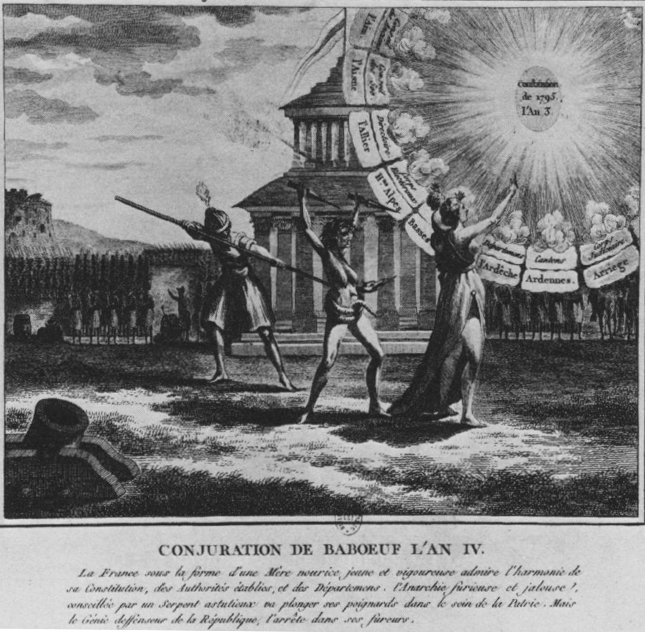
The Babeuf Conspiracy. Anonymous French print.

Babeuf’s party comes down to us as a “conspiracy,” under which word the state would charge him and which his follower Philippe Buonarroti would later rebrand the “Conspiracy of Equals”. It was not so much a grassy-knoll type of conspiracy as it was an underground organization.

When its adherents placarded Paris with the seditious “Analysis of the Doctrine of Babeuf” as the city endured a potentially dangerous economic crisis in April 1796, the government was put to a test of its strength.

It passed.

Having infiltrated Babeuf’s network, it arrested the principals on the eve of the Conspiracy’s intended insurrection. They were hailed out of Paris (a safeguard against sympathetic risings) to the commune of Vendome and there put on trial.* Babeuf and his associate Augustin Alexandre Darthe were condemned to death on May 26th and guillotined the very next day.

The last gasp of the French Revolution dropped with their heads into the basket.

Revolutionary Babeuvism, however, had scarcely just begun.

I don’t know what will become of the republicans, their families, and even the babies still at their mothers’ breasts, in the midst of the royalist fury that the counter-revolution will bring. O my friends! How heart-rending these thoughts are in my final moments! … To die for the fatherland, to leave a family, children, a beloved wife, all would be bearable if at the end of this I didn’t see liberty lost and all that belongs to sincere republicans wrapped in a horrible proscription.

-Babeuf’s last letter to his family

* The trial of Babeuf was itself a jurisprudential milestone: it was the first French trial to be transcribed verbatim.

What might look today like a nifty little advance for efficient judicature was bitterly controversial in 1797. The French Revolution had overturned an ancien regime practice of professional magistrates accepting legal testimony by written deposition and deciding matters behind closed doors. The liberte, egalite, fraternite way would instead demand that testimony be given live in the courtroom where citizen jurors could weigh its credibility.

Babeuf’s lawyer, Pierre-Francois Real, protested against the court stenographers, arguing that “The law insists that the system of written depositions not be restored in any way. That system will undoubtedly return if any means are used to save testimony given orally.”

There’s a fascinating disquisition on the curious and contradictory development of this issue and the way it “violates … common assumptions about the advance of textuality in the West” during the French Revolution in Laura Mason, “The ‘Bosom of Proof’: Criminal Justice and the Renewal of Oral Culture during the French Revolution” The Journal of Modern History, March 2004.

On this day..

1871: Hostages of the Paris Commune

The fall of the Paris Commune on May 28, 1871 launched many a leftist insurrectionary into the martyrs’ firmament.

But the last semaine sanglante that engulfed the Commune there was blood enough for many martyrdoms.

On this date in 1871, just days before the Commune gave way, it executed a clutch of hostages (French link) in desperate reprisal for the Versailles army’s cruelties. For the Commune, it was too little ruthlessness and much too late. For the 52 who stood up against the wall this date, they were just as dead.

These unfortunates were marched from La Roquette prison — whose inmates by dint of timely resistance only narrowly avoided a more extensive massacre — to Rue Haxo and slaughtered.

A number of them were men of the cloth. In 1938, the Catholic church of Notre Dame des Otages was erected on the site and dedicated to the victims’ memory.


A crucifix at Notre Dame des Otages. Copyrighted image used with permission.

(The markers on the spot have settled on 52 as the number of the victims, which might be the historically authoritative count; different sources, however, provide slightly different numbers.)

On this day..

1946: Marcel Petiot, Vichy serial killer

Paris, 1942.

On the run from the Gestapo — as a Jew or a Gypsy, a common criminal or a Resistance fighter whose cover is blown — you get wind of a man who can help.

“Dr. Eugène” will (for a fee) spirit you over the Pyrenees and thence to South America. In his house at rue le Sueur, you make the arrangements. One small matter: the tropics requires an inoculation, which le bon docteur will readily provide. One small prick of the needle and then …

The needle contained cyanide and the destination turned out to be a lime pit, and so “Dr. Eugène” — Marcel Petiot — was guillotined this date in 1946.

His opportunistic exploitation of the dangerous Vichy years is what he’s famous for, but Petiot had decades of crime behind him by the time he got his phony “underground railroad” up and running.

From youthful compulsive thieving, Petiot graduated into a shady medical practice in Villeneuve-sur-Yonne where he was the resident black market abortionist.

He’s thought to have killed a mistress there, and maybe a couple of others, but was able to segue into a political career by winning the mayoralty of Villaneuve when he sabotaged his opponent’s campaign appearances. The sticky-fingered Petiot naturally plundered the town treasury and was forced out of office in 1931.

By the time the war years had rolled around, Petiot had judiciously relocated to Paris where he retained his capacity for professional advancement in the face of profoundly disturbed behavior: he was institutionalized for kleptomania the same year he was appointed an official mĂ©decin d’Ă©tat-civil.

So he had the requisite two-faced background for his whackadoodle wartime “escape route”, which he creepily code-named “Fly-Tox.”

Twists and turns elided — trutv.com and crimemagazine.com both have detailed biographies/case histories — Petiot’s enterprise was quasi-exposed early in 1944 when the stink of incinerating bodies prompted neighbors to summon the police and uncover his charnel house.

Amazingly, Petiot was able to beg off with the claim that he was a Resistance activist — these were French police — and that the victims were Nazis or collaborators who had been eliminated by his network on orders. The Gestapo had sniffed him out too late in the war to do anything about him, but its judgment that Petiot was a “dangerous lunatic” actually turned out to bolster the deranged doctor’s case that he was an anti-fascist.

The alibis fell apart as the war wrapped up, and Petiot was finally recognized in a Paris manhunt and brought to trial for 27 homicides. Police thought 60-plus was more like it — maybe even into the hundreds — but secured 26 of the 27 counts. That’s more than enough to do a man to death, especially since they were the for-fun-and-profit murders of desperate people already on the run from the late and hated occupying army. Bit of a touchy subject in France in ’46.

But there was good news.

This London Times (May 27, 1946) observed that Petiot’s beheading marked

the first time that the guillotine has been used since the war. Until now executions have been by firing squads. Although gruesome, it is one more indication of the return of this country to normal civil ways of life.

On this day..

1725: Jonathan Wild, Thief-Taker General and Receiver of Stolen Goods

(Thanks to Anthony Vaver, author and publisher of EarlyAmericanCrime.com for the guest post. Vaver is the author of Bound With An Iron Chain: The Untold Story of How the British Transported 50,000 Convicts to Colonial America. -ed.)

A buzz filled the air as people stood on their toes and filled every window in an attempt to get a glimpse of the great Jonathan Wild as he was paraded through the London streets on Monday, May 24, 1725. Despite the festive atmosphere surrounding the procession, Wild appeared to be unmoved by the shouts of the crowd, his attention focused instead on the Bible held open in his hands. After traveling about a third of the way to his destination, the procession stopped at the Griffin Tavern, so that Wild could drink a glass of wine.

Not long after leaving the Griffin Tavern, a rock thrown from a window hit Wild in the head, and blood began to pour down his face. The crowd roared with approval and people started to hurl insults at him, along with more stones and dirt. The cart stopped twice more before reaching its final destination: first at the White Lion, where Wild drank another glass of wine, and once again at the Oxford Arms, home of the bare-knuckle boxing champion James Figg, where Wild drank a tankard of beer and even more wine. His next and final stop was Tyburn Hill, where he was scheduled to be executed.

Convicts often stopped for drinks at various taverns during their march from Newgate Prison to Tyburn to be executed, so the fact that Wild stopped at three along the way to his execution was not unusual. What was unusual, however, was the fact that he was able to hold down his liquor, given that the previous night at two in the morning he had tried to kill himself in his jail cell by drinking a large dose of laudanum, a concoction of opium dissolved in alcohol. Wild was already in a half-stupefied state before his slow journey to the gallows and his wine drinking had even begun.

Wild’s dramatic execution marked a precipitous fall for a man who was perhaps the most influential person in England’s criminal justice system, even though he never held an official government position. As the self proclaimed “Thief-Taker General of Great Britain and Ireland,” Wild was instrumental in capturing and bringing to justice scores of petty thieves that plagued the London streets. He consulted the government on the passage of laws intended to encourage the capture of criminals. He also oversaw a vast criminal empire, the likes of which has never been duplicated.

Wild ran an Office for the Recovery of Lost and Stolen Property where people could apply to him for help in recovering their possessions for a fee that fell below what it would cost them to replace the objects. Wild would then use his connections in the criminal underworld to recover the goods and return them to the owner. His business proved to be extremely popular.

In addition to recovering lost and stolen property, Wild was particularly adept at catching and prosecuting criminals, a public service that enhanced his general reputation and gained the approval of the authorities. In the absence of a true police force, the government relied on rewards to encourage people to police the streets themselves. Anyone who could capture a thief and convict him or her with evidence received a reward of £40, far more than what most people in England could earn in a year. Wild benefited from this policy by collecting a fee every time he was able to prosecute a criminal. His office, then, essentially served as the de facto “Scotland Yard” of the day.

Wild’s knack for catching criminals brought him great renown. He often appeared at trials to give evidence against the criminals he helped to capture. He got to know the bailiffs of the prisons and could be seen socializing in the local taverns with Justices of the Peace. He entertained government officials in his house.

The public remained blissfully unaware that there was another, more sinister, side to Wild.

In point of fact, the man supposedly responsible for clearing the streets of criminals was also the head of a vast criminal empire and a well-oiled criminal machine. Wild’s Lost Property Office turned out to be a clearinghouse for stolen goods that members of his own organized gang had themselves acquired. The thieves he apprehended, supposedly for the good of the community, were fall guys; they either belonged to rival gangs, or were members of his own gang who tried to double-cross him, quit his business, or had ceased to be more valuable than the £40 reward given by the government for capturing and convicting a criminal. Wild sent many of these criminals to the gallows by appearing in court to give evidence — real or otherwise — against them. The unofficial head of crime prevention was in actuality the foremost perpetrator of crime and organizer of criminals in London and throughout Great Britain.

Wild’s downfall began when he helped prosecute the thief and burglar Jack Sheppard, whose daring and dramatic escapes from the notorious Newgate Prison turned him into a folk hero. Public opinion soured on the “Thief-Taker General” and his involvement with Sheppard’s execution … and when details of Wild’s criminal operation emerged after his arrest for receiving stolen goods, the public was furious.

When Wild finally reached the gallows at Tyburn, the noise from the crowd was so loud that the Ordinary of Newgate found it almost impossible to say his prayers with Wild and the three other criminals scheduled to die. The hangman, Richard Arnet, who years before had been a guest at Wild’s wedding, tried to give Wild as much time as he needed before preparing him for execution. The crowd, however, grew restless and threatened to tear Arnet to pieces if he did not proceed in carrying out his duties immediately. Reluctantly, Arnet placed a noose around Wild’s neck.

A great shout went up from the crowd as the cart drove away leaving the convicts dangling from the ropes tied around their necks. After the drop, Wild desperately grabbed onto Robert Harpham, who was being executed for coining, in an attempt to lift himself up and slacken the rope connected to his neck. Arnet intervened and separated the two, and after a few minutes, the life of Jonathan Wild came to an end at the age of about 42.

Almost as soon as Wild’s body was cut down, a rumor began to circulate that it was being carried off to the Surgeon’s Hall for dissection. The bodies of executed criminals were often used for such a medical purpose, but the practice usually led to a struggle between the surgeons, who were trying to take the body of the criminal away, and the disapproving crowd. In this case, Jonathan’s wife, Mary Wild, had arranged to circulate the rumor that he had been turned over to the surgeons as a ruse, so that his body could be properly buried without interference. Her plan didn’t work. Three or four days after it was buried Wild’s body was dug up from the St. Pancras churchyard by the surgeons.

Today, Jonathan Wild’s skeleton can be seen on display at the Hunterian Museum at the Royal College of Surgeons in Lincoln’s Inn Fields.


The skeleton of Jonathan Wild at the Hunterian Museum at the Royal College of Surgeons in Lincoln’s Inn Fields.

On this day..