1766: Edmund Sheehy, James Buxton, and Buck Farrell, Whiteboys

This account from the London Chronicle, June 5, 1766 refers to the disappearance and alleged murder of the informer John Bridge. We’ve visited this case previously, in the form of Father Nicholas Sheehy, who had also been drawn and quartered a few months previous for the Bridge affair; collectively, these cases are pretext for state reprisal against the Irish Whiteboys movement, which opposed large landholders’ moves to consolidate estates, expel tenants, and let people starve while the land that once fed them was shifted towards commercial agriculture.


The Trials of Mr. Edmund Sheehy, Mr. James Buxton, and Mr. John Farrell, at Clonmel Assizes in Ireland, for the Murder of John Bridge, on the Night of the 18th of October, 1764

Mr. Edmund Sheehy being put to the bar, the lawyers for the crown first called upon John Toohy, who declared, that the prisoner was within two or three yards of John Bridge, when he received the fatal blow from John Mechan.

Mary Brady swore that she came up immediately after the murder, and that the prisoner was present, together with the Rev. Mr. Sheehy, and Edmund Mechan, and that the latter held in his hand a bill hook all bloody, and that the Priest commended the action.

Mr. James Herbert, Farmer, declared, that on Sunday Oct. 28, 1764, he was called upon by Roger Sheehy, then on horseback, behind whom he rode to a meeting of twenty or thirty persons, on the lands of Shanbally, near Clogheen, where they were sworn by Father Sheehy to murder John Bridge, John Bagwell, Esq; William Bagnell, Esq; the Rev. Dr. Hewetson, and every other person who should oppose them; that they would be faithful to the French King, and conquer Ireland.

After having thus sworn, they came to the house of one English, on the lands of Shanbatly, where Bridge was; they took him to a field, where was another party of about a hundred and thirty; here they accused him of giving information against the White Boys, and insisted that he should by oath contradict whatever he had given information of, which he refused to do; hereupon one Byrne made a stroke at him with a turf-slane, which he kept off with his arm; then Edmond Meehan took a bill hook from under his coat, with which he struck Bridge on the back part of his head, which so cleft his scull, that he instantly expired; that the Priest was then within the distance of two yards, with a hook in his hands. After this (being first sworn not to divulge what had been done) they put the body in a blanket, which they conveyed to a ploughed field, where they buried it; but in about eight days after, lest the plough should turn up the body, it was taken up and carried to a church-yard about two miles off.

John Lenorgan swore, that being sent by his uncle, Guynan, to the house of English, where the Bridge had been, between ten and twelve at night, he heard the noise of a number of people; that not caring to be seen, he concealed himself in a ditch, where he was discovered by Thomas McGrath, who put him on horseback behind the Priest, with whom he rode some time, and on the way discovered the body of a dead man, wrapt up in a blanket, before a person on horseback, and through a hole in the blanket, saw the head bloody, and that there was a number of persons attending it, both on foot and horseback, of whom he knew Father Sheehy, Edmond Meehan, Buck Sheehy, Thomas McGrath, Bartholomew Kenneley, and John Toohy; and that when they came to the turn of the road, the Priest let him down, directing him the shortest way home, and gave him three half crowns, charging him not to mention to any one what he had seen; and that he understood the dead body was that of John Bridge.

Here was closed the evidence for the crown. James Prendergast, Esq, attempted to prove an alibi, by swearing that, on the 28th of October, 1764, he and the prisoner, with their wives, dined at the house of Mr. Joseph Tennison, near Ardfinan, in the county of Tipperary; where they continued until after supper, and that it was about eleven o’clock when he and the prisoner left the house of Mr. Tennison, and rode a considerable way together on their return to their respective homes, and that the prisoner had his wife behind him; that when they parted, he (Mr. Prendergast) rode directly home, where, on his arrival, he looked at the clock, and found it to be the hour of twelve exactly, and as to the day he was positive, the 29th being the fair day of Clogheen; that he had desired the prisoner to sell some bullocks for him at the fair, not being able to give his attendance; and that Paul Webber, of Cork, Butcher, was in treaty for the said bullocks with the prisoner, on the 29th.

Mr. Tennison declared he remembered the prisoner and Mr. Prendergast dining with him some time in the month of October, 1764, but was inclined to believe it was earlier in the month than the 28th, for that on the 29th he dined with the Corporation of Clonmell; that on the Wednesday following he dined with the prisoner and Mr. Prendergast, at the prisoner’s house, and that day he invited the prisoner and his wife, with Mr. Prendergast and his wife, to dine with him the Sunday following, and was positive that company did not dine with him on any other day in October.

Paul Webber, of Cork, Butcher, swore, that he was at the fair of Clogheen on the 29th of October, 1764, where he saw the prisoner, but was not in treaty with him for any bullocks belonging to Mr. Prendergast, but the prisoner told him, that Mr. Prendergast had some bullocks on his hands to dispose of, on which he sent a person to Mr. Prendergast’s house, who bought them for him.

Thomas Mason, Shepherd to the prisoner, swore to the night and hour of the prisoner’s return abovementioned, and that he took him from his master his horse, and turned him out to the field. The following persons were also produced to discredit the testimony of John Toohy: viz. Bartholomew Griffith, Surgeon, Daniel Griffith, and John Day, servants to Brooke Brasier, Esq.

The purport of the evidence given by Bartholomew Griffith was to confront Toohy, who, being asked by the prisoner, who gave him the new cloaths he then had on, answered they were given him by his uncle Bartholomew Griffith, who being examined, denied it. Daniel Griffith declared, that Toohy was, on the 28th and 29th of October, 1764, at his house at Cullen.

John Day swore, that Toohy lived for six weeks with his master Brooke Brasier, Esq, when he behaved very ill, and was a person of bad characer; but Mr. Brasier declared he did not know the said Toohy, but that a person was in his family, for that time, of a very bad character, but that he did not know him.

The evidence of James Herbert, for the Crown, was not attempted to be invalidated. Mr. Herbert came to the Assizes, in order to give evidence in favour of Father Sheehy; the Grand Jury, who before had found bills of high treason against him, sent for Toohy, who said he knew him very well, and would assist to take him; upon this William Bagnell, Esq, attended Toohy, with some of the light-horse, went and took him; when being told on what occasion he was secured, he said he would discover the rise and meeting of the White Boys, and their intentions; and acknowledged himself guilty of what he was accused.

Mr. James Buxton, commonly called Capt. Buxton, on account of the power he had over the people he commanded, was the next person put to the bar to be tried. The testimony, which has been already related, was in every particular supported by the additional evidence of Mr. Thomas Bier, who was an accomplice, and acknowledged being present when they all swore allegiance to the French King, and to murder John Bridge, &c. and that too in consequence of a letter he received from Father Sheehy. Mr. Bier declared, that, at the time Bridge was murdered, the Priest was within two or three yards of the unfortunate man, holding the book, on which he a little before pressed and exhorted him to swear for the purpose, as has been mentioned.

Mr. James Farrell, commonly called Buck Farrell, a young man of a genteel appearance, was the last convicted, and on the joint evidence of the prosecutors.

Tuesday, the 15th of April, they received sentence to be executed the 3d of May, at Clogheen.

The general characters of the prisoners, until this unfortunate affair, were very respectable. Their influence must have been considerable, otherwise they could not have brought after them, and inlisted, the number of people they did, who were subject to martial law, by which they were tried on misbehaviour. It was in resentment of a whipping, which was inflicted on John Bridge with remarkable severity, to which he was sentenced by one of the Court-martials, that he was led to give evidence against them, by which he lost his life.

On this day..

1230: William de Braose, bold paramour

In this year William de Breos the Younger, lord of Brycheiniog, was hanged by the Lord Llywelyn in Gwynedd, after he had been caught in Llywelyn’s chamber with the king of England’s daughter, Llywelyn’s wife.

-Chronicle of Ystrad Fflur

The Welsh king Llywelyn the Great had William de Braose hanged on this date in 1230 near Bala for — well, the aforesaid.

The lords of his Norman house patrolled the Welsh marches, and our man — Gwilym Ddu (“Black William”) to the Welsh — was Llywelyn’s prisoner from 1228 via capture in some skirmish. All in a day’s work for the feudal nobility, for whom “captivity” meant honored hospitality while waiting around for their relatives to raise the ransom for their relief.

Black William made time in more ways during this spell, not only seducing Llewelyn’s wife Joan, Lady of Wales, but playing matchmaker between Llywelyn’s son and his, da Braose’s, daughter. This marriage still went off notwithstanding Llywelyn’s discovery that his own had been violated, something the Welsh prince allegedly found out by walking in on the two in the middle of the night, when an already-ransomed Black William had gone back to pay an Easter visit to his future in-laws.

In the record of the Abbott of Vaudey, “On 2nd of May, at a certain manor called ‘Crokein’, he was made ‘Crogyn’, i.e. hanged on a tree, and this not privily or in the night time, but openly and in the broad daylight, in the presence of more than 800 men assembled to behold the piteous and melancholy spectacle.”

On this day..

1813: Adriana Bouwman, guillotined at The Hague

The young maid Adriana Bouwman was guillotined on this date in 1813 for theft and arson; it was the second and last use of that notorious machine in The Hague, during the three years that the Netherlands was directly incorporated into Napoleon’s First Empire.

Arijaantje Apersdr Bouman was condemned for robbing and torching a farmhouse where she worked as a domestic. She was four months shy of her 20th birthday when beheaded.

On this day..

1919: Seven Thule Society hostages

A century ago today, seven hostages taken from the German pre-Nazi Thule Society were executed by the short-lived Munich Soviet just before it was crushed by right-wing militias.

The Thule Society (logo at right) was a Bavarian volkisch club with a profound interest in stuff like crackpot race theory and Teutonic mythology; its very name alludes to a legendary territory hypothesized since antiquity to lie at the fringes of the world, often associated with Scandinavia and with the origins of the Aryan race.*

Society members figured in the founding of the German Workers’ Party (DAP), the party which became the National Socialist German Workers’ Party (NSDAP), better known as the Nazis. Former Thuler Hans Frank was among those eventually hanged via the postwar Nuremberg trial.

One will readily imagine where this lot stood in relation to the Soviet Republic that was declared in Bavaria in early April, and the sentiment was fully returned. As right-wing Freikorps paramilitaries intent on destroying the Red Bavarian statelet surrounded Munich, the Communists seized seven Thule Society members — notably Countess Haila (or Hella) von Westarp and Gustav Franz Maria, Prince of Thurn and Taxis and held them in the basement of the Luitpold Gymnasium.

On April 30, 1919, all these seven were executed by order of the Communist sailor Rudolf Egelhofer, together with either two or three captured Freikorps prisoners, an affair known as the Münchner Geiselmorde (“Munich hostage-murder”).


Countess Haila von Westarp

The very next day, the Freikorps broke through Munich’s defenses and commenced the bloody rout that destroyed the Munich Soviet.

The Thule Society as a body survived and briefly prospered after its brush with the revolutionaries’ muzzles — the eventual Nazi party newspaper Völkischer Beobachter was previously a Thule Society-owned periodical called the Münchener Beobachter — but it fizzled out into a memory during the 1920s.

Still, this esoteric nursemaid to the infancy of national socialism features prominently in histories of Third Reich occultism; aficionados might wish to browse some of its iconography in this Pinterest gallery, or just punch their distinctive name into your search environment of choice and feel that third eye opening.

* The element Thulium is named for Thule, because it was discovered by a Scandinavian chemist; the U.S.’s Thule Air Base in Greenland developed from an Arctic Circle trading post established and named by a Scandinavian explorer. (From which he launched a series of early 20th century “Thule Expeditions”.)

More recently, the word made the news when astronomers controversially christened the most distant observed trans-Neptunian object “Ultima Thule”.

On this day..

1947: Karel Čurda and Viliam Gerik, Czechoslovakia resistance betrayers

Turncoat Czechoslovakian resistance fighters Karel Čurda and Viliam Gerik were hanged for traitors on this date in 1947.


Čurda (left) and Gerik

Both were special operatives trained in England and parachuted into Nazi-occupied Czechoslovakia. Gerik (Czech Wikipedia entry) became separated from his compatriots and couldn’t re-establish contact. Seemingly panicked as he contemplated his lonely situation in Prague, he turned himself in in early April 1942 and became a Gestapo collaborator, informing on his underground compatriots. Among other things, he identified the body of his onetime companion on his parachute jump, Arnošt Mikš — who had committed a well-timed suicide to avoid capture after killing a gendarme in a shootout. Gerik’s helpful ID enabled the Gestapo to shoot Mikš’s brothers by way of collective punishment.

This man did not greatly prosper by his betrayal even during the war years, for after later attempting to break free from his masters and re-establish contact with the resistance he was tossed in Dachau and only released when that camp was liberated by the U.S. Army, going in his case from frying pan to fire.

Far more notorious was the Judas act of Čurda (English Wikipedia entry | Czech), whose proximity to the operation that killed Reichsprotektor Reinhard Heydrich enabled him to give up the assassins hiding out in the basement of Prague’s St. Cyril and Methodius Cathedral.

Čurda’s reward was a half-million Reichsmarks and a German wife with whom he had a child, prior to his postwar arrest; such payoffs obviously make him a ready target of vilification, although more sympathetic interpretations exist suggesting that Čurda acted days after the demonstrative eradication of the village of Lidice because he feared that his own family or town might suffer the same fate.

On this day..

1494: Joan Boughton, “old cankered heretic”

Lollard heretic Joan Boughton was burned on this date in 1494 — purportedly England’s first female Christian martyr.

Followers of pre-Luther English church reformer John Wyclif(fe) had been thick on the ground in the early 15th century, terrifying the English state into a violent suppression.

But these years of headline repression did not suffice to drive Lollardy into the grave … only underground. The Lollard heresy continued to persist, quietly, its trajectory and dimensions largely undocumented, barely surfacing here and there with the odd arrest. “Between 1450-1517, Lollardy was almost wholly restricted to the rural districts, and little mention is made of it in contemporary records,” notes this history. “How extensively Wyclif’s views continued to be secretly held and his writings read is a matter of conjecture.”

Its adherents still had the stuff of martyrdom, for on this occasion decades on from the heyday of Lollardy and into the reign of Henry VII,

an old cankered heretic, weak-minded for age, named Joan Boughton, widow, and mother unto the wife of Sir John Young — which daughter, as some reported, had a great smell of an heretic after the mother — burnt in Smithfield. This woman was four score years of age or more, and held eight opinions of heresy which I pass over, for the hearing of them is neither pleasant nor fruitful. She was a disciple of Wycliffe, whom she accounted for a saint, and held so fast and firmly eight of his twelve opinions that all the doctors of London could not turn her from one of them. When it was told to her that she should be burnt for her obstinacy and false belief, she set nought at their words but defied them, for she said she was so beloved with God and His holy angels that all the fire in London should not hurt her. But on the morrow a bundle of faggots and a few reeds consumed her in a little while; and while she might cry she spoke often of God and Our Lady, but no man could cause her to name Jesus, and so she died. But it appeared that she left some of her disciples behind her, for the night following, the more part of the ashes of that fire that she was burnt in were had away and kept for a precise relic in an earthen pot.

On this day..

1877: James Singleton, Beeville character

James Edward Singleton caught a death sentence in Texas after setting out from Beeville with a business partner carrying a wad of cash with which they intended to set up a saloon in Rockport.

The business partner never made it there, and Singleton swung in Beeville on April 27, 1877, after having been arrested boarding a boat with all their saloon boodle in his pocket. He left this colorful last will and testament; the reader will not be surprised to learn that it was not honored. (The document survives in damaged condition; ellipses indicate lost text.)

In the Name of the Omnipotent, Omnipresent, Omnificient of science and common sense Amen. I, J.E. Singleton (cosmopolite) Now sojourning in Galveston Jail, State of Texas, And, being of sound mind. Do by these presents, Will, divise, and bequeath, (for the diffusion of anatomical knowledge among mankind) — my mortal remains to J.J. Swann, on the following conditions.

First, that my body — after the execution — be prepared in the most scientific & skillful manner known in anatomical art, and placed in his Office, in the Courthouse in Beeville … O … ter temple of Justice … may …

Second. It is my express desire — If [his prosecutor -ed.] Dave Walton has no objections — That two drumheads, be made of skin. On one of which shall be written in Indellible characters Popes universal prayer, & on the other the following Verdict, –

We, the Jury, find the defendant, Jas. E. Singleton, guilty of murder in the first degree, as charged in the Indictment, and assess the penalty of death.

The said drum heads to be presented to my distinguished friend and fellow citizen, Frank Boggus — drummer for Tom Holly’s division — On the following conditions that he, the aforesaid Frank Boggus, shall beat, or cause to be beaten on said drum heads the popular tune [Old Mollie Hare] … front on the 8th day of June Annually.

The viscera, and other parts of my body, useless for anatomical purposes, I wish composted for a fertilizer, and presented to Mr. Barclay, proprietor of the Grand Palace Hotel in Beeville, to be used by him for the purpose of nourishing the growth of cabbage, turnips, pertaters, and other garden sass, that the worthy people of Bee County — or at least the masculine portion thereof — may have something to relieve the monotony of hash & dried apples, during their brief sojourn at the aforesaid Hotel, while assembled at Beeville, for the purpose of dishing out Justice to Violators of the Law.

J.E. Singleton.

The foregoing is my last will and testement, and I wish J.J. Swann to act as Executor. I feel very grateful to the Citizens of Bee County in general, and to J.J. Swann in particular for the many favors conferred upon me by them. I also feel that I am indebted to them, to some extent pecuniarily, and being at present in Indigent circumstances, I write and leave this will, alike to liquidate my debts, and prove my gratitude.

Singleton really was quite a character. Newspapers around the Republic reported his pig-out last meal request of “one dish ham and eggs, one apple pie, one peach pie, one egg custard, one fruit pudding, one large pound cake, and two bottles of wine.” He also attempted to cheat the hangman by taking his own life, leaving a note for his mother that also hit the papers in which he confesses himself in very human terms not excluding his amusing disdain for the community that was preparing to take his life. (This from the Galveston Weekly News of May 7, 1877:)

Dear Mother — When you read this, I, your sinful, rebellious, neglectful son, will be no more on this earth. But, mother dear, I am not going to give these worthy people of Bee county the pleasure of publicly executing me. You will understand by this that I contemplate destroying my own life. And such is the case. I am aware that you look upon it as an unpardonable sin, or almost as such, but I can not bear the idea of being hanged in public, before a gaping multitude of fools, and especially Bee county fools. I am compelled to lose my life, mother dear; there is no other alternative, and you will pardon me, I’m sure, for this act, for it is only shortening my existence a few hours at most.

As for the justice of my conviction, I will not speak or write falsely to you at this time, and I reckon the verdict of the jury was a just one. I did the murder, but not with malice aforethought, as every one thinks, nor was I actuated by any hope of gain. It was for a quarrel about a trifle, and the provocation was not sufficient to warrant the killing; therefore, I don’t feel justified.

It’s hard, mother dear, for me to calmly contemplate death, and a great deal harder, when I think of your long suffering toll and privations for me. I know you are suffering and will suffer after my death. I would to God I could avert it from you, but I can not; but I think it’s better to take my life, than to be executed by the minions of the law in this place. I will not ask you not to grieve for me, mother, for I know that would be useless; but try and bear up the best you can. I trust that we may meet again in that better world beyond the grave. I do not feel capable of saying anything that will strengthen or comfort you at this time, when I know how much you need comfort and strength. But one thing, mother, please for my sake, and for the sake of Lee and Mamie, do not despair nor give up, if you can help it. Think how you, and none but you, can instruct them how to be great and good men. Some would think that my career was a contradiction of what I say, but God knows that the fact of my now being under sentence of death, and my name forever disgraced, is not the consequence of my home training. I was taught things that were right, but I was too weak and sinful to profit by your good teachings, but I do hope to God it will be different with the two younger ones. Teach them always to do right at all times, and for my sake teach them to think with pity and never with scorn of the disgraced and outcast murderer. For with all my faults, I always loved them; but I am not much afraid on that score, if they continue as they are now, as I do not in the least doubt their love for me. I saw Mamie this evening. I am thankful that I was permitted to see him once more. I regret not having seen Lee very much, but as I did not, you must convey my loving farewell to him. I must close this, mother, for writing here, solitary and alone as I am, of our loved ones causes such a rush of old half-forgotten memories that I am almost overpowered. I am not as near cast-iron as I thought. Well, dear, dear mother, farewell, and may God, in His infinite mercy, bless, comfort and console you is the prayer of your loving but unhappy son.

JAMES EDWARD SINGLETON

On this day..

1831: Atanasio, shot for some buttons

This episode from Mexican Alta California comes from the short-lived administration of Manuel Victoria, who proved himself such a martinet in his few months as governor of that territory that a rebellion that December forced Victoria’s resignation.

Our source is Hubert Howe Bancroft, a historian of the American West, in this volume of his chronicle of California:

The administration of justice was a subject which early claimed the new ruler’s attention. It had been much neglected by the easy-going Echeandia, and crime had gone unpunished. Criminal proceedings had been often instituted, as we have seen in the local presidial annals of the last six years, but penalties had been rarely inflicted with fitting severity. Victoria had strict ideas of discipline, and no doubt of his ability to enforce the laws. He is said to have boasted soon after his arrival at Monterey that before long he would make it safe for any man to leave his handkerchief or his watch lying in the plaza until he might choose to come for it. How he carried out his ideas in this direction will be apparent from a few causas celebres of the year.

The case of Atanasio was pending when Victoria came. Atanasio was an Indian boy less than eighteen years of age, a servant in sub-comisario Jimeno’s office, who had in 1830 stolen from the warehouse property to the extent of something over $200. The prosecution was conducted by Fernandez del Campo, Padres, and Ibarra as fiscales; and the last-named demanded, in consideration of the youth and ignorance of the culprit, as well as on account of the carelessness with which the goods had been exposed, a sentence of only two years in the public works. The asesor, Rafael Gomez, after having sent the case back to the fiscal for the correction of certain irregularities, rendered an opinion April 18th, in favor of the death penalty; and by order of the comandante general Atanasio was shot at 11 a.m. on the 26th. Gomez was an able lawyer, and I suppose was technically correct in his advice, though the penalty seems a severe one. Naturally the Californians were shocked; and though an example of severity was doubtless needed, Victoria was not fortunate in his selection. The circumstance that led to the culprit’s detection seems to have been his using some military buttons for gambling with his comrades; and the popular version of the whole affair has been that an Indian boy was shot by Victoria for stealing a few buttons.

On this day..

1804: Hans Jakob Willi, Bockenkrieger


(cc) image by Paebi

“We are free Swiss, completely equal citizens. That government that will not hear the voice of the people is a tyranny.”
Hans Jakob Willi, leader of the Bockenkrieg, who was executed on 25 April 1804.

The defeat of the Old Swiss Confederacy by Napoleon had shaken up political arrangements in Switzerland, creating the successor Helvetic Republic. As Napoleonic revolutions were wont to do, this new state aimed to centralize, universalize, and rationalize, having done with archaic redoubts of canton authority and ancient feudal privileges.

This new Republic was a short-lived affair, held up only by French bayonets; upon their withdrawal in 1802, it succumbed quickly to civil strife which necessitated the Corsican’s mediation — and a new political order which restored some powers of the prostrated cantons.

It was the consequent flex of Zurich upon its former provincial domains that brought about the Bockenkrieg insurgency — a rural rebellion near Horgen requiring Zurich to impose its will by means of a very picturesque suppression.


The Bocken estate after the battle for the manor during the Bockenkrieg, 28 March 1804 by Johann Jakob Aschmann (c. 1804)

Hans Jakob Willi, a cobbler turned soldier who gave the insurgency a veteran military man at its fore, was injured in battle, resulting in the speedy collapse of the rising. A court martial declared his death, despite Napoleon’s attempted intercession on Willi’s behalf.

German speakers might enjoy this public domain history on the rebellion.

On this day..

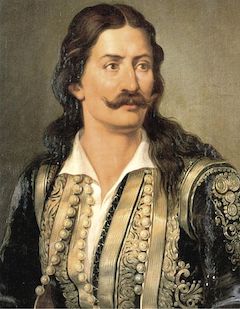
1821: Athanasios Diakos, Greek War of Independence hero

Greek independence hero Athanasios Diakos died by Ottoman impalement on this date in 1821.*

Though he acquired his nickname Diakos (“deacon”) from a youthful spell in a monastery, this fellow Athanasios (English Wikipedia entry | Greek) while the Turks still governed Greece made his way as a klepht — Greece’s version of the Balkan hybrid outlaw/guerrilla archetype, similar to the hajduk figures among the South Slavs. All of these outlaw types took to the mountains where they could subsist as brigands and mercenaries beyond the reach of the Porte, and seek opportunities where they might to strike at Ottomans. Many of the Greek persuasion, Diakos included, adhered to the Filiki Eteria secret society that aspired to liberate Greece.

With the onset of the Greek War of Independence in early 1821, Diakos jumped right into the fight. Picturesquely, he met a much larger Turkish detachment in battle at Thermopylae where he made like Leonidas and with a handful of companions heroically held out against impossible odds at the Alamana Bridge.

Captured wounded, Diakos spurned the temptation of an officer’s commission in the Turkish army should he but switch sides with words that remain legendary in his homeland to this day: “I was born a Greek, I shall die a Greek.” He was impaled at the city of Lamia, fearlessly musing, “Look at the time Charon chose to take me, now that the branches are flowering, and the earth sends forth grass.”

He’s a very famous and beloved figure in Greece, albeit much less so in parts beyond. The village where Diakos was allegedly born has been renamed for him full stop.

* The narratives I’ve seen run a bit hinkie between the Battle of Alamana on April 22 and the great klepht’s death on April 24 since there’s a two-day gap and everyone seems to agree that he was ordered for execution “the next day”. I’m sticking to the agreed death date here, which is universal, but as best I can discern the timeline alternatives for accounting the missing day appear to break down between the notion that Diakos was impaled on the 23rd and lingered on his spike overnight before death, and that it was not until the 23rd that the Ottoman commander had the opportunity to interrogate him and decide his fate and thus “the next day” was the 24th. I haven’t located a source that appears dispositive on this issue.

On this day..