1721: William Spigget, after peine forte et dure

English courts during the Bloody Code were strewn with all manner of weird pre-modern juridical relics, among which one must surely number the peine forte et dure — the “hard and forceful penalty” applied by courts against a defendant who refused to submit a plea.

The jurisdiction of criminal courts that we take for granted today initially emerged opposite potentially rival legal mechanisms for dispute resolution: ecclesiastical courts, weregild, even trial by combat. In principle, a defendant entering a plea at the bar was submitting himself to the specific jurisdiction of the court … a submission that, in principle, he could decline.

The march from that point to the present — when refusing to plead means the court simply enters an automatic “not guilty” plea on your behalf — consisted of gradually making the principle impossible in practice by dint of physical violence to force open the prisoner’s lips. It doesn’t matter if you lift a finger to defend yourself at trial, Mack, but we need you to say “guilty” or “not guilty” first.

The French term itself dates to a statute of Edward I in 1275, under the heading “The Punishment of Felons refusing lawful Trial” — one of those situations where the existence of the legislation proves the existence of the phenomenon. “Notorious Felons, and which openly be of evil Name,” the text complains, “will not put themselves in Enquests of Felonies, that Men shall charge them with before the Justices at the King’s Suit, shall have strong and hard Imprisonment (la prisone forte et dure), as they which refuse to stand to the Common Law of the Land.”

The text’s language suggests close confinement, fetters and guards, crummy rat-gnawed rations in the dumpiest hole of the dungeon: probably the king who introduced hanging, drawing, and quartering could make “hard imprisonment” quite persuasively uncomfortable.

But by the time of Queen Elizabeth, the state saw the need to narrow this potential refuge from the law down to the size of a pinprick. From the 16th century, we find that a special form of torturing to death is designed for prisoners refusing to plead:

the Prisoner is laid in a low dark Room in the Prison, all naked but his Privy Members, his Back upon the bare Ground his Arms and Legs stretched with Cords, and fastned to the several Quarters of the Room. This done, he has a great Weight of Iron and Stone laid upon him. His Diet, till he dies, is of three Morsels of Barley bread without Drink the next Day.*

“Which grievous death some resolute Offenders have chosen,” we understand, “to save their Estates to their Children.” Even this potential pecuniary loophole — the one once sought by Salem witch trials victim Giles Corey when he preferred pressing to death to the certainty of condemnation as a warlock — had vanished, for “in case of High Treason, the Criminal’s Estate is forfeited to the Sovereign, as in all capital Crimes, notwithstanding his being pressed to Death.”

The crown was trying to open an impassable gap between theory and practice, and it was accomplishing that end: this stuff happened once in a blue moon.

People threatened to withhold their plea, sure. What would follow is that a judge would read out in chilling detail everything that was about to befall the fellow (it was usually a fellow, though not always), then a bailiff would seize him and painfully tie his thumbs together right there in court, then march him off to the staking-out room to get things ready. Just showing the instruments of torture was the first rung on the torture-ladder, and usually somewhere in this whole process the defendant — be he ever so hardened — would chicken out and agree to make a plea before the first weight was ever loaded onto his torso.

Usually.

A Tyburn hanging is the focus of this post: it’s a mass execution of seven souls on the 8th of February in 1721. So the peine forte et dure did indeed do its job, force its plea, and noose its man.

But even though William Spigget/Spiggot died at the end of a rope, he was the rare soul who did go so far as to force the awful pressing torture, and to endure it for a little while.

Spigget led a robber gang of eight or so men preying on the roads out of London; one of those men, Thomas Phillips aka Thomas Cross, hanged alongside his boss. They had been caught only days before their eventual trial on January 13, and Spigget bravely, stubbornly, or foolishly refused to submit his plea. (Cross at first refused too, but he was in the chicken-out camp.)

The Ordinary of Newgate, plainly struck by the experience (and not a little aware of its potential to move copy), dwelt at greater length on Spigget’s 30 minutes under the stones than he did on the whole lives of some of the other February 8 hang-day compatriots.

Before he was Put into the Press, I went to Him, and endeavour’d to dissuade him, from being the Author and Occasion of his own Death; and from cutting Himself off from that Space and Time which the Law allowed Him, to repent in, for his vicious Course of Life: He then told me, that if I came to take Care of his Soul, he would regard Me, but if I came about his Body, he desired to be excused, he could not hear one Word. After a while, I left him, and when I saw him again, it was in the Vault, upon the bare Ground, with the Weights (viz. 350 pounds) upon his Breast. I there pray’d by him; and at Times ask’d him, why he would destroy his Soul as well as Body, by such an obstinate Kind of Self-Murder:** All his Answer was, Pray for Me; Pray for Me! In the Midst of his Groans, he sometimes lay silent, as if Insensible of Pain; then would fetch his Breath very quick and fast. Two or three Times, he complained that they had laid a cruel Weight on his Face; tho’ nothing was upon his Face, but a thin Cloth; That was however remov’d and laid more light and hollow; but he still complain’d of the prodigious Weight they had laid upon his Face; which might be occasion’d by the Blood being flush’d and forc’d up into his Face, and pressing as violently against the Veins and small Tendrills there, as if the Pressure upon them had been externally on his Face. When he had continu’d about half an Hour in the Torture, and 50 pound more of Weight had been laid on his Breast, he told the Justice of Peace who committed him, and myself, That he would Plead.

Having thus been awed by 400 pounds of the law’s majesty — and restored to something like sensibility with a splash of brandy, and several days’ rest during which Spigget’s post-ordeal health at times turned so precarious that he besought the last sacrament — both the apex robber and his henchman were easily convicted of several specific robberies upon the roads. One victim was able to identify the two as his assailants; in other cases, specific victims’ stolen goods were recovered from Spigget’s own lodgings, like Neal Sheldon’s valuable wig. Any one of these crimes would have been good enough to hang them.

Showing honor among thieves, the two men concentrated their few remarks on clearing a third confederate tried with them: the evidence against William Heater being circumstantial, and Spigget and Cross insisting that he was more incidental flunky than accomplice, his neck went un-stretched.

So why endure the hard and forceful penalty at all? By all appearances Spigget’s reason in the end resolved to pride: a violently exaggerated performance of the same criminal bravado that led so many of his peers to make a show of dying game at the gallows. “The Reasons, as far as I could learn from Him,” the Ordinary reported,

were, That he might preserve his Effects, for the use of his Family; That it might not be urged to his Children, that their Father was hanged; and that — Linsey should not tryumph over him, by saying he had sent him to Tyburn.

(Joseph Lin(d)sey was a former fellow-robber who saved his own life by turning crown’s evidence against his former mates. Spigget, we are told, was particularly galled by this betrayal “because Spigget had once rescued him [Lindsey] when he was nigh being taken, and in the defending him was wounded, and in danger of his Life.”)

As we have noted, Blighty’s seizure laws had already made the first objective a nonstarter, which leaves our man aspiring to a desperate exertion of masculine defiance. The Spigget of his own mind’s eye was a knight of the road so scornful of death that he would even let them slowly crush him to death. He fell short on that score, but dared much more than anyone had done in years, and no wonder: even the moments he endured as if hours might have been enough to shorten his years had he received an unlikely reprieve.

Sometimes he would say, that he wish’d he had dy’d in the Pressing, For that all sence of Pain was by the Pain taken from him, and he was fallen into a kind of Slumber. At other Times he express’d himself, that he was glad he did not cut himself off, by his Obstinacy, from that space the Law had allow’d him, for his Repentance, for the Sins of his whole Life.

On Monday, February 6, before the Execution, he receiv’d the Sacrament; and said that he desir’d not to Live, for he could be only a weak and unhealthy Man; and added that he could raise his Breath only in the lower Part of his Stomach

* This is not statutory language but that of a contemporary observer.

** The Ordinary really fixated on the suicide angle, just as if entering the trial were not an equally suicidal choice; the whole lot of the condemned got to hear as part of his sermon

That it was a False-Courage, for Malefactors assured that they shall dye, to lay violent Hands upon Themselves, to prevent the effects of the Law; and that if it was an Action fit for Socrates and Cato, and the greatest Heathens; it was yet too mean and indecent for the lowest Christian; as there is something Cowardly and Base, in cutting off our Lives, for fear of Pain and Shame. Nor would Sampson perhaps have obtain’d Licence from God, to Murder Himself, but that in his Person the Name of his God was mocked and ridiculed, and made a Jest for Dagon.

On this day..

1723: Hermann Christian von Wolffradt, Chancellor of Mecklenburg-Schwerin

On this date in 1723, Hermann Christian von Wolffradt was beheaded by the German duchy of Mecklenburg which he had long served as a minister of state.

Pomerania, the territorial strip along the south of the Baltic Sea,* has often been divided in its history — as it is now (between Germany and Poland) and as it was then (between Sweden and the emerging Prussian empire — with Mecklenburg-Schwerin still an independent principality destined eventually to be subsumed into Prussia/Germany). Various products of the noble Wolffradt house lived and served the different realms that planted flags in Pomerania; our man’s father, also named Hermann von Wolffradt, was chancellor of Swedish Pomerania.**

Our Hermann Christian was a chip off the old block, but since he got a slice of the patrimony on the Prussian side, he climbed the ranks of the Duchy of Mecklenburg-Schwerin.

He was a fixture in the court of Duke Friedrich Wilhelm I (not to be confused with his contemporary Friedrich Wilhelm I of Prussia, Frederick the Great’s severe father). But Wolffradt’s relationship with Friedrich Wilhelm’s son and successor, Karl Leopold, proved to be a strained one even as Wolffradt reached the position of Chancellor in 1721. This was no great distinction, as Karl Leopold’s relations were rocky with just about everyone; he called in Russian troops to beef with the Swedes, and so alienated the Mecklenburg estates that by 1728 the Holy Roman Emperor had him deposed.

Karl Leopold might have first suspected his chancellor — whose wife was incidentally also Karl Leopold’s mistress — of conniving with the duchy’s knights against him in the 1710s. By 1721 the duke was on his guard against his minister once more, and contrived to convict him of disloyalty and have him beheaded at Dömitz.

* Its name derives from the Slavic “po more” — “by the sea”.

** And our executed Hermann’s younger brother Carl Gustav von Wolffradt was a general in the Swedish army, while Carl’s most notable son was Erich Magnus von Wolffradt, a Prussian general.

On this day..

1721: John Meff

John Meff hanged at Tyburn on this date in 1721 for returning from convict transportation.

If we are to credit the autobiographical account that Meff furnished the Ordinary of Newgate prior to his hanging, it was the last act in an adventuresome life. (Here’s the Ordinary’s account of the execution of Meff with three other men; here’s the Newgate Calendar entry based upon it, and which provides the quotes ensuing in this post.)

“I was born in London of French parents,” Meff begins — Huguenots who had fled Catholic harassment.

Huguenot refugees formed an important part of London’s Spitalfields weavers, and Meff apprenticed in this business until he could hang out his own shingle. But finding business too slow to support his family, he took to a bit of supplementary thieving.

Meff says that he had already once been condemned to death for housebreaking “but, as I was going to the place of execution, the hangman was arrested, and I was brought back to Newgate.”

Certainly the era’s executioners had frequent criminal escapades, but I have not found this remarkable Tyburn interruptus related in any press accounts in the 1710s. It’s possible that Meff is embellishing on the 1718 downfall and execution of hangman John Price — though Price was seized red-handed and not detained in the exercise of his office. This inconsistency has not prevented creation of a wonderful illustration, The Hangman Arrested When Attending John Meff to Tyburn, from this volume.

At any rate, Meff’s sentence was moderated to transportation to the New World, and he says that he “took up a solemn resolution to lead an honest and regular course of life … But this resolution continued but a short time after the fear of death vanished.”

Here Meff’s story really gets colorful — whether to the credit of the unsettled Atlantic economy or to the teller’s gift for embroidery we cannot say.

The ship which carried me and the other convicts was taken by the pirates. They would have persuaded me and some others to sign a paper, in order to become pirates; but we refusing, they put me and eight more ashore on a desert uninhabited land, where we must have perished with hunger, if by good fortune an Indian canoe had not arrived there. We waited till the Indians had gone up the island, and then, getting into the vessel, we sailed from one small island to another, till we reached the coast of America.

Not choosing to settle in any of the plantations there, but preferring the life of a sailor, I shipped myself on board a vessel that carried merchandise from Virginia and South Carolina to Barbadoes, Jamaica, and other of his majesty’s islands. And thus I lived a considerable time; but at last, being over-desirous to see how my wife and children fared inEngland, I was resolved to return at all adventures.

Once back, Meff says, he “quickly fell into my former wicked practices” — as if by gravity, no further explanation ventured. It’s hard not to suspect that he simply managed to escape his American indenture to continue a career in larceny, absent the whole marooned-by-pirates subplot. Men were known to tell tall tales to the Ordinary — who, after all, had their own story to sell the public through the deaths of their charges.

“The narrow escape he had experienced from the gallows ought to have taught him more wisdom than to have returned from transporation before the expiration of his time; but one would think there is a fatality attending the conduct of some men, who seem resolutely bent on their own destruction,” the Newgate Calendar’s entry concludes.

“One truth, however, is certain. It is easy, by a steady adherence to the rules of virtue, to shun that ignominious fate which is the consequence of a breach of the laws of God and our country.”

On this day..

1732: Pompey, poisoner of James Madison’s grandfather

On this date in 1732, a Virginia slave entered American presidential lore at the end of a noose.

The Madisons were “planters, and among the respectable though not the most opulent class”* resident in Virginia from the 1650s or so — and would in time bequeath the new American Republic its fourth president, James Madison.

We are concerned for today’s post with President Madison’s paternal grandfather, Ambrose Madison. Alas, concern will not necessarily translate to elucidation, for most of the Madison family’s records and correspondence were destroyed in the 19th century: the first Madison generations are shadowy historical figures. Ann Miller has pieced together the fragments in the short book “The Short Life and Strange Death of Ambrose Madison”, published by the Orange County (Va.) Historical Society, and that is the primary source for this post.**

Ambrose Madison was a local grandee of King and Queen County, with landholdings elsewhere in Virginia; it was Ambrose Martin who in the 1720s acquired (via his father-in-law, a land surveyor) the Orange County grounds that would become the great Madison estate Montpelier.

In 1732, Madison moved his family to the Montpelier property. By that time, he controlled 10,000 acres in present-day Orange and Greene Counties, and was gobbling up land elsewhere — like the new frontier of westward settlement, the Piedmont.

And of course, Madison owned human beings, too. The inventory of his estate from 1732 lists 29 black slaves by their first (sole) names: ten adult men, five women, and 14 children.

In the summer of 1732, Ambrose Madison took ill and started wasting away towards death. The fact was apparent to Madison and those around him; the last weeks of his life were taken up in settling affairs. (He made out a will on July 31.)

Shortly before Madison’s death on August 27, two of his slaves — a man named Turk and a woman named Dido — along with another slave, Pompey, property of a neighboring plantation, were arrested on suspicion of having poisoned Madison. No record survives to indicate how or why they would have done so.

If grievances can only be guessed-at, they are not difficult to guess. At the same time, for aught we know the trio might have been falsely accused: there had never been a murder in the vicinity, but Madison’s death came just months after a gang of slaves committed a series of armed robberies and shot at three white people.† As we have seen from later and better-documented slave resistance, southern whites were prone to great paranoia where the prospect of servile rebellion was concerned. And as Madison was a healthy fellow in his mid-thirties, attributing his unexpected death to poison was a natural move.‡

As Miller notes,

It is likely that Ambrose Madison’s case sent ripples of fear — even panic — through the region … the court [appeared] eager to have a quick trial (and, perhaps, to make quick examples of those found guilty and hopefully deter any other slave rebellions).

All three slaves were convicted together on September 6 of “feloniously Conspiring the Death” of Ambrose Madison. Pompey hanged the next day — after he’d been appraised (at £30) to compensate his owner for the destruction of property. Turk and Dido were only found to be “concerned in the said felony but not in such a degree as to be punished by death but … by Whipping.” They suffered 29 lashes apiece “on their bare backs at the Common Whipping post, and thereafter to be discharged”.

We must deny the fact, that slaves are considered merely as property, and in no respect whatever as persons. The true state of the case is, that they partake of both these qualities: being considered by our laws, in some respects, as persons, and in other respects as property … Let the compromising expedient of the Constitution be mutually adopted, which regards them as inhabitants, but as debased by servitude below the equal level of free inhabitants, which regards the slave as divested of two fifths of the man.

-(Future President) James Madison awkwardly defending the three-fifths compromise in the Federalist #54

Madison’s principal heir was his only son, James — a nine-year-old boy at the time of the events in this post.

The family brush with slave revolt did not deter this future Col. Madison from resuming (once he came of age) the family trade in land acquisition. He had 108 slaves of his own by the time that he died in 1801.

Col. Madison’s more famous son, the U.S. “founding father” and eventual president also named James, had slaves in the White House but was deeply conflicted about the horrid institution.

“He talked more on the subject of slavery than on any other, acknowledging without limitation or hesitation all the evils with which it has ever been charged,” a slavery abolitionist who visited Madison (post-presidency) reported of the evening’s tete-a-tete. “Mr. Madison spoke strongly of the helplessness of all countries cursed with a servile population, in a conflict with a people wholly free.” Madison eventually came to support the fantastical solution of resettling U.S. slaves to an African colony; still, beset by debts, he never quite saw his way to manumitting his own slaves — not even in his will.

Whether the fate befalling his grandfather ever entered into President Madison’s considerations on the subject is left to posterity’s imagination; the documents surviving in his hand never mention anything about grandpa Ambrose.

* Per James Madison, Sr., Ambrose Madison’s son and the U.S. president’s father.

** Since the primary sources available are so scarce, there seems to be little that can be said with confidence of Ambrose Madison’s personality. Miller suspects him a skinflint, on the basis of a merchant’s exasperated correspondence: “I am sorry to find you complain of the cost of the Goods I sent you” … and the same man again two years later: “have Ship’d the Goods you ordered … I don’t expect that you’ll like the Cotton, you order the Cheapest.”

† A slave named Jack, owned by Mildred Howell, was hanged on May 2, 1732 for this affair. The fate of his seven compatriots history passes over in silence.

‡ Miller notes in an appendix several other trials of slaves for poisoning in 18th century Virginia, including some that resulted in acquittal — possibly militating against the railroading hypothesis.

On this day..

1729: James Cluff, on appeal

From the Newgate Calendar:

This unhappy young man was born in Clare-market, and lived as a waiter at several public-houses, in all of which he maintained an extraordinary character for diligence, obligingness, and integrity.

Mr. Payne, master of the Green Lattice, in Holborn, hired Cluff [or Clough -ed.] as a servant, and during his residence there, he fell in love with Mary Green, his fellow-servant; but she being courted by another man, constantly rejected his addresses, which frequently agitated his mind in the most violent degree.

Green’s other lover coming to see her, sat in the same box with her, and was received by her in an affectionate manner; but this did not seem to be much regarded by Cluff, who was then engaged in attending the customers: but when the lover was gone, Mr. Payne, perceiving that something had discomposed Cluff’s mind, asked him the reason of it; but could not prevail on him to tell the cause.

While Mr. Payne and his wife were at dinner in the parlour, and the girl was eating her dinner in one of the boxes, Mrs. Payne heard a noise, as if two persons were struggling, and going into the tap-room, Cluff said, “Come hither, madam.” On this she advanced, and saw the prisoner holding the deceased by the shoulders, who was sitting on the floor, and speechless, while the blood streamed from her in large quantities.

Mrs. Payne called out, “What have you been doing, James?” He said, “Nothing.” He was asked if he had seen her hurt herself? He said, No; but that he had seen her bring a knife from the cellar where she had been to draw some beer for her dinner. Mr. Payne now entered the tap-room, and then went into then cellar to discover if there was any blood there; but finding none, he accused Cluff on suspicion of having committed the murder; and instantly sent for a surgeon. When the surgeon arrived, he found that a knife had been stabbed into the upper part of the thigh, and entered the body of the girl, in such a manner that she could not survive the stroke more than a minute. [i.e., it gashed her femoral artery -ed.]

A bloody knife was found in the room, and Cluff was committed to Newgate for the murder. On his trial, the surgeon deposed that the knife fitted the wound that had been made, and that he believed the woman had not killed herself: but the jury acquitted the prisoner, from what they deemed insufficiency of evidence.

A discharge of the accused party would now have followed of course; but William Green, the brother and heir of the deceased, immediately lodged an appeal in consequence of which Cluff was brought to trial at the next sessions but one, when his case was argued with the utmost ingenuity by the counsel for and against him, but this second jury found him guilty, and he was sentenced to die.

Holy double jeopardy! Though rarely used, it was indeed formerly an option for a victim or a victim’s heir to lodge a private appeal against the purported malefactor, even one who had already been acquitted — indeed, even against one who had been convicted and then pardoned.

The distinction between a “public” and a “private” prosecution was usually more theoretical than real, since — at least until Sir John Fielding began organizing professional police in the late 18th century — even normal Crown trials often depended mostly on the exertions of the victim or friends to bring a man to book with sufficient evidence to punish him.* But in a close case, like Cluff’s, the rarely-used private appeal option could occasionally offer what amounted to a second bite at the apple.** (See Whores and Highwaymen: Crime and Justice in the Eighteenth-century Metropolis)

Perhaps tracing to the ancient weregild system of atoning crimes via direct redress by offenders to their victims, private prosecutions were completely immune from interference by a sovereign pardon. (However, they could be dropped any time the prosecuting party wished — which also made them leverage for extracting cash settlements.)

Back to the Newgate Calendar:

“I earnestly press’d upon him to glorify God by a plain Confession of his Crime, and urg’d to him the most material Circumstances, in Consideration whereof scarce any Body doubts but he committed the Fact. He could not pretend that his Master, or Mistress, who gave him the Character of a good Servant, had any Prejudice, or Ill-will to him, upon which Account they might be easy, whether he lived or died. He neither reflected on them, nor none of the Witnesses, as if they had any View in Prosecuting him, but that Justice might be executed. I urg’d him with the Surgeon’s Opinion, that it was improbable, if not impossible, for the Maid to give herself such a Wound; that she had no Knife in the Cellar; that in the first Trial, three Persons had sworn that he was Rude and Barbarous to the Deceased upon many Occasions, and upon that Account she made grievous Complaints to her Mother, and others … he continued Peremptory in his Denial. At first, indeed, he seem’d to be in Confusion, at the many pressing Instances which were made to extort a Confession from him; but recollecting himself, he denied that he gave the mortal Wound, and said, that he knew nothing at all how she came by her Death … Many of his Friends and Acquaintances came daily to visit him, while he was under Sentence, and I wish they did not divert him too much from his Duty, and that some of them did not under-hand, buoy him up with false Hopes. He hop’d to be sav’d only by the Mercy of God, through the Merits of Jesus Christ, and that he forgave all the World any Injuries done him, as he expected Forgiveness from Almighty God.”

James Guthrie, the Ordinary of Newgate

After conviction, his behaviour was the most devout and resigned that could be imagined; he exercised himself in every act of devotion, but solemnly declared his perfect innocence with respect to the murder. He was visited by his friends, who earnestly entreated him to make a sincere confession; especially as in his case it was not in the power of the king himself to grant him a pardon. In answer hereto, he freely confessed all his other crimes; but, saying he would not rush into eternity with a lie in his month, again steadily denied the perpetration of the crime of which he had been convicted. The clergyman who attended him urged him to the confession of his guilt, and even refused to administer the sacrament to him on the morning of his execution, on any other terms than those of acknowledging his crime, but nothing could shake his resolution; he still steadily persisted in his innocence.

On his way to the place of execution, he desired to stop at the door of his late master, which being granted, he called for a pint of wine, and having drank a glass of it, he addressed Mr. Payne in the following terms:

“Sir, you are not insensible that I am going to suffer an ignominious death, for a crime of which I declare I am not guilty, as I am to appear before my great Judge in a few moments to answer for all my past sins. I hope you and my good mistress will pray for my poor soul. God bless you, and all your family.”

At the place of execution he behaved in the most composed, devout, and resigned manner; and seemed to possess in the consciousness of innocence. There was a great concourse of spectators to witness his fatal end; to whom he spoke in the following manner: “Good people, I am going to die for a fact I never committed, I wish all mankind well; and as I have prayed for my prosecutors, I hope my sins will be forgiven through the merits of my ever blessed redeemer. I beg you to pray for my departing soul; and as to the fact now die for, I wish I was as free from, all other sins.”

He was hanged at Tyburn on the, 25th of July, 1729, exhibiting no signs of fear to his last moment.

The case of this man is very extraordinary. The evidence against him was at best but circumstantial; and this not supported with such strong corroborative proofs as have occasioned conviction in many other instances. No person was witness to his commission of the murder; nor was there any absolute proof that he did commit it; and from the steady perseverance with which he denied it, under the most awful circumstances, and at the very concluding scene of his life, charity would. tempt one to believe that he was innocent. Ought not this case to afford a lesson of caution to juries how they convict on circumstantial evidence? Is it not better that the guilty should escape, than the innocent be punished? All the decrees of mortals are liable to error; but the time will come when all mists shall be cleared from our sight; and we shall witness to the wisdom of those laws of Providence, which are now inscrutable to mortal eyes. Then shall we see that what appeared inexplicable to us was divinely right; and learn to admire that wisdom which, at present, so much exceeds our finite comprehension. In the mean time, we ought to adore that goodness we cannot comprehend, and rest satisfied with those dispensations, which are eternally and immutably just.

After Cluff’s hanging, his friends published a paper delivered them by the dead man “wherein [Cluff] makes a solemn Declaration that he was innocent of the Murder, and that several material Circumstances given in Evidence against him (which he particularly mentions) were untrue.” (London Journal, Aug. 2, 1729)

* Most notoriously, Jonathan Wild profiteered wildly from this system of privatized law enforcement by extracting a cut both from thieves whom he could threaten to shop for a reward, and from victims whose effects he could recover for a percentage.

** Though such proceedings would normally be handled, as Cluff’s was, by a jury trial, it was for private prosecutions that trial by combat still remained a possibility; one wonders if the accused servant considered taking his chances in the lists. This archaic legal artifact would not be abolished for ninety more years yet — after an 1818 case, Ashford v. Thornton, in which the burly accused in a private appeal successfully sued for the right to fight his wispy accuser in arms rather than in court. The magistrate gave an embarrassed ruling in the brawler’s favor (“however obnoxious I am myself to the trial by battle, it is the mode of trial which we, in our judicial character, are bound to award. We are delivering the law as it is, and not as we wish it to be”), leading the appellant to wisely back out of the case … and leading Parliament to ban private appeals and trial by combat in 1819.

When such an abolition was mooted as a means of soothing the American colonies in the early 1770s, however, conservative Lords decried the innovation as tending to “a system of ministerial despotism” that would remove a failsafe for crime victims — although Edmund Burke did allow that the ugly remnant of judicial combat “was superstitious and barbarous to the last degree.”

Have there been attempts even in 21st century Anglosphere courts to assert the right to trial by combat? Reader, there have.

On this day..

1722: Marie-Jeanne Roger, “la Grande-Jeanneton”

On this date in 1722, Cartouche’s redoubtable lover “Big Jenny” was executed on Paris’s Place de Greve.

As befits a thief intrepid enough to grace the execution playing cards, the great French outlaw Cartouche boasted a veritable harem of mistresses whose offices were no less valuable for their contributions to Cartouche’s criminal enterprises: “‘La Catin,’ ‘La Bel-Air,’ ‘La Galette,’ ‘La Petite Poulailliere,’ ‘La Mion,’ ‘La Belle-Laitiere,’ ‘Margot-Monsieur,’ ‘La Religieuse,’ ‘La Bonne,’ ‘La Blanche,’ “Tape-dru,’ &c. &c. But far beyond them all stands out, in rich relief, the name of that most celebrated, most accomplished, most devoted of all the (titular) wives of Cartouche — Big Jenny!” (Source)

Under the guise of an innocent fruit-pedlar, Marie-Jeanne Roger, alias La Grande-Jeanneton “flitt[ed] about from place to place, spying, plotting, drinking, fighting, robbing, and being robbed — the terror and admiration (according to the spectator’s point of view) of every one that approached her.” And she and the robber prince had by accounts that might admittedly be colored by sentimental projection a passionate romance. (Parlement’s published condemnation traduces her as a “debauched woman, concubine” of a number of disreputable characters. Our doomed principal tartly replied that Paris would halve her vices if only greedy innkeepers were not so eager to play procurer.)

La Grande-Jeanneton‘s well-known dalliance with Cartouche made her a prime target after authorities started rolling up that brigand’s gang, and they were mean enough to deny her request to go to the scaffold with her man.

Her sex did not spare her the horrible torture of the Brodequin; posterity has not seen fit to blame her overmuch for succumbing to the leg-crusher to the extent of yielding 52 names, especially since she at least salvaged the opportunity to embarrass many distinguished merchants.

Depuis un an logeait, vers le Palais-Royal,
Une fille de bien qui se gouvernait mal.
Cartouche fréquentait cette tendre poulette;
Salope, s’il en fut, d’ailleurs assez bien faite.
Oeil fripon, petit nez retroussé, teint fleuri,
Friande d’un amant, bien plus que d’un mari,
Fourbe au dernier degré, mutine jusqu’à battre,
Son coeur fut captivé par ce jeune tendron,
Que chacun appelait ta Grande Jeanneton.

On this day..

1726: Three molly-house sodomites

Nine men and one notorious women died at Tyburn on this date in 1726 at a more than usually raucous execution-day.

“At the Place of Execution, Map got himself loose, threw himself out of the Halter, and jump’d 3 or 4 Yards from the Cart, upon the Heads of the numerous Crowd of People, but the Officers following after him, wounded him with their Pikes, and the Executioner and some others soon brought him back again,” the Ordinary’s account remarked. “Vigous got himself free of the Halter also, which was immediately observ’d: Gillingham was the more desirous of Prayers, having the Night before taken Poyson, and conscious of his Guilt.”

And that’s just what was happening under the nooses.

Out in the audience,

Just before the Execution, a Scaffold that had been built near Tyburn, and had about 150 People upon it, fell down. A Snuff Box Maker in Castle-Street, and a Gentleman then not known, were, as ’tis believed, mortally Wounded; and about 12 other Men and Women, Maimed and Wounded in a most cruel Manner: Some having their Legs, others their Arms, &c. broke.

Some part of the Scaffold being left standing, the Mob gathered upon it again in Numbers; and in about Half an Hour more, that also fell down, and several were hurt. Soon after another Scaffold broke down, with about 100 Persons upon it; but the People that were damaged by it, being immediately carried off on Mens Backs, and in Coaches, we must defer the Particulars of that Mischief … (Daily Journal, May 10, 1726)

We will leave for a future May 9th the notorious fate of the woman, Catherine Hayes, and focus for this post on the fate of the notorious men: sodomites Gabriel Lawrence, William Griffin, and Thomas Wright.

A mere three months before, this trio had been among dozens of men rounded up in a raid on London’s thriving “molly house”.

These establishments catered to what we might anachronistically call the gay scene of Georgian London — or the molly scene, if you like, from the slang term for effeminate, cross-dressing, or homosexual men encompassing a panoply of alternate sexual identities and preferences. What these behaviors “among Christians not to be named” had in common, of course, was the opprobrium of the surrounding world.

Rictor Norton, who keeps the voluminous Homosexuality in Eighteenth-Century Enland site and wrote a book about Mother Clap’s Molly House, records a 1726 letter to the editor demanding an exemplary punishment to check the misuse of genitalia.

It being too notorious, that there are vile Clubs of Miscreants in and about this City, who meet to Practise and Propagate the detestable Sin of Sodomy, a Crime which drew down the flaming Vengeance of God upon the City of Sodom, in a Day when they had not that Light which we are bless’d with now, ’tis humbly propos’d that the following Method may not only destroy the Practice, but blot out the Names of the monstrous Wretches from under Heaven, viz. when any are Detected, Prosecuted and Convicted, that after Sentence Pronounc’d, the Common Hangman tie him Hand and Foot before the Judge’s Face in open Court, that a Skilful Surgeon be provided immediately to take out his Testicles, and that then the Hangman sear up his Scrotum with an hot Iron, as in Cases of burning in the Hand.

Old Blighty was never favored with courtroom scrotum-searings, but connoisseurs of same-sex love “must risque our necks for” it well into the next century.

But what pleasures welcomed the man who was ready to wager his life! An informant reported from that same Mother Clap’s that he

found between 40 and 50 Men making Love to one another, as they call’d it. Sometimes they would sit on one another’s Laps, kissing in a lewd Manner, and using their Hands indecently. Then they would get up, Dance and make Curtsies, and mimick the voices of Women. O, Fie, Sir! – Pray, Sir. – Dear Sir. Lord, how can you serve me so? – I swear I’ll cry out. – You’re a wicked Devil. – And you’re a bold Face. – Eh ye little dear Toad! Come, buss! – Then they’d hug, and play, and toy, and go out by Couples into another Room on the same Floor, to be marry’d, as they call’d it.

Several such informers were stalking the city’s molly-houses in the 1720s, goaded (or forced) by both police and private bluenoses. One of the resulting court records notes that “[t]he discovering of the Molly Houses, was chiefly owing to a Quarrel betwixt Mark Partridge and – Harrington: For upon this Quarrel Partridge to be revenged on Harrington, had blab’d something of the Secret, and afterwards gave a large Information of a great many others.”

Many lives hung on this lover’s spat. Mother Clap’s was raided in February 1726, but it was just the most famous of a whole series that forced into public awareness “a new, distinct molly ‘sodomite’ identity.”

The saving grace for the twoscore arrestees at Mother Clap’s was that even in Bloody Code England, a fairly high bar was required to execute for same-sex sodomy: penetratio, that is res in re (“thing in thing”)* — often quite difficult to prove.** As nobody had actually been caught in flagrante delicto, most of those initially arrested were simply released un-charged.

But the informants raise their scaly heads once more here: as they were themselves habitues of the molly circuit, they could provide firsthand eyewitness testimony about the acts of buggery several men had committed with them.

Five men were put on trial for their lives in April on the strength of accusations made by informants Mark Partridge, Thomas Newton, and Edward Courtney. The cases are described in some detail at Norton’s site: Gabriel Lawrence and William Griffin, both 43-year-old married men, were Mother Clap regulars who implausibly claimed to have no idea it was a molly house. (The place was a coffee shop/tavern.) Griffin actually lived there. Both these men were easily condemned but refused to the end to admit their proclivities to the Newgate Ordinary, and insisted that they had been framed.

Thomas Wright, seller of ale, had gone so far to set up his own molly house where he both slept with Newton, and procured Newton for his other customers. Wright, who “inclin’d to the Anabaptist-Way,” also said that Newton had perjured himself; nevertheless, he “could not deny his following this abominable Courses, only he refus’d to make particular Confessions.”

A third informant keyed two additional capital trials that didn’t end at Tyburn. George Kedger (Keger) and George Whittle (Whytle) both mounted much stronger defenses casting much greater doubt on the circumstances of their entrapment.

Charged with taking Courtney into his bed, Kedger contended that he had in fact resisted Courtney’s advances until the latter threatened to “swear my Life away”. Kedger was condemned, but pardoned. Whittle did still better by forcing his accuser to admit that he was a convict three times over and insinuating that rumors about his buggery were started by a disgruntled lodger. With a parade of character witnesses at his back, Whittle was acquitted outright.

* This was also the standard for same-sex rape; we’ve seen in these pages a man’s life hang on a question of just the tip.

** Attempted buggery — a charge which could result from making a sexual advance on another man that he rejected, or as a judicial punt when same-sex activity was afoot but no penetration could be proven — might land one a fine and a trip to the pillory. This was no mean sentence; the pillory could be quite a dangerous (sometimes lethal) ordeal for homosexuals or for anyone else.

Mother Clap herself, whose molly house we have referred to throughout this post, was also pilloried, not executed. Her eventual fate is not known; a marker in Holborn notes the former site of her famous establishment.

On this day..

1724: Christian George, Peter Rombert, Peter Dutartre, and Michael Boneau

On this date in 1724, four members of a colonial religious cult were hanged together at the gallows of Charleston, South Carolina.

The Dutartre family, whose members comprise two of those executed four, numbered among many Huguenot refugees to settle around Charleston in the late 17th century fleeing religious persecution after France revoked the Edict of Nantes. They settled into the young town’s “Orange Quarter” where for many years French was heard in the streets and from the pulpits.*

The Dutartres would turn the orange quarter crimson in the early 1720s, when they fell under the spell of two newly-arrived Moravian prophets, Christian George and Peter Rombert, who pulled the family into a millenial free-love commune.**

These colonial Branch Davidians were also slated with civic transgressions such as refusal of taxes and militia duty.

At last, a constable named Peter Simmons was dispatched with a small posse to arrest the cult. The Dutartres fired back, killing Simmons — but the other seven members in the bunker were overwhelmed by the Charleston militia.

Mark Jones describes the aftermath in his Wicked Charleston: The Dark Side of the Holy City.

Four of the family males were tried in general sessions court in Charles Town in September 1724: Peter Dutartre, the father; Peter Rombert, the prophet; Michael Boneau, husband of a Dutartre woman; and Christian George, the milister.

During the trial, the men appeared to be unconcerned about the crimes they had committed or their fate. They were convinced that God was on their side and even if they were executed, they, just like Jesus, would be resurrected on the third day.

They were marched to the gallows near the public market (present-day location of City Hall). Standing with ropes around their necks the condemned men confidently told the gathered crowd they would soon see them again. They were hanged together and their bodies were allowed to dangle from the gallows for several days — so the resurrection (or lack thereof) could be witnessed by the public.

Judith Dutartre and her two brothers, David and John, aged eighteen and twenty, were the three other prisoners. Judith, due to her pregnancy, was not tried. David and John were convicted and condemned to prison. [actually reprieved -ed.] They were sullen and arrogant, confident God would protect them. However, after the third day of their kinfolk’s execution (and the fourth, and fifth), when none of the men hanging from the gallows was resurrected, David and John began to see the error of their ways. They later asked for a pardon from the court, which they received.

Less than five months later, David Dutartre attacked and murdered a stranger on the street. He was brought to trial and told the court he killed the man because God commanded him to do so. David was sentenced to death.

A total of seven people (two innocents) died as a result of what has to be one of the most unusual cases of religious fanaticism in American history.

* The French Quarter still exists today, as a cobblestoned downtown Charleston historic district with a Huguenot Church whose congregation dates to the 1680s but whose services now transpire in English.

** Given the timeless popularity of the sexual misbehavior trope for slandering religious outsiders, I do suggest the reader handle this received part of the narrative with due caution.

On this day..

1720: Edward Hunt, the first counterfeiter executed in colonial Pennsylvania

On November 19, 1720, Edward Hunt was hanged in Philadelphia. He was the only Pennsylvanian executed for treason prior to the American Revolution — that treason being not the betrayal of the state (in the sense we might think of it today), but counterfeiting.

In the bitterness of his scaffold speech, which disdains the customary acknowledge-my-guilt, pray-for-my-soul form of the genre to complain about his case, Hunt made plain that he was not reconciled to the justice men had rendered him.

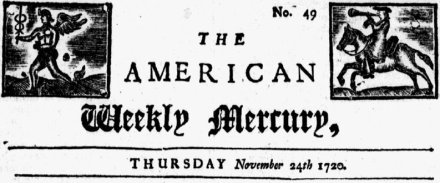
The American Weekly Mercury of Thursday, November 24 published “this extraordinary Piece” only with a preface complaining that “it is evident, that the following Speech was intended to misrepresent the Administration and Justice of this Government, as well as to infuse both ill Principles and Practices into the Minds of the People.”

The Dying Speech of Edward Hunt, formerly taken in Rebellion at Preston, and transported a bound Servant to the Island of Antigua, before his Execution upon the 19th Instant, at Philadelphia, where he had been legally convicted of High Treason, and most justly condemn’d for his Counterfeiting Spanish Silver Coin, made current* by Act of Parliament within all his Majesties Colonies in America.

It may be expected, that I should say some thing now concerning my Life and Conversation, which i must with Sorrow own to God and the Word has not been according to the Precepts and Principles of the Church, in which I was bred and educated: But with a sincere repentance and hearty Sorrow I do lament all the Errors of my past Life, firmly believing in my Saviour Jesus Christ, in whose Merits and ever flowing Mercy I do only trust for Salvation and Pardon, who has promised Eternal Life on no other Terms to the most Righteous upon Earth.

As to the Crime that now I suffer for in particular, I must own it is an Offence against the Laws, which I hope God will pardon me since he knows that I did not do it with any Design to cheat or defraud any one, or to make a Practice of Coining; but being ignorant of the Breach of any Laws of God or Man, I thought I might cut those Impressions as innocently as any other, or the Stamps that the Gentlemen of this place imploy’d me about, to make Farthings.** I am an English Subject, and desired to have the Privilege of the Laws of England, but it was not granted in any Point, except in Condemning me.

I am the first unhappy Instance of this kind that ever suffered in the King’s Dominions, pray God it may be a Warning to all, not to offend wilfully in the same that I did through Ignorance: For if I had known it, I would not have taken all the World to have done it. God give me a patient Resignation to submit to his blessed Will, in whatsoever he please.

I do heartily ask Forgiveness of all that I have offended in any manner of way, and do sincerely forgive all that have injured or offended me; particularly Mr. John Moore and Morris Birchfield, and the Evidence that swore against me in that Tryal. I do solemnly declare, That I know not any thing, or have been guilty of any one thing laid to my Charge in that Matter, or any of the other things laid to my Charge, by John Butler, either in England or Ireland.

I did petition the Honourable Governor for a Reprieve, until the King’s Pleasure was known concerning me, being I could not be tried by the Laws of England in all Points, as a Church of England Man ought to be: But it was a Privilege too great for me to obtain. Pray God to forgive them all, and every one that has a hand in taking away my Life any manner of way, and that my Blood be not required at their Hands, for they know not what they do. I am on Earth judged and condemned to die for the Breach of a Law of Man that was not duly published, which for that Reason I transgress’d it ignorantly, though the first that suffers for the Transgression of unknown Laws, or that was sentenced according to the Laws of England, without the Privilege of a Subject, which I desired of the Judge, which I know was not qualified by the same Laws to try me.

I do not know what Advantage there can be to any in my Death, and that I could not appeal to my King, neither before nor after my Tryal. I do not speak this because I am not in Charity with all the World, I do, from the Bottom of my Heart, forgive all in Obedience to my Saviour’s Command and Example, who suffered more for me, being innocent, and had not only done no Harm, but Good, and pray’d even for is cruel Persecutors and Murderers, and promised, That those that follow his Examples in this World by patiently enduring the Cross, shall reign with him to all Eternity: To Him therefore I commit all, an my poor Wife, beseeching him to help her, and be her Support and Comfort, and preserve her poor Soul free from the Polutions [sic] of the World, that through his precious Merits we may meet where we shall be both happy to all Eternity, in the merciful Arms of our dear Lord and Saviour Jesus, who I do beseech to receive my poor Soul.

According to Kenneth Scott’s Counterfeiting in Colonial America, Edward Hunt’s wife, Martha, got a £500 fine and a lifetime prison sentence for misprision of treason. (If that book is up your alley, Scott has an even more specific Counterfeiting in Colonial Pennsylvania.)

* Early colonial American commerce was severely hampered by a shortage of English/British currency. As a result, coins minted in Spain’s lucrative southern territories served as the colonies’ primary currency in the 17th and 18th centuries, particularly the iconic eight-real silver “pieces of eight”.

This is the reason why the currency of the present-day U.S. isn’t an “American pound sterling” but the almighty dollar: Dutch colonists had brought a coin called the leeuwendaalder to their former New Amsterdam (New York) province, the name deriving from the German thaler. As the pieces of eight corresponded to the thaler/daalder, it inherited the same name. Indeed, the “Spanish Dollar” remained legal tender in the post-colonial United States until 1857.

This is also the reason for reckoning of the eight constituent bits that comprised the dollar, and hence of the American colloquialism “two bits” to denote $0.25 … and, later, the adjective “two-bit” to man something cheap, mean, or small-time.

** They may have been Spain’s coins, but it’s wildly implausible that any Englishman could think he could counterfeit “innocently.”

On this day..

1729: Jephthah Big, ineffective extortionist

On this date in 1729, Jephthah Big was hanged at Tyburn — “so ill at the place of execution, that he could not attend the devotions proper for men in his calamitous situation,” according to the Newgate calendar.

This member of the all-name team got his from an Israelite warrior-judge noted for the human sacrifice of his daughter. The sin of Jephthah Big was much the smaller.

When Big’s brother got hired as a London gentleman’s coachman, Jephthah decided to make a quick hundred guineas of his own off the guy by sending him “such a letter as would make the gentleman tremble.”

The difficulty in this scenario is always in actually taking possession of the boodle without exposing oneself to capture.

Jephthah’s big plan was to ask for the money to be delivered to the Black Boy ale-house in Goodman’s Fields, but while his confederate Peter Salter was holding down a bench there day after day waiting for the windfall, Salter chanced to read a newspaper advert taken out by the target himself offering a reward for busting the shakedown. When a porter turned up asking for their extortionist alias, Salter sagely opted not to answer to it and instead left the tavern … but the porter had his own suspicions, and when he saw Salter by chance again a few days later, he had him arrested.

Salter got out of the scrape by turning crown’s evidence against Jephthah Big, who was hanged as the instigator of the whole mess.

On this day..