On this date in 1763, fifteen-year-old Elizabeth Morton was hanged on Gallows Hill, Nottingham for the murder of her employer’s two-year-old daughter.
Elizabeth, a servant girl employed by the farmer John Oliver and his family in the parish of Walkeringham, was caught after attempting to kill one of the Olivers’ other children. Loretta Loach describes Elizabeth’s crime in her book The Devil’s Children: A History of Childhood and Murder:
In August 1762, Mrs. Oliver found one of her children under some straw in a barn, “struggling in the agonies of death, the blood gushing from its mouth, nose and eyes.” The child recovered and accused Elizabeth. The servant was immediately suspected of having strangled the family’s two-year-old daughter Mary, who had been found dead in her cradle months earlier.
Elizabeth confessed to the crime, but said she had been incited to commit it by a gentleman in black who came to bed with her and told her she must murder two of her master’s children. She could not feel easy, she said, until she had done as he directed. Despite the fact that the report in the Annual Register suggested she was an “idiot” (which would have been grounds for a pardon), she was executed…
After she was hanged, her body was dissected and then buried in a village near her home.
In the 1760s, Toulouse was no place for a Huguenot, not even for an affable, prosperous paterfamilias like Jean Calas. The whole southwestern region of France barely tolerated Protestants.
The Calas household included two adult sons, Louis, who had converted to Roman Catholicism, and Marc-Antoine, their sisters, as well as their parents, Jean Calas and his wife, and a longtime maid who was Catholic. Monsieur and Madame Calas and their daughters were Protestant, as was Marc-Antoine. Friends and associates described the ménage as placid, except for occasional outbursts of misbehavior by elder son Marc-Antoine.
Jean Calas was a textile dealer. On October 13, 1761, young Marc-Antoine Calas was found hanged in his father’s shop. Wishing to spare the family’s reputation from the stigma of suicide as well as his son’s corpse from the mutilation which was customary for suicides, Jean Calas at first claimed to the authorities that an intruder killed his son.
An ugly rumor swept Toulouse: Marc-Antoine was murdered by his own parents, because he planned to convert to Catholicism. (Never mind that Jean Calas kept his Catholic son Louis in the bosom of his family and employed a Catholic servant.) Jean Calas was arrested and subjected to a trial that was anything but fair; by this time, he had admitted, too late, that his son had hanged himself, probably over gambling debts.
No dice. The appellate court of Toulouse condemned Jean Calas to death on March 9, 1762. The execution was set for the following day.
Murder of a family member was held to be a particularly hideous crime, and hideous was the penalty: breaking on the wheel. Jean Calas was tied to a cartwheel in the main square of Toulouse. His limbs were broken with iron rods. He proclaimed his innocence until the executioner finally strangled him to death.
L’affaire Calas inspired Voltaire to new vigor in his fight for religious toleration. In 1763 he published A Treatise on Tolerance, a landmark document which remains well-read today.
O different worshippers of a peaceful God! if you have a cruel heart, if, while you adore he whose whole law consists of these few words, “Love God and your neighbor,” you have burdened that pure and holy law with false and unintelligible disputes, if you have lighted the flames of discord sometimes for a new word, and sometimes for a single letter of the alphabet; if you have attached eternal punishment to the omission of a few words, or of certain ceremonies which other people cannot comprehend, I must say to you with tears of compassion for mankind: “Transport yourselves with me to the day on which all men will be judged and on which God will do unto each according to his works.
“I see all the dead of past ages and of our own appearing in his presence. Are you very sure that our Creator and Father will say to the wise and virtuous Confucius, to the legislator Solon, to Pythagoras, Zaleucus, Socrates, Plato, the divine Antonins, the good Trajan, to Titus, the delights of mankind, to Epictetus, and to many others, models of men: Go, monsters, go and suffer torments that are infinite in intensity and duration. Let your punishment be eternal as I am. But you, my beloved ones, Jean Châtel, Ravaillac, Damiens, Cartouche, etc. who have died according to the prescribed rules, sit forever at my right hand and share my empire and my felicity.”
…
May all men remember that they are brothers! May they hold in horror tyranny exerted over souls, just as they do the violence which forcibly seizes the products of peaceful industry! And if the scourge of war is inevitable, let us not hate one another, let us not destroy one another in the midst of peace, and let us use the moment of our existence to bless, in a thousand different languages, from Siam to California, [God’s] goodness which has given us this moment.
-Voltaire, A Treatise on Tolerance
As a result of Voltaire’s efforts, 50 French judges were appointed to a panel to review Jean Calas’s case. Their charge was to decide whether anti-Huguenot prejudice had cost Jean Calas his life. They reversed Calas’s conviction on March 9, 1765, the third anniversary of the poor man’s condemnation.
On this date in 1769, two weavers hanged in East London in a bitter fight over wages and labor power.
Spitalfields, the East London district also known as the stomping-ground of legendary jailbreaker Jack Sheppard, was the capital of a thriving English silk-weaving industry. It had attained 18th century prosperity thanks in large measure to the decision of William and Mary to invite Lyons Huguenots being hard-pressed by the French crown to relocate their talents across the channel. This now-domestic industry* quickly began supplanting formerly dominant French imports.
In 1713 it was stated that silks, gold and silver stuffs and ribbon made here were as good as those from France, and that £300,000 worth of black silk for hoods and scarves was made annually. In 1721 the value of the silk manufactured in England amounted to £700,000 more than in 1688, when wrought silks were imported from France to the annual value of half a million sterling. (Source)
In this roaring and prestigious business, William Hogarth situated his 1747 Industry & Idleness plates: both the Industrious Prentice (eventually destined to become Lord Mayor of London) and the Idle Prentice (eventually executed at Tyburn) start off shoulder to shoulder at the Spitalfields looms.
But as the 18th century unfolded, even the most industrious Spitalfield weavers came under increasing competitive pressure especially from Chinese and Indian imports.
Although Parliament attempted to ban textile imports to preserve the domestic industries, Spitalfield workers were known to enforce their prerogatives directly by attacking people in the street thought to be wearing foreign prints. This simmering tension came to a rapid boil after settlement of the Seven Years’ War enabled England and France to resume trading — and a glut of French textiles to undermine weavers’ price controls.
Conflicts were no less fierce within the weavers’ community, between masters and laborers. Workers combined to maintain wages by attacking those thought to be undercutting prices.
In September 1769, one such action punished a wealthy anti-“combination” (for “combination”, read “labor union”) manufacturer named Lewis Chauvet, and cut the silk handkerchiefs right out of his looms.
From Season 3, Episode 2 of the BBC drama Garrow’s Law, which is directly based on this case. As of this writing, the entire episode can be found on YouTube.
Cutting silk from the loom was a rough method of enforcement by the labor combination. It had also been made a capital crime a few years before. And it turned out that Chauvet was ready to make his the test case.
Richly paying off a couple of independent artisan weavers for their questionable testimony, he secured the conviction of John Valloine or Valline (other alternate spellings are possible; the name clearly denotes the district’s Huguenot heritage) and John Doyle, two weavers allegedly part of the loom-smashing action. The accused denied it, Doyle reported to have fulminated at the gallows, “I am as innocent of the fact I am now to die for as the child unborn. Let my blood lie to that wicked man who has purchased it with gold, and them notorious wretches who swore it falsely away.”**
Manufacturers’ purposes were served just as well whether innocent or guilty. The point was labor discipline, not a few lost hankies.
Accordingly fixing “to strike Terror into the Rioters”, the crown ordered the execution to occur not at the Tyburn gallows, but right in the weavers’ backyard, adjacent Spitalfields at Bethnal Green.
This order actually delayed the sentence for the judiciary’s consideration of the minor point of whether this was allowed at all — since the actual boilerplate sentence read from the bench had specified “the usual place.” The wisest magistrates of the land considered the matter and in time agreed that “the time and place of execution was no part of the sentence” and therefore subject to His Majesty’s discretion. Bethnal Green it was.
They were therefore this morning taken in a cart from Newgate through the City to Whitechapel, and thence up the road to Bethnal Green, attended by the Sheriffs &c, with the gallows, made for the purpose, in another cart; it was fixed in the cross road, near the Salmon and Ball.
There was an inconceivable number of people assembled, and many bricks, tiles, stones &c thrown while the gallows was fixing, and a great apprehension of a general tumult, notwithstanding the persuasion and endeavours of several gentlemen to appease the same. The unhappy sufferers were therefore obliged to be turned off before the usual time allowed on such occasions, which was about 11 o’clock; when, after hanging about fifty minutes they were cut down and delivered to their friends. (cited here)
Vengeful weavers having their noses rubbed in their comrades’ executions smashed up Chauvet’s house in the riots on this date, and the powers that be decided that one hanging-day at Bethnal Green was plenty. A few other rioters convicted as confederates of Doyle and Valline were put to death at Tybun later in December 1769.
Years of violent labor conflict were finally quelled with the 1773 Spitalfield Weavers Act, a political compromise which protected the domestic industry from foreign competition and enabled magistrates to set wages.
Though this act stabilized a tense domestic situation, its effect over several decades was seriously problematic: a protected monopoly with wage-controlled workers maintained an increasingly obsolete system of labor-intensive manufacture that fell behind power looms coming online elsewhere.
As late as 1851 — mechanization wouldn’t fully take over until Britain’s trade liberalization of the 1860s — Charles Dickens visited Spitalfields, and saw a weaver
doing now, exactly what his grandfather did. Nothing would induce him to use a simple improvement (the ‘fly shuttle’) to prevent the contraction of the chest of which he complains. Nothing would turn him aside from his old ways. It is the old custom to work at home, in a crowded room, instead of in a factory.
Disallowed from taking lower wages even in bad times (or when cheaper cotton started displacing silk), many weavers sat completely unemployed instead — gradually sinking into a proletarianization they had fought to avoid. Spitalfield weavers eventually became one of the classic case studies in the laissez faire economics canon.
* Just to be clear, Huguenots weren’t the first silk weavers in Spitalfields; it’s just that their arrival let the industry take off.
** The hanged man’s comrades made good his gallows menace. Peter Linebaugh, whose The London Hanged is an outstanding resource on the economic pressures that brought these weavers and many others to the gallows, relates:
At noon upon a cold and snowy day, 16 April 1771, [Chauvet’s paid witness against the weavers] Daniel Clarke … went walking in Spitalfields. It had been sixteen months since the hangings of the cutters whom Clarke had sworn against, and he must have thought the people cowed or forgetful. He was recognized. ‘There goes Clarke, that blood-selling rascal,’ was the shout, and instantly a small crowd gathered to badger and pester him. He took to his heels and found temporary refuge in the house of Mary Snee. The currents of popular memory run deep; now they flooded to the surface. A hundred people beset the house hurling maledictions. ‘They would hang him, or burn him, or stone him,’ said Mary Snee. He was cornered, stripped and dragged by his feet into the street, where he was led by the neck on a parade of humiliation. The crowds grew. Widow Horsford [wife of one of the weavers hanged later in December 1769 at Tyburn] was seen to ‘jump out of the loom’ at the news Clarke was cursed and dragged to the brick-fields. Children pelted him with dirt. Bespattered with muck, he was thrown into a pond where he was ducked within a breath of drowning. He was removed to a sandheap, buried, dug up and returned to the freezing water. It was estimated that the crowd numbered 3,000. While he could speak, he taunted his tormentors, saying ‘he would take twenty of them’. Widow Horsford said, ‘Clarke, Clarke, I am left a widow, my children is fatherless on account of you.’ Clarke answered, ‘Chauvet is worse than me,’ and then he expired. A grim ending that would be remembered for generations.
On this date in 1767, a larcenous bank clerk was hanged at Tyburn for robbing the till.
Sleigh ride: Detail of a studious William Guest being drawn to Tyburn (click for full print).
In this case, it wasn’t anything so gross as grabbing the money and running. No, our malefactor William Guest — the “son of a clergyman of unblemished character” whose “constant handling of gold [for the Bank of England] shook his integrity” — started milling the edges of the guineas he handled and innocuously returning them to the bank’s stock whilst piling up his own supply of gold filings.
It’s sort of the pre-digital version of the Office Space scheme: “I’m just talking about fractions of a penny here, but we do it from a much bigger tray. A couple of million times. So what’s wrong with that?” Literal profit on the margin: perfect for the FIRE sector.
Though 18th century London’s perpetual necktie party was obviously focused on the lowest classes, its busy gallows had room enough for the occasional white-collar crime.
And by England’s lights, debasing the currency was as serious a crime as there was: Guest’s conviction wasn’t for larceny or fraud, but for treason.
Because of that, he didn’t get the plain-old cart ride to the gallows, but was drawn on a sledge — the “drawn” bit of “hanged, drawn, and quartered,” although for this penny-shaver the execution itself didn’t entail the horrible quartering.
After enduring this archaic ignominy, the minister’s son “was indulged to pray on his knees” before being noosed and “his whole deportment was so pious, grave, manly and solemn, as to draw tears from the greatest part of the numerous spectators.”
On this date in 1768, Isaac Frasier hanged at Fairfield, Connecticut for his career of (as the pamphlet told it) “Abominable Thefts”.
Frasier took to his larcenous ways from a very young age, and committed a host of thefts from the time of his minority apprenticed to a tightfisted shoemaker. For the volume and audacity of his thefts, Frasier was a sort of Charlie Peace of colonial New England with the significant difference that he was also extraordinarily bad about conducting his career in serial burglary without (repeated) detection.
And so Frasier was caught, over and over and over again: really, he might have thought about a different vocation. Eventually he ran afoul of an 18th-century three strikes law allowing the execution of repeat offenders. (And drawing in its case some lively public debate over the justice of hanging a man for a mere property crime under any circumstances whatsoever.
Anyway, thanks to his want of both restraint and wile, Frasier was clapped in irons, whipped, branded, sold to a privateer, had an ear cropped, whipped some more. He lost his wife after one arrest (that wasn’t juridical penalty, just a modicum of shame.)
He had a gift for escape which jibed well with his gift for arrest, but every time he busted out of stir he returned instantly to burglary with a positively alcoholic compulsion.
Even when he effected his last jailbreak while already under sentence of death for recidivism, he exercised not an iota of discretion but invited his swift recapture by frantically plundering every shopkeep he laid eyes on in a whirlwind tour of Connecticut and environs. Just one last fix for the road.
Last Wednesday evening the notorious FRASIER, who was under sentence of death for burglary, as has been mentioned, was brought from Worcester, (where he was taken up for theft, and whipt) and re-committed to the goal [sic] in this town, from whence he escaped about a month since, — in which time he has committed five or six burglaries and thefts, and traveled near 500 miles. The next night but one after his escape, he broke open no less than three shops in Middletown, from one of which he stole 70l. value in goods and cash. The Superior Court now sitting in Fairfield, have given strict orders, that he should be loaded with chains, and the goal guarded every night till the time of his execution …
“Excessive Wickedness, the Way to an untimely Death.” That was the title of the gallows sermon they gave for him. At least they couldn’t knock him for idleness.
Since said lord hewed to the Jacobite party favoring restoration of the Stuarts to the English throne, the family found itself relocated with the exiled Pretender to a continental power whose spiritual and temporal interests were similarly inimical to the Hanoverian king.
Our man landed himself, like a proper retainer of his adoptive liege, a gig in the French army in which capacity he actually served at the Jacobites’ last doomed British hurrah, the 1746 Battle of Falkirk.
But his problems came from his Bourbon service much further afield — in India.
There, his expeditionary force suffered reversal after reversal at the hands of the hated Brits, even then in the process of appending India to their dominions.
Our general’s military misadventures were compounded by impolitic high-handedness towards his officers and men, and to the locals whose alliances he needed. He was, in the main, a man ill-suited to the job entrusted to him. As the Memoirs of Sanson remark, “his temper, his obstinacy, and especially his contempt for all means of action except brutal strength, were destined to lead him into mistakes in a position demanding more knowledge of politics than science of war. Sixteen years before Lally-Tollendal’s appointment, Dupleix, with scanty forces, at enmity with the Company, receiving neither help nor subsidies from the mother country, had held in check English power in the Indian peninsula by mere diplomatic proficiency. Lally knew how to conquer; but he was incapable of studying and detecting the secrets of Dupleix’s policy.”
By the time the bad news that established all this hit France, the subcontinent was pretty much Britain’s to command — just another piece of the imperial butt-kicking France suffered in the Seven Years’ War.
And Lally’s enemies were holding him personally responsible as a potential traitor. After all, he was conveniently now in English custody.
Incensed at having his honor impugned, Lally unwisely obtained English parole to return to repel these charges. He proved no more diplomatic with the barristers than he had been with the Hindus:
he was so convinced of his own innocence that he was imprudent enough to impeach the officers who had served under his orders, together with the administrators of the colony. He charged them with such violence that his death and condemnation became indispensable for their justification … When the accused appeared before his judges, he was no more able to control his temper than when he was in India … answering, fuming, retorting, stigmatising the cowardice of some, the cupidity of others, and hinting that the only guilty party was the powerless Government.
Just the sort of vindication liable to appeal more to posterity than to said government. Louis XV, another man unequal to his position, was by this autumn of his reign plumbing the nadir of his unpopularity; for the officer who had risked his life in battle under French colors throughout adulthood, Louis calculated more profit in severity (or expedience) than in clemency. Hey, it had worked for the English.
And really, for a Stuart adherent, sacrificial execution was kind of an apt fate.
We guess it worked.
“The people were pleased with all that made his punishment ignominious: the cart, the handcuffs, and the gag,” recorded aristocrat-of-letters Madame du Deffand (Source) “He was a great rascal, and besides he was very disagreeable.”
Thomas Carlyle, in his The French Revolution, spared in Lally’s defense a few sentences of delicious invective for the rotting regime that did him in.
The Parlement of Paris may count itself an unloved body; mean, not magnanimous, on the political side. Were the King weak, always (as now) has his Parlement barked, cur-like at his heels; with what popular cry there might be. Were he strong, it barked before his face; hunting for him as his alert beagle. An unjust Body; where foul influences have more than once worked shameful perversion of judgment. Does not, in these very days, the blood of murdered Lally cry aloud for vengeance? Baited, circumvented, driven mad like the snared lion, Valour had to sink extinguished under vindictive Chicane. Behold him, that hapless Lally, his wild dark soul looking through his wild dark face; trailed on the ignominious death-hurdle; the voice of his despair choked by a wooden gag! The wild fire-soul that has known only peril and toil; and, for threescore years, has buffeted against Fate’s obstruction and men’s perfidy, like genius and courage amid poltroonery, dishonesty and commonplace; faithfully enduring and endeavouring,–O Parlement of Paris, dost thou reward it with a gibbet and a gag?
There’s a public-domain 19th century lecture on our man’s adventurous career here. And there’s a monument back home near Tuam, Ireland.
On this date in 1761, John Perrott was hanged at Smithfield for fraudulent bankruptcy.
Perrott was one of the bare handful of British subjects executed during the last century that bankruptcy legislation officially came with hemp teeth; he’s sometimes noted as the last bankrupt put to death, although in reality, he was simply the most famous of the last few.
John Perrott hanged at Smithfield (detail view; click for full image). From here.
He got famous in the usual way.
A once-reputable merchant who blew his fortune in the late 1750s? That backstory does not get you into the Newgate Calendar.
Fortune blown by siphoning creditors’ money to shady mistress, then refusing to divulge the particulars? Now you’re talking. It’s a wonderful vignette in the annals of moralism to find Perrott on the eve of his execution keeping mum on the subject because he had already received his last Sacrament — the inference being that in speaking, he would only sully his soul with a lie.
It was an aggravating position for his creditors, who had reason to believe that there remained recoverable cash, in the hands of his “Mrs. Ferne” or elsewhere.
Creditors always get stuck in a bind when debt goes bad.
The death penalty for bankruptcy has a long and illustrious history, back to the Roman Twelve Tables with its Shylock-like right for the aggrieved lenders to cut the debtor apart into parts proportional to their lost investments, de debitore in partes secando.*
Still, that stern corporal stricture has tended to run up against the simple fact that creditors are financially interested parties whose benefit is almost always better served by keeping their debtor among the living where he might be capable of repairing some part of his bond. Slavery, therefore, was often preferred by the ancients and retains a symbiotic relationship to debt to this day: to force the service of a debt, make a man your slave; likewise, to force someone into slavery, make him your debtor. Human traffickers love this tactic.
At any rate, English bankruptcy law as it evolved was a strange hybrid of public (criminal prosecutions) and private (creditors initiated and paid for the prosecutions). Bluffing a charge at the Old Bailey was just one potential strategem in the contentious relationship between borrower and lender, and not the most effective one, as this Duke law journal article (pdf) by Emily Kadens notes:
“[I]f this Bill Pass,” [critics of a 1706 bankruptcy measure] warned, “it will never be executed.” The latter prognostication turned out to be virtually correct. Creditors prosecuted infrequently because of the severity of the punishment and the cost and difficulty involved. Even when creditors did bring lawsuits, juries may have been reluctant to convict not only because of the penalty but also because they understood the potential for fraud in the bankruptcy system itself … A man was made a bankrupt by the ex parte declaration of a person claiming to be a creditor … The alleged bankrupt had no right to object … In the meantime, his alleged creditors had taken possession of his assets, leaving him nothing with which he could fight his case, unless he committed a felony by concealing his assets or had friends or family support him.
That fraud aspect was essential to making it, as Perrott did, so far as the gallows; plain-vanilla bankruptcy was not in itself a capital offense, but a debtor hiding his assets in the process changed matters. The law distinguished the accidental bankruptcy (e.g., the ship with your imports sunk) from the larcenous: “To the misfortunes … of debtors, the law has given a compassionate remedy,” Blackstone notes. “But denied it to their faults.” Which is not to say that many, many debtors did not indulge these “faults.”
It was nearly two full years from the time Perrott sat his lenders down in a tavern in — naturally — Cheapside to give them the bad news that he was a little bit short, until the time he met the hangman. In that span, auditors picking through the wreck of his estate gradually became aware that the numbers didn’t add up, and his bum business practices (selling 20% below cost to obtain ready cash) still left up to 17,000 missing pounds unexplained.
By the by, the emergence into the investigation of a paramour, who then turned out to be hiding Perrott-issued banknotes, transformed an ordinary bankruptcy into one of those felonious asset-concealment situations. (And, into fine tabloid fodder for the broadsheets.) When Perrott wouldn’t come clean with the whereabouts of his purloined boodle, his creditors had him up on hanging charges. And when Perrott still wouldn’t come clean — Sacrament and all — he stiffed his lenders at the last by leaving them no way to recover their swag.
Hopefully, Mrs. Ferne was worth the trouble.
* More discussion of the Roman jurisprudence here.
On this date in 1769, five French Creoles were shot in New Orleans for a revolt the previous year against a Spanish takeover.
This date’s story begins with the French King Louis XV getting his French clock cleaned in the French and Indian War. This conflict blew an ill wind all over Francophone North America, much of which was taken by the British. Result: a quarter-millennium later, this blog is in English.
Even what France kept, she did not keep. In a secret pact, France ceded to wartime ally Spain “the country known as Louisiana, as well as New Orleans and the island in which the city is situated.”
This projection onto New World colonists of Old World diplomatic horse-trading was rife with potential hostility among the traded horses. In this instance, Louisianans were widely dismayed when they were finally informed that they’d become Spaniards.
These weren’t mere rabble who showed Ulloa “insubordination … a sense of liberty and independence,” but elites of French New Orleans. Nicolas de Lafreniere was the attorney general.
“The name of Lafreniere deserves rank with those of foremost American patriots,” Americans later reckoned. O’Reilly’s reputation did not fare as well in the patriotic literature, but he perhaps had the best of the law.
Between a rock and a hard place, the leftover French adjutant Charles-Philippe Aubry refused to support the rebels, but also refused to fire on fellow Frenchmen. Meanwhile, Ulloa refused to provide his credentials to the uppity colonists. Louis XV refused to receive the delegations sent to implore him to keep Louisiana.
All these refuseniks found the matter adjudicated by immigrant Irish officer Alejandro O’Reilly, plucked out of Cuba to replace Ulloa and lay down the law. He spoke softly when he landed, but the amnesty he offered was followed a few months later by the surprise arrest of the chief rebels.
Lafreniere, Joseph Milhet, Jean-Baptiste Noyan, Pierre Caresse, and Pierre Marquis were ordered hanged on this date. Noyan, nephew of the city’s founder and a young man just married, was offered his pardon, but melodramatically refused.
It was found that there was no hangman in the colony, so the condemned prisoners were ordered to be shot. When the day of execution came, hundreds of people left the city. Those who could not leave went into their houses, closed the doors and windows and waited in an agony of sickening dread to hear the fatal shots. Only the tramping of soldiers broke the deathlike stillness which brooded over the crushed and helpless city. At three o’clock on a perfect October afternoon in 1769, the condemned men were led to the Spanish barracks. Lafreniere, it is said, gave the order to fire. A volley of muskets broke out on the still air, and five patriots went to their death, — the first Louisianians to give their blood for the cause of freedom.
Whether or not all that stuff about Louisiana planters as freedom-loving patriots trod down by the barbarous Spanish has any real merit to it, that’s the way they’ve been memorialized.
When next visiting the Louisiana State House, keep an eye out for this day’s victims on the frieze to the right of the main entrance. And when next visiting New Orleans, keep an ear out for the ghost of the priest that buried them.
* Ulloa was also a scientist and gave his name to the Ulloa Halo, a “physical illusion consisting of a white luminous ring or arch that can sometimes be seen in mountainous regions, typically in foggy weather, while facing an area opposite the Sun.”
On this date in 1761,* the Jesuit Gabriel Malagrida became a late casualty of the Tavora Affair and the Lisbon earthquake when he was garroted for heresy.
Malagrida (English Wikipedia entry | Portuguese) was a 72-year-old Italian with decades of missionary service to the Portuguese New World colonies under his belt.
He had, in his time, been a prominent exponent of the Jesuits missions’ policy in the Amazon, which amounted to asserting their own jurisdiction against the secular government’s attempt to order its overseas territories. (There’s more on that conflict here.)
And this only exacerbated his principal sin of being a Jesuit — an order whose diminution was eagerly sought by the rising statesman of Enlightenment Portugal, the Marquis of Pombal.
The shock of the 1755 Lisbon earthquake would deal Pombal the trump hand he needed to start reshaping both city and society to his liking.
Malagrida, meanwhile, carped that the earthquake’s causes
“are not comets, are not stars, are not vapors or exhalations,** are not phenomena, they are not natural contingencies or causes; but they are solely our intolerable sins … I do not know how a Catholic subject dares to attribute the present calamity of this tragic earthquake to causes and natural contingencies. Do not these Catholics understand this world is not a house without an owner?”
This published pamphlet merely echoed what many of the order were saying in the pulpits, and Pombal was not about to let the backwards, superstitious crowd** own the catastrophe.
Malagrida was banished from Lisbon: and, when the Tavora family was implicated in an attempt to assassinate the Portuguese king, Malagrida, their confessor, found himself clapped in prison.
Though the now-septuagenarian priest did not share the Tavoras’ grisly public butchery, he was left to molder. A couple years in a dungeon saw him go a bit strange, and supposedly he published treatises with such eccentric features as God’s personal instructions to Malagrida, and Malagrida’s fascination with St. Anne’s uterus. Catholic sources, which consider Malagrida a martyr, doubt that he ever published any such thing; if he did, it seems apparent that it was dementia rather than heresy that afflicted the old man.
But Pombal had installed his own brother as judge of the tribunal, so the matter was prearranged. The execution itself was
staged in a dramatic way, even to the point of Malagrida’s appearing on the scaffold in Jesuit habit, to impress upon the Portuguese and the world at large that an old order had come to an end and a new one was to be established … one might say that … symbolism at the cost of one human life was a relatively humane procedure in comparison with the symbolic elimination of whole classes of society in the twentieth century.
Detail view (click for the full image) of Malagrida executed at a Lisbon auto de fe. CC image from Ricardo Mealha, original provenance unknown.
Pitying the superstitious Jesuit at the stake, Enlightenment secularist Voltaire inveighed against Enlightenment secularist Pombal for conducting the execution … just part of Voltaire’s queer ideas about not killing people over their religious beliefs.
“It is all pity and horror,” Voltaire wrote in a private correspondence. “The Inquisition has found the secret to inspire compassion for the Jesuits.”
Voltaire’s appraisal in Candide (already published by this time) of a country in the grip of religious superstition unjustly stands as one of the lasting literary monuments to an event that actually rolled back clerical influence: “the sages of [Portugal] could think of no means more effectual to prevent utter ruin than to give the people a beautiful auto-da-fé; for … the burning of a few people alive by a slow fire, and with great ceremony, is an infallible secret to hinder the earth from quaking.” That the philosophe who penned those words waxed so immoderately outraged at the demonstrative chastisement of a man who preached precisely all that hocus-pocus — that Voltaire ascribed his execution to “the Inquisition” — plants the cherry on the irony sundae.‡
But Pombal’s expedient use of the Inquisition’s medieval machinery to make an example of Father Malagrida would not be the start of a pattern; the Pombaline reforms of the years to come brought the Inquisition sharply to heel, and it was Malagrida himself who was its last victim (pdf) in Portugal in its classical ecclesiastic form.
** The “God is pissed” hypothesis was posited against theories of earth’s vapors promulgated by the Pombal-sponsored scientist Ribeiro Sanches.
† Anti-Jesuit sentiment was widely abroad in Europe at this time; increasingly resented as political manipulators, the Society would be suppressed by papal order in 1773, only to revive during the post-Napoleonic reaction.
‡ Malagrida was well-known to contemporaries in Europe, but that does not mean sympathy for him was universal. The British pol Lord Shelburne was satirized as “Malagrida” for his putative duplicity.
On this date in 1764, Pierre-Paul Sirven and his wife — who lay beyond the reach of the law, in Switzerland — were burned in effigy at Mazamet, France, for murdering their daughter.
The Sirvens actually had three daughters; the purported victim, Elisabeth, was mentally unbalanced. The Protestant Pierre-Paul Sirven had had a recent run-in with the Catholic hierarchy in his native Castres, when Elisabeth was shanghaied to a convent for Catholic indoctrination under a lettre de cachet.
The Sirvens moved away to Saint Alby, near Mazamet, but when Elisabeth turned up dead in a well there early in 1762, the official presumption was that her schismatic parents had done her in to prevent her returning to the true church. It could have been that she just fell down the well accidentally, or went and committed suicide; as often in such cases, investigations commencing from a suspicion of foul play are liable to find that suspicion self-affirming.
To make matters worse, all this transpired during the dangerous run-up to the execution of Jean Calas in Toulouse, another instance where a doubtful criminal case was pursued against a Protestant.
Wisely, the Sirvens (parents and two remaining daughters) blew town.
They made it to Switzerland, where they holed up with Voltaire. Back in Mamazet, the parents were condemned to death and the other two children to exile for participating in the purported murder of Elisabeth. “This judgment was equally absurd and abominable,” Voltaire wrote.
If the father, in concert with his wife, had strangled his daughter, he ought to have been broken on the wheel, like Calas, and the mother to have been burned — at least, after having been strangled — because the practice of breaking women on the wheel is not yet the custom in the country of this judge. To limit the punishment to hanging in such a case, was an acknowledgment that the crime was not proved, and that in the doubt the halter was adopted to compromise for want of evidence.
The death sentences — further compromised by the absence of their objects — were nevertheless carried out in effigy on September 11, 1764.
Meanwhile, Voltaire turned his pen to the service of the Sirven cause; a French pamphlet he wrote vindicating both the Sirvens and Calas can be perused here. (Deadly religious persecution in France kept Voltaire quite preoccupied in the 1760s.)
After spending the decade trying to clear the family name from abroad, Pierre-Paul Sirven sensed an opening to return and gave himself up in 1769. The anti-Protestant hostility of the early 1760s had cooled by this time; the Calas execution was widely regretted.
Pierre-Paul Sirven was officially tried and exonerated in 1771, leading Voltaire to remark,
It only took two hours to sentence a virtuous family to death and it took us nine years to give them justice.


 An ugly rumor swept Toulouse: Marc-Antoine was murdered by his own parents, because he planned to convert to Catholicism. (Never mind that Jean Calas kept his Catholic son Louis in the bosom of his family and employed a Catholic servant.) Jean Calas was arrested and subjected to a trial that was anything but fair; by this time, he had admitted, too late, that his son had hanged himself, probably over gambling debts.


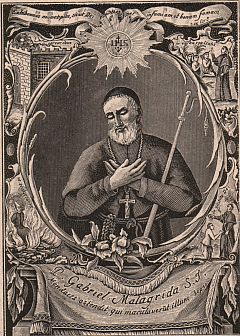 Malagrida (

